



Abstract
The value in Ayona Datta's notion of distant time is that the spatialisation of temporal power and its resistance is made explicit. As she demonstrates, the temporal tactics and techniques of statecraft are expressed in the landscape; in the case of Shimla, literally contoured onto the hillside, reproducing spatio-temporal divides. In this commentary, I tease out the contoured temporal relations of the smart and subaltern city and argue that Datta's notion of distant time be extended by creating a typology of the temporal techniques and mechanisms of statecraft and resistance, considering further the temporalities of politics and policies of statecraft, and charting further the multi-scalar nature of statecraft temporalities.
Most geographical accounts of urbanisation and the politics of urban management and development employ spatial theory and chart the production of space in order to explain the on-going contestation over territory and its consequences. However, as Ayona Datta (2026) convincingly demonstrates in her paper, the production of space is thoroughly temporal in nature, not just in its timing in the here-and-now, but through its entanglement of the past, present, and future. This is an argument that she has been constructing over a number of years through a set of projects that have examined the spatio-temporalities of urbanisation in the digital era, with particular reference to India and the Global South more generally (Datta, 2017, 2019, 2020, 2022). Her work highlights how spatio-temporal relations in postcolonial settings are actively produced through individual and collective agency framed within an inherited colonial legacy of institutional structures and social systems (relating to gender, class, ethnicity, caste) and the contemporary network time of digital technologies. Datta's theorisation thoroughly fuses the spatial with temporal, arguing that temporal modalities and practices shape the spatial, and space is mobilised to mediate temporalities.
The anchor article for this forum advances this line of thinking through the notion of distant time and its role with respect to making sense of the contested urban imaginaries and futures for Krishna Nagar, a community built on debris of colonial city-making and the planned site for a smart city development. For Datta, ‘distant time is a form of statecraft that uses a combination of time and distance (materially and socially) to produce a form of marginality across past, present and future’. It is a metaphor for temporal power in which the past, present, and future, along with temporal relations such as time rules, speed, prioritisation, optimisation, pre-emption, and preparedness, are used as temporal ordering and distancing devices to direct and control people in place and maintain precarity and temporal arbitrage. This temporal power is not simply accepted by populations but is resisted, transgressed, and subverted as those experiencing temporal arbitrage seek to claim some degree of temporal sovereignty (self-control over temporal relations) that delays, halts, and re-configures temporal processes and enacts temporal justice (fairer, more equitable temporal relations).
Importantly, the use of distance signifies that temporality is not just stretched from the past to the future, but is also spatialised and materialised in the landscape. That is, the control of temporality is used to structure peoples’ lives in space – putting people in their place and shaping their ability to claim space and build communities. Temporal power is literally expressed in the landscape, as is well illustrated by Datta's case study site of Krishna Nagar in Shimla, the former summer capital of colonial India. Krishna Nagar is a poor neighbourhood built on the unstable hillside debris produced by clearing the hilltop to construct the site of colonial government. Here, temporalities vary across the hillside contours, with those performed and experienced on the upper plateau differing to those living on the steep slopes, and those at the top of the slope exerting temporal power through various forms of statecraft over the hillside neighbourhood. As Datta illustrates, these forms of spatio-temporal statecraft have been expressed in various forms of planning and development control since the mid-nineteenth century, with the state seeking to limit and regulate land and property rights and the construction of buildings and infrastructure, while local people have sought to claim rights and territorial sovereignty by utilising temporal (and other) tactics.
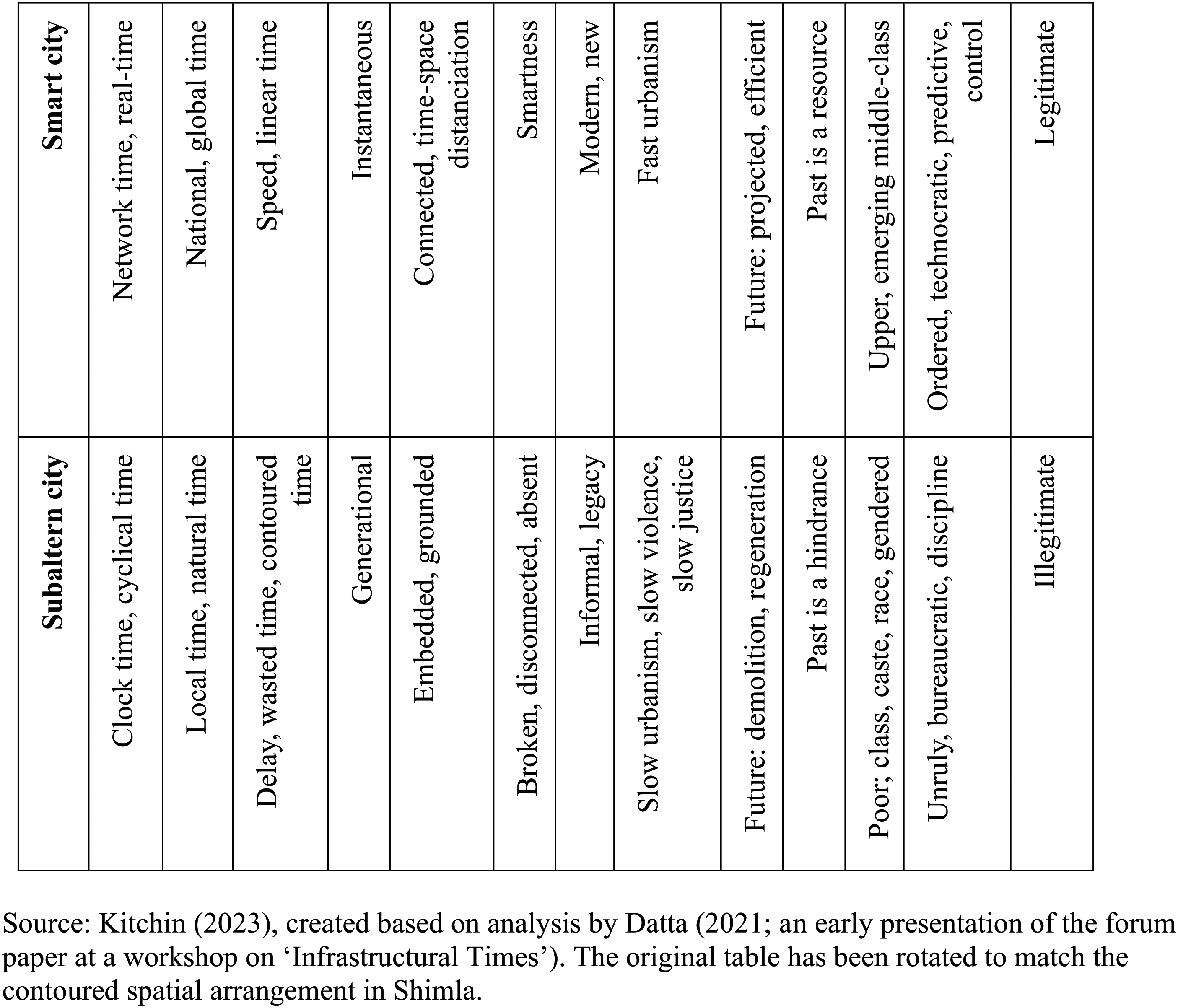
Distant time is also evident in the current contestation of Krishna Nagar as a designated site for redevelopment as a smart city district in which local properties, their residents, and associated temporalities will be displaced by new investment aimed at modernising and redeveloping Shimla, improving urban management, growing economic opportunity, and addressing ecological risks (such as flooding and landslides). This displacement will not, however, be straightforward as while smart urbanism seeks to disconnect the area from distant time in order to realise a new future, the land and properties it seeks to appropriate remain connected and entangled in a colonial legacy and community histories that are not easily ruptured or severed. Past futures (empire, independence, community building) continue to shape the future present (postcolonial, socio-spatially divided urban landscapes), with smart urban futures not just produced in the ‘here and now’ of the present, ‘but also from the “there and then” of different pasts and futures.’ The result is a contested set of temporalities, with the anticipated network time and real-time of the smart city clashing with the distant times of the ‘long durée of hillside urbanisation, cyclical time of ecological “slow emergencies”’, and the claims for temporal sovereignty and justice by citizens settled on the hill. Nonetheless, as with previous generations, the temporal relations and power of the smart and subaltern city are reflected in their spatial arrangement with the smart city at the top of the hill, seeking to move down the slope, and the subaltern city located on the slope. This contoured spatio-temporal arrangement, wherein time is vertically structured along the slope, is illustrated in Table 1, wherein the first row I have detailed the new and anticipated temporalities of the smart city, with the temporalities of the subaltern city noted in the second row. As Datta notes, these juxtaposing temporal relations cannot be reconciled, ensuring on-going contestation over the future of the neighbourhood. As such, understanding the urban futures of Krishna Nagar, as she rightly contends, necessitates charting its past and present futures and the unfolding temporal entanglements of statecraft, people, ecology, and technology.
The contoured spatio-temporality of the smart and subaltern city in Shimla.
In the remainder of this commentary, I present some suggestions for extending this approach focusing on the temporal techniques and mechanisms of statecraft and resistance, the temporalities of politics and policies of statecraft, and the multi-scalar nature of statecraft temporalities. While the paper identifies a number of temporal techniques and tactics used to exert or resist temporal power (e.g., time rules, delay, phasing, speed, tempo, anticipation, slow violence) it would be useful, I feel, to construct a typology of these relations. This typology would systematically chart the specific characteristics of temporal techniques and tactics, if and how they are spatialised in their enactment, and how they work together to produce a timescape (the cluster of associated temporal features and relations that (re)produce a temporal regime and landscape; Adam, 2004). This would provide a clearer picture of the diverse ways in which a temporal regime is sustained and temporal power is manifested.
Statecraft uses temporal techniques to try to engender particular outcomes, but it also has its own temporalities that frame and shape its work; for example, relating to political and policy cycles. Bureaucracy has its inherited legacy of laws, policies, regulations, infrastructures, and practices that ensures a general consistency in the approach and ethos of statecraft, and reproduces its temporal regime. But it is also open to modification and rupture, not least through the application of the political ideology of the prevailing political party in power, the influence of vested interests, and the collective power of public sentiment. As has been evident elsewhere, smart city initiatives and their associated statecraft can be radically reconfigured or stall and dissipate with a change of government (March and Ribera-Fumaz, 2018), and this could well happen in the Shimla case. Nonetheless, it will no doubt be replaced by a new epistemic notion that entwines state and capital interests to drive an urban agenda that appropriates, redevelops, and gentrifies the slopes of Krishna Nagar (just as the notion of the creative city, or the eco-city or safe city, was replaced by the idea of a smart city in many places; Coletta et al., 2018). A key question arising from such an epistemic shift is whether the new, preferred form of urbanism employs the same temporal techniques and enacts the same distant time, or do different epistemic urbanisms (e.g., entrepreneurial city, creative city, smart city, sustainable city, etc.) assemble different statecraft temporalities that mobilise varying forms of temporal power and require different forms of temporal resistance?
Temporality in Shimla is not just distant, varying across locales and drawing on the legacy of the past to contest the urban present and future, but is multi-scalar; that is, local, natural, national, colonial, network, and global time are all simultaneously present. With respect to statecraft, the work of government and bureaucracy is multi-scalar in organisation and activity. In the case of Shimla, this multi-scale political geography is organised as a nested set of: 41 city wards (neighbourhood) of Shimla Municipal Corporation (city); the city being one of 12 districts (sub-region) that compose three divisions (region) in the state of Himachal Pradesh (federal state). Himachal Pradesh is one of 28 states and 8 union territories of India (nation-state). In turn, India sits participates in a set of supra-national governmental bodies such as the United Nations. The politics, policies, and statecraft enacted at these varying scales produces multi-scalar temporalities that stretch from the local to global, with temporal power located at different levels. For example, the Shimla smart city initiative resides at the city scale and is enacted at the neighbourhood scale, but it is part of a national smart city programme that controls policies, budgets, and time rules. As such, distant time is never just local but is multi-scalar. In Datta's paper, this is evident in time-space distanciation of colonial rule from London, and its postcolonial legacy, shaping local temporal arbitrage on the slopes below Cart Road. However, while the paper makes reference to multi-scalar temporalities it is not a central or well-developed theme in the analysis and an interesting extension of the research would be to map out the constitution and operation of temporal relations and temporal power across scales and actors.
Ayona Datta's paper provides a very useful charting of how temporal power is spatialised and materialised in the landscape, introducing the notion of distant time. In turn, the analysis opens up a set of interesting questions concerning the nature and operations of distant time that, I believe, it will be profitable to explore further.
Footnotes
Declaration of conflicting interests
The author declared no potential conflicts of interest with respect to the research, authorship, and/or publication of this article.
Funding
The author received no financial support for the research, authorship, and/or publication of this article.
