



Abstract
This article argues for an understanding of material geographies as invested with an unconscious dimension. I put forward the notion of spacetimeunconscious not as an inverse, double, or ‘other’ to Karen Barad's concept of spacetimematter, but as a supplement. Manifesting the spacetimeunconscious through the technique of montage, I draw together a range of phenomena, from the icing of water and the flashing of lightning to the awakenings of traumatised and displaced subjects. Across these juxtaposed parts, I argue that the unfolding of space and time responds to the enigmatic, irreducible message of the unconscious in the real. Spacetimeunconscious arrives as the ambassador of an unknown knowledge remembered for – or in the place of – a forgetful substance: water, dreamer, or electron. In an echo of the analytic method, I use montage to create generative connections, discontinuities, and instabilities between events, poetry, literature, and film, in the interstices of which the spacetimeunconscious may make an appearance.
Water is not that good at remembering
In the words of Erin Pettit, a glaciologist at the University of Alaska–Fairbanks, ‘As it turns out, water by itself is not actually that good at remembering how to become ice’ (Radio Lab, 2017).
What she means is that, as water cools down, as the molecules start to slow their movement, they get a bit closer together, but they do not quite remember how they are supposed to join together into the stable structure of ice. To freeze is not a given.
The very cold molecules need what is called a nucleator, the intrusion of a tiny solid, such as a speck of dust. The solid particle gives the water a structure to mimic. Dropped into the pure, cold water, the nucleator is a reminder and a command: Ice.
The best nucleator is ice itself.
There is a remembering and a forgetting. This is not the same remembering and forgetting that might be the property of a human being. Neither does it belong to water. There is knowledge – a matrix, giving rise to what is possible and what is not, what can follow and what must not – and yet there is also a knowledge that does not know itself: the know-how of becoming ice. The nucleator is a molecule whose form itself carries a command (Ice!). The knowledge of the angles and relations of solidity that the nucleator conveys is not subjectivised; it is passively registered. When the command comes, it arrives as if from outside (the speck of dust, the snowflake) – but this icing was always possible; it was/is a capacity of water whether known or unknown to it, its past and future.
What is playing out in this drama of the becoming-ice of water? Following feminist quantum physicist and philosopher Karen Barad, we might see in this scene the ‘ongoing differential articulation of the world’ as taking place through a ‘non-linear enfolding’ in which the ‘past, present and future [are] threaded through one another’ (Barad, 2010: 234, 244). This is what Barad calls the ‘intra-active’ becoming of spacetimematter, through which the nonlinearity of time is enfolded with the (dis)continuities of space and the responsiveness of matter.
There is also a role for knowledge in this ‘articulation of the world’. Barad's (2007: 247) work draws out the philosophical implications of Neils Bohr's epistemological lesson that ‘our knowledge-making practices are material enactments … that contribute to, and are part of, the phenomena we describe’. Matter will be a particle or a wave depending on the apparatus used to measure it. Positions and states are superimposed until observed. The future retrofits the past to correspond with the present. Our knowledge of the world affects the world as we know it. To resituate Lacan's axiom, there is something of knowledge in the real (Žižek, 1992).
But there is something funny about the story of water and its icing, for it concerns what water knows, but does not know it knows, regarding its own capacities. Not only are water and the nucleator ‘implicated in various forms of sensing and signalling’ (Engelmann and McCormack, 2021: 1426; also, see Peters, 2020), but there is something enigmatic in the signal that is transmitted. As Mitch Rose suggests, signs are ‘not human constructs organizing the material world into something knowable and meaningful’ (2021: 124; drawing upon Kohn, 2013), but enigmatic events that open gaps through which something might pass. The nucleator arrives as if from outside to impart what is already known, what has already happened and will not stop happening. The functioning of this unknown knowledge is not reducible to the entanglement of matter and meaning. There is something else, not wholly separate from but also not reducible to the discursive-material interplay of observation and measurement: an unconscious knowledge without a subject. When the nucleator arrives, the water encounters its own alterity (its capacity for solidity) as a forgotten knowledge that has nonetheless been preserved. The unconscious remembers for – or in the place of – the forgetful substance (Lacan, 1998 [1972–1973]; Soler, 2014).
Spacetimeunconscious is the parallax between the spatiotemporality of the unconscious (manifest in the psychotopological rotations of dreams and symptoms) and the enfolding of unconscious knowledge with spacetimematter (in all its intra-active becoming and quantum indeterminacy). Spacetimeunconscious does not replace spacetimematter or oppose it, but instead arrives as a supplement: ‘an addition from the outside’ that, by ‘supplying what is missing’, is ‘already inscribed within that to which it is added’ (Bernasconi, 2014: 19; also, see Derrida, 1997 [1967]). What follows attempts to summon this supplement through the distribution of cuts, a montage of sorts. The result is fragmentary and refers to no totality, lost or to come (Blanchot, 1995). Dreams are folded into other dreams, spaces and times collide and coincide – psychically, molecularly, atmospherically, and traumatically. These fragments are flotsam, skimmed from the surface. We are panning for the unconscious in the real.
To keep dreaming in reality
Restage the opening scene. Who will play the water? Who the dust? What will provide the mise-en-scène: a glacier, an asteroid, a myth, a lab?
How about a dream? Let the dream be an asteroid. Let it carry within it a form, a memory, a speck of dust: ‘[t]he dream waits secretly for the awakening’ (Benjamin, 1999: 390 [K1a,2]). Maybe we begin dreaming at Auschwitz. Primo Levi recounted his recurrent dream in The Drowned and the Saved: It is a dream within other dreams, which varies in its details but not in its content. I am seated at the dinner table with my family, or with friends, or at work, or in the countryside – in a surrounding that is, in other words, peaceful and relaxed, apparently without tension and suffering. And yet I feel anguish, an anguish that is subtle but deep, the definite sensation of some threat. And, in fact, as the dream continues, bit by bit or all of a sudden – each time it's different – everything falls apart around me, the setting, the walls, the people. The anguish becomes more intense and pronounced. Everything is now in chaos. I’m alone at the center of a gray, cloudy emptiness, and at once I know what it means, I know that I’ve always known it: I am once again in the camp, and nothing outside the camp was true. The rest – family, flowering nature, home – was a brief respite, a trick of the sense. Now this inner dream, this dream of peace, is over; and in the outer dream, which continues relentlessly, I hear the sound of a voice I know well: the sound of one word, not a command, but a brief, submissive word. It is the order at dawn in Auschwitz, a foreign word, a word that is feared and expected: ‘Get up’, Wstawac. (Levi, 1988: 245–255, translation amended; quoted in Agamben, 1999: 101)
As Agamben points us towards in Remnants of Auschwitz, this dream recurs in Levi's poem, At An Uncertain Hour. It re-appears, reversed and re-doubled: In savage nights, we dreamt teeming, violent dreams with our body and soul: to go back, to eat – to tell. Until we heard the brief and submissive order of dawn: Wstawac. And our hearts were broken in our chests. Now we have found our homes again; our bellies are full; we have finished telling our tales. It's time. Soon we will once again hear the foreign order: Wstawac. (Levi, 1988: 530; quoted in Agamben, 1999: 102)
But after Auschwitz, the dream does not stop arriving, inseparable from the awakening that it precipitates. Blowing across the surface of space and time, the dream encodes the structure of potentiality, a capacity: a past and a future, a form, an arrangement, a memory, a command. The dream catalyses an awakening to the dream structure of (waking) life. Having dreamt at Auschwitz, Levi is subject to the command of the dream – Get up – arriving out-of-place and out-of-sequence – and he is commanded to awaken from the inner dream to the outer dream, from the full belly to Auschwitz, once more.
There is also another displacement, after the camp, another awakening. In the passage from The Drowned and the Saved, Levi awakens from the inner dream (the dream-within-the-dream) to the outer dream (Auschwitz). But what happens when he awakens from the outer dream, and he is ‘home’? He awakens in this other room, as the poem implies (‘Soon we will once again hear the foreign order’), but what he awakens to is the dream structure of reality. The full belly, at whatever point it arises, is always a fantasy in the destroyed world after (before, or in the presence of) Auschwitz. Levi wakes, but only to keep dreaming. As Lacan said in his seminar, The Other Side of Psychoanalysis (1991 [1969–1970]: 57), ‘a dream wakes you up just when it might let the truth drop, so that the only reason one wakes up is so as to continue dreaming – dreaming in the real, or to be more exact, in reality’.
For Levi, the foreign command continues to awaken him to the potential – the form, the capacity – of the awakening itself. Wstawac is the nucleator, the speck of dust that carries the enigmatic message of the substance's own capacity for alterity and displacement: the solid of liquid, the ice of water, the dream of awakening, the outside of the inside of the camp. These are amongst what Marijn Niewenhuis and Aya Nassar (2018) might call the perpetual displacements of matter and position that dust manifests and bears witness to. As they write, ‘[d]ust is the fragment and the fragmented that remains after explosions of established orders and that corrodes the materiality of determined grounds’ (Niewenhuis and Nassar, 2018: 502). What remains after Auschwitz but dust.
Spacetimeunconscious, already there
If psychoanalysis and quantum theory can be made to collide, this is because there is another scene in which they already have. For philosopher and mathematician Arkady Plotnitsky, Bohr and Lacan can be grouped together (alongside Heisenberg and Derrida) as ‘nonclassical’ thinkers who go beyond the ‘classical’ concerns of physics and philosophy to grapple with the manifestations and effects of the unknown and the unknowable. If quantum and psychoanalytical theory converge around the point that ‘the irreducibly unknowable [is] a constitutive part of knowledge’, this interplay is evidence of the contemporaneity of these fields (Plotnitsky, 2002: xiv). Without direct connection but exhibiting strange symmetry, Lacan and Bohr orbit the same dense space. Spacetimeunconscious, as a supplement, is an addition to what is already there.
One might also expect to find spacetimeunconscious ‘already there’ in what is now longstanding, ‘more-than-human’ concerns for the ‘redistribution of subjectivity’ in the world (Whatmore, 2006: 306). But the more-than-human has only rarely been spliced with an unconscious channel (perhaps for fear of a short circuit, given the field's phenomenological underpinnings). Nonetheless, if you listen, there is a hum, like the buzz of a loose or overloaded wire. Incipient passions and alchemical affinities stir the air (Adey, 2015). What is it that buoys the elemental lure that Sasha Engelmann (2020) writes of so beautifully? How is something like desire generated in the heating and cooling of molecules, updraft and downdraft, the gathering storm? In his ‘political ecology of desire’, Jared Margulies demonstrates how a more-than-human geography might attune to ‘the flicker of what would seem to be someone else's speech within our own’ (2022: 253). Margulies, after all, is interrupted by a cactus, A. marylanae. Signalling trans-species extinction anxiety, the cactus (for Margulies) is both a lure for desire and a portent of its end: the thrum of the unconscious in the real.
Yet the parts do not line up neatly, seam to seam. If ‘more-than-human’ suggests an excess (more!), spacetimeunconscious exhibits an affinity for what is more-or-less, for the decomposed and the decomposable. Spacetimeunconscious (re)distributes the human and the nonhuman as fragments: unfolds them, flays them, stuffs and stitches them, rearranges them. Composts them.
In this dispersal, spacetimeunconscious is recognisable as a species of the ‘distributed’ notion of the unconscious: an understanding of the unconscious not as submerged in the depths of individual psyches but instead ‘distributed, spatially, in and beyond the body, and over distance’ (Campbell and Pile, 2010: 404, 422; also, see Pile, 1996). As indicated by the Lacanian portmanteau ‘extimacy’ (exterior-intimacy), the unconscious in this sense is not contained or walled off within the bounds of a human or even the human (Kingsbury, 2007; Lacan, 1992 [1959–1960]; Miller, 1994; Pile, 2014b; Pohl, 2020). Instead, the dislocations and disorientations that are the observable signs of the unconscious are manifest in and through the objects, spaces, and temporalities of the world's unfolding. What enables such a thought of the unconscious, which does not become a ‘collective unconscious’ in the Jungian sense but rather a ‘distributed’ one that is more than human? Steve Pile puts forward the argument from Freud's own description of the unconscious as not only constituted by repression: ‘the repressed does not constituted the whole of the unconscious. The unconscious is the more extensive; the repressed is one part of the unconscious’ (Freud, 2005 [1915]: 49; quoted in Pile, 2014a: 138). From Pile's ‘distributed unconscious’ we arrive at a notion of unconscious knowledge that is not repressed knowledge with reference to a subject, but nonetheless at once ‘forgotten’ and functioning, manifest in its effects in the enfolding of space, time, and matter. Spacetimeunconscious therefore is none other than a psychoanalytical-geographical understanding of the unconscious. This orientation distinguishes it from other worthy efforts to develop a ‘preindividual and nonhuman conception of the unconscious’ (Lapworth, 2022: 3; also, see Searles, 1972). I share Andrew Lapworth's interest in untethering the unconscious from the ‘individuated substance’ or any presumption of enclosure within a matrix of ‘known identities and dominant representations’ (2022: 3–4). But while Lapworth draws on Gilbert Simonden to elicit an explicitly anti-Freudian concept of ‘the transindividual unconscious’, I begin from the premise that not only is there already grounds for such thought in psychoanalytical geographies, but that, with some gall, this distributed unconscious can be worked over – wedged, pinched, scored, and slipped – and moulded into something even less-than-more-than-human, the spacetimeunconscious.
To do this, I turn to Lacan's late and less-loved notion of the real unconscious, or the unconscious in the real (Lacan, 1998 [1972–1973], 2016 [1975–1976], 2019 [1974]; Moncayo, 2017; Soler, 2014, 2016). I make this turn to the late Lacan because, while the unconscious of spacetimeunconscious remains veined with the extensive Freudian unconscious, a different vocabulary is required to call forth the unconscious in the register of spacetimematter. I find this vocabulary in Lacan's later teachings that elaborate the unconscious not in terms of repressed meaning but as enigmatic enunciation: something is articulated in the body that has ‘a sense beyond meaning’ (Moncayo, 2017: 57). The nucleator signals, but it is not one in a coherent chain of signifiers. The speck, or even the foreign command, operates without grammar: its effects arise by way of significance (‘signifierness’) rather than signification (Fink, 1995). That which has arisen from ‘the body’ (or the material sensorium) but is not directly decipherable to it returns, now as its uncanny limit and retroactive cause. 1
This notion of the unconscious-in-the-real allows us to consider how unknown knowledge outside the symbolic hooks directly into the matter of what happens. While the early Lacan emphasised the unconscious structured like a language, in his later teachings, the real unconscious appears as an ‘inconsistent multiplicity of differential elements that do not fix meaning’, ‘a vast reserve from which deciphering extracts only some fragments’ (Soler, 2014: 10). The unconscious is in this sense a knowledge whose effects exceed what is available for interpretation. What emits from the real unconscious (its swarm of unchained signifiers) manifests in the living body and its jouissance – that is, its enjoyment as it comes to pass. It is in this sense that Lacan suggests that the signifiers of the unconscious (extracted through the practice of deciphering) do not represent the subject, ‘but nevertheless affect his jouissance as an event of the body’ (1998 [1972–1973]: 21). This formulation opens onto the idea of unconscious knowledge without a subject, an unconscious that is manifest (that is, observable) in the body-event (the enigmatic affects) to which its intrusive signifiers (nucleator, Wstawac) give rise. Unknown or unknowable, unconscious knowledge affects the past and arrives from the future, functioning topologically to create folds of time and space (Blum and Secor, 2011). Or, to put it another way, spacetimematter enfolds the enigmatic, irreducible message of the unconscious in the real.
The method of the cut
The unconscious, in fact, is only ever illuminated and only reveals itself when you look away a little …. [Y]ou look away and this makes it possible for you to see what is not there (Lacan, 2017 [1957–1958]: 15).
There is no (spacetime)unconscious except that there is an interpretive practice that establishes it. Or, as Collette Soler puts it, ‘[t]he unconscious only responds to the one who summons it’ (2014: xiv). But what is that practice that might summon the spacetimeunconscious? We have close to hand the techniques of psychoanalysis (free association, the interpretation of dreams and parapraxes, and transference), but it is not all the same between speaking beings and water molecules. A ‘water clinic’ is yet to be invented.
We can experiment. Play around a bit. We do have scissors. ‘The cut is undoubtedly the most effective mode of psychoanalytical interpretation’, says Lacan (2019 [1958–1959]: 485). One of Lacan's clinical innovations was ‘scansion’, or the practice of breaking off analytic sessions at variable moments. ‘Cutting, punctuating, or interrupting the analysand's discourse’, scansion is a practice of listening for breaks and slips, just as one might scan a verse by listening to its rhythm and marking its metre (Fink, 1999: 229). As psychoanalyst Vanessa Sinclair writes in Scansion in Psychoanalysis and Art: The Cut in Creation, scansion is not only ‘another “royal road” to the unconscious, like free association and dreams’, but also a technique of artists and others who use methods of cutting and splicing to disrupt the expected (2020: 6). Sinclair traces ‘the cut’ (including techniques of interruption, collage, montage, and assemblage) across photography, film, poetry, painting, sculpture, music, body art, performance, and digital art forms. Intellectually and aesthetically, scansion and the coming into being of the psychoanalytic unconscious are intertwined, Sinclair shows, with the punctum of the photograph, the de-familiarisation practiced in the avant-garde movements of Dadaism and cubism, and features of uncanniness and derangement within surrealism and the digital. Cutting, repeating, distorting. Folding in, hollowing out, arraying, layering, inter-splicing.
Perhaps the most proliferating method of the cut in geography is ‘montage’ (Cresswell, 2019; Doel, 1999; Doel and Clarke, 2007; Pred, 2014; and see You Are Here, Issue XVII: The Montage Effect, 2014). As James Riding and Carl Dahlman suggest, montage may be especially suitable for representing complex and unsettled ‘immaterial–material, representational–nonrepresentational, and human–nonhuman spaces’ (2022: 282). Having arisen in film to refer to the cutting and splicing of discontinuous scenes, montage has traversed its origins to become a method for art and writing as well (Willerslev and Suhr, 2013). By disrupting continuity and juxtaposing heterogeneous elements, montage both breaks the surface of the world and creates new associations. In the hands of creative geographers, it has been a means to grasp the fleeting time and contracting space of modernity, the overlay of past and present, and the potentialities of place-writing (Hawkins, 2014). For Marcus Doel, montage and geography fractures the order of things to ‘open up a spliced splacing that is twisted and tortuous’: a space that is cut from itself, displaced from the place where it appears, an after-effect of its own future (Doel, 2014: 12).
Montage offers a way to proceed, to speak without recourse to an established order but instead with the ‘generative instability’ of the cut (McLean, 2013: 59). But there is not a simple consensus about what montage generates, and not all versions of montage are suitable to the summoning at hand. For some, montage signals not a cut but a suture: a promise that a new or hidden totality will be revealed. This whole may be presumed to have preceded the tearing up or to be constituted by the montage itself. Indeed, for Allan Pred, ‘[t]o be for montage/is not to be for pastiche – /for a jumble of atomistic elements/for a whimsical hotchpotch/to which there is nothing more’. Rather, ‘[t]o be for montage/is to be for a totality of fragments/in which the p(r)o(s)etics of the textual strategy/are the politics of the textual strategy./Consciously, rather than by unreflected default’ (Pred, 2014: 27). This is a very sensible montage. Strategic. Conscious. It is hard to imagine anything slipping through the cracks.
There are different ways to cut and paste, and different ends. The spacetimeunconscious is neither an unrevealed depth nor ground of meaning, but an aspect of how ‘materialism, in all its forms, exceeds materialism’ (Grosz, 2017: 5). It is the functioning of unconscious knowledge in the ongoing articulation of the world. The method of its summoning, its interpretation, is the cut. Since the (spacetime)unconscious is manifest as its mode of address, the cut (technique) is itself the locus of the encounter at stake in the cutting. The cut is ‘agential’: provisionally materialising subject-object, interior-exterior (Barad, 2007). There is nothing to ‘encounter’ except these ‘cuts that cut (things) together-apart (one move)’ (Barad, 2015: 406). And on the cutting room floor: scraps of the spacetimeunconscious.
The fragmentary text of spacetimeunconscious ‘is the pulling to pieces (the tearing) of that which never preexisted (really or ideally) as whole, nor can it ever be reassembled in any future presence whatever’ (Blanchot, 1995: 60). The text as reconfiguring both the past and the future of its ‘parts’ (Barad, 2015). Its fragments are parts that resist totality (Adorno, 1997 [1970], as quoted in Hill, 2012). Resistance takes the form of abrupt shifts, refusals, evasions, non-response, and whimsy.
In the cracks and gaps between these resisting parts, it may be possible to catch a glimpse of what is enigmatic in how space, time, and matter enfold – that is, to conjure some indications of the spacetimeunconscious. Jacques-Alain Miller maintains that, while the symbolic unconscious might be approached by imitating its own practices (interpretation, punctuation), an analysis approaching the irreducible opacity of the real unconscious calls for something other: a post-interpretive practice that ‘takes its bearings on the cut’, functioning against the grain and looping back on itself (2007: 8). The fragments are events, poetry, literature, and film. The fragments themselves decohere, shedding bits of dust, sparks, floating words, and strange feelings. These are the messages. They at once emit from and cause temporal and spatial jolts, twists, sinkholes: ‘What happens when ground gives way?’ (Nieuwenhuis and Nassar, 2017: n.p.; Kingsbury and Secor, 2021; Landau et al., 2021). In what elapses between fragments, in the lapsus of their continuous discontinuity, it may be possible to intercept the signal of the spacetimeunconscious.
Rooms are haunted by other rooms
The unconscious, in its timelessness – in the deathless persistence of its knowledge – is well known to emit breaches into the linearity of time (Freud, 2005 [1915]; Johnston, 2005; Laplanche, 2017 [1989–1990]). The ur-case appears in Freud's (1955 [1895]) unpublished text, A Project for a Scientific Psychology: a young woman, Emma, has come to Dr Freud with a symptom – she will no longer visit shops alone. Her symptom arose following a recent incident in which she entered a shop. The shopkeepers were laughing. She imagined they were laughing at her clothes and found herself inexplicably aroused (Freud calls this scene 1). Scene 1 appears senseless until Freud connects it to something (not repressed but psychically disconnected) that happened to Emma as a child. As a child, she went to a shop alone and was sexually assaulted through her clothes by a shopkeeper. That is scene 2. By the calendar, it happened first, but as far as Emma's symptom is concerned, it ‘happens’ (i.e. starts to have an effect) after the enigmatic incident of laughter in the shop when she is an adult. It is when scene 1 resonates retroactively with scene 2 that the symptom emerges. She did not stop going to shops after the assault in her childhood. She stopped going to shops in the future when a present event – they laugh (a speck of dust) – called forth a form in the past, a potential arrangement that inhered within the situation but was inchoate, known but unknown. Emma's trauma is not past, present, or future, but the resonance between them. This is the action of the Nachträglichkeit, translated as après-coup, or ‘afterwardness’, in which the chronologically second scene of trauma functions psychically as the first (Laplanche, 2017 [1989–1990]). The message arrives and we know what we knew all along. Emma jolts awake in order to keep dreaming, Emma does not go to shops alone anymore – she dreams on.
The après-coup signals the nonlinearity of time, yet the dreamer awakens not only in the folds of time, but in the darkness of a space at once familiar and all wrong (Blum and Secor, 2014). The dreamer fumbles in the dark, crashing into a shrouded object, the implacable obstacle. The dreamer, awakened, stretches out her hands. She feels a wall where the door should be. This is the case for the young Viennese woman known as Anna O. who, in 1881, was being treated by Freud's colleague, Josef Breuer, for symptoms such as paraphasia, paralyses, disturbances in vision, and somnambulism. It is Anna O. who names Breuer's method the ‘talking cure’, and it is also she who culminates the treatment: with a phantom pregnancy, Breuer's (non)baby. Until this awkward ending, during the course of her hysteria, Anna O., day by day, was re-experiencing the corresponding events of the year before, of 1880. This folding of time is something that Freud also notes in two other cases, calling it an ‘abreaction of arrears’ (Breuer and Freud, 2000 [1893]: 9). But for Anna O., there is more than a temporal doubling; Anna O. is also lost in space. In 1881, Anna O. is in a new house; her family had moved following the death of her father the previous year. And now, each day, in Breuer's words, ‘[s]he was carried back to the previous year with such intensity that in the new house she hallucinated her old room, so that when she wanted to go to the door she knocked up against the stove which stood in the same relation to the window as the door did in the old room’ (Breuer and Freud, 2000 [1893]: 33). Anna O. stumbles in the dark, walking into the stove in search of a door, on the wrong side of her own doubled world.
The shop is another shop; the room contains the contours of another room. Before coming to ‘embody the mysteries of quantum mechanics’ (Barad, 2007: 255), the message of superposition (of times, spaces, states) arrived too early. Superposition refers to how waves (of any number) can occupy the same point in space. It is what makes the finding that particles are also waves – established by the famous two-slit experiment and its modified versions – paradoxical, for it requires accepting the reality of something seemingly impossible: that particles (matter) also occupy the same space at the same time until their superposition is resolved by observation. And that is only the beginning of how quantum indeterminacy requires rethinking commonsense notions of time, space, and matter. Think of Schrödinger's cat, hovering in the superposed states of dead and alive until the box is opened. Anna O. lives in two times and spaces. It is 1881, her father has died, and she is being impregnated by words. It is also 1880, and the event of her father's death is unaccomplished, the past is still unfolding in the present and the traumatic event is deferred to the future (Fernando, 2023).
Anna O.'s room is haunted – by another room. How many rooms can haunt a room? Is there a limit? Perhaps not. Certainly, for Marcel Proust, rooms are haunted by a multiplicity of other rooms. In the famous awakening that opens the first volume of In Search of Lost Time, it is as though every room in which the body has slept is retained as a kind of corporeal sense-memory. It is only when the waking person settles upon an answer to the question ‘Where am I?’ that both the room and thereby the subject are snatched from the multiplicity of places and times within which they circulate to become the singular present of the awakening. Proust writes: A sleeping man holds in a circle around him the sequence of the hours, the order of the years and worlds. He consults them instinctively as he wakes and reads in a second the point on the earth he occupies, the time that has elapsed before his waking; but their ranks can be mixed up, broken. … But it was enough if, in my own bed, my sleep was deep and allowed my mind to relax entirely; then it would let go of the map of the place where I had fallen asleep and, when I woke in the middle of the night, since I did not know where I was, I did not even understand in the first moment who I was …. [W]hen I woke thus, my mind restlessly attempting, without success, to discover where I was, everything revolved around me in the darkness, things, countries, years. My body, too benumbed to move, would try to locate, according to the form of its fatigue, the position of its limbs so as to deduce from this the direction of the wall, the placement of the furniture, so as to reconstruct and name the dwelling in which it found itself. Its memory, the memory of its ribs, its knees, its shoulders, offered in succession several of the rooms where it had slept, while around it the invisible walls, changing place according to the shape of the imagined room, spun through the shadows. (Proust, 2002 [1913]: 5).
In Proust's narrative, awakening is like a magnet, pulling in and reassembling the dispersed, re-narrativising (Get up! Ice!). Awaken to keep dreaming; this dream is reality. Awaken (dream on) in order not to fly to pieces, to put in order what is in fact without a chain, to return dogmatically to an ideal of the wakeful, intentional subject (Harrison, 2009). For Proust, the obsessive bourgeois, the room reassembles itself. Doors and windows and beds and the angle of the light: all of these are recovered and in turn work together to recover the present moment, to resolve the superposition (to collapse the wave function). Discrete positions are established and recorded: x, y, z, and t for time. Objects are re-oriented. A determined ‘reality’ is recuperated from the indeterminacy of the real.
For Anna O., this operation proceeds differently, hysterically, and she stumbles about her bedroom of 1880 day after day in 1881 – until she is impregnated by the talking-cure that she has talked into existence. Anna O.'s awakening is not localised in space and time; it extends across different spaces and times, irreducibly. ‘The past was never simply there to begin with and the future is not simply what will unfold: the past and the future are iteratively reworked through the iterative practices of spacetimemattering’, writes Barad (2007: 315) in her explanation of the ‘quantum eraser experiment’, in which it is shown that the paths taken by photons are entangled with how they come to be observed – interpreted – in the future. As Jacques-Alain Miller (2007) puts it, the paradox is that the unconscious is its interpretation. The unconscious interprets: Anna O. travels in time and space, Anna O. is pregnant. For Anna O., there is no Bayesian interpretation (probabilistically, it will be this or that). Her interpretation knocks up against the reality of superposition.
The rotation of the stars
Inexorable. They always return to the same place. Little cuts in the fabric of the night, these ‘slits are what allow us to map the real’ (Lacan, 2019 [1958–1959]: 480).
Another rotation, another cut. It is the 21st century and an awakening. No walls, no ceiling, no room. The one who dreams and wakes is a Syrian refugee, homeless in Istanbul. It is the cold winter of January 2014. The untitled film (Ali, 2015) is a five-minute video in three takes, directed by Ali Ali, who also acts (camera by Imad Hussin and Nour Ali, editing by Markus Schmidt). It was produced as part of a series of workshops called Searching Traces organised by the Turkish based association Diyalog and supported by the Goethe-Institut in Istanbul in 2015.. The Searching Traces program offered migrants from Syria in Turkey also the opportunity to become a Civic Journalist by using mobile devices and online publishing tools. One of these workshops trained young adults like Ali to make short films documenting or creatively reflecting upon their experiences of displacement in Istanbul.
The opening shot is of a corner framed by two concrete walls and a patch of scrubby grass, some litter, and the sound of wind (Figure 1).
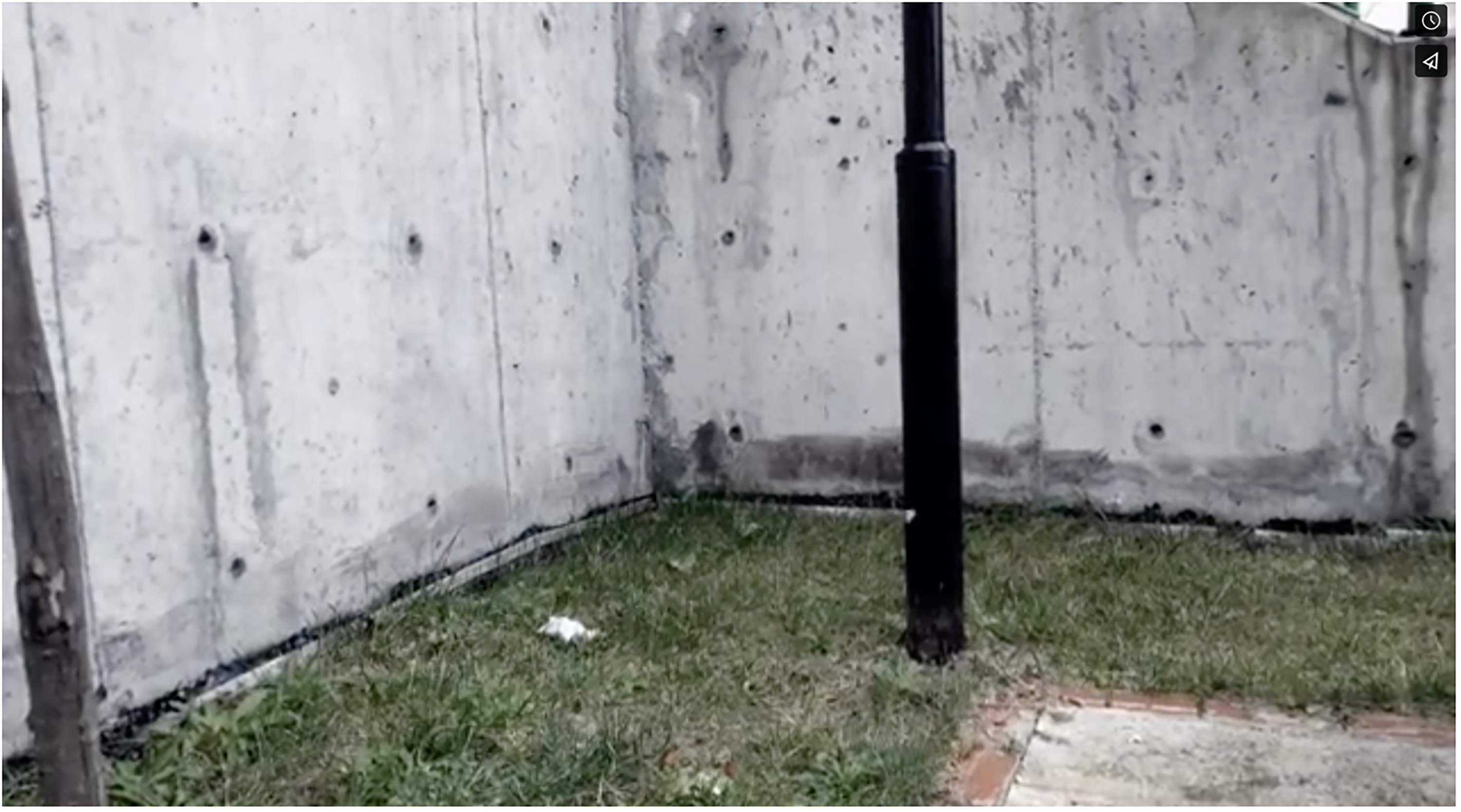
The opening frame from untitled film shows a patch of grass bounded by two concrete walls near a highway (Ali, 2015, screenshot).
A few flakes of snow trace wild paths in the air. From the left, a figure shuffles into the frame. With a beige-orange floral blanket pulled around his shoulders, all that is visible of the person are his bare feet in slip-on plastic sandals and his knit cap pulled low over his ears. He settles into the corner, pulling the blanket around himself against the cold (Figure 2).
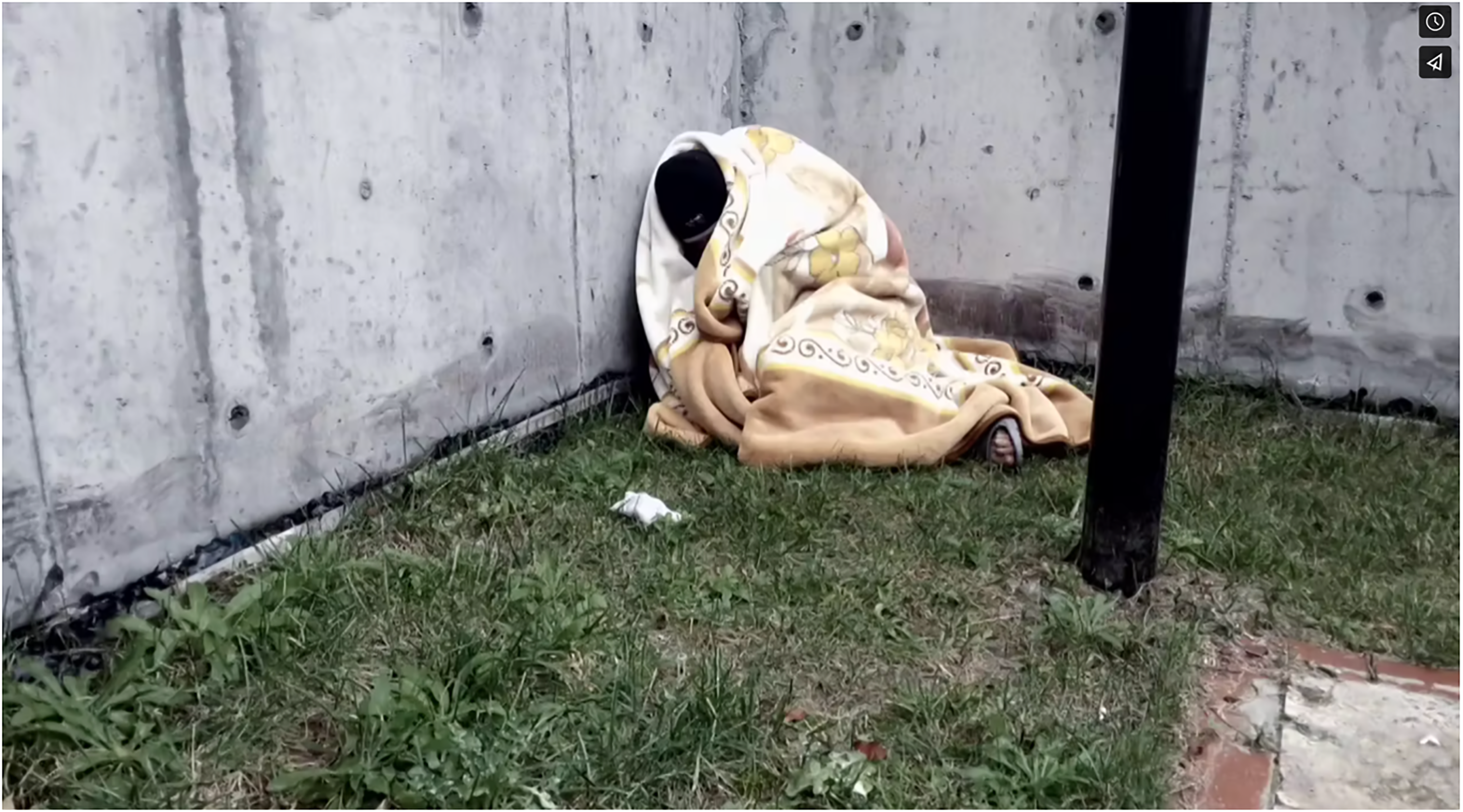
A man settles in the corner and pulls a blanket around himself (Ali, 2015, screenshot).
He has a small plastic bag from which he begins to pull some pieces of something (perhaps bread) to gnaw on. The camera has not moved, maintaining its gaze on the corner where the man huddles and eats. The bag, now empty, is sucked back under the blanket, which the man pulls ever closer, then up so high that only the top of his cap is visible. When he re-emerges, he has lit a cigarette. Propped against the wall as though perhaps in a bed, he holds the blanket across himself with his left hand, and smokes with his right. He begins to cough, a racking, rattling deep cough. A couple more shallow puffs through the coughing and he tosses the half-smoked cigarette in the grass. He gets slowly to his feet and the camera follows him as he trudges along the grey wall, which slopes down to reveal that this little patch of grass and concrete is below street level, part of a sloping hill into which another building is cut. There is the sound of traffic horns. The man crawls under the overhanging roof of the building, pulls a big rock over for a pillow, and lies down on a narrow strip of grass against the wall. He coughs convulsively, pulling the blanket around himself, up under his chin, until he settles into sleep.
The cold scene fades to a new, golden-orange pallet (the colours of the blanket). We hear delicate piano music as a new scene comes into focus. Another corner, this one of smooth peach-coloured walls. A bed tucked into the corner. A pillow on the bed. The same blanket, with someone under it, on the bed. The man in the knit cap emerges from the blanket. He sits up. The blanket falls back – he is not cold. Looking around himself in confusion, he strokes the wall, leaving his hand resting flat upon it while the music swells, female vocals (Figure 3). He feels the pillow. And then lies back down, pulling the blanket over himself once more.
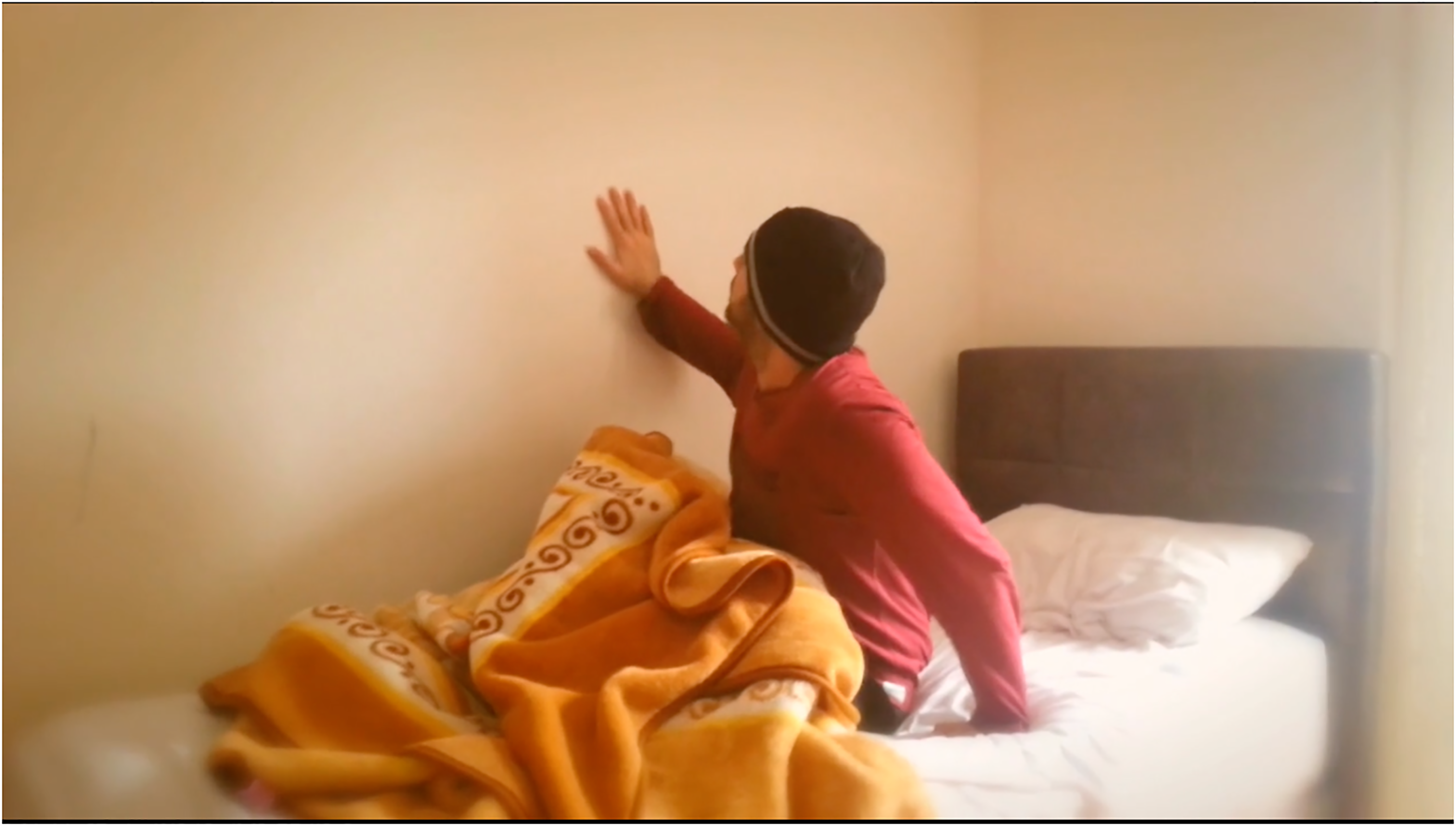
The man awakens under the same blanket, but with a pillow and in a room. He feels the wall and music surges (Ali, 2015, screenshot).
There is a sound like a shot (POP) and the bedroom is gone, he is back on the patch of grass, his head on a rock (Figure 4). The snow flurry has picked up. He huddles, writhes, and weeps. He pulls out and lights another cigarette. He whimpers while he smokes and pulls the blanket around himself. But he can only take a few puffs before he starts coughing again. He tosses the cigarette and retreats under the blanket. The screen cuts to black.
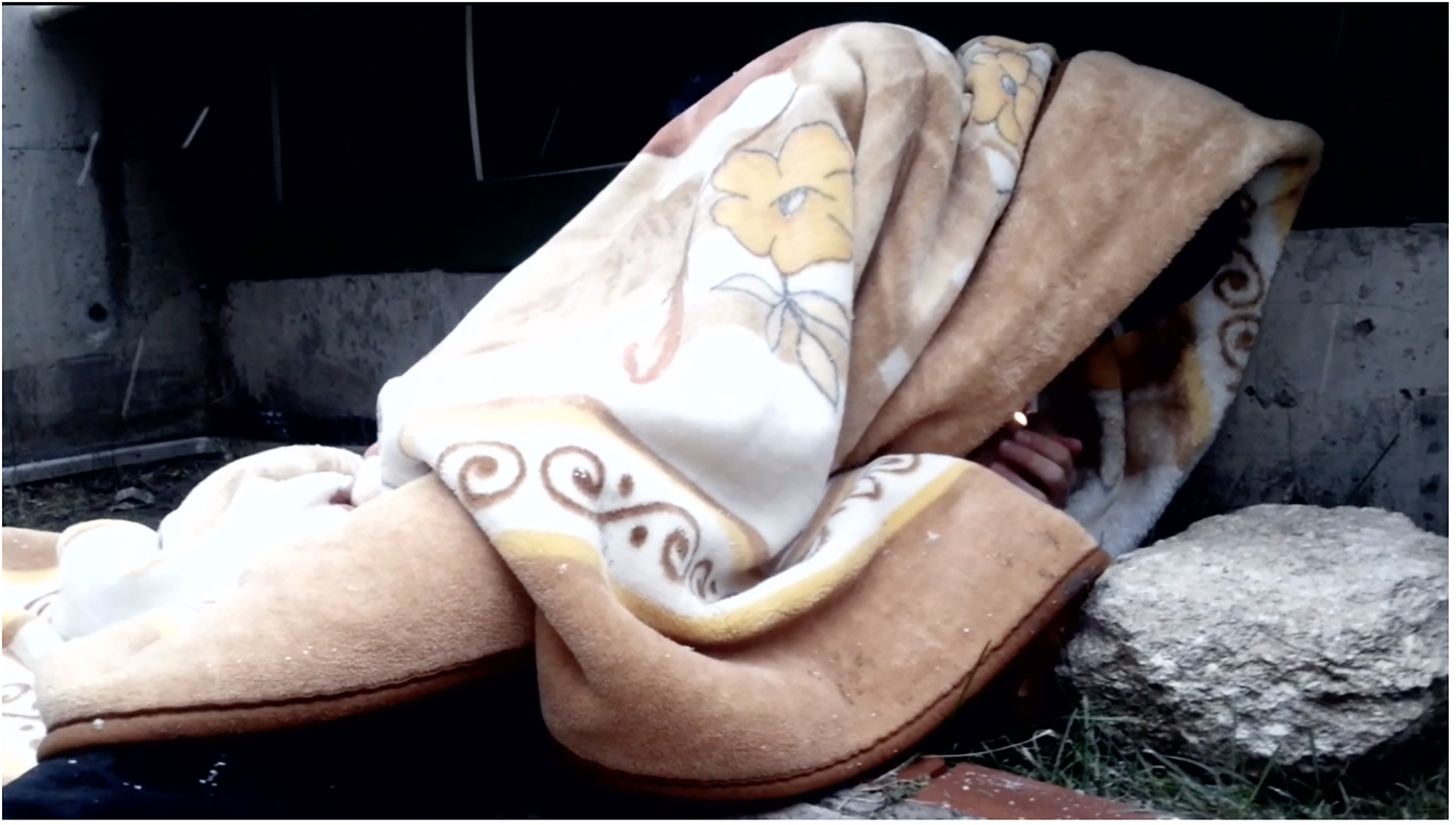
Back outside, it has started to snow. The man coughs and weeps under the blanket. (Ali, 2015, screenshot).
Like the dream of the burning child (Freud, 1953 [1900]), like Levi's dream of the full belly, the untitled video embeds two awakenings: one to a world in which the loss is restored, one to the world in which it is not. The man huddles against the edges of a bordered patch of grass, as though seeking a sense of enclosure, but he is still cold and exposed. In the next take, he wakes to run his hand over the interior wall. He strokes it, feeling its difference, the smooth texture of a dream. A sound (POP) returns him to the cold patch of grass, the stone pillow. The POP (maybe reminiscent of a gunshot) is what is invoked to ‘entwine materiality and sensibility, the world and the self, things and words, through the forms of a summons, a directive, a questioning – an imperative’ (Anderson and Wylie, 2009: 325; emphasis in original). But what is summoned, what is imperative, is not just an entwining. There is splitting and dissociation.
The dream of the untitled film is like an inverse of the trauma dream. The one who is displaced and homeless in Istanbul returns in sleep to a coherence – between blanket, bed, pillow, walls, sleep, subject – that is no longer or not yet. He awakens not to a reassembling room but to roomlessness. Both seeking and resisting its own coming into being, the unbearable calamity dismembers the present and forestalls the future (Fernando, 2023). For the unnamed man in the unnamed film, this calamity is now, and the present moment is breaking down. In the unravelling of processes of differentiation and integration in the present, ‘experience takes on strange qualities, of fragmentation but also of lack of the usual boundaries between self, other, and various features of perception and feeling’ (Fernando, 2023: 34).
An interruption, a signal: the aural POP both links and separates stone/pillow, here/there, now/then, Ali/Ali, distributing them to the edges of intelligibility: one to each side of a single-sided figure, distinct but not separable. This is the topological figure of the Möbius, familiarly represented as the rotation of a twisted loop, in which whatever moves slips from one side to the other and meets itself in reverse. In fact, since the real topology of a Möbius is two-dimensional, the thing that slips – that is, whatever point of the surface – is always the same place as its reversed self. It is a field of doppelgangers. Mathematically speaking, it is a nonorientable surface.
POP – and it is another rotation, disorienting. The Möbius dynamises the unconscious: ‘its space start[s] to move, and what's more, doesn’t cease to be in movement’ (Bursztein, 2017: 61). Psychotopology is a spatialization of time: not just of what is timeless in repetition, but also of its durational acting out that circles around the edge of the real and returns something reversed and uncanny, never quite the same (Blum and Secor, 2011, 2014; Friedman and Tomsic, 2016; Kingsbury, 2007). The Möbius rotation circles the split; its torsion is the cut of irreducible difference within the same (Lacan, 1992 [1959–1960]; Pile, 2014b). The rotation is disorienting. The film is another dream and this telling yet another; each circles the same hole and returns with its own minimal difference. None of this is representable except projected and dissected: snip, splay, pin to the medium.
Distortion is all there is. Objects (stone, pillow, wall, grass, blanket, cigarette, bread) alternate in their presence and absence, transforming ‘from being locatable in reality to being unlocatable in the Real’ (Pohl, 2020: 81). This is what Lucas Pohl calls an ‘object-disoriented ontology’, in which ‘the non-place of the object leads to the ontological disorientation of the subject’ (2020: 74). And it is not only the non-place of the object, but the non-place of place, and the non-time of time, that troubles the one who loops through a nightmare. ‘The clock is thus also a compass’ (Peters, 2020: 214). Lost or broken, the objects withdraw, do not give of themselves, become recalcitrant (Rose, 2011); the landscape watches the subject vanish (Wylie, 2021). Displacement, or becoming unlocatable in the real, is the ‘geo-trauma’ (Ehrkamp et al., 2019, 2022; Pain, 2021) that fragments and distributes Levi and Ali across the folds of time and space and in relation to the objects that are supposed to (re)orient them to the here-now.
Not even the stars are where they seem to be. ‘LIGHTS ALL ASKEW IN THE HEAVENS’ read the headline of a special cable to the New York Times on 10 November 1919, after an eclipse verified Einstein's predictions based on his theory of relativity. ‘Stars Not Where They Seemed or Were Calculated to Be, But Nobody Need Worry’, read the subheading. 2 They are also not when they appear to be, what with the time it takes for their light to become visible to us. Some might even be already dead, inverted into black holes. But nobody needs to worry. Like the dead father in the dream (Freud, 1953 [1899]; Lacan, 2019 [1958–1959]), the light that continues to travel from the star knows nothing of its death. And anyhow from our great distance and from within the blip of our temporal being, they appear not as objects but as cuts, as a map of something real, as wishing wells.
The lightning knew nothing of the ground
The prisoner knew nothing of the light, but a dream of freedom appeared over him like a lightning flash in the night, which leaves it darker behind (Schiller, 1782).3
The dream is the lighting flash that reveals the darkness, that traces a boundary between what is illuminated and what is not. The lightning is that which conjoins the darkness and the illumination, the sky and the earth, the storm cloud and the ground. It is itself an articulating edge, linking divergent, communicating series, but with a twist: ‘Lightning … distinguishes itself from the black sky but must also trail it behind, as though it were distinguishing itself from that which does not distinguish itself from it. It is as if the ground rose to the surface, without ceasing to be ground’ (Deleuze, 1994: 28). Like a foetus in the womb, lightning is a ‘discontinuity that emerges in the midst of continuity’ (Kristeva, 1985: 254). This continuous separation initiates the (im)possibility of distinguishing a subject, or an object. The lightning bolt emerges as a ‘response to difference’, but the ‘cut’ of differentiation does not separate out an independent or autonomous entity (Barad, 2015: 398). What is ‘on the other side’ remains entangled within an intra-action of mutual constitution (Barad, 2007: 393). Like the dream and the awakening that it embeds, lightning traces the conjoining edge between contradictory states: ‘something “passes” between the borders, events explode, phenomena flash’ (Deleuze, 1994: 118).
Both Barad (2011, 2015) and Vicki Kirby (2011), drawing upon each other's work, toy with lightning: the play between the build-up of negative charge in a storm cloud, its drive to discharge, and the responsiveness of the ground. They write of the multiple, glancing attempts (‘stepped leaders’) of the charged electrons to find a conductive path to the earth, and the rise of reciprocating filaments from the ground. The lightning bolt is the discharge that happens in the connection. For Barad, the story is one of yearning and seduction: ‘Lightning is an energizing play of a desiring field’ (2015: 38). For Kirby, what transpires is a ‘sort of stuttering chatter between the ground and the sky’ (2011: 10). Both authors quote lightning expert Martin Uman when he notes that the stepped leaders (the electrons seeking discharge) do not begin with ‘knowledge’ of the earth; the message comes from a spark traveling upwards, and the lightning bolt is what happens when ‘“awareness” occurs’ (1986, 49–50; quoted in Kirby, 2011: 11). If the bolt of lightning is the edge of the Möbius (light-dark, sky-ground, negative-positive), the spark called forth from the ground is the twist.
What does it mean to talk about desire and chatter (and stuttering) in the context of charged electrons seeking connection with the ground? Are these just personifications, the projection of human yearnings and repetitions onto things that cannot be thought to desire or to chatter? Or do these observations suggest a crossing over, an ‘awareness occurring’ in between? For Lacan, speaking subjects chatter and desire (and stutter – or repeat) as a way of papering over the twin traumas of alienation and separation (their ‘cut’ from the field of their emergence). But speaking beings are not the only split entities: reality is ‘made up of cuts, including and going far beyond the cuts made by language’ (Lacan, 2019 [1958–1959]: 397). Is it so far-fetched to suggest that electrons too are agitated by their own alterity? As Barad explains, blipping and birthing in/of the void, the electron is in a perpetual state of discontinuous continuity: cut and uncut, engaged in an ongoing ‘encounter with the infinite alterity of the self’ (2015: 399). No wonder it yearns and chatters, gets stuck, repeats, and crosses over.
Transit between fields requires experimentation. We can test out the possibilities and gesture towards multiple conductive channels until something sparks. Paths proliferate. Only one needs to work out for the accomplishment of the aim. The spark transmits awareness (of the earth, of the possibility of lightning). The flashes of desire and chatter fade out. The message (spark) that allows lightning (or more accurately, the charged field that will become lightning) to accomplish its discharge (to become a lightning bolt) is a portent that the charged field has itself called forth, unknowingly. It is not just the bolt itself that transits between sky and earth, (re)distributing the darkness and the light, but also the enigmatic affects, unchained signifiers, and looped messages that called it forth and that follow in its wake.
Elemental media, wonky transistor
There is chatter. Some of it is empty, but some seem to be part of the unfolding of both matter and meaning across interlocking phenomena, well beyond (and calling into question) what passes for humans (Barad, 2007; Peters, 2020). The media of this communication are manifold and more-than-human, fields of transmission that range from the biogenetic or the sedimentary to the atmospheric. As Sasha Engelmann and Derek McCormack write, ‘[t]his means that sky, sea and fire are message bearing systems of a kind, offering signs, signals or portents of things to come’ (2021: 1426–1427). It also means that there is a more-than-human distribution of capacities for the reception and interpretation of these signals. As Physicist David Bohm writes, ‘even an electron has at least a rudimentary mental pole’, evident in how it participates in ‘unfolding the meaning of the information that is implicit in the quantum field’ (1990: 284–285).
‘We must be careful not to understand’ (Lacan, 2019 [1958–1959]: 424). A form that is comprehensible from one position is not necessarily so from another. Understanding is limited to what is phenomenologically available, what is sensible, from a particular position. ‘I am trying to get you to go a bit beyond by inviting you to stop trying to understand’, says Lacan to his students. ‘It is in this regard that I am not a phenomenologist’ (2019 [1958–1959]: 415). Not even the electron knows what it knows or what it is capable of.
There are gaps. Something does not line up. Relays in the elemental field backfire, and become twisted and uncanny. It is not only sensible information but unconscious knowledge that is transmitted in and through the message-bearing systems of an unfolding spacetimematter. For Bohr, the electron's ‘mental pole’ emerges as both a cause and effect of how it ‘unfolds’ – interprets or responds to – the enigmatic messages it encounters. But the call comes from inside the house (When a Stranger Calls, Walton, 1979). An electron emits a photon, progeny of its self-touching, and then reabsorbs it (Barad, 2012, 2015). Water encounters its doppelganger and transitions. A swarm of spurting, pooling, charged electrons call forth their own dark precursor (Deleuze, 1994). Like in a time travel film or in analysis itself, the message to the subject is the subject's own (Žižek, 2000; Secor and Blum, 2023). Operating the elemental media, spacetimeunconscious is a demonic transistor, working a relay that runs on reversal, estrangement, and misalignment. The disturbance goes both ways. As media studies scholar John Durham Peters (2020: 318) muses, ‘[i]f it is a mistake to think that nature is a subject that speaks intentionally, might it not also often be a mistake to think the same of humans?’
While the particle exercises its ‘mental pole’, the dreamer particulates. Theoretical cosmologist and particle physicist Chanda Prescod-Weinstein writes, ‘I know that my brain is a quark and electron collection. These particles are not just a Black child dreaming’, but also ‘all the things that a Black child is made out of’ (2021: 18). In response to the quantum physics-derived premise that ‘knowing is a distributed practice that includes the larger material arrangement’ (Barad, 2007: 379), the distributed unconscious of psychoanalytical geography improvises. Yes, and there is also a distributed not-knowing of knowledge, a confounding and a dreaming, inherent to this distributed practice of knowing. ‘The “mind” is a specific material configuration of the world, not necessarily coincident with a brain’, says the physicist (Barad, 2007: 379). Yes, and the configuration of the world (of the room or prison or cold stone wall, of the sky or sea or void) is an unconscious-material unfolding that never coincides with itself, rejoins the psychotopologist.
The spacetimeunconscious flickers in the gap between the tense sky and the interested earth, between ice and Auschwitz. It twists (tosses and turns) between the dream and the awakening. It glitches in the blur between Levi and Ali, and hums in the void of (re)birthing electrons and Anna O's phantom pregnancy. The stars (or slits) are dead (or dust), ‘disjunctive constellations’ (Highmore, 2020). The cuts proliferate. Therein dreams a dream without a dreamer.
* * *
Speck, spark, wstawac, POP. The shopkeepers laugh, quarks go mental, and Anna O bumps into her dresser.
These are conjured scraps. They’re different in kind and do not add up. Circling the hole where the spacetimeunconscious exists, these are the ‘equivocations that produce explosions, sudden changes of trajectory’ from which analytic work takes its bearings (Brousse, 2019: 46). They are intrusive signifiers that have fallen off the chain of meaning but are full of ‘signifierness’. Metaphors that generate no meaning, displacements that bring forth no being, they unleash enigmatic affects: strange yearnings, inexplicable repulsions, uncanny half-recognitions. They are the emanations of unknown knowledge in the real.
These specks are waves: transmissions of the spacetimeunconcious.
Footnotes
Acknowledgements
I am grateful for Mitch Rose and the Gregynog Theory School, where I presented the earliest version of this manuscript. This manuscript also owes a debt to Adam Lipszyc and the Center for Psychoanalytic Thought, Polish Academy of Sciences conference on 'Space in Psychoanalysis, Psychoanalysis in Space' in 2022, where the ideas that appear here were further honed. Many thanks as well to Thomas Büsch and Sabine Küper-Büsch of Diyalog, and Ali Ali, for inspiration and permission for film stills. Most of all, I am deeply grateful for interlocutors and readers Aya Nassar, Maria Montero Sierra, and Paul Harrison. Finally, this manuscript has benefitted greatly from the comments of the anonymous reviewers and the editorial guidance of Reuben Rose-Redwood. All persistent faults are my own.
Declaration of conflicting interests
The author(s) declared no potential conflicts of interest with respect to the research, authorship, and/or publication of this article.
Funding
The author(s) received no financial support for the research, authorship, and/or publication of this article.
