



Abstract
This commentary responds to Carr's thoughtful intervention on the work of climate crisis by, first, foregrounding a pluriversal perspective on repair and, second, pushing Carr's work to more explicitly engage with forms of work enacting postcapitalist possibility. This could be framed as the move from ‘transition’ to ‘transformation’. In doing so, the role of geographers in intervening for transformation is flagged as one possible future direction for such work.
Introduction
With her article, Carr (2023) has presented us with a wide-ranging intervention on ‘life's work’ (Mitchell et al., 2004) in an age of ecological disruption. She sensitively pays attention to the repair and care work undertaken to maintain diverse lifeways, as societies around the world face increasingly frequent conditions of flood, fire, and disease. As such, the article taps into this topic's growing currency within the geographical literature (Corwin and Gidwani, 2021; DeSilvey et al., 2018). In this response, I would like to complement the paper's rich insights: firstly, to more explicitly clarify why it is important that we move beyond what has been identified as a ‘Western’ modality of repair (as invisibility and techno-fix), towards pluriversal understandings of ‘transformative’ repair. This is about opening up to cultures of repair and care which reject the logics of infinite economic growth and human supremacy. Secondly, and relatedly, I would like to highlight the potential for community economies which go beyond conventional waged labour in ways the paper does not quite elaborate. Here, moving from ‘transition’ to ‘transformation’, I will point more concretely to the postcapitalist possibility emerging beyond carbon-intensive industry.
Given the current juncture, it is no wonder that Strebel et al. (2019: vii), in their book Repair Work Ethnographies, are able to refer to a ‘glut’ of publications on the topic of ‘repairing the world’. The flourishing of interest in cognate topics, including craft and making in geography (Carr and Gibson, 2015; Gibson-Graham et al., 2019; Hawkins and Price, 2018), emerges at a time when, as Carr points out, we are confronted with the need to connect with, and care for, each other and our things in a world which is increasingly volatile. In the place of a top-down model of climate maintenance, the paper aptly foregrounds the potential for inter-generational care cultures to emerge, attuned to geography and local needs.
One of the side effects of early career precarity, moving from country to country and contract to contract, is prolonged exposure to this diversity of relationships with work, repair, and things. One sunny day, for example, during a postdoc in the city of Brno in the Czech Republic, I came across something which struck me as remarkable, though it clearly did not seem so to its numerous customers – a mobile umbrella repair stand (Figure 1). Despite growing up in one of the rainiest parts of Europe (Ireland), where umbrellas are indispensable, I had been immersed in a culture of linear disposability surrounding this most mundane of objects. Rather than pre-emptively repairing an umbrella on a sunny day, a more familiar response can be seen with a quick online search for similar services at home – a forum post asking about umbrella repair in Dublin comes up emptyhanded, quickly descending into bitter debates about why the poster doesn’t simply buy a new one. After all, the responses stated, why waste your time with repair when cheap imported umbrellas only cost a few euros – even if they are likely to break in the first gust of wind. Linear disposability is profitable, of course, but far from most ideas of a good and sustainable engagement with our possessions.
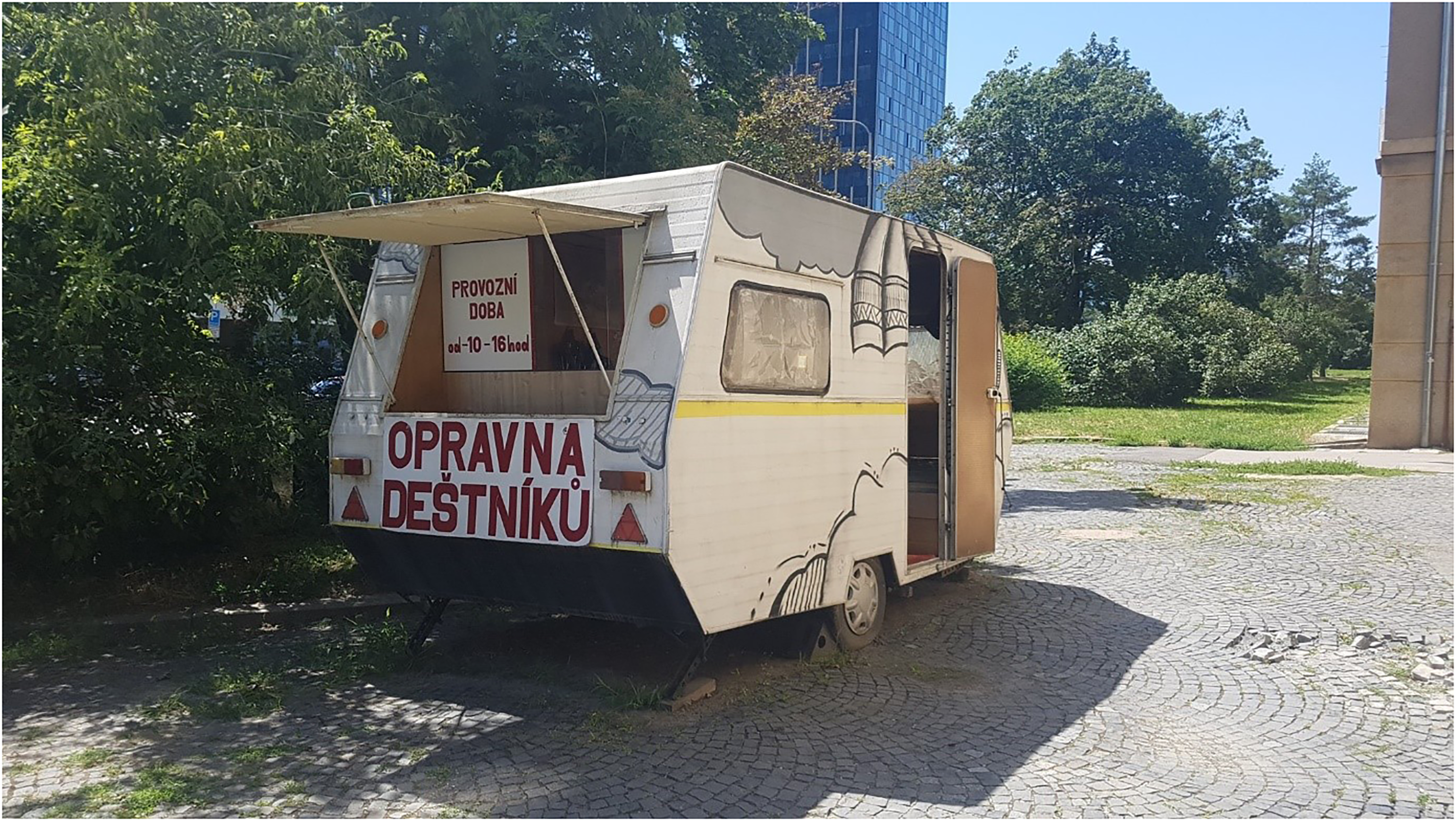
Umbrella repair stand in Brno.
Pluriversal repair
Repair, then, demonstrates what customarily matters to us (Strebel et al., 2019), what we care about, what has value, what habits we possess, what troubles us, and how we are accustomed to going about rectifying matters. It always emerges as a social relation (Corwin and Gidwani, 2021), revealing a dynamic balance between continuity and novelty, repetition and improvisation. As Carr makes clear with the example of the industrial steelworks, such cultures build on a deep history of machinery, tools, desires, and embodied engagement in order to create something new and unpredictable. By engaging in such thick description, a pluriversal perspective on care for things and place emerges (Kaul et al., 2022).
A contrasting and prevalent attitude to repair, particularly in the West, however, is exemplified in the notion of ‘climate repair’, which Carr raises. This does not just fail to question the underlying socio-economic relations which produced the damage in the first place but seeks to hide itself through technological control and to fix some sense of return to a stable past (Jackson, 2019). As the question of planetary repair comes to seem so urgent, geoengineering is worryingly increasingly taken for granted in both policy and scientific circles. As such, in the desperate attempt to repair for stability, we might forget what actually needs to be radically reshaped, or even allowed to wither away or decline (Feola et al., 2021) – in this case, the imperial modes of living which underpin the most basic of needs in the minority world (Brand and Wissen, 2021).
Carr is right to imply that caution is needed and that an important differentiation lies between humble forms of repair and technocratic control-based ones. While perhaps cliché, it is apt to contrast this desire for global stasis and human control with the well-known Japanese art of kintsugi, which uses precious metals (such as gold or silver) and natural adhesives (urushi) to undertake visible, beautiful, and transformative repair of cracked ceramics (DeSilvey et al., 2018; Keulemans, 2016). There is a geographical and temporal specificity to kintsugi's emergence: as with Carr's wildfire example, this repair practice takes place at the crossroads of local socio-material catastrophe and amelioration. For kintsugi, this context is a country where earthquakes are a regular occurrence, often resulting in both broken ceramics and a cracked earth. Indeed, Keulemans (2016: 22) notes that the ‘Great Eastern Japan Earthquake of 2011 has been suggested as behind a recent resurgence in popularity of kintsugi craft’.
Geographical transformations
It is all-too-often overlooked that human intervention can leave our world more beautiful, like kintsugi, rather than just blindly replicating the practices which push us closer to existential peril. This is a vision of human labour as part of ecology, which leads to my second point of focus – the economic and social forms of work, repair, and care which will prevail, as societies face the necessary transformations away from high-energy, high-throughput, and unequal ways of living. How can geographers not only understand and study such reparative possibility, but also multiply it, nurture it, care for it? Time and again, it has been shown that this question is one that researchers can perform and intervene in (Dombroski and Roelvink, Forthcoming), including through the production of ‘counter-knowledges’ (Gibson, 2019: 810). This is where we push from what exists, to what could come into existence.
To return to Carr's HVAC workers, for example, at some point the transition must be made from the maintenance and efficiency of air conditioning systems to the redesign of urban environments and social practices in accordance with low-energy futures. The case of these workers shows us the complex balance of moving beyond the status quo, while not forgetting the life-saving work being done within the HVAC industry here and now (Corwin and Gidwani, 2021). With this come questions about the relationship between Just Transitions – with workers from fossil industries needing meaningful alternative livelihoods – and transformative repair. Here, at certain points in Carr's paper, I feel transformative possibility slips ever-so-slightly out of focus.
As Dant (2019: 284) notes, ‘Industrialisation, standardisation and mechanisation have led to the removal of manufacture from the context of use and made things less amenable to repair and maintenance’. However, if researchers look beyond the overly broad economic generalisations which have become prevalent, such as ‘consumer society’ or ‘post-industrialism’, it is possible to become attuned to already-existing possibilities of local production and care. What emerge, for me, are Carr's ‘more hopeful and united alternative[s] … that will not carelessly dispose of these industrial and resources workers’: I take inspiration here from a plurality of postcapitalist economic forms which defy orthodox categories. Here, going beyond market- or technology-based ‘solutions’, ethical negotiations take place through alternative production networks (APNs) to decide what is produced and how our creations can more ethically come into being.
These post-capitalist attempts to seek prosperity-within-limits (Kallis, 2019) face enormous challenges, of course, but can provide real transformative alternatives (Schmid and Smith, 2021). Repair cafes and maker spaces, for instance, have become interstitial spaces of care for materials and objects, often fostering and facilitating inter-generational solidarity, learning, and continuity of skill. They also, as seen time and again, become hubs and resource nodes for the types of emergency community responses with which Carr opens her paper. In turn, repair of goods has gradually emerged as a thoroughly political question, countering planned obsolescence (and thus further capital accumulation) through various grassroots campaigns aiming to institute a ‘Right to Repair’.
Moving to care-full production and maintenance, intriguing possibilities are emerging in ways which confound traditional ecological politics. The Earthworker Cooperative in Australia's Latrobe Valley produces the infrastructure needed for low-carbon energy supply, such as heat pumps and solar hot water systems, in a worker-owned factory. Supported by trade unions, they aim to establish a network of such coops. This led, in 2018, for example, to the establishment of an ecological cleaning cooperative, providing ‘worker-controlled direct democracy and dignified jobs grounded in an economics of care’. 1 In North Carolina in the United States, The Industrial Commons is similarly working to establish an ecosystem of cooperatives that will build democratic, sustainable livelihoods in traditionally marginalised areas. Their work has so far led to the creation of opportunities in textile production and the circular textile economy. Meanwhile, Cooperation Jackson in Mississippi has made intriguing moves towards a ‘Community Production Initiative’ which unites radical municipalist ideas with the Fabrication Laboratory (Fab Lab) movement, to build community wealth and possibility.
Radical possibility at the nexus of care, repair, and ecology is a theme that has also been well discussed by the degrowth research and action community (Jackson, 2021). Dengler and Lang (2022) provide insight into the role that autonomous caring commons could play in addressing (or at least kick-starting ethical conversations around) the intersectional oppressions and anthropocentrism which underlie top-down and growth-oriented care modalities and infrastructures. There is no space here to do justice to the wider socio-ecological transformations that this would necessarily be a part of, but good work is being undertaken on that, often led by – or in close dialogue with – the work of geographers (Barlow et al., 2022; Demaria et al., 2019; Schmid, 2019).
A recent collaboration I have undertaken, looking at just transitions in the central European automotive industry and regional transformations in north Bohemia, tells us that not enough credibility or imagination is given to the role communities can play in forging viable alternatives (such as the replacement of inefficient individualised mobility with quality public transport) that build on hard-earned skills but do not cost the earth (Gažo et al., 2022). Instead of harnessing this possibility, things appear to proceed in the manner Carr warns about – the narrative of transition being pushed overlooks indigenous skills and interests, instead focusing on subsidising and attracting Foreign Direct Investment (FDI), Just Transition funding is funnelled to the very mining corporations who have benefited from extractivism, and ‘green capitalism’ takes pride of place in the form of lithium extraction and battery production. All of this goes alongside incantatory efforts to rebrand long-marginalised regions as ‘innovative’. Nonetheless, despite under-resourced unions struggling to be the site of any broader collective politics, there are hopeful signs that the classic ‘jobs vs. environment’ narrative dichotomy may be falling away, as communities step up to create their own alternative visions within the cracks.
To conclude, interest in the topic of ‘planetary care’ is expanding (Corwin and Gidwani, 2021), and for good reason. Carr's paper is extremely generative in its parallels with recent ideas by geographers around ‘quiet sustainability’ (Smith and Jehlička, 2013): embedded and embodied knowledge and skill may not be explicitly or overtly sustainability-focused, but it holds profound implications for living well in an unpredictable world, nonetheless. As DeSilvey et al. (2018: 208) note ‘Practices of repair implicitly reframe and reclaim the economy as a space for ethical action, to be shaped for the wellbeing of individuals, communities, and environments. They also prompt dialogue about how we consume, and how we can best ensure preservation of common resources.’ Geographers have a role to play in this reclamation (Gibson-Graham et al., 2019), and Carr has provided a valuable waymarker for further work along that path.
Footnotes
Declaration of conflicting interests
The author(s) declared no potential conflicts of interest with respect to the research, authorship, and/or publication of this article.
Funding
The author(s) disclosed receipt of the following financial support for the research, authorship, and/or publication of this article: This work was supported by the European Union's Horizon 2020 Marie Skłodowska-Curie Actions (grant no. 101029512).
