



Abstract
Mental images associated with possessions may maintain hoarding problems by impeding discarding. We tested whether generating a rescripted image, highlighting a positive outcome of discarding a hoarded object, would facilitate discarding relative to Thought Listing (TL) – a strategy commonly used in hoarding treatment that relies on verbal processing. Participants with hoarding symptoms (N = 103) were invited to a videocall with a psychologist. They selected an object they were having difficulty discarding, identified interfering images connected to this item, and were then randomised into a therapist-guided imagery rescripting (ImRs) or TL exercise before engaging in a discarding task. Whereas both exercises made discarding less aversive, ImRs outperformed TL at post-test by reducing some maladaptive savings beliefs, increasing positive affect, enhancing motivation, and increasing discarding frequency. No effect of condition was found on measures assessing the impact of the original interfering image over time, although participants high in imagery use tendency reported less vividness after rescripting. At 1-week follow-up, both exercises reduced hoarding symptoms, and discarding frequency became equivalent between conditions. Given the advantages that generating rescripted imagery demonstrated on some indices of discarding ease relative to an established approach, this technique may hold clinical utility for individuals with hoarding problems.
Introduction
Hoarding disorder (HD) is a psychological disorder characterised by a strong attachment to objects, leading to difficulty discarding and the accumulation of clutter that compromises living areas (American Psychiatric Association, 2022). It afflicts up to 2.5% of the population (Postlethwaite et al., 2019). When left untreated, hoarding has a chronic course and becomes more burdensome over time (Cath et al., 2017). Individuals with HD often live in homes that become unusable because of clutter and susceptible to health and sanitation concerns, including pestilence, falls risk, and fire hazard (Dozier & Porter, 2020). They also report psychosocial difficulties, including high levels of unemployment, conflict with cohabitating family members and neighbours, and high rates of mental and physical health comorbidities (Spittlehouse et al., 2016). Overall, hoarding is estimated to contribute to a worsened quality of life greater than other leading causes of disability worldwide, including diabetes, heart-disease and substance use disorders (Nutley et al., 2022).
The treatment with the highest evidence base for HD is cognitive behavioural therapy (CBT; Rodgers et al., 2021), which targets factors considered to maintain hoarding specified in Frost and Hartl’s (1996) model. Although this therapy results in symptom improvement with large effect sizes that sustain at follow-up, only a third of individuals show clinically significant change (David et al., 2022). This may be because CBT fails to address some prominent clinical features of the disorder that remain unspecified in dominant hoarding models. Further, many clients refuse CBT or drop out prematurely due to motivational concerns or because the (rightful) emphasis on discarding in this therapy is experienced as too aversive (David et al., 2022). As such, there is scope to improve HD treatment by targeting unexamined clinical features of the disorder and addressing motivational and emotional blocks to discarding.
Mental Imagery in Hoarding
Emerging evidence suggests targeting mental imagery may be a promising avenue for refining HD treatment (Stewart et al., 2020). Mental images are internally generated sensory-perceptual experiences occurring without afferent input (‘seeing with the mind’s eye’; Kosslyn et al., 2001, p. 635). They can take the form of memories, dreams or mental forecasts of future events, and can be voluntarily evoked (e.g. fantasizing about a holiday) or involuntarily triggered (e.g. post-traumatic flashbacks). While imagery is an important part of mental life for most people, including healthy individuals, growing evidence suggests abnormalities in mental imagery processes play a transdiagnostic role in psychopathology (Brewin et al., 2010), including hoarding.
Research in clinical HD samples has revealed individuals who hoard experience more frequent, intrusive and aversive mental images in daily life compared to community controls, and these images cause life-interference and promote avoidance behaviour (Stewart et al., 2020). They also report saving possessions to preserve mental images, such as important memories linked to items, and worry about losing access to these images by discarding (Hartl et al., 2004; Steketee et al., 2003). Moreover, individuals with HD experience intrusive images, such as resurfacing memories and images featuring feared discarding outcomes, when attempting to part with possessions that disrupt this process (Stewart et al., 2020). As such, images appear to be important psychological phenomena in HD maintaining the disorder, especially by contributing to problematic saving behaviour and difficulty discarding.
Imagery Rescripting
One strategy to address problematic images in HD suggested by previous researchers is imagery rescripting (ImRs; Sabel et al., 2025; Stewart et al., 2020). ImRs is an emotion-focused therapeutic technique where problematic images are reshaped or replaced by positive ones to reduce negative impacts of the original trace (Kip et al., 2023). The most common version follows Arntz’s (2012) protocol, which involves modifying schemas associated with traumatic memories by envisioning a different outcome to the memory or the satisfaction of an unmet emotional need, usually via the imagined intervention of an attachment figure. Other prominent ImRs variants include the Holmes et al. (2019) method (also termed ‘Imagery Modification’), where a mental image associated with distress or a maladaptive implicit meaning is first evoked, and then the individual is guided to imagine an alternative, competing image that carries a more adaptive meaning. Newer protocols where prospective images are rescripted instead of aversive memories are also emerging, often emphasising positive re-imagined future outcomes or adaptive coping with feared events (Cooper et al., 2023; Stavropoulos et al., 2025).
ImRs demonstrates strong effects reducing symptoms of psychopathology in various meta-analyses (Kip et al., 2023; Kroener et al., 2023; Morina et al., 2017), including disorders sharing transdiagnostic processes with hoarding, such as anxiety and other obsessive compulsive related disorders (Strachan et al., 2020). While most empirical research focuses on the rescripting of aversive memories (Kip et al., 2023; Morina et al., 2017), rescripting prospective images also appears to result in promising shifts, such as reductions in anxiety, improved coping, and greater receptivity to exposure (Kroener et al., 2023). Although often studied as a component of larger treatment packages (ten Napel-Schutz et al., 2011), ImRs can exist as a standalone intervention, with single sessions demonstrating remarkable effectiveness (Kroener et al., 2023). Although the mechanism is still contested, and may differ across rescripting protocols, theoretical models propose ImRs either updates the meaning of the pre-existing problematic image (Arntz, 2012), or creates a better elaborated, alternative image that outcompetes the original during retrieval (Brewin, 2006).
Recently, Sabel and colleagues (2024) found a novel, future-oriented, written ImRs technique showed promise addressing difficulties discarding in an online analogue HD sample. In their paradigm, participants were guided to imagine a feared outcome of discarding a hoarded object and then rescripted this into an image highlighting an alternative, positive discarding outcome. Results revealed promising effects, favouring rescripting, with regard to motivating discarding, making it less aversive, and promoting discarding frequency, relative to other cognitive behavioural strategies (i.e. imaginal exposure, cognitive restructuring, positive imagery). Moreover, individuals with higher baseline imagining ability appeared to derive more benefit, reporting greater discarding motivation and readiness after rescripting. The authors conclude ImRs may hold promise as a clinical technique to facilitate discarding and be a useful addition/adjunct to hoarding treatment.
However, before ImRs is promoted clinically, the technique requires replication and extension. Sabel and colleagues (2024) utilised an online, self-guided, written ImRs task. It is yet to be determined whether these promising effects translate to face-to-face settings with a therapist guiding rescripting, which may have greater emotional impacts than written, self-guided variations. The authors also rescripted deliberately generated imagery of a feared discarding outcome. Individuals with HD experience other types of images that interfere with discarding, including positive memories linked to their items (Stewart et al., 2020), so it is uncertain whether pre-existing idiopathic images inhibiting discarding (regardless of their temporal orientation or valence) can be successfully rescripted.
Although Sabel and colleagues (2024) used multiple measures to assess for effectiveness, the authors failed to examine change in certain cognitive and experiential factors possibly responsible for ImRs’ promising effects. ImRs can induce belief change, as well as alter the properties (i.e. vividness) of the original trace (Kroener et al., 2023). The authors also did not include a follow-up, nor verify discarding had taken place beyond participants’ self-report. These are important oversights to address given hoarding’s chronicity and the tendency of individuals with HD to ‘churn’ items (i.e. merely moving objects around when discarding, without getting rid of them; Muroff et al., 2014).
Summary
The current study was designed to address these gaps. Drawing on elements from established rescripting methods (Arntz, 2012; Holmes et al., 2019), and newer protocols suggesting ImRs can be future-oriented (Kroener et al., 2023), we piloted a single-session rescripting task, focused on helping participants with hoarding tendencies rehearse positive outcomes of discarding a difficult item through imagery to compete with any pre-existing idiopathic images inhibiting discarding (Stewart et al., 2020). We had psychologists guiding rescripting in a setting intended to resemble therapeutic conditions, and compared ImRs to an active Thought Listing (TL) control exercise – a verbal/linguistic ‘distancing strategy’ commonly used in hoarding treatment to facilitate the discarding of difficult items that has outperformed cognitive restructuring in previous experimental trials (Frost et al., 2016). Change was assessed on a triad of emotional, cognitive and behavioural discarding-related primary outcome variables (e.g. motivation and emotions associated with discarding, savings beliefs, discarding ease and frequency). We also assessed for shifts on several secondary imagery-related indices, such as the effect of ImRS on the vividness, urge to suppress, and valence of participants’ imagery inhibiting discarding, the content/themes within these images, and whether imagining ability moderated intervention effectiveness.
In line with research suggesting imagery is an ‘emotional and motivational amplifier’ compared to verbal processing (Holmes & Mathews, 2010), we expected to see greater reductions in discarding-related distress, maladaptive savings beliefs, and aversive imagery-characteristics in ImRs compared to TL, and greater increases in discarding motivation, readiness and frequency. However, as individuals who experience imagery more frequently and vividly appear to benefit more from rescripting (Liu et al., 2025; Sabel et al., 2024), we hypothesised these effects may be more marked among participants with a greater baseline tendency to use imagery in daily life.
Method
Participants
Participants with elevated hoarding tendencies were recruited from the university and surrounding community through the home institution’s undergraduate (SONA-1) and paid (SONA-P) research participation systems (https://www.sona-systems.com/). The SONA-1 participant pool consists of enrolled psychology undergraduate students who participate in research opportunities for course credit, whereas the SONA-P participant pools is comprised of individuals from the university and surrounding community who agree to participate in exchange for monetary renumeration. The use of non-clinical analogue samples in HD research is appropriate as hoarding tendencies are dimensional in severity and frequency within the population (Timpano et al., 2013), and sufficiently prevalent in student and community groups (Kajitani et al., 2019; Samuels et al., 2008).
Previous research has indicated ImRS produces medium-to-large effects on discarding-related outcomes relative to other cognitive-behavioural strategies (Sabel et al., 2024). A power analysis using G*Power, Version 3 (Faul et al., 2007) was performed using this input, and revealed to detect an effect of this size with 80% power and significance set at 0.05 for a repeated measures MANOVA with a between-within subjects’ interaction, 90 participants were required. However, to account for attrition, we planned to collect data from 100 participants.
We used a cut-off score of 33 on the Savings Inventory Revised (Frost et al., 2004) to screen individuals into the study with clinically significant hoarding or subclinical/probable HD (Kellman-McFarlane et al., 2019; Spittlehouse et al., 2016). Additional inclusion criteria involved having sufficient proficiency in English, and access to video-conferencing technology. From the 1633 people who completed the screening, 152 met inclusion criteria and were invited to participate. One hundred and eight participants accepted this invitation and completed the study. Participants were subsequently excluded if they were given an extremely low effort rating on a clinician administered scale (n = 2), failed to adhere to task instructions (n = 1), or were suspected of impersonation (i.e. attempting to participate twice under different aliases; n = 2). The remaining sample included 103 participants (SONA-1: n = 43, SONA-P: n = 60). Importantly, there was an equal distribution of SONA-1 and SONA-P participants in each condition (p > .05). See Figure 1. Flow of the protocol from initial screening through to randomisation and analysis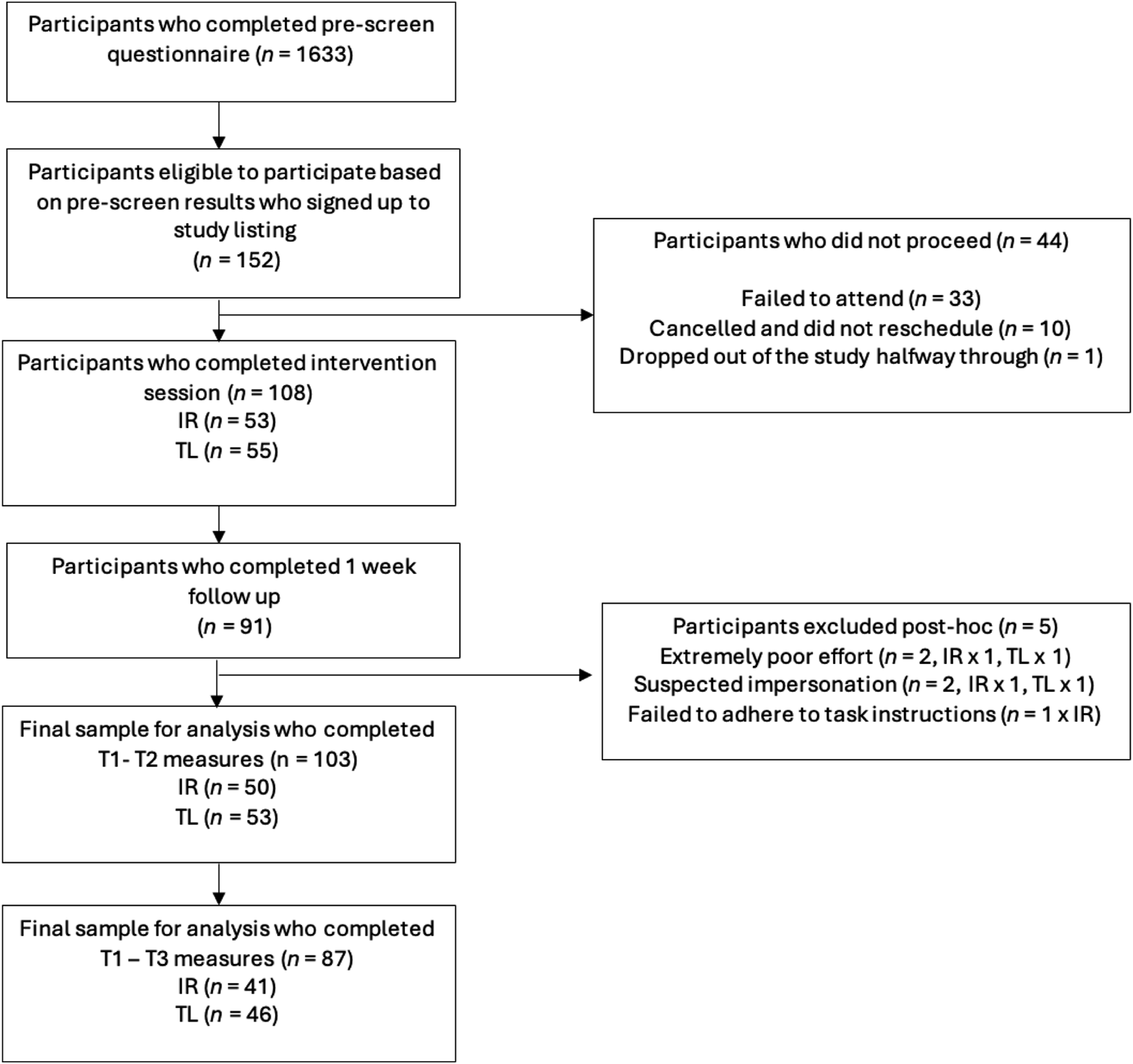
Participants ranged from 17 to 43, with a mean age of 22.32 (SD = 4.69). Fifty-two participants identified as male, 50 as female, and one as non-binary. Participants identified their ethnicity as East Asian (n = 33), South Asian (n = 18), Caucasian (n = 11), South-East Asian (n = 7), African (n = 7), Middle Eastern (n = 5), South American (n = 3), Pacific Islander (n = (2) and Aboriginal or Torres Strait Islander (n = 2), or mixed race (n = 15). Most participants were studying (n = 66) and/or working (n = 56) in a full or part-time capacity and had completed some tertiary education or higher (n = 61). Fifty-eight participants lived in suburban areas, 41 in urban areas, and four in rural settings.
Materials and Measures
Primary Discarding Related Outcome Measures
We included the
We used the
We also included the
We used the
Single item ratings of participants’
A single item
Secondary Imagery Related Outcome Measures
We used the
We also included the
Exercises
Participants were randomised to either a ImRs or a TL exercise, guided by one of two doctoral level psychologists (i.e. IS or LS). As per standard rescripting protocols, the exercises lasted for 15–20 min.
An example item, image, and rescript for a sample of three participants

In the TL condition, participants were instructed to speak aloud their thoughts and feelings about whether to discard their item(s) for 5-min. The researcher spent the remaining time reflecting back participants’ thoughts and emotions and prompted them to elaborate on reasons verbalized in favour of discarding. If participants found it difficult to speak continuously for 5 min, gentle prompts or words of encouragement were used (i.e. ‘Keep going if you can’, ‘Can you tell me more about that thought?’). This procedure was taken from Muroff and colleagues’ (2014) CBT manual for HD, although the exercise was lengthened to match the rescripting condition.
Procedure and Design
Study procedures were approved by the university’s human research ethics committee (HREC File no. HC220235). Following ethics approval, participants were screened for hoarding from the university and surrounding community via the institution’s research participation systems. The study was advertised as an investigation determining whether imagery could help people make decisions about possessions. For SONA-1 participants, the SI-R was included within a battery of pre-screening measures completed by all enrolled psychology undergraduates, as per course requirements; and the study listing was only visible to participants who scored above our clinical threshold value. For SONA-P participants, the SI-R was included as a hyperlink within the study advertisement, and interested individuals scoring above this value were provided with an invitation code to participate.
Eligible participants were then invited to an hour-long Microsoft Teams call with a psychologist and were asked to bring in an item (or a cluster of related items e.g. a three-book trilogy) they were having difficulty discarding. To ensure participants chose items representative of conventionally hoarded objects used in discarding exposures, participants were instructed to bring in items they felt they should be able to part with, that were inexpensive/low in monetary value, and that other people would have little trouble discarding. These parameters have been used in previous research (e.g. Yap & Grisham, 2020), and several example objects were provided to guide item selection (e.g. old books, clothes, paper items; see Table 1).
The study used a mixed between and within-subjects design. After consenting to the study, participants completed the demographics items, baseline study measures, and the imagery interview – where their idiopathic images inhibiting discarding were elicited. For cases where participants did not report an image (n = 6), the clinician-experimenter explored what thoughts and feelings inhibited discarding for that participant and used this idiopathic mental representation as the basis for rescripting; consistent with contemporary approaches suggesting that a pre-existing image is not necessarily a prerequisite for rescripting (e.g. Landkroon et al., 2022; Stavropoulos et al., 2025). Participants were then randomised into either a 15–20-minute therapist-guided ImRs or TL task. After the exercises, participants recompleted the measures and underwent a 5-minute discarding exposure, where they were instructed to attempt to discard their item(s), and rate whether they were able to on the discarding decision-making index. Participants who discarded were prompted to upload a photograph verifying this. To minimize the impact of demand characteristics, all participants were reassured that they would be granted renumeration irrespective of whether they discarded their item(s). Moreover, the video-call ended just prior to the discarding exposure to limit the impact of perceived pressure/coercion from the experimenter. All participants were then debriefed via a written statement and granted course credit renumeration or a $15 e-gift voucher.
One week later, participants were emailed a follow-up survey, which was completed by the majority of participants (n = 87/103, 84.47%). In this survey, all participants re-completed the SI-R difficulty-discarding subscale and rated whether they had discarded their item(s) since the videocall. Participants who indicated that they still had not discarded (n = 41) were then re-presented with the study measures to determine if there was any shift in how they felt about their object(s). Those who had discarded did not recomplete the full battery of measures to prevent priming attachment to the already-discarded item(s), thereby inadvertently encouraging them to seek out that item. To incentivise follow-up survey completion, participants were granted additional course credit or a $5 e-gift voucher.
Data Analytic Strategy
Inferential statistics were run in SPSS v.29 (IBM Corp, 2022). Changes in continuous outcomes were assessed through 2 (Condition: ImRs, TL) by 2 (Time: pre-test to post-test) mixed-model MANOVAS and ANOVAS, whereas shifts on categorical outcomes (e.g. the frequency of participant’s discarding outcomes) were examined via Chi-square and McNemar tests. The moderating effects of baseline imagery use tendency was assessed using a series of regression analyses using the PROCESS Macro Extension V4.3 for SPSS (Hayes, 2022), model 1, on participant’s time-2 data, controlling for their time-1 ratings, with condition as the predictor and the SUIS as the theoretically proposed moderator. Qualitative coding of the themes within participant images was conducted by two authors (i.e. IS and BG) using content analysis (Forman & Damschroder, 2007). This was achieved through an iterative process, where the two authors first familiarised themselves with the data, searched for themes and generated initial codes. They then corresponded several times to resolve discrepancies in coding, before applying the final codes to the dataset to generate a tallied shortlist.
Preliminary assumption testing was performed prior to analyses. To ensure randomisation, Chi-square and independent-samples t-tests were used to compare the different measures at baseline between the two conditions, and no significant differences were found for any measures or demographic items (all ps >. 05). Examination of Boxplot and Mahalanobis distance calculations revealed one non-extreme univariate and one multivariate outlier, which were retained as outcomes did not change when re-run with outliers excluded. While a matrix of scatterplots revealed the assumption of linearity was satisfied, Shapiro Wilk normality tests revealed some dependent variables were non-normal (e.g. participant ratings of their readiness and motivation to discard, all imagery ratings, p > 0.05). However, this test is sensitive to departures from normality when sample size exceeds 50 (N = 103; Le Boedec, 2016), and inspection of quantile-quantile plots did not indicate significant deviations. Box’s MTest of Equality of Covariance Matrices was significant for some multivariate analyses, violating homogeneity of variance-covariance assumptions, so Pillar’s trace was used as the omnibus test-statistic. Available case analysis was used for tests affected by missing data from follow-up survey attrition, as Little’s MCAR test was not significant, χ 2 (1, 103) = 0.098, p = .75, and a comparison of participants who did and did not complete the follow-up survey on the demographics items and hoarding baseline measures did not significantly differ; suggesting missingness completely at random (all ps >. 05; Okpara et al., 2022). Partial eta-squared (ηp2) and Crammer’s V effect sizes were interpreted in accordance with guidelines by Cohen (1988), and the risk of type-1 error was controlled for through a familywise Bonferroni correction strategy. Adjusted p-values are reported where these corrections have been applied.
Results
Descriptive Statistics
Mean and standard deviation scores for the study outcomes between conditions

Note. SUIS = Spontaneous Use of Imagery Scale, SI-R = Savings Inventory Revised, SCI – M = Savings Cognition Inventory Memory Subscale, SCI-C = Savings Cognition Inventory Control Subscale, SCI – EA = Savings Cognition Inventory Emotional Attachment Subscale, SCI-R = Savings Cognitions Inventory Responsibility Subscale, OAQ = Object Attachment Questionnaire, DEQ – Discrete Emotions Questionnaire, T1 = Pre-test, T2 = Post-test, T3 = Follow-up.
Primary Discarding Related Outcomes
Negative and Positive Emotions About Discarding
Participants’ negative emotions about discarding (i.e. anger, disgust, anxiety, fear, sadness, and desire/yearning ratings) significantly reduced from pre-to post-exercise, F (1, 101) = 67.51, p<. 001, ηp2 = .40, but contrary to predictions these reductions were comparable across conditions, F (1, 101) = 1.79, p = . 18, ηp2 = .02. Contrastingly, participants’ positive emotions about discarding (i.e. happiness and relaxation ratings), increased from pre-to post-exercise as hypothesised, F (1, 101) = 31.17, p < .001, ηp2 = .24, and significantly more so for participants in rescripting, F (1, 101) = 22.27, p < .001, ηp2 = .18. When we examined the positive emotion indices separately, findings confirmed participants in ImRs reported greater increases from pre-to post-exercise in feelings of both happiness, F (1, 101) = 19.14, p adjusted <.001, ηp2 = .16, and relaxation about discarding, F (1, 101) = 20.03, p adjusted<. 001, ηp2 = .17, than those in TL.
Motivation and Readiness to Discard
As hypothesised, participants’ discarding motivation and readiness significantly increased from pre-to post-exercise, F (1, 101) = 67.74, p < .001, ηp2 = .40, and these increases appeared more marked for participants who underwent rescripting, F (1, 101) = 4.38, p = .04, ηp2 = .08. However, when we examined participant ratings of their readiness and motivation to discard separately, findings revealed that while participants in ImRs reported greater increases in their motivation to discard than those in TL, F (1, 101) = 10.04, p adjusted<.01, ηp2 = .09, both conditions equivalently increased their discarding readiness from pre-to post-exercise, F (1, 101) = 4.97, p adjusted = .06, ηp2 = .05.
Saving Cognitions
Consistent with predictions, participants’ maladaptive savings cognitions decreased from pre-to post-exercise, F (1,101) = 20.89, p < .001, ηp2 = .17, and these reductions appeared to be more marked for participants in rescripting, F (1,101) = 10.49, p < .01, ηp2 = .09. When we examined the subscales of the SCI and the OAQ separately, findings confirmed that participants in ImRs reported greater reductions than those in TL in their object attachment on the SCI-EA, F (1,101) = 7.33, p adjusted = .04, ηp2 = .07, and on the OAQ, F (1,101) = 8.71, p adjusted = .02, ηp2 = .08, as well as greater reductions in memory-concerns, F (1,101) = 11.44, p adjusted <.01, ηp2 = .10, from pre-to post-exercise. However, both conditions equivalently reduced participants’ need for control, F (1,101) = 4.20, p adjusted = .20, ηp2 = .04, and sense of responsibility over their item(s), F (1,101) = 6.59, p adjusted = .06, ηp2 = .06, from pre- to post-exercise.
Discarding Frequency
As predicted, participants’ discarding outcomes at post-test differed significantly between conditions, χ 2 (3, 103) = 8.46, p = .04, Crammer’s V = .29, with participants in TL being significantly more likely to choose to ‘not discard’ their item(s) compared to participants in rescripting (p adjusted = .01). However, the frequency distributions of participants’ discarding outcomes changed between post-test and 1-week follow-up, χ 2 (6, 87) = 26.38, p < .001, Crammer’s V = .48. By 1-week follow up, participants’ discarding outcomes no longer significantly differed between conditions, χ 2 (3, 87) = 7.01, p = .07, Crammer’s V = .28.
Frequency of discarding decisions over time by condition

Note. ImRs = Imagery Rescripting, TL = Thought Listing.
Discarding Ease
Participants’ self-reported difficulty discarding reduced from pre-test to 1-week follow-up with a large effect size, F (1,85) = 31.72, p adjusted<.001, ηp2 = .27, but there was no significant difference between conditions, F (1,85) = 2.07, p adjusted = .16, ηp2 = .02, suggesting both exercises equally reduced participants’ symptoms of discarding difficulty overtime.
Subgroup Analysis: Non-discarding Participants
To understand whether participants who had
Secondary Imagery Outcomes
Imagery Content and Characteristics
Examples images linked to participants’ hoarded object(s)

Imagery Ratings
Contrary to predictions, there were no significant changes from pre- to post-exercise, nor any differential effects of condition on participant ratings of the vividness (Time: F (1,101) = 2.64, p adjusted = .43, ηp2 = .03, Interaction: F (1, 101) = 1.541, p adjusted = .89, ηp2 = .02), positivity (Time: F (1, 101) = .00, p adjusted = 1.00, ηp2 = . 00, Interaction: F (1, 101) = .03, p adjusted = 1.00, ηp2 = .00), negativity (Time: F (1, 101) = 3.17, p adjusted = .32, ηp2 = . 03, Interaction: F (1, 101) = .0.27, p adjusted = 1.00, ηp2 = .00), or urge to suppress (Time: F (1, 101) = .05, p adjusted = 1.00, ηp2 = .00; interaction F (1, 101) = .32, p adjusted = 1.00, ηp2 = .00) their original image interfering with discarding.
Imagery Use Tendency as a Moderator
We found participant’s baseline imagery use tendency moderated the effect of rescripting on their vividness ratings of their original interfering image only (B = −1.53, SE = .49, p adjusted <.01, all other DVs ps > .05). Simple slopes analysis revealed the effect of rescripting on participants’ imagery vividness ratings was non-significant one SD below the mean (B = 6.76. P = 0.21), non-significant at the mean (B = −5.23, p = 0.16), but significant one SD above the mean (B = −17.24, p < .01). As shown in Figure 2, as imagery use tendency increased, an effect of ImRs on reducing participants’ vividness ratings of their original image became apparent. The opposite trend emerged for participants in TL, with those higher in imagery use tendency reporting greater vividness of the original image linked to their hoarded object(s) after the exercise. Imagery use tendency as a moderator between ImRS and the vividness of participants’ imagery impeding discarding
Discussion
This study investigated whether a single session of therapist-guided rescripting, focused on helping individuals with elevated hoarding tendencies rehearse positive outcomes of parting with a challenging object through imagery, facilitated the ease and frequency of discarding compared to TL – a widely used technique in HD treatment that relies on verbal-processing (Frost et al., 2016). While both conditions made discarding less aversive and equally reduced hoarding symptoms at follow up, we found some promising differential effects of rescripting on our primary emotional, cognitive, and behavioural discarding-related outcomes, such as increasing positive affect and motivation to discard, reducing some savings beliefs, and increasing discarding frequency at post-test. Contrary to predictions, neither exercise had any effect on our secondary imagery-related outcomes, although participants higher in imagery use tendency reported less vividness of their original image after rescripting. Differences in discarding frequency, apparent at post-test, also became equivalent between conditions by 1-week post-exercise. These results have interesting implications for the utility of imagery-based interventions in hoarding, as well as suggesting avenues for future research.
Emotions and Motivation
The finding that ImRs was equivalent or superior to TL on our affective and motivational discarding-related outcomes is broadly consistent with research demonstrating imagery acts as an ‘emotional and motivational amplifier’ relative to strategies relying on verbal processing (Holmes & Mathews, 2010). Pending replication and extension in a clinically diagnosed sample, ImRs may be a therefore be a valuable tool to employ in HD treatment (perhaps prior to in-vivo discarding exposures) as an alternative to verbal-persuasive methods for individuals who are reluctant to part with items due to anxiety or other affective blocks, or for those who are struggling with the motivation to initiate decluttering.
The affective and motivational benefits observed in ImRs may be due to ability of imagery to generate rewarding ‘pre-experiences’. Research on episodic future imagining, such as envisioning consuming sugar or nicotine, suggests imagery can elicit rewarding sensory-perceptual experiences and positive affective states, such as relief, pleasant tastes, and relaxation, while also highlighting the current absence of these rewards, motivating approach seeking behaviour (May et al., 2015). Perhaps by instructing participants to simulate a positive outcome of discarding via rescripting we allowed them to ‘pre-experience’ benefits discarding might result in (reduced clutter volume, stress relief, improved relationships etc.), thereby inducing positive affect and increasing motivation to partake in this often-avoided activity.
Savings Beliefs
We also found ImRs was equivalent or superior to TL at inducing belief change, particularly for cognitions pertaining to object attachment and memory concerns. Furthermore, even amongst those who chose not to discard, ImRs appeared to make these participants less controlling over their item(s) by follow-up, relative to those who underwent TL. One potential explanation for this differential effect on cognitive change may depend on the techniques’ contrasting mechanisms of action. TL is considered to facilitate the process of distancing or ‘defusing’ from automatic thoughts in order to reduce distress associated with believing or ‘fusing’ with them (Frost et al., 2016), whereas ImRs is thought to alter cognition at a deeper level of underlying core beliefs and maladaptive schemata (Arntz, 2012). Perhaps some saving beliefs we observed differential effects on are particularly amenable to techniques like rescripting that facilitate shifts at a deeper level of semantic memory and schematic beliefs. Pending replication in a clinically diagnosed sample, ImRs may therefore be a particularly useful strategy to facilitate discarding of more difficult ‘cherished’ items that have a stronger personal meaning and value as part of moving up a discarding exposure hierarchy during treatment.
Discarding Outcomes
Consistent with hypotheses, we found ImRs made participants more likely to discard their item(s) at post-exercise. Although this difference disappeared at follow up, nevertheless, the effects of rescripting were not short-lived as exploratory analyses allowed us to isolate that there was a significant proportion of contemplative participants in ImRs at post-test who followed through with discarding by follow-up. As difficulty discarding is the cardinal symptom of HD, and leads to some of the most negative consequences in terms of health, safety, and quality of life outcomes (American Psychiatric Association, 2022), these findings were promising; especially as we were able to confirm self-reported discarding took place through photo-verification methods. These results suggest ImRs may be a useful tool to encourage adaptive behavioural change, alongside inciting positive emotional and cognitive shifts.
We also found both exercises reduced trait difficulty discarding from baseline to 1-week follow-up with a large effect size. Given the chronicity of hoarding, this was a surprising finding as we did not expect to observe symptom change following brief (i.e. 15–20 minute) therapeutic exercises. Although we caution against drawing strong conclusions from this result as we cannot rule out non-specific effects, and did not perform clinical benchmarking, this may suggest practicing strategies to facilitate discarding on difficult possessions under guidance of a psychologist generalise to the ability to discard other items. Moreover, it suggests ImRs may warrant further investigation as a clinical strategy for addressing difficulty discarding in HD as it appears at least as effective as an established TL method in producing symptom change over time.
The positive effects of ImRs on participants’ discarding outcomes may be explained by the ability for imagery to simulate action rehearsal. Research suggests merely visualizing performing specific behaviours can increase follow-through and subsequent performance outcomes in a range of domains, from voting behaviour to surgical skills (Arora et al., 2011; Libby et al., 2007). Alternatively, perhaps, through rescripting we capitalized on the benefits imagining confers on planning and decision-making processes. Generating imagery of episodic future events allows individuals to ‘try out’ different behaviours ahead of time (Zaleskiewicz et al., 2023), and influences the perceived likelihood of imagined outcomes (Sobkow et al., 2016). Perhaps, through rescripting we prompted participants to consider more reasons in favour of discarding, and made these benefits appear more plausible – assisting them in the discarding decision-making process. Pending clinical replication, rescripting may therefore be particularly helpful during HD treatment when the patient is experiencing decisional difficulties during decluttering efforts.
Imagery Outcomes
In keeping with previous research (Stewart et al., 2020), a high proportion of our sample experienced interfering imagery when contemplating discarding their item(s). These images tended to take the form of positive memories, although prospective images (e.g. of feared discarding outcomes) were also reported. This finding further affirms images are important mental events in hoarding that play a role in problematic saving behaviour and difficulty discarding; perhaps via positive (e.g. dwelling on positive images associated with objects), and/or negative reinforcement contingencies (e.g. avoiding distress associated with ‘losing’ a memory by saving).
However, neither condition had any effects on the vivacity, urge to suppress or emotional valence of this interfering image over time, despite ImRs being predicted to target these mechanisms. One explanation is that the version of ImRS used in our study, which aligns with variants of rescripting that leave the original trace unaltered (e.g. Holmes et al., 2019), may change the impact of the idiopathic image on an implicational level (i.e. meaning) only while leaving its visual properties largely intact. Future research may therefore seek to compare different ImRs protocols that alter the outcome or narrative of idiopathic imagery directly (Arntz, 2012), with variants that work on generating ‘competing’ imagery (Holmes et al., 2019) on imagery related outcomes. Alternatively, perhaps a larger sample size was required to detect subtler, differential shifts on these imagery-related indices; although we note that previous meta-analyses suggest rescripting tends to produce large reductions in aversive imagery characteristics, such as vividness and image-related distress (Kroener et al., 2023).
Nevertheless, individuals who used imagery more habitually in daily life did report less vividness of their original image inhibiting discarding after rescripting; suggesting that an effect on imagery related outcomes may still occur following ImRs for this subgroup of participants. Interestingly, the opposite trend emerged for participants in TL, with those reporting greater baseline imagery use tendency describing greater vividness of their original interfering image after the exercise. This suggests that greater access or awareness of intrusive images may be one iatrogenic effect of standard TL procedures, as currently used in HD treatment (Muroff et al., 2014), although further research is required to confirm this finding. As we did not find a moderating effect of our ‘trait’ mental imagery measure on any primary outcomes, unlike Sabel et al. (2024), future research may also seek to compare the moderating effects of various mental imagery measures on the potency of ImRs. For example, comparing instruments such as the VVIQ (as used in Sabel et al., 2024) that require individuals to generate different imaginal stimuli and report on their vividness, with self-report measures like the SUIS that assess the frequency of mental imagery use.
Limitations
Several limitations are noteworthy. Firstly, we used a non-clinical analogue sample. While all participants had scores on a hoarding symptom measure above a threshold value indicating clinically significant or subclinical/probable HD (Spittlehouse et al., 2016), formally diagnosing HD requires a structured clinical interview, so it is uncertain how many participants met criteria. Although the SI-R is the industry standard measure and can reliably differentiate hoarding from other clinical and community groups (Frost et al., 2004), relying on a symptom measure in the absence of certifying a formal HD diagnosis means that we are unable to rule out that individuals with hoarding-like behaviours resulting from other psychopathology (e.g. eating disorders, dementia, psychosis; Novara et al., 2016) were not inadvertently recruited. Results should therefore be interpreted with some degree of caution and future research should seek to replicate our methodology in a clinically diagnosed sample, applying more rigorous inclusion and exclusion criteria.
Secondly, our sample consisted mostly of young adults from the university and surrounding community. This limits generalizability, especially as individuals with HD tend to present for treatment later in life compared to other clinical groups (Cath et al., 2017). However, as hoarding tendencies are dimensional in the population (Timpano et al., 2013), sufficiently prevalent in student and community groups (Kajitani et al., 2019; Samuels et al., 2008), and young adulthood is the time of symptom emergence (Cath et al., 2017), early detection and intervention could markedly reduce hoarding’s lifetime toll. Nevertheless, future research should test our protocol in a sample of participants with a greater age range, especially as imagining ability worsens across the lifespan (Gulyás et al., 2022).
Thirdly, future research may seek to compare ImRs to an alternative matched comparison condition. TL was selected as our active control given its widespread use in HD treatment (Muroff et al., 2014) and strong performance in previous experimental trials in facilitating discarding; having previously outperformed cognitive restructuring (Frost et al., 2016). However, this technique differs from ImRs in multiple ways (modality, hypothesised mechanism of action etc.). Future studies may therefore seek to compare ImRs to other controls to delineate the mechanisms driving change. For instance, comparing ImRs against an imagery ‘defusion’ technique (e.g. Wang et al., 2022) or a general positive imagery condition (Schubert et al., 2020) to ascertain whether it is the mere utilisation of imagery, or how imagery is used to facilitate meaning or schema change, that is the more critical factor. Future research may also seek to compare ImRs against waitlist, placebo or alternative, ‘passive’ controls, such as supportive counselling, to account for non-specific effects (expectancy, regression to the mean, the therapeutic relationship etc.) and estimate the magnitude of ImRs’ effects compared to no intervention.
Although we found some promising differential effects of rescripting, another limitation is that the intervention was single-session, and our follow up period was short (i.e. 1-week post-intervention). Given hoarding’s chronicity, future research should examine the use of repeated rescripting sessions, using alternative research designs. Furthermore, although we attempted to certify discarding took place by using photo-verification, it is possible that participants may have later retrieved their object(s), which is a limitation of conducting the study via videoconferencing. Although this allowed us to assess individuals in their naturalistic home environment and ensured easy access to an item(s) for the discarding exposure, future research may seek to assess participants in the laboratory where greater certainty can be exercised over behavioural outcomes or find other more reliable methods to ensure discarding has taken place. Finally, although all hypotheses were theoretically derived, we did not pre-register our study or analytic plan. To support replicability, future studies should seek to address these issues prior to data collection.
Concluding Remarks
This study aimed to replicate and extend a novel application of ImRs for hoarding (Sabel et al., 2024). We achieved this by comparing a therapist guided rescripting exercise to TL – an established verbal-linguistic technique widely used in hoarding treatment – on the ease and frequency of discarding in a hoarding sample. Results revealed ImRs was equivalent or superior to TL on a range of discarding-related emotional, cognitive and behavioural primary outcomes at post-test, and at 1-week follow-up. Pending future research in a clinically diagnosed sample, these findings provide further support for the important role of mental imagery in hoarding (Stewart et al., 2020) and suggest rescripting, with its ability to engender adaptive emotional, cognitive, and behavioural change, may be a promising avenue to facilitate discarding in hoarding treatment.
Footnotes

Ethical Considerations
All study procedures were reviewed and approved by the University of New South Wales Human Research Ethics Committee (HREC File no. HC220235, approval date 20/03/2023), which applies human research ethics principles in accordance with the Declaration of Helsinki.
Consent to Participate
Written Informed consent was obtained from all participations prior to data collection.
Consent for Publication
Participants were informed before providing consent that study findings would be submitted to a journal for publication.
Funding
The authors disclosed receipt of the following financial support for the research, authorship, and/or publication of this article: This work was supported by the by an Australian Government Research Training Program Scholarship (RTP) awarded to Isaac Sabel by the University of New South Wales (UNSW). This project will contribute towards a doctoral degree award for the first author.
Declaration of Conflicting Interests
The authors declared no potential conflicts of interest with respect to the research, authorship, and/or publication of this article.
Data Availability Statement
Data is available upon request from the authors.