




Abstract
This study investigates the intricate relationship between Internet addiction disorder and employee performance. Besides, this study investigates the mediating function of workplace harassment between Internet addiction disorder and employees’ performance. Drawing upon the theory of planned behavior, we meticulously gathered responses online from 345 employees across various non-governmental organizations worldwide. This paper employed the partial least squares structural equation modeling approach and SmartPLS-4 software for analyses. The results show that Internet addiction disorder substantially and adversely impacts employees’ performance. Workplace harassment emerges as a critical mediator, as it partially mediates the relationship between Internet addiction disorder and employees’ performance. This study contributes to the existing literature by shedding light on this complex relationship. It advances our expertise in Internet addiction disorder’s effect on painting-associated results. Organizations can leverage those insights to combat Internet addiction disorder, foster healthier virtual habits, and create supportive work environments that guard employees against the toxic effects of harassment.
Keywords
Introduction
An Internet facility is essential for every organization, as it enhances employees’ access to knowledge, opportunities for self-expression, and interactions with colleagues (Pires et al., 2006). Information technology helps organizations reduce operational and communication costs while facilitating connections with individual clients, business partners, and internal communities (Kraus et al., 2019). In today’s business environment, the Internet serves as a crucial link to keep the organizational system running and to increase productivity for both employees and the organization (Yunis et al., 2018). Specifically, information technology, particularly the Internet, drives transformational changes in the workplace, such as job design and crafting, stakeholder communication, and the employee-employer relationship. The Internet has reshaped workplace behaviors and modes of interpersonal engagement, leading to both positive and negative outcomes (Gosling & Mason, 2015).
Employees typically use Internet facilities at work to share knowledge, learn new practices, improve performance, engage in social networking, and enjoy online entertainment (Gosling & Mason, 2015). However, there is a downside to Internet use, such as cyberloafing (Lim & Chen, 2012). Cyberloafing refers to using Internet resources for personal interests instead of work tasks (Blanchard & Henle, 2008). Organizations view cyberloafing as a serious threat because it impacts employees, organizational performance, and disrupts the work environment (Mercado et al., 2017). Employees engage in cyberloafing at two levels: minor cyberloafing, like sending and receiving personal emails, job hunting, and reading newspapers; and severe cyberloafing, like online game addiction, pornography, and online sex chats. Unrestricted Internet use at work can lead to Internet addiction among employees (Mat et al., 2022).
Hadlington (2015) defines Internet addiction as the inability of individuals to control their online activities, leading to psychological, social, academic, and occupational challenges in their lives and work. Similarly, Widyanto and Griffiths (2006) describe Internet addiction as a behavioral addiction where humans interact with machines. Such addictions are a specific type of behavioral addiction characterized by six core components: relapse, withdrawal symptoms, tolerance, mood modification, conflict, and salience. An Internet-addicted person may become so absorbed in online activities that they neglect certain aspects of their daily life (Widyanto & Griffiths, 2007). The Internet is often considered a dangerous place, filled with pornography, indecent material, and obscene content that can cause users to spend excessive amounts of time on websites each day (Bargh & McKenna, 2004; Seidman, 2013). Additionally, social media influences people’s thoughts, decisions, social interactions, studying, relaxation, engagement, and even shopping behaviors (Seidman, 2013). Psychoactive substances and other activities providing reinforcement, such as playing video games, gambling, and viewing pornographic content, are commonly used as coping mechanisms to reduce heightened anxiety and stress. The desire to consume such content may increase during crises or holidays, such as during the COVID-19 pandemic. Internet addiction is also viewed as counterproductive workplace behavior (Mercado et al., 2018). Many individuals are more addicted to specific behaviors than to the Internet itself, using it as a means to satisfy these tendencies (Kim & Haridakis, 2009).
Drawing on the theory of planned behavior (TPB) (Ajzen, 1991), Internet addiction disorder (IAD) may lead to workplace harassment, which causes stress and tension at work. Specifically, members of the opposite gender in the workplace may feel awkward and uncomfortable. TPB relates to employees’ online behaviors in the workplace, specifically focusing on their attitudes, subjective norms, and perceived behavioral controls. Attitudes toward online behavior influence whether employees perceive actions such as harassment or online incivility as acceptable or unacceptable, thereby affecting their behavioral intentions. Subjective norms shape perceptions of acceptable Internet use at work. If organizational culture is permissive, employees may perceive online harassment or inappropriate behavior as socially acceptable. Perceived behavioral control reflects an individual’s belief in their ability to manage their online actions. When employees feel they have the autonomy and capacity to control their digital interactions, they are less likely to engage in harmful online behavior.
IAD refers to a maladaptive pattern of Internet use characterized by loss of control and negative personal or professional consequences (Wu et al., 2020). Organizations face serious challenges from IAD, such as exploring obscene content, engaging in online chatting, participating in gaming activities, making financial investments, or shopping during work hours (Gillespie, 2018). As a result, IAD damages both organizational and individual performance. Kim & Byrne (2011) categorized personal Internet users into aimless, strategic, and problematic groups. The IAD falls into the problematic category of personal Internet use. An employee addicted to the Internet may harass the opposite gender at work through activities like viewing pornography, online sexual games, and sexy cartoon videos. Although previous studies have examined IAD, this study uniquely integrates IAD and workplace harassment under the TPB to investigate how attitudes, norms, and perceived control jointly influence employee performance and online misconduct among NGO employees.
The harassment, particularly sexual harassment in the workplace, affects employees both psychologically and physically. Workplace harassment causes stress and tension among employees, which can reduce their performance. Based on TPB, this study suggests that IAD negatively influences employees’ performance, with workplace harassment serving as a mediating factor. The study has two objectives: first, to understand how IAD develops in the workplace and its effect on employees’ performance; second, to explore how IAD generates stress and anxiety that may lead to workplace harassment. The aim is to examine the role of workplace harassment as a mediator between IAD and employees’ performance. To meet these objectives, the study addresses two research questions: first, what is the impact of IAD on employees’ performance? Second, how does workplace harassment mediate the relationship between IAD and employees’ performance?
Literature Review and Hypotheses Development
Internet Addiction Disorder and Employees’ Performance
Organizations have transformed their operations by adopting various Internet-based technologies (Wu et al., 2020). Employees use these technologies for both professional and personal activities at work (Al-Hashimi et al., 2021). IAD is associated with excessive Internet use, which significantly impacts worker performance (Cheng et al., 2025). Internet-addicted employees can have problems with communication, emotional regulation, collaboration, productivity, and successful teamwork. Moreover, IAD interferes with time management and reduces adherence to deadlines. It also affects personal, professional relationships. Finally, poor concentration, ineffective communication, and excessive workload also negatively impact employee performance.
Goldberg (1996) initially coined the concept of “Internet addiction” as a behavioral addiction. Later, Davis (2001) described Internet addiction as the inability of individuals to control their Internet use, leading to difficulties in their psychological, social, academic, and occupational areas (Wang et al., 2024). Internet addictions are categorized into five groups: cyber sexual addiction (i.e., viewing content on the adult web), cyber relationship addiction (i.e., forming online interpersonal connections), net compulsions (i.e., repeatedly visiting habitual websites or gambling databases), information overload (i.e., browsing habitual websites or searching databases), and computer addiction (i.e., engaging with virtual applications). O’Day & Heimberg, 2021; Chen et al., 2014 found a significant link between IAD and job stress, which negatively affects employee performance. Mohammad et al., 2019 concluded that excessive Internet use for leisure activities at work significantly impacts employees’ satisfaction levels.
An individual’s specific thoughts, such as poor coping skills and negative cognitive expectations, increase the risk of IAD (Brand et al., 2014). Excessive Internet use also raises the likelihood of developing maladaptive online behaviors, including abuse, harassment, and spam (Askew et al., 2014). Researchers have explained that IAD can lead to various psychological issues like alcohol use, attention deficits, impulsivity, stress, and anxiety (Askew et al., 2014; Eltahir et al., 2025). Similarly, Lozano-Blasco et al. (2022) describe how IAD can cause depression and social withdrawal, which in turn decrease employee performance at work. Access to the Internet for non-work activities during working hours reduces overall productivity (Shrivastava et al., 2018). Based on these arguments and the TPB, this study suggests that.
Internet addiction disorder affects Employee performance
Workplace Harassment as an Underlying Mechanism
Any form of action, whether verbal or nonverbal, that displays disrespectful, obscene, or indecent behavior toward women is considered gender harassment, regardless of any sexual relationships (McDonald, 2012). Workplace harassment refers to negative interactions within the professional environment that affect employees’ working conditions or decisions about their jobs, or create unpleasant work situations (McCord et al., 2018; Rospenda et al., 2005). In a professional setting, engaging in gender-based harassment is categorically seen as unacceptable and morally disgraceful (Ali & Kramar, 2015). They highlighted the contextual nature of sexual harassment at work and noted that supervisors have significant influence through their cultural practices and personal biases. Today, sexual harassment has become a major societal concern. The study showed that the occurrence of sexual harassment has decreased among men in industries dominated by males and females. However, women in male-dominated sectors are more likely to face sexual harassment from superiors (Clarke, 2020).
The Internet is no different from the real world when it comes to sexual harassment. The characteristics of the Internet allow individuals to act in ways that resemble harassment. A new term, “textual harassment,” has been introduced, referring to the sending of inappropriate messages to colleagues via the Internet or other communication channels (Scarduzio et al., 2018). Personal messages between colleagues can lead to workplace romance, which may sometimes escalate into workplace harassment (Li et al., 2025; Mainiero & Jones, 2013). Sexual harassment can stem from romantic relationships in the workplace; therefore, policies and legal protections are needed to prevent it (Mainiero & Jones, 2013). Organizations that recognize and address workplace harassment early can prevent workplace violence that might result from the development of aggressive behavior (LaVan & Martin, 2021).
Employee productivity can be affected by workplace violence, which impacts workers’ physical and mental health as well as their performance (Ramzy et al., 2018). It is estimated that over 36 million Americans, or 27% of the labor force, have experienced “abusive conduct” at some point in their careers (ILO, 2020). Jung and Yoon (2020) explained that the widespread effects of workplace violence and harassment on organizational outcomes are numerous, including decreased profitability and increased financial burdens due to higher compensation for affected employees. Griffiths (2000) examined the dynamics of IAD, involving excessive engagement in sexual activities and Internet pornography consumption. Griffiths discussed emerging aspects of Internet sexuality, such as the nature of “online relationships,” and explored the realm of cyber offenses related to sexuality (Walsh & Magley, 2019).
Workplace harassment encompasses various harmful behaviors, such as bullying, ostracism, and mistreatment (Jung & Yoon, 2019). It impacts employee well-being, job satisfaction, and engagement. Scholars have explained that toxic work environments, characterized by harassment, can reduce employee engagement and performance (Walsh & Magley, 2019). When employees face harassment, it exacerbates the negative effects of IAD on their performance and productivity. Harassment can heighten stress, anxiety, and emotional exhaustion, further impairing work performance. It is suggested that there is a plausible link between IAD and organizational performance.
Workplace harassment serves as a mediator between IAD employee performance Figure 1 presents the paper framework and the development of the hypothesis.

Study framework
Methodology
Sampling and Data Collection Process
This paper collected data from employees working in non-governmental organizations (NGOs). The reason for choosing NGOs is their work environment and the nature of employees’ activities. For data collection, the authors used social media platforms such as Facebook, LinkedIn, and WeChat. They selected 30 official NGO pages with high traffic and active involvement in various official activities. The authors asked for permission from the social media managers of these pages to post the questionnaire link on their page walls. After a few messages, only 23 pages responded and granted permission. The survey was created on Google Forms and written in English. At the beginning of the survey, guidelines explained to participants that they could respond however they wished, as there are no right or wrong answers. It was also specified that employees who regularly use digital devices for work should participate. All procedures were completed before starting data collection. Ethical approval was obtained from the Ethical Review Board of the School of Finance and Accounting, Fuzhou University of International Studies and Trade, Fuzhou, China. It was made clear that the data would be used solely for this study. Informed consent was obtained from all respondents prior to data collection. No harm was done to humans, animals, or plants during or after the study. These steps helped reduce biases related to social desirability and acquiescence (Baloch et al., 2018).
This cross-sectional study completed data collection in 3 months. The authors regularly shared survey links weekly and also asked the official page handlers to motivate employees to participate. After 3 months, they received 369 responses, of which 24 were improperly filled. As a result, 345 complete responses were included. Of these respondents, 61% were females and 39% were males. Forty-seven percent were married, and 53% were single. Sixty-one percent of respondents were under 40 years old, 32% were between 40 and 50, and the rest were over 50. 30 percent had less than 5 years of experience, 48% had 6 to 10 years, and 22% had more than 10 years.
This study’s procedures adhere to the Declaration of Helsinki and the Measures for the Ethical Review of Life Science and Medical Research Involving Humans (https://www.nature.com/palcomms/author-instructions/submission-instructions#statements). Specifically, this study is not classified as medical research and does not involve human experimentation as defined by the 1964 Declaration of Helsinki, its subsequent amendments, or similar ethical standards. The questionnaire’s items are designed to have no adverse effects on respondents’ mental health. Additionally, this study uses anonymized data to prevent harm to participants and does not include sensitive personal information or commercial interests. After a thorough discussion with the ethics committee of the author’s institution, it was concluded that ethical approval is not required for this questionnaire-based research. Informed consent was implied when each participant completed and submitted the survey. Between 29 August 2024 and 7 September 2024, participants were provided with an informed consent form (Google form link) before taking part. This form clearly outlined the purpose of the study, the confidentiality and anonymity of the data, the voluntary nature of participation, and the right to withdraw at any time. By completing and submitting the survey, each respondent is deemed to have read the informed consent, agreed to participate, and consented to the use of their anonymized data for research, reporting, and academic purposes in accordance with ethical guidelines, including the principles outlined in the Declaration of Helsinki. Appendix 1, Harman’s single-factor test using principal axis factoring, showed that the 1st factor explained 45.42% of the total variance (Initial Eigenvalue = 14.116; Extraction Variance = 45.42%). Since this value is less than the 50% threshold, it specifies that common method bias is unlikely to significantly inflate our results. Consequently, the findings support the discriminant validity of our measures. To evaluate potential nonresponse bias, we compared key demographic and study variables between the first 25% of respondents who responded early and the last 25% of respondents who responded late. Authors found no significant differences, suggesting that our findings are unlikely to be influenced by nonresponse bias (Shaheen et al., 2019).
Measurement of Variables
Internet Addiction Disorder
This study utilized the 12-item scale developed and validated by Wéry et al. (2016) to measure IAD, administered on a 5-point Likert scale (1 = never to 5 = always). However, one item was removed because of a significantly lower outer loading figure (Hair Jr. et al., 2021). For instance, “How often do you find that you stay on Internet adult sites longer than you intended?” The Cronbach’s alpha was 0.825.
Workplace Harassment
This study adopted the 8-item scale designed by Li et al. (to measure workplace harassment on a 5-point Likert scale (1 = strongly disagree to 5 = strongly agree). For instance, “In the past year, supervisors or coworkers made offensive and unethical gestures.” The Cronbach’s alpha was 0.838.
Employee Performance
Employees were asked to rate their performance by comparing their work over the last 5 years. Employee performance (self-perceived) is measured by using a 6-item scale developed by Blickle et al. (with some modifications as per study objectives and context. A 5-point Likert scale ranging from 1 = strongly agree to 5 = strongly disagree is used (reversed measurement). A sample item is “I am more committed to meeting work-related commitments and agreements.” The Cronbach’s alpha was 0.836.
Statistical Model
Partial least squares structural equation modeling (PLS-SEM) is considered the most appropriate advanced statistical technique for the social sciences among contemporary options. According to Hair et al. (2014), there are two types of SEM: PLS-SEM and covariance-based SEM (CB-SEM). The current empirical inquiry utilizes the statistical technique of PLS-SEM. PLS-SEM can be used for both exploratory and confirmatory research purposes (Hair et al., 2016). It is widely considered a suitable choice for analyzing intricate models that incorporate multiple orders (Bari et al., 2020). Working with small datasets, PLS-SEM is a valuable tool that also serves to mitigate potential biases in parameter estimations by evaluating all path coefficients and loadings during data analysis, as elucidated by Hair et al. (2016) and Bari et al. (2019). This study examined the hypothesis relationship between measurable and latent variables using SmartPLS-4.0 while minimizing measurement errors.
Results and Analyses
Model Measurement
Model Measurement
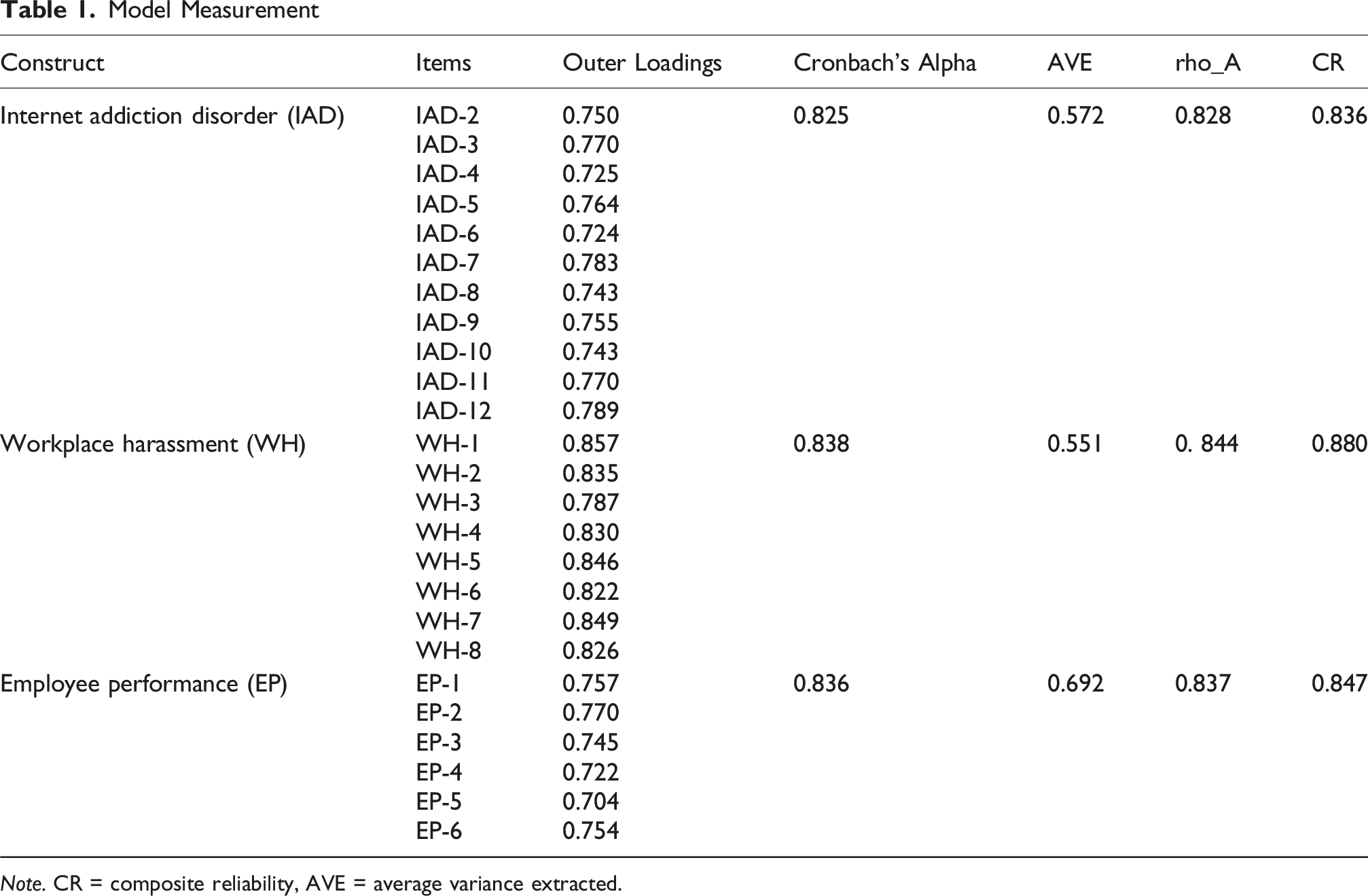
Note. CR = composite reliability, AVE = average variance extracted.
Discriminant Validity
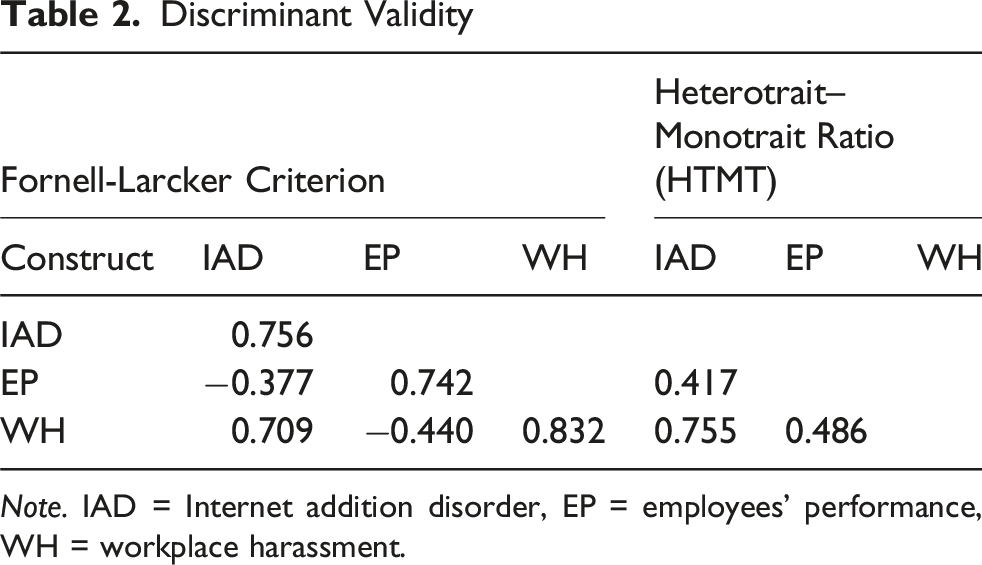
Note. IAD = Internet addition disorder, EP = employees’ performance, WH = workplace harassment.
The model’s predictive significance is assessed using four metrics: variance inflation factor (VIF), R-squared (R2), f-statistic (F2), and Q-squared (Q2). According to experts, VIF values less than 3 indicate no collinearity issues in the data (Hair Jr. et al., 2016). The R2 value measures the proportion of variance in the dependent variable that can be explained by the independent variable. Generally, R2 values should be at least 0.75, with 0.50 to 0.75 considered moderate, and 0.25 to 0.50 regarded as satisfactory (Henseler et al., 2014). The R2 values for WH and EP are 0.202 and 0.502, respectively, indicating that R2 can be deemed satisfactory for the primary data. Effect size (f2) values of 0.02 (small), 0.15 (medium), and 0.35 (large) are regarded as significant (Hair Jr. et al., 2016). The Q2 (cross-validated redundancy index) value is above zero, confirming the model’s fitness (Chin, 2010).
Hypothesis Verification (Direct Relationship)
Hypotheses Confirmation (Direct Relationship)

IAD = Internet addiction disorder, EP = employees’ performance, WH = workplace harassment.
Mediation Verification (Indirect Relationship)
Mediation Analysis (Indirect Effect)

IAD = Internet addiction disorder, EP = employees’ performance, WH = workplace harassment.

Post-analysis model
Discussion
The objectives of this study were to measure the impact of IAD on employee performance and the role of workplace harassment as a mediator between IAD and employee performance. This study used data collected from employees of various NGOs who also use digital devices and the Internet at their workplaces. The study’s results were analyzed using the PLS-SEM approach and SmartPLS-4 software. The findings confirm that IAD has a significant negative effect on employees’ performance. Additionally, this study shows that IAD also generates workplace harassment during work, which further reduces employees’ performance. These findings also align with the results of other studies (Jung & Yoon, 2019; Mak, Lai, and Watanabe et al., 2014; Sariyska et al., 2014). The investigation reveals multiple reasons behind IAD, as follows.
First, cyberloafing is a major reason behind the development of IAD in employees. Cyber loafing at work wastes employees’ time and can also harm their mental health (Wu et al., 2020). It begins when employees have free time, low targets, or lose supervisory control over their work and performance (Lim & Chen, 2012). The interaction between employees’ cyberloafing and IAD, along with overall work productivity, resembles a cosmic waltz. Cyber loafing draws attention away from duties and allows individuals to focus on tasks unrelated to their job (Askew et al., 2014). This contrasts with IAD, where everything else takes precedence over the task at hand. Employees get caught between their jobs and electronic devices for many hours, like celestial objects swinging the pendulum of their productivity. The challenge lies in harmonizing these elements: striking a balance between mindful Internet use, fostering creativity, and maintaining optimal performance.
Second, overloaded online information can lead to employees developing Internet addiction, which in turn reduces their productivity and performance (Brand et al., 2014). Third, spending excessive time on online activities like gaming, gambling, and stock trading can also lead to IAD in employees. Fourth, cyber relationships and cybersex addiction among workers can result in IAD, potentially fostering workplace harassment and decreasing employees’ performance and organizational reputation (Widyanto & Griffiths, 2007). Feelings of anxiety, depression, and stress may contribute to IAD. Fifth, these issues can stem from genetic problems or irregular functioning of neurotransmitters, such as dopamine levels (Mak, Lai, and Ko et al., 2014). Organizations can take measures to control IAD, such as creating a healthier work environment. They can also show staff how to engage in digital activities mindfully by encouraging specific offline moments, promoting personal contact, and sharing information about signs and symptoms of Internet dependency, all of which can help improve productivity among workers.
The TPB describes the effect of attitudes and subjective norms in selected development of individual actions and perceived behavioral control. They can lead to development of compulsive online phenomena among the employees in the scheme of IAD, thereby affecting employee performance adversely. According to TPB, the behavior can occur due to lowered self-control and the feeling of having a lack of control. Moreover, it could be partially mediated by workplace harassment. The victims of bullying can adopt excessive use of Internet in order to escape the problem, which further deteriorates performance. Thus, TPB will provide the conceptualization of the ways IAD and harassment jointly act to deteriorate employee performance.
Theoretical Contribution
The connection between Internet addiction and low workplace performance is rather complicated, and we have demonstrated it with the help of TPB. This implies that harassment is a key deterrent of organizations whose statistics is used in the employments of employees in non-governmental organizations. Such awareness is what ought to inform the organization policies, interventions and training programs hence leading to healthy work environment to enhance employee well-being. The results of the given research portray that the workplace bullying is one of the mediators in this correlation. Even though the employees with Internet addiction challenges have their performances influenced by the very character of the addictive behavior in question, its performance is also influenced by the toxic environment they attempt to sustain by being harassing to others. These two effects explain why extensive interventions are necessary. This document is that which will fill the gap between the psychological theories and effective application in the field of organization. It urges us to reconsider policies at the place of work, focusing on prevention, awareness raising and support mechanisms. This research is useful in space of healthier working environment and overall well-being of employees, by acting both on the level of individual behavior and organizational culture. It aligns with behavioral economics theories (Thaler, 2016), emphasizing how individual choices (like excessive Internet use) intersect with external factors (workplace dynamics). Insights from this perspective can guide targeted interventions that nudge employees toward healthier online habits. By examining workplace harassment as a mediating factor, this study also extends social cognitive theory (Michel & Hargis, 2017). It shows how observational learning and self-regulation are vital in shaping employee responses to Internet addiction cues.
Managerial Implications
This research has significant business implications for organizations. So, let us examine this further. The first is that organizations should consider their digital engagement policies. Easy rules on proper usage of the Internet, how long to be on the Internet, and how to detox online can all curb Internet abuse. Managers could also facilitate such efforts toward a healthier workplace. Second, managers play a crucial role in educating employees about the dangers posed by the misuse of the Internet. The training can be devoted to the early signs of it, the coping strategies, and its effect on performance. Enhanced knowledge enables employees to make informed choices concerning their online lives. Third, it is essential to address workplace bullying. Managers are expected to pay special attention to events and respond to them in time. Internet addiction is prevented through a favorable and friendly working culture. It is useful to discuss respectful communication and conflict resolution at regular meetings. Fourth, managers are supposed to emphasize on work life balance. Well-being can be promoted by encouraging recreation, offline activities and by strengthening social relationships. Employees who feel supported are less likely to turn to online extremism. Last, to address the risks associated with online misconduct and employee performance, we recommend three practical implications. First, digital detox training can help employees become more mindful of their screen time and reduce impulsive or inappropriate online behavior. Second, peer mentoring programs can foster a culture of support and accountability, where senior or experienced employees’ model healthy digital behavior. Third, organizations should develop clear and enforceable digital behavior policies in collaboration with employees to boost ownership and compliance.
Limitations and Future Research Directions
Like other social and management studies, this research also has certain limitations. First, the cross-sectional nature of this study’s data limits causal inferences. Future studies should consider longitudinal data to capture changes over time better and establish stronger cause-and-effect relationships. Second, online surveys depend on self-reported data, which may introduce biases. Participants might underreport or overreport their Internet use or incidents of harassment. Therefore, using a case study approach or focus group studies could yield different results. Third, the findings are based on data provided by employees working in NGOs. Future research can consider other sectors or organizational contexts to improve the generalizability of the results. Fourth, using the same technique (online survey) for each predictor (IAD) and outcome variable (employee performance) can lead to inflated correlations. Future studies might consider employing unique information assets or strategies. Fifth, exploring additional mediators beyond workplace harassment, such as organizational support, coping strategies, or work–life balance, could provide more insight. Seventh, future research could also examine how personality traits, task roles, training programs, and organizational traditions (moderators) influence the relationship between IAD and performance. Eighth, this study has collected demographic data, including age, gender, and tenure, from the participants. However, these demographic factors are not used as control variables in this study model. In the future, scholars can use these factors to explore the same model.
Footnotes

Ethical Approval
This study was conducted in accordance with the principles outlined in the Declaration of Helsinki. Ethical approval was obtained from the Ethical Review Board of the School of Finance and Accounting, Fuzhou University of International Studies and Trade, Fuzhou, China. All methods were carried out according to relevant guidelines and regulations. The participants provided their written informed consent to participate in this study.
Author Contributions
Conceptualization: ZY and MWB. Methodology: ZY, QK, and MWB. Formal analysis: ZY, QK, and MWB. Data curation: QK. Software: QK and MWB. Writing—original draft preparation: ZY and MWB. Writing—review and editing: ZY, QK, and MWB. Supervision: ZY. Project administration: MWB. Correspondence: MWB. All authors have read and approved the final version of the manuscript.
Funding
The author(s) received no financial support for the research, authorship, and/or publication of this article.
Declaration of Conflicting Interests
The author(s) declared no potential conflicts of interest with respect to the research, authorship, and/or publication of this article.
Data Availability Statement
The datasets used and/or analyzed during the current study are available from the corresponding author upon reasonable request.
Author Biographies
Appendix
Extraction method: principal axis factoring.
Factor
Initial Eigenvalues
Extraction Sums of Squared Loadings
Total
% of Variance
Cumulative %
Total
% of Variance
Cumulative %
1
14.116
47.050
47.050
13.625
45.421
45.412
2
2.102
7.008
54.059
3
1.862
6.205
60.264
4
1.299
4.332
64.596
5
.899
2.997
67.593
6
.721
2.402
69.995
7
.665
2.218
72.214
8
.644
2.147
74.361
9
.589
1.964
76.324
10
.558
1.859
78.184
11
.480
1.600
81.423
12
.463
1.544
82.966
13
.441
1.469
84.435
14
.405
1.350
87.190
15
.376
1.254
88.444
16
.348
1.160
90.831
17
.339
1.129
91.960
18
.319
1.064
93.024
19
.264
.879
94.893
20
.251
.837
96.587
21
.240
.799
97.386
22
.232
.773
98.158
23
.199
.663
98.821
24
.191
.638
99.458
25
.162
.542
100.000