



Abstract
Exposure-based therapy for anxiety disorders involves confrontations with feared but innocuous stimuli to promote inhibitory safety learning and fear extinction. Little is known about factors that may impede generalization of fear extinction memory from stimuli used during exposure therapy to similar stimuli later encountered. Trait anxiety is a vulnerability factor for developing anxiety-related disorders and is associated with deficient safety learning. In this preregistered study, we tested whether high-trait compared to low-trait anxious individuals would show less generalization of fear extinction. Intolerance of uncertainty and worry were also measured as closely related dimensions of dispositional negativity. Participants completed a fear conditioning paradigm with three phases: acquisition, extinction, and extinction generalization. Dependent measures were online threat expectancy and distress ratings. Fear acquisition and extinction were successful in both groups, and there were no group differences in extinction generalization. These results suggest that high trait anxiety does not impede generalization of fear extinction memory.
Keywords
Exposure therapy for anxiety-related disorders involves repeated confrontations with feared but innocuous stimuli (e.g., objects, situations, mental representations) without any aversive outcome. Successful exposure therapy presumably requires a mismatch between the expected and actual outcome (Pittig et al., 2023) and promotes inhibitory safety learning (Craske et al., 2022). After treatment, stimuli that are similar to the feared stimuli will likely be encountered (other dogs, other situations where escape is difficult, etc.), which may evoke threat expectancies. Generalization of extinction memory not only reflects successful therapy (Richter et al., 2021), but might also prevent relapse following symptom remission, which occurs in a minority of patients (Van Dis et al., 2020). Yet little is known about factors that play a role in extinction memory generalization (Barry et al., 2016).
Fear extinction learning is the laboratory analog for exposure-therapy (Carpenter et al., 2019; Mertens et al., 2020; Scheveneels et al., 2016). An advantage of these laboratory paradigms is that they provide experimental control over stimuli. In an acquisition phase of a typical differential fear conditioning paradigm, one neutral stimulus (CS+; e.g., picture of a large circle) is repeatedly followed by an aversive unconditioned stimulus (US; e.g., loud scream), and another neutral stimulus (e.g., picture of a small circle) is not (CS-). This procedure usually leads to increased threat expectancy to the CS+, compared to the CS-. During an extinction phase, only CSs are presented, which usually leads to the reduction of threat expectancy and other conditioned responses to the CS+ (Duits et al., 2015, 2021).
Fear generalization can be modeled by introducing generalization stimuli (GSs) that are similar to the CS+ (e.g., pictures of intermediate circles; e.g., Lissek et al., 2014; Mertens et al., 2021). The spread of fear to GSs allows us to respond fast to potential new threats, which is critical for survival. However, overgeneralization of fear towards harmless stimuli hinders adaptive functioning and is one of the proposed mechanisms involved in the development of anxiety disorders (Dymond et al., 2015; Lenaert et al., 2014; Lissek et al., 2014). Indeed, greater de novo fear generalization has been found in patients suffering from anxiety-related disorders (for meta-analysis see Cooper et al., 2022) and in healthy individuals with high neuroticism or trait anxiety scores (Lommen et al., 2010; Sep et al., 2019; Wong & Beckers, 2021; Wong & Lovibond, 2021), which are risk factors for the development of anxiety-related disorders (e.g., Engelhard et al., 2009; Jeronimus et al., 2016). High-trait anxious individuals also show difficulty with safety learning (Dibbets et al., 2015; Duits et al., 2015, 2021; Lissek et al., 2014; Wroblewski et al., 2022), but it remains unknown whether they show less generalization of extinction memory to stimuli that are (perceptually or conceptually) similar to the original fear stimulus.
In a typical extinction procedure, unreinforced CS trials are presented, but in some studies unreinforced GS trials are presented during extinction training to examine generalization of extinction memory (e.g., Waters et al., 2018; Wong & Lovibond, 2020). They showed that extinction training involving one or multiple GSs, compared to extinction training using the CS+, reduces fear to the CS+ and to other GSs less strongly (Barry, Griffith, et al., 2016; Vervliet et al., 2004; Zbozinek & Craske, 2018; but see; Struyf et al., 2018). Wong and Lovibond (2020) tested whether high-trait versus low-trait anxiety individuals would show less generalization of extinction memory to a novel GS after extinction training involving the CS+ or a GS. Results showed less generalization of GS extinction compared to CS+ extinction, and overall higher threat responding in high-trait relative to low-trait anxiety individuals during the extinction and test phase. Due to the use of a single GS, the extent of extinction generalization along a gradient after extinction to the CS+ could not be examined. Thus, it remains unclear whether high anxious relative to low anxious individuals show less generalization of extinction towards GSs along a gradient after extinction to the CS+.
The aim of the current study was to test whether high versus low anxious individuals show less generalization of extinction in an online differential fear conditioning paradigm (i.e., including both CS+ and CS- to control for overall threat responsiveness). We hypothesized that, after CS+ extinction, the high anxious group would show higher threat responding (i.e., threat expectancy and distress ratings) towards GSs after CS+ extinction relative to the low anxious group. In this study, generalization of extinction learning was operationalized as the extent to which generalization performance is transferred from an extinguished CS+ to stimuli varying in perceptual similarity to CS+ and CS-. Other studies have examined generalization of extinction from GSs to the original CS+ (e.g., Barry, Griffith, et al., 2016; Vervliet et al., 2004; Zbozinek & Craske, 2018). We explored the unique role of trait anxiety in extinction generalization by controlling for intolerance of uncertainty (i.e., the tendency to interpret uncertain situations as threatening; Hunt et al., 2022; Morriss et al., 2016) and worry (i.e., reflecting a more cognitive component of anxiety; Ryum et al., 2017), which are closely related to trait anxiety (Mertens et al., 2022; Sep et al., 2019). Because these constructs are closely related and partially overlap (Mertens et al., 2022), we explored whether group allocation based on cluster analysis including all three variables would yield similar results.
Method
Participants
Dutch-speaking participants were recruited at Utrecht University and on social media platforms (Facebook, LinkedIn, and Instagram) between December 2021 and February 2022. Exclusion criteria were assessed by self-report, and were: pregnancy, heart or hearing problems, psychiatric diagnosis in the past 2 years (including anxiety- and attention hyperactive deficit-disorder), and (uncorrected to normal) visual impairment. A total of 106 participants enrolled. Before the experiment, we determined that data would be excluded if participants: (1) did not complete the task (n = 16), (2) failed the manipulation checks (n = 14), (3) were not aware of the CS-US contingency (n = 13), (4) reported US aversiveness of 6 or lower during the work-up procedure (n = 8), (5) failed to complete the experiment (n = 0), (6) showed non-response on 3 consecutive trials (which could not be checked due to a programming error), (7) indicated a stronger US expectancy towards CS- relative to CS+ at the final acquisition trial (n = 20), or (8) had a higher US expectancy towards the CS+ in the final extinction trial relative to the last acquisition trial (n = 11). The final sample consisted of 55 participants. To divide the sample into groups, we preregistered using a cluster analysis, unless <40% of the sample would be allocated to one group; in the latter case, we would perform a median-split instead. A cluster analysis showed that <40% of the sample was allocated to one group. Therefore, a median-split was used on STAI-T scores (see Questionnaires below, Med = 47) to divide participants into a high anxious group (n = 28) or low anxious group (n = 27). Trait anxiety, intolerance of uncertainty, and worry are related, therefore we explored whether we would find similar results when groups were formed based on their shared variance to check the robustness of the results. Similar to Wroblewski et al. (2022), a multivariate K-means cluster analysis with a maximum of 25 iterations was used to form two groups (Cluster 1, n = 34 and Cluster 2, n = 21). An a-priori power analysis was conducted on the smallest effect of interest (Anvari & Lakens, 2021), namely Cohen’s f = 0.143. It was comparable to previous fear conditioning research that focused on trait anxiety (Gazendam et al., 2013). The sample size was calculated using G*power 3.1.6 (Erdfelder et al., 2009). For a 2 (groups) × 9 (stimuli) repeated-measures ANOVA, with f = 0.143, α = 0.05, and power of 0.80, a total of 42 participants (n = 21 per group) was needed. Due to the online nature of the study, we expected more non-compliance to instructions or more unsuccessful fear learning. Therefore, we aimed at testing at least 100 participants.
This study was pre-registered before analyses were conducted (see https://osf.io/axwyd). To preserve statistical power, one deviation was made from the preregistration: data were excluded from analysis when participants reported an US aversiveness of ≥6 instead of ≥7 in the workup procedure. The study was approved by the faculty’s ethics committee at Utrecht University (21-2187). Participants received course credit (Utrecht University students) or could participate in a lottery (3 × €50,- vouchers).
No evidence for group differences was found for age (M = 23.83, SD = 3.48, t (52) = .81, p = .424), and ethnicity (53 Dutch, 1 Moroccan, educational level (4 high school, 4 vocational school, 46 college/university, 1 other), but they did differ on gender (15 males, 40 females X 2 (1) = 4.85, p = .028) 1 .
Questionnaires
Trait anxiety was assessed with the Dutch version of the 20-item trait anxiety subscale of the State-Trait Anxiety Inventory (STAI-T; Spielberger et al., 1970; Van der Ploeg, 2000). Participants are asked to indicate to what extent statements apply to them on a 4-point Likert scale (1 = not at all, 4 = totally). The STAI-T has shown good psychometric properties (Spielberger et al., 1970; Van der Ploeg, 2000). Internal consistency in this study was excellent (α = 0.93).
Intolerance of uncertainty was assessed with the Dutch 12-item version of the Intolerance of Uncertainty Scale (IUS-12; Buhr & Dugas, 2002; Boelen et al., 2010), using a 5-point Likert scale (1 = not at all, 5 = totally). It has shown good psychometric properties (Helsen et al., 2013). Internal consistency in this study was good (α = 0.86).
Worry was assessed with the 16-item Dutch version of the Penn State Worry Questionnaire (PSWQ; Meyer et al., 1990; van der Heiden et al., 2009), using a 5-point Likert scale (1 = not at all, 5 = totally). It has good psychometric properties (van der Heiden et al., 2009). Internal consistency in this study was excellent (α = 0.90).
Stimuli
CSs consisted of nine yellow squares (5.5 × 5.5 cm) with a black outline containing a black dot varying in horizontal position from left to right (see Figure 1), based on the study by Wong and Lovibond (2018). They were labeled A (far left) to I (far right). During acquisition, A and I served as CS+ and CS−, respectively (counterbalanced). A black fixation cross (4-5 s) was shown before each visual stimulus. Visual stimuli were presented in the center of a white background with the expectancy VAS (duration: 4-5 s) or distress VAS (duration: 4–5 s) located below the CS. The US was a 2s female scream (van Dis et al., 2024). Participants were instructed to wear headphones/earbuds throughout the experiment and to use the maximum volume available on their system (Purves et al., 2019). The sound that was rated as most aversive during the sound intensity workup was used in the fear conditioning paradigm. Overview of the visual stimuli. Note. A and I served as CS+ and CS-. B-H served as GSs.
Ratings
US expectancy, distress, and US aversiveness were measured with one question each, based on prior research (Gazendam et al., 2013; Hendrikx et al., 2021). US expectancy, “To what extent do you expect to hear a sound?” was rated on an 11-point VAS ranging from 0 (definitely no sound), to 5 (uncertain) to 10 (definitely sound). Distress, “How distressed or anxious do you feel at the moment?” was rated on an 11-point VAS ranging from 0 (not distressed at all) to 10 (very distressed). US aversiveness was assessed using an 11-point VAS ranging from 0 (not unpleasant at all) to 10 (extremely unpleasant). US aversiveness was rated during the workup procedure after US presentation.
Manipulation and attention checks
An attention check question was added to STAI-T: “please type 2.” In addition, after the conditioning task, a CS was presented with four auditorily presented numbers. After the experiment, participants were asked “Which numbers did you hear?” Participants passed the attention check when they typed “2” and correctly identified three out of four numbers. The following questions were asked as manipulation checks: (1) “Did you remove your headphones during the experiment?” (2) “Did you lower the volume during the experiment?” (3) “Which picture predicted the scream in the first part of the experiment?” (to measure awareness of the CS-US contingency).
Procedure
The recruitment poster provided a weblink to direct potential participants to the online experiment that was programmed in Gorilla (Anwyl-Irvine et al., 2020). It started with the instruction to use a desktop computer or laptop in a quiet room where they were unlikely to be disturbed. Next, they were asked to complete eligibility procedures, read information about the study, and provide written informed consent. Then they were asked to provide demographic information and complete the questionnaires (STAI-T, IUS, and PSWQ).
The online experiment consisted of five phases (Figure 2): sound intensity workup, practice, acquisition, extinction, and generalization of extinction. In the sound intensity workup phase, eight “screams” in differing sound intensities (∼50 – 80 dB) were presented in a randomized order to control for individual differences in auditory sensitivity and differences in sound equipment (Glenn et al., 2012). In the practice phase, participants were familiarized with rating the scales on time. Six geometric shapes (a square and a rhombus) were presented and each was followed by the distress VAS (5s). In intertrial intervals (ITIs), a black fixation cross was presented for 4s or 5s (counterbalanced across stimuli). Stimuli were presented in a random order. Between each phase, a black fixation cross (10s) was presented. In the fear acquisition phase, the CS+ and CS- (Stimulus A and I) were each presented eight times in randomized order with similar ITIs as in the practice phase. The US reinforcement rate was 75%. In the extinction phase, the CS+ and CS- trials were each presented 10 times (randomized order). In the extinction generalization phase, stimuli A-I were each presented once, in random order without the US. Finally, attention and manipulation checks were done, and participants were thanked and reimbursed for their participation. Overview of procedure. Note. CS: Conditioned Stimulus, US: Unconditioned Stimulus.
Statistical analyses
To examine differences between the high anxious and low anxious groups, t-tests were performed for trait anxiety, intolerance of uncertainty, and worry scores. To examine group differences for US expectancy and distress ratings during the acquisition and extinction phases, four analyses of variance (ANOVAs) were performed with trait anxiety (high anxious, low anxious) as between factor and trials (acquisition: 1–8, extinction: 1–10) and stimuli (CS+, CS−) as within variables. To investigate the primary hypothesis (do high anxious individuals show less extinction generalization than low anxious individuals), two repeated measures ANOVAs were performed separately for US expectancy and distress ratings with 2 groups (high anxious, low anxious) as between-subject variable and 9 stimuli A-I as within-subjects factors. Next, analyses on the acquisition, extinction, and generalization of extinction phase were repeated with intolerance of uncertainty and worry as covariates. To examine the robustness of our results, we repeated these analyses (without covariates) with the full sample (N = 106). A median-split (Med = 45) was used to split the sample into two groups; high anxious (n = 54) and low anxious (n = 52) 2 . For exploratory purposes, the same analyses were repeated (without covariates), but now with cluster (Cluster 1, Cluster 2) as between-subject variable. This did not change the direction of the results (see: https://osf.io/ru7bk). In case the predicted main (group) or interaction effect was significant, post hoc analyses were performed, using a Bonferroni correction for multiple testing. Greenhouse–Geisser corrections are reported in case of a violation of the sphericity assumption. A standard alpha level of .05 was used. Additionally, for acquisition, extinction, and extinction generalization phases, we computed Bayes factors to evaluate whether the data come from the null compared for the alternative hypothesis. These Bayes factors are denoted with BF01 (for an introduction of Bayes factors, see Krypotos et al., 2017). All data were analyzed in JASP using the default settings (JASP Team, 2023).
Results
Means (SD) for questionnaires and US aversiveness.

Note. STAI-T = State-Trait Anxiety Inventory, trait scale; IUS = Intolerance of Uncertainty Scale; PSWQ = Penn State Worry Questionnaire.
aBrown–Forsyth test is significant (p < .05), suggesting a violation of the equal variance assumption.
Acquisition phase
The trial × CS interaction was significant for US expectancy, F (4.72, 250.36) = 37.94, p < .001, ƞ2 = .10, and distress ratings F (4.55, 241.06) = 3.22, p = .010, ƞ2 = .01, indicating that participants learned to differentiate between the CS+ and CS- over time (see Figure 3). After Bonferroni correction for multiple testing, post hoc analyses showed significant higher threat responding towards the CS+ compared to the CS- in the last acquisition trial, with a mean difference of 3.21 [95% CI: 1.55-4.88] for US expectancy and 2.23 [95% CI: 1.02-3.43] for distress ratings. The trial x CS × groups interaction effects were not significant for US expectancy, F (4.72, 250.36) = 0.90, p = .507, ƞ2 < .01, and distress ratings, F (4.55, 241.06) = 0.52, p = .741, ƞ2 = .00, so there was no evidence of group differences in fear acquisition. Bayesian analyses indicated strong evidence for data coming from the null hypothesis, compared to the alternative hypothesis, for US expectancy (BF01 = 19.27) and distress ratings (BF01 = 56.69). Taken together, these results indicate that both groups showed successful differential fear acquisition. US expectancy and distress ratings towards CS+ and CS− in acquisition and extinction phases. Note. 1–8: trials in the acquisition phase; 1–10: trials in the extinction phase. US expectancy and distress were measured on 0–10 Likert-scales. Error bars represent standard errors.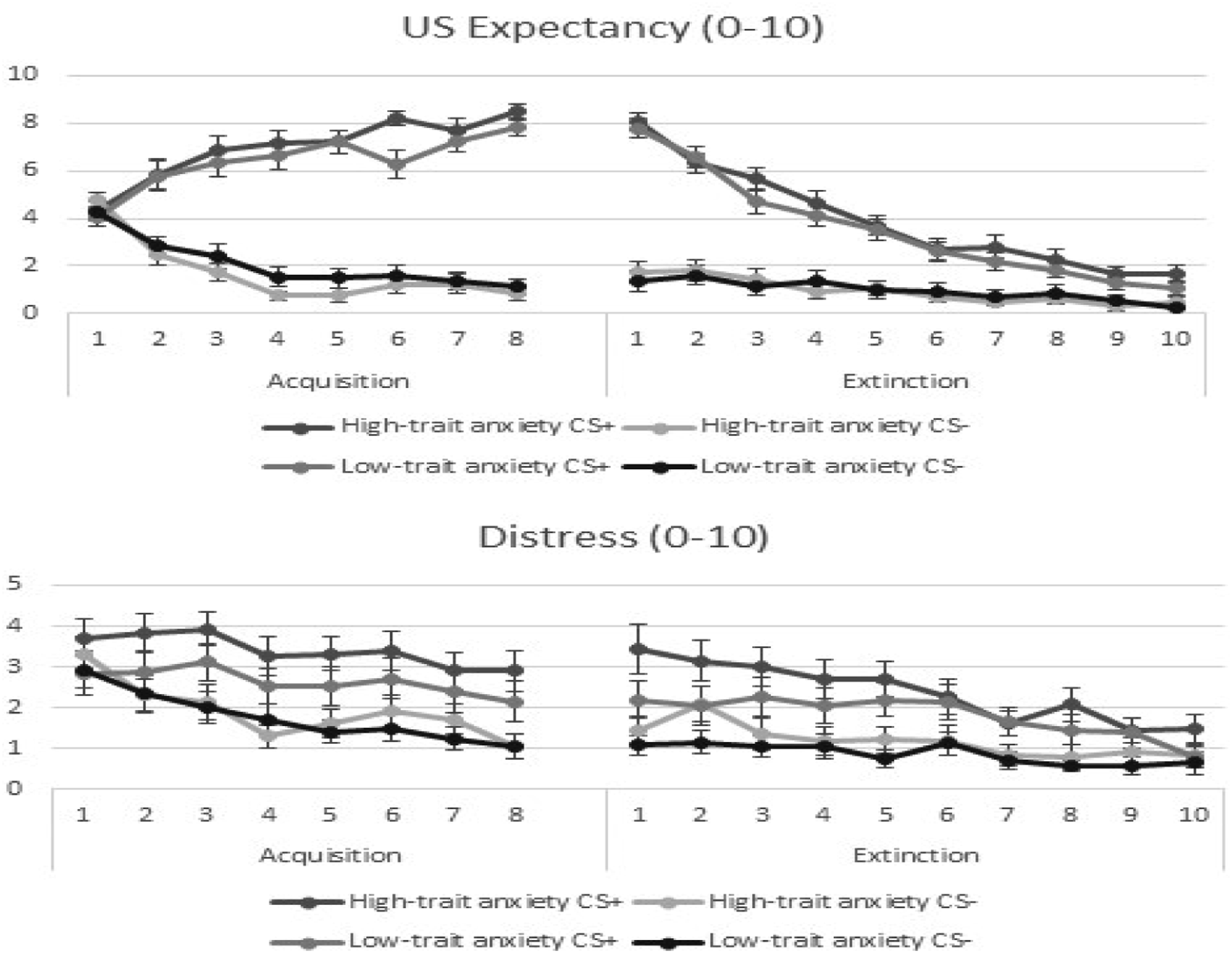
Extinction phase
The trial × CS interaction was significant for US expectancy, F (4.76, 252.31) = 36.69, p < .001, ƞ2 = .09, and distress ratings, F (5.86, 310.39) = 2.44, p = .027, ƞ2 = .01. After Bonferroni correction, post hoc analyses showed a statistically significant mean reduction of M = 6.57 [95% CI: 5.50–7.63] in US expectancy ratings and M = 1.69 [95% CI: 0.71–2.66] in distress ratings from the first to last CS+ trial in the extinction phase. Again, the trial x CS × group interaction effects were not statistically significant for US expectancy, F (4.76, 252.31) = 0.55, p = .728, ƞ2 = .00, and distress, F (8.19, 310.39) = 0.59, p = .732, ƞ2 = .00, and there was strong evidence for the null hypothesis for US-expectancy (BF01 = 97.98) and distress ratings (BF01 = 98.15). The results indicate that extinction learning took place in both groups (see Figure 3).
Extinction generalization phase
The predicted Group × Stimuli interaction was not observed for US expectancy, F (8, 424) = .84, p = .569, ƞ2 = .01, and distress ratings, F (6.49, 344.16) = 0.91, p = .492, ƞ2 = .01. Furthermore, there was strong evidence for data coming from the null compared to alternative hypothesis for US expectancy (BF01 = 53.47), and distress ratings (BF01 = 34.86). There was also no significant group effect for US expectancy, F (1, 53) = 1.78, p = .186, ƞ2 = .01, and distress ratings, F (1, 53) = 2.80, p = .100, ƞ2 = .03, but there was a main stimulus effect for US expectancy, F (8, 424) = 11.56, p < .001, ƞ2 = .11, and distress ratings, F (6.49, 344.16) = 3.32, p = .003, ƞ2 = .21, indicating a generalization gradient. Post hoc analyses indicated higher US expectancy ratings towards stimuli B-G compared to stimulus A (M
dif
≥1.47, p
s
≤ 0.001), C compared to H and I (M
dif
≥1.09, p
s
≤ 0.032), D and F compared to H (M
dif
≥1.07, p
s
≤ 0.043), and E compared to B,I,H (M
dif
≥1.49, p
s
≤ 0.017). Post hoc analyses indicated lower distress ratings towards stimulus A compared to E and D (M
dif
≥ −1.12, p
s
≤ 0.003). Taken together, these post hoc results indicate stronger threat responding towards stimuli in the middle of the stimulus dimension. In summary, there was no evidence that the high anxious relative to the low anxious group showed more threat responding towards generalization stimuli (see Figure 4). US expectancy and distress ratings towards generalization stimuli A–I in the generalization of extinction phase. A–I: Stimuli A–I in the generalization of extinction phase. US expectancy and distress were measured on 0–10 Likert-scales. Error bars represent standard errors.
Despite the lack of the predicted group effects, we repeated the analyses with intolerance of uncertainty and worry as covariates, but these covariates did not affect the patterns described earlier. The trial x intolerance of uncertainty interaction on US expectancy showed the highest F-value, F (8, 408) = 1.56, p .135, ƞ2 = .00.
Discussion
The aim of this study was to examine whether high versus low trait anxious individuals show less generalization of CS+ extinction to GSs in a differential fear condition paradigm. Fear acquisition and extinction were successful, but contrary to our expectations, there was no evidence for increased threat responding towards generalization stimuli in trait anxious individuals. Our findings align with a recent study that also found no effect of trait anxiety on generalization of extinction (Wong & Lovibond, 2020). These results suggest that de novo extinction generalization learning is not impaired in anxious non-clinical individuals, and it remains to be seen whether this is also the case for patients suffering from anxiety disorders. One important difference compared to results by Wong and Lovibond (2020) is that in our study trait anxiety was not associated with overall increased threat responding during the generalization of extinction phase. However, our data show a similar trend for higher threat responding in the high-trait anxiety group (see Figure 4). Although our sample size was comparable to Wong and Lovibond (2020), this effect may not have reached statistical significance, potentially because our study was underpowered to detect small between-group differences.
The current sampling strategy may have obscured between-group differences. In the current study, a median-split procedure was used to form groups, whereas extreme ends sampling was used by Wong and Lovibond (2020). Their approach maximizes the chance of finding between group effects (Lonsdorf & Merz, 2017). However, to what extent groups are comparable across studies is complicated by the fact that trait anxiety was measured differently. Wong and Lovibond (2020) used the DASS-21 (Depression Anxiety Stress Scales; P. F. Lovibond & Lovibond, 1995a; S. H. Lovibond & Lovibond, 1995b), we used the STAI-T. Taken together, studies in larger samples using a more dimensional approach (see e.g., Haaker et al., 2015) could further clarify whether trait anxiety is associated with reduced generalization of extinction.
To what extent GSs are perceived as ambiguous in the generalization of extinction phase may largely depend on how strongly fear is inhibited for the CS- and extinguished for the CS+. Previous research has shown that patients with anxiety disorders and high-trait anxious individuals, on average, show less discrimination between the CS+ and CS- during fear acquisition (Duits et al., 2015; Haddad et al., 2012; Sjouwerman et al., 2020), and show impaired safety learning during the extinction phase (Duits et al., 2021; Wroblewski et al., 2022). However, the current study and several other studies did not find these effects (e.g., Torrents-Rodas et al., 2013). Perhaps using fewer extinction trials than the 10 in the current study leaves more room for ambiguity and makes the paradigm more sensitive to find associations between individuals differences and extinction generalization. In addition, ambiguity of GSs could be higher in single cue paradigms, like the one used by Wong and Lovibond (2020). They argued that including a CS- may obscure group differences as the CS- may help participants to form generalization rules (Lee et al., 2018; Wong et al., 2020), such as stimulus similarity or linearity (Wong et al., 2020). The perceived likelihood of the US increases when the GS is perceptually more similar to the CS+, and perceived likelihood increases when the GS is positioned further away from the CS+ (i.e., more towards CS-). High-trait anxious individuals show a stronger tendency to generalize fear to novel stimuli under ambiguous situations (e.g., when no clear rule can be identified; Wong & Lovibond, 2018). Indeed, we observed stronger threat responding towards stimuli in the middle of the stimulus dimension (e.g., stimuli perceptually similar to CS+ and CS-), compared to stimuli at the extreme ends (CS+ or CS-). However, we did not find group differences in threat responding. So, a single cue paradigm might be suited to evoke ambiguity in a healthy sample (e.g., Lee et al., 2018; Wong et al., 2020), whereas a differential paradigm might be more suited to evoke ambiguity in a clinical population with deficient extinction learning such as patients with anxiety disorders who do not benefit sufficiently from exposure therapy (e.g., Endhoven et al., 2023).
Several limitations of this study should be discussed. First, data from 52 participants was excluded, because they did not meet the pre-registered attention and manipulation checks. This was expected due to the online nature of the task, and therefore we recruited more than 100 participants to preserve statistical power. Second, due to the online nature of the task, there was less experimental control over the test situation. Although experiments designed to elicit individual differences benefit from greater between-person variation (Hedge et al., 2018), differences in equipment could have resulted in a US that was not aversive enough. Even though the US work-up procedure was used, distress ratings were relatively low (see Figure 3). To preserve statistical power, a US aversiveness score of ≥6 instead of the pre-registered score of ≥7 was used as threshold. A more aversive US can result in more generalization of fear (Dunsmoor et al., 2017). However, whether an US needs to be strongly aversive, to examine extinction effects in the laboratory, remains an empirical question (Scheveneels et al., 2021; Spix et al., 2021). For instance, online fear conditioning research using the same US (a female scream) has shown increased threat responding in high-anxious but not in low-anxious individuals towards CS+ and CS− (Purves et al., 2019). Indeed, acquisition was also successful in the current study, which demonstrates the predictive validity of fear conditioning even with a relatively low US intensity. Nonetheless, further studies should investigate whether group differences appear when a more aversive US is used (e.g., electric shock; Glenn et al., 2012) and whether this depends on the type of setting (i.e., online or laboratory). Third, self-report associative (US expectancy), and evaluative (distress) ratings were rated during CS presentation which may have affected cognitive emotional processing of the stimuli (Lonsdorf et al., 2017). Participants were, however, aware of the CS-US contingency and fear acquisition and extinction was successful. In fact, prior research showed that including expectancy ratings can facilitate fear acquisition learning (e.g., Warren et al., 2014). Nonetheless, in our opinion this is an advantage, because it strengthens acquisition memories and thus leads to less exclusion of participants and loss of statistical power due to non-learning. Additionally, this procedure is commonly used in studies examining fear extinction processes (e.g., Gazendam et al., 2013; Hendrikx et al., 2021; Purves et al., 2019). To capture different aspects of fear responding, future research could replicate the current study in the lab using physiological measures during CS presentation, which correlate moderately with subjective measures (Constantinou et al., 2021). An alternative operationalization of generalization of extinction learning that could also be clinically relevant is the transfer from an extinguished CS+ to a non-extinguished second CS+. Future research may elucidate to what extent trait anxiety is associated with this form of generalization.
To conclude, we found no evidence of deficient generalization of CS+ extinction in high-trait compared to low-trait anxious individuals in a differential fear-conditioning paradigm. These findings are in line with a single-cue paradigm study by (Wong & Lovibond, 2020), but we did not find overall higher threat responding towards GSs in the high-trait compared to the low-trait anxiety group. Group differences in this healthy sample may have been obscured by a relatively strong extinction procedure, potentially reducing the ambiguity for the generalization stimuli. Future studies using larger samples are required to test whether trait anxiety impedes generalization of extinction. The current paradigm might be suited to examine whether extinction generalization to novel stimuli is impaired in patients with anxiety disorders.
Footnotes
Acknowledgments
We thank Damian Koevoet for programming the task, Eva A.M. Van Dis for help with the conceptualization of the study, and Pieterjan Harbers, Isabel Wiechers and, Isabella Kooij, for their help with the data collection.
Authors’ contributions
Bart Endhoven: conceptualization, methodology, formal analysis, investigation, resources, data-curation, writing - original draft, project administration. Angelos M. Krypotos: methodology, formal analysis, resources, data-curation, writing – review & editing, supervision, Gaëtan Mertens: methodology, resources, writing – review & editing, Iris M. Engelhard: conceptualization, methodology, investigation, resources, supervision, writing – review & editing, funding acquisition. All authors have approved the final version of the manuscript.
Declaration of conflicting interests
The author(s) declared no potential conflicts of interest with respect to the research, authorship, and/or publication of this article.
Funding
The author(s) disclosed receipt of the following financial support for the research, authorship, and/or publication of this article: This study is funded by a VICI grant for innovational research (453-15-005) awarded to Prof. Dr. Iris Engelhard by the Dutch Research Council (NWO). The sponsor (NWO) had no role in the design, execution, analyses, interpretation of the data, or decision to submit results of this study. The sponsor promotes open science and knowledge utilization. NWO: P.O. Box 93138, 2509 AC, The Hague,  .
.
Open science statement
Data availability statement
Notes
Author Biographies