




Abstract
Attentional bias towards rewards has been extensively studied in both healthy and clinical populations. Several studies have shown an association between reward value-modulated attentional capture (VMAC) and greater substance use. However, less is known about the association between these VMAC effects and internalizing symptoms. Moreover, while VMAC effects have also been found in punishment contexts, the association between punishment VMAC and psychopathology has not been studied so far. In the present two-part preregistered study, we adapted a novel VMAC task to also include a punishment context and examined associations with internalizing symptoms and substance use. Our results showed consistent VMAC effects in reward contexts across two separate studies. Attentional capture was stronger for distractors associated with high rewards than for low rewards. We replicated and extended previous findings by showing such VMAC effects in a substantially shorter task that also included alternating punishment blocks. Contrary to our expectations, we found no VMAC effects in punishment contexts and no direct associations between VMAC and symptom measures. Our results speak to the feasibility of assessing VMAC effects using a scalable and short behavioral online task, but the relationship with the development of internalizing and externalizing psychopathology remains uncertain.
Introduction
It has been well-documented that our attention can be automatically directed towards stimuli that have been associated with positive or negative outcomes (Watson et al., 2019; Wentura et al., 2014). Individuals are more likely to look at stimuli predicting higher rewards, compared to neutral or low-reward stimuli, even when such stimuli are completely irrelevant to the current task (Anderson et al., 2011), or when doing so is counterproductive and results in a monetary loss (Le Pelley et al., 2015). Similarly, threat or punishment-related stimuli capture our attention even when attending to them results in an unpleasant electric shock (Anderson & Britton, 2020; Mikhael et al., 2021; Schmidt et al., 2015), monetary loss, or loud noise. This automatic attentional bias towards distractors signaling high rewards or punishments is known as value-modulate attentional capture (VMAC). Little is known about the test-retest reliability of these VMAC tasks and their utility for studying punishment-related attentional capture.
Such capture effects are argued to be evolutionary adaptive processes that ensure potential threats or rewards are quickly detected in order to be avoided or approached. However, substantial evidence also shows that attentional biases for rewards and punishments can become maladaptive and have been associated with psychopathology (Anderson, 2021). For example, individuals with a history of substance use problems often show an attentional bias towards substance-related stimuli (Field et al., 2016; Wiers et al., 2023). On the other hand, studies reported that individuals with moderate to severe depressive symptoms show no such reward-driven attentional capture (Anderson et al., 2014, 2017).
Greater value-modulated attentional capture has been associated with the severity of addictive and obsessive-compulsive behaviors (Albertella et al., 2019a, 2020a, 2020b; Anderson et al., 2013). This effect of reward on attentional capture may be particularly persistent in individuals with alcohol use disorder (Albertella et al., 2019a): a higher persistence of learned attentional capture following reversal of stimulus-reward contingencies predicted risky patterns of alcohol use. In other words, individuals who were quicker and better able to adapt to the changed reward contingencies were less likely to exhibit risky alcohol use.
Individual differences in cognitive control may explain the propensity for these automatic attentional capture effects. For instance, Albertella and colleagues (2017) showed that VMAC is associated with illicit substance use only among individuals with low cognitive control (Albertella et al., 2017). Similarly, a study by Houben and Wiers (2009) showed that stronger implicit associations between alcohol and positive affect predicted increased alcohol use and alcohol-related problems only in individuals with low response inhibition. This interaction between cognitive control and attentional capture is in line with dual-process theories (Gladwin et al., 2011) that conceptualize the competition of automatic and reflective processes in the development of addictive behaviors.
Most studies on the association between VMAC and psychopathology have focused on addictive behaviors, and little is known about the transdiagnostic value of attentional capture. Specifically, the link between attentional capture and internalizing symptoms or general distress is not yet fully understood. Various studies have emphasized the importance of decreased sensitivity to reward in depression, especially in individuals exhibiting anhedonia (Pizzagalli, 2014; Zald & Treadway, 2017), but to date, only a handful of them (Anderson et al., 2014, 2017) have studied blunted reward-processing specifically in terms of value-driven attentional capture. Additionally, hypersensitivity to negative stimuli has been associated with depression, such that individuals with depression have difficulties in shifting attention away from negative stimuli (Gotlib & Joormann, 2010; Grahek et al., 2018). Similarly, this hypersensitivity to punishment has been linked to anxiety disorders (Bar-Haim et al., 2007). Other studies using the spatial orienting task have found no evidence for cross-sectional or temporal associations between attentional bias for cues signaling reward or punishment and anxiety or behavioral problems (Kreuze et al., 2020, 2022).
While research on VMAC and anxiety in the punishment context is still lacking, Kim and Anderson (2020) have recently shown that threat-induced anxiety (through electrical stimulation) reduces reward-related attentional capture in a healthy population. Nonetheless, similarly to reward-related attention, little research has been done to assess the link between punishment-related attentional capture and anxiety and depressive symptoms.
Individual differences in attentional control as a clinical assessment tool for psychopathology would only be useful if tasks measuring such attentional control or biases show to have high test-retest reliability. So far, to the best of our knowledge, no studies have explored the reliability of the VMAC task as used in the current study. However, a notable exception by Anderson and Kim (2019) has shown that a similar version of the VMAC task has in fact very low test-retest reliability when using RT measures. In this paper, we aim to shed light on the reliability of the novel VMAC task.
Understanding the reward and punishment processing specifically in the context of VMAC is important considering its clinical implications with respect to attentional biases in different mental health conditions (e.g., addiction) but also its theoretical importance as it may represent a direct test of valence (reward/punishment) processing at a low and automatic level.
The present preregistered study aimed to investigate the association between reward- and punishment-related attentional capture, general cognitive control, and substance use and internalizing symptoms. First, we aimed to replicate the VMAC reward effects found in Le Pelley et al. (2015) and Albertella et al. (2019a). We extended these studies by (1) testing a novel punishment variation and (2) assessing the test-retest reliability of the VMAC task, and (3) investigating associations between VMAC and internalizing symptoms and substance use. In an exploratory (non-preregistered) fashion following the approach by Albertella et al. (2017), we aimed to investigate if general cognitive control, as assessed by a Stroop Deadline Task, would moderate the relationship between VMAC and substance use.
Methods
The present paper consists of two separate studies that follow a similar procedure and design. In Study 1, our goal was to examine value-modulated attentional capture effects in both reward and punishment contexts in a student population. We aimed to replicate these VMAC effects in Study 2 in which the task contained more blocks and the condition (reward/punishment) of the first block was randomized across participants. We preregistered the study design, variable selection, and analytical strategy before data collection for both studies. Complete results of the preregistered analyses that are not reported below can be found in the Supplementary Materials. The preregistrations can be accessed via the Open Science Framework (Study 1: https://tinyurl.com/7wbyhky6; Study 2: https://tinyurl.com/yckczxjr).
Study 1
Participants
Eighty-four undergraduate psychology students were recruited from the University of Amsterdam in exchange for course credits. Participants also had the opportunity to enter a raffle for an additional 50 EUR voucher based on their performance on the VMAC task. Participants were informed they would receive one raffle ticket for every 250 points earned, therefore increasing their chances of winning a voucher with better performance. All participants reported normal or corrected-to-normal vision, normal color vision, and fluency in English. The assessments (in English) were conducted online twice, 2 weeks apart, in a full within-subject design. The study was approved by the Ethics Committee of the Psychology Department of the University of Amsterdam (2022-DP-14766; 2022-COP-15790). The final sample size (n = 84) was smaller than the originally planned and preregistered target sample size, as student recruitment encountered various difficulties.
Materials
Value-modulated attentional capture task
The VMAC task, based on Albertella et al. (2019a), consisted of a short practice block, followed by eight blocks of the actual task. In Study 1, the task always started with a reward block, in which participants could gain points, followed by a punishment block in which they would lose points. The rest of the task continued to alternate between the reward and punishment blocks in the same way. All stimuli were generated using jsPsych (de Leeuw, 2015) and presented online on a black background through Pavlovia (https://pavlovia.org/). Each block comprised 30 trials, and each trial began with a fixation cross at the center of the screen (for 300–500 ms), followed by the search display (for 1000 ms) and feedback (for 1000 ms). The search display (see Figure 1) consisted of four gray circles (non-targets), one gray diamond (target), and one colored circle (distractor), arranged evenly around the center of the screen. Example of a VMAC Task Sequence in Reward and Punishment Blocks.
Participants were instructed to respond to the direction (vertical or horizontal) of the line inside a diamond while ignoring the colored distractor (all shapes other than the target contained line segments tilted randomly 45° to the left or right). Fast and correct responses to the line inside the target resulted in a greater reward and a smaller loss in the reward and punishment blocks, respectively (+0.1 point for each millisecond the RT was below 1000 ms in reward blocks; −0.1 point per millisecond in punishment blocks). Incorrect or slow responses resulted in zero points in reward and maximum loss of points in punishment blocks. The distractor on each trial was rendered in one of the four colors; either a high (e.g., cyan) or low (e.g., red) color in reward blocks, and high (e.g., yellow) or low (e.g., purple) color in the punishment blocks. The colors of the distractors were counterbalanced across participants. A high-colored distractor signaled a bonus trial in which 10 times more points could be earned or lost. The location of the shapes and the orientation of the target line were randomly and evenly counterbalanced across trials. During practice no rewards or punishments were given. Figure 1 depicts an example of a VMAC task trial sequence.
We recorded RT and response accuracy on each trial. Of particular interest was the extent to which distractors interfered with responding to the target as a function of their motivational status (high vs. low value), since this would imply an influence of value on the likelihood that distractors captured participants’ attention (i.e., a VMAC effect). Following previous VMAC studies (Albertella et al., 2019a), the VMAC-Reward score was calculated as the difference between high-reward and low-reward RTs and the VMAC-Punishment score as the difference between high-punishment and low-punishment RTs. Scores closer to zero indicate little difference in attentional capture between high and low distractors, while scores larger than zero indicate greater attentional capture by high-value distractors.
Stroop deadline task
In the Stroop Deadline task (SDL; Burgoyne & Engle, 2020), participants were instructed to respond to the color of a word presented on-screen and to ignore the meaning of the word. The novel version of this task meant that the response deadline adapted to participants’ accuracy; the task got more difficult (i.e., shorter response deadline) with each correct response. Conversely, the task got easier (i.e., longer response deadline) with incorrect responses. The SDL score was calculated as the response deadline of the last (18th) block. Better performance at the end of the task (lower SDL score) indicated better attentional control. Further details on the SDL task procedure can be found elsewhere (Burgoyne & Engle, 2020).
Clinical measures
Alcohol use
The Alcohol Use Disorders Identification Test (AUDIT; Saunders et al., 1993) is a gold-standard 10-item self-report screener to classify alcohol use and related problems. The total score (0–40) of the AUDIT assessed alcohol use-related problems.
Cannabis use
The Cannabis Use Disorders Identification Test-Revised (CUDIT-R; (Adamson et al., 2010) is an 8-item self-report screening measure of cannabis use and cannabis-related problems in the past 6 months. The CUDIT-R is a commonly used measure with good psychometric properties in college students (Schultz et al., 2019). The CUDIT-R total score ranged from 0 to 32, with higher scores representing higher levels of cannabis use-related problems.
Internalizing problems
The 21-item short-form version of the Depression, Anxiety, and Stress Scale (DASS; Lovibond & Lovibond, 1995) consists of three 7-item subscales that assess depression, anxiety, and stress symptoms on a four-point Likert scale (0 = Did not apply to me at all, 3 = Applies to me very much). Scores on each scale ranged from 0 to 21 with higher scores representing greater symptom levels. A recent cross-country investigation of the factor structure and reliability of the DASS-21 provided support for the validity of the DASS-21 as a general indicator of distress (Zanon et al., 2021). Furthermore, DASS-21 scores have previously been associated with addictive behaviors and used to control for psychological distress in studies using the same reward VMAC task paradigm (e.g., Albertella et al., 2019a, 2020a).
Procedure
After consenting to the study and providing demographic information (gender, age, and nationality), participants completed the two cognitive tasks in Study 1 followed by the clinical questionnaires in a single 1-hour session. The order of the two cognitive tasks was randomized across participants, with half of the participants starting with the VMAC task and the other half with the Stroop Deadline Task (SDL). After 2 weeks, participants were invited to participate again, and they followed the same procedure.
Data analysis
Eighty-three participants finished the first session of Study 1. Following the specifications in the preregistration, participants with overall accuracy below 65% on the VMAC task (n = 9) were excluded from all analyses. Several participants (n = 3) were furthermore excluded as they responded in less than 150 ms on more than 25% of the VMAC trials, preventing calculation of the mean RTs for some of the blocks. Following Albertella et al. (2019a), the first two trials of each block of the VMAC task were discarded, and reaction times (RTs) less than 150 ms (0.07% of all RTs) were excluded. Analyses of RTs were restricted to correct responses only (81.43% of all RTs). Accuracy and RTs of the VMAC task were analyzed on the rest of the sample (n = 72) separately for reward and for punishment blocks using a 4 × 2 analysis of variance (ANOVA) with Block (1–4) and Distractor Type (high, low) as factors. We included Session (1,2) as an additional factor. Separate regression models that included gender and the VMAC reward/punishment scores as predictors were used to examine associations with clinical measures.
Additionally, participants with accuracy below 70% on the SDL task (n = 3), and those who did not respond correctly to at least two out of three attention check items in the clinical questionnaires (n = 1) were excluded from analyses of associations with clinical measures. A multiple regression with VMAC scores, SDL score, and their interaction as independent variables, and AUDIT/CUDIT-R sum scores and DASS-21 subscales as dependent variables, was conducted on the rest of the sample (n = 68).
Out of the 72 participants who successfully finished the first session, 44 returned for session 2. The same exclusion criteria applied to the second session; participants were excluded based on VMAC task accuracy (n = 1), SDL accuracy (n = 0), and attention check item (n = 0), leaving a final sample of 43 for the second session. Analyses of accuracy and RTs of the VMAC task of session 2 were analyzed using the same procedures as session 1.
Study 2
Participants
In Study 2, 144 undergraduate psychology students were recruited from the University of Amsterdam in exchange for course credits and the opportunity to win an additional 50 EUR voucher. All participants reported normal or corrected-to-normal vision, normal color vision, and fluency in English. All assessments were conducted online.
Procedure
To replicate and more accurately interpret the findings of Study 1, the procedure of the second study was mostly kept identical to Study 1, but with the following exceptions: First, the number of blocks in the VMAC task was increased from eight to twelve, with half of the blocks being reward and the other half punishment. Second, half of the participants started the VMAC task with a punishment block, and the other half with reward, to test for order effects. Finally, the SDL task and the second assessment session were not included in Study 2.
Data analysis
Out of 144 participants, 112 successfully finished all assessments. Following the same procedures as in Study 1, participants with overall accuracy below 65% on the VMAC task (n = 3), and those that had RTs lower than 150 ms on more than 25% of the trials (n = 3) were excluded. For the rest of the sample (n = 106), RTs less than 150 ms (0.18% of all RTs) were excluded, and analyses of RTs were restricted to correct responses only (82.59% of all RTs). Furthermore, participants who did not respond correctly to the attention check item in the clinical questionnaires (n = 1) were excluded from analyses of clinical measures. The RTs of the Reward VMAC task were analyzed using a 6 × 2 × 2 analysis of variance (ANOVA) with Block (1–6) and Distractor Type (high, low) as within-subject, and Block Order (reward first, punishment first) as between-subject factors.
Results
Sample characteristics
Sample Characteristics in Both Studies.

Note. The N/A (Not Applicable) refers to measures that have not been assessed during the second session of Study 1.
SD: Standard Deviations; AUDIT: Alcohol Use Disorders Identification Test; CUDIT-R: Cannabis Use Disorders Identification Test-Revised; DASS-21: Depression Anxiety Stress Scales-21.
Study 1
VMAC effects
ANOVA Results for VMAC Reaction Time Effects At Both Sessions of Study 1.

Notes. Degrees of freedom (DF) reported are corrected for sphericity. Effect sizes reported are partial eta squared (η2). ** denotes p-values below 0.001, and * denotes p-values below 0.05.
For the VMAC-Punishment task, we found a significant main effect of Block (lower RTs as participants progressed through the task) and a significant main effect of Distractor Type (higher RTs on trials with a high-reward distractor compared with low-reward distractor). There were no significant Block x Distractor Type interaction effects.
In both reward and punishment VMAC tasks, there were also main effects of Session (i.e., faster responses during the second session) and significant Block x Session interaction indicating that the change in RT across blocks depends on the session (i.e., learning effects). Only in the punishment VMAC, we found a significant Block x Distractor Type x Session interaction which may indicate stronger VMAC effects (i.e., difference between high and low reward) during the later blocks of session 2. ANOVAs conducted for reward and punishment at both sessions separately can be found in the supplementary table S2.
Slower responses on high-value trials than low-value trials in the VMAC task could reflect attentional capture by the high-value distractor interfering with search for the target, or could reflect a strategic slowing by participants in order to respond more accurately when more points were at stake. To assess this latter possibility, an additional exploratory analysis was conducted to test for a possible speed-accuracy tradeoff. Response accuracy in the VMAC task was analyzed using a 4 × 2 × 2 ANOVA with Block (1–4), Distractor Type (high, low), and Session (1, 2) as factors. Across sessions and both reward and punishment blocks (see supplementary Table S3), the main effect of Block was significant, with higher accuracy as participants progressed through the task. For reward, there were no main effects of Distractor Type, and no significant interaction effects (Block x Distractor Type) at either session, indicating no speed-accuracy tradeoff. However, we found a significant main effect of Distractor Type on accuracy in the punishment VMAC task (see Table S3), with higher accuracies in the low distractor compared with the high distractor conditions. That is, participants were less accurate in responding to the target when the display contained a high-value (vs. low-value) distractor. However, when running ANOVAs separately for the two sessions, we found no more main effect of Distractor Type on the accuracy in the punishment VMAC task (see Table S4).
Figure 2 summarizes the reaction times for different distractor types and VMAC task blocks (reward/punishment) at both sessions. The significant VMAC Reward effect (RT difference between high and low reward) appears mostly after the third block during both sessions. VMAC Effects for Reward and Punishment in Study 1 (For Both Session 1 and Session 2).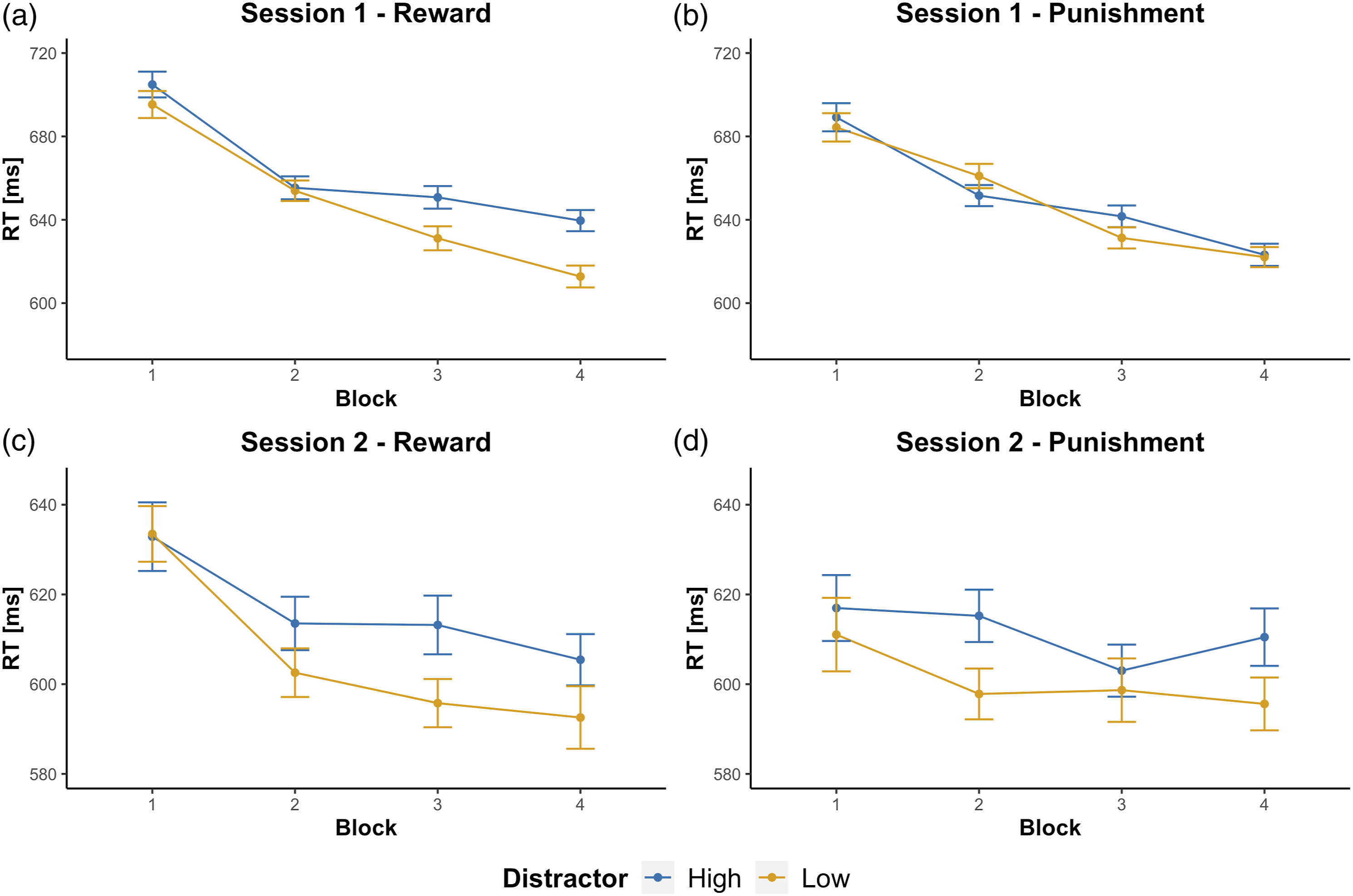
Clinical measures
Following the preregistration, we examined associations between attentional capture in reward/punishment blocks and alcohol/cannabis use and depression/anxiety, respectively, in session 1. None of the models were significant (see Figure S1 in the supplementary materials). We also found no significant interaction effects between the VMAC Reward scores and the SDL measure (p > 0.05). In an exploratory fashion following the approach by Albertella et al. (2017), we examined interaction effects between the SDL score, the VMAC Reward effect, and the association with internalizing symptoms. We found a significant interaction effect (p = 0.03) for the DASS-21 anxiety symptom score (see Figure S2 in the supplementary materials). A higher VMAC-Reward score was positively associated with more anxiety symptoms in individuals with poorer attentional control (long response deadline as assessed through the SDL task). We found no significant interaction effects for the stress and depression subscales (p > 0.05).
Test-retest reliability
The bivariate correlation between the VMAC-Reward scores (i.e., difference in RT for high-value vs. low-value trials) at session 1 and session 2 was non-significant, r (41) = 0.086, p = 0.585. The correlation between the VMAC-Punishment scores at session 1 and session 2 was also non-significant, r (41) = −0.021, p = 0.893. The separate RT measures for high and low reward/punishment at session 1 and session 2 showed statistically significant moderate to strong correlations (see Figure S3 in the supplementary materials). The test-retest reliability for the SDL response deadline was moderate; SDL scores at session 1 and session 2 showed a significant association (r = 0.56, p < 0.01).
Study 2
VMAC effects
ANOVA Results for VMAC Task Effects for Study 2.

Note. Degrees of freedom (DF) reported are corrected for sphericity. Effect sizes reported are partial eta squared (η2). ** denotes p-values below 0.001, and * denotes p-values below 0.01.
The analysis conducted on the RTs of the Punishment VMAC task revealed similar results as Study 1. A significant main effect of Block was found, with lower RTs as participants progressed through the task. There was no effect of Distractor Type, and no effect of Block Order, but a significant Block x Block Order interaction was found. No other two-way (i.e., Block Order x Distractor Type; Block x Distractor Type) or three-way interactions were found.
Furthermore, the analysis of accuracy of the Reward VMAC task revealed no speed-accuracy tradeoff. A 6 × 2 × 2 ANOVA with Block (1–6) and Distractor Type (high, low) as within-subject, and Block Order (reward first, punishment first) as between-subject factors revealed a significant main effect of Block, with higher accuracy as participants progressed through the task. There was no effect of Distractor Type and no effect of Block Order. A Block x Block Order interaction was found. No other interactions were found (see Table S5). As we did not find any significant differences in RTs of the Punishment VMAC task, we did not conduct the corresponding speed-accuracy tradeoff test.
Figure 3 shows the RT for both distractor types (low/high) and study conditions (reward as first block, punishment as first block). The VMAC Reward effects (difference in RT between high and low) are present regardless of whether reward or punishment appears as a first block. VMAC Effects for Reward and Punishment in Study 2.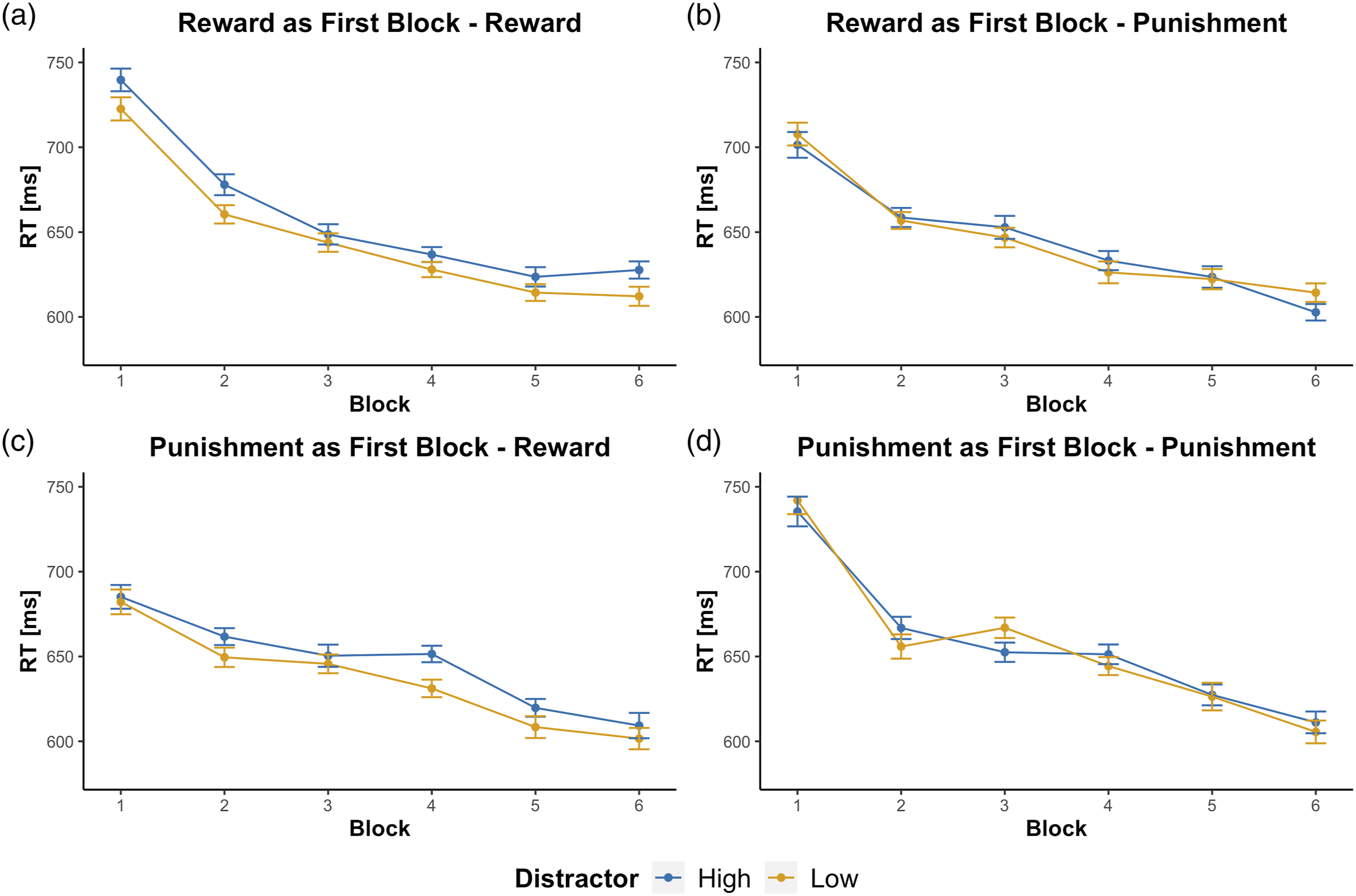
Clinical measures
We found no significant associations between the VMAC reward/punishment scores and clinical measures (see Figure S3 for an overview of all regression estimates). In an exploratory fashion, when controlling for DASS-21 total score, all findings stayed the same (p < 0.05).
Discussion
The present two-study report investigated the associations between reward- and punishment-modulated attentional capture effects and internalizing symptoms and substance use in a student sample. As predicted, we found reward-related VMAC effects across both studies. However, contrary to our predictions, test-retest reliability of the VMAC effect was very low, we did not find punishment-related VMAC effects across sessions, and there were no meaningful associations between attentional capture and clinical measures.
During the reward VMAC trials in both studies participants took longer to respond to high-reward compared to low-reward distractor trials, indicating they were more likely to attend to the distractor that signaled a high reward, even though such distraction resulted in less money earned. These findings are consistent with several value-modulated attentional capture studies in which reward-associated distractors capture attention even when task-irrelevant (e.g., Anderson et al., 2011; Le Pelley et al., 2015). We extend these previous studies by showing that the reward-related attentional capture persists in a shorter task setup and despite the presence of alternating punishment blocks. This suggests that reward contingencies are maintained despite the alternating punishment blocks. Interestingly, while most of the previous VMAC tasks contained at least 400 (and up to 2000) trials, our current task in Study 1 consisted of only 120 trials for reward and punishment blocks. The difference in capture between the high- and low-reward distractors can already be seen after three reward blocks, at which point participants have only gone through 90 reward trials. Furthermore, our exploratory accuracy analyses showed that these effects are not a result of a speed-accuracy tradeoff, indicating that participants did not simply take longer to respond to the high-reward distractor in order to be more accurate.
A range of studies have shown that aversively conditioned stimuli similarly capture attention (e.g., Schmidt et al., 2015). However, we did not find such effects in the current VMAC-Punishment task in session 1 of Study 1 or Study 2. In this novel punishment adaptation, we found no significant differences in participants’ response time between high- and low-punishment distractor trials. Importantly, previous studies that used a similar task setup as the current VMAC task, almost exclusively focused on threat- and fear-related attentional capture (e.g., electrical shock or loud noises). Likely, this may activate punishment contingencies that are different from processes relevant in monetary loss. Threatening stimuli, as opposed to losing money, could indicate a biological adaptation, as life-threatening dangers should quickly be seen and avoided. Moreover, those studies that have focused on monetary loss specifically, did not use this particular VMAC design in which a distractor is merely a signal of punishment, rather than an association between a response and monetary loss. For example, Wentura et al. (2014) found attentional capture effects related to monetary loss using a task design that included a variation of the classic training and test phases, that have often been used in value-driven attentional capture tasks by Anderson and colleagues (e.g., Anderson et al., 2011). This could potentially make a difference in interpreting the results of the current and previous punishment-modulated capture effects. Considering the paucity of research on VMAC effects in punishment settings, future studies should test other variations of the VMAC task which could include threat stimuli (e.g., loud noises or electric shocks), rather than monetary signals of punishment. It remains yet to be tested whether indeed such punishment effects can only be detected in instrumental conditioning designs with a separate training phase.
Another possible explanation for the absence of punishment VMAC effects in the present studies may be the small number of trials. While it is striking how quickly reward contingencies can be established, it is possible that participants need more time to learn punishment contingencies compared to the reward ones. Although this might seem at odds with evolutionary theories which suggest that threatening stimuli capture attention faster (Öhman & Mineka, 2001, 2003), the present study does not use evolutionary-related stimuli but goal-related stimuli (i.e., monetary loss). Some recent research suggests that indeed participants needed fewer trials to learn reward compared to punishment and neutral associations (Wang et al., 2018) which may speak to this alternative explanation. Indeed, in Study 1, we did find significant punishment VMAC effects two weeks later, which could not be explained by selective attrition. However, these punishment effects of session 2 should be interpreted with caution due to the smaller sample size and different sets of distractor colors used for the second session. In fact, increasing the number of trials within the same VMAC task in Study 2 still did not reveal punishment-related attentional capture effects. Future studies should aim to compare different task lengths and times between task sessions.
Several limitations should be considered when interpreting our results. First, we used a sample of college students that showed substantial variability with respect to alcohol use, but little variability with respect to internalizing symptoms and cannabis use. This lack of variability may also explain the absence of associations between VMAC effects and substance use. Future studies should investigate whether heightened reward-processing is associated with greater drug use only in individuals diagnosed with substance use disorders. Moreover, in our analyses of the associations between VMAC and substance use and related problem (AUDIT, CUDIT-R total scores), we did not control for the recency of use. Thus, it is possible that acute substance use impairs individuals’ attentional control making it more difficult to differentiate between high and low distractor stimuli. This may explain the lack of an association. To better understand the relationship between VMAC and substance use, future studies should consider controlling for the time elapsed since last substance use.
We found that individuals with low attentional control (high SDL score) showed a positive association between VMAC Reward scores and anxiety symptoms. Although this pattern is broadly consistent with previous findings that suggest interactions between cognitive control and attentional capture (Albertella et al., 2017), it should be interpreted with caution considering a) the low test-retest reliability of the VMAC Reward score and b) the exploratory nature of this analysis which included many contrasts.
Second, the primary outcome measure of our VMAC task (reward and punishment difference scores) showed low test-retest reliability. This is consistent with a previous report of low test-retest reliability of a different VMAC version by Anderson and Kim (2019), and it could also explain the lack of associations between VMAC scores and clinical measures in our study. Prior research suggests that low test-retest reliability may be related to factors such as low between-subject variability (Hedge et al., 2018) or the use of reaction time difference scores as measures of attentional control (Draheim et al., 2019). Nonetheless, the VMAC Reward RT difference score remains a commonly used metric in the attentional bias literature and our study is one of the first to report test-retest reliability estimates.
The present study replicates previously established reward-related attentional capture effects (Le Pelley et al., 2015) in which individuals are slower to respond to a target when a distractor that signals a high reward is present. The study also provides additional insights into how these capture effects can be established fairly rapidly, and with a fewer number of trials. Moreover, our findings show how these reward-related effects persist throughout the task, despite several interruptions of similar punishment trials. Further research on punishment-related attentional capture is needed in order to establish the nuances of how such punishment attentional biases occur. Accurately assessing reward- and punishment-modulated attentional capture effects using a scalable and short behavioral online task may provide a window of opportunity to better grasp the cognitive-motivational processes underlying the development of mental health problems.
Supplemental Material
Supplemental Material - Value-modulated attentional capture in reward and punishment contexts, attentional control, and their relationship with psychopathology
Supplemental Material for Value-modulated attentional capture in reward and punishment contexts, attentional control, and their relationship with psychopathology by René Freichel, Lana Mrkonja, Peter J. de Jong, Janna Cousijn, Ingmar Franken, Tom A. Ruiter, Mike Le Pelley, Lucy Albertella, Poppy Watson, Ilya M. Veer, and Reinout W. Wiers in Journal of Experimental Psychopathology
Footnotes
Acknowledgments
We would like to thank Harriet Galvin for her help with creating an early version of the VMAC task.
Declaration of conflicting interests
The author(s) declared no potential conflicts of interest with respect to the research, authorship, and/or publication of this article.
Funding
The author(s) disclosed receipt of the following financial support for the research, authorship, and/or publication of this article: This study is part of the project “New Science of Mental Disorders” ( ), supported by the Dutch Research Council and the Dutch Ministry of Education, Culture, and Science (NWO gravitation grant number: 024.004.016).
Supplemental Material
Supplemental material for this article is available online.
Author Biographies
References
Supplementary Material
Please find the following supplemental material available below.
For Open Access articles published under a Creative Commons License, all supplemental material carries the same license as the article it is associated with.
For non-Open Access articles published, all supplemental material carries a non-exclusive license, and permission requests for re-use of supplemental material or any part of supplemental material shall be sent directly to the copyright owner as specified in the copyright notice associated with the article.
