




Abstract
Depression is associated with difficulties in goal pursuit which could be related to deficits in emotional anticipation regarding goal success. Therefore, the reported study investigated emotional anticipation for personal goals and whether this differs as a function of depressive symptoms. After listing approach and avoidance goals, 263 participants made predictions about these goals (e.g. likelihood of achievement and controllability) and rated the vividness and perspective with which they envisaged goal achievement. They also provided ratings of either anticipated (predicted emotions that would accompany goal success) or anticipatory (in-the-moment emotions when imagining goal success) positive emotions. Higher levels of depressive symptomatology were associated with pessimistic predictions about goal achievement, coupled with reduced vividness and greater adoption of observer perspective when envisaging achievement. Furthermore, those experiencing higher levels of depressive symptoms evidenced biases in both anticipated and anticipatory positive emotions associated with goal success. They believed that goal achievement would bring them lower levels of positive emotion and also reported less in-the-moment happiness, satisfaction, and pleasure when thinking about achieving their goals. Irrespective of depressive symptom level, anticipated emotions were generally stronger than anticipatory emotions. These findings have implications both for research on future-oriented emotions (anticipated and anticipatory) and for the development of therapeutic techniques to aid depression.
Personal goals are future-oriented representations pertaining to a desired state towards which one is striving, with an expectation of pleasure and satisfaction if successful (Cochran & Tesser, 1996). In order to plan, prepare for, and shape events in line with one’s goals, one needs to be able to anticipate future events and/or states. Anticipation involves cognitive processes, whereby one generates and maintains cognitive representations of possible future experiences (Szpunar et al., 2014). These are accompanied by two conceptually distinct, yet inter-related, types of future-oriented emotion, anticipated and anticipatory emotions. The current study explores the anticipated and anticipatory emotions associated with personal goals and whether these emotional anticipation processes are compromised in individuals experiencing high levels of depressive symptomatology.
Anticipated emotion refers to how the individual predicts they would feel if the simulated event(s) were to happen, whilst anticipatory emotion constitutes the in-the-moment feelings they currently experience when they think about a potential future experience. These emotional components of anticipation impact on goal-oriented behaviours as one is unlikely to be motivated and engage effortfully in working towards a goal that one does not foresee as pleasurable or does not bring pleasure upon in-the-moment contemplation. Evidence supports this notion, suggesting that both components serve as motivating factors in goal-directed intentions/behaviours (Baumgartner et al., 2008; Carrera et al., 2012).
The role of emotional anticipation in driving goal-directed activity is particularly pertinent in the context of depression because evidence suggests depression is associated with biases in future-oriented emotion (e.g. Hallford & Sharma, 2019; MacLeod & Salaminiou, 2001). This literature has investigated individuals with a diagnosis of major depressive disorder (MDD) and individuals with elevated levels of depressive symptomatology but no formal diagnosis.
Inherent within diagnostic criteria for MDD is anhedonia, defined as a loss of interest or pleasure in usual activities (American Psychiatric Association [APA], 2013). However, our understanding of depressive anhedonia has been limited by traditional conceptualisations that place emphasis on the online, in-the-moment, experience of pleasure or ‘liking’. Thus, anhedonia has been reconceptualised as an ‘impairment in the ability to pursue, experience and/or learn about pleasure’ (Thomsen, 2015, p. 2). This definition acknowledges future-oriented emotions whereby anticipation of pleasure, or ‘wanting’, is a key factor that motivates the individual to expend effort to gain a reward. Literature suggests that both anticipated and anticipatory emotions are biased within depression. For instance, compared to non-depressed individuals, depressed individuals anticipate less happiness for potential positive future experiences (e.g. MacLeod & Salaminiou, 2001) and rate personally relevant positive future events as less pleasurable to think about (Hallford & Sharma, 2019).
Emotional anticipation biases are likely to impact on goal-directed cognition and behaviour within depression. For instance, why would an individual feel motivated to work towards a goal if they cannot foresee the pleasure that achievement would bring and experience very little in-the-moment pleasure when thinking about its achievement? Studies examining the relationship between personal goals and depression have primarily focused on difficulties in goal setting and goal pursuit. The literature examining the relationship between goal setting and depression is mixed. Some research suggests that depressed adolescents and adults exhibit difficulties with goal fluency, whereby they produce fewer approach (things they would like to achieve), but not avoidance (things they would like to avoid), goals than non-depressed individuals (e.g. Dickson et al., 2016; Dickson & MacLeod, 2004). Conversely, other research has found that depressed individuals report similar levels of goal fluency and attribute similar levels of importance to these goals (e.g. Dickson et al., 2011; Dickson & Moberly, 2013). Consistent within the literature, however, is the finding that depressed individuals hold pessimistic beliefs about the outcomes of goals and evidence difficulties with goal pursuit. Compared with non-depressed individuals, they report that they have less control over their occurrence (Dickson et al., 2011) and that their approach goals are less likely to occur (Dickson et al., 2011). Furthermore, they also report greater ease of disengagement from unattainable goals and more difficulty re-engaging with new goals (Dickson et al., 2016). Higher levels of depressive symptomatology have also been associated with lower levels of self-reported motivation and higher levels of urgency, whereby individuals respond to emotional states with impulsive actions (that are later regretted) with respect to goal pursuit (Dickson et al., 2017).
It is logical to suggest that these pessimistic beliefs about goal outcomes, and difficulties with goal pursuit, could be underpinned by difficulties in anticipating the pleasure of goal achievement. To date, only one study has provided evidence consistent with this. Gamble et al. (2021) found that higher levels of depressive symptoms were associated with a reduction in expected joy deriving from goal success, as well as lower perceived attainability of goals and diminished phenomenological detail in goal-related episodic simulations. Thus, their findings suggest that depression is associated with impaired anticipated emotion with respect to goal attainment. However, questions remain because Gamble et al. (2021) investigated only anticipated, but not anticipatory, emotions pertaining to goal achievement. Thus, the current investigation examined how depressive symptoms are related to both forms of future-oriented emotions.
Participants were asked to generate both approach and avoidance personal goals. This manipulation served primarily to obtain a representative sample of different types of goals, rather than to assess differences between these goal types per se. Participants were asked to provide a series of predictions about these goals, such as likelihood of occurrence and controllability. Additionally, they predicted how motivated they were to achieve that goal and how much effort would be required. We did not use an arbitrary cutoff to compare depressed participants with non-depressed controls; rather we treated severity of depressive symptoms as a continuous variable to reflect the evidence that they exist along a continuum of severity throughout the population (Rodríguez et al., 2012). In line with previous literature (e.g. Dickson et al., 2011), it was hypothesised that participants with higher levels of depressive symptoms would evidence more pessimism about the potential outcomes of their goals and the necessary effort/motivation to achieve them. Specifically, such participants would report that their personal goals, both approach and avoidance, are less likely to be achieved, less controllable, would require more effort, and that they are less motivated to achieve them.
To fulfil the key aims of the study, we also assessed future-oriented emotions pertaining to goal achievement. Participants were separated into two groups, whereby they were either asked to rate anticipated emotions, the positive emotions they might experience if goal achievement occurs, or anticipatory emotions, the extent to which they feel positive emotions now when thinking about future goal achievement. This was done in an attempt to minimise any confusion or carry-over effects between the concepts of anticipated and anticipatory emotions among participants. In line with previous literature evidencing difficulty with anticipated/anticipatory happiness in depression (e.g. Hallford & Sharma, 2019; MacLeod & Salaminiou, 2001), it was predicted that higher levels of depressive symptomatology would be associated with muted anticipated and anticipatory positive emotions associated with goal achievement (happiness, pleasure, and satisfaction).
Method
Participants and design
281 undergraduates participated in exchange for course credit. 18 participants had not adhered to goal task instructions (e.g. provided same goal twice and misunderstood description of avoidance goals) or had not produced, at minimum, one avoidance and one approach goal; these participants were excluded from the dataset. 263 participants were included in analyses, giving estimated power of 0.91 to detect small effects (η2 = 0.04) in ANCOVA (G*Power; Faul et al., 2007). 1
Goal type (approach vs. avoidance) constituted a within-subjects factor, and CESD-R score was treated as a continuous predictor. The ratings provided in the Goals Task formed the primary dependent variables. Participants were split into two groups for the measures of future-oriented emotion, with 149 completing ratings of anticipated emotion (Age X̄ = 21.88, SD = 6.71, 122 female, 26 male, 1 other/prefer not to say; CESD-R Score X̄ = 20.26, SD = 16.10) and 114 completing ratings of anticipatory emotion (Age X̄ = 21.02, SD = 5.36, 93 female, 20 male, 1 other/prefer not to say, CESD-R Score X̄ = 22.20, SD = 16.42). Although the two conditions were run sequentially (anticipated first) rather than with truly random allocation, independent sample t-tests confirmed that participants in the two groups did not differ significantly in either age, t(261) = 1.13, p = .26, or CESD-R Score, t(261) = 0.96, p = .34. The research was approved by the faculty ethics committee in compliance with the host institution’s Code of Good Research Practice.
Materials
Center for Epidemiologic Studies Depression Scale - Revised (CESD-R)
The CESD-R (Eaton et al., 2004) is a 20-item inventory assessing the presence of depressive symptoms as defined by the Diagnostic and Statistical Manual of Mental Disorders (APA, 2013). Each item is scored using a five-point scale for the extent the individual has experienced that symptom over the previous 1–2 weeks. Scores are summed to provide a total score ranging from 0 to 80. The inventory has strong psychometric support in young adults (Van Dam & Earleywine, 2011).
Goals task
Adapted from a similar task by Dickson and MacLeod (2004), participants were asked to think about their personal goals, defined as ‘things you would like to achieve in the future’ (approach goals) and ‘things you would like to avoid in the future’ (avoidance goals). These goals could occur across various time frames (short-, medium-, and long-terms). Participants were presented with a prompt of either ‘In the future, it will be important for me to…’ or ‘In the future, it will be important for me to avoid…’, and they were asked to type a personal goal to complete the sentence.
After providing details of a personal goal, participants were asked to anticipate how far into the future this goal could realistically be achieved (temporal distance) on a five-point scale: 1 = within the next week; 2 = within the next month; 3 = within the next year; 4 = within the next 2–4 years; 5 = in 5+ years.
Then, on Likert scales anchored from 1 (not at all) to 7 (extremely), they provided a series of ratings assessing beliefs, cognitive characteristics, and future-oriented emotions associated with each goal. There were five belief measures: Participants predicted how likely they were to achieve the goal (likelihood); how much control they had over whether they achieved the goal (controllability); and how important achieving the goal would be to their life story (importance). They also estimated their level of motivation to achieve the goal (motivation) and how much effort would be required to achieve it (effort). There were two measures of cognitive characteristics: Participants rated how vividly they were able to imagine themselves achieving the goal (vividness) and the extent to which they imagined it from a first-person perspective or a third-person/observer perspective (perspective). The perspective rating was anchored between 1, indicating an entirely first-person perspective, and 7, indicating an entirely third-person (observer) perspective.
Participants in the anticipated emotion group were asked to rate how happy (happiness) and satisfied (satisfaction) they would feel if they were to achieve the goal; and how much pleasure they would derive from achieving the goal (pleasure). In contrast, participants in the anticipatory emotion group were asked to rate how much happiness, satisfaction, and pleasure they felt right now when they imagined achieving the goal.
Participants generated eight goals in total: four approach goals and four avoidance goals. The order of prompts for approach/avoidance goals was randomised for each participant, and all ratings were required for each of the eight goals. After completion of the study, all goals were coded for specificity (general/moderate/specific) and life domains using recommendations outlined by Belcher and Kangas (2014) and Gamble et al. (2021).
Procedure
Recruitment and participation occurred online, with all tasks administered using Qualtrics XM (Qualtrics, Provo, UT). After providing informed consent and demographic details (age and gender), participants completed the CESD-R, before moving on to the Goals Task. After completing their ratings for all eight goals, participants were debriefed.
Results
Descriptive statistics
Frequency (%) breakdown for goal specificity and life domain, by goal type.
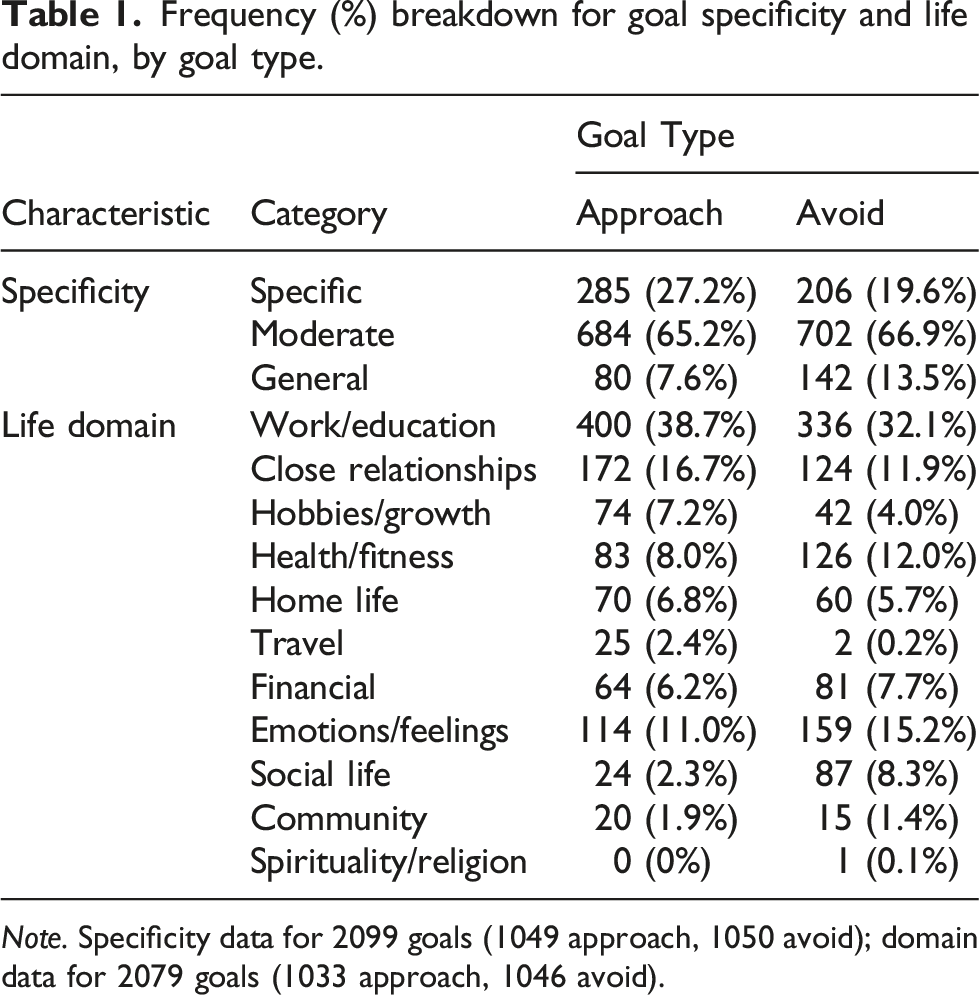
Note. Specificity data for 2099 goals (1049 approach, 1050 avoid); domain data for 2079 goals (1033 approach, 1046 avoid).
Descriptive statistics for beliefs/cognitive measures and emotional anticipation measures.

Goal beliefs and characteristics as a function of goal type and CESD-R score
Parameter estimates and model fit statistics for mixed-effects models predicting goal beliefs and characteristics.

aReference category = avoidance goals;
bReference category = anticipated emotion;
†.05 < p < .10,
*p < .05, **p < .01, and ***p < .001.
Goal type showed significant effects for temporal distance (F(1, 263) = 65.92, p < .001), likelihood of success (F(1, 263) = 21.59, p < .001), importance (F(1, 263) = 30.67, p < .001), motivation (F(1, 263) = 20.48, p < .001), effort (F(1, 263) = 28.17, p < .001), and vividness (F(1, 263) = 24.62, p < .001), with approach goals rated higher on all these characteristics (bs > .5, ps < .001; see Table 3). Furthermore, in line with predictions, CESD-R score showed significant negative effects for likelihood (F(1, 263) = 20.52, p < .001), control (F(1, 263) = 24.27, p < .001), motivation (F(1, 263) = 33.26, p < .001), and vividness (F(1, 263) = 25.89, p < .001); and a significant positive effect for perspective (F(1, 263) = 20.59, p < .001). Thus, elevated depressive symptoms coincided with lower ratings of likelihood of success; reduced perceptions of control; reduced vividness in imagining, and motivation to achieve, one’s goals; and a greater tendency to imagine goal achievement from a third-person (observer) perspective. Emotion type yielded one significant main effect, for motivation (F(1, 263) = 5.66, p = .018); ratings here were lower in the anticipatory group than the anticipated group (b = −.399, p = .037; Table 3).
Four interactions were also significant. Firstly, goal type × CESD-R predicted temporal distance (F(1, 263) = 5.74, b = −.007, p = .017), with the difference in temporal distance by goal type (approach > avoidance) tending to be greater for participants reporting lower levels of depressive symptoms. Secondly, goal type × CESD-R predicted perceived control (F(1, 263) = 4.73, b = .008, p = .031), with participants experiencing higher levels of depressive symptoms tending to feel diminished control over avoidance (as opposed to approach) goals. Thirdly, goal type × emotion type predicted temporal distance (F(1, 263) = 9.29, b = −.291, p = .002), with the difference by goal type (approach > avoidance) tending to be greater for anticipatory-group participants. Finally, emotion type × CESD-R predicted vividness (F(1, 263) = 4.72, b = .015, p = .031), with a stronger negative relationship between severity of depressive symptoms and vividness in the anticipated (r(1192) = −.248, 95% CI [−.301, −.194]) than the anticipatory group (r(1192) = −.104, 95% CI [−.167, −.039]).
Future-oriented emotions as a function of goal type, CESD-R and emotion type
Parameter estimates and model fit statistics for mixed-effects models predicting future-oriented positive emotions.

aReference category = avoidance goals.
bReference category = anticipated emotion.
d.05 < p < .10.
ep < .05.
***p < .001.
Goal type positively predicted scores on all three emotion variables, indicating that approach goals were associated with greater happiness (F(1, 263) = 26.88, p < .001), satisfaction (F(1, 263) = 25.18, p < .001), and pleasure (F(1, 263) = 35.83, p < .001). CESD-R score negatively predicted all three emotion variables, indicating that higher levels of depressive symptoms were associated with diminished happiness (F(1, 263) = 7.26, p = .008), satisfaction (F(1, 263) = 4.60, p = .033), and pleasure (F(1, 263) = 7.66, p = .006). 3 Additionally, emotion type was associated with happiness (F(1, 263) = 7.22, p = .008) and satisfaction (F(1, 263) = 5.59, p = .019), with anticipated emotion ratings being higher than anticipatory emotion ratings (confirmed by corrected post hoc tests; happiness: t(1787.959) = 9.15, p < .001, satisfaction: t(1770.062) = 8.58, p < .001). This effect did not reach significance in the model predicting pleasure (F(1, 263) = 3.44, p = .065). Finally, none of the tested interactions were significant in any model (Fs < 1.5, ps > .20).
Discussion
Previous literature has suggested that individuals experiencing depression hold pessimistic beliefs about goal outcomes and show impaired goal pursuit (e.g. Dickson et al., 2011; Dickson et al., 2017). The current study sought to replicate and expand on this previous work by exploring the potential role of future-oriented emotions in driving these difficulties.
After listing approach and avoidance goals, participants provided a series of predictions about their goal pursuit and outcomes. In line with hypotheses, elevated levels of depressive symptomatology were associated with increased pessimism – whereby participants rated their goals as less likely to be achieved; saw the process of goal pursuit as less controllable; and were less motivated to try and achieve their goals. Nevertheless, higher depressive symptomatology was not associated with diminished goal specificity, nor were goals viewed as less important, projected further into the future or more effortful to achieve. These findings are in line with previous literature that suggests depressed individuals hold pessimistic beliefs about their ability to achieve their personal goals and lower levels of goal-related motivation, but that these biases are not necessarily a function of difficulties with goal setting (e.g. Dickson et al., 2011). Instead, the pessimistic tendencies and reduced motivation observed may be driven by other factors, including, for instance, biases in the emotional anticipation of goal achievement. The fundamental aim of the present investigation was to elucidate differences in positive future-oriented emotions as a function of depressive symptomatology.
This study was the first to investigate both anticipated and anticipatory emotions associated with goal achievement in relation to depressive symptom level. In line with hypotheses, we found that participants experiencing higher levels of depressive symptoms exhibited biases in anticipated emotions associated with the achievement of personally relevant goals. They expected to feel less happiness, satisfaction, and pleasure upon achieving their reported goals than those experiencing lower levels of depressive symptoms; this was the case across both approach and avoidance goals. In addition, we found that higher depressive symptomatology was associated with biases in anticipatory emotions, with significantly reduced ‘in-the-moment’ feelings of happiness, satisfaction, and pleasure when thinking about future goal achievement.
Our findings are in line with previous literature suggesting that depression is associated with biases in anticipated positive emotion (e.g. MacLeod & Salaminiou, 2001). In particular, our findings support and extend those of Gamble et al. (2021), who found depressive symptoms to be negatively correlated with the level of anticipated joy expected to accompany goal success. Our study differed subtly to that of Gamble et al., with respect to the relatively minimal constraints we imposed on the generation of personal goals. It is likely, therefore, that our participants generated a wider range of goals, from concrete, lower-level, goals through to more abstract, higher-order, goals (Belcher & Kangas, 2014). Arguably, these responses represent the more natural tendency to generate a range of goals at varying levels of abstraction. Given the consistency between Gamble et al. (2021) and the present results on anticipated emotion, the latter may be taken as reinforcing the link between depression and (reduced) expectation of positive emotions in a more naturalistic context. Across different task constraints, individuals experiencing higher levels of depressive symptoms struggle to envisage the positive emotions that would accompany goal success.
Higher levels of depressive symptoms were also associated with muted anticipatory positive emotion, as indicated by lower ratings of in-the-moment happiness, satisfaction, and pleasure when contemplating achievement of one’s future goals. Previous research has suggested that anticipated and anticipatory emotions are conceptually distinct; Baumgartner et al. (2008) implied that one needs to be able to predict pleasure (anticipated emotion) in order to experience an in-the-moment affective response (anticipatory emotion). Consistent with this, we found ratings of happiness and satisfaction to be significantly lower in the anticipatory group, irrespective of depressive symptom level (and numerically so for pleasure). This attenuation of present feelings, relative to expected feelings, suggests that the latter might serve as a reference point or input for evaluating how one feels in the present; a possibility warranting further exploration in within-subjects designs tracking both emotion types in each participant. Added to this, the finding that individuals experiencing high levels of depressive symptoms can generate equivalent goals to others (in terms of specificity, importance, and timescale), yet struggle both to anticipate positive goal-related emotions and to experience associated in-the-moment affective responses, suggests that the two may be causally linked.
In addition to the biases found in future-oriented emotion, we also found that participants experiencing higher levels of depressive symptoms reported lower vividness and more observer perspective when envisaging goal achievement. Although we did not ask participants to explicitly generate episodic simulations associated with goal success in the same way as Gamble et al. (2021), our findings support the previous literature suggesting that high levels of depressive symptoms are associated with difficulty in generating vivid, first-person cognitive representations of positive future events, including goal achievement (e.g. Gamble et al., 2021; Morina et al., 2011). Existing evidence suggests that envisaging future events vividly, and in first person, positively predicts the extent to which an individual believes such events are plausible, likely to occur, and worthwhile drivers for action (e.g. Ernst & D’Argembeau, 2017; Gaesser & Schacter, 2014). Coupled with this literature, our findings add weight to the argument that the ability to visualise a personal goal being achieved is fundamental to believing it can be achieved and feeling motivated to work towards it.
Taken together, our findings suggest that individuals experiencing elevated levels of depressive symptomatology have difficulty in generating vivid, first-person cognitive representations of goal achievement as well as diminished positive, future-oriented emotion (anticipated and anticipatory) relating to their goals. It is feasible to argue that these biases may drive the pessimistic beliefs about goal attainment, and reduced motivation, observed in depression. Therefore, our findings add further weight to arguments that therapeutic techniques focusing on future-oriented imagery are critical in tackling motivational deficits in depression (see Renner et al., 2021, for a review).
The current study asked participants to produce both approach and avoidance goals. We made no explicit predictions about goal type because this manipulation served primarily to obtain a representative sample of different goals and, furthermore, previous literature had yielded mixed findings (Dickson & MacLeod, 2004; Dickson & Moberly, 2013). Our data showed approach goals to be perceived as more important and more likely to occur, and their achievement to be imagined more vividly, than avoidance goals. Furthermore, participants felt more motivated to work towards approach goals (while conceding that they would require more effort). These patterns did not differ as a function of depressive symptom level. Interactions between goal type and depression level did however emerge with respect to perceived control over, and temporal distance to, goal achievement. Regarding perceived control, those experiencing lower levels of depressive symptoms did not differentiate between approach and avoidance goals. However, those with higher levels felt their avoidance goals were less controllable than their approach goals. Previous research suggests that avoidance goals are generally viewed as less controllable than approach goals (e.g. Dickson et al., 2011), and our findings suggest that this may be more salient to depressed individuals. The interaction between goal type and depressive symptom severity when predicting temporal distance corresponded to approach goals being more temporally distant relative to avoidance goals for participants with lower symptom severity. In contrast, this difference was smaller in those with higher symptom severity. We measured temporal distance of goal achievement because the richness of the phenomenological experience of imagined events, including vividness and accompanying emotions, decreases for events projected further into the future (D’Argembeau & Van der Linden, 2004). In relation to this, we did find that participants with higher symptom severity reported both reduced vividness and increased third-person perspective. However, these biases were present across both goal types and, therefore, are unlikely to be explained by the interaction between goal type and CESD-R score when predicting temporal distance.
In the present investigation, goal-oriented emotional anticipation was only considered in the context of positive emotions associated with potential goal achievement. However, the anticipation of negative emotions may also play a part in goal-oriented activities. For instance, if one contemplates goal failure, one might anticipate how disappointed or frustrated one would be. Furthermore, these thoughts might also elicit anticipatory, in-the-moment, negative emotions. This foretaste of negative affect could motivate the individual to strive to achieve the goal in order to avoid stronger unpleasant emotions. Perugini and Bagozzi (2001) support this proposal, demonstrating that both positive and negative anticipated emotions predict desire to engage in goal-oriented behaviours. To date, it is not clear how the anticipation of negative emotions associated with goal failure might vary as a function of depressive symptomatology. Furthermore, it is unclear what role such negative emotions might play in the pessimism around goal achievement and reduced motivation seen in depression.
Another aspect which could be reconsidered in future work is the design used to contrast anticipated and anticipatory forms of future-oriented emotion with respect to personal goals. The present study adopted a between-subjects design to avoid any confusion or contamination arising from asking participants to make subtly different introspective judgements about the same set of goals. However, some unexpected differences emerged between groups (greater motivation and a stronger depression-vividness relationship in the anticipated emotion group). These could, in principle, be attributable to procedural differences, yet the groups only differed in the instruction used to elicit emotion ratings (after motivation and vividness were rated for each goal) – hence this appears unlikely. Rather, it potentially highlights the problem of ensuring invariance in the particular goals reported across groups when goals are known to vary extensively between individuals (see Milyavskaya & Werner, 2018). Future work could therefore utilise within-subjects designs to compare anticipated and anticipatory emotions across the same set of individuals and goals. Such studies would benefit from pre-registration of methodology and analysis plan.
Finally, the current study focused on the anticipation of goal achievement as a function of differing levels of depressive symptomatology. Whilst some participants at the higher end of our depressive continuum may have met criteria for a formal diagnosis, the majority were most likely experiencing sub-threshold levels of symptomatology. However, this does not necessarily negate the importance of our findings and we purposefully treated depressive symptomatology as a continuous variable for a number of reasons. Evidence suggests that depressive symptomology lies on a continuum whereby sub-threshold experiences differ quantitatively, rather than qualitatively, from those reaching the diagnostic threshold for MDD. Additionally, sub-threshold symptoms are associated with reduced quality of life, greater health service burden, and have been identified as a risk factor for developing MDD (see Rodríguez et al., 2012, for a review).
In conclusion, this study extends previous findings to demonstrate that future-oriented positive emotions associated with goal achievement, both anticipated (expected in the future) and anticipatory (in-the-moment), are compromised in individuals experiencing elevated levels of depressive symptomatology. These findings have implications for future work on (the relationship between) anticipated and anticipatory emotions as well as continued development of therapeutic techniques to aid depression.
Footnotes
Declaration of conflicting interests
The author(s) declared no potential conflicts of interest with respect to the research, authorship, and/or publication of this article.
Funding
This work was supported by the Economic and Social Research Council (grant number ES/R007152/1).
