




Abstract
Episodic imagery has been shown to amplify emotion more than abstract verbal representations. This may prove useful for clinical interventions aiming to motivate adaptive behaviours. However, most findings rely on self-report measures and verbal control conditions not designed to actively prevent automatic engagement in episodic imagery. We thus investigated the difference in emotionality between Episodic Imagery (EI) and Verbal Visualisation (VV) using pupil dilation as a physiological measure of emotional arousal. A sample of 75 participants listened to audio recordings describing activities in a positive manner. Subjects were randomly assigned to the EI or VV condition. Participants in the EI condition imagined performing the described activity, while participants in the VV condition visualised the words constituting the descriptions. As predicted, EI led to greater pupil dilation than VV, independent of mental effort. Self-reported anticipatory reward assessed throughout the task was also greater for EI than VV, yet no difference was found for arousal, anticipated reward or motivation. Our findings extend previous work demonstrating the property of episodic imagery to amplify emotion to a physiological level using pupillometry. However, we did not find a transfer to motivation, which is in line with previous studies using verbal control conditions for episodic imagery.
Introduction
Selecting an adaptive behaviour efficiently requires anticipation of potential gains and losses. A plausible route for approximating the consequences of choice and behaviour is projecting oneself into hypothetical situations using mental imagery (i.e. an experience like perception in the absence of sensory input; Boyer, 2008; Holmes et al., 2016). Episodic imagery (i.e. the mental simulation of a specific episode using mental imagery) has been previously described as a motivational amplifier to promote the engagement in planned activities (Renner et al., 2019). This is based on the assumption that episodic imagery amplifies emotion more than abstract processing modes, particularly representations of verbal information (Holmes & Mathews, 2010; Ji, Burnett Heyes, MacLeod, Holmes, 2016). As pupil dilation has been previously shown to be modulated by emotional arousal (Henderson et al., 2018), it could provide valuable information on the preferential link between episodic imagery of activities and emotion processing and further elucidate its effect on behavioural motivation.
Episodic imagery and emotion share a special bond. It has been shown to induce and amplify positive and negative emotions more than other forms of mental processing, particularly abstract verbal representations (Holmes et al., 2008). Early work by Vrana, Cuthbert and Lang (1986), for instance, has shown a sustained heart rate acceleration in response to imagining fearful scenarios as compared to silently rehearsing them. However, it has been criticised that verbal representation always preceded episodic imagery (Holmes et al., 2008; Holmes & Mathews, 2005). The supplementation of the verbal condition with an additional representational processing mode, thus, may be responsible for the observed difference in emotionality. To address this, Holmes and colleagues (Holmes et al., 2009; Holmes & Mathews, 2005; Holmes et al., 2006; Holmes et al., 2008; Mathews et al., 2013) conducted a series of studies during which participants were instructed to imagine emotional (positive and negative) scenarios or to think about them verbally by focussing on the verbal meaning of imagery scripts or constructing sentences combining picture-word cues. Results also showed that episodic imagery induces a stronger emotional response than verbal thought of the same emotional material. However, these studies solely relied on subjective ratings of emotionality and did not account for episodic imagery automatically elicited by the processing of verbal information (Amit et al., 2017). Wicken et al. (2021) recently addressed this by investigating the physiological response to frightening written and perceptual scenarios of individuals incapable of visual imagery, a condition referred to as aphantasia. Compared to a control group, individuals with aphantasia exhibited a flat-line skin conductance response to written but not perceptual scenarios. This provides first psychophysiological evidence for the special relation between episodic imagery and emotion accounting for imagery automatically elicited by the processing of verbal information.
Due to its emotion enhancing property, episodic imagery may, in turn, prove useful to promote behavioural motivation in clinical interventions aiming to motivate adaptive behaviours. It has recently been proposed that a greater emotional response following imagery of a desirable activity consequently may translate to heightened reward anticipation and motivation to actually perform the activity (Heise et al., 2022; Renner et al., 2019, 2021). Studies by Renner et al. (2019), Heise et al. (2022) and Bär et al. (2022), indeed, found evidence for this increase in reward anticipation and motivation experimentally using no-imagery and neutral imagery control conditions, but not yet employing physiological measures or verbal control conditions. The impact of episodic imagery on reward anticipation is highly relevant for treatment innovation in depression where Behavioural Activation already constitutes one of the most common and effective treatment strategies (Cuijpers et al., 2007) and dysfunctional reward anticipation is thought to play a key role in anhedonia (Bakker et al., 2017; Schneider et al., 2020; Sherdell et al., 2012).
A study by Schneider et al. (2018) suggested that a promising physiological indicator of arousal induced by reward anticipation is pupil dilation. Moreover, pupil dilation has been repeatedly demonstrated a valuable physiological measure of emotional arousal (for a recent review, see Peinkhofer et al., 2019). Through a connection between the sympathetic nervous system and the dilator muscle of the iris, pupil size increases in response to arousal (Mathôt, 2018). Importantly, increased pupil size has been found in response to imagining emotional (positive and negative) as compared to neutral scenarios, which corresponded with subjective ratings of emotional arousal (Henderson et al., 2018). This suggests that pupil dilation is a promising tool to detect an increase in emotional, reward-related arousal induced by positive episodic imagery of activities. To minimize the effect of episodic imagery automatically elicited by the processing of verbal information, the present study occupied visual imagery using a newly developed verbal visualisation task.
The present study
In a mixed experimental design, we investigated whether pupil dilation is greater when engaging in Episodic Imagery (EI; projecting oneself into a situation using mental imagery) compared to engaging in a more abstract form of processing, namely Verbal Visualisation (VV; visualising written words and thereby occupying visual working memory) involving the same information. Participants (N = 75) received instructions to either engage in EI or VV while listening to the same audio recordings describing the performance of activities in a motivational manner. Pupil dilation was recorded during EI/VV and subjective ratings of imagery vividness/verbal focus, arousal, anticipatory pleasure (i.e. how pleasant it is to think about a future activity), anticipated reward (i.e. how rewarding a future activity is expected to be) and motivation to perform the respective activity were recorded after each trial. The following hypotheses were preregistered (https://osf.io/93yvu): (1a) Pupil dilation will be greater during EI than during VV of the same motivational information; (1b) EI will have a greater emotional and motivational impact than VV as assessed via self-report; (2a) Self-report assessment of imagery vividness, arousal, anticipatory reward, anticipated reward and motivation will be positively associated with pupil dilation; (2b) behavioural activity during the past week will be positively associated with pupil dilation; (2c) depressive symptoms assessed at baseline will be negatively associated with pupil dilation.
Method
Participants
Sample demographics and baseline characteristics.
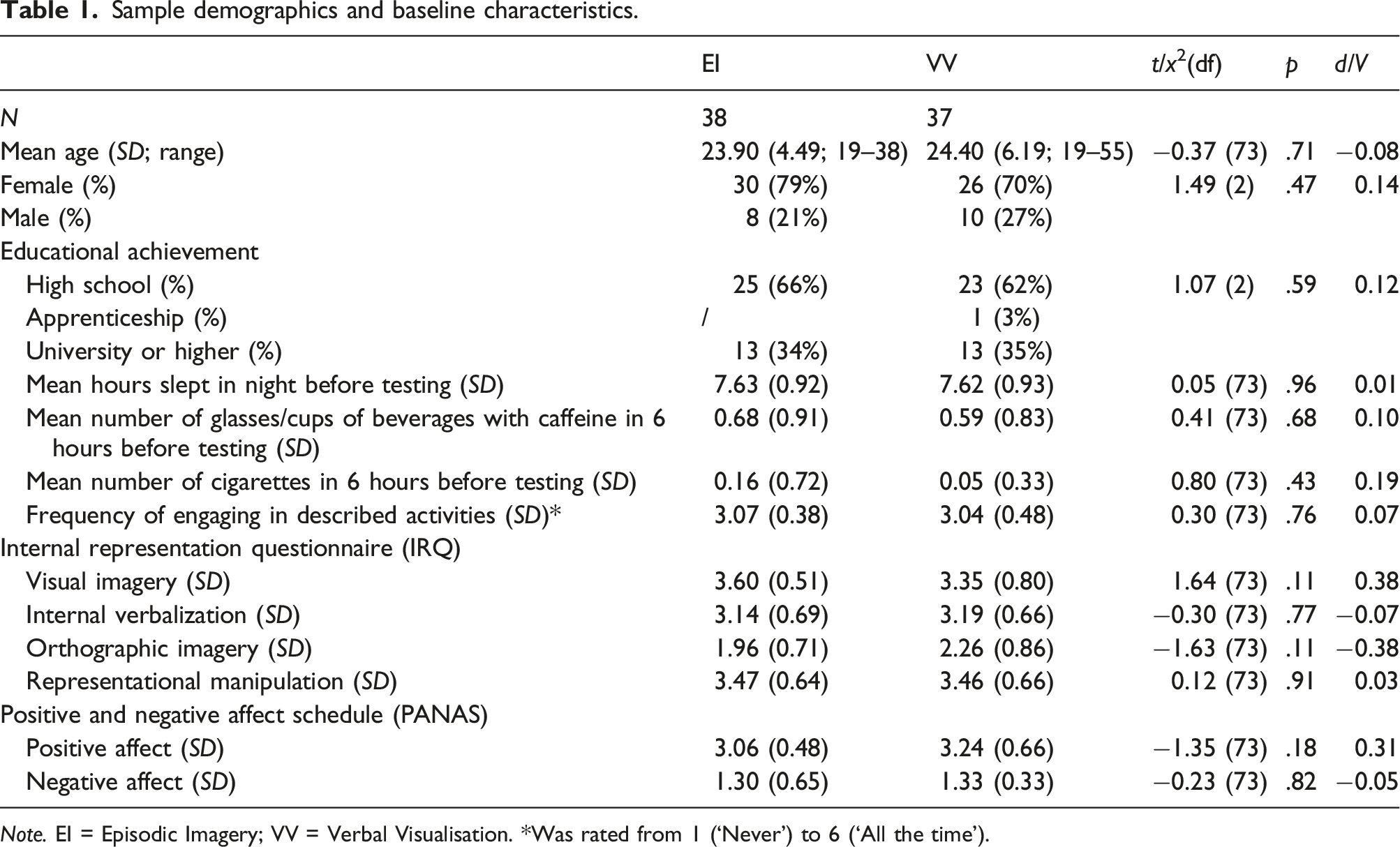
Note. EI = Episodic Imagery; VV = Verbal Visualisation. *Was rated from 1 (‘Never’) to 6 (‘All the time’).
Procedure
Participants who met inclusion criteria based on self-report first received study information online. After providing written informed consent, they completed a battery of self-report questionnaires, including demographic information and all questionnaires listed under Instruments (except for the PANAS). After completion of the PANAS and questions concerning their last night’s sleep as well as their caffeine and nicotine consumption during the previous six hours, the participant´s dominant eye was determined and the RMT started as described below. The study was conducted in concordance with the COVID-19 guidelines of the Institute of Psychology of the University of Freiburg. Experimenters and participants wore FFP-2 facemasks during the duration of the study on site.
Instruments
Depression anxiety and stress scale (DASS-21)
The DASS-21 depression subscale (Lovibond & Lovibond, 1995; Nilges & Essau, 2015) was used to assess depressive symptoms in this non-clinical sample. The subscale consists of seven items concerning the past week that are rated on a scale from 0 (‘did not apply to me at all’) to 3 (‘applied to me very much or most of the time’). In the present study, the subscale exhibited a high internal reliability (α = .86, ω = .89).
Behavioral activation for depression scale
The Behavioral Activation for depression scale (BADS) factor ‘activation’ (Kanter et al., 2007; Teismann et al., 2016) was used to assess behavioural activity during the past week. The factor consists of seven items rated on a scale from 0 (‘not at all’) to 6 (‘completely’). The internal consistency in the present study was adequate (α = .79, ω = .80).
Internal representation questionnaire
The Internal representation questionnaire (IRQ) (Roebuck & Lupyan, 2020) was employed to measure tendencies of participants to think visually, verbally or in orthographic imagery (i.e. visualising language as it is written) and the ability to manipulate mental representations. The questionnaire was translated to German by the first and second author (AB & HEB) using a back-translation procedure (Brislin & Freimanis, 2001). It consists of 36 statements rated on a scale from 1 (‘strongly disagree’) to 5 (‘strongly agree’). The internal consistency of the four factors was adequate (Visual imagery: α = .82, ω = .84, Internal verbalization: α = .83, ω = .84, Orthographic imagery: α = .76, ω = .80, Representational manipulation: α = .74, ω = .74).
Positive and negative affect schedule
The Positive and negative affect schedule (PANAS) (Krohne et al., 1996; Watson et al., 1988) was used to assess current positive and negative affect. Ten adjectives per dimension are rated on a scale ranging from 1 (‘not at all’) to 5 (‘extremely’). Internal consistency of the dimensions was very high (positive affect: α = .85, ω = .85, negative affect: α = .93, ω = .95).
Ratings of vividness, emotionality and motivation
After every trial, participants were asked to answer six questions according to the respective condition, rated on visual analogue scales ranging from 0 (‘not at all’) to 100 (‘completely true’): Vividness (EI only: ‘I could vividly imagine the described activity’, ‘It felt like I actually engaged in the activity’), Verbal Visualisation (VV only: ‘I could concentrate well on the spoken words’, ‘I could see the spoken words in my mind’s eye’), Arousal (‘Performing the exercise was arousing’), Anticipatory Reward (‘Performing the exercise felt pleasant’), Anticipated Reward (‘The described activity would make me happy’), and Motivation (‘I am motivated to do the activity’). Based on Holmes and Mathews (2005), condition-specific questions were asked to subtly remind participants of the respective task instructions and to further direct the focus of the participants on the most crucial aspects of the task (episodic imagery or verbal focus, respectively).
Manipulation check and mental effort
Several questions were asked on visual analogue scales (0 ‘not at all’ to 100 ‘very’) as a manipulation check at the end of the study (EI item 1: ‘To what extend did you imagine engaging in the activities vividly during the exercises?’, EI item 2: ‘To what extend did it feel like you actually engaged in the activities?’; VV item 1: ‘To what extend did you think in words during the exercises?’, VV item 2: ‘To what extend did you see the spoken words like written text in your mind’s eye?’) and concerning the mental effort of engaging in the respective experimental condition (‘How mentally effortful were the exercises for you?’). Manipulation check items were averaged per condition. For items concerning the engagement in EI, mean values were 73.60 (SD = 13.00) in the EI condition and 55.20 (SD = 19.50) in the VV condition. For VV manipulation check items the mean values were 21.60 (SD = 20.40) in the EI condition and 72.70 (SD = 14.90) in the VV condition.
The reward modality task
The Reward Modality Task (RMT) was developed based on a task by Holmes and Mathews (2005) to experimentally manipulate the motivation to perform activities through episodic imagery. All participants listened to the same 20 audio recordings (number of audio stimuli for studies employing pupillometry based on Winn et al., 2018) describing activities (half non-social, half social) in a motivating manner focussing on positive aspects of the activity. Depending on the allocated condition, participants were instructed to either imagine performing the described activities (EI condition) or to visualise the words constituting their descriptions (VV condition).
Prior to experimental trials, participants completed two practice trials during which activities were described in a neutral manner focussing on circumstances of the activity (see supplementary material Table A1). In the present study, arousal ratings and anticipatory reward ratings were significantly higher for reward-focused scripts than for neutral practice scripts (arousal: M = 55.70, SD = 17.40, M = 43.30, SD = 19.20; t(74) = 5.54, p < .001, d = 0.64; anticipatory reward: M = 66.90, SD = 15.30, M = 58.10, SD = 14.50; t(74) = 6.38, p < .001, d = 0.74, respectively). Throughout all trials, participants were instructed to look at a black fixation cross presented at the center of a grey screen. After two seconds, the audio recording started playing for 15 seconds. This was followed by four seconds of silence during which participants were asked to either focus on a mental image of the imagined activity (EI condition) or to visualise a key word of the description (VV condition). At the end of each trial, participants were asked to rate the vividness and emotionality of the EI or VV as well as their motivation to perform the respective activity (see Instruments section). Participants were then instructed to relax their eyes for 5.5 seconds (Winn et al., 2018) before the next trial began. At the end of the task, participants were asked to answer manipulation check items and to rate the mental effort of engaging in the respective experimental condition (see Instruments section). Audio recordings were presented in a random order across participants.
Audio recordings of activities
Audio recordings describing activities in a motivating (experimental trials) and neutral manner (two practice trials) were developed for the purpose of the present study by the first and second author (AB & HEB). Activities were chosen based on activity lists typically used in Behavioral Activation treatment (Renner et al., 2019). After initial pilot testing, 20 out of 30 audio recordings for experimental trials were selected according to the highest arousal ratings. Half of the audio recordings were spoken by a male speaker and half by a female speaker. A German and English version of all employed scripts for the audio recordings can be found in Table A1 of the supplementary material.
Task instructions
Participants were first informed that people can think about the audio recorded descriptions of activities in two different ways: episodic imagery or verbal visualisation. In the EI condition, participants were then instructed to engage in episodic imagery by fully immersing themselves in the described activities and vividly imagining performing them from a first person perspective. In the VV condition, participants were instructed to engage in verbal visualisation by visually imagining the words constituting the descriptions of activities as if they were written with a keyboard. How to engage in EI and VV was further illustrated using the lemon-exercise (Holmes & Mathews, 2005). While in the EI condition, an example of the original lemon-exercise was described, participants in the VV condition received a description of an adapted version in which they were instructed how to visualise the words used in the exercise (see supplementary material). Participants were lastly told to focus on a snapshot of the imagined activity that felt most intense and striking to them (EI condition) or to focus on the – from their perspective – most central and important word of the description and to visually underscore it in their imagination (VV condition) at the end of each exercise until they hear a signalling tone.
Pupillometry
Pupil dilation was recorded using a desktop mounted EyeLink 1000 Plus system (SR Research Ltd., Mississauga, Ontario, Canada) following 9-point calibration and subsequent validation procedure. Distance between the stabilised chin and forehead rest to the screen was kept constant at 90 cm. The room was constantly dimly lit at approximately 50 lux and the background colour of the computer screen was kept light grey (RGB: 204, 204, 204) throughout the entire experiment. During periods of interest, a black fixation cross was presented in the centre of the screen in order to reduce spontaneous eye movements, which can result in pupil size artefacts. Participants were instructed to fixate this cross whenever it appeared and to blink as little as possible. Pupillometry data for which eye gaze was outside the area of the fixation cross was removed. For eye blinks, data were removed for the 100 ms prior and after the respective blink (Weiskrantz et al., 1999). The average number of data points removed due to blinks did not differ between conditions (EI = 11,661.16, VV = 9721.568, t = 0.64, df = 73.00, p = .53, d = 0.15) and corresponded to about 3% of the total data points in both conditions. Trials were removed when pupil data were not available for at least 50% of the respective trial (including data removal due to eye movements and blinks) and participants were excluded, if data were not available for at least 15% of trials. These criteria were preregistered and based on previous studies employing pupillometry (Schneider et al., 2020). Pupil dilation was aggregated into one-second time bins, while the first second of the description was omitted to accommodate for the time needed for the pupil to react to stimuli (Mathôt, 2018). Thus, 14 one-second time bins remained while the audio scripts were playing and four one-second time bins remained for the instructed brief exercise thereafter (i.e. focus on an imagery snapshot or underscoring a word). A one-second baseline recording of pupil dilation per trial was subtracted from each time bin for all participants to address individual differences in pupil size and potential changes in baseline pupil size as the task progresses (Mathôt et al., 2018). In addition, participants were provided 5.5 seconds to relax their eyes after each trial so that the pupil dilation could return to a baseline level before each new trial (Winn et al., 2018).
Statistical analyses
Data were analysed using jamovi version 1.6 (The jamovi project, 2021). The study design and analyses were preregistered (https://osf.io/93yvu). To test whether pupil dilation is greater during EI than VV, we conducted a mixed ANOVA with pupil dilation as the dependent variable. Condition (two conditions) acted as a between-subjects factor, while time was entered as a within-subjects factor (18 one-second time bins). Data were aggregated at the individual participant level so that each participant had a mean score for each time bin, resulting in 18 data points. Self-reported mental effort required to perform the respective task (between-subjects variable) was included as a covariate. Further, self-report items assessing the emotional and motivational impact of EI or VV (i.e. arousal, anticipatory reward, anticipated reward and motivation) were averaged across trials and compared between the two conditions using independent samples t-tests. Correction for multiple testing was applied. To investigate associations between pupil dilation and self-report measures, regression analyses were conducted with pupil dilation as the dependent variable and condition, mental effort, and (1.) imagery vividness, or (2.) arousal, or (3.) anticipatory reward, or (4.) anticipated reward, or (5.) motivation, or (6.) behavioural activity during the past week, or (7.) baseline depression as predictors, as well as their interaction with condition, respectively. Since imagery vividness is only measured in the EI condition, the factor ‘condition’ was not included in this regression analysis.
Results
Manipulation check and mental effort
Individuals in the EI condition reported a greater engagement in episodic imagery of the described activities than individuals in the VV condition (EI: M = 73.60, SD = 13.00, VV: M = 55.20, SD = 19.50; t(73) = 4.81, p < .001, d = 1.11), while individuals in the VV condition reported a greater engagement in verbal visualisation than individuals in the EI condition (EI: M = 21.60, SD = 20.40, VV: M = 72.70, SD = 14.90; t(73) = −12.34, p < .001, d = −2.85). Engaging in VV was rated to be significantly more mentally effortful compared to engaging in EI (EI: M = 36.90, SD = 25.60, VV: M = 61.90, SD = 22.60; t(73) = −4.48, p < .001, d = −1.04).
Pupil dilation during episodic imagery
Controlling for mental effort, pupil dilation was significantly greater during EI than VV with a medium effect size (F(1, 72) = 4.72, p = .03, η2p = .06).
1
Employing Greenhouse–Geisser correction, a main effect was found for time (F(2.40, 173.02) = 18.90, p < .001, η2p = .21), but not for the interaction effect of condition by time (F(2.40, 173.02) = 0.99, p = .38, η2p = .01). Estimated marginal means of pupil dilation for reward-focussed scripts corrected for mental effort can be found in Figure 1, while the raw means of pupil dilation per time-bin can be found in Figure B1 of the supplementary material. Pupil dilation (arbitrary units) from baseline with Standard Error per one-second time-bin during Episodic Imagery (EI) or Verbal Visualisation (VV) based on Estimated Marginal Means 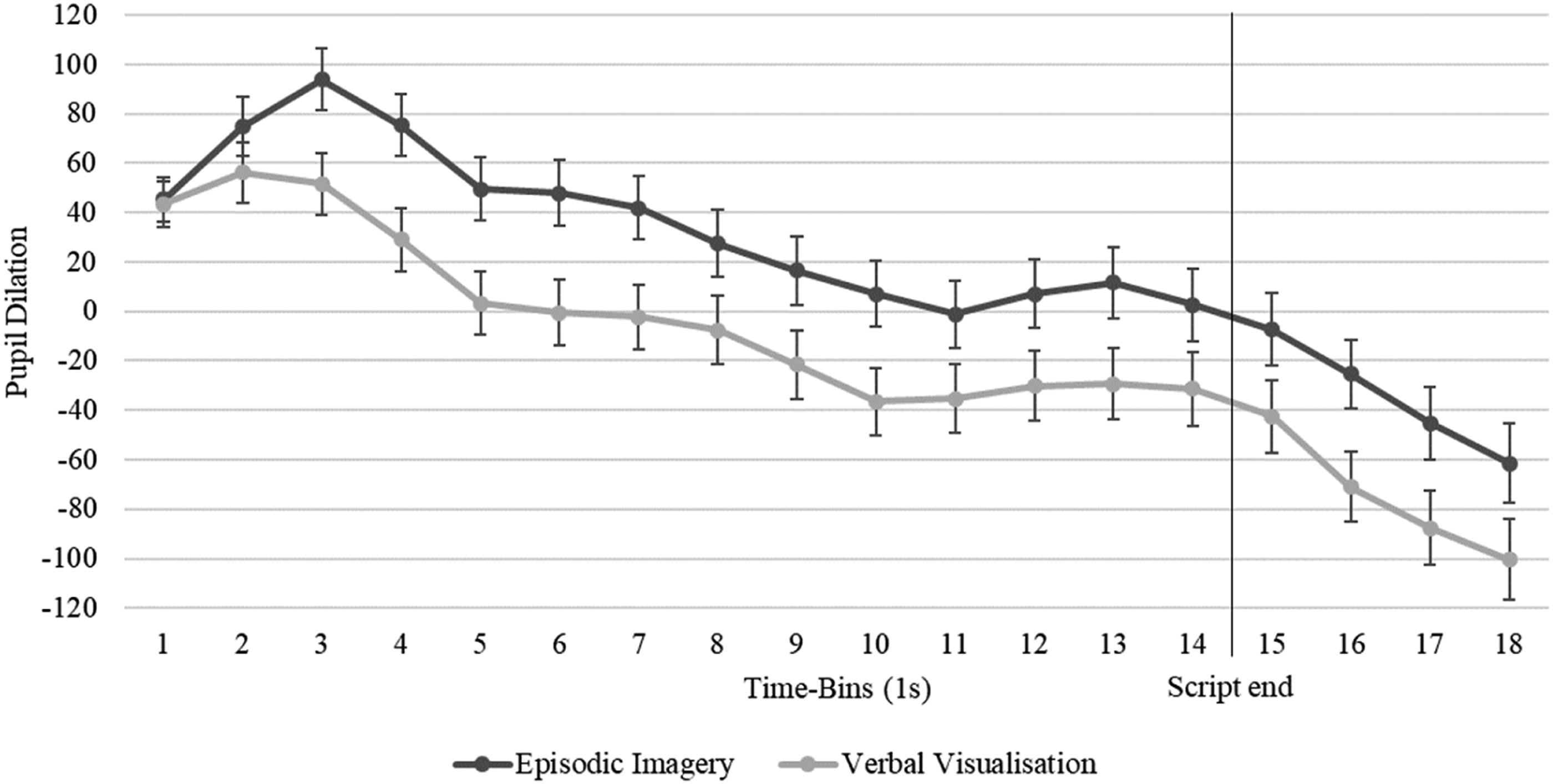
Self-reported emotional and motivational impact
Comparing the immediate emotional impact of EI versus VV based on single-item self-report ratings showed significantly higher ratings for anticipatory reward (EI: M = 71.70, SD = 10.20, VV: M = 61.90, SD = 17.94; t(73) = 2.92, p < .01, d = 0.67), but not for arousal (EI: M = 57.00, SD = 14.10, VV: M = 54.40, SD = 20.30; t(73) = 0.66, p = .51, d = 0.15). No significant differences were found for the concepts associated with the transfer from emotion to motivation: anticipated reward (EI: M = 76.20, SD = 10.40, VV: M = 76.70, SD = 9.40; t(73) = −0.23, p = .82, d = −0.05) and motivation (EI: M = 69.00, SD = 13.10, VV: M = 68.70, SD = 14.29; t(73) = 0.07, p = .94, d = 0.02; see Figure 2). Self-report ratings of ratings of emotionality and motivation (scale from 0 to 100) per condition with Standard Error.*Significant difference at Bonferroni-corrected α of .01.
Association between subjective ratings and pupil dilation
Regression analysis with mean pupil dilation as the outcome neither revealed main effects of the self-report measures nor interaction effects with condition. For the single-item measures as part of the RMT, results were as follows: Vividness (β = −0.06, t = −0.07, p = .94); Arousal (β = −0.76, t = −0.10, p = .92), Arousal x Condition (β = 0.44, t = 0.46, p = .65); Anticipatory reward (β = 0.17, t = 0.16, p = .88), Anticipatory reward x Condition (β = 0.18, t = 0.15, p = .88); Anticipated reward (β = −0.59, t = −0.56, p = .58), Anticipated reward x Condition (β = 0.69, t = 0.43, p = .67); Motivation (β = −0.73, t = −0.87, p = .39); Motivation x Condition (β = 1.15, t = 1.01, p = .32). For behavioural activity results were (β = −1.01, t = −0.09, p = .93; Behavioural activity x Condition, β = −2.02, t = −0.14, p = .89) and for depressive symptoms (β = 1.46, t = 0.46, p = .65; Depression x Condition, β = −2.46, t = −0.56, p = .58). Thus, none of the included self-report ratings was related to pupil dilation. Full results of all regression models can be found in Table B1 of the supplementary material.
Exploratory Analyses of Neutral Practice Scripts
To rule out other factors contributing to differences in pupil dilation between conditions next to mental effort (which was controlled via self-report measures), we conducted several analyses using pupil dilation data from the neutral practice scripts of the RMT. Pupil dilation during the neutral practice scripts was therefore baseline-corrected and averaged per participant. Here, the reverse was found in that individuals in the EI condition exhibited a less pronounced pupil dilation compared to individuals in the VV condition (EI: M = 35.90, SD = 106, VV: M = 86.10, SD = 115, t = −1.97, p = .05, d = −.45). We decided to re-run analyses regarding Hypothesis I using mean pupil dilation for neutral scripts as a covariate instead of the self-report measure of mental effort. This was done to control for all possible differences in pupil dilation between the two conditions that are not due to the difference in valence of the scripts. Controlling for pupil dilation during neutral scripts, pupil dilation for reward-focused scripts was significantly greater during EI than VV with a large effect size (F(1, 72) = 9.49, p < .01, η2p = .12). Employing Greenhouse–Geisser correction, a main effect was found for time (F(2.42, 174.06) = 62.58, p < .001, η2p = .47), but not for the interaction effect of condition by time (F(2.42, 174.06) = 1.54, p = .21, η2p = .02). The corresponding estimated marginal means per time-bin corrected for pupil dilation during neutral scripts can be found in Figure 3. Pupil dilation (arbitrary units) from baseline with Standard Error per one-second time-bin during Episodic Imagery (EI) or Verbal Visualisation (VV) based on Estimated Marginal Means 
Discussion
The aim of this study was to investigate the emotional and motivational impact of episodic imagery compared to an abstract representation of verbal information (i.e. verbal visualisation). As predicted, episodic imagery of activities resulted in higher emotional arousal as demonstrated by a greater pupil dilation and self-reported anticipatory reward. Contrary to our predictions, participants in the EI condition did not report higher anticipated reward, motivation and arousal compared to participants in the VV condition. Furthermore, no relationships between pupil dilation and self-reported reward anticipation, motivation, vividness, depression and behavioural activity were shown. Taken together, we found evidence to support the notion that episodic imagery is more emotional than abstract verbal representation of the same information, however, this effect did not transfer to behavioural motivation.
The present study replicates and extends previous research on episodic imagery concerning anticipatory emotion and motivation (e.g. Holmes et al., 2006; Holmes & Mathews, 2005; Ji et al., 2021) using a novel verbal control condition exerting more control over visual working memory processes and by providing consistent physiological evidence for state emotionality using pupillometry. Our observation that only anticipatory reward, but not anticipated reward or motivation, was amplified by episodic imagery compared to verbal visualisation corroborates recent findings by Ji et al. (2021). Comparing an experiential imagery condition to a verbal control condition (i.e. verbal analytical thinking about the benefits of an activity), they found experiential imagery to be associated with increased subjective anticipatory pleasure (state mood), but not with increased anticipated pleasure, motivation or actual performance of the activity. One possible explanation for the non-superiority of episodic imagery on these measures is that the manipulation might not be strong enough to impact behavioural motivation toward specific activities. While the concrete emotional state during the task was affected by the manipulation, it might not have been sufficiently strong to change conscious evaluations of the level of motivation to perform an activity. While Bär et al. (2022), for instance, did not find an effect of positive episodic imagery on the rather conscious duration of attention, an effect was demonstrated for more automatic early attention. Repetitions of episodic imagery versus verbal exercises of the same activity over a period of time might, however, show that the motivation for activities changes differently depending on thought modality. It could be that repetitions are needed to associate the activity with positive emotions during the imagery exercise (Murray, 2007). Thus, our measurement of an emotional state – anticipatory reward – may have been more susceptible to change than our measurement of motivation, which could be considered a more consolidate and trait-like construct.
Contrary to expectations, pupil dilation was not related to any of the relevant self-report constructs. One explanation for this could be the design of the RMT, which was specifically tailored to evoke a state of positive emotion that could potentially lead to reward anticipation and motivation rather than reward anticipation itself. Relationships of pupil dilation to constructs such as anticipated reward may, thus, not have been present in contrast to, for example, findings by Schneider et al. (2020), whose task was tailored to specifically investigate reward anticipation using pupillometry. Moreover, self-report measures often tend to show no or only weak correlations to task performance or physiological measures. A possible reason for this is that tasks are usually designed to maximize within-person differences in an experimental setting at a cost of between-person variance, which can render them unsuitable for assessing individual differences (Dang et al., 2020). The reliability of pupil dilation in the context of the RMT, thus, requires further evaluation. Moreover, self-reported depressive symptoms and the related construct of behavioural activity could have suffered from a limited range of scores within the data of the present study, since only non-clinical participants were included. Therefore, the lack of correlation between pupil dilation and these constructs might not be as informative. The same might be the case for motivation towards positive activities, since the sample was not selected to score low on motivation and, hence, motivation could have been high irrespective of the manipulation.
Limitations and suggestions for future research
Although great care was taken to assess factors that could influence pupil dilation and to avoid differences between experimental conditions, a within-subjects design should be considered in future studies to further limit the influence of individual differences. For this first study, however, we chose a between-subjects design, as it was unclear how readily participants could switch between the two modes of thought within a single task. Moreover, various verbal control conditions have been used in mental imagery experiments over the years, ranging from focussing on the meaning of words to writing a pro and con list or formulating sentences. Further evidence is, thus, needed using a variety of what can be considered verbal thought as control conditions. One major strength of the present study was that participants in both conditions received the same information and detailed guidance through identical audio-recordings. This aspect of standardisation could, however, be reduced in future studies to allow for control conditions that require a more equivalent degree of mental effort and abstractness as when engaging in episodic imagery. Nevertheless, it is also possible that verbal types of thought are generally more mentally effortful and abstract than episodic imagery, which could be an additional defining characteristic of episodic imagery-based thought. This difference in concreteness/depth of processing could be a plausible mechanism by which episodic imagery exerts its influence on emotion. An important general limitation of pupillometry is the difficulty to pin down which exact process is responsible for the observed dilation. Arousal, emotion and mental effort are only a few of the processes that have been attributed to changes in pupil size (Mathôt, 2018). Effects could, for example, be due to enhanced action preparation (Sege et al., 2020) or processes involved in retrieval that were more active during episodic imagery. Moreover, pupil dilation might have been influenced by differences in brightness of what was envisioned (words or scenes), since research has shown that the pupil reacts to imaginary light (Laeng & Sulutvedt, 2014; Mathôt et al., 2017). Although brightness itself was not the focus of the employed scripts, the effects of brightness and emotion need to be disentangled in future studies. Another possibility is that the measurement and controlling for mental effort using self-report was insufficient. However, building on our exploratory analysis controlling for differences in pupil dilation during neutral trials and the study by Henderson et al. (2018) showing greater pupil dilation during emotional episodic imagery compared to neutral episodic imagery, we argue that emotional impact is the most likely cause for the difference found in pupil dilation. The main analysis of the present study was preregistered and based on analyses by Henderson et al. (2018), who first employed pupil dilation to differentiate between episodic imagery of positive, negative and neutral valence. Future studies, however, should consider the use of analyses that utilize more of the available data, such as multi-level regression. In the present study, comparability to Henderson et al. (2018) and conformity to the preregistration was given priority. Data are openly available for further explorative analyses.
Conclusion
Mentally projecting oneself into an activity bears greater emotional impact than verbal visualisation as shown via self-report and pupil dilation. Whether this immediate emotional reaction transfers to behavioural motivation regarding the imagined activity, however, remains unclear and could not be demonstrated via self-report in the present study. Nonetheless, crucial support based on physiological data was found for the common fundamental assumption that episodic imagery can act as an emotional amplifier, which holds implications for both clinical practice and research.
Supplemental Material
Supplemental Material - The pupil as a window to the mind’s eye: Greater emotionality of episodic imagery than verbal visualisation of rewarding activities
Supplemental Material for The pupil as a window to the mind’s eye: Greater emotionality of episodic imagery than verbal visualisation of rewarding activities by Andreas Bär, Hannah E. Bär, Max Schneider and Fritz Renner in Journal of Experimental Psychopathology
Footnotes
Acknowledgments
This study was supported by a Sofja Kovalevskaja Award from the Alexander von Humboldt Foundation and the German Federal Ministry for Education and Research awarded to FR. We thank Lea Fuchs for assistance in data collection.
Declaration of conflicting interests
The author(s) declared no potential conflicts of interest with respect to the research, authorship, and/or publication of this article.
Funding
The author(s) disclosed receipt of the following financial support for the research, authorship, and/or publication of this article: This work was supported by the Alexander von Humboldt-Stiftung.

Supplemental Material
Supplemental material for this article is available online.
Notes
Author Biographies
References
Supplementary Material
Please find the following supplemental material available below.
For Open Access articles published under a Creative Commons License, all supplemental material carries the same license as the article it is associated with.
For non-Open Access articles published, all supplemental material carries a non-exclusive license, and permission requests for re-use of supplemental material or any part of supplemental material shall be sent directly to the copyright owner as specified in the copyright notice associated with the article.
