




Abstract
social communication represents one of the main areas of impairment in the case of individuals with autism spectrum disorder (ASD) (APA, 2013). Several studies have investigated predictors in this domain; however, the results are mostly inconsistent or lack clarity. The purpose of this theoretical review is to analyze studies that address vocabulary, prosody, and cognitive flexibility in relation to deficits in pragmatic language, in the case of individuals with ASD. This synthesis was conducted on 18 studies, based on a systematic search of ScienceDirect and NCBI (PubMed and PubMed Central) databases. A number of 1523 participants were included in the analyzed studies. Results indicate that prosody has a major impact on social communication. However, difficulties in processing prosody do not account as the only predictors in the general abilities of language and communication. Regarding the executive functioning, future research is needed to fully understand the relationship between social communication and cognitive flexibility.
Keywords
Introduction
Autism Spectrum Disorder (ASD) is defined in the Diagnostic and Statistical Manual of Mental Disorders (DSM- 5) (APA, 2013) as a complex neurodevelopmental disorder characterized by persistent difficulties in communication and social interaction, and by restrictive and repetitive behaviors, interests, or activities. However, there is a broad spectrum of symptoms regarding its manifestation and severity among those bearing a diagnosis, conceptualized on a continuum from a severe impairment to a mild impairment.
social communication
Even though language delay or language disorders are not diagnosis criteria in ASD, they seem to have been one of the main reasons or complains that elicited an initial diagnosis (Richards et al., 2016). Considering the spectrum nature of the disorder, linguistic abilities in ASD vary significantly, from a minimal functional language level to a fluent language level. In a recent study that addressed the length of utterance, grammar and social use of language, 3.7% of ASD children were identified as nonverbal, while 34% presented minimal linguistic abilities (Bacon et al., 2018). Linguistic abilities also vary as a function of the linguistic domain that is assessed. One of the most prominent symptoms in ASD is the deficit in the development of social communication skills (Charman & Stone, 2008).
Due to such deficits, many children with ASD have insufficient social interaction opportunities as compared to children with typical development, make a greater effort when they initiate interactions with others and seem to be less aware of their social difficulties (Bauminger et al., 2003). Such challenges often become an obstacle to making friendships and maintaining them (Fein, 2015). Also, they often cause anxiety and distress in social situations (Corbett et al., 2012).
social communication refers to the communication of cognitive and emotional information through facial expressions, gestures, and prosody, and through implicit understanding of pragmatics and of theory of mind (Tanguay et al., 1998). According to the American Speech-Language-Hearing-Association (ASHA, 2020), social or pragmatic communication comprises three major skills: a. using language for different reasons, such as greeting, offering information, asking, giving directions/commands, promising; b. changing language according to the listener or context; c. Following the rules of a conversation or narrative. However, there seems to be a lack of agreement on the definition or on the dimensions of this broad construct (Tajik-Parvinchi et al., 2021). There are several terms interchangeably used with reference to social communication, such as pragmatic communication or pragmatic language. Deficits have been reported in the case of ASD individuals on various aspects of social communication.
social communication difficulties relevant to conversational exchanges experienced by those on the autism spectrum have been widely reported. These include difficulties in initiating social interactions, sustaining interaction through brief comments (Jones & Schwartz, 2008), providing a response when others initiate a conversation (Ozonoff et al., 2002), staying on topic, considering the interlocutor’s responses (Jones & Schwartz, 2009), resolving a conflict due to a misinterpreted or misunderstood message by the interlocutor (Volden, 2004), using an appropriate vocal tone, using gestures appropriately, understanding the other’s perspective (Ozonoff et al., 2002). Children with ASD may also exhibit repetitive, stereotyped and atypical language in the form of echolalia, imitation of other people’s language in real life, on TV or in movies, and use of neologisms (Ozonoff et al., 2002).
Topic retention deficits of social communication in children with ASD has been widely examined and research shows that children with autism provided more irrelevant or inadequate details, were less open to elaborating on a topic or providing new information during conversational exchanges, and generally appeared to put extra effort into properly participating in a conversation as compared to control groups (typical or developmentally delayed children) (Sng et al., 2018). Waiting for one’s turn in a conversation refers to offering to one’s interlocutor or accepting opportunities to intervene in a discussion. Two studies have investigated this issue and found that there was no difference between children with ASD and typically developing children with regard to dominance of a discussion, as both groups were equally likely to allow the conversation partner an opportunity to intervene (Adams et al., 2002; Bauminger-Zviely et al., 2014). In two other studies, Bauminger-Zviely et al. (2014) and Paul et al. (2009) found that the group of children with autism is more likely to avoid responding to their dialogue partner. This information may suggest that individuals with autism tend to avoid engaging in social interactions and doing so provides the conversation partner with additional opportunities to take turns in the discussion. Bauminger-Zviely et al. (2014) reported that participants with ASD with higher linguistic and cognitive function showed a tendency towards better pragmatic skills, but this was not true for this process of information clarification. This suggests that information clarification may depend more on the interlocutor’s understanding of thought or theory of mind, rather than on their overall pragmatic ability.
Vocabulary
social communication skills also bring into play a wide range of language skills. Even though language difficulties vary in the case of children with ASD, many studies indicate that basic language skills are predictive of pragmatic language skill performance (Whyte & Nelson, 2015). There is no doubt that vocabulary is important for effective communication (Lucas et al., 2017). Vocabulary supports conversational skills, as well social interaction skills. Kalandadze et al. (2018) addressed in a meta-analytic study studies that compared ASD and children with typical development on comprehension of figurative language. Results support the role of language abilities for pragmatic skills. Ketelaars et al. (2011) brought support for the relationship between social communication skills and vocabulary, as their pragmatic language impairment group also had lower receptive and expressive vocabulary skills as compared to typically developed children. In another study, Kenworthy et al. (2009) obtained that expressive vocabulary was significantly and negatively related to autism communication symptoms in a sample of children and adolescents with ASD. Another important result is that semantic fluency was negatively correlated to communication symptoms and to reciprocal social interaction. Cascia and Barr (2017) obtained strong correlations between measures of expressive and receptive vocabulary and empathy in ASD adolescents. There are not many studies addressing the relationship between vocabulary as part of structural language abilities and social communication in the broad sense. Some researchers (Andrés-Roqueta & Katsos, 2017) discuss the potential different involvement of structural language knowledge and skill (such as vocabulary or grammar) for particular communicative situations, while making a distinction between linguistic pragmatics and social pragmatics.
Prosodics
Prosodic deficits have not been consistently reported in the case of individuals with ASD, however, when these deficits are present, they are some of the most significant barriers to one’s social integration and professional acceptance (Eigsti et al., 2012). Even though often these characteristics and their degree of manifestation do not significantly affect speech intelligibility, they are salient features, quickly noticed as unusual (Shivani et al., 2020). The prosodic differences are persistent and show little change over time, even when other aspects of language improve (Eigsti et al., 2012). Such differences include atypical intonation (monotone intonation, robot-like voice), incorrect word stress, speech rhythm differences (too slow or too alert), difficulty using a high or low pitch and controlling intensity, poor resonance (nasalization, pharyngeal resonance) and voice quality (Eigsti et al., 2011; Shivani et al., 2020).
Prosody works on different levels to allow speakers to construct speech through expressive language. It also plays an important role in understanding and expressing emotions (Paul, Augustyn, et al., 2005). The functions of prosody also include verbal punctuation or phrasing; expressing feelings and emotions through intonation and tone of voice; indicating the type of utterance, i.e., whether a sentence uttered during a conversation is a question, a statement or an invitation to continue the conversation; and signaling the point of interest of a sentence (Peppé et al., 2006). Prosodic functions can be classified into three subdomains: grammatical prosody, pragmatic prosody and affective prosody (Paul, Augustyn, et al., 2005). Grammatical prosody includes suprasegmental cues that are used to signal syntactic information within sentences (Warren, 1996). The stress can be used in morphology with the role of differentiating grammatical forms. Pitch can signal the end of a sentence and indicates whether they are interrogative (voice is higher at the end of the sentence) or affirmative sentences (pitch is falling) (Paul, Augustyn, et al., 2005).
Pragmatic prosody is used to convey social information beyond that of sentence syntax. It expresses the speaker’s intentions or prioritizes information in a sentence and results in optional changes in the way a person can express themselves. An example is the way accent can be used to highlight an element in a sentence as a focus point. This pragmatic use of emphasis, usually referred to as emphatic accent, draws the listener’s attention to new, unfamiliar or unexpected information introduced into the conversation from within the utterance (Paul, Augustyn, et al., 2005).
Affective prosody includes changes in the speech for different social functions (distinct ways in which an individual speaks to peers, younger children, or people of higher social status). It is also used to convey the general moods and feelings of the speaker. For example, a child might say the following sentence, “My mother, she’s not here yet.” with different suprasegmental features, depending on the emotional state he is in (sad because his mother hasn’t come yet, happy that he still has time to play until his mother arrives, or scared that her mother hasn’t arrived in time). Paul, Augustyn, et al. (2005) hypothesized that prosodic deficits most frequently encountered in autism are primarily pragmatic and affective rather than grammatical.
The ability to identify the speaker’s emotions correctly and effectively from their intonation is very important in social and pragmatic communication (O’Connor, 2012). Prosody is also important in interpreting ironic remarks. Irony is marked by a specific prosodic contour that helps the listener interpret the ironic statement correctly (Surian & Siegal, 2008). Wang et al. (2006) reported that individuals with autism were less accurate in deciding which remarks were ironic. In another study, Wang and Tsao (2015) noted that there were no major differences between children with high-functioning autism and typically developing children in the parsing of emotional prosody. Another finding of this study was that children with ASD performed similarly in recognizing negative emotions (angry, nervous), but had trouble in recognizing positive emotions (happy). Furthermore, the results of this study revealed the association between the perception of happy emotion prosody and pragmatic language. The results of the study support the contention that limitations in the perception of affective prosody are related to social communication difficulties in school-aged children with ASD and that the difficulty of children with ASD in perceiving the prosody of positive emotions underlies their poor performance in recognizing the emotions and communicative intent of their conversation partner.
Deficits in the perception of prosody can lead to the generation of atypical prosody, and also to other difficulties in understanding emotional signals during social communication (Paul, Augustyn, et al., 2005). Peppé et al. (2007), suggested that poor language skills may explain at least some of the poor prosodic performance of children with autism.
Executive Functions
The term executive functions is traditionally used as an umbrella term for functions such as planning, working memory, impulse control, inhibition, cognitive flexibility, and action initiation and monitoring (Hill, 2004). Executive function (EF) comprises a set of cognitive control processes, mainly supported by the prefrontal cortex, which regulates lower-level processes (e.g., perception, motor responses) and therefore enables self-regulation and orientation of behavior towards a particular goal, allowing us to dispense with some reinforced responses, make decisions and assess risks, plan for the future, prioritize our actions, and cope with novel situations (Miyake & Friedman, 2012; Predescu, et al., 2020). EF also encompasses a wide range of higher-order functions, including specific goal-directed behaviors, abstract reasoning, decision-making, and regulation of social behaviors.
Taken together, these cognitive processes allow an individual to detach from the immediate context to coordinate and attain future goals. Executive function deficits have been implicated in both social and non-social symptoms of ASD. For example, restricted and repetitive behaviors can be attributed to a lack of cognitive flexibility or attentional switching and may also explain rigid and perseverative behaviors (Hill, 2004; Lopez et al., 2005). Deficits in inhibition, information recall, flexibility, and the ability to monitor, update, and select socially appropriate responses, all aspects of executive function, may contribute to the social impairments that characterize ASD (Channon et al., 2001; Dennis et al., 2009; Joseph & Tager-Flusberg, 2004).
While executive dysfunction is widely reported in ASD, there is limited research investigating the link between executive functioning and social and communicative symptoms of autism spectrum disorder (Gilotty et al., 2002; Joseph & Tager-Flusberg, 2004; Kenworthy et al., 2009).
Initially, studies investigated executive functions in individuals with high-functioning autism, particularly in the areas of cognitive flexibility, planning, and working memory. Studies have consistently found persons with autism to be deficient in executive functions (Ozonoff et al., 1995). Several studies have shown difficulties in planning, and cognitive flexibility has often been observed in the form of error perseveration in this population (Hughes et al., 1994; Pascualvac et al., 1998). In addition to these errors, children with autism have also shown more deficits in shifting attention (Courchesne et al., 1994), sustained or selective attention (Noterdaeme et al., 2002), and response inhibition (Brian et al., 2003; Ozonoff & Jensen, 1999). In his work on executive functions in ASD, Hill et al. (2004) show deficits (compared to the control group, typical children) on at least two key aspects of executive functions: planning and flexibility. O’Hearn et al. (2008) showed deficits in tasks requiring response inhibition, working memory, planning and attention that appear to be present in adulthood.
Aspects of planning, cognitive flexibility, inhibition and self-monitoring may be directly or indirectly related to social skills in theory.
Cognitive flexibility is defined as the ability to switch from one mental process to another to form new concepts, to shift attention from one task to another, from one stimulus attribute to another, to switch attention between two responses, perspectives or strategies (Magnusson & Brim, 2014). Cognitive flexibility is particularly important in social interaction. The ability to switch to a different thought or action as a situation change is necessary, for example, in order to respond appropriately when the conversation changes direction or requires taking a different perspective. Geurts et al. (2009) associate deficits in social interaction and communication with specific deficits in cognitive flexibility. For example, some of the problems that can occur and are related to cognitive flexibility could be the inability to switch visual attention from the speaker’s eyes to the mouth, from one speaker to another, rigid application of social rules, difficulty in changing topics of conversation, perseveration on the meaning of a word or generally inflexible use of language.
Previous studies have shown that cognitive flexibility has a fundamental role in the development and appropriate use of language in a social context, more specifically to take decisions in regard to the use of linguistic representations available (Deák, 2003). On the other hand, Varanda (2011) identified the presence of failure in social interaction attempts and social response adequacy, to be linked with joint attention deficits. According to Varanda and Fernandes (2017) difficulties in the fast shifting of attentional focus (which is considered a sub-component of cognitive flexibility) can contribute to an increased joint attention failure. Namely, increased flexibility is required to be able to do the transition between attention to oneself, to one object and to someone else. Moreover, the performance in different social context may also be associated with the cognitive ability of children with ASD to switch between environmental signals (Memari et al., 2013). As a result, the perseverance of children with ASD is negatively associated with adaptative social skills, which leads to more conflicts and less cooperation in everyday life.
Flexibility skills, both cognitive and behavioral are highly related to and predictive of adaptative social skills in ASD (Pugliese et al., 2016). While developing a new measurement for cognitive flexibility in children with ASD Strang et al. (2017) discovered that a new form of flexibility emerged, social flexibility, which represents the ability of the child to behave in a flexible way in social contexts (e.g., show interest in other people interests, share his/her toys and take turns). Furthermore, cognitive behavioral intervention that targets planning and cognitive flexibility leads to increased social communication skills, as well as improved executive functioning (Kenworthy et al., 2014). Considering all the above-mentioned evidence, we strongly believe that cognitive flexibility may influence children’s social communication skills. However, cognitive flexibility cannot be directly linked to the way the child communicates with his/her peer, without considering his/her vocabulary or the way he/she uses the words (prosody).
social communication is a fairly broad term, as it is the construct of social communication impairment within the ASD (Bishop et al., 2016). Moreover, there is a bulk of research addressing deficits on various social communication skills, as well as on the relationship of various cognitive or linguistic factors to social communication impairment. For these reasons, our review focuses on three variables in relation with social communication, such as vocabulary (less addressed and with mixed results), cognitive flexibility, and prosodics (one aspect of social communication).
Aim of the Theoretical Review
The aim of the current review is to investigate studies in the field that address a. The relationship between vocabulary, prosody and cognitive flexibility in ASD and social communication, and (b) the differences and similarities between individuals with ASD and typically developing children in terms of vocabulary, prosody and cognitive flexibility in ASD and social communication.
Our assumption is that people with ASD have difficulties in making the transfer (due to difficulties in cognitive flexibility) of knowledge (e.g., vocabulary, prosody) for reaching their purposes in social contexts (Figure 1). A theoretical model which may explain the predictors of Social communication abilities in children with ASD.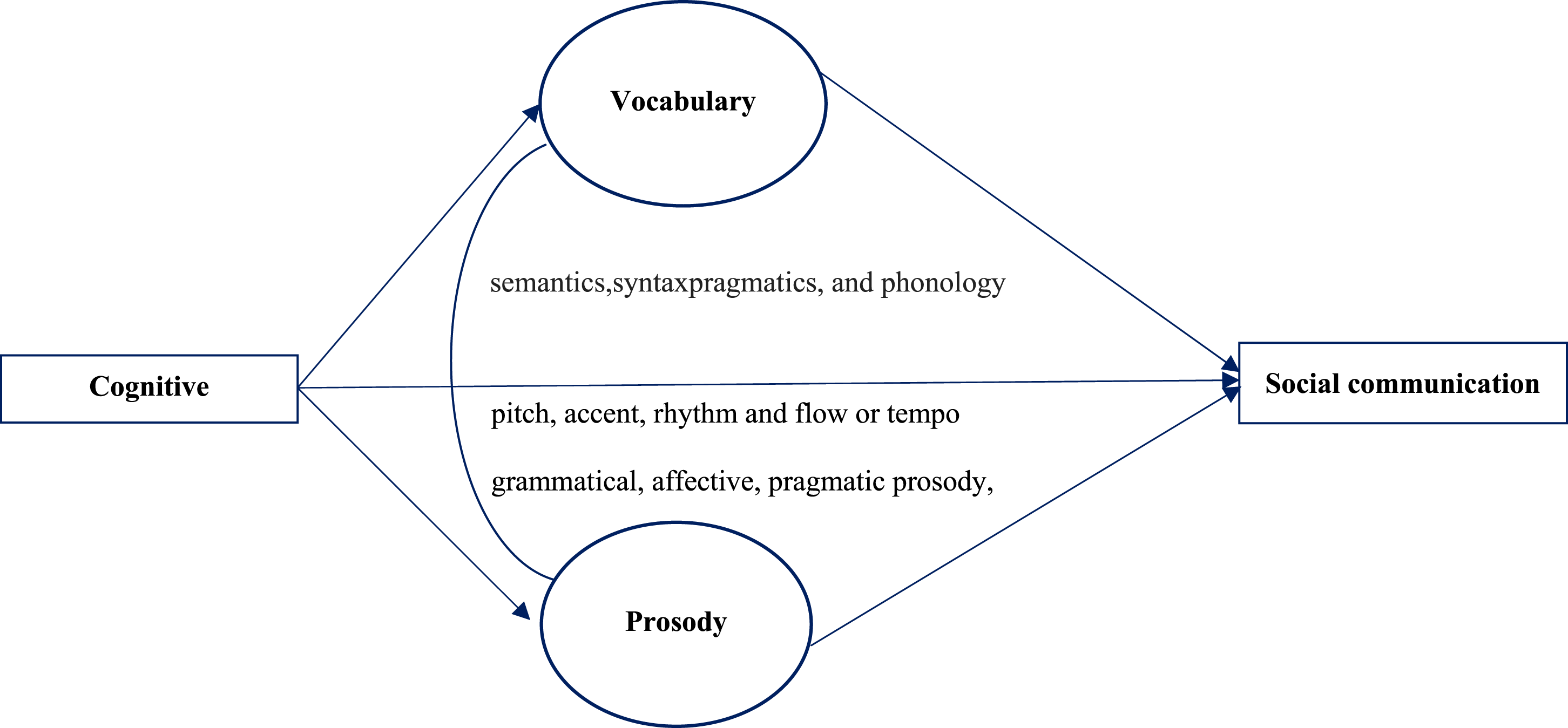
Methodology
Included Studies
To carry out this theoretical review, a systematic search of the ScienceDirect and NCBI (PubMed and PubMed Central) databases was performed. The search key-terms entered the databases were: (autism OR ASD) AND (social communication OR pragmatic) combined with the terms vocabulary, prosody, and cognitive flexibility (or other terms that cover the same ability: ‘switching’ and ‘shifting’). Searches were limited to articles written in English and published from 1990 to 2021, we didn’t include theses or dissertations or unpublished data.
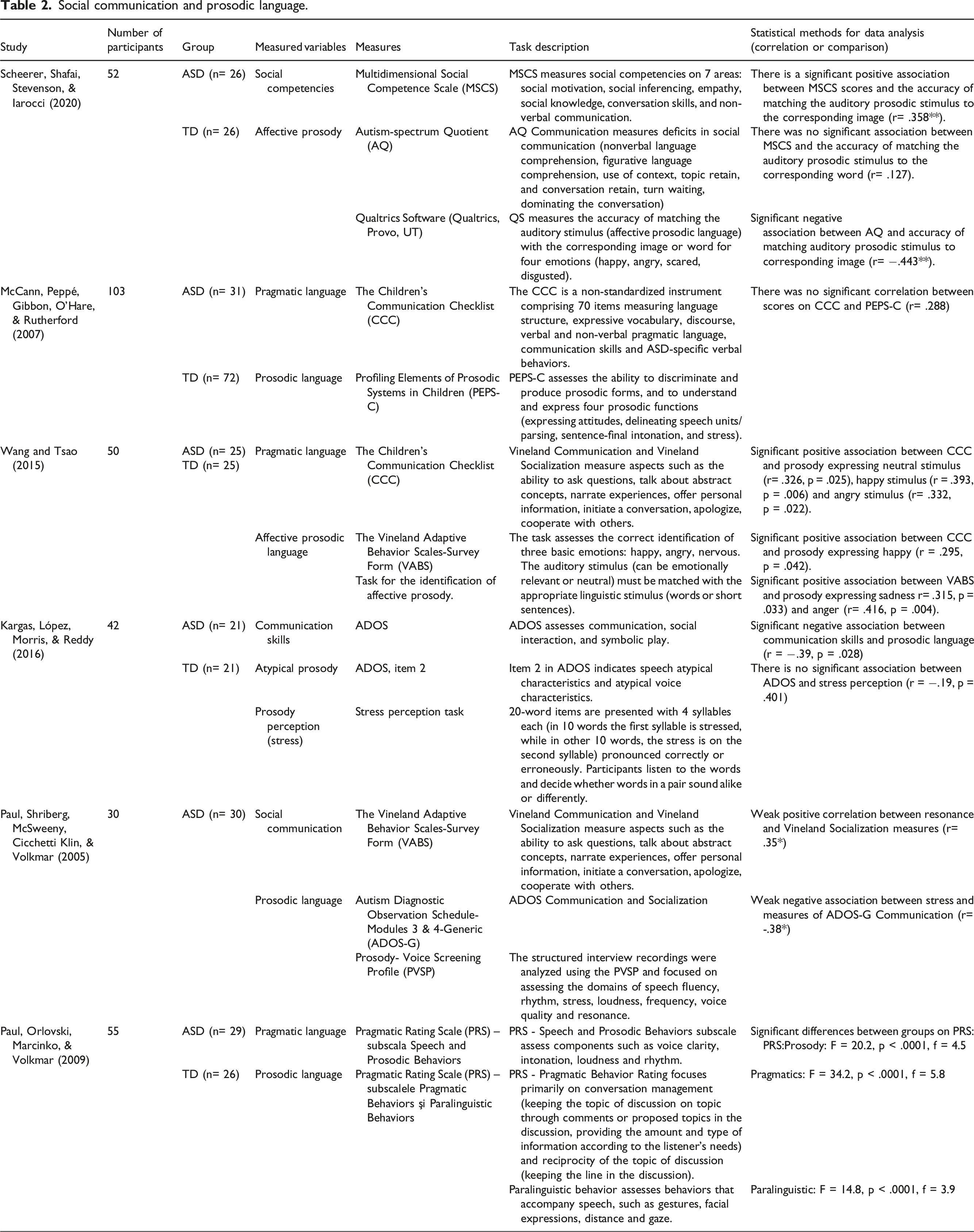
The following inclusion criteria were used: (a) participants to be clinically/professionally diagnosed with autism spectrum disorder, Asperger’s disorder, pervasive developmental disorder without further specification according to DSM or ICD criteria; (b) to report correlational data (Pearson’s correlation index) or quantitative comparison analysis; (c) to measure the targeted components (social communication, vocabulary, prosody and cognitive flexibility). Initial searches identified 10,491 items. In the first stage of the selection process, all papers whose titles or abstracts were not clearly relevant to this synthesis were excluded. In the second stage of the selection process, all papers with a title or abstract that appeared to be relevant to the review (N = 162) were examined in detail to exclude any irrelevant and/or studies that did not meet the inclusion criteria. 18 articles were selected at the end of this process (see Figure 2). After selecting the studies included in the synthesis, relevant information and variables from each study were summarized in Table 1, Table 2, Table 3. The data described in the table include: the size and diagnostic description of the participant group, the components measured (expressive and receptive language, pragmatic language, social communication, prosodic language, and cognitive flexibility), the assessment instruments, a brief description of the instruments, and a specification of the significance of the correlation or comparison measured in the study. PRISMA diagram (summary of the studies selection process). Social communication and vocabulary. Social communication and prosodic language. Social communication and cognitive flexibility. Note. TD = typically developing children; SXF = fragile X syndrome.


Results
Characteristics of the Studies: Participants And Measures
18 studies met the criteria. The studies were published between 1991 and 2021, with only one study published before 2000. Sample sizes ranged from 29 to 225 participants, with an average sample size of 76 participants and a total of 1523 participants. The age of the participants ranges from 6 to 49 years old. Reported diagnoses of participants included autism, autism spectrum disorder, Asperger’s disorder, pervasive developmental disorder without further specification, and often participants were described as high functioning. The method of data collection varied between studies. Studies used a wide range of instruments to assess target components (Table 1, Table 2, and Table 3). Researchers have used standardized instruments alongside interviews, experimental tasks, other assessments based on parent/caregiver/teacher reports.
Vocabulary
Few studies have investigated the relationship between social communication or pragmatic language and vocabulary in children with ASD. Two of these studies are included in this paper and are primarily aimed at identifying the relationship between language and perspective change (Eisenmajer & Prior, 1991; Losh et al., 2012), and the third compares language and communication skills in boys and girls with ASD (Sturrock et al., 2020).
Eisenmajer and Prior (1991) assessed, using the WISC-R or WPPSI, language skills in several domains (verbal concept formation, comprehension, and vocabulary) and pragmatic language using the Pragmatic Skills Test (Table 1). Correlations could be observed between comprehension and pragmatic skills, verbal concept formation and pragmatic language. However, no association was reported between vocabulary and social communication. The second study was included because it measures and compares pragmatic skills in children with ASD and typically developing children. The results indicated that the group of children with ASD had poorer levels of pragmatic performance (measured using CASL and CCC, Table 1.) than the group of typically developing children (Losh et al., 2012).
In the third study, both receptive and expressive vocabulary were measured. In general, typically developing children showed a more developed receptive vocabulary than boys and girls with high-functioning autism. However, this effect disappeared when the intelligence variable was controlled for. For expressive vocabulary, no significant differences were observed between groups. In general, all results of pragmatic language measures were consistent, girls diagnosed with ASD performed better than boys on the spectrum, and typically developing children performed better than children with high-functioning ASD (Sturrock et al., 2020).
Prosodics
Closely related to pragmatic skills is the understanding and production of prosody. Both the perception of prosody by children with ASD and the specific features of expressive prosody within the disorder have been investigated in the literature. Prosodic impairments in ASD are mainly thought to result from increased attention to verbal cues, leading to decreased attention to linguistic information, or due to higher order processing impairments at the level of interpretation, such as understanding others’ mental or affective states (Kargas et al., 2016). McCann et al. (2007), reported that most children in the study had significant deficits in both receptive and expressive prosodic skills, and all children had difficulty on at least one of the PEPS-C subtests. When comparing children with autism to the control group, it was observed that prosodic ability is less developed in children with autism. Most of the studies that were included in this synthesis reported significant deficits. Four of them focused on the receptive part of the prosodic language (Scheerer et al., 2020; McCann et al., 2007; Wang & Tsao, 2015; Kargas et al., 2016). Kargas et al. (2016) observed that adults with ASD have difficulty with stress perception. Even within a relatively homogeneous group (in terms of diagnosis and intelligence level) performance on the stress perception task for four-syllable words (first stressed syllable or second stressed syllable) varied considerably.
Regarding the perception of emotions conveyed using prosody, Scheerer et al. (2020) reported that both children with ASD and typically developing children correctly matched auditory stimuli carrying an emotionally relevant message, with words describing the main emotional states (happy, angry, scared, disgusted). These results suggest that, in certain contexts, children with ASD can accurately extract the affective meaning conveyed by changes in prosody. On the other hand, when the auditory stimulus had to be paired with a picture, both groups had lower accuracy in identifying the correct facial expression, but in these conditions’ children with ASD had a more significant drop in performance.
In another study assessing the identification of affective prosody, it was found that participants (both children with ASD and the control group) found it easier to correctly identify emotions in sentences than in words, suggesting that prosodic cues serve as a more useful basis for emotional judgments in sentences than in words. In other words, children with ASD perceive emotions more accurately in sentences with embedded prosodic cues than in words (Wang & Tsao, 2015). The results of this study also showed that children with ASD (high functioning) had greater difficulty recognizing positive emotional prosody than typically developing children for both emotionally neutral sentences and emotionally relevant words.
In terms of producing prosody, one study reported only 33% (10 of 30) of participants as having inadequate resonance and 47% (14/30) as using inadequate accent. Moreover, these prosodic deficits are relatively independent of each other, so that individuals may struggle in some aspects of prosodic production while in others exhibit relatively typical prosody (Paul, Shriberg, et al., 2005). Paul et al. (2009) also observed unnatural intonation in children and young people with autism.
The Relationship Between Pragmatic Language And Prosody
Three of the studies presented in the current paper reported an association between social communication and prosodic language (Paul, Shriberg, et al., 2005; Scheerer et al., 2020; Wang & Tsao, 2015). Two of the studies investigated the relationship between social skills and perceived affective prosody (Scheerer et al., 2020; Wang & Tsao, 2015). Both showed a significant association between social communication or pragmatic language and the perception of emotions conveyed through prosody.
In the first study, correlational analyses were conducted to investigate the relationship between social skills (measured with MSCR, Table 2), communication characteristics in autism spectrum disorder (measured with AQ, Table 2) and the accuracy of perception of affective prosody. Accuracy of matching facial expressions in pictures to the appropriate prosody correlated with parent-rated general social skills (MSCR) as well as with characteristics of ASD. These results suggest that the ability to extract affective information from a speaker’s voice in certain contexts may be associated with more effective social communication (Scheerer et al., 2020). In addition, a second study revealed associations between the perception of positive (happy) emotion prosody, pragmatic language, and social adjustment. Moreover, poor perception of prosody is associated with more severe symptoms in ASD. These findings support the hypothesis that limitations in the perception of affective prosody are related to social communication impairments in school-aged children with ASD. The results of this study support those difficulties for children with ASD in perceiving positive emotion prosody underlie their poor performance in recognizing emotions and speaker’ communicative intentions (Wang & Tsao, 2015).
Also in this study, the understanding of emotional prosodic perception in children with high-functioning autism was investigated using emotional prosody presented with words and sentences. Results showed that school-aged children with high-functioning autism are less accurate than typically developing children in using prosodic information to recognize positive emotion (happy); however, they perform as well as typically developing children in perceiving negative emotion prosody (sad and angry). In addition, children with autism who had higher accuracy in perceiving positive affective prosody also had higher functional abilities in pragmatic language and social adjustment, suggesting that increasing prosody perception skills in children with ASD may reduce their communication and social adjustment difficulties (Wang & Tsao, 2015).
However, a third study that assessed both understanding and production of prosody found no association between these, and social communication skills assessed with The Children’s Communication Checklist (CCC). In this study, the authors proposed a prosody assessment tool, PEPS-C, an instrument designed to assess a range of prosodic functions/forms that develop at different ages in typically developing children. This test does not measure prosodic difficulties that are the result of atypical expressive prosody. For example, some of the children who participated in the study had unusual expressive prosody, but this did not result in any loss of communicative function (e.g., the conversation partner could distinguish a question from a statement, albeit possibly in an atypical way). If this test had also measured these atypical features, some positive correlations may have been identified (McCann et al., 2007). The authors of the study argue that these results may also be due to the test that assessed prosodic skills (CCC).
Also, Kargas et al. (2016) reported that performance on the stress perception task was not significantly related to communicative skills in ASD, indicating that difficulties perceiving primary prosodic information may not fully predict differences in general language and communication skills. However, a significant negative correlation could be observed between the communicative ability score measured with ADOS (total communicative ability score without item 2) and atypical prosodic items also measured with ADOS (item two only). In other words, communication skills are highly associated with prosodic skills.
In Paul et al.'s (2005b) study of expressive prosodic skills, both regression and distribution analyses revealed weak correlational relationships between specific prosodic voice deficits and social and communicative skill. Although some individuals with ASD have more difficulty with appropriate phrasing than typically developing children of the same age, their errors do not appear to have any significant effect on listeners’ judgments of their social and communicative ability. Stress and resonance problems do, however, appear to influence listeners' perceptions of their social and communicative skills.
In the last study presented in the synthesis, the focus was on investigating differences between children with ASD and typically developing children on three domains assessed by the PRS scale. These domains relate to pragmatic language and prosodic language. Study results have shown that there is a significant difference between groups in intonation (Paul et al., 2009).
Cognitive flexibility
Most studies included in the review reported no statistically significant association between social communication and cognitive flexibility. One study reported that cognitive flexibility reached statistical significance as an independent predictor for social behavior in children with ASD (Bertollo et al., 2020) and another longitudinal study found that poorer cognitive flexibility executive skills predicted poorer adaptive behavioral socialization skills (Pugliese et al., 2016).
In three of the studies, the statistical association between the two components was reported to be weak (Akbar et al., 2013; Memari et al., 2013; Torske et al., 2018). In the study by Memari et al. (2013), language (language, syntax, and communication) and social skills were measured with two subscales of the ATEC test, and a weak association between cognitive flexibility and language skills could be observed. The authors noted that cognitive flexibility and language depend on each other. The main finding of the study conducted by Torske et al. (2018) was that the most important factor in explaining social function in children with ASD was the metacognitive component of executive functions (MI - initiation, working memory, planning and self-monitoring). Despite the high scores of the behavioral regulation component (BRI- inhibition, cognitive flexibility, and emotional control), the metacognitive component explained better the social responsiveness deficits (Table 3) in children with ASD.
The study conducted by Kouklari et al. (2018) obtained a positive association between working memory and cognitive flexibility and social verbal communication skills in ASD. However, this association decreased when control variables (perspective shifting) were adjusted. Another similar study measured executive functions in addition to understanding mental or emotional states and concluded that between executive functions (including cognitive flexibility) and social behavior typical of autism spectrum disorder there is no direct association. There is an indirect effect through their association with theory of mind (Jones et al., 2018).
Two other studies reported no correlation between social communication and cognitive flexibility. Tsermentseli et al. (2018) measured social skills with the SRS scale, and scores on this scale were not associated with any executive function scores. When social interaction was measured using the ADI-R (Table 3), again there was no correlation with executive functions (Chen et al., 2016).
Two studies comparing cognitive flexibility skills in children and adolescents with ASD and typically developing children were also included in the review (Chen et al., 2016; Kouklari et al., 2018). In the first study, results demonstrated the presence of specific executive function deficits in children with ASD (especially cognitive flexibility and inhibition) as compared to typical children of the same age (8–12 years) (Kouklari et al., 2018). The second study obtained the same results for the group of children of 8–12 years of age, but the difference between groups did not remain significant for the groups of adolescents with ASD and for those with typical development (13–18 years).
Conclusions and Discussions
The aim of this study was to collect and analyze scientific data that have been reported so far in the literature on social communication or pragmatic language and its relationship to vocabulary, prosodic language, and cognitive flexibility in children with autism spectrum disorder. Another aim of this study was to highlight the differences between children with ASD and typically developing children by comparing their performance and skills in language (vocabulary and prosody), social (pragmatic language) and executive (cognitive flexibility). There was wide variation in reported outcomes both between and within studies, which also reflects the wide individual variation characteristics of people with ASD.
Taken together, the studies showed that the receptive and expressive vocabulary of children with autism are similar to typically developing children. However, they perform much less well in social communication situations. Following the results reported by Eisenmajer and Prior (1991), we can say that there is no association between vocabulary and pragmatic language, but due to the few studies that have measured the two variables, we cannot draw a conclusion on the relationship. Also, at the level of prosodic language, the reported results show that adults and children with autism perform worse at identifying, understanding, and producing prosody compared to typically developing children. The most common difficulties encountered among those with autism spectrum disorder were in perceiving stress, understanding the affective message conveyed through prosody, and in producing prosody (inadequate resonance, accent and intonation). It is possible that these problems are not simply due to a pure prosodic deficit, but rather to the complexity of the task or to the nature of the disorder, as numerous studies have noted this difficulty in processing the emotions of facial expressions (Balconi & Carrera, 2007). Another explanation proposed by the authors for this difference in performance could be due to the inability to simultaneously process and integrate several stimuli (perception of prosodic changes and facial expressions). In producing prosodic language, children with autism performed worse than typical children, and the areas most affected were intonation, stress, and expression of emotion (the ability to express likes and dislikes). However, social communication was very little affected by these atypical forms of prosody.
The relationship between the accuracy of perceiving affective prosody and social communication behaviors suggests that the modality used to assess the ability to extract affective meaning conveyed through prosodic language may provide valuable insights into the everyday conversational skills of children with ASD. In interactions with others, the ability to understand the prosodic shifts that indicate the emotional states and intentions of the speaker is very important. The inability to understand the emotion the speaker is expressing, whether the speaker is being serious or sarcastic, making a statement or asking a question, along with other important issues related to the changes that occur in prosody, can cause confusing or awkward social interactions. The inability to accurately deduce the intended meaning of other people’s speech would certainly create a barrier to effective social communication. If children with ASD can be taught to identify changes more accurately in prosody during social interactions, this may have a positive effect on social skills and thus social functioning in general.
Except for the two studies showing an association between the perception of affective prosody and social communication, results reported in the other studies were mixed, making it difficult to pinpoint the exact relationship between pragmatic and prosodic language. Other studies have found that there is a relationship between the production of prosodic language by children with ASD especially stress and resonance, and communication skills (Paul et al., 2005a; 2005b) but there is no relationship between stress perception and social communication (Kargas et al., 2016). Overall, we can say that expressive prosody (stress and resonance) and affective receptive prosody have an effect on social communication, but future research is needed to understand more precisely the link between the two domains.
The third variable examined in this paper was cognitive flexibility. In two of the studies, the cognitive flexibility skills of children and adolescents with ASD were compared to those of typical children/adolescents of the same age (Chen et al., 2016; Kouklari et al., 2018). Both studies reported significant differences between groups of children aged eight to 12, but the difference did not remain significant for the adolescent group. This age difference between participants could explain this discrepancy in results. Previous studies have also reported inconsistent results in adults with ASD. Researchers have suggested that the difficulty of the attention-shifting task may play an important role in adult outcomes (WCST uses a more complex task, while CANTAB uses simpler rules). Therefore, adolescents or adults with ASD may or may not have deficits in cognitive flexibility depending on the task (Chen et al., 2016).
Regarding the relationship between cognitive flexibility and communication in social situations the results were mixed. Two studies reported a significant association, three studies showed a weak association, two other studies obtained that cognitive flexibility has an indirect effect on communication through theory of mind, while the last two studies found no association between the two variables. One explanation for this result could be the variety of assessment instruments. For example, some studies used only parent reports in measuring pragmatic language, other studies did not measure executive functions individually, but measured them using the BRIEF-BRI, a scale that provides a total score of cognitive flexibility, inhibition, and emotional control.
In conclusion, social communication is a fundamental factor underlying the quality of life, relationships, and professional independence of individuals with ASD, which shows the need to understand this complex domain and the importance of identifying the underlying causes of these deficits within the disorder. For this reason, the aim of this paper was to investigate studies in the literature on the relationship between communication in social contexts and vocabulary, prosodic language, and cognitive flexibility as well as to investigate whether there are differences between groups of participants with ASD and typical participants across the four domains.
The results showed that there are no significant differences in receptive vocabulary and expressive vocabulary between children with ASD and typically developing children, and that the vocabulary is not a unique predictor of pragmatic language. Investigation of other components of language in relation to social communication is needed.
Studies have also shown that there are significant differences between the two groups in the production and perception of prosody. It was also observed that expressive prosody (stress and resonance) had a major impact on social communication, as did the perception of emotions conveyed through prosody (perception and understanding of affective prosody).
Regarding cognitive flexibility studies reported significant differences between groups of children on tasks measuring cognitive flexibility, but the difference did not remain significant for the adolescent group. Currently studies have reported mixed results, future research is needed to fully understand the relationship between social communication and cognitive flexibility. Moreover, it is difficult to find a direct link between cognitive flexibility and social communication, considering the mediating effect of vocabulary and prosody between that relation. Even if our theoretical review didn’t manage to capture entirely and emphasize the link between executive functioning, vocabulary, and social communication, at least parts of this model were addressed. Further studies are needed in order to establish the underlying mechanisms of social communication deficits in children with ASD, as well as the role of executive functions in their social adaptative skills.
Our theoretical review has also some practical implications, starting from our theoretical model described in Figure 1. We believe that investigating the relationship between the predictors of social communication in ASD some integrative models could emerge that could explain the strengths and weakness of people with ASD. Moreover, intervention models based on the development of vocabulary and prosody in social contexts could emerge from our theoretical model. Finally, the emphasis on how knowledge is being transferred from one social context to another in order to reach social acceptance and inclusion can also be the subject of next research studies which involve cognitive flexibility in children with ASD.
Limits and Future Research Directions
The conclusions of this theoretical analysis should not be interpreted without considering its limitations. Firstly, the search could have been extended to other databases to exclude the risk of missing important studies. In addition, the search process was not repeated by another researcher, but was carried out by the author alone. Lastly, the studies varied widely in terms of selection and sample size, many of the studies did not have a control group, diagnosis and assessment measures were diverse, some studies had a high number of participants with high-functioning autism which could limit the generalizability of the results to a wider spectrum of children with autism. Some studies used only indirect assessment through reports completed by caregivers or teachers and other methodological features that prevented establishing a fair way of taking all these factors into account in qualitative assessment of studies. In this study we have attempted, to identify consistent patterns and trends in the included studies. Therefore, this data should be interpreted with caution and future studies it is important to investigate other factors that might influence social communication deficits (such as working memory). Even if cognitive flexibility fails to fully explain poor social communication in children with ASD, some executive functions (e.g., planning, flexibility and working memory) may improve social performance to some extent. Secondly, it is essential to investigate what causes the low performance in emotional prosody perception among children with ASD (whether the deficit is of a prosodic nature, related to emotion perception or multisensory integration) and to what extent cognitive flexibility is impaired in adolescents and adults with ASD. On the other hand, more databases should be included in the search and quantitative approaches (e.g., meta-analysis) should be implanted for more reliable conclusion. Moreover, one more possible limitation of this study is represented by the fact that we did not control for IQ. Previous studies have shown the link between IQ and verbal skill, therefore that can also partly explain our mixed results. Understanding the different profiles of social communication, language, and executive functions will allow the creation of specific interventions for distinct developmental patterns, with major implications for the quality of life, satisfaction and social integration of people with ASD.
Footnotes
Author Note
Cristina Costescu, Special Education Department, Faculty of Psychology and Educational Sciences, Babes -Bolyai University, Pitariu Delia, Special Education Department, Faculty of Psychology and Educational Sciences, Babes -Bolyai University Carmen David, Special Education Department, Faculty of Psychology and Educational Sciences, Babes -Bolyai University, Adrian Roșan, Special Education Department, Faculty of Psychology and Educational Sciences, Babes -Bolyai University
Declaration of Conflicting Interests
The author(s) declared no potential conflicts of interest with respect to the research, authorship, and/or publication of this article.
Funding
The author disclosed receipt of the following financial support for the research, authorship, and/or publication of this article: This work was supported by the Babes-Bolyai University (GTC No. 35285/18.11.2020).
