




Abstract
Perfectionism is a personality disposition usually defined considering the demands toward performance outcomes. Maladaptive perfectionists have more concerns over getting adverse performance outcomes than adaptive perfectionists. As an indicator of impulsivity, individuals' reaction time is significantly shorter after getting negative performance feedback than positive feedback. We conducted the present study to investigate the differences among perfectionists concerning the task-based impulsivity measures after getting negative and positive performance outcomes in a gambling task. A sample of 60 adults (22 adaptive, 20 maladaptive, and 18 non-perfectionists) performed a monetary gambling task while receiving positive or negative feedback. The findings revealed that maladaptive perfectionists had more impulsive responses than the other groups regardless of the feedback. The adaptive perfectionists spent more time choosing answers after each kind of feedbacks to make accurate decisions. The reinforcement sensitivity probably addresses the between-group differences of perfectionists in impulsivity. The findings of this study will help clarify the complex process of learning.
Introduction
Performance outcomes define how people then behave. Both negative and positive performance outcomes are a great resource to learn (Freedberg et al., 2017; Van Duijvenvoorde et al., 2008). After getting negative feedback, individuals will learn to behave in a manner that will not lead to more negative outcomes. They may learn to slow down and to spend more time to have better performances (Danielmeier & Ullsperger, 2011; Wessel, 2018). From another perspective, it seems that people learn from their performance outcomes regarding their differences and personality traits. Thus, Individual reactions may be significantly different after getting positive and negative feedbacks according to their personality traits, such as perfectionism (Lo & Abbott, 2019).
Perfectionism is a personality trait characterized by striving for flawlessness and setting excessively high standards for performance accompanied by tendencies toward overly critical evaluations of one’s behavior (Stoeber, 2018). Factor analysis studies have revealed that perfectionism includes two factors: a maladaptive dimension and an adaptive dimension.
Adaptive perfectionism is related to perfectionistic striving, such as setting high personal standards for one’s performance. In addition, this dimension is correlated with positive psychological outcomes such as positive affect (Mallinson-Howard et al., 2019), happiness, life satisfaction (Suh et al., 2017), and self-esteem (Chen et al., 2017). In contrast, maladaptive perfectionism subsumes those facets related to evaluative concerns such as excessive concerns over making mistakes, self-critical performance evaluations, doubts about actions, negative reactions to mistakes, negative feelings of the discrepancy between one’s actual and expected performance outcomes, and fear of negative evaluations (Stoeber & Otto, 2006). This dimension is associated with negative psychological outcomes such as depression (Cooks & Ciesla, 2019), anxiety (Tyler et al., 2019), and low self-esteem (Taylor et al., 2016).
The significant difference between these two groups is their evaluative concerns about performance outcomes; accordingly, maladaptive perfectionists are more concerned over making poor performance and getting negative outcomes (Stoeber & Otto, 2006). Considering the diverse performance outcome evaluation in perfectionists, it is predictable that there will be between-group differences in their reactions after getting particularly negative performance outcome.
Regardless individual differences and personality traits like perfectionism, a negative feedback may elucidate emotional reactions like impulsivity rather than rational response in normal population (Dyson et al., 2018; Verbruggen et al., 2017). Impulsivity is a multidimensional construct characterized by a tendency to place immediate gain ahead of long-term consequences (Logue, 1995), quick response to stimuli without adequate forethought (Moeller et al., 2001), and failure to inhibit a pre-potent reaction (Horn et al., 2003).
Previous studies showed the associations between impulsivity and perfectionists. Some of them suggested a positive relationship between the maladaptive dimension of perfectionism and impulsivity. Boon et al. (2014) reported high levels of self-reported impulsivity between maladaptive perfectionists. Based on Slof-Op’t Landt et al. (2016), unhealthy perfectionism can positively predict impulsivity. It seems that adaptive perfectionists spend more time responding to cognitive tasks than maladaptive perfectionists, which may justify their differences in performance quality. Maladaptive perfectionists with impulsive reactions demonstrate poor performance, while adaptive perfectionists spend additional time to choose more accurate responses. (Stoeber et al., 2010). On the other side, Wainwright et al. (2020) demonstrated the association of self-report impulsivity with specific perfectionism dimensions; while, the behavioral measure was not associated with perfectionism. Maladaptive perfectionism has been associated with decreased self-reported impulsivity, whereas adaptive perfectionism has been associated with increased impulsivity. This result contradicts the findings of previous studies. It might potentially result from bias in the self-report measures, which may be inaccurate compared to more objective behavioral measures.
As mentioned above, impulsivity has been studied between perfectionists; however, it is not studied yet regarding performance feedback. Considering the cognitive differences between two groups of perfectionists in performance outcomes processing, maladaptive perfectionists' reaction time may differ from those of adaptive perfectionists in the subsequent trial of a task after receiving negative feedback regarding their performance in the previous trials of the task. Investigating their difference will be beneficial in understanding learning and its’ related cognitive processes such as performance outcome evaluation regarding personality dispositions like perfectionism. In addition, self-reported studies may suffer from biases. So, it is needed to do more behavioral and task-based studies in this area. Thus, the present study aimed to investigate the group differences between perfectionists’ task-based impulsivity measures after receiving different positive and negative performance feedback. According to previous studies revealed maladaptive perfectionists are more evaluative about their performance, we hypothesized that maladaptive perfectionists would have greater levels of impulsivity in adverse conditions than adaptive perfectionists.
Method
Participants
A sample of 400 university students was initially selected using the cluster sampling method. The participants completed the Almost Perfect Scale-Revised (APS-R) to assess perfectionism. Subsequently, out of 400 students, 60 (18 non-perfectionists as well as 42 participants who got the highest scores on adaptive (22), and maladaptive dimension (20) and accepted our invitation to participate in the study; 42 women, 18 men), aged between 18 and 30 years old, participated in this study. All the participants were right-handed, with normal or corrected-to-normal vision, and no neurological or psychiatric disease history. After receiving the subjects’ consent forms, participants completed the monetary gambling task.
Perfectionism measures
Almost perfect scale-revised
The almost perfect scale-revised (APS-R; Slaney et al., 2002) was applied to measure the participants’ perfectionism. This test contains 23 items and three subscales, namely High standards, Order, and Discrepancy. The responses were rated on a 7-point Likert scale from 1 (strongly disagree) to 7 (strongly agree). Based on the cut-off points introduced by Rice and Ashby (2007), the participants were divided into three groups. High scores (greater than or equal to 42) in the high standards scale with low scores (less than 42) in the discrepancy scale indicate adaptive perfectionism. High scores in high standards and discrepancy scales (greater than or equal to 42) indicate maladaptive perfectionism. Those with low scores in high standards were recognized as non-perfectionists. Sastre-Riba et al. (2016) found Omega coefficients of 0.67, 0.82, and 0.85, respectively, for the high standards, order, and discrepancy, indicating adequate reliability. Cronbach’s alpha coefficients were 0.84, 0.72, and 0.75 respectively in the present study. A study in the Iranian sample reported Cronbach’s alpha coefficients of 0.65, 0.50, 0.64, and 0.70 for high standards, order, discrepancy, and the whole scale, respectively, which shows good reliability (Noori Samarin et al., 2013).
Monetary gambling task
A modified version of the monetary gambling task (Gehring & Willoughby, 2002) was used to provide participants with positive and negative feedbacks. The task was administered and presented employing the eevoke™ (ANT Neuro, Enschede, Netherland) software. As shown in Figure 1, the task began with the presentation of a 500 ms fixation mark (*). The participants were shown two cards with 5 and 25 numerals (choice alternatives). The alternatives remained on the screen for 2000 ms, and the participants had to select one of them by pressing the left or the right arrow key respectively for the cards on the left and right sides of the screen with their index and middle fingers. After presenting the 500 ms inter-stimulus interval, the chosen and alternative responses were shown by revealing the sign (+ or -) of each numeral. The feedback remained on the screen for 1000 ms, and the next trial started following the 1000 ms inter-trial interval. The sequence of events in a trial of monetary gambling task.
Lists of possible combination of chosen outcome and alternative outcomes. The blue conditions indicate the four conditions chosen here to analyze. Adopted from Nieuwenhuis et al., 2004.

A negative outcome in cognitive tasks could be loss or error feedback. We chose to use the monetary gambling task since it provides both kinds of negative and positive feedbacks. In such tasks, loss and correct feedback illustrate a “loss” even when the chosen answer is correct. Moreover, gain and error feedback implies an “error” regardless of whether the chosen answer is followed by gain. Even though the two mentioned conditions represent negative performance outcomes, the loss/error condition is the most illustrative marker of negative feedback. The feedback shows that a participant has lost some money and the chosen answer is wrong. It is expected that this kind of performance feedback will lead to the most emotional reactions (i.e., more impulsive reactions in the current study) since the subject loses money and chooses an incorrect answer. In addition, again/correct answer is completely positive feedback.
The whole task consisted of 160 trials for the loss/error and gain/correct conditions and 32 trials for loss/correct and gain/error conditions. Given the notion that one of the possible outcomes was analyzed per condition, the number of analyzed trials was 32 in each condition. The blue conditions represented in Table 1 indicate the four conditions chosen here to analyze.
Statistical analysis
A repeated measure ANOVA using group (adaptive, maladaptive, non-perfectionist) by condition (loss/error, gain/error, loss/correct, gain/correct) was conducted on mean response times (RTs). Mauchly test that showed violation of the assumption of sphericity [X2(5) = 12.64, p < .001], therefore, Greenhouse-Geisser correction was applied. Posthoc comparisons were conducted to explore the significant main and interaction effects. The analyses were conducted using jamovi (Version 1.6).
Results
Mean and SE for each group and condition.

Between-group comparisons.

We further explored the significant interaction of group by condition. Post hoc comparisons between the groups revealed significantly faster responses in all four conditions in the maladaptive group as compared to the other two groups. The adaptive perfectionist and non-perfectionist groups differed only in the gain/correct condition that the non-perfectionist group was faster than the adaptive group (Figure 2).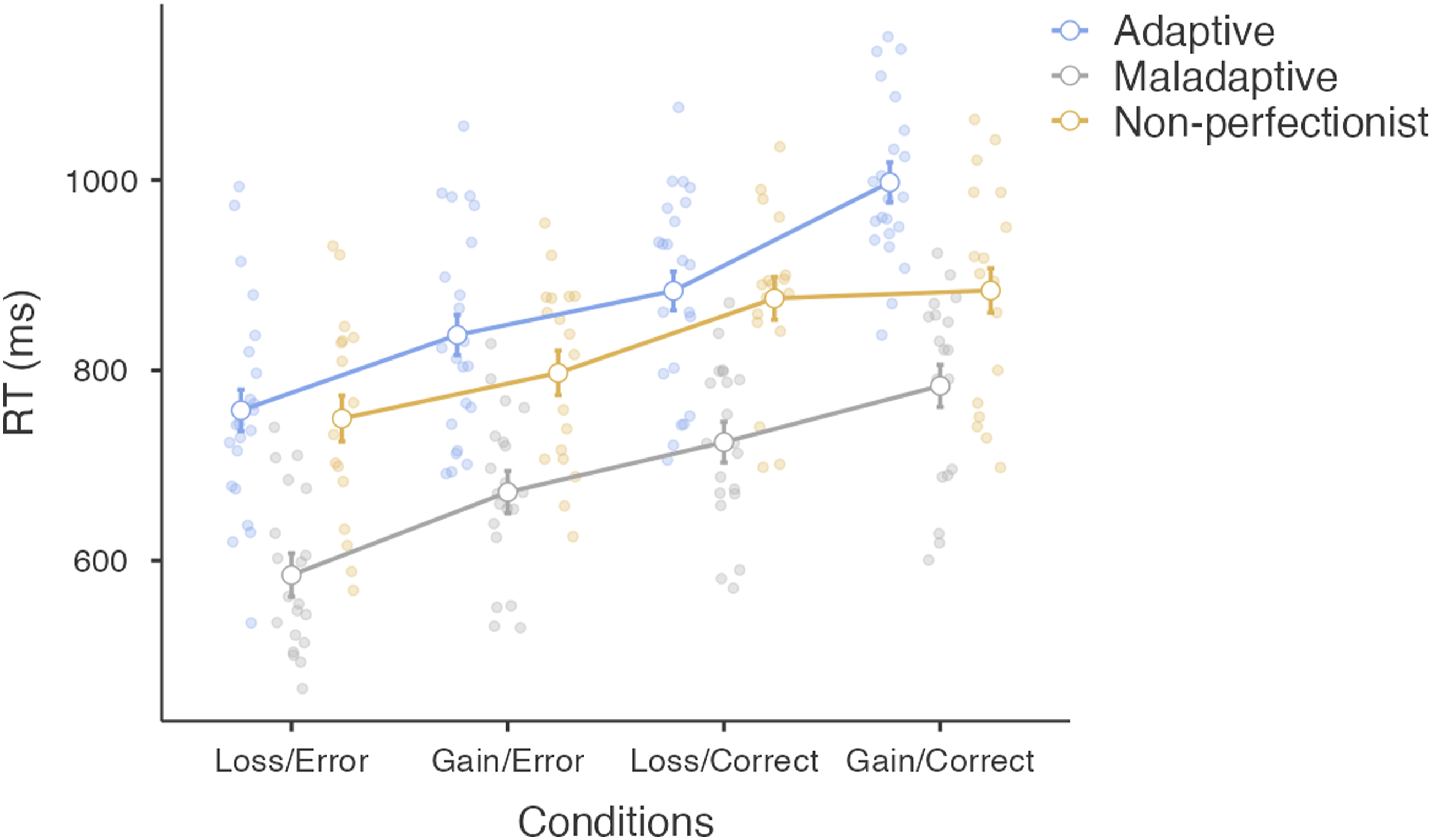
Discussion
Impulsivity after getting negative feedback may reveal us that human is not necessarily rational under each condition. They may react in an emotional and impulsive manner when they are upset from having a poor performance (Verbruggen et al., 2014). It is not the end of the story, but individuals may have a different level of impulsivity in terms of their personality traits, such as perfectionism (Wainwright et al., 2020). In the present study, we aimed to compare two sub-groups (adaptive and maladaptive) of perfectionists and non-perfectionists in terms of task-based impulsivity following several positive and negative performance outcomes. For this purpose, we used the Monetary gambling task, which provides positive and negative performance feedbacks, and we assessed impulsivity in participants.
The results supported our main hypothesis that maladaptive perfectionists would be more impulsive than adaptive perfectionists after receiving adverse performance outcomes. This finding is consistent with previous research in which maladaptive perfectionists showed more emotional responses after failure (Sagar & Stoeber, 2009). Generally, previous investigations have demonstrated that maladaptive perfectionists have been distinguished from adaptive perfectionists due to their concern about making poor performance. Furthermore, maladaptive perfectionists negatively react after getting poor performance feedbacks (Kaap-Deeder et al., 2016; Sagar & Stoeber, 2009).
In addition, maladaptive perfectionists have exhibited more impulsive reactions after favorable conditions than adaptive perfectionists and non-perfectionists. This finding revealed that maladaptive perfectionists reacted more impulsively than adaptive perfectionists and non-perfectionists in each condition of receiving negative and positive outcomes. The reinforcement sensitivity theory (RST) could also be a basis to explain how adaptive and maladaptive perfectionists differ in impulsivity following gain/correct outcomes. Moreover, adaptive perfectionists have shown high scores in the behavioral approach system (BAS; Mautz, 2013), which high scores of BAS in a group reveal that they are more sensitive to positive stimuli, persistently pursue goals, have a willingness to approach rewarding events, and positively react toward rewards (Corr & Cooper, 2016). However, previous research demonstrated that impulsivity was the only BAS subscale, which was not correlated with perfectionism’s adaptive facets (Stoeber & Corr, 2015). In the present study, the adaptive perfectionists with high sensitivity toward reward positively reacted after receiving a rewarding performance outcome, such as gain/correct feedback.
According to the related literature, maladaptive perfectionists with high scores in the behavioral inhibitory system (BIS; Mautz, 2013) are also more sensitive to adverse events. Furthermore, they have high scores only in the impulsivity subscale of BAS (Stoeber & Corr, 2015), which is also in line with the result of the present study. A study showed that self-oriented perfectionism (an ambivalent form of perfectionism) has positive correlations with both BIS and BAS. However, BAS is a mediator between self-oriented perfectionism and positive effect while BIS has a mediation role between self-oriented perfectionism and negative effects. Both BAS and BIS are the mediators of the correlation between socially prescribed perfectionism (a maladaptive aspect of perfectionism) and negative affect (Stoeber & Corr, 2015). Based on the mentioned research works, the maladaptive group in the present study reacted negatively and impulsively under each condition regardless of whether the outcome is positive or negative. In fact, the pattern of the mean RTs in different conditions was equal in all the groups herein.
Additionally, we found that the greatest impulsive responses followed loss/error outcomes. Impulsivity was highest in the gain/error, loss/correct, and gain/correct conditions, respectively. This finding is consistent with previous studies showing that negative outcomes were followed by further impulsive decision-making (Verburggen et al., 2017), particularly once participants did not have enough control over the outcome (Dyson et al., 2018). As mentioned earlier, the possibility of different outcomes was equal in the present study, and the participants did not have enough control over the feedbacks of their responses. It could be explained through the importance of receiving the largest scores in a monetary gambling task. The correct answers evolved the greatest gains with the greatest scores that would be changed with money. It would probably explain the greatest impulsivity after the conditions consisting of error feedback in all the groups regardless of whether the chosen answer contains gain or loss.
Another finding of the present study revealed that the overall RT in the maladaptive perfectionists was shorter than in the adaptive ones, suggesting that maladaptive perfectionists were more impulsive regardless of the condition. This is also in agreement with previous research reporting that adaptive perfectionists spend more time on a task (Stoeber et al., 2010). As the significant characteristic of adaptive perfectionists, perfectionism strivings could predict more time spent on a task. As a result of spending more time, adaptive perfectionists choose accurate responses. In other words, they put more effort into accuracy rather than speed. However, perfectionists' concern as the main factor in distinguishing maladaptive from adaptive ones does not affect their performances (Stoeber et al., 2010). The findings herein also implied that maladaptive perfectionists probably put more effort into speed than adaptive perfectionists. These findings could probably explain the differences between adaptive and maladaptive perfectionists concerning performance quality. Adaptive perfectionists usually show more efficient performance than maladaptive ones. In addition, they do not evaluate themselves based on their performance outcomes. Yet, self-evaluation of maladaptive groups is dependent on their performance outcomes and achievements (Shafran et al., 2002). As a result, maladaptive perfectionists probably react more negatively in an evaluative task, start to blame themselves, get depressed, and make irrational decisions.
Conclusion
In summary, our results shed light on the fact that maladaptive perfectionists are more impulsive than adaptive perfectionists and non-perfectionists. Behavioral systems' mediator role may address the larger differences in positive than negative conditions. Furthermore, all the studied groups were more impulsive after receiving negative feedback than positive feedback, indicating that individuals could probably make irrational decisions after a negative performance and outcome.
Limitations and future studies
Our study had some limitations. Primarily, the sample predominantly included females since they make 70%. However, future studies should reexamine our findings with samples with a more balanced proportion of males and females. Secondly, the major instrument to choose and distinguish the subjects was the questionnaire; an additional interview would be more precise and useful to find and choose the sample. Thirdly, Iranian cut-off points of APS-R have not been studied yet; therefore, we used the original cut-offs. Future research could also focus on the mediator role of BAS/BIS to clarify the relationship between perfectionism and impulsivity and perfectionism and risk-taking under the conditions of positive and negative outcomes. Additional studies could also be performed to differentiate the impacts of loss and error on different aspects of perfectionism.
Footnotes
Authors’ contributions
LKI: Conceptualization, Data curation, Writing- Original draft preparation, Writing- Reviewing and Editing
MZ: Conceptualization, Visualization
MTS: Methodology, Software
SH: Supervision, Validation, Writing- Original draft Writing- Reviewing and Editing, Investigation
MS: Statistical analysis
Declaration of conflicting interests
The author(s) declared no potential conflicts of interest with respect to the research, authorship, and/or publication of this article.
Funding
The author(s) received no financial support for the research, authorship, and/or publication of this article.
Ethical approval
Prior to the experiment, all the participants received ethical research clearance and presented written informed consent, which was approved previously by the ethics committee of Tabriz University of Medical Sciences (Research ethics code: IR.TBZMED.REC.237).
