




Abstract
The study investigated the affective and cognitive responses (including self-beliefs about personality attributes and the level of certainty associated with these beliefs) to the repeated delivery of performance feedback (failure vs. success) across adaptive and maladaptive dimensions of perfectionism. Participants completed questionnaires and a mental rotation computer task, to which they received feedback for. Performance feedback was delivered at Time point 1 (initial) and at Time point 2 (repeated). Results showed that maladaptive perfectionism predicted increased negative affect after initial failure and decreased confidence in self-descriptiveness ratings for negative-related personality attributes after initial success, with these confidence levels further decreasing following repeated success. Adaptive perfectionism predicted higher self-ratings on positive-related personality attributes but only after initial success. The findings suggest that changes in responses across adaptive and maladaptive perfectionism are influenced by experiences of success rather than failure. Adaptive perfectionism also seemed resilient to input from external sources while maladaptive perfectionism appeared more susceptible to such influence. However, given the preliminary nature of the present findings, further research in this area is needed to understand the impact of performance feedback on the self-concept across these two dimensions of perfectionism.
Despite the many different ways in which perfectionism is defined in the literature, there appears to be consensus among researchers and theorists that perfectionistic individuals are those who set high personal standards and measure their self-worth solely on achievement and productivity (Burns, 1980; Shafran, Cooper, & Fairburn, 2002). The growing body of literature and empirical research has evolved to conceptualize perfectionism as a multidimensional construct (Frost, Marten, Lahart, & Rosenblate, 1990; Hewitt & Flett, 1991), with studies demonstrating support for a two-dimensional approach in studying perfectionism (Bieling, Israeli, & Anthony, 2004; Frost, Heimberg, Holt, Mattia, & Neubauer, 1993; Stairs, Smith, Zapolski, Combs, & Settles, 2012). The first dimension can be considered “adaptive” and has been shown to be related to higher levels of positive affect, self-esteem, self-efficacy, life satisfaction, and lower levels of negative affect (Chang, Watkins, & Banks, 2004; Dunkley, Zuroff, & Blankstein, 2003; Frost et al., 1993; Rice, Ashby, & Slaney, 1998). The second dimension is believed to reflect the more “maladaptive” aspects of perfectionism and has been consistently associated with higher levels of negative affect, external locus of control, and feelings of hopelessness (Enns, Cox, Sareen, & Freeman, 2001; Frost et al., 1993; Suddarth & Slaney, 2001). Such findings suggest potential differences in the underlying self-beliefs that maintain adaptive and maladaptive dimensions of perfectionism.
The self-concept is an organized structure that contains one’s self-beliefs and is responsible for the processing of self-relevant information (Kihlstrom et al., 1988; Markus, 1977). The structural features of the self-concept typically focus on the way in which the contents of the self-concept are organized, such as self-concept clarity and temporal stability (Campbell, 1990). Research into the structural components of the self-concept have implicated “clarity” in one’s perception of their self as being related to psychological well-being (Campbell et al., 1996). Further, Campbell (1990) suggests that those with uncertain self-concepts are more likely to be influenced by external self-relevant information. Similarly, Crocker and colleagues’ work on contingencies of self-worth (i.e., the domains in which individuals base their self-worth on) (Crocker, 2002; Crocker & Knight, 2005; Crocker & Wolfe, 2001) suggests that external contingencies (e.g., approval from others) are linked to poorer psychological well-being than those contingencies that are dependent on intrinsic aspects of the self (e.g., religious faith) (Crocker, Luhtanen, Cooper, & Bouvrette, 2003).
Previous studies investigating the relationship between structural aspects of the self-concept and perfectionism have found that the more “adaptive” dimensions of perfectionism are associated with higher levels of self-concept clarity, while the “maladaptive” dimensions are related to poor self-concept clarity (Campbell & Di Paula, 2002). Recently, Lo and Abbott (2019) examined the potential differences in self-concept content (and the level of self-concept certainty) across subtypes of perfectionists and found that individuals classified as adaptive perfectionists tended to possess more positive beliefs and less negative-related beliefs about their personality attributes than do those classified as maladaptive perfectionists. However, their findings regarding self-concept certainty were less clear, although adaptive perfectionists typically appeared to be less uncertain about the beliefs related to their positive self-attributes when compared to maladaptive perfectionists.
To understand how perfectionists respond to “less than perfect” performance (i.e., circumstances that are suggestive of a failure in meeting their high standards and perfectionistic demands), performance feedback studies have been carried out. Hewitt, Mittelstaedt, and Wollert (1989) were one of the first to examine responses to experiences of failure in perfectionists and non-perfectionists. Participants were given negative feedback about their performance on a series of tasks, with the importance of the feedback varied (i.e., either that good performance was important or unimportant). Hewitt and colleagues found that perfectionism scores predicted dysphoric mood, but only when the importance of good performance was made salient.
Besser, Flett, and Hewitt (2004) examined the cognitive and affective responses to performance feedback across different dimensions of perfectionism. Unlike Hewitt et al. (1989), participants in this study either received negative or positive feedback about their performance on a task, all of which were independent to their actual level of performance. The results revealed no significant interactions between perfectionism and feedback; however, high self-oriented perfectionism (a dimension generally considered to reflect the more “adaptive” aspects of perfectionism due to its relationships with positive outcomes, such as conscientiousness) (see Stoeber & Otto, 2006, for review) predicted increased levels of anxiety, dysphoria, and hostility (irrespective of feedback condition). In addition, there were few significant findings regarding changes in affective and cognitive responses for socially prescribed perfectionism (a dimension typically believed to represent the “maladaptive” components of perfectionism given its relationships with detrimental consequences, such as negative affect) and other-oriented perfectionism (another dimension that is also considered to reflect the “adaptive” features of perfectionism) (see Stoeber & Otto, 2006, for review). Besser, Flett, Hewitt, and Guez (2008) extended upon Besser et al. (2004) by including additional measures of physiological responses. However, findings from this study were inconsistent to the pattern of results reported in the earlier study. Specifically, socially prescribed perfectionism predicted increased levels of anxiety, dysphoria, and systolic blood pressure but only following receipt of negative performance feedback. In addition, socially prescribed perfectionism was related to increased heart rate after negative performance feedback, but only in those who were low in confidence about their performance on the task.
A more recent study by Stoeber, Schenider, Hussain, and Matthews (2014) investigated responses to repeated negative (and positive) performance feedback in two forms of perfectionism. As with previous studies, participants received feedback following completion of a task (initial feedback), but also received additional feedback after completing another task (repeated feedback). The results indicated that socially prescribed perfectionism predicted increases in anxiety, depression, and anger after initial receipt of negative performance feedback, and further increased anger after receiving repeated negative performance feedback. In addition, self-oriented perfectionism predicted increased anxiety but only after repeated negative feedback, with no changes in negative affect following initial negative feedback about performance. Stoeber and colleagues interpreted these findings as an indication of a lack of resiliency in the “maladaptive” forms of perfectionism and a greater level of tolerance to single episodes of negative experiences in the more “adaptive” forms of perfectionism.
To date, very few studies have explored the cognitive and affective responses to repeated failure and success in perfectionists. Moreover, there is a scarcity of research conducted to examine the relationships between dimensions of perfectionism and the structural features of the self-concept (e.g., the level of certainty or stability associated with self-beliefs) and more importantly, how feedback about one’s performance could impact these relationships. Therefore, the present research aimed to extend upon Stoeber et al.’s (2014) study by including affective and cognitive measures at baseline to investigate whether there are differences in responses to repeated experiences of failure (i.e., receiving negative performance feedback repeatedly) and repeated experiences of success (i.e., receiving positive performance feedback repeatedly) between adaptive and maladaptive perfectionism. In addition, the current study will examine how repeated experiences of failure versus success may impact the self-concept across these two dimensions of perfectionism (specifically, the beliefs about self-attributes, as well as the level of certainty associated with these beliefs).
A schematic diagram of the current study hypotheses is presented in Figure 1. It was hypothesized that:

Schematic diagram of the current study hypotheses.
Method
Participants
Participants were 175 university students enrolled in a first-year psychology course who received course credit for their participation in the study. Seventy-three percent of the sample was female, with a mean age of 19.05 years (SD = 2.26). An a priori power analysis using G*Power3 (Faul, Erdfelder, Lang, & Buchner, 2007) indicated that a sample size of 103 was needed to have 80% of power for detecting a medium sized effect (using α = .05).
Self-report measures
Perfectionism
The Almost Perfect Scale-Revised (APS-R; Slaney, Rice, Mobley, Trippi, & Ashby, 2001) is a 23-item self-report measure that yields three subscales: Standards, Discrepancy, and Order. Participants responded using a 7-point Likert-type scale, ranging from “1” (strongly disagree) to “7” (strongly agree). Items include “I have high standards for my performance at work or at school” (Standards), “I am an orderly person” (Order), and “I am never satisfied with my accomplishments” (Discrepancy). Higher scores on the Standards subscale are reflective of a demand for high personal standards, while a higher score on the Discrepancy subscale tends to indicate higher levels of self-criticism and perceived failure, and greater preference for order on the Order subscale. The Standards subscale is considered to measure the more “adaptive” features of perfectionism, while the Discrepancy subscale assesses the “maladaptive” features of perfectionism (Rice, Ashby, & Slaney, 2007; Slaney, Rice, & Ashby, 2002). This has been supported by a number of studies (e.g., Kim, Chen, MacCann, Karlov, & Kleitman, 2015; Rice, Lopez, & Vergara, 2005; Suddarth & Slaney, 2001). Although the Order subscale is also considered to assess for adaptive perfectionism, it has been argued that order is a rather neutral feature of perfectionism and is typically not included in the differentiating of adaptive and maladaptive perfectionism due to its little empirical predictive value in understanding perfectionism (Cazan, 2016; Rice & Ashby, 2007; Rice, Ashby, & Gilman, 2011; Rice, Richarson, & Tueller, 2014; Stoeber & Otto, 2006). Thus, only the Standards and Discrepancy subscales were used to measure adaptive and maladaptive perfectionism in the current study. The Cronbach’s αs for the three subscales in this study were .84 (Standards), .92 (Discrepancy), and .79 (Order).
Experimental measures
Manipulation check
Two individual questions were included in the present study to assess for the effectiveness of the experimental manipulation, which varied the valency of the performance feedback delivered (i.e., success vs. failure) and believability of the feedback provided. Items included “Please rate how positive or negative you found your feedback for your performance on the decision-making computer task to be” (−5 = negative to 5 = positive); and “You were provided feedback regarding your performance on a decision-making computer task today at two different time points. Overall, how believable did you find the feedback to be at the time it was given?” (0 = not at all to 4 = extremely believable).
Positive and negative affect
The Positive and Negative Affect Schedule (PANAS; Watson, Clark, & Tellegen, 1988) was used to measure both positive affect and negative affect experienced within a specific time period. It consists of 20 items, with each being rated on a 5-point Likert-type scale ranging from “1” (very slightly or not at all) to “5” (extremely). Items include “Interested,” “Distressed,” “Enthusiastic,” and “Irritable.” In the current study, the Cronbach’s α coefficients for the two dimensions on the PANAS were .91 (Positive affect) and .91 (Negative affect).
Task anxiety
The state anxiety rating (SAR) was originally developed by Rapee and Abbott (2007) to assess an individual’s level of anxiety regarding a speech task, but was modified to measure participants’ level of anxiety and apprehension about completing an upcoming mental rotation task in the present study. Of the original 12-items on the SAR, 8 items were kept. Participants responded to each item using a 5-point Likert-type scale ranging from “0” (not at all) to “4” (extremely), with higher scores reflecting greater task anxiety. Items include “I feel nervous,” “I feel shy,” and “I feel worried.” The Cronbach’s α for the SAR in this study was .86.
Self-ratings of personality attributes
A 33-item self-rating questionnaire was employed in the present study to assess an individual’s self-concept content and their level of certainty regarding the self-concept. Wilson and Rapee (2006) originally designed the questionnaire to examine the beliefs about self-attributes and level of certainty associated with these self-beliefs in individuals with social phobia. Participants rated items on a 7-point Likert-type scale ranging from “0” (much less than average) to “6” (much more than average) for 11 positive (e.g., “admirable,” “good-natured,” and “kind”) and 11 negative personality attributes (e.g., “boring,” “greedy,” and “unappealing”), with higher scores reflecting a greater endorsement in the self-descriptiveness of each attribute. In addition, 11 negative-perfectionism personality attributes were included in the questionnaire to assess the specific perfectionism-related beliefs endorsed by perfectionists (e.g., “critical,” “incapable,” and “slack”). For each personality attribute, participants also provided a confidence rating, with higher scores indicating greater certainty in the accuracy of their ratings. In the current study, the Cronbach’s αs for the three self-descriptiveness rating scales were .82 (Positive), .88 (Negative), and .89 (Perfectionism-related), and .90 (Positive), .91 (Negative), and .92 (Perfectionism-related) for the three confidence rating scales.
Mental rotation task
In keeping with the computer task used in Stoeber et al.’s (2014) study, all participants performed the same mental rotation tasks in the present study, which consisted of two sets of 10 figure pairs from Peters and Battista’s (2008) library of mental rotation figures. Participants were first provided with task instructions and one pair to practice. Both sets of figure pairs were presented in a random order using MediaLab, V2010 (Empirisoft Corporation, 2010). For each pair, participants were instructed to decide whether the figures were the “same” or “different” using the designated keys on the keyboard.
Procedure
Participants were randomly allocated to either one of the two experimental conditions: failure or success. Participants were seated in front of a computer and then completed a battery of self-report questionnaires, including state-based measures of mood, anxiety, and self-concept (i.e., self-ratings of personality attributes) for the purpose of a baseline measurement. They were then asked to participate in a mental rotation task on the computer. Following completion of the first set of mental rotation figures, participants received feedback about their performance on the computer screen (e.g., “You have scored below the 20th percentile” for those in the failure condition and “You have scored above the 80th percentile” for those in the success condition). Feedback was provided in the form of percentiles rather than actual scores is a slight modification to Stoeber et al.’s (2014) study. This modification is anticipated to further increase feedback credibility and difficulty with identifying how many figure pairs participants had correctly classified. As per Stoeber and colleagues’ methodology, participants were also provided verbal feedback following completion of the first set of figure pairs (e.g., “You scored below the 20th percentile. This is a very low score. Sorry!” vs. “You scored above the 80th percentile. This is a very high score. Well done!”). Participants then completed measures of mood, anxiety, and self-concept to assess their responses to initial success/failure performance feedback. Next, participants were presented with the second set of mental rotation figures. As with the initial task instructions, participants received feedback about their performance following completion of the second set (e.g., “You again have scored below the 20th percentile” for those in the failure condition and “You again have scored above the 80th percentile” for those in the success condition). Participants then completed measures of mood, anxiety, and self-concept to assess their responses to repeated success/failure performance feedback. Finally, participants were debriefed and thanked for their participation.
As explained in Stoeber et al.’s (2014) study, participants were provided with the exact same performance feedback for the first and second set of mental rotation figures to ensure that experiences of failure and success would be kept constant across the two time points. In addition, this allowed for examination of participants’ responses to repeated experiences of performance failure or performance success, rather than their responses to failure and then success, or vice versa.
Results
Manipulation checks
An independent t-test showed that participants allocated to the failure condition (M = −2.93, SD = 1.47) rated the performance feedback that they received as being significantly more negative than those who were in the success condition (M = 2.74, SD = 1.54), t(173) = 24.89, p < .001. In addition, one-sample t-tests showed that participants’ believability about the performance feedback they received was statistically significant for both the failure condition (M = 1.88, SD = 1.06), t(87) = 16.60, p < .001, and the success condition (M = 2.03, SD = 1.01), t(86) = 18.88, p < .001, suggesting that participants considered the feedback delivered to them as being “moderately believable” in both feedback conditions.
Multiple one-way analyses of variance also revealed no significant differences in mean scores on the state-based measures of mood, affect, and self-concept (administered at baseline) between the two experimental conditions (i.e., success vs. failure), all ps > .05.
Affective responses following feedback
Initial feedback
Separate hierarchical multiple regression analyses were conducted to predict participants’ affective responses to initial feedback using measures of perfectionism and to determine whether these relationships were dependent on the type of feedback that participants received (i.e., success vs. failure). Prior to calculating the interaction terms, adaptive perfectionism scores (as measured by the Standards subscale on the APS-R) and maladaptive perfectionism scores (as measured by the Discrepancy subscale on the APS-R) were both mean-centered, while type of feedback was effect-coded in the direction of failure (+1 =failure, −1 =success, as in the work of Stoeber, Schenider, Hussain, & Matthews, 2014). The two interaction terms: adaptive perfectionism-by-feedback and maladaptive perfectionism-by-feedback were then computed (Aiken & West, 1991). For all analyses, scores on measures of affect at baseline were entered first (in Step 1), followed by scores on the Standards subscale, scores on the Discrepancy subscale, and feedback (in Step 2), and finally the two interaction terms (in Step 3). An examination of the standardized residual scores and Mahalanobis distance scores indicated no univariate or multivariate outliers. A summary of the models for affective measures is presented in Table 1.
Summary of multiple regressions for variables predicting affective responses following initial and repeated feedback (N = 175).

Note. PANAS-P = Positive and Negative Affect Schedule—positive affect; PANAS-N = Positive and Negative Affect Schedule—negative affect; SAR = state anxiety rating; DV = dependent variable; APSR-S = Almost Perfect Scale Revised (Standards subscale); APSR-D = Almost Perfect Scale Revised (Discrepancy subscale). Failure: n = 88; success: n = 87. Time point 1 = after receiving initial failure/success feedback. For Time point 1 analyses, DV at baseline was controlled for in Step 1. Time point 2 = after receiving repeated failure/success feedback. For Time point 2 analyses, DV at baseline and Time point 1 were both controlled for in Step 1. Feedback was effect-coded as +1 = failure and −1 = success.
*p < .05; **p < .01; ***p < .001.
Results indicated that both higher levels of adaptive perfectionism and maladaptive perfectionism were significantly associated with increased levels of negative affect and state anxiety (βs ranging from .13 to .22, all ps < .05), but not positive affect (all ps > .05). Failure feedback was related to lower positive affect (β = −.22, p < .001), higher negative affect, and higher state anxiety (β = .40, p < .001 and β = .38, p < .001, respectively). The interaction between a measure of adaptive perfectionism and feedback was significant for positive affect only (β = −.13, p < .05), suggesting that the effect of adaptive perfectionism on positive mood depended on the type of feedback that participants received. The interaction between the measure of maladaptive perfectionism and feedback was also significant for both positive (β = .19, p < .01) and negative affect (β = .15, p < .05). Simple slopes analyses were used to follow-up these significant interactions, and specifically for those who were identified as being high (+1 SD) and low (−1 SD) on the Standards and Discrepancy subscales (see Figure 2). Results showed that maladaptive perfectionism scores predicted decreased levels of positive affect after initial success (β = −.15, p = .05), but increased levels of positive affect if initial feedback was about failure (β = .20, p < .05). When compared to participants with low maladaptive perfectionism scores, those with high maladaptive perfectionism scores reported lower levels of positive affect after initial success but higher levels of positive affect after failure. Maladaptive perfectionism was also a significant predictor of increased negative affect but for the failure condition only (β = .30, p < .01), with high maladaptive perfectionism participants reporting higher levels of negative affect than those with low maladaptive perfectionism scores, see in Figure 2(a) and (b). Adaptive perfectionism scores however, did not predict positive affect for success (β = .10, p > .05) or failure (β = −.14, p > .05).

Responses to initial feedback (failure and success) for adaptive and maladaptive perfectionism. (a) Positive mood, (b) negative mood, (c) self-ratings for positive personality attributes, (d) self-ratings for positive personality attributes (for adaptive perfectionism scores), and (e) confidence in self-ratings for negative personality attributes.
Repeated feedback
Similar hierarchical multiple regression analyses were carried out to predict participants’ affective responses to repeated feedback while controlling for participants’ scores on measures of affect at baseline and at Time point 1 (entered into the model at Step 1; see Table 1, for a summary of the model). Maladaptive perfectionism scores were found to predict a decrease in levels of positive affect only (β = −.12, p < .01) at Time point 2. Adaptive perfectionism scores and feedback were not significant predictors of affective measures after controlling for all other predictors in the model (all βs ≤ .08, all ps > .05). None of the interactions contributed significantly to scores on measures of affect (all ps > .05; see Table 1).
Self-descriptiveness ratings following feedback
Initial feedback
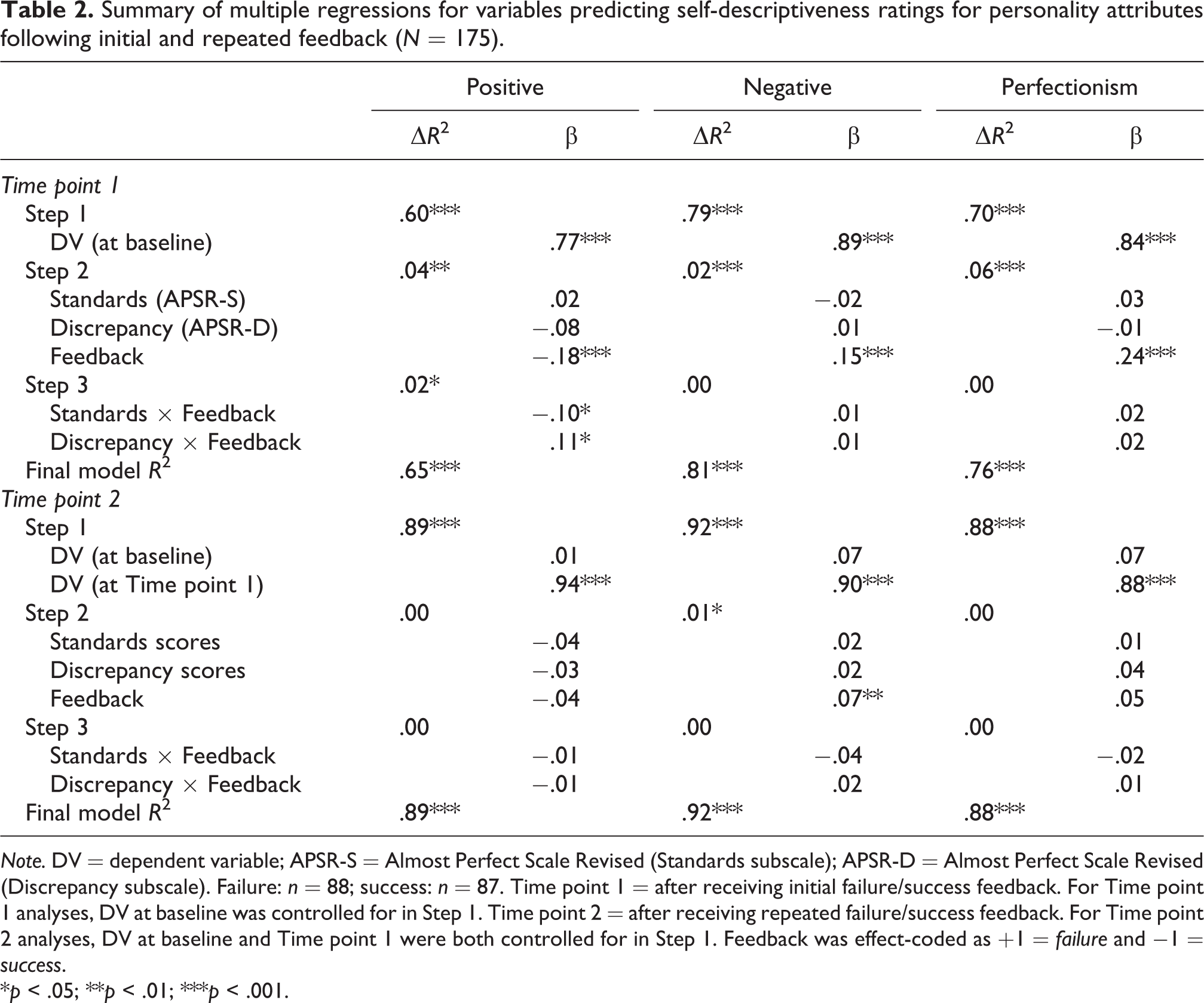
The moderated regression analyses assessing participants’ self-descriptiveness ratings for personality attributes after initial feedback about performance revealed that feedback about failure significantly predicted lower self-descriptiveness ratings for positive personality attributes, but higher ratings for negative and perfectionism-related personality attributes (all ps < .001), after controlling for other predictors and participants’ self-ratings at baseline. In addition, the interactions between adaptive perfectionism and feedback and maladaptive perfectionism and feedback were both statistically significant for self-ratings on positive attributes only (β = −.10, p < .05 and β = .11, p < .05, respectively; see Table 2). Follow-up simple slope analyses showed that maladaptive perfectionism scores were a significant predictor of self-descriptiveness ratings for positive attributes following initial success only (β = −.22, p < .01). Specifically, those who identified as having high maladaptive perfectionism scores reported lower positive self-ratings than those with low maladaptive perfectionism scores after receiving successful feedback about their performance. Similarly, adaptive perfectionism scores were also a significant predictor of positive self-ratings for the success condition only (β = .15, p < .05), with high adaptive perfectionism participants reporting higher self-descriptiveness ratings for positive attributes than participants with low adaptive perfectionism following initial success, see Figure 2(c) and (d).
Summary of multiple regressions for variables predicting self-descriptiveness ratings for personality attributes following initial and repeated feedback (N = 175).
Note. DV = dependent variable; APSR-S = Almost Perfect Scale Revised (Standards subscale); APSR-D = Almost Perfect Scale Revised (Discrepancy subscale). Failure: n = 88; success: n = 87. Time point 1 = after receiving initial failure/success feedback. For Time point 1 analyses, DV at baseline was controlled for in Step 1. Time point 2 = after receiving repeated failure/success feedback. For Time point 2 analyses, DV at baseline and Time point 1 were both controlled for in Step 1. Feedback was effect-coded as +1 = failure and −1 = success.
*p < .05; **p < .01; ***p < .001.
Repeated feedback
After controlling participants’ self-ratings on personality attributes at baseline and at Time point 1, further hierarchical regression analyses revealed that failure significantly predicted higher self-descriptiveness ratings for negative personality attributes (β = .07, p < .01) at Time point 2. Measures of adaptive perfectionism and maladaptive perfectionism were not significant predictors of any self-descriptiveness ratings, after controlling for all other predictors in the model. In addition, neither of the interaction terms reached statistical significance (all ps > .05; see Table 2).
Confidence in self-descriptiveness ratings following feedback
Initial feedback
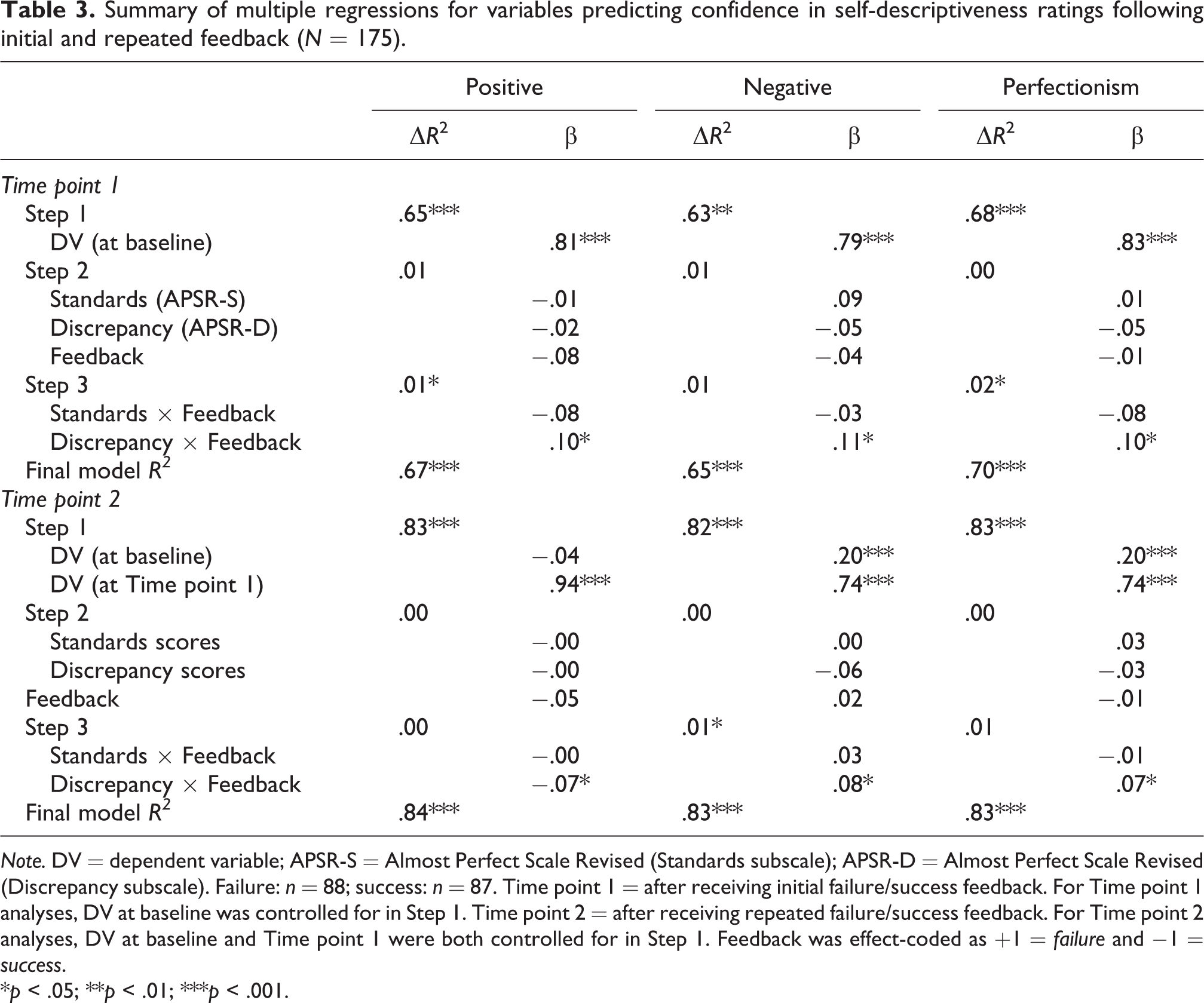
Further hierarchical multiple regression analyses were used to examine participants’ levels of confidence in their self-descriptiveness ratings for positive, negative, and perfectionism-related personality attributes. Results revealed that measures of adaptive perfectionism and maladaptive perfectionism, as well as feedback were all nonsignificant predictors of confidence levels, after controlling for participants’ level of confidence in self-ratings at baseline (βs ranging from −.08 to .09, all ps > .05). The interaction between maladaptive perfectionism scores and feedback was the only significant predictor of confidence levels for positive self-ratings, negative self-ratings, and perfectionism-related self-ratings (βs ranging from .10 to .11, all ps < .05; see Table 3). Follow-up simple slope analyses showed that maladaptive perfectionism scores were not a significant predictor of confidence levels for both positive and perfectionism-related self-ratings across both success (β = −.08, p > .05 and β = −.10, p > .05, respectively) and failure (β = .09, p > .05 and β = .07, p > .05, respectively) feedback conditions. In addition, maladaptive perfectionism predicted confidence levels in self-descriptiveness ratings for negative attributes but for the success condition only (β = −.13, p < .05). That is, participants with high maladaptive perfectionism scores reported lower confidence levels in their self-ratings about negative attributes when compared to participants with low maladaptive perfectionism scores, after receiving initial feedback about success, see Figure 2(e).
Summary of multiple regressions for variables predicting confidence in self-descriptiveness ratings following initial and repeated feedback (N = 175).
Note. DV = dependent variable; APSR-S = Almost Perfect Scale Revised (Standards subscale); APSR-D = Almost Perfect Scale Revised (Discrepancy subscale). Failure: n = 88; success: n = 87. Time point 1 = after receiving initial failure/success feedback. For Time point 1 analyses, DV at baseline was controlled for in Step 1. Time point 2 = after receiving repeated failure/success feedback. For Time point 2 analyses, DV at baseline and Time point 1 were both controlled for in Step 1. Feedback was effect-coded as +1 = failure and −1 = success.
*p < .05; **p < .01; ***p < .001.
Repeated feedback
The moderated regressions used to assess participants’ confidence in making self-descriptiveness ratings showed that measures of adaptive perfectionism, maladaptive perfectionism, and feedback were all nonsignificant predictors of confidence levels after controlling for participants’ self-ratings at baseline and at Time point 1 (βs ranging from −.06 to .03, all ps > .05). The interaction between maladaptive perfectionism and feedback was again the only significant predictor of confidence levels for positive self-ratings, negative self-ratings, and perfectionism-related self-ratings (βs ranging from −.07 to .08, all ps < .05; see Table 3). Follow-up simple slope analyses revealed that maladaptive perfectionism scores predicted decreased confidence levels in both negative self-ratings and perfectionism-related self-ratings, but for the success condition only (β = −.11, p < .01 and β = −.08, p < .05, respectively). Specifically, participants with high maladaptive perfectionism scores were found to report lower confidence levels in making self-ratings about both negative personality attributes and perfectionism-related personality attributes following repeated success when compared to participants with low maladaptive perfectionism scores, see Figure 3(a) and (b).

Responses to repeated feedback (failure and success) for maladaptive perfectionism. Confidence in self-ratings for (a) negative personality attributes and (b) perfectionism-related personality attributes.
Discussion
The present study was focused on examining how affective and cognitive responses to receiving failure versus successful performance feedback (initially and repeatedly) may differ between adaptive and maladaptive dimensions of perfectionism by utilizing a similar experimental design and methodology to that of the work of Stoeber et al. (2014); however, with the addition of measuring participants’ affect and cognitive levels at baseline. In addition, the present study sought to investigate how repeated experiences of failure versus success may impact the self-concept and level of self-concept certainty across dimensions of perfectionism.
As anticipated, maladaptive perfectionism (as measured by the Discrepancy subscale on the APS-R) was found to predict increased negative affect after initial failure. However, inconsistent with study hypotheses, no further changes in negative affect were found following repeated failure. Thus, it appears that while initial experiences of failure may result in higher levels of negative affect on maladaptive facets of perfectionism, this level of increased negative affectivity does not seem to continue inflating after repeated experiences of failure but is instead maintained. These results provide support to previous research that has shown maladaptive dimensions of perfectionism (e.g., socially prescribed perfectionism) to be predictive of increased depression levels following initial negative performance feedback (Stoeber et al., 2014). Interestingly, maladaptive perfectionism was found to predict increased positive affect following initial failure. This finding was surprising and rather counter-intuitive as one would expect levels of positive affect to decrease following experiences of failure. It is unclear as to what exactly may have contributed to these results; however, they suggest that those characterized by maladaptive perfectionism appeared to be “content” with performing below the 20th percentile on the mental rotation task. Given this unusual finding and its inconsistency with the previous literature, it would be interesting to see whether such findings will be replicated in future studies. In addition, maladaptive perfectionism did not predict any changes on measures of task anxiety after feedback about failure or success (initially or repeatedly) in the present study. This is inconsistent to the findings of Besser et al. (2008) and Stoeber et al. (2014). A possible explanation for these inconsistent results may be due to affect levels not being measured at “baseline” (i.e., prior to any experimental manipulation) in previous studies, while the present study controlled for participants’ baseline levels of affect when interpreting their affective responses to initial feedback.
The findings with regard to self-concept certainty and maladaptive dimensions of perfectionism did not support study hypotheses. That is, maladaptive perfectionism did not predict lower self-descriptiveness ratings for positive personality attributes or decreased confidence levels with making these self-ratings after initial failure, nor did it predict further worsened levels following repeated failure. Instead, maladaptive perfectionism predicted less confidence in making self-ratings regarding negative-related personality attributes after initial success, and further decreased confidence in making both negative- and perfectionism-related self-ratings after repeated success. These findings are generally in line with, but also extend upon the results from Campbell and Di Paula’s (2002) study that identified a significant inverse relationship between “negative” dimensions of perfectionism and level of self-concept clarity. Overall, the predominant pattern of the current results suggest that it is those experiences related to initial and repeated success (e.g., receiving “positive” feedback about one’s performance on a task initially and repeatedly) that has the effect of reducing certainty in self-beliefs (specifically those regarding negative- and perfectionism-related personality attributes) among those who are high on the maladaptive perfectionism dimension. Interestingly, the results also show that self-concept certainty in individuals high on maladaptive perfectionism do not appear to be affected by experiences related to initial or repeated failure. This is inconsistent with study hypotheses but is perhaps not particularly surprising as such experiences may only be serving as “confirmation” or evidence for their already negatively biased self-perceptions. Conversely, experiences of success may be more likely to elicit significant changes in level of certainty regarding self-beliefs for those high on maladaptive perfectionism due to the inconsistencies between their internal negatively biased perception of the self and the external successful outcomes, but also because of their possible concerns about having to maintain this level of success in the future, and their possible predictions that future failure will occur.
In addition, the present study found that maladaptive perfectionism predicted decreased positive affect and lower self-ratings for positive-related personality attributes after initial success. These are particularly surprising results as one would expect the conditions of initial and repeated failure (i.e., receiving “negative” feedback about task performance either initially or repeatedly) to be associated with lower levels of positive affect and less endorsement of positive-related personality attributes. This finding may be explained by the biased beliefs that maladaptive perfectionists tend to endorse in (e.g., doubts in their ability to meet their personal standards, morbid fear of failure, critical self-evaluation) (Shafran et al., 2002; Slaney et al., 2001), which appears to be amplified in conditions involving success. As a consequence, individuals who were high on maladaptive perfectionism responded to initial success with decreased positive affect and lower self-ratings for positive attributes but interestingly, not with increased negative affect or increased anxiety. This finding also provides support for the idea that perceptions about future failure are worsened following experiences of success (i.e., one has further to fall). However, the decrease in level of positive affect and level of endorsement of positive attributes did not appear to decline further following repeated success but was instead maintained. Overall, these findings are not consistent with those from previous studies and again were possibly detected by the inclusion of affective and cognitive measures at “baseline” in the present study; however, they also suggest that the self-concept for those high on maladaptive perfectionism is highly contingent upon experiences of success. This is consistent with the perspective that individuals who are uncertain about achieving success in the domains of contingent self-worth result in emotional lows and disengagement from tasks (Crocker, 2002; Crocker & Knight, 2005; Crocker & Wolfe, 2001).
Adaptive perfectionism (as measured by the Standards subscale on the APS-R) was found to predict higher self-ratings for positive personality attributes, but only after initial success. As with some of the earlier findings in the present study, this level of endorsement for positive attributes did not show any further increase following repeated success but was instead maintained. No other changes on measures of affect or self-descriptiveness ratings (including the level of confidence associated with making such ratings) was predicted by adaptive perfectionism following either failure or success (both initially and repeatedly). Taken together, it appears that those who are high on adaptive perfectionism are less affected (both affectively and cognitively) by the feedback they received about their performance, possibly due to less self-doubts and smaller perceived discrepancies between their personal standards and their actual level of performance, which subsequently results in their higher level of “immunity” against the influence of external sources of information. Moreover, it appears that the self-concept (and associated affect) for those high on adaptive perfectionism is less contingent upon experiences of success and failure, especially when compared to their counterparts high on maladaptive perfectionism. Surprisingly, these findings are largely inconsistent with the previous research that has found self-oriented perfectionism (a dimension typically considered as representing the more “adaptive” aspects of perfectionism) to be predictive of increased negative affectivity (regardless of whether performance feedback was negative or positive) (Besser, Flett, & Hewitt, 2004) and increased anxiety following repeated failure (Stoeber et al., 2014). Again, such inconsistencies in the findings may be best explained by the controlling of participants’ affect and thoughts at the “baseline” level in our analyses regarding their responses to initial and repeated feedback.
The current study extends upon the earlier work of Stoeber et al. (2014) with the present findings providing a further understanding about the differences in affective and cognitive responses to feedback about task performance (i.e., given initially and repeatedly) across adaptive and maladaptive dimensions of perfectionism. Moreover, to the best of the authors’ knowledge, the present study is the first to examine the impact of manipulating performance feedback on the self-beliefs (and specifically, the level of certainty associated with such beliefs) across different dimensions of perfectionism. In addition, the present findings provide insight into the areas that therapeutic interventions could potentially target in vulnerable populations such as those with high levels of maladaptive perfectionism, by identifying the self-schemata and self-beliefs that are vulnerable to the influence of external factors and those that are more resilient.
A limitation of the present study involves the use of self-ratings about different personality attributes to assess self-concept content and self-concept certainty, which is susceptible to the influence of social desirability demands (particularly for items such as “cruel,” “greedy,” or “selfish”). Future studies may benefit from utilizing objective measures of self-concept content and self-certainty at a more implicit level (e.g., reaction-timed tasks that measure the speed at which individuals take to respond to stimuli regarding certain self-beliefs). Another limitation of the present study is that repeated feedback regarding task performance was delivered over the course of one testing session. Thus, it remains unclear whether the significant changes found in affect and self-concept is maintained or will become less pronounced over longer periods of time. The need for further research to examine the impact of receiving repeated feedback over extended periods of time is therefore warranted. In addition, the present study solely focuses on the content of the self-concept and a structural aspect of the self-concept (i.e., self-concept certainty). Hence, it is important that future studies consider investigating how other components related to the organization, and structure of self-beliefs may shift as a function of receiving initial and repeated feedback about success versus failure (e.g., the stability and malleability of the self-concept, or the discrepancies between the actual-self and ideal/ought-self).
The overall pattern of the present findings suggest that it is those experiences related to success (e.g., receiving positive feedback about performance on a task) rather than failure which evoke the significant changes in responses on maladaptive dimensions of perfectionism, including decreased levels in certainty for making self-descriptiveness ratings about negative-related personality attributes, decreased positive affect, and less endorsement of positive-related personality attributes. Adaptive dimensions of perfectionism appear to also be only affected by experiences related to performance success, with an increase in self-ratings for positive personality attributes following initial success only. It is speculated that due to the smaller discrepancies between one’s perception of their “actual” performance and their “ideal” performance, individuals characterized by high levels of adaptive perfectionism are more resilient to external input while those characterized by high levels of maladaptive perfectionism are less resilient and more susceptible to the influence of external sources of information. The present findings demonstrated some support for previous research; however, due to the very limited number of studies in this area, it is imperative that further research be carried out to examine the effect of performance feedback on the self-concept, and namely self-concept certainty with the use of objective measures or more implicit-based tasks.
Footnotes
Declaration of Conflicting Interests
The author(s) declared no potential conflicts of interest with respect to the research, authorship, and/or publication of this article.
Funding
The author(s) received no financial support for the research, authorship, and/or publication of this article.
