




Abstract
The prevalence of a negative body image among women is high. Because of its serious consequences for individuals’ mental health, there is an urgent need to improve current body image interventions. Recent studies using evaluative conditioning to strengthen the association between women’s body and positive (social) stimuli have shown promising results. In two experimental studies, we tested whether incorporating more age appropriate positive social stimuli as unconditioned stimuli (USs) can strengthen the conditioning procedure as a means to enhance women’s body satisfaction. In the experimental condition, participants’ body pictures were systematically followed by the Facebook like-button and youthful smiling faces (study 1, experimental condition: n = 68; control condition: n = 67) or positive Emojis (study 2, experimental condition: n = 64; control condition: n = 67). The results indicated that neither conditioning procedure enhanced participants’ body satisfaction more than a control procedure, and in both studies, there was no valence transfer from the positive USs to the body pictures. Thus, incorporation of age appropriate USs did not result in the anticipated conditioning effects. These findings challenge the utility of current evaluative conditioning procedures as an intervention technique to address a negative body image.
Introduction
Over the last decades, Western media have been persistent in their celebration of the ultra-thin female body (e.g., Katzmarzyk & Davis, 2001; Seifert, 2005; Wiseman et al., 1992), yet over that same period, the average body weight of women has increased considerably (Abarca-Gómez et al., 2017; NCD Risk Factor Collaboration, 2016). As the idealized thin body type is not representative of the average female body and (genetically) unattainable for many, it is not surprising that body dissatisfaction is nowadays prevalent among women (e.g., Fallon et al., 2014; Tiggemann, 2004). The high prevalence of body dissatisfaction is particularly problematic because a negative body image (NBI) is considered a key component in the development, maintenance, and relapse of eating disorders (Carter et al., 2004; Stice & Shaw, 2002). The cognitive behavioral model of eating disorders (Fairburn et al., 1999) proposes that eating disordered individuals base their self-worth almost entirely on how they evaluate their body shape and weight. These evaluations are thus an important target for intervention. However, a meta-analysis by Alleva et al. (2015) showed that once corrections for several sources of bias were applied, current stand-alone body image interventions only led to small improvements. Thus, there is an urgent need to further advance NBI treatments.
In this study, we tested a relatively new technique for improving body image in which the principles of evaluative conditioning are used to enhance positive body evaluations. Evaluative conditioning (EC) is a procedure for changing the liking of a stimulus by systematically pairing that stimulus (i.e., the conditioned stimulus; CS) with a positive or negative unconditioned stimulus (US). As a consequence, the valence of the CS changes in the direction of the valence of the US (e.g., De Houwer et al., 2001). Due to the pervasiveness of women’s negative beliefs about their bodies, this implicit approach may be more effective than interventions that challenge women’s NBI in a more direct manner (Martijn et al., 2015). Martijn and colleagues (2010) were the first to test if indeed individuals’ body image could be improved by a brief computerized EC procedure during which own-body pictures (CS+) were systematically followed by smiling faces as positive USs, and pictures of two healthy-weight control bodies (CS−) were followed by neutral and frowning faces. Smiling faces were selected as positive US because they signal social acceptance. Since sociocultural pressures and direct social influences (e.g., negative feedback or teasing) are among the most important determinants of body dissatisfaction (Littleton & Ollendick, 2003; Stice, 2002), others’ approval of the own body was expected to have a large effect on women’s body evaluations. In the control condition, the own body and control bodies were equally often followed by smiling, neutral, and frowning faces. After a single session of this EC procedure, women in the experimental condition (n = 26) reported an increase in body satisfaction and global self-esteem compared to women in the control condition (n = 28). In a different sample of college women at risk for developing an eating disorder (N = 39), four sessions of this procedure led to an increase in self-esteem and decrease in body concern, and the latter improvement was maintained at 12-weeks follow-up (Aspen et al., 2015).
Subsequent research that used relatively similar EC procedures were, however, not successful in replicating these promising findings. In a clinical sample of healthy weight adolescent girls with an eating disorder (N = 51), the EC procedure did not result in short-term or long-term (3- and 11-week follow-up) effects on body satisfaction, body concern, or global self-esteem (Glashouwer et al., 2018). Also, Kosinski (2019) found that the weeklong use of a mobile memory game in which body pictures (CS+) had to be matched with smiling faces (US) improved the body satisfaction and global self-esteem of female undergraduate students (N = 60) to the same extent as a placebo game with neutral USs. In light of these conflicting results, we carried out a direct replication of the proof-of-principle study of Martijn et al. (2010) in a well-powered sample of 129 female undergraduate students (Glashouwer et al., 2019). In contrast to the original findings, we did not find a positive effect of a single session EC procedure on self-reported body satisfaction. Yet, supporting the validity of the EC procedure, women in the experimental condition evaluated the own-body pictures (CS+) as more positive than women in the control condition. These results suggest that the EC effects might not have been strong enough to transfer to self-reported body satisfaction.
The aim of this study was to strengthen the EC procedure of Martijn and colleagues (2010) by tackling three limitations of the original procedure that can have weakened positive EC effects on body satisfaction. First, the facial USs were potentially a bit outdated as signs of body approval, considering young women rely heavily on social media for reassurance about their appearance (e.g., Haferkamp et al., 2012; Perloff, 2014). The majority of the facial USs also looked too old to pass for undergraduate students, which may have reduced their relevance as a positive US, because young women primarily desire social approval from peers (Harter et al., 1996; Mota & Matos, 2013; Rubin et al., 2007; Thomaes et al., 2010). Second, the original EC procedure exposed body concerned women to control bodies, and comparison making to these bodies will probably negatively influence satisfaction with the own appearance (Newton & Minhas, 2005). Finally, the salience of CS+ trials might have been suboptimal in previous research. Decreasing the predictability of the occurrence of a CS+ trial (e.g., by increasing the number of CS− trials), might promote contingency learning because it renders the CS+-US pairings more salient.
We therefore developed a modified EC procedure in which women’s own-body pictures (CS+) were systematically followed by a youthful smiling face (50%) or Facebook like-button (50%) as positive USs, whereas neutral body-unrelated control pictures (CS− trials) were followed by a blank screen. The CS+ was presented only in 25% of the trials to heighten the saliency of the CS+-US pairings. Finally, we used a control condition in which the CS+ and CS− were never followed by a negative or positive outcome, but always by a blank screen. Previous research has shown that individuals with body concerns tend to overestimate the contingency between pictures of their body and negative outcomes (covariation bias; see Alleva et al., 2014; Glashouwer et al., 2019), 1 and the control condition of Martijn et al. (2010) might have unintentionally (and undesirably) reduced participants’ body satisfaction due to this overestimation of negative USs. To prevent the stimulus configuration from artificially increasing the contrast between the experimental and control condition, we thus removed the USs from the control procedure.
Given the novelty of the current approach, we decided to first conduct a proof-of-principle study and test the modified EC procedure in a female sample that was not specifically selected on the basis of body image concerns (cf. Glashouwer et al., 2019; Martijn et al., 2010). Using the modified EC and control procedure, we tested the hypotheses that women in the experimental condition would (i) evaluate their own body pictures more positively and (ii) report higher levels of body satisfaction after the procedure than women in the control condition. In addition, we tested whether in line with Martijn et al. (2010) the anticipated EC effects would be most pronounced in women with relatively high body concern.
Study 1
Method
Participants
In total, 138 women (M age = 23.17, SD = 4.48) were recruited via participant databases of the University of Groningen. Participants received course credit points (n = 3) or money (n = 135) in return for their participation. Inclusion criteria were female sex and proficiency in the English language. The majority of participants were university students (n = 114, education data of three participants were missing) and participants were predominantly European (n = 92). Data of two participants were discarded because they refused to wear the standardized clothing (because of religious reasons), and data of one participant were excluded because she became unwell during testing. The remaining 135 participants were randomly assigned to the experimental (n = 68) or control condition (n = 67). The study was approved by the Ethical Committee Psychology of the University of Groningen (code: PSY-1819-S-0253).
Materials
Stimuli
CSs+ were three photographs that were taken from the front, left, and right side of the participant. Participants were photographed in front of a white background, while they held their arms next to their body and posed with a neutral facial expression. All participants wore a pink short-sleeved T-shirt and black sports legging. Photographs were taken with a Panasonic DC-FZ82 camera and cropped to 352 (width) × 452 (length) pixels.
As neutral pictures (CSs−), we used 90 pictures (352 × 452 pixels) from the International Affective Picture System (Lang et al., 1997). The USs consisted of one image of an upward thumb with the word “Like” next to it (cf. Facebook’s like-button; 266 × 140 pixels) and 45 youthful smiling facial stimuli (352 × 452 pixels) that were derived from the 3rd version of the Face Research Lab London Set (DeBruine & Jones, 2017) and the Max Planck FACES Database (Ebner et al., 2010). See the appendix for a detailed description of the selection procedure.
Evaluative conditioning procedure
The evaluative conditioning procedure was programmed with E-prime 2.0 software (Psychology Software Tools, Pittsburgh, PA). Participants were informed that a stimulus would randomly appear at the center of one of four quadrants, and instructed to click on each appearing stimulus as fast as possible. After participants clicked on a CS+ (90 trials), a facial US (45 trials) or the social media US (45 trials) appeared for 400 milliseconds. When participants clicked on a CS− (270 trials), it disappeared and the next trial started after 400 milliseconds (see Figure 1). The order of stimulus presentation was random. When participants in the control condition clicked on a CS+ or CS−, the stimulus disappeared and the next trial started after 400 milliseconds (similar to the CS− trials in the experimental condition). Examples of trials in the evaluative conditioning procedure. After a participant clicked on the full-body picture (CS+), a smiling facial US appeared at the same location (a) or the social media US appeared in the right bottom corner of the picture (b). The US disappeared after 400 ms. After a participant clicked on a neutral control picture (CS−), it disappeared and the quadrants were empty until the next trial started after 400 ms (c).
Measures
Stimulus valence
The body pictures (CS+) were rated on valence (0 = negative to 100 = positive) and attractiveness (0 = unattractive to 100 = attractive). Control pictures (CS−) and USs were only rated on valence. Participants also indicated the extent to which the facial USs signaled a positive appraisal of the CS+ by answering the question “How do you think this person feels about you?” (0 = negative to 100 = positive). The USs were rated in both conditions, so also by participants in the control condition who had not seen the USs before. Stimuli were presented one-by-one at the middle of a computer screen, with a Visual Analogue Scale (VAS) directly underneath it. VAS scores were averaged for each stimulus type and dimension.
Body satisfaction
Post-intervention body satisfaction was assessed with two VAS scales (“At this moment I feel; 0 = Not at all satisfied with my weight/shape and 100 = very satisfied with my weight/shape”). In line with the procedure of Martijn et al. (2010), these items were hidden in a 13-item questionnaire that measured participants’ mood and satisfaction with various life domains. The two body satisfaction items were highly correlated (r = .78) and therefore averaged to obtain a mean body satisfaction score (cf. Martijn et al., 2010).
The Body Image States Scales (BISS; Cash et al., 2002) were used as a secondary outcome measure of state body image. The BISS consists of 6 items that measure participants’ satisfaction with aspects of the physical appearance on a 9-point Likert scale (1 = extremely dissatisfied or a great deal worse and 9 = extremely satisfied or a great deal better). To conceal our interest in body image, six similar questions about participants’ satisfaction with appearance-unrelated domains were administered before and after the BISS. After recoding the reverse scored items, a total score was calculated by averaging the six BISS items. Higher scores indicate a more positive state body image (Cronbach’s α = .83).
Body concern
The 6th version of the Eating Disorder Examination Questionnaire (EDE-Q; Fairburn & Beglin, 2008) was administered as a measure of participants’ body concern. The EDE-Q measures self-reported body concerns and eating disorder pathology in the last 28 days. Its 28 items are answered on a 7-point Likert scale (0 = not at all or no days and 6 = markedly or every day). The EDE-Q has four subscales: Shape concern, Weight concern, Eating concern, and Eating restraint. The Weight concern and Shape concern subscales were strongly positively correlated (Spearman’s rho: rs = .87); therefore, the scores on these subscales were averaged to get one measure of body concern (cf. Glashouwer et al., 2019; Martijn et al., 2010). Higher scores indicate greater concern for the appearance of the body (Cronbach’s α = .93).
Procedure
The study was advertised as a study about the influence of exposure to selfies on feelings of happiness. Participants were tested individually, in a single 1-hour session. Each participant actively gave informed consent at the start of the test session. The researcher estimated participants’ clothing size and provided the participant with the standardized clothing (size labels were covered). After the photoshoot, participants completed the EDE-Q on the computer (1920 × 1080 IIYAMA, refresh rate = 60 Hz). Next, participants were randomly assigned to the experimental or control condition, and executed the EC procedure. Participants then completed the life satisfaction questionnaire and the BISS. For comparability to prior study procedures, the Rosenberg Self-Esteem Scale (RSES; Rosenberg, 1965) was administered after the EDE-Q and the State Self-Esteem Scale (SSES; Heatherton & Polivy, 1991) after the BISS. 2 Next, participants rated the valence of the stimuli from the EC procedure and completed demographic questions and questions about the presumed purpose of the study. Finally, participants’ weight (with clothing) and length were measured.
Statistical analyses
The effect of the EC procedure on the primary outcome measures was tested using three stepwise hierarchical regression analyses with CS+ valence, CS+ attractiveness, or VAS body satisfaction as dependent variable. Condition (Control, Experimental), Body concern, and the interaction of Condition × Body concern were entered in the model in a first, second, and third step, respectively. The first step was essential to test if the EC procedure improved the evaluation of the CS+ and heightened body satisfaction. The hypothesis that women with higher body concern profit more from the EC procedure was tested in the third step. A similar stepwise hierarchical regression analysis was performed with BISS scores (i.e., the secondary outcome measure) as dependent variable. For the primary analyses, alpha criterion was set to .0167 (α = .05/3) to correct for multiple testing. In case of outlying datapoints (i.e., scores that extended 1.5 times the interquartile range), the analysis was repeated without the outliers to assess if they had disproportionately influenced the outcome of the test.
Power calculation
A priori power calculation indicated that a sample size of 99 participants was required to obtain a power of .80 to detect a medium effect (f2 = .15), at an alpha level of .0167 (α = .05/3). The aim was to include at least 128 participants (cf. Glashouwer et al., 2019).
Results and discussion
Descriptives
Means and standard deviations for group characteristics in studies 1 and 2.
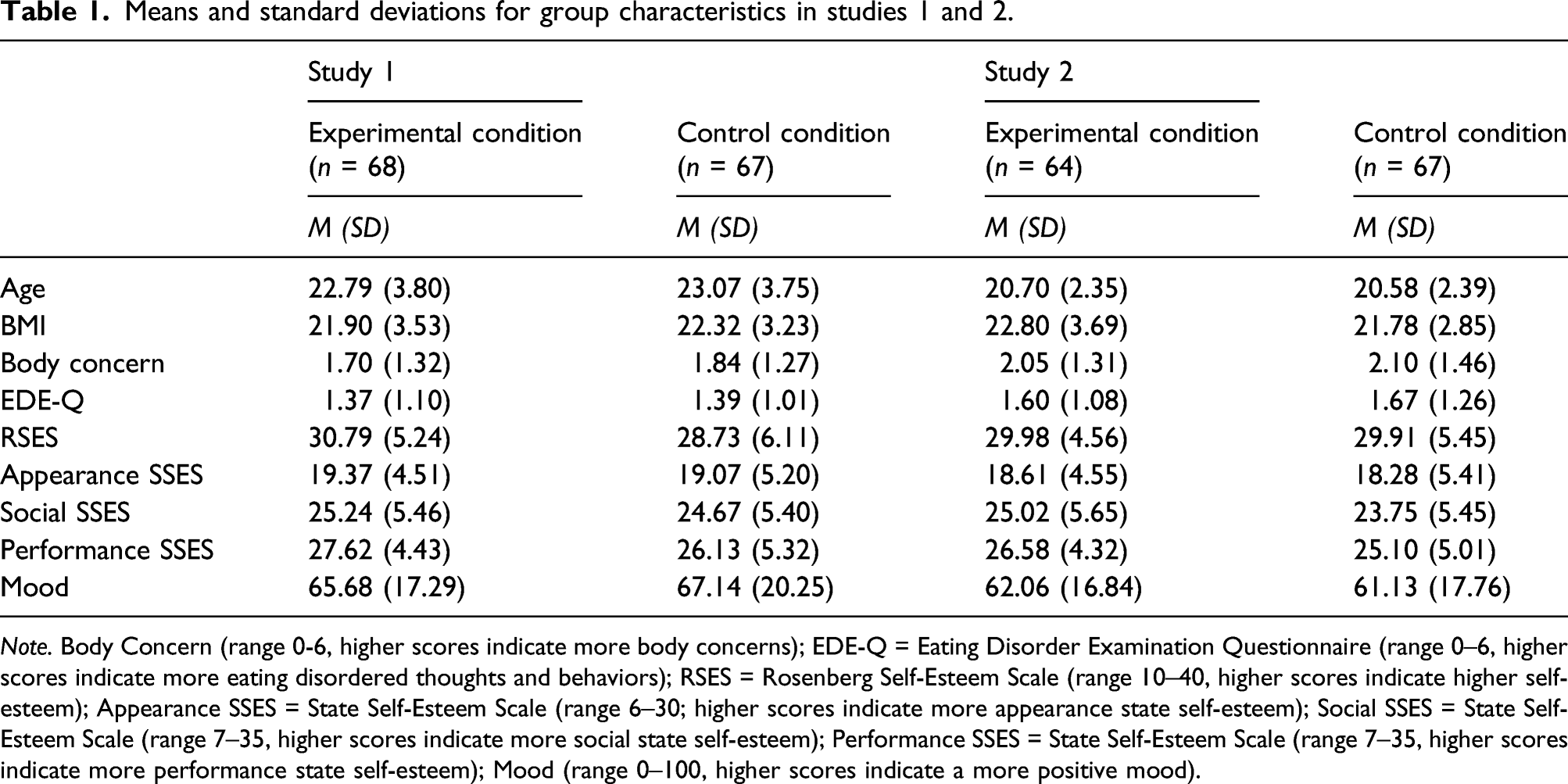
Note. Body Concern (range 0-6, higher scores indicate more body concerns); EDE-Q = Eating Disorder Examination Questionnaire (range 0–6, higher scores indicate more eating disordered thoughts and behaviors); RSES = Rosenberg Self-Esteem Scale (range 10–40, higher scores indicate higher self-esteem); Appearance SSES = State Self-Esteem Scale (range 6–30; higher scores indicate more appearance state self-esteem); Social SSES = State Self-Esteem Scale (range 7–35, higher scores indicate more social state self-esteem); Performance SSES = State Self-Esteem Scale (range 7–35, higher scores indicate more performance state self-esteem); Mood (range 0–100, higher scores indicate a more positive mood).
Means and standard deviations for the evaluation of the USs in studies 1 and 2.

Note. Study 1: Social media US = Facebook’s like-button; Facial US = 45 smiling facial stimuli; Study 2: Social media US = Emojis; VAS Valence (range 0–100, higher scores indicate a more positive valence); VAS Appraisal CS+ (range 0–100, higher scores indicate a more positive appraisal of the CSs+ by the US).
Primary and secondary outcome measures
Means and standard deviations for outcome measures in studies 1 and 2.

Note. VAS Valence CS+ (range 0–100, higher scores indicate a more positive valence of the body pictures); VAS Attractiveness CS+ (range 0–100, higher scores indicate more attractive body pictures); VAS Valence CS− (range 0–100, higher scores indicate a more positive valence of the control pictures); VAS Attractiveness CS− (range 0–100, higher scores indicate more attractive control pictures); VAS Body Satisfaction (range 0–100, higher scores indicate higher body satisfaction); BISS = Body Image States Scale (range 1–9, higher scores indicate a more positive state body image).
Discussion
After the EC procedure, women in the experimental condition did not evaluate the own-body pictures more positively, nor did they report more body satisfaction or state body image than women in the control condition. Also, body concerned women did not profit more from the EC procedure than women with relatively low body concern. These results indicate that the modified EC procedure failed to manipulate body satisfaction at a fundamental level, namely, the EC procedure did not improve the affective appreciation of the CS+. Post-manipulation valence ratings of the CSs+ indicated that on average, participants rated their body pictures close to neutral (M = 48.3, SD = 20.8, cf. Glashouwer et al., 2019), suggesting that there was overall considerable room for improvement with regard to the valence of the CSs+. A potential explanation for the null-findings is the weak positive valence that we found for the USs, especially the social media US (M = 62.6, SD = 28.3). Both types of USs were rated as less positive than the USs of the original procedure (M = 85.4, SD = 11.8; Glashouwer et al., 2019).
One reason for the weak positive valence of the social media US could be that the Facebook like-button was perceived as being a bit outdated. Young women tend to use newer social media which use other buttons to like something (e.g., Instagram’s heart icon; Auxier & Anderson, 2021). An alternative reason that would also explain the moderate appreciation of the facial USs could be that the removal of neutral and negative USs from the current design diminished the reward value of the positive USs that followed the CSs+. Contrasting positive feedback on the own body with the neutral and negative feedback on the control bodies, could increase the rewarding properties of the positive feedback by underscoring that the social acceptance signaled by the USs is specific to the own body. Perhaps the positive effect of including control bodies as CSs− might actually outweigh the cost of undesirable upward comparison processes. After all, in our prior study (Glashouwer et al., 2019) the control bodies were (on average) rated as more attractive than the own body, yet body concerned participants did report a more positive appreciation of the own-body pictures after the EC procedure.
Therefore, we carried out a second study in which we went back to the original EC procedure of Martijn and colleagues (2010) and only adjusted the age appropriateness of the positive USs by replacing the facial stimuli with signs of social media approval. This time, we used Emojis as USs instead of the Facebook like-button. Given that all major social media platforms allow the use of Emojis, positive Emojis may have a stronger impact as a sign of approval than the like-button, especially for women who use other social media than Facebook. In the new EC procedure, participants’ body pictures (CSs+, 90 trials) were systematically followed by positive Emojis, whereas the control bodies (CSs−, 180 trials) were followed by neutral and negative Emojis (see Figure 2). In the control condition, the own-body pictures and control body pictures were followed by an equal amount of positive, neutral, and negative Emojis. The USs were again presented for 400 milliseconds. To determine the effectiveness of the EC procedure with positive Emojis, we used the same outcome measures and tested the same hypotheses as in study 1. Examples of a trial from the Evaluative Conditioning Procedure. After a participant clicked on the full-body picture (CS+), a positive US appeared for 400 ms at the same location (a). After a participant clicked on a control body (CS−), a neutral (b) or negative (c), US appeared for 400 ms (the depicted USs differ slightly from the ones that were used; the original stimuli can be obtained via the first author).
Study 2
Method
Participants
The sample consisted of 133 women (M age = 20.6, SD = 2.36) who participated in this study for course credits (n = 65) or money (n = 68). The study was advertised and conducted in Dutch (n = 34) and English (n = 99). The sample consisted mainly of university students (n = 126) and again was predominantly European (n = 108). Data of two participants were excluded from analyses because the hair of one participant covered the body in the pictures and one participant could not wear the standardized clothes due to an injury. Participants were randomly assigned to the experimental (n = 64) and control condition (n = 67). The Ethical Committee Psychology of the University of Groningen approved the study (code: PSY-1920-S-0196).
Stimuli
The only difference with the CSs+ from study 1 is that the pictures were smaller (226 × 301 pixels) and that participants’ T-shirt color was counterbalanced (cf. Martijn et al., 2010). The CSs− (i.e., three full-body pictures of two control women) were previously used by Glashouwer et al. (2019). As USs, 18 WhatsApp Emojis were used (303 × 301 pixels). Emojis were derived from the Internet and based on the valence ratings in a pilot study of 39 women below the age of 30 years old (M = 22.2, SD = 2.94), we selected the 6 stimuli that were rated most positive, neutral, or negative on the question “How would someone think of you if he/she comments this Emoji on a picture of you?” (0 = negative to 100 = positive; positive Emojis: M = 90.6, SD = 8.87; neutral Emojis: M = 51.9, SD = 7.15; negative Emojis: M = 18.4, SD = 9.08).
Measures
The measures that were used were identical to those of study 1. Consistent with study 1, the body satisfaction items were highly correlated (Spearman’s rho: r s = .73) and therefore averaged, as were the Weight and Shape concern subscales of the EDE-Q (Spearman’s rho: r s = .86). The internal consistency was again high for the EDE-Q measure of participants’ body concern (Cronbach’s α =.94), and the BISS (Cronbach’s α = .83).
Procedure
The study procedure was similar to that of study 1, with three exceptions. The CSs− were rated on valence and attractiveness (so not only valence), and for the USs the estimated evaluation question was rephrased to “How would someone think of you if he/she comments this Emoji on a picture of you?” (0 = negative to 100 = positive). Third, after the demographic questions participants were asked to estimate the percentage of CSs+ and CSs− that were followed by positive, neutral, and negative feedback to check for contingency awareness (cf. Martijn et al., 2010).
Statistical analyses
To test if the EC procedure improved participants’ evaluation of their own body (pictures), four identical stepwise hierarchical regression analyses as in study 1 were performed with CS+ valence, CS+ attractiveness, body satisfaction, or state body image (secondary outcome measure) as the dependent variable. Our predictions were consistent with study 1, and the alpha criterion was again set at .0167.
Results and discussion
Descriptives
Table 1 presents the means and standard deviations of the characteristics for each condition of study 2. The mean level of global self-esteem was comparable to the previous study and that of Martijn et al. (2010), whereas the mean level of body concern and eating pathology were a bit higher. The RTs during the EC procedure indicated that the participants again had executed the task conscientiously (RT: M = 516 ms, SD = 138 ms, range = 306-1025 ms, mean % of trials > 3 s = < 1%). Also, participants’ ratings corroborated that the USs were representative of their category (see Table 2). Of all participants in the experimental condition, only 16 participants correctly indicated that own-body pictures were always followed by a positive Emoji. 3 Nevertheless, on average, participants in the experimental condition seemed to have noticed that the own-body pictures were most often followed by positive Emojis (estimated proportion of CSs+ followed by positive US: M Percentage = 72.4, SD = 27.9). In the control condition, mean estimates of the percentage of each type of US after each type of CS were as expected closer to 30% (range = 27.9–39.4). Only a small proportion of participants (n = 16, 12.2%) correctly indicated the own-body pictures were paired with positive Emojis with the purpose of improving body image. 3
Primary and secondary outcome measures
See Table 3 for an overview of the means and standard deviations of the outcome measures across conditions. Results of the hierarchical regression analyses indicated that contrary to expectations, Condition did not significantly predict CS+ valence (F change (1, 129) = 1.23, p = .27, R 2 change = .009), CS+ attractiveness (F change (1, 129) = 1.41, p = .24, R 2 change = .011), or body satisfaction (F change (1, 129) = 0.14, p = .71, R 2 change = .001). As expected, higher levels of body concern were associated with lower CS+ valence (F change (2, 128) = 37.0, p < .001, R 2 change = .22), CS+ attractiveness (F change (2, 128) = 39.7, p < .001, R 2 change = .23), and body satisfaction (F change (2, 128) = 144, p < .001, R 2 change = .53). When the interaction of Condition × Body concern was entered, this did not improve the explained variance in CS+ valence (F change (3, 127) = 0.40, p = .53, R 2 change = .002), CS+ attractiveness (F change (3, 127) = 0.31, p = .58, R 2 change = .002), or body satisfaction (F change (3, 127) = 2.66, p = .11, R 2 change = .010). Repeating the analyses without the outlying datapoints (Experimental condition: n = 1; Control condition: n = 3) did not change the pattern of the results. That is, participants in the experimental condition did not evaluate their own body (pictures) more positively after the EC procedure than control participants. The lack of an effect was independent of participants’ level of body concern. Results from the hierarchical multiple regression analysis on BISS scores were consistent with the results from the primary analyses (Step 1: F change (1, 129) = 1.70, p = .19, R 2 change = .013; Step 2: F change (2, 128) = 73.2, p = < .001, R 2 change = .36; Step 3: F change (3, 127) = 0.085, p = .77, R 2 change = .000).
Discussion
In study 2, we attempted to improve the EC procedure of Martijn et al. (2010) by selecting influential signs of social media approval (Emojis) as positive USs. However, in line with the results of study 1, we did not find an effect of the modified EC procedure on the satisfaction with the body (pictures) in the total sample nor in women with high body concern. This is somewhat surprising given that participants’ ratings indicated that the Emojis had a strong positive valence (M = 90.3, SD = 8.07) and the USs were in fact, evaluated more positively than the facial stimuli that Martijn et al. (2010) used to successfully induce positive body associations (M = 85.4, SD = 11.8; Glashouwer et al., 2019). Yet, in the present study there was no valence transfer to the CSs+.
There are two limitations of study 2 which might have hampered the effectiveness of the current EC procedure. First of all, women in the experimental condition evaluated the control body pictures more positively than women in the control condition, 4 and as a result, they may have made more upward comparisons to the control bodies. The negative effect of these comparisons can have undermined the positive effect of the EC procedure. Without a baseline measure of CSs− valence, it is unclear whether the difference between the conditions existed before the manipulation or whether it reflects an effect of the manipulation. The latter would be difficult to explain in terms of EC because the CSs− were in the experimental condition more often paired with negative USs. Second, participants rated five out of six “neutral” Emojis as positive (M = 67.2, SD = 12.7). This implies that the own-body pictures of participants in the control condition were followed by (moderately) positive USs in 61.1% of the trials, instead of the planned 33.3%. It can therefore not be ruled out that the control procedure led to a positive EC effect in the control condition, which can have reduced the contrast between conditions.
General discussion
In the present studies, we attempted to improve a procedure for improving a NBI based on the principles of EC (Martijn et al., 2010) that previously led to promising yet inconsistent results. To enhance the effect of the EC procedure on women’s body satisfaction, age appropriate signals of social approval were incorporated as positive USs. However, neither the procedure with youthful smiling faces and Facebook’s like-button (study 1) nor the procedure with Emojis as USs (study 2) resulted in a more favorable evaluation of the body pictures, or in higher body satisfaction. Although body concerned women had more room for improvement with regard to the appreciation of their body (pictures), they did not profit more from the EC procedures than women with low levels of body concern. Thus, incorporation of age appropriate USs appeared ineffective in improving the EC procedure.
Given the novelty of social media, there is presently not much research available that can help with understanding participants’ responses to affective social media stimuli. There is some preliminary empirical evidence from EEG studies, however, that suggests that positive Emojis are not as inherently rewarding (Weiß et al., 2020) and salient as smiling facial stimuli (Gantiva et al., 2020). Emojis generally depict an exaggerated sentiment, so they may be perceived as less sincere social cues and are, therefore, more likely discarded as signals of social approval. Observations in the lab also raised the suspicion that a substantial proportion of the participants had an unfavorable opinion about social media, which may have been an unwanted effect of how studies 1 and 2 were advertised (i.e., as a study on the influence of selfies on happiness). The finding that the valence of the Facebook like-button used in study 1 was not as positive as anticipated, fits with this idea. Since we did not measure participants’ opinion and use of social media, it cannot be ruled out that we unintentionally attracted women with negative opinions of social media. This could have negatively influenced the appreciation of the USs and thereby the efficacy of the current EC procedures.
Another limitation is that we did not include baseline measurements of women’s satisfaction with the body (pictures). To prevent body dissatisfied individuals from dropping out in between test sessions (e.g., due to the discomfort of being photographed), we decided to test participants in a single session. Measuring body satisfaction just before the manipulation could have made participants aware of our hypotheses and may have resulted in socially desirable responding. Although participants were randomly assigned to the conditions, it is still possible that women in the experimental condition were more body dissatisfied at baseline than women in the control condition. If so, the present results underestimate the effect of the EC procedures.
A completely different explanation for why the current EC procedures did not work is that the not-neutral valence of the body pictures of women with a NBI may have interfered with the induction of body-positive associations. Neutralizing an affective response (i.e., counter-conditioning; see Keller et al., 2020) may require a different approach than using EC to induce an affective response for initially neutral stimuli. Keller and colleagues (2020) argue that during the inhibition of a negative/aversive response by a positive/appetitive response, it is imperative that the induced positive response is stronger than the unwanted negative response. An issue with using EC as a procedure to improve participants’ NBI is that the body (CS+) likely elicits a stronger affective response than the smiling faces (US). Consequently, the CS+-US pairing may be associated with the negative affect elicited by the body and not the positive affect elicited by the smiling face.
On the one hand, this problem can be solved by masking techniques that minimize participants’ aversive reaction to seeing pictures of the own body (cf. Siegel et al., 2017). Without the interference of implicit and explicit body-evaluative processes, there may be enough leeway for novel implicit body-positive associations to form. On the other hand, this issue can be addressed by selecting USs that match the intensity of the negative affect elicited by the body pictures of women with a NBI. Given that social media stimuli can be interpreted as social signals and as references to the concept of social media, the affective appreciation of these stimuli may be stronger influenced by interpersonal and contextual factors than is the case for smiling facial stimuli. Smiling faces may therefore be more appropriate as USs, and there is research that suggests that smiles involving lip-pressing are particularly equipped to convey social affiliation (Rychlowska et al., 2017). Furthermore, virtual-reality can be used to make the social approval cues more rewarding by increasing their ecological validity (e.g., an avatar that starts smiling upon noticing the participant). The rewarding properties of the USs may be further increased by contrasting the approval of the own body with the disapproval of control bodies, although more research is necessary because exposure to control bodies can also have a negative effect on women’s body satisfaction. If proven effective, the dose of EC can be increased to see if this leads to stronger generalization to other measures of body satisfaction. More diverse CSs+ (e.g., the participant in different outfits or several body-focused environments) may also aid the generalization of EC effects. Thus, although it remains unclear if EC can be used to improve the body satisfaction, there are several alternative procedural improvements that seem worth investigating.
Conclusions
The present studies provided no evidence for the effectiveness of EC as a technique to improve women’s body image. Despite our efforts to strengthen the EC procedure developed by Martijn et al. (2010), the modified EC procedures did not improve women’s evaluation of the own-body pictures nor did they enhance self-reported body satisfaction. The results of study 2 demonstrate that even when the women’s body pictures are conditioned with USs that are very positively evaluated, this does not guarantee transfer of the USs’ positive valence to the body. Thus, the EC procedure in its current form is not ready for being applied as a NBI intervention technique.
Footnotes
Acknowledgments
The authors would like to thank Carolien Martijn for sharing the original materials; Elise van der Laan and Anne Jet Kloosterman for helping with the data collection; and the students who volunteered to participate in these studies.
Declaration of conflicting interests
The author(s) declared no potential conflicts of interest with respect to the research, authorship, and/or publication of this article.
Funding
The author(s) disclosed receipt of the following financial support for the research, authorship, and/or publication of this article: This research was supported by a Veni grant [451-15-026] that was awarded to the third author by the Netherlands Organization for Scientific Research. The funding source was not involved in the design of these studies nor in the production of this manuscript.
CRediT authorship contribution statement
Irina Masselman: conceptualization, methodology, software, formal analysis, investigation, and writing—original draft; Klaske Glashouwer: conceptualization, methodology, resources, writing—review and editing, supervision, project administration, and funding acquisition; and Peter de Jong: conceptualization, methodology, writing—review and editing, and supervision.
Pre-registration
The present studies were preregistered. To view the preregistration forms, go to https://aspredicted.org/h3v85.pdf (study 1) and  (study 2).
Data
Notes
Appendix
The following IAPS pictures were used as neutral control stimuli*: 1121, 1313, 1390, 1616, 1670, 1935, 1947, 2870, 5120, 5130, 5390, 5395, 5500, 5510, 5520, 5530, 5531, 5532, 5533, 5534, 5535, 5661, 5731, 5740, 5900, 5920, 6150, 6930, 7000, 7004, 7006, 7009, 7010, 7025, 7030, 7034, 7035, 7036, 7037, 7039, 7040, 7041, 7050, 7060, 7080, 7090, 7095, 7096, 7100, 7110, 7130, 7140, 7150, 7160, 7161, 7170, 7179, 7180, 7182, 7183, 7184, 7185, 7186, 7187, 7190, 7205, 7207, 7211, 7217, 7224, 7233, 7235, 7236, 7237, 7490, 7491, 7495, 7500, 7504, 7560, 7590, 7595, 7620, 7705, 7710, 7820, 7830, 7920, 8211, and 8311. IAPS picture 1935 was cropped to remove a spider, and IAPS pictures 1935, 2870, 7620, 8211, and 8311 were cropped to remove a body in the periphery of the picture.
The following facial stimuli were used**: Max Planck FACES Database, 020_y_f_h_b, 028_y_f_h_b, 048_y_f_h_b, 090_y_f_h_b, 101_y_f_h_b, 106_y_f_h_b, 115_y_f_h_b, 150_y_f_h_b, 152_y_f_h_a, 182_y_f_h_a, 013_y_m_h_b, 016_y_m_h_b, 057_y_m_h_b, 062_y_m_h_b, 066_y_m_h_b, 072_y_m_h_b, 089_y_m_h_a, 114_y_m_h_a, 119_y_m_h_b, 123_y_m_h_b, 127_y_m_h_b, 147_y_m_h_b, 153_y_m_h_b, 167_y_m_h_b; Face Research Lab London Set, 009_08, 013_08, 014_08, 030_08, 032_08, 064_08, 094_08, 097_08, 099_08, 100_08, 127_08, 129_08, 134_08, 004_08, 022_08, 026_08, 031_08, 036_08, 104_08, 117_08, 172_08. * Using the valence norms of the IAPS, we identified the 90 pictures that were considered most neutral and that were not centered on a human body or food item (Lang et al., 2008).
** From the Face Research Lab London Set, we selected 8 male and 13 female faces (Age: M = 25.3 years, SD = 5.34), and from the Max Planck FACES Database 14 male and 10 female faces (Perceived age: M = 25.9 years, SD = 4.88). Although we included some older models, the majority of the models looked as if they were in their early twenties. Since the reward value of attractive faces may be greater than that of unattractive ones (e.g., Cloutier et al., 2008; Kranz & Ishai, 2006; O’Doherty et al., 2003; Tsukiura & Cabeza, 2011; Winston et al., 2007), we only selected faces that were (on face value) physically attractive and smiled in a way that we considered unambiguously friendly. Faces were photographed from the shoulders up and in a white T-shirt in front of a white background (Face Research Lab London Set) or in a gray T-shirt in front of a gray background (Max Planck FACES Database).