




Abstract
This study investigated the relationship between body dissatisfaction, eating disorder symptoms, and attentional bias to images of male bodies using a compound visual search task. Sixty-three male participants searched for a horizontal or vertical target line among tilted lines. A separate male body image was presented within proximity to each line. Overall, search times were faster when the target line was paired with a muscular or obese body and distractor lines were paired with bodies of average muscularity and body fat (congruent trials) than on neutral trials, in which only average muscularity and body fat images were shown. Attentional bias for muscular bodies was correlated with muscle dissatisfaction, eating restraint, and shape concern, and attentional bias for obese bodies was correlated with eating restraint. For incongruent trials, in which a single muscular or obese body was paired with a distractor line, search times were indistinguishable from neutral trials. Unexpectedly, we found a negative association between search times and both body fat dissatisfaction and eating disorder symptoms in conditions where obese bodies were paired with distracting stimuli. This result implicates a potential role for attentional filtering and/or avoidance of obese bodies in predicting body fat dissatisfaction and eating disorder symptomology.
Body dissatisfaction can be defined as negative evaluation of body size, shape, muscularity/muscle tone, and weight (Grogan, 2016). Of concern, body dissatisfaction has been considered a risk factor in the development of body image-related disorders, such as eating disorders (Grogan, 2016; Kearney-Cooke & Steichen-Asch, 1990) and muscle dysmorphia (Leone, Sedory, & Gray, 2005; Pope, Pope, Phillips, & Olivardia, 2000), and associated with obesity (Mond, van den Berg, Boutelle, Hannan, & Neumark-Sztainer, 2011; Wardle & Cooke, 2005) and poorer mental and physical health-related quality of life (Griffiths et al., 2016).
Of note, body dissatisfaction in the western male population is prevalent and increasing (Adams, Turner, & Bucks, 2005; Frederick et al., 2007; McCabe & Ricciardelli, 2004; Watkins, Christie, & Chally, 2008). For instance, Frederick et al. (2007) reported that 90% of undergraduate men from a U.S. university were dissatisfied with their level of muscularity, and 51–71% were dissatisfied with their level of body fat.
Recently, the association between attentional bias, body dissatisfaction, and eating disorder symptoms has been considered with the implication that attentional biases toward body image-related stimuli could play a role in the perpetuation and causation of body dissatisfaction. For example, cognitive models propose that individuals with greater levels of body dissatisfaction and eating disorder symptomatology attend to information that is congruent with their body image-related self-schema (i.e., attending to “ideal” bodies of others, while noticing flaws in their own body) (Faunce, 2002; Vitousek & Hollon, 1990; Williamson, White, York-Crowe, & Stewart, 2004). Visual attentional bias refers to the tendency for certain classes of visual stimuli to be prioritized over other stimuli in the visual field. Such biases may be adaptive. For example, the attentional biases humans exhibit toward threatening stimuli (Ohman, 2005) are likely to be important for detecting and avoiding external threats in the environment. However, not all attentional biases are necessarily adaptive. For example, various studies have demonstrated a heightened attentional bias toward threatening faces in individuals with anxiety disorders, compared to non-clinically anxious counterparts (Bar-Haim, Lamy, Pergamin, Bakermans-Kranenburg, & vanIJzendoorn, 2007).
The relationship between body dissatisfaction, eating disorder symptoms, and visual attentional bias to body stimuli has been examined through a variety of paradigms in women, including dot-probe task (e.g., Smith & Rieger, 2006), Stroop task (e.g., Dobson & Dozois, 2004), and eye tracking (Cho & Lee, 2013). These studies have shown that individuals with high levels of body dissatisfaction and eating disorder symptoms tend to exhibit an attentional bias toward ideal body image-related stimuli, relative to low body dissatisfaction control groups (Cho & Lee, 2013; Gao et al., 2013, 2014).
Typically for both men and women, a low muscle tone and high body fat constitute a feared/undesirable body (Grogan, 2016). Prior studies have also demonstrated that males and females with high body dissatisfaction possess attentional biases toward feared/undesirable body image-related stimuli relative to individuals with low body dissatisfaction (Gao et al., 2013, 2014; Onden-Lim, Wu, & Grisham, 2012; Rosser, Moss, & Rumsey, 2010). Cognitive models of eating disorders attribute this bias to a maladaptive body self-schema, which is readily activated by external or internal cues. These models theorize that this maladaptive self-schema directs an individual’s attention to body-related stimuli and bias interpretations of self-relevant events in favor of fatness interpretations (Vitousek & Hollon, 1990; Williamson et al., 2004).
One limitation of the current body of research is that compared to females, there are very few studies that examine attentional bias toward body stimuli in males. Generally, the results of these studies provide initial evidence that males tend to show a bias toward the thin but muscular (mesomorph) body shape and toward thin bodies generally. Many of these studies employ eye-tracking paradigms; Cho and Lee (2013) found that men with high body dissatisfaction engaged in longer more frequent attention toward muscular (ideal) bodies. Similarly, based on eye-tracking data, Stephen, Sturman, Stevenson, Mond, and Brooks (2018) found that men who were less satisfied with their bodies directed a higher number and greater duration of fixations to thin male bodies. Nikkelen, Anschutz, Ha, and Engels (2012) showed that when viewing idealized male bodies, men who tended to fixate on abdominal regions reported feeling better about their body compared to men who fixated less on this region. Further, when viewing neutral stimuli, men with high attention to the stomach felt worse about their body compared to men with low attention to the stomach. Using eye tracking, Warschburger, Calvano, Richter, and Engbert (2015) showed that obese men maintained attention longer on attractive regions of their own as well as control bodies compared to unattractive regions. Cordes, Vocks, Düsing, Bauer, and Waldorf (2016) found that men with a high drive for thinness showed increased attention toward body parts with which they were least satisfied. Additionally, the attractive body parts of the muscular male body drew the most visual attention when viewing another’s body. Waldorf, Vocks, Dusing, Bauer, and Cordes (2019) found that men with muscle dysmorphia demonstrated attentional biases toward subjectively negative areas of their own body.
The dot-probe task has also been utilized to assess attentional bias toward body stimuli in men; Joseph et al. (2016) found that high body dissatisfaction among men predicts an attentional orientation bias for low body fat bodies after controlling for body mass index. Jin et al. (2018) also used a dot-probe task, finding that men at higher risk of muscle sysmorphia displayed biases in orienting and maintaining their attention toward images of bodybuilders with larger musculatures, compared to low-risk men.
Body dissatisfaction in boys and men is prevalent and increasing (Adams et al., 2005; Frederick et al., 2007; Grogan, 2016; McCabe & Ricciardelli, 2004; Watkins et al., 2008) and is associated with negative health outcomes. Given that male body weight and shape concerns, and indeed psychopathology of male eating disorders and other body- and weight-related conditions, may differ from females (Darcy et al., 2012; Stanford & Lemberg, 2012), it is essential to consider the role of attentional bias and body dissatisfaction in male populations.
A further limitation of the extant empirical literature could lie in the nature of the paradigm employed to measure visual attentional bias. The majority of studies that use images of bodies have employed either the eye-tracking or dot-probe paradigm. The use of the dot-probe paradigm is somewhat problematic as both Schmukle (2005) and Staugaard (2009) have shown that the dot-probe task produces poor internal consistency and test–retest reliability. Eye tracking fairs better in terms of reliability; however, results are not entirely convincing. For example, Skinner et al. (2018) assessed the reliability of eye tracking to examine attentional bias toward threatening words. They found that over 12 measures, eye tracking returned test–retest intraclass correlations (ICCs) with a mean score of .23 (ranging from −.31 to .71) and a mean internal consistency of .89 (ranging from .57 to .99).
The present study aims to address the limitations of the above research by examining the relationship between measures of body dissatisfaction and eating disorder symptoms and attentional bias toward muscular and obese body stimuli in men using a compound visual search paradigm. Visual search allows for the assessment of both attentional engagement and disengagement. While visual search has been employed extensively in the anxiety disorder and attentional literature, it has yet to be used to assess biases toward male body stimuli. Additionally, the visual search paradigm has demonstrated moderate test–retest reliability evidence (Fernandez-Marcos, de la Fuente, & Santacreu, 2018). Fernandez-Marcos, de la Fuente, and Santacreu (2018) present high test–retest Pearson’s correlations (r = .79) and ICCs (.75) for a pictorial visual search. In comparison, Schmukle (2005) and Staugaard (2009) report poorer reliability evidence for the pictorial dot-probe task (r = .14 and r = .01–.26). Additionally, Skinner et al. (2018) report poorer mean reliability evidence for the eye-tracking paradigm (ICC = .23). Although not a direct comparison of test–retest reliability evidence, these studies suggest that the visual search may be a more reliable measure than the dot-probe and eye-tracking paradigms.
A typical compound visual search task is composed of a primary stimulus and task in the presence of a secondary (and theoretically more important) stimulus (Cass, Van der Burg, & Alais, 2011). The goal of the primary task is to locate and identify the primary target stimulus among an array of distractors (the remaining stimuli). Figure 1 provides an example of a compound visual search task.

Visual Search Task trial types. Trial type depicts (a) a neutral trial, (b) an obese congruent trial, (c) an obese incongruent trial, (d) a muscular congruent trial, and (e) a muscular incongruent trial. In each trial, the vertical or horizontal blue bar was the “target bar,” and the seven blue oblique bars were “distractor bars.” For congruent trials, an obese or muscular body was paired with the target bar, and average bodies were paired with distractor bars. For incongruent trials, an obese or muscular body was paired with a distractor bar and average bodies were paired with the target bar and remaining seven distractor bars. For average trials, all primary stimuli (target and eight distractor bars) were paired with average bodies.
The present study used a compound visual search task to assess whether males display an attentional bias toward muscular and/or obese bodies compared to average. In this task, blue bars of various orientations constitute the primary stimulus, and male bodies constitute the secondary stimuli (see Method section for extensive details of this task). Additionally, this study aimed to compare attentional bias and attentional disengagement to muscular and obese bodies, and this biases association to body dissatisfaction, eating disorder symptoms, and body composition. It is hypothesized that participants will exhibit search benefits (faster response times (RTs) relative to neutral trials) in congruent trials and search costs (slower RTs relative to neutral trials) in incongruent trials. Additionally, based on prior studies that demonstrate positive associations between body dissatisfaction, eating disorder symptoms, and attentional bias to male body stimuli (Cho & Lee, 2013; Hewig et al., 2008; Jin et al., 2018; Joseph et al., 2016; Rosser et al., 2010; Stephen, Sturman, Stevenson, Mond, & Brooks, 2018), it is hypothesized that participants with higher body dissatisfaction and eating disorder symptoms will display a greater Attentional Bias scores compared to participants with lower body dissatisfaction and eating disorder symptoms. This would be reflected by significant positive correlations between Attentional Bias scores and the Male Body Attitudes Scale (MBAS) and the Eating Disorder Examination Questionnaire (EDE-Q), respectively. Additionally, based on the relationship between inhibited attentional disengagement and body dissatisfaction demonstrated by Janelle et al. (2009), it is hypothesized that participants with higher body dissatisfaction will display low Attentional Disengagement scores compared to participants with lower body dissatisfaction. This should be reflected by significant negative correlations between Attentional Disengagement scores and the MBAS and the EDE-Q, respectively. Finally, based on previously demonstrated associations between body composition and body dissatisfaction and eating disorder symptoms (Calzo et al., 2012; Talbot, Cass, & Smith, 2018; Yates, Edman, & Aruguete, 2004), it is hypothesized that body fat percentage will correlate positively with Attentional Bias scores and negatively with Attentional Disengagement scores. Conversely, it is hypothesized that fat free mass index (FFMI) will correlate negatively with Attentional Bias scores and positively with Attentional Disengagement scores.
Method
Participants
Sixty-three male undergraduate students from an Australian university (age rage = 17–35, M = 21.91, SD = 4.92) consented to participate in the study. Participants were recruited through online research participation system over the course of 4 months and completed the task in exchange for course credit. Participants were given no information about the content of the study during the recruitment process. All participants who consented completed the study. From the sample, 45% of participants identified as Caucasian, 21% of participants identified as North or South-East Asian, 16% of participants identified as African or Middle Eastern, 10% of participants identified as Southern or Central Asian, and 8% of participants identified as others. Participants’ EDE-Q scores were comparable to norms for nonclinical males (Carey et al., 2019). Participants received course credit or monetary compensation for their time. Ethical approval to conduct the present study was provided by the Western Sydney University Human Research Ethics Committee (ethics ID: H11778).
Materials
Compound visual search task
The visual search task was programmed in Matlab using the Psychtoolbox extensions (Brainard, 1997; Kleiner et al., 2007; Pelli, 1997). The visual search task contained five main trial types (presented in Figure 1). At the beginning of each trial, a white fixation cross appeared in the center of the screen against a gray background; 500 ms later a primary and secondary search stimulus appeared. The primary stimulus comprised a single vertical or horizontal blue “target bar” surrounded by an array of seven blue oblique distractor bars. Distractors randomly varied ±10° from vertical to horizontal. Target and distractor bars were 5.5 mm in length, 1.0 mm in width, and located on an invisible circle with a radius of 72 mm centered on the fixation cross. The secondary stimulus consisted of rendered images of male bodies taken from the Visual Body Scale for Men (Talbot et al., 2018) and New Somatomorphic Matrix–Male (Talbot, Smith, Cass, & Griffiths, 2018). Black ellipses were used to cover the heads of male body stimuli to avoid potential bias caused by obvious ethnic facial structure and/or features (Thompson, 2001) and attentional distraction (Altabe & Thompson, 1992). Each target and distractor bar were paired with a single male body. Each male body was presented immediately adjacent to its paired primary bar stimulus on an inner invisible circle (also centered on the fixation cross) with a radius of 50 mm. Male body stimuli consisted of three categories, with each category varying in terms of body composition. The first body stimulus category was average body stimuli (Figure 1(a)), in which body fat percentage varied between 12% and 16% and FFMI (an index of muscular bulk, the average American has an FFMI of 20; Pope et al., 2000) varied between 20 and 21.5 (kg/m2). The second body stimulus category was obese body stimuli (Figure 1(b)) in which body fat varied between 36% and 40% and FFMI varied between 20 and 21.5 (kg/m2). The third category was muscular body stimuli in which body fat varied between 8% and 10% and FFMI varied between 28.5 and 30 (kg/m2). On average, each body image was 34 mm in height (top of head to bottom of feet) and 17 mm in width (left hand to right hand). A random size variation of 15% was applied to each body image, both within and between trials to avoid subjects using body size per se rather than body shape to their guide visual search.
The compound visual search task was comprised of three conditions: congruent, incongruent, and neutral trials. For congruent trials, all body stimuli were composed of average bodies with the exception of the body paired with the target bar. The body paired with the target bar was either a muscular body or an obese body. For incongruent trials, all body stimuli were composed of average bodies with the exception of one body paired with one of the seven distractor bars. The body paired with the distractor bar was either a muscular body or an obese body. For neutral trials, all eight bars were each paired with an average body.
The location of the target bar varied at random from trial to trial so that participants were unable to reliably predict its location. Participants were instructed to indicate whether the horizontal or vertical target bar was present in each trial. Participants made a response through key press, with the left shift key indicating a horizontal bar was present and the right shift key indicating a vertical bar was present. Participants were told to respond as quickly and accurately as possible. Once a response was made, the primary and secondary stimulus disappeared. The fixation point remained on the screen for 200 ms between trials. The accuracy and speed of response was recorded for each trial. Each participant completed a total of 420 trials. This included 224 congruent trials, 84 neutral trials, and 112 incongruent trials. In half of the congruent and incongruent trials, a muscular body was displayed, and in the other half, an obese body was displayed. There was a higher percentage of congruent trials compared to incongruent and average trials in order to help facilitate learning and to encourage participants to utilize the varying body times when searching for the target bar. Participants completed the visual search task in two blocks (210 trials per block). RT and response accuracy (correct target or incorrect target) were recorded for each trial.
Attentional Bias scores were calculated by subtracting congruent RTs from neutral RTs. Higher Attentional Bias scores indicate greater attentional bias toward either an obese or muscular body (depending on the trial). Attentional Disengagement scores were calculated by subtracting incongruent RTs from neutral RTs. Higher Attentional Disengagement scores indicate a greater ability to disengage attention from either an obese or muscular body. Attentional Bias and Attentional Disengagement scores were each calculated for both muscular and obese body stimuli.
Male Body Attitudes Scale
The MBAS is comprised of 24 items and was used to assess three dimensions of male body dissatisfaction, including muscularity, body fat, and height dissatisfaction. The MBAS has demonstrated sufficient internal reliability, test–retest reliability, and validity (Tylka, Bergeron, & Schwartz, 2005). Examples of items include “I think I have too little muscle on my body” (muscularity subscale), “I think my body should be leaner” (low body fat subscale), and “I wish I were taller” (height subscale). For the present study, only the muscularity and body fat subscales were used. Participants responded via a 6-point Likert-type scale ranging from 0 (“never”) to 5 (“always”). Higher scores indicate a higher level of body dissatisfaction. In the current study, Cronbach’s α were .89 and .94 for the muscularity and body fat subscales, respectively.
Eating Disorder Examination Questionnaire
The EDE-Q, adapted from the EDE interview (Fairburn & Beglin, 1994), was used to measure self-report eating disorder symptoms over the past 2 weeks. The EDE-Q consists of 28 items, comprising four subscales, Restraint, Eating Concern, Shape Concern, and Weight Concern, and a global score. Participants were required to rate the frequency or severity of core eating disorder symptoms, including dietary restriction, binge eating, and overvaluation of shape and weight using a 7-point Likert-type scale ranging from 0 (“no days”) to 6 (“every day”). Higher scores indicate a greater amount of eating disorder symptoms. The EDE-Q presents sufficient psychometric properties in female populations (Berg, Peterson, Frazier, & Crow, 2012) and moderate psychometric properties in males (Rose, Vaewsorn, Rosselli-Navarra, Wilson, & Weissman, 2013; Smith et al., 2017). Cronbach’s α were .74, .71, .87, and .75 for Restraint, Eating Concern, Shape Concern, and Weight Concern EDE-Q subscales, respectively.
Biometric data: Body fat and FFMI
Body fat percentage was obtained via Tanita BC-1000 Wireless Body Composition Monitor Scales. Prior research has shown that Tanita Body Composition technology is accurate in providing measurements of body fat percentage, relative to skinfold thickness measurements (Jebb, Cole, Doman, Murgatroyd, & Prentice, 2000) and to dual-energy X-ray absorptiometry (Beeson et al., 2010). FFMI was also obtained. The following formula was used to calculate FFMI, with weight (kilograms) represented as W, body fat percentage represented as BF, and H is height (meters): FFMI = W × [(100 – BF)/100] × H 2 + 6.1 × (1.8 − H).
Procedure
Participants were tested individually and completed (i) a demographic survey, (ii) the EDE-Q, and (iii) the MBAS on a computer. Height was recorded using a stadiometer (to the nearest 10 mm). Height and date of birth were entered into Healthy Edge V1.6.0, a software package that provides a user interface for the Body Composition Monitor Scales. Participants were then instructed to stand on the scales Tanita BC-1000 Body Composition Monitor Scales (after removing shoes and socks) in order to calculate their body fat percentage and FFMI. Participants were then seated in front of a COMPAQ S920 cathode ray tube computer monitor (screen resolution was set at 1024 × 768, refresh rate = 85 Hz). Viewing distance was fixed at 340 mm. Participants were given verbal instruction as to the goal of the visual search task and completed 10 practice trials. Participants then completed the task in two blocks (approximately 17 min per block; with an optional 5-min break separating each block) and were automatically notified at the completion of each block.
Statistical analysis
The average RTs for congruent, incongruent, and neutral trials were analyzed using a series of four paired-sample t-tests. This included the following RT comparisons: (1) neutral-muscular congruent, (2) neutral-muscular incongruent, (3) neutral-obese congruent, and (4) neutral-obese incongruent. A Bonferroni adjusted α of .013 was utilized to compensate for familywise error. Additionally, a post hoc paired-sample t-test examined mean differences between muscular congruent and obese congruent conditions.
A series of six Spearman’s correlations were used to examine associations between muscular Attentional Bias scores, and the four subscales of the EDE-Q, and the MBAS muscularity and body fat dissatisfaction subscales. Six Spearman’s correlations were used to examine associations between obese Attentional Bias scores, and the four subscales of the EDE-Q, and the MBAS muscularity and body fat dissatisfaction subscales. An additional 12 Spearman’s correlations were conducted to assess the same correlations Attentional Disengagement scores. In order to control for type-1 error, the Benjamini–Hochberg method (false discovery rate control) was utilized (Benjamini & Hochberg, 1995).
Results
Table 1 presents participants’ descriptive information. Four paired-sample t-tests were conducted to examine whether participants exhibit search benefits in congruent trials and search costs in incongruent trials (hypothesis 1). Results showed that mean RTs for both muscular congruent, t(62) = 5.82, p < .001, and obese congruent, t(62) = 4.51, p < .001, were each significantly faster than the neutral condition. Furthermore, there was no significant difference between the incongruent condition and the neutral condition. A post hoc paired-sample t-test revealed that muscular congruent condition returned significantly lower RTs than the obese congruent condition, t(62) = 4.01, p < .001. These results are presented in Figure 2.
M, SD, and range of participants’ age, MBAS scores, EDE-Q scores, and physiological data.

Note. M = mean; SD = standard deviation; MBAS = Male Body Attitude Scale; EDE-Q = Eating Disorder Examination Questionnaire; BMI = body mass index; FFMI = fat free mass index.
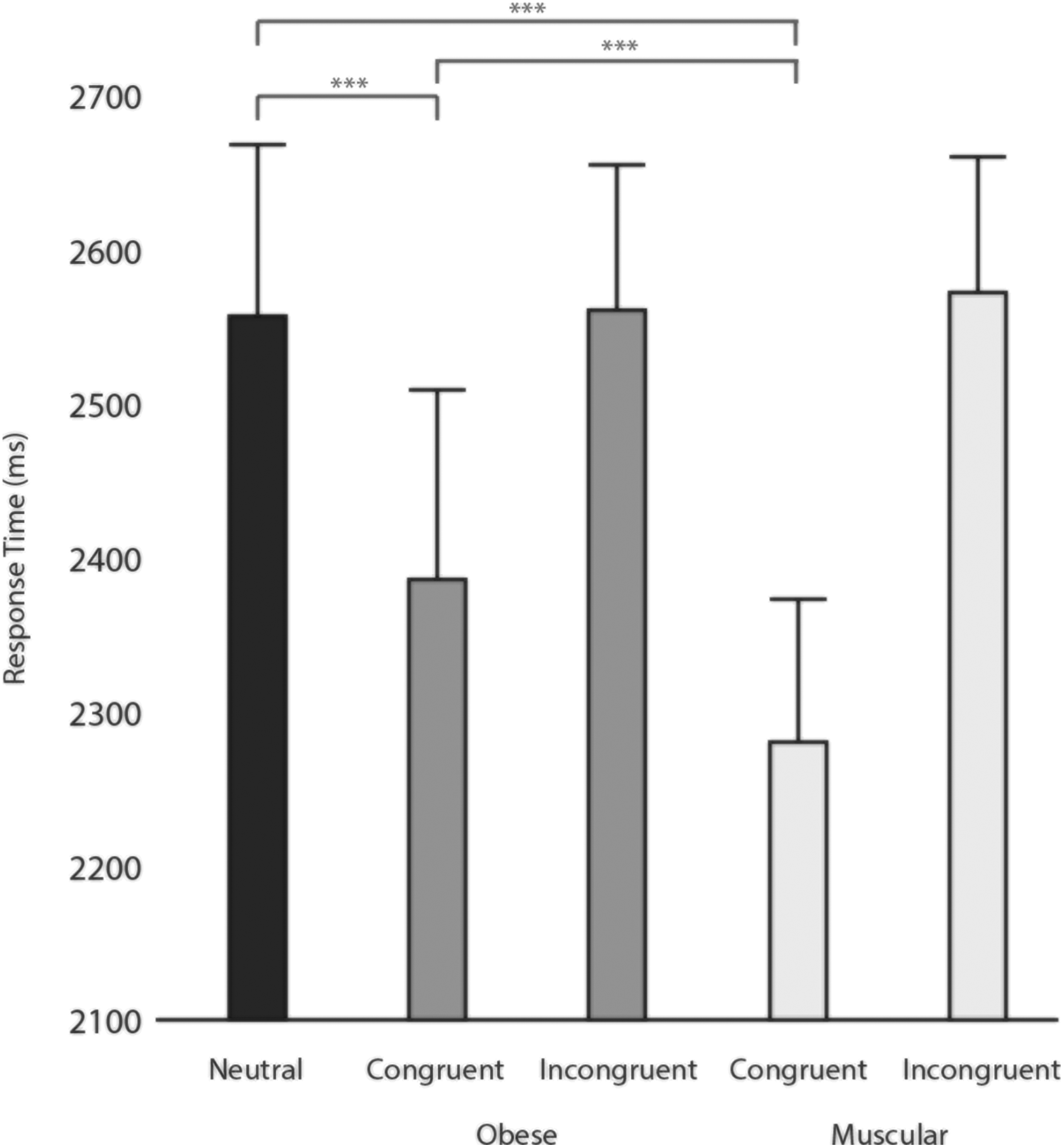
Means and standard error (denoted by error bars) of all visual search conditions. Note: ***p < .001.
In order to examine associations between RTs and psychological and biometric measures (hypotheses 2–5), a series of 24 Spearman’s correlations were conducted. Results returned positive correlations between muscular Attentional Bias scores and the MBAS muscularity subscale and Restraint and Shape Concern subscales of the EDE-Q. Further, for obese trials, Attentional Bias scores were positively correlated with the Restraint subscale of the EDE-Q, and Attentional Disengagement scores were positively correlated with the MBAS body fat subscale, the Shape and Weight Concern subscales of the EDE-Q, and participants’ body fat percentage (Table 2).
Spearman’s correlations between attentional bias score and attentional disengagement score, RT index scores, and psychological and physiological variables related to body dissatisfaction.
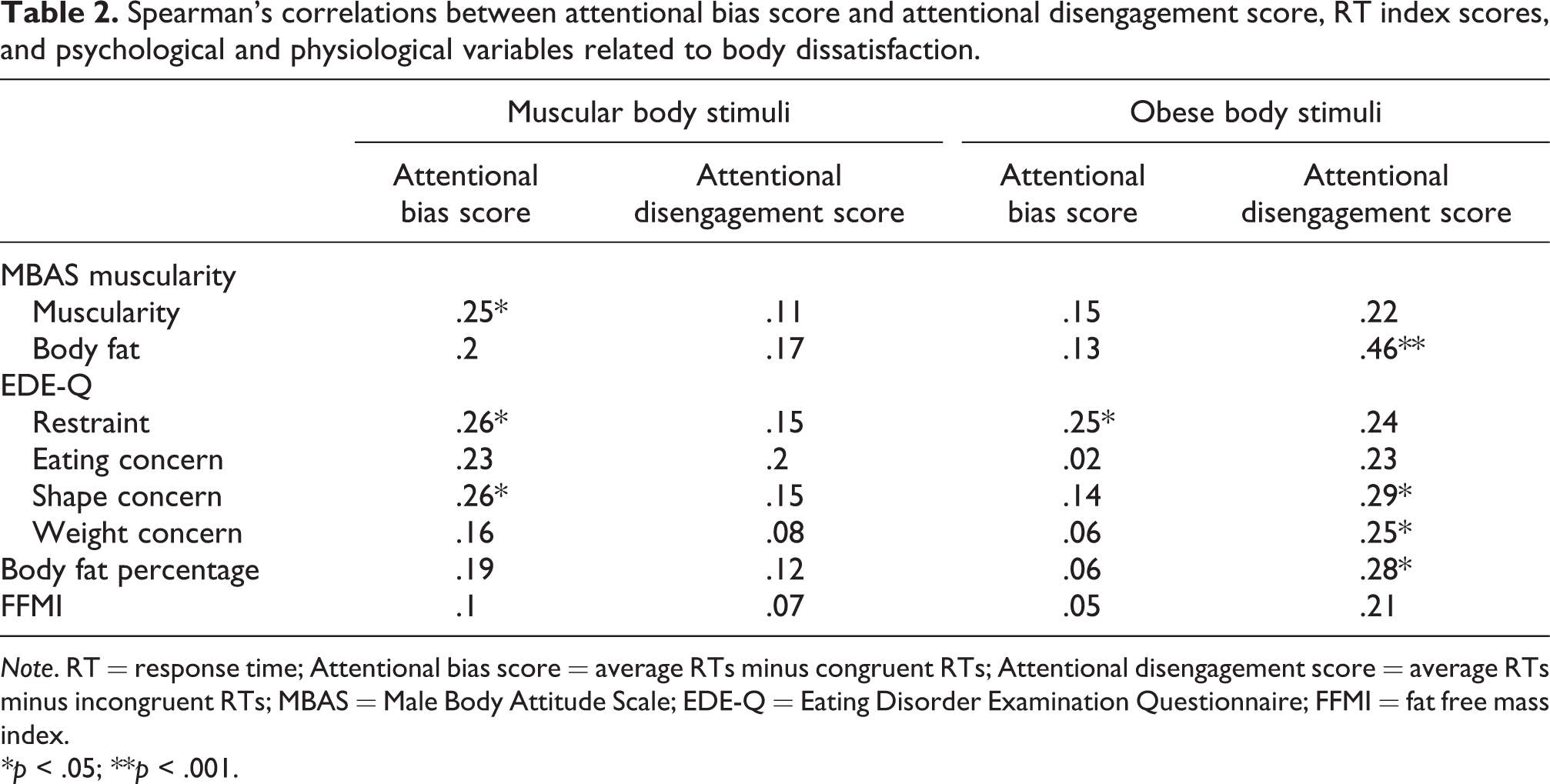
Note. RT = response time; Attentional bias score = average RTs minus congruent RTs; Attentional disengagement score = average RTs minus incongruent RTs; MBAS = Male Body Attitude Scale; EDE-Q = Eating Disorder Examination Questionnaire; FFMI = fat free mass index.
*p < .05; **p < .001.
Discussion
The present study aimed to examine the relationship between measures of body dissatisfaction and eating disorder symptoms and attentional bias and disengagement toward muscular and obese body stimuli in men using a compound visual search paradigm. The first hypothesis, that participants would display faster RTs in congruent trials and slower RTs in incongruent trials compared to neutral trials, was partially supported. Participants showed a marked advantage for locating and identifying the target when it was associated with a muscular or obese body, compared to when it was associated with an average body (neutral trials). This suggests that men could use frontal body images of males varying in muscularity and body fat to guide their search. Additionally, post hoc analyses revealed that men displayed an additional advantage for muscular stimuli compared to obese stimuli, reflected through significantly faster RTs in muscular congruent conditions. This suggests that muscular bodies may have induced a greater degree of attentional capture than obese bodies in our sample. Importantly, we found no difference in RT between incongruent and neutral trials, that is, no cost effects. Combined with the performance advantage conferred by congruent trials, these results imply that while both obese and muscular images may be capable of guiding visual attention (when embedded among neutral distractor body images), there is no evidence that these stimulus dimensions necessarily capture attention nor inhibit attentional disengagement.
The second hypothesis, that there would be significant positive correlations between Attentional Bias scores and body dissatisfaction and eating disorder symptoms, was partially supported. In muscular–congruent trials, as participants’ muscularity dissatisfaction increased, so did participants’ Attentional Bias scores. Additionally, an analogous relationship was observed between dietary restraint and shape concern and RT in muscular–congruent trials. These results suggest that muscle-related body dissatisfaction and eating disorder symptomatology played a role in facilitating attention. These findings are consistent with prior studies that show attentional differences toward ideal bodies in high body dissatisfaction groups (Cho & Lee, 2013; Gao et al., 2013, 2014; Joseph et al., 2016).
In obese–congruent trials, as participants’ dietary restraint increased, Attentional Bias scores increased. However, no further significant associations were found between obese congruent RTs and body dissatisfaction or eating disorder symptom scores. Why would dietary restraint be the only measure to predict an attentional bias toward obese bodies? In relation to the EDE-Q, the Restraint subscale is unique compared to the other three subscales. It has been argued that a two-factor solution, comprised of (1) restraint and (2) eating–shape–weight concern, might better fit the EDE-Q (Penelo, Negrete, Portell, & Raich, 2013). EDE-Q items relating to dietary restraint center around an individual’s active goal-directed behaviors aimed at influencing body shape and weight, as opposed to cognitions and attitudes relating to weight and shape. For our sample of men, it could be that eating-related behavior is the key factor in body fat-related attentional bias, as opposed to body fat-related cognitions and attitudes.
The third hypothesis, that there would be significant negative correlations between Attentional Disengagement scores (neutral trial RTs minus incongruent trial RTs) and the MBAS and the EDE-Q, respectively, was not supported. Muscular–incongruent RTs returned no significant correlations with any of the psychological variables. Thus, participants displayed no evidence of inhibited attentional disengagement as a function of body dissatisfaction or eating disorder symptoms toward muscular stimuli. This result was somewhat unexpected. Attentional bias toward disorder-related stimuli is implicated in both eating disorders and anxiety disorders. Further, there is a well-established presence of attentional disengagement inhibition toward disorder-relevant stimuli in anxiety disorders (Koster, Crombez, Verschuere, Van Damme, & Wiersema, 2006).
When considering this result, one possibility is that our visual search paradigm was not able to effectively measure attentional disengagement. Alternatively, the absence of the expected incongruent effect may be due to the nonclinical population employed in this study. Perhaps higher overall levels of body dissatisfaction and eating disorder symptoms are required to statistically extract evidence of attentional disengagement/inhibition in groups of participants. Future research involving clinical eating disordered, body dissatisfied, and/or obese populations is necessary to determine whether our results (or lack thereof) generalize to clinical populations.
Contrary to our prediction, obese–incongruent trials exhibited a significant positive association with body fat dissatisfaction, shape concern, and weight concern. Participants high in body dissatisfaction exhibited benefits in incongruent trials (compared to neutral trials), while participants low in body dissatisfaction exhibited RT costs. This surprisingly beneficial incongruent effect (for those high in body dissatisfaction and eating disorder symptoms) suggests the application of a search strategy that once identified allows these participants to more efficiently discount and/or filter obese images from their subsequent search, effectively reducing the number of potential distractors. Cognitive avoidance of non-ideal (i.e., fat) body stimuli has been implicated as a maintenance factor in cognitive models of eating disorders (Vitousek & Hollon, 1990; Williamson et al., 2004). To what extent cognitive avoidance may be linked to the more efficient discounting and/or attentional filtering of obese stimuli by body dissatisfied and eating disordered males is currently unknown.
Our fourth and fifth hypotheses were not supported. Results yielded no significant associations between Attentional Bias or Attentional Disengagement scores and biometric variables, bar 1: a significant positive correlation between body fat disengagement scores and body fat percentage. This result likely mirrors the strong positive association found between the MBAS body fat dissatisfaction score and Attentional Disengagement toward obese bodies.
Although our study employed a nonclinical sample, several of our results may have clinical implications. Firstly, our finding that for men, body dissatisfaction and disordered attitudes toward eating are associated with attentional biases favoring muscular body images suggests that evidence of a preoccupation with these images may signify a tendency toward body dissatisfaction. More surprisingly, the faster incongruent obese search times we found were associated with male body fat dissatisfaction, suggesting a previously unreported cognitive strategy involving attentional avoidance and/or ignoring of obese bodies. What role this avoidance may play in the manifestation of body dissatisfaction is unknown, although it may plausibly be linked to the avoidance of negative rumination (Rawal, Park, & Williams, 2010).
This is the first study to investigate the relationship between male body dissatisfaction and visual search performance using male body stimuli. We offer the following suggestions for future research. First, the use of stimuli with Caucasian skin tone may have affected the performance of non-Caucasian participants. This is an important consideration due to the ethnic diversity of the sample (only 45% of participants identified as Caucasian). Future research should seek to emulate the present study with stimuli specific to each participant’s ethnicity. Second, eye tracking could be used in combination with the visual search to examine participants’ gaze and provide an alternate measure of attentional disengagement. Third, systematic variation of the magnitude of each body extreme (muscular and obese) could be manipulated for congruent trials to equate discriminability across muscularity and body fat dimensions. Fourth, this study excluded the use of very thin (“skinny”) male bodies—a body type that is typically undesirable in men (Pope et al., 2000). Future research should seek to examine the relationship between attentional biases and skinny male body stimuli. Fifth, given the rise of eating disorders in men (Murray et al., 2017), the present study should be replicated with a clinical sample as it would be meaningful to consider the role of as attentional bias modification therapy (Renwick, Campbell, & Schmidt, 2013) for men with clinical body image issues.
The present study is the first to examine attentional bias toward male bodies through the use of the visual search paradigm. The robust search benefits afforded by congruent conditions imply that body image-related information can guide and facilitate visual search. The lack of any evidence for attentional disengagement (absence of significant overall search costs) suggests that in the present study, there was no body-related preconscious attentional capture. The present study also showed a significant association between muscle-related dissatisfaction and the ability to utilize muscular bodies to guide search. Similarly, men who were greater in dietary restraint were more efficient at utilizing obese bodies to guide their search. Additionally, there was a significant positive association between body fat dissatisfaction and eating disorder symptoms, and obese Attentional Disengagement scores. This result implicates a potential role for attentional filtering and/or avoidance of obese bodies in predicting male body fat dissatisfaction and eating disorder symptomology.
Supplemental material
SupplementaryMaterial_JEP_02April - Male body dissatisfaction, eating disorder symptoms, body composition, and attentional bias to body stimuli evaluated using visual search
SupplementaryMaterial_JEP_02April for Male body dissatisfaction, eating disorder symptoms, body composition, and attentional bias to body stimuli evaluated using visual search by Daniel Talbot, Evelyn Smith and John Cass in Journal of Experimental Psychopathology
Footnotes
Acknowledgement
The authors thank Patricia Kay for helpful comments on the manuscript.
Declaration of Conflicting Interests
The author(s) declared no potential conflicts of interest with respect to the research, authorship, and/or publication of this article.
Funding
The author(s) received no financial support for the research, authorship, and/or publication of this article.

Supplemental material
Supplemental material for this article is available online.
References
Supplementary Material
Please find the following supplemental material available below.
For Open Access articles published under a Creative Commons License, all supplemental material carries the same license as the article it is associated with.
For non-Open Access articles published, all supplemental material carries a non-exclusive license, and permission requests for re-use of supplemental material or any part of supplemental material shall be sent directly to the copyright owner as specified in the copyright notice associated with the article.
