




Abstract
Studies indicate that rumination might play a role in obsessive–compulsive disorder. In a previous experimental study, rumination about an unwanted intrusive thought (UIT) maintained the urge to neutralize this thought. We sought to replicate and extend these findings with measures of behavioral and mental neutralizing. Additionally, we investigated possible mechanisms that might be involved in the effects of rumination on the UIT. We activated a UIT by asking students (N = 105) to write down a sentence stating that they wished a loved person would die in a car accident. Participants were randomly allocated to rumination about the UIT, rumination about negative mood, or distraction. As predicted, rumination about the UIT maintained the urge to neutralize the UIT, relative to rumination about negative mood and distraction. In addition, rumination about the UIT also maintained distress associated with the UIT compared to rumination about negative mood and distraction. The effects of rumination did not extend to behavioral or mental neutralizing. UIT frequency and vividness were unaffected by rumination. The present findings strengthen the confidence that rumination contributes to the maintenance of UITs.
Keywords
Introduction
Individuals with obsessive–compulsive disorder (OCD) typically experience distressing obsessive thoughts (Rachman, 1997, 1998; Salkovskis, 1985), defined as “recurrent and persistent thoughts, urges, or images that are experienced, at some time during the disturbance, as intrusive and unwanted, and that in most individuals cause marked anxiety or distress” (American Psychiatric Association, 2013, p. 237). Once an obsession enters the mind, there are multiple behavioral and mental strategies an individual with OCD can use to respond (Freeston & Ladouceur, 1997). Analyzing the thought, its reasons, and causes has been identified as one of these strategies (Freeston & Ladouceur, 1997). This indicates that obsessive thoughts might be followed by rumination about the obsessive thoughts. For example, individuals diagnosed with OCD might ruminate about why they cannot get rid of their obsessive thoughts, what reasons caused the obsessive thoughts in the first place, and what might happen if the obsessive thoughts persist.
Rumination is defined as passive repetitive thinking about symptoms of distress and its causes, meanings, and consequences (Nolen-Hoeksema, 1991). Although originally researched in the area of depression (Nolen-Hoeksema, 1991; Nolen-Hoeksema et al., 2008), rumination has been associated with a number of mental disorders, such as anxiety (Harrington & Blankenship, 2002), alexithymia (Di Schiena et al., 2011), eating disorders (Naumann et al., 2015), and sleeping disorders (Carney et al., 2013). In addition, Nolen-Hoeksema et al. (2007) demonstrated that rumination might convey a risk of the onset of psychopathology. In their study, prior rumination increased the risk of subsequent onset of major depression, recurrent binge eating, and substance abuse over a 3-year period.
A number of studies with nonclinical individuals have demonstrated associations between rumination and obsessive–compulsive (OC) symptoms. For instance, Grisham and Williams (2009) and Wahl, Ertle et al. (2011) showed that the tendency to ruminate was positively correlated with OC symptoms in student samples. Studies with clinical samples indicated that ruminative thoughts occur as frequently as obsessive thoughts in individuals diagnosed with OCD (Wahl, Schönfeld et al., 2011). Dar and Iqbal (2015) found positive correlations between rumination and OC symptoms in a mixed sample of individuals diagnosed with OCD or generalized anxiety disorder. Rumination was related to the unacceptable thoughts/neutralization domain of OCD when negative affect was controlled for in an unselected treatment-seeking sample (Raines et al., 2017). Overall, these studies indicate an association between rumination and OCD symptoms and raise the question of whether and in what way they might influence each other.
Wahl et al. (2019) investigated the immediate rumination effects on the distress associated with an unwanted intrusive thought (UIT), the urge to neutralize it, depressed mood, and the frequency of this thought in an experimental study. Rumination about the UIT led to an attenuated decrease of the urge to neutralize the UIT in comparison to rumination about negative mood and distraction. This means that rumination might contribute to the maintenance of intrusive thoughts by reducing the natural decrease of the urge to act upon them. The authors did not find an effect of rumination about the UIT on the distress, depressed mood, or frequency of the UIT.
Several mechanisms by which rumination might influence the persistence of intrusive thoughts have been discussed. Raines et al. (2017) suggested that rumination might promote the misinterpretation of naturally occurring intrusive thoughts by changing the appraisals of these thoughts. This idea was supported in the previous experimental study (Wahl et al., 2019). Rumination about the UIT resulted in a stronger belief that the thought might come true relative to rumination about negative mood and distraction. This suggests that ruminating about one’s UITs might strengthen dysfunctional appraisals of the UIT. In addition, rumination could result in the persistence of negative mood. Negative mood increases the frequency of intrusive thoughts (Clark, 2002; Reynolds & Salkovskis, 1991) resulting in a vicious circle of negative mood and intrusive thoughts (Wahl, Schönfeld, et al., 2011). Moreover, Grisham and Williams (2009) suggested that rumination might fuel the frequency of intrusive thoughts by increasing their accessibility as a result of a quicker spread of activation in the semantic network. Previous research has demonstrated a clear association between rumination and frequency of intrusive cognitions such as intrusive memories (James et al., 2016; Luo et al., 2013; White & Wild, 2016). For example, White and Wild (2016) showed that individuals who were trained to adopt an abstract mode of processing—such as rumination—in response to a traumatic film reported more intrusive memories than individuals who were trained to adopt a concrete processing style. Abstract processing was defined as rumination focused on the reasons, meanings, and consequences of the traumatic event and concrete processing was characterized by focusing on the concrete details of the event. In another study, rumination clearly correlated positively with intrusion frequency (Zetsche et al., 2009). Taken together, these results lead us to expect rumination about a UIT to affect not just the urge to neutralize the UIT but also the associated distress, depressed mood, frequency, and negative appraisals of the thought.
Two further candidates that might be involved in the effects of rumination on UITs are trait rumination and thought–action fusion (TAF). Trait rumination refers to the tendency to ruminate in daily life (Just & Alloy, 1997; Nolen-Hoeksema, 1991, 2000). Studies indicate that higher levels of trait rumination are associated with greater negative emotional outcomes (Moberly & Watkins, 2006; Watkins, 2004). TAF is the belief that experiencing an unacceptable thought is morally equivalent to acting according to the thought or that mere thinking about a particular event makes it more likely to happen (Rachman, 1997, 1998; Rassin et al., 2001; Salkovskis, 1985; Shafran et al., 1996). The effects of rumination on UITs might be particularly pronounced for individuals who have a strong tendency to ruminate or who strongly endorse beliefs about TAF. In this way, trait rumination and TAF might moderate the effects of rumination on UITs.
Finally, rumination might change the vividness of a UIT. In one study, a majority (81%) of individuals with OCD reported having mental images (Speckens et al., 2007). These images were mainly visual and were experienced as distressing and vivid (Lipton et al., 2010). Intrusive images in OCD seem to occur more frequently than in anxiety disorders, are less often associated with past memories, and are typically viewed from a person’s own vantage point rather than from an observer’s perspective (Lipton et al., 2010). Rumination has been identified as one of the main triggers of intrusive images (Birrer et al., 2007), and one can assume that rumination affects the vividness of UITs (Birrer et al., 2007; Pearson et al., 2013).
The present study seeks to further clarify the imminent effect of rumination on UITs by replicating and extending previous findings by Wahl et al. (2019). The first aim was to replicate their main finding (rumination on a UIT attenuates the decline in the urge to neutralize) using an identical experimental paradigm in an independent sample. The second aim was to extend these findings by including measures of actual behavioral and mental neutralizing. While Wahl et al. (2019) investigated the urge to neutralize, an even stronger indication of the effects of rumination on UITs would be changes in actual neutralization. Additionally, we investigated several possible mechanisms that might be related to the influences of rumination on UITs.
We hypothesized that, relative to distraction and rumination about negative mood, rumination about a UIT would attenuate the natural waning of the urge to neutralize the UIT (replication of previous main result, Hypothesis 1). We additionally hypothesized that distress, depressed mood, and UIT frequency would decrease to a smaller degree after rumination about a UIT than after rumination about negative mood and distraction (Hypothesis 2a, b, and c). To extend the previous findings, we predicted that actual behavioral and mental neutralizing would be more pronounced after rumination about a UIT than after rumination about negative mood and distraction (Hypothesis 3a and b).
Concerning the potential mechanisms, we predicted that trait rumination and TAF, respectively, would moderate the relation between rumination about a UIT and the urge to neutralize (Hypothesis 4a and b). Specifically, we expected that the higher the level of trait rumination, the stronger the effects of rumination about a UIT on the urge to neutralize would be. Similarly, we predicted that the higher the TAF beliefs, the stronger the rumination about a UIT would affect the urge to neutralize. Furthermore, we hypothesized that rumination about a UIT would increase the negative appraisals of the UIT in comparison to rumination about negative mood and distraction (Hypothesis 5). Finally, we examined whether rumination about a UIT would affect the UIT vividness in comparison to rumination about negative mood and distraction in an exploratory analysis.
Method
Participants
All participants (N = 105) were undergraduate psychology students recruited at the University of Basel (M age = 22.35 years, SD = 4.94; 89 females, 16 males). For their participation, they received course credit. During the experimental manipulation, the participants were randomly allocated to rumination about a UIT (UIT rumination group; n = 34), rumination about negative mood (mood rumination group; n = 35), or distraction (n = 36). The experimental groups did not differ in sociodemographic variables, positive or negative affect, depressive symptoms, OC symptoms, degree of brooding, or degree of TAF, all ps > .05 (see Table 1 for means and standard deviations [SDs]). The study was reviewed and approved by the institutional review board of the University of Basel (approval number: IRB 009-16-1).
Sociodemographic variables, affect, and clinical characteristics.

Note. All values except for gender are means with standard deviations in parentheses. BDI = Beck Depression Inventory, OCI-R = Obsessive–Compulsive Inventory, Revised, PANAS = Positive and Negative Affect Schedule, RRS-brood = Ruminative Responses Scale, brooding subscale, TAFS = Thought–Action Fusion Scale, UIT = unwanted intrusive thought.
Measures
Standardized questionnaires
The Positive and Negative Affect Schedule (PANAS; Watson et al., 1988; German version: Krohne et al., 1996) is a measure of positive (10 items) and negative (10 items) affect with good reliability and validity (Crawford & Henry, 2004; Krohne et al., 1996). In this study, we measured the affect experienced within the last 12 months. Cronbach’s α was high in the current sample (for positive affect, α = .81; for negative affect, α = .84).
The Obsessive–Compulsive Inventory–Revised (OCI-R; Foa et al., 2002; German version: Goenner et al., 2007) is an 18-item self-report measure of OC symptoms consisting of six subscales (washing, obsessions, hoarding, ordering, neutralizing, and checking). The scale possesses good psychometric properties (Goenner et al., 2007, 2008). In the current sample, the internal consistency of the total scale was high with Cronbach’s α = .85.
The Beck Depression Inventory (BDI; Beck et al., 1979; German version: Hautzinger et al., 1995) is a 21-item self-report measure of depressive symptoms. The BDI is a widely used instrument in research with good reliability and validity (Beck et al., 1988). In this sample, Cronbach’s α = .84.
The Ruminative Responses Scale (RRS; Nolen-Hoeksema & Morrow, 1991; German version: Kuehner et al., 2007) is a 22-item self-report questionnaire that measures trait rumination. For this study, we used only the 5-item brooding scale (RRS-brood), which measures unproductive self-focused responses to sad mood. We chose this subscale because it is not contaminated by items focusing on depression (Treynor et al., 2003). For our study, we used RRS-brood to operationalize trait rumination. Psychometric properties of the brooding subscale are satisfactory (Treynor et al., 2003). Cronbach’s α was acceptable in this sample (α = .70).
The Thought–Action Fusion Scale (TAFS; Shafran et al., 1996; German version: Hansmeier et al., 2014) is a self-report measure of TAF consisting of two subscales: TAF-moral (12 items) and TAF-likelihood (7 items). The former focuses on a morality bias and the latter on a probability bias. The TAF-likelihood further differentiates between negative consequences to oneself (TAF-LS) and to others (TAF-LO). The psychometric properties of the scale are good (Hansmeier et al., 2014; Meyer & Brown, 2013; Rassin et al., 2001). In our study, Cronbach’s α for the total TAFS score was .89.
The Revised Obsessive Intrusions Inventory Part 2 (ROII Part 2; Purdon & Clark, 1993, 1994) was used to measure the appraisals of the activated UIT. We used 8 of the 10 appraisal items to assess unpleasantness of the UIT, a sense of guilt associated with the UIT, worry that the UIT would come true, unacceptability of the UIT, perceived likelihood of the UIT coming true, the importance of controlling the UIT, perceived harm or danger associated with the UIT, and perceived responsibility for the UIT coming true. We employed this measure to get an indication of the similarity in appraisal ratings between the induced UIT in our study and appraisals in individuals with OC symptoms. All items were rated on a 5-point Likert-type scale ranging from 0 (not at all) to 4 (extremely).
Assessment of distress, urge to neutralize, depressed mood, and vividness of UITs
Participants were asked to rate distress (“How distressed are you right now?”), urge to neutralize (“To what degree do you experience an urge to neutralize the UITs, that is, to undo the intrusive thought or to do something to prevent something bad happening?”), depressed mood (“How depressed are you right now?”), and vividness of the UITs (“Please indicate how vivid your intrusive thoughts are, that is, to what degree they appear as vivid images in your mind.”) on visual analog scales (VASs) ranging from 0 (very low/not at all vivid) to 9 (very high/extremely vivid).
Assessment of UIT frequency
We assessed UIT frequency with a smartphone counter app. Participants were instructed to press the “+” volume button whenever the UIT occurred. The display was covered so that participants could not see the counter app.
Manipulation checks
To check whether the experimental manipulation worked, the participants were asked to rate their concentration (“What percentage of time were you able to concentrate on the sentences shown?”), degree of self-focus (“While the statements were presented, to what degree were you thinking about yourself?”), and degree of UIT focus (“While the statements were presented, to what degree were you thinking about causes, meaning, and consequences of your intrusive thoughts or images?”) on VASs ranging from 0% to 100%. If the manipulation was effective, participants in the distraction condition should score lower on both self-focus and UIT-focus variables in comparison to those in the rumination groups. In addition, participants in the UIT rumination group should be less self-focused and more UIT focused than those in the mood rumination group.
Assessment of behavioral and mental neutralizing
To assess behavioral and mental neutralizing strategies, we modified items of previous work in that area (Freeston et al., 1991; Goodman et al., 1989; Purdon & Clark, 1993, 1994; Rachman et al., 1996), supplemented by items about leaving the room and inwardly calming oneself down. Items were ordered so that they assessed first behavioral (11 items) and then mental (9 items) forms of neutralizing. Examples of behavioral neutralizing are ripping the paper with the sentence or changing the name. Examples of mental forms of neutralizing are thinking about something positive or saying a prayer. First, the experimenter observed whether the participant had performed any behavioral neutralizing strategies. Subsequently, the experimenter asked the participant whether he or she had used any mental neutralizing strategies. The presence of behavioral or mental neutralizing was rated by the experimenter as either 0 (absent) or 1 (present). Given that the participants mostly performed only one behavior to neutralize the UIT, we analyzed behavioral neutralizing as a dichotomous variable (performed vs. did not perform). The final score for mental neutralizing was the number of different strategies used to neutralize the UIT per participant (sum score), since all participants but one used at least one mental neutralizing strategy. For a detailed description of the neutralizing assessment, see the Appendix.
UIT activation
The UIT activation was identical to that of the previous study (Wahl et al., 2019) and was based on a previous paradigm used to study characteristics of neutralizing in nonclinical samples (Rachman et al., 1996; van den Hout et al., 2001, 2002). First, we provided the participants with a pen and a sheet of paper and asked them to think of a loved person and to get a vivid image of that person in their mind. Once they had a clear picture in their mind, they were instructed to write down and subsequently to read aloud the following sentence: “I wish that [loved person] would die today in a horrible car accident.” Three participants refused to write down the sentence and two did not read it aloud.
Thought monitoring
During the thought-monitoring phases, participants were instructed to observe their own thoughts for 5 min and to assess the UIT frequency using the counter app, in the same way as in Wahl et al. (2019). The instructions were as follows: During the next 5 min, you may think about anything you like. You might think of your target unwanted intrusive thought, but you do not have to. However, if at any time you think of your target unwanted intrusive thought, please record the occurrence of each thought by pressing the “+” key on the smartphone once for each occurrence. It is important that you continue in the same way for the full 5 min. (adapted from Marcks & Woods, 2005)
Experimental manipulation
Following Wahl et al. (2019), we randomly assigned participants to the three groups: UIT rumination, mood rumination, or distraction. During the experimental manipulation, they were instructed to focus their attention on statements presented to them on a computer screen for 8 min. Each experimental condition used 28 statements to induce a designated thinking style or distraction. The participants could use the mouse to navigate through the statements.
To induce rumination about the UIT, we used a modified version of the rumination task by Morrow and Nolen-Hoeksema (1990), which was identical to the one used by Wahl et al. (2019). The participants assigned to this condition were asked to focus on the reasons for, implications of, and possible consequences of their activated UIT (e.g., “Think about: the possible consequences of having intrusive thoughts or images”). In the rumination about negative mood condition, the participants had to focus on reasons for, meanings of, and possible consequences of their negative mood (e.g., “Think about: the way you feel inside”). This induction was based on the depressive rumination paradigm (Blagden & Craske, 1996; Huffziger & Kuehner, 2009; Lyubomirsky et al., 2003; Morrow & Nolen-Hoeksema, 1990). In the distraction condition, the participants were asked to distract themselves by thinking about everyday objects and situations. (e.g., “Think about: raindrops sliding down a window pane”). This condition was based on the original distraction task (Huffziger & Kuehner, 2009; Morrow & Nolen-Hoeksema, 1990).
Procedure
The experimental procedure of the study is depicted in Figure 1. To administer the study, we used the online survey tool Unipark (Questback GmbH, 2013). All participants gave their written informed consent and were tested individually in a quiet room, seated in front of a computer screen. At the beginning, participants were randomly allocated to one of the three experimental groups and completed a set of standardized questionnaires (PANAS, OCI-R, BDI, RRS-brood, TAFS), followed by the activation of the UIT. The activation of the UIT was immediately followed by the first ratings on the VAS (distress, urge to neutralize, and depressed mood, at T1). Participants were subsequently asked to monitor and register their thoughts for 5 min (baseline), followed by the second ratings (distress, urge to neutralize, and depressed mood) on the VAS (T2). Participants were then asked to follow one of the three instructions of the experimental manipulation for 8 min, succeeded by a third rating of the VAS scales (distress, urge to neutralize, depressed mood, and UIT vividness, at T3). The study continued with the second thought-monitoring phase (return to baseline), followed by the fourth VAS ratings at T4 (distress, urge to neutralize, and depressed mood) and the completion of the ROII items and manipulation checks. Finally, behavioral and mental neutralizing were assessed. The procedure was identical to the procedure used in the study by Wahl et al. (2019) with the addition of three components: TAF was assessed as part of the questionnaire set at the beginning of the study, UIT vividness was assessed as part of the VAS ratings at T3, and behavioral and mental neutralizing were assessed at the end of the study.

Experimental procedure. The additions that extend Wahl et al. (2019) are marked in bold. BDI = Beck Depression Inventory; OCI-R = Obsessive–Compulsive Inventory, Revised; PANAS = Positive and Negative Affect Schedule; ROII = Revised Obsessive Intrusions Inventory; RRS-brood = Ruminative Responses Scale-brooding subscale; TAFS = Thought–Action Fusion Scale; T1 = before baseline; T2 = after baseline; T3 = after experimental manipulation; T4 = after return to baseline; UIT = unwanted intrusive thought; VAS = visual analog scale. Adapted from K. Wahl et al. (2019). Copyright 2018 by Elsevier. Adapted with permission.
Statistical analysis
Data were analyzed with IBM SPSS Statistics 23. First, we used box plots and z scores to identify outliers and detected four in UIT frequency. To reduce the bias, we applied Winsorizing by replacing these outliers with the next highest score that was not an outlier (Field, 2013). Next, we examined the assumption of normality, allowing small violations because our sample size included more than 30 participants per group (Field, 2013). To test whether the experimental groups differed in sociodemographic variables, clinical characteristics, or degree of concentration (first manipulation check), we used one-way analyses of variance (ANOVAs). We performed a χ2 test to compare the groups on gender. To investigate whether the experimental groups differed in the expected directions during the experimental manipulation (second manipulation check), we conducted a 3 × 2 mixed-model ANOVA with group (UIT rumination, mood rumination, and distraction) as between-subjects factor and content of thinking (self-focus vs. UIT focus) as a within-subject factor. We additionally carried out this analysis just for the rumination groups with a 2 × 2 mixed-model design, excluding distraction.
To examine Hypotheses 1 and 2 (a, b, and c), the outcome variables (distress, urge to neutralize, and depressed mood) were calculated as the mean difference between T2 and T3. We focused on these two time points as the crucial interval since they were immediately before and after the experimental manipulation and could also be directly compared with the Wahl et al.’s (2019) study. The outcome variable UIT frequency was calculated as the mean difference between the two thought-monitoring phases (baseline and return to baseline). Planned contrasts were conducted comparing the UIT rumination group with the combined mood rumination and distraction groups. Where necessary, we adjusted for heterogeneity of variances. To analyze the effect of rumination about the UIT on behavioral and mental neutralizing (Hypothesis 3a and b), we conducted a logistic regression and a Welch test (due to slight heterogeneity of variances on this variable), respectively.
To investigate the moderating effects of trait rumination and TAF (Hypothesis 4a and b), we conducted moderation analyses using PROCESS (Hayes, 2017). For the interactions, we report percentile bootstrap 95% confidence intervals (CIs), because this method is more robust than the standard CI (Field, 2013). Significant moderation effects were followed by a simple slopes analysis (Aiken & West, 1991; Rogosa, 1981). This analysis looks at the relation between the predictor and outcome at 1 SD above and below the mean value of the moderator. Specifically, we looked at the effect of rumination about the UIT on the urge to neutralize from T2 to T3 at lower (1 SD below mean), average (mean), and higher (1 SD above mean) levels of trait rumination and TAF, respectively. Urge to neutralize from T2 to T3 was calculated as the mean difference between these two time points. To analyze the effect of rumination about the UIT on UIT appraisals (Hypothesis 5), we carried out a multivariate ANOVA, which tests the difference between groups across multiple outcomes simultaneously and therefore controls better for multiple testing (Field, 2013). Last, changes in UIT vividness were analyzed with an ANOVA, followed by Tukey’s post hoc test.
As effect sizes, we report Pearson’s correlation coefficient (r; planned contrasts), partial eta-squared (
Results
Manipulation Check
First, we analyzed whether participants were able to concentrate on the statements provided during the experimental manipulation. Results showed that on average, all participants were able to focus to a high degree on the statements, with no significant group differences, F(2, 102) = 0.36, p = .696 (see Table 2 for all manipulation check means and SDs). Next, we investigated differences between groups on the content of thinking. We expected that distraction would lead to lower scores on self-focus and UIT focus in comparison to rumination about the UIT and rumination about negative mood. In addition, we predicted that the rumination groups would differ from each other in the content being ruminated on (self-focus vs. UIT focus), with rumination about the UIT being more UIT focused and rumination about negative mood being more self-focused. A significant interaction between the experimental group and the content of rumination with the expected patterns suggests that three distinct thinking styles were successfully induced, F(2, 102) = 6.41, p = .002,
Manipulation checks by experimental group.

Note. Values are means with standard deviations in parentheses. UIT = unwanted intrusive thought.
Replication
Table 3 presents means and SDs for urge to neutralize for each time point. The analysis focuses on the comparison between T2 and T3. Urge to neutralize showed an attenuated decline in those participants who had previously ruminated about their UIT compared to participants who had ruminated about negative mood and those who were distracted, t(81.58) = 2.74, p = .007, r = .29. For illustration and comparison with the study by Wahl et al. (2019), means and standard errors of the urge to neutralize are depicted graphically in Figure 2.
Distress, urge to neutralize, depressed mood, UIT frequency, mental neutralizing, UIT appraisals, and UIT vividness by experimental group with time points.

Note. Values are means with standard deviations in parentheses. ROII = Revised Obsessive Intrusions Inventory; T1 = before baseline; T2 = after baseline; T3 = after experimental manipulation; T4 = after return to baseline; UIT = unwanted intrusive thought.
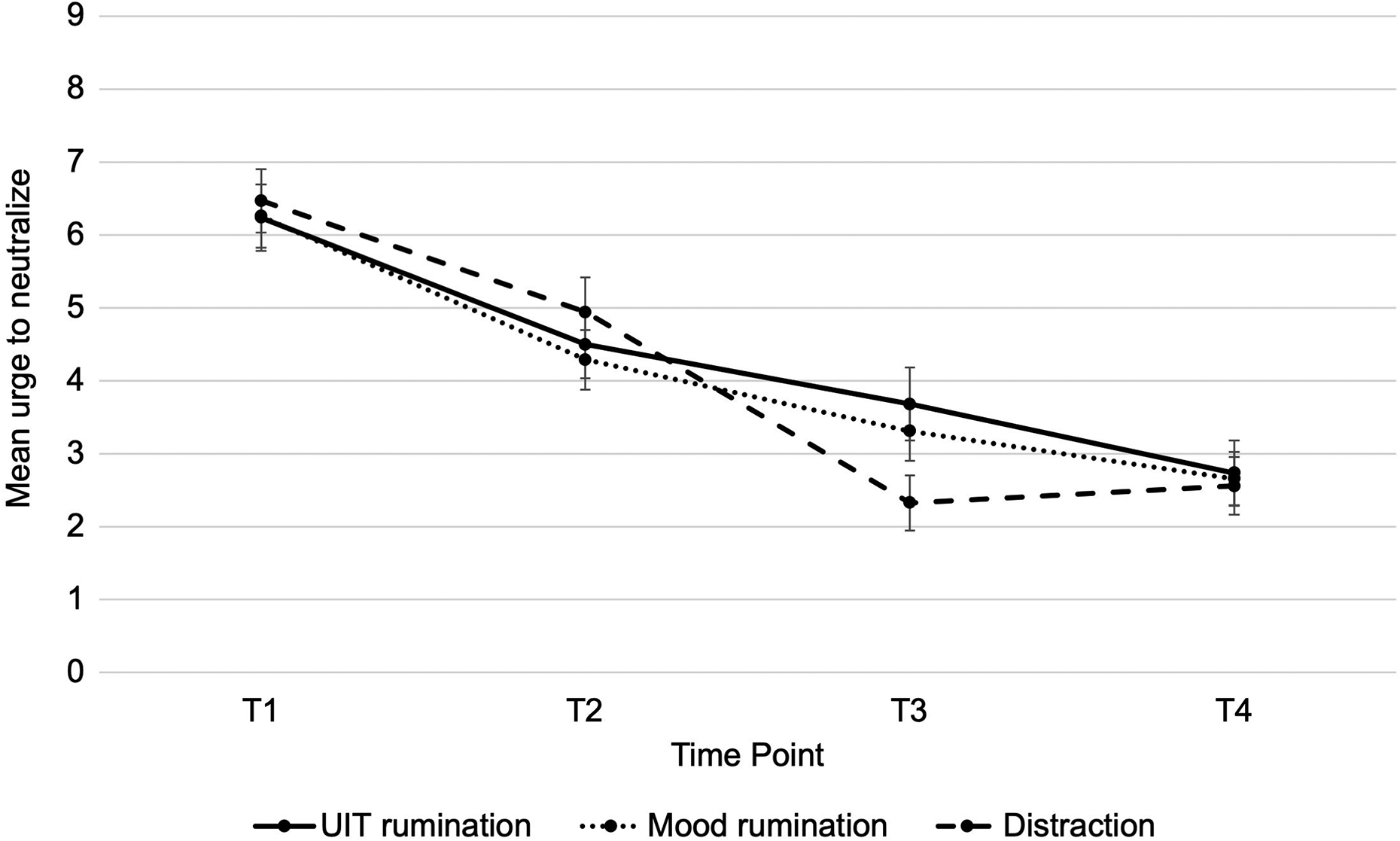
Means of urge to neutralize by group (UIT rumination, mood rumination, and distraction). Error bars represent standard errors. UIT = unwanted intrusive thought.
Table 3 presents means and SDs for distress, depressed mood, and UIT frequency. Similar to urge to neutralize, distress showed an attenuated decline from T2 to T3 in those participants who were in the UIT rumination group compared to participants who were in the mood rumination and distraction groups, t(102) = 2.45, p = .016, r = .24. The effect of rumination about the UIT on depressed mood was not significant, t(102) = 1.56, p = .121, r = .15. Figure 3 shows the effects for distress and depressed mood. With regard to UIT frequency, there was no significant difference between the experimental groups, t(102) = 0.45, p = .656, r = .04.
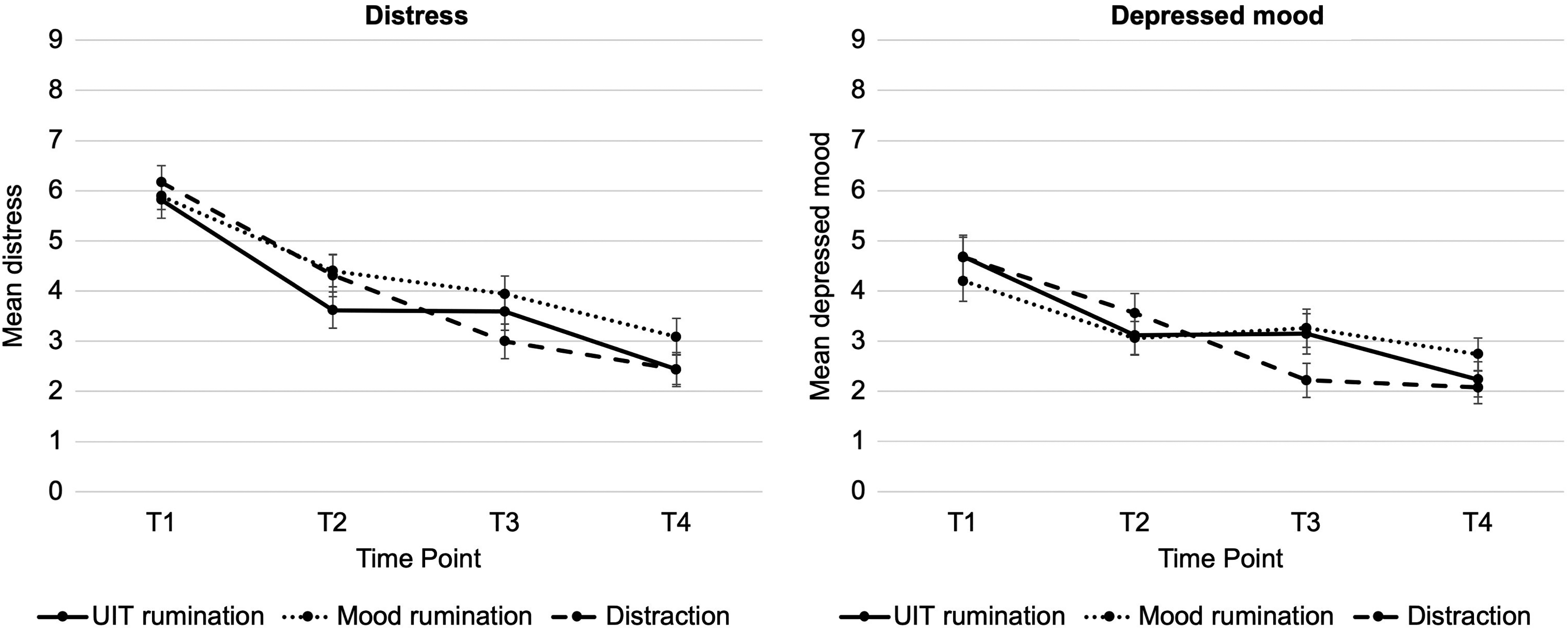
Means of distress and depressed mood by group (UIT rumination, mood rumination, and distraction). Error bars represent standard errors. UIT = unwanted intrusive thought.
Additional analysis: Rumination about negative mood versus distraction
Visual inspection of the data (Figures 2 and 3) and the means in Table 3 suggest that the two rumination groups followed a similar pattern, that is, a reduced decline in comparison to distraction. Thus, we decided to conduct an additional contrast to test the differences between rumination about negative mood and distraction for statistical significance. Relative to distraction, rumination about negative mood maintained the urge to neutralize, t(60.84) = 3.42, p = .001, r = .40; distress, t(102) = 2.15, p = .034, r = .21; and depressed mood, t(102) = 3.54, p = .001, r = .33, from T2 to T3.
Extension
There was no significant effect of the experimental manipulation on behavioral neutralizing,
1
b = 0.65, SE = 0.50, p = .196, OR = 1.92, 95% CI [0.715, 5.157] (UIT rumination vs. distraction), b = −0.19, SE = 0.54, p = .731, OR = 0.83, 95% CI [0.288, 2.392] (UIT rumination vs. mood rumination), or mental neutralizing, F(2, 67.63) = 1.20, p = .309,
Mechanisms
When comparing rumination about the UIT with distraction, trait rumination did not moderate the effect of the experimental manipulation on the urge to neutralize, b = −0.28, percentile 95% CI [−0.637, 0.027], t = −2.25, p = .027, since the percentile bootstrap CI included zero. TAF moderated the relation between the experimental group and the urge to neutralize from T2 to T3, b = −0.09, percentile 95% CI [−0.155, −0.012], t = −2.33, p = .022, when comparing rumination about the UIT with distraction. When comparing rumination about negative mood with distraction, the moderation was not significant, b = −0.07, percentile 95% CI [−0.145, 0.010], t = −1.98, p = .051. Further analysis showed that the effect of TAF occurred only in the distraction group and not in the two rumination groups (see Table 4). Specifically, when TAF score increased, so did the mean difference in urge to neutralize from T2 to T3; that is, urge to neutralize decreased to a greater degree.
Conditional effects of TAF on urge to neutralize from T2 to T3 by experimental group.
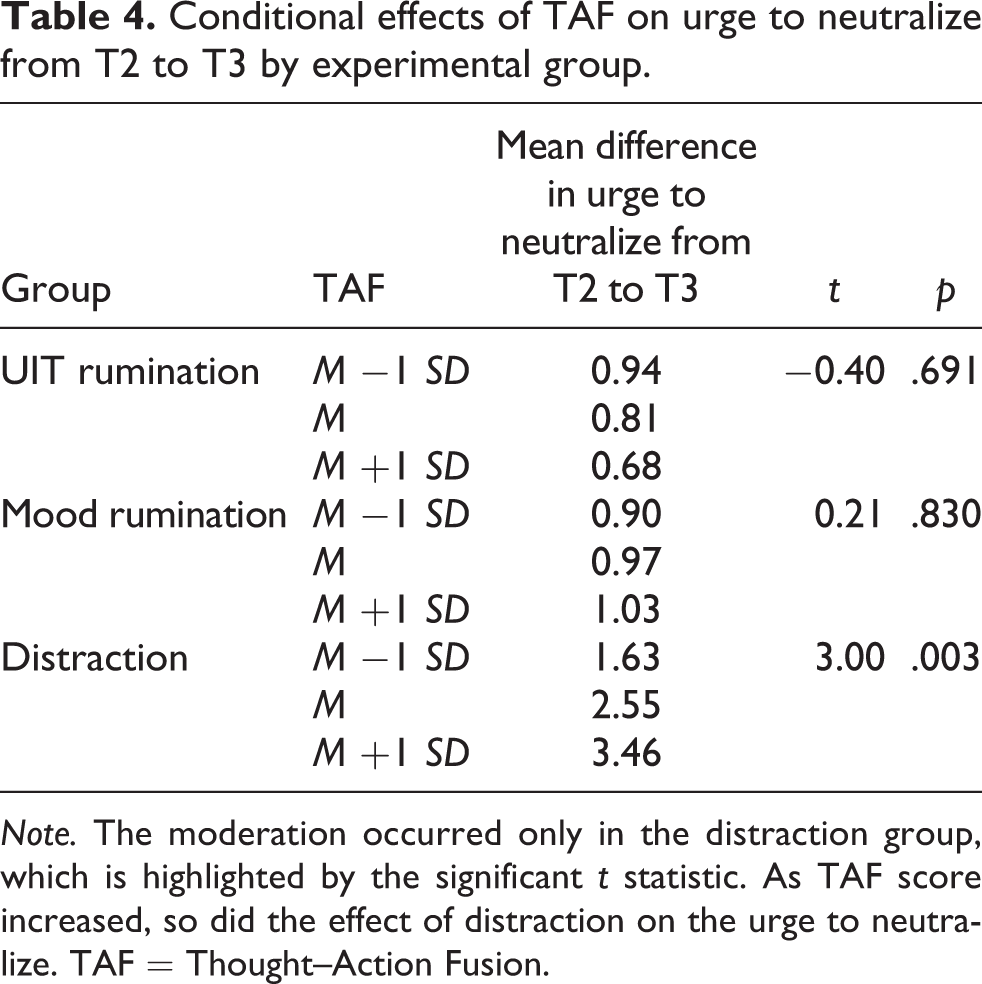
Note. The moderation occurred only in the distraction group, which is highlighted by the significant t statistic. As TAF score increased, so did the effect of distraction on the urge to neutralize. TAF = Thought–Action Fusion.
We did not find evidence for an effect of rumination about the UIT on the UIT appraisals, V = 0.15, F(16, 192) = 0.96, p = .504 (for means and SDs, see Table 3).
Exploratory analysis: Effect of rumination on UIT vividness
The effect of the experimental group on the UIT vividness was not significant, F(2, 102) = 2.51, p = .086,
Discussion
The major goal of the study was to investigate whether rumination about a UIT reduces the natural decline of the urge to neutralize these thoughts relative to rumination about negative mood and distraction, thereby replicating findings by Wahl et al. (2019). Consistent with Hypothesis 1, rumination about the UIT attenuated the general decline of the urge to neutralize the UIT relative to rumination about negative mood and distraction. Interestingly, we observed a similar effect on the urge to neutralize for individuals who had ruminated about negative mood, relative to those in the distraction group. In other words, individuals who ruminated—irrespective of the content of rumination—experienced a reduced decline in the urge to neutralize compared to individuals who were distracted. Findings partially replicate results by Wahl et al. (2019) who used a novel experimental paradigm for the first time. This replication in an independent sample further strengthens our confidence in the assumption that rumination about a UIT is involved in the maintenance of the urge to act upon these thoughts.
In contrast to the previous study (Wahl et al., 2019), rumination about the UIT also attenuated the decline of distress associated with the UIT, relative to rumination about the negative mood and distraction (Hypothesis 2a). These findings suggest that rumination about the UIT is involved not only in the maintenance of the urge to neutralize but possibly also in the persistence of the distress experienced with the UIT. It is possible that the nonsignificant effect on distress found earlier represented a power problem, as Wahl et al. (2019) assessed a smaller sample. In addition, rumination about negative mood maintained both the distress associated with the UIT and depressed mood, relative to distraction. The present findings suggest that the two types of rumination exerted similar effects on the urge to neutralize and distress. The reasons for this discrepancy in the effects of rumination about negative mood between the previous study (Wahl et al., 2019) and the current study are unclear. Manipulation checks in both studies indicate that two distinct types of rumination were successfully induced to a similar degree, using identical methodology. The differences between rumination on UIT and rumination on negative mood seem to be particularly relevant for individuals diagnosed with OCD (Wahl, Schönfeld et al., 2011), and future studies should retain this distinction and investigate whether they differ in their effects on OC symptoms.
Neither the current nor the previous study (Wahl et al., 2019) found an effect of the experimental manipulation on the frequency of UITs (Hypothesis 2c). Whether this can be interpreted as a robust finding, meaning that the frequency of UITs is unaffected by previous rumination, or whether the findings are attributable to methodological difficulties such as the reliable and valid assessment of such transient phenomena as UITs remain to be seen in future studies, which could develop valid assessments of UITs that also differentiate between frequency and duration of UITs.
The second aim was to extend the previous findings by investigating whether also actual behavioral and mental neutralizing are affected by rumination. Although the effect was going in the predicted direction (i.e., participants in the UIT rumination group performing behavioral neutralizing more often than participants in the distraction group), the experimental groups did not significantly differ in their effect on behavioral neutralizing (Hypothesis 3a). This means that participants in each group engaged in actual neutralizing behavior such as ripping the paper or crossing out the name of the loved person to a similar degree. Likewise, rumination about the UIT did not result in a higher frequency of mental neutralizing strategies compared to rumination about the negative mood and distraction (Hypothesis 3b). Each group engaged in a high total number of mental neutralizing strategies (UIT rumination: M = 4.88, SD = 1.45; mood rumination: M = 5.23, SD = 1.52; distraction: M = 4.61, SD = 1.89), such as saying silently to oneself that the sentence “does not count” since one was told to write it down to fulfill the requirements of the study. Thus, the lack of group differences might be explained by a ceiling effect, attributable to the strong activation of a UIT. In sum, results do not support Hypothesis 3a and b. Future studies should address this question with more power and a more refined assessment of actual behavioral and mental neutralizing.
Several potential mechanisms involved in the associations between rumination and UITs were addressed in this study in a conjunct analysis to better understand how exactly rumination impacts the maintenance of UITs. We did not find evidence of trait rumination or TAF moderating the effect of rumination about the UIT on the urge to neutralize (Hypothesis 4a and b). Thus, it appears that rumination about a UIT affects the urge to neutralize regardless of the tendency to ruminate in daily life, or the predisposition to misinterpret the occurrence and meaning of UITs. Additionally, we did not find that rumination directly affected the appraisals of the UIT (e.g., rumination did not increase the perceived likelihood of the thought coming true, relative to distraction), which is consistent with the finding on TAF. Future studies might focus on the assessment of key misinterpretations of UITs and their potential changes as a result of rumination.
Finally, we examined whether rumination about the UIT influenced the vividness of the UIT. Findings suggest that vividness did not differ between the groups. Future studies might want to include more aspects of imagery related to UITs to draw conclusions about their possible involvement in the effects of rumination on UITs.
There are several limitations to this study that should be addressed. First, the use of one-item measures as the main dependent variables poses questions about their psychometric properties. Second, the current and the previous study (Wahl et al., 2019) did not find an effect of rumination about the UIT on the frequency of UITs. These findings are surprising, given that in the current study rumination about the UIT had a broader impact on variables (urge to neutralize and distress). This raises the question of whether the use of a smartphone to assess frequency of UITs is a valid and reliable measure. Future studies might consider other measures of intrusive thoughts, for instance, the think-aloud approach (Zanov & Davison, 2010) or thought sampling (Hirsch et al., 2015). Finally, replications of key findings should ideally be conducted by an independent research group. Although the study was double blind, it cannot be completely ruled out that the previous experiences with the experimental paradigm or the researchers’ expectations might have influenced the current results.
To conclude, the study replicated the main result from a previous study (Wahl et al., 2019) that rumination about a UIT attenuates the decrease in urge to neutralize compared to rumination about negative mood and distraction. Given the additional findings that rumination about the UIT affected distress, this strengthens the confidence in the argument that rumination has an influence on the maintenance of UITs. Findings are also consistent with previous studies suggesting that rumination might play a role in OCD (Dar & Iqbal, 2015; Grisham & Williams, 2009; Raines et al., 2017; Wahl et al., 2019). Findings warrant replication in individuals diagnosed with OCD to investigate whether rumination also affects obsessive thoughts in the same way as it affects UITs.
Footnotes
Acknowledgments
The authors would like to thank Florence Allegro, Antonino Cusano, Anja Laura Käch, Rahel Velte, and Leonie Kanzler for collecting the data.
Declaration of conflicting interests
The author(s) declared no potential conflicts of interest with respect to the research, authorship, and/or publication of this article.
Funding
The author(s) disclosed receipt of the following financial support for the research, authorship, and/or publication of this article: This research received no specific grant from any funding agency in the public, commercial, or not-for-profit sectors. The Swiss National Science Foundation (SNSF) is funding the PhD position for Martin Kollárik. The SNSF was not involved in the research question, data collection, data analysis, interpretation of results, or publication.
