




Abstract
The Macbeth effect is a proposed phenomenon, whereby feelings of immorality activate a desire to cleanse. Extensions of this theory suggest that cleansing alleviates immoral feelings, thus reducing the urge to engage in compensatory behaviors, such as volunteering. We examined the Macbeth effect and volunteerism in undergraduate students with high levels of obsessive-compulsive disorder contamination concerns (n = 164). Participants underwent an immorality, anxiety, or neutral emotion-induction condition and subsequently cleansed their hands or performed a control task. For participants in the immorality condition, increased ratings of distress were associated with increased accessibility of cleansing words. Furthermore, individuals in the immorality condition who cleansed volunteered for significantly less time than those who did not cleanse. We discuss findings in relation to the literature on the Macbeth effect and mental contamination.
Obsessive-compulsive disorder (OCD) is a clinically heterogeneous disorder that is characterized by obsessions, frequent and persistent thoughts, impulses, or images that are experienced as intrusive and inappropriate. To neutralize the distress triggered by these obsessions, individuals with OCD engage in specific, repetitive behaviors or mental rituals, known as compulsions. Research on the dimensional structure of OCD has identified several heterogeneous types of obsessions and compulsions, which include (1) contamination obsessions and washing compulsions, (2) responsibility for harm obsessions and checking compulsions, (3) symmetry obsessions and ordering compulsions, (4) unacceptable thoughts, and (5) neutralizing compulsions (Stewart et al., 2008).
After checking, washing is the most common compulsion and typically involves ritualized cleaning such as washing one’s hands or showering excessively due to fears of contamination (Mataix-Cols, Rauch, Manzo, Jenike, & Baer, 1999). Indeed, this dimension of OCD is specifically associated with symptoms of fear disorders such as agoraphobia, whereas other dimensions of OCD are more likely to be associated with symptoms of distress disorders such as depression (Raines, Allan, Oglesby, Short, & Schmidt, 2015). The contamination fears that induce compulsive washing comprise two broad categories: contact contamination, which involves fears of external contaminants such as disease or germs, and mental contamination, which involves a sense of impurity in the absence of a physical pollutant (Rachman, 2006).
Conversely, mental contamination is a phenomenon involving a sense of impurity in the absence of a physical pollutant. Unlike contact contamination, in which the source of uncleanliness is easily identified, feelings of dirtiness attributable to mental contamination are not localized and thus are more ambiguous (Coughtrey, Shafran, Lee, & Rachman, 2012). Most commonly, feelings of mental contamination are characterized as “emotional” or “internal” uncleanliness (Herba & Rachman, 2007).
The literature on mental contamination has documented numerous hypothesized reasons for why feelings of internal uncleanliness may occur. For example, internal uncleanliness may occur in cases of mental violations, which is a term used to refer to feelings of betrayal or humiliation (Fairbrother, Newth, & Rachman, 2005). This is an example of mental contamination being evoked through perceived ill-treatment by a third party; however, there are also cases in which it is “self-generated” (Coughtrey, Shafran, Lee et al., 2012). Self-generated mental contamination transpires as a result of one’s own intrusive thoughts, images, or memories (Elliott & Radomsky, 2013).
The cognitive elements that induce mental contamination, that is, thoughts, images, emotions, or memories, are largely associated with the concept of immorality. Although immoral feelings frequently arise in cases of mental contamination, these feelings are not typically associated with contact contamination (Fairbrother & Rachman, 2004). Specifically, situations that are perceived to be either immoral or unethical (e.g., sexual or aggressive) are likely to provoke symptoms of mental contamination. For example, individuals with contamination-related OCD are particularly susceptible to mental contamination when they experience an unwanted, intrusive thought that is perceived to be immoral. This is because immoral thoughts engender feelings of internal uncleanliness which consequently leads to the compulsion to cleanse oneself (Rachman, 2006).
Another significant contributor to mental contamination is disgust—although this is an integral emotion in both contact and mental contamination. The relevance of disgust in OCD symptomatology has been illustrated in studies determining that disgust sensitivity mediates the relationship between health anxiety and washing compulsions (Thorpe, Barnett, Friend, & Nottingham, 2011). Further studies revealed that disgust is a greater predictor of obsessions and compulsions, in comparison to fear, anxiety, and depression. Therefore, theorists have proposed that perhaps individuals with contamination-related OCD perform washing compulsions to reduce the disgust associated with either mental or contact contamination rather than anxiety as frequently conceptualized (Mancini, Gragnani, & D’Olimpio, 2001).
Mental contamination is a phenomenon that is more pervasive than currently recognized. Recent research has indicated that approximately 46% of those with OCD symptoms have experienced mental contamination (Coughtrey, Shafran, Knibbs, & Rachman, 2012). In addition, the majority of individuals with OCD contamination concerns report being affected by both mental and contact contamination (Rachman, 2006). However, mental contamination is not limited to individuals with OCD; feelings of internal uncleanliness arise in individuals with post-traumatic stress disorder as a result of feeling violated after a traumatic event. Feelings of internal uncleanliness also arise from the disgust engendered by hypochondriasis and disease phobia (Elliott & Radomsky, 2009). It must also be noted that mental contamination is not exclusively observed in individuals with psychological disorders—empirical evidence indicates that it may also occur in unselected samples (Zhong & Liljenquist, 2006).
The Macbeth effect
Empirical studies have suggested that threatening one’s moral integrity activates a need to cleanse. This phenomenon has been termed the “Macbeth effect”—named after Shakespeare’s Lady Macbeth who compulsively washed her hands in an attempt to clear her conscience after orchestrating murder. The Macbeth effect can be conceptualized as a form of mental contamination that arises from feelings of immorality. Zhong and Liljenquist (2006) introduced the Macbeth effect via a series of experiments in which they instructed participants to recall either a past ethical or an unethical deed. Participants who recalled an unethical deed were more likely to complete word fragments as cleansing-related words, suggesting that feelings of immorality increased mental accessibility of cleansing-related themes.
In a follow-up study, participants recalled an unethical deed and then half of the participants wiped their hands before completing a questionnaire assessing “moral emotions” (e.g., embarrassment, regret, shame). Finally, the experimenter informed participants that a graduate student urgently required volunteers for their study and asked whether they would be interested in helping. Participants who cleansed themselves reported significantly lower levels of moral emotions and volunteered significantly less than participants who did not cleanse. The premise of the volunteerism measure was based on research indicating that a violation of one’s core values drives an individual to restore their “moral self” through compensatory behaviors such as volunteerism (Tetlock, Kristel, Elson, Green, & Lerner, 2000). Accordingly, participants who cleansed their hands were less likely to volunteer as they already compensated for their immorality (Zhong & Liljenquist, 2006).
Despite the intriguing literature on the Macbeth effect, several replications of Zhong and Liljenquist’s (2006) studies have not been successful (Earp, Everett, Madva, & Hamlin, 2014; Gamez, Diaz, & Marrero, 2011). Gamez, Diaz, and Marrero (2011) explained their nonsignificant findings by theorizing that the Macbeth effect may simply be a culturally specific phenomenon. However, further research failed to find evidence of the Macbeth effect despite conducting the investigation in three different countries, that is, America, the United Kingdom, and India (Earp et al., 2014).
The Macbeth effect and OCD
The aforementioned studies investigated the Macbeth effect in unselected samples, although there have been attempts to examine this phenomenon specifically within the context of OCD (Cougle, Goetz, Hawkins, & Fitch, 2012; Reuven, Liberman, & Dar, 2013). Issues such as immorality and bodily cleanliness are particularly salient for individuals with high OCD contamination symptoms and thus such individuals may be more susceptible to the Macbeth effect. Individuals with OCD tendencies may also be more likely to engage in compensatory behaviors to alleviate feelings of immorality (Ahern & Kyrios, 2010), and as such may be more likely to volunteer after recollecting experiences of immoral deeds.
Reuven, Liberman, and Dar (2013) attempted to establish whether there are differences in the susceptibility of the Macbeth effect between participants with OCD and matched controls. Their findings indicated that both participants with and without OCD were susceptible to the Macbeth effect. However, the effects of cleansing were significantly magnified in participants with OCD in comparison to the matched controls. Two studies, however, failed to find an association between the Macbeth effect and OCD symptoms and demonstrated that OCD contamination symptoms did not moderate the duration of hand washing after recalling unethical behavior (Cougle et al., 2012). Consequently, an overview of the literature reveals that there are mixed findings regarding the Macbeth effect when considering both unselected and OCD samples.
The contradictory findings in the Macbeth effect literature may be attributed to methodological limitations. None of the experiments verified that the preference for cleansing words or the differing rates of volunteerism were specifically due to feelings of immorality (e.g., Cougle et al., 2012; Earp et al., 2014; Gamez et al., 2011; Reuven et al., 2013; Zhong & Liljenquist, 2006). The Macbeth effect may have occurred due to the negative affect engendered by recalling an immoral deed, rather than specific feelings of immorality. Relatedly, formal manipulation checks were not performed to ensure whether feelings of immorality were actually induced (e.g., Earp et al., 2014; Gamez et al., 2011; Reuven et al., 2013; Zhong & Liljenquist, 2006).
A second limitation is that in several of the studies (e.g., Gamez et al., 2011; Reuven et al., 2013; Zhong & Liljenquist, 2006), half of the participants cleansed their hands and the other half simply moved on to the next phase of the experiment. This is problematic because the absence of a control task makes it unclear whether cleansing itself led to the alleviation of moral emotions and decreased volunteerism (Cougle et al., 2012).
A third limitation is that volunteerism was measured by categorical measures (e.g., Gamez et al., 2011; Reuven et al., 2013; Zhong & Liljenquist, 2006), which do not capture variability in helping behavior. Previous volunteerism measures also measured whether participants had an intention to volunteer—they did not measure volunteerism directly (e.g., Earp et al., 2014; Gamez et al., 2011; Reuven et al., 2013; Zhong & Liljenquist, 2006). Such an approach is disadvantageous because there is a discrepancy between intentions and behavior, such that individuals who express an intention to volunteer typically fail to act in accordance with their expressed intentions (Ajzen, Brown, & Carvajal, 2004).
Fourth, the two experiments investigating the Macbeth effect within the context of OCD did not examine a specific OCD symptom dimension. For example, Cougle et al. (2012) assessed whether general OCD symptoms in an undergraduate sample acted as a moderator of effects.
The current study
The primary aim of the study was to examine whether the Macbeth effect occurs within a sample of individuals with high OCD contamination concerns, as issues with cleanliness are most relevant to the Macbeth effect. Specifically, we aimed to (1) investigate whether immoral feelings led to increased accessibility of cleansing-related concepts, (2) examine whether cleansing reduced immoral feelings, and (3) determine whether this alleviation of immoral feelings reduced volunteerism.
We applied a rigorous methodology to address limitations of past research on this question. We randomly allocated participants with high OCD contamination concerns to an immoral, anxious, or neutral emotion-induction condition and employed manipulation checks. Following the emotion-induction task, we assessed mental accessibility of cleansing-related themes using a word fragment task. At completion, half of the participants performed a control task, while the remaining half cleansed their hands in order to investigate the effect of cleansing on moral emotions and volunteerism. To assess volunteerism dimensionally, we measured the time participants engaged in helping behavior.
Hypotheses
First, we predicted that participants in the immorality condition would form significantly more cleansing-related words during the word fragment task compared to individuals in the anxiety and neutral conditions. Second, for participants within the immorality condition, we hypothesized that increased moral emotions would be associated with greater accessibility of cleansing-related concepts. Third, we predicted that cleansing would reduce self-reported moral emotions and time spent volunteering for participants in the immorality condition, but not for participants in the anxiety or neutral conditions.
Method
Participants
A sample of 164 undergraduate students with high OCD contamination concerns were recruited from a large Australian university. The sample was 71.3% female, ranged in age from 16 years to 31 years (M = 20.10, SD = 2.58) and received either course credit or $25AUD for their participation. To be considered eligible for this study, students were required to score in the top 30% on the OCD contamination symptom subscale of the Padua Inventory—Washington State University Revision (PI-WSUR; Burns, Keortge, Formea, & Sternberger, 1996). All students provided written informed consent prior to participation, and ethical approval was obtained from the university’s Human Research Ethics Board.
Several participants were excluded from the primary analyses due to not engaging with the emotion-induction by not writing anything (n = 13) and one participant was excluded due to technical malfunctions. Participants for whom the immorality or anxiety emotion-induction was unsuccessful (e.g., those who endorsed the lowest rating (zero) of the induced emotion) were also excluded (n = 24). Finally, several participants who were randomly assigned to the neutral condition were excluded because they reported higher than average levels of guilt or anxiety (n = 7). Thus, the final sample consisted of 119 participants (72.6% female), ranging in age from 16 years to 31 years (M = 20.11, SD = 2.65).
Materials and measures
Induction task instructions
Participants were instructed to recall and type an action performed in the past year that made them feel immoral/anxious/emotionally neutral for 3 min, which has been shown to be sufficient for inducing the required emotions (Cougle et al., 2012).
Contamination subscale of the PI-WSUR
This subscale comprises the first 10 items of the PI-WSUR, which assess contamination obsessions and washing compulsions (Burns et al., 1996). Items consist of thoughts and behaviors that may occur to anyone in everyday life such as “I find it difficult to touch garbage or dirty things.” The α coefficient for this contamination subscale is reported to be .85 and it has good test–retest reliability (r = .72) (Burns et al., 1996).
Manipulation check
Linguistic inquiry and word count (LIWC; Pennebaker, Booth, Boyd, & Francis, 2015)
Emotion-induction narratives were analyzed using LIWC, which evaluates text on 74 dimensions, to assess for immoral and anxious content. Several studies have supported its internal reliability and external validity (e.g., Guastella & Dadds, 2006). Unlike anxiety, LIWC did not contain a category for assessing immorality-related words; thus, we created an “immoral emotions” dictionary in LIWC based on previous research (McGregor, 2010). Examples of immoral emotions include “guilty,” “remorseful,” and “regretful.” McGregor (2010) assembled these words having independent rater rate synonyms of guilt- and shame-related words on a 5-point Likert-type scale; Cronbach’s α was .70 and .76 for guilt- and shame-related words, respectively.
The Positive and Negative Affect Scale (PANAS; Watson, Clark, & Tellegan, 1988)
This questionnaire comprises 10 positive emotions such as excited and 10 negative emotions such as irritable and has good psychometric properties (Crawford & Henry, 2004). To ensure that the emotion-induction condition was successful, participants in the immoral condition were required to score significantly higher on the emotions “ashamed” and “guilty,” whereas participants in the anxious condition were required to score significantly higher on the emotions “nervous” and “jittery,” compared to participants in the other conditions.
Word fragment task
To assess mental accessibility of cleansing-related themes, we utilized 14 word fragments adapted from Zhong and Liljenquist (2006). Seven word fragments could be completed as either a cleansing-related word or a non-cleansing-related word. An example is s_ _p, which can either be completed as “soap” or “shop.” Mental accessibility of cleansing-related concepts was operationalized by summing the number of word fragments out of seven completed as a cleansing-related word. There were also seven control items, which could only be completed as non-cleansing-related words.
Emotional experience questionnaire
This questionnaire assesses the extent of moral emotions an individual is currently feeling. Participants rated their emotions on a 7-point scale (1 = Not at all, 7 = Extremely) (Zhong & Liljenquist, 2006). Six of the emotional states were categorized as having moral connotations, that is, guilty, embarrassed, regretful, disgusted, ashamed, and angry, whereas four did not, that is, calm, excitement, confident, and distressed. Internal consistency for moral emotions in the current study was .87.
Measure of volunteerism
The questionnaire packet consisted of 19 pages of problem-solving questions, intended to be tedious and cognitively challenging. These questions were obtained from Bartlett and DeSteno (2006), Raven’s (1995) progressive matrices, and the Wechsler (1958) Intelligence Scales.
Procedure
Prior to the study, participants completed the PI-WSUR as part of a screening procedure. At the commencement of the study, eligible participants provided basic demographic information and then engaged in an immoral, anxious, or neutral emotion-induction task. These tasks required participants to recall and type an action they had performed in the past year that made them feel and continued to make them feel their respective emotion. After 3 min for the task, participants completed the PANAS, which served as the manipulation check. Subsequently, participants completed a word fragment task with fragments appearing on the screen randomly.
After the task, the experimenter stated to half of the participants that “the computer section of the experiment is now over. Since a lot of people have been using this computer recently, why don’t you use this antiseptic wipe for hygienic purposes, before we begin the paper and pen task?” The remaining participants received the instructions for the control task, “the computer section of the experiment is now over. Since it is over, why don’t you log out of the computer, before we begin the paper and pen task?” 1 Afterward, all participants completed the Emotional Experience questionnaire.
At completion, the experimenter informed participants that the study had finished. She then partially debriefed participants and explained that a graduate student on a separate project was desperately in need of students to complete her questionnaires. She emphasized that volunteers would not receive compensation and that they were not obliged to complete the questionnaire packet, but that the more questions they complete, the more helpful it would be. While participants were volunteering, the experimenter surreptitiously timed them. Finally, participants were fully debriefed and were asked questions such as “What do you think was the purpose of this study?” to gauge the level of suspicion regarding the hypotheses. However, no participants correctly guessed the true purpose of the study.
Results
Participant characteristics
Preliminary analyses were conducted to determine whether randomization was successful. A χ2 test confirmed that there were no significant between-group differences with respect to gender, χ2 (5, n = 119) = 9.57, p = .09. Further, a one-way analysis of variance (ANOVA) determined that there were no between-group differences in age, F(5, 113) = 1.69, p = .14.
Manipulation check
LIWC
As expected, there were no significant differences with regard to total word count among emotion-induction conditions, F(2, 166) = 0.89, p = .42, partial η2
Means for key measures by emotion-induction condition.
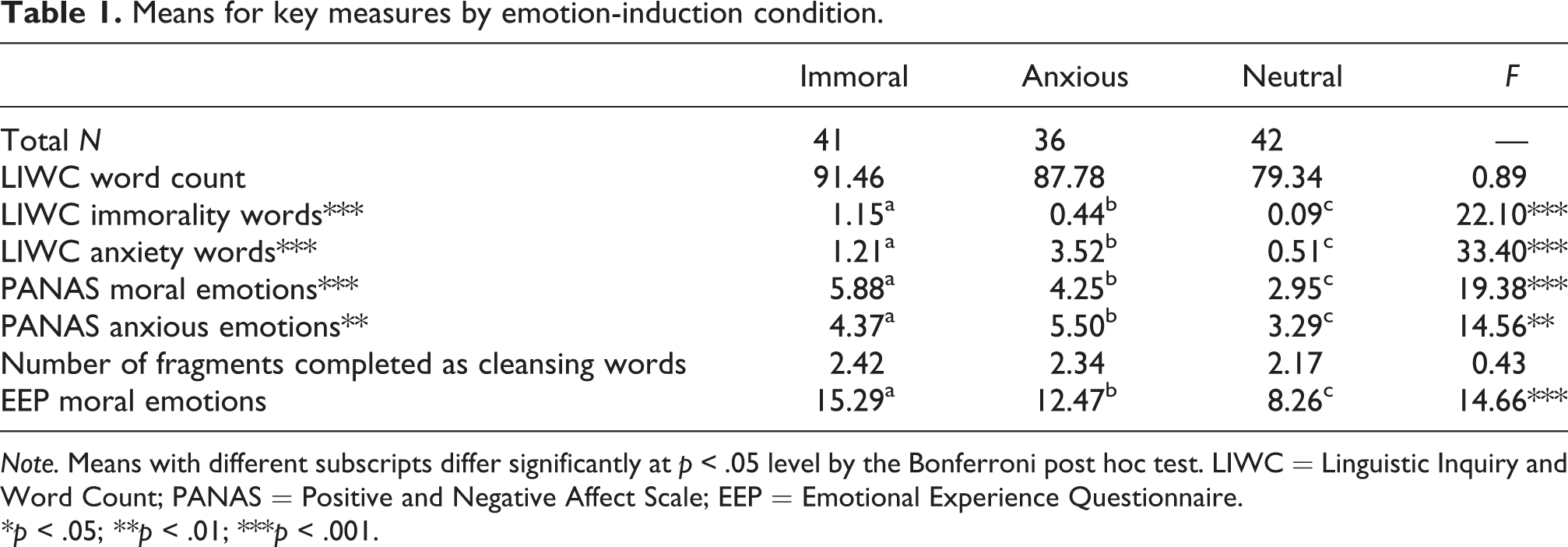
Note. Means with different subscripts differ significantly at p < .05 level by the Bonferroni post hoc test. LIWC = Linguistic Inquiry and Word Count; PANAS = Positive and Negative Affect Scale; EEP = Emotional Experience Questionnaire.
*p < .05; **p < .01; ***p < .001.
PANAS
A one-way ANOVA revealed that scores on the combined PANAS emotions “guilt” and “ashamed” differed significantly among the emotion-induction conditions, F(2, 116) = 19.38, p < .001, partial η2 = .25. Moral emotions for participants in the immorality condition were significantly higher than for participants in both the neutral condition, p < .001, and anxious condition, p = .004. Similarly, combined scores PANAS emotions “nervous” and “jittery” differed significantly among the emotion-induction conditions, F(2, 116) = 14.56, p < .001, partial η2 = .20. Anxious emotions were significantly higher for participants in the anxiety condition compared to participants in both the neutral condition, p < .001, and the immorality condition, p = .02.
Word fragments
Contrary to expectations, a univariate ANOVA revealed that the number of cleansing words formed did not differ significantly among emotion-induction conditions, F(2, 116) = 0.43, p = .66, partial η2 = .007. However, for participants in the immorality condition, the number of cleansing words formed was significantly correlated with ratings of distress, r(39) = .40, p = .01. Significance levels were adjusted for multiple correlations using the Benjamini–Hochberg procedure (see Benjamini & Hochberg, 1995). Table 2 displays the correlations between the number of cleansing words and emotion ratings.
Correlations between emotion ratings and number of cleansing words by emotion-induction condition.
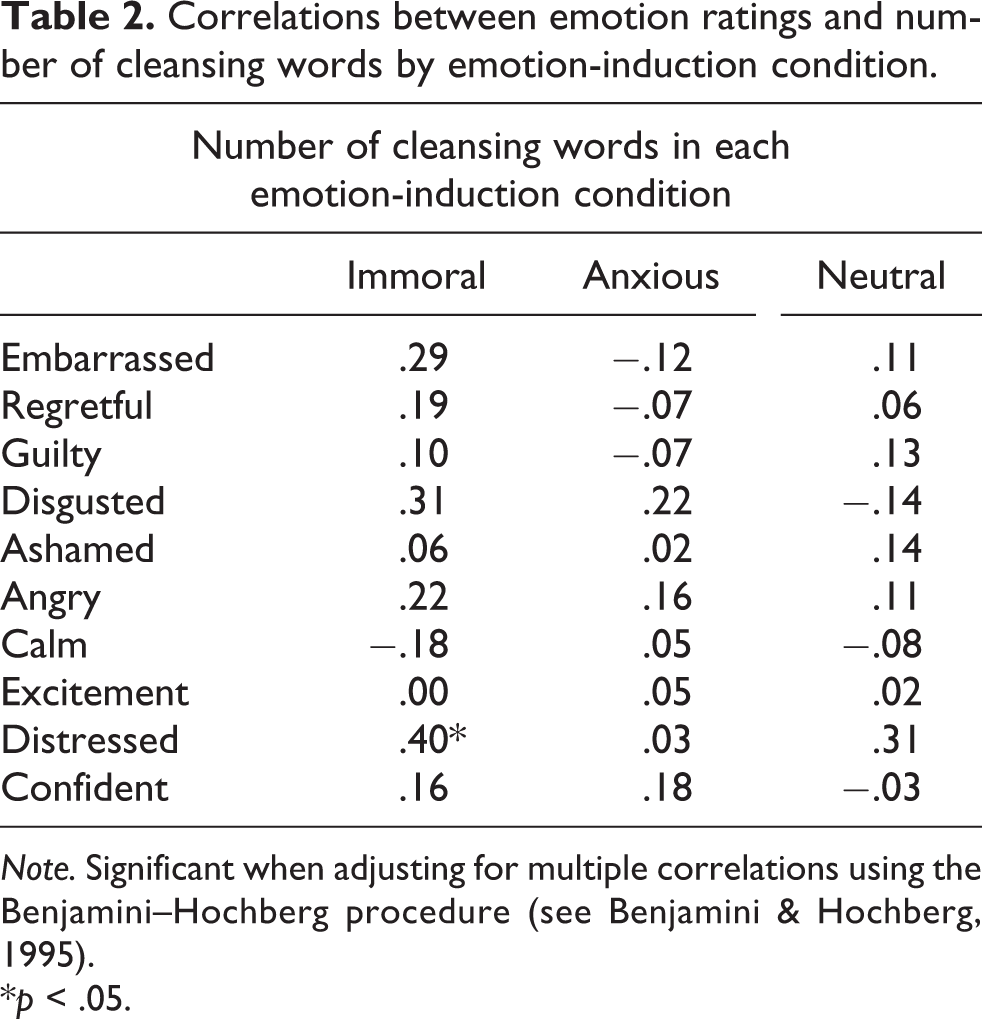
Note. Significant when adjusting for multiple correlations using the Benjamini–Hochberg procedure (see Benjamini & Hochberg, 1995).
*p < .05.
Emotional experience questionnaire
Consistent with expectations, a two-way between-groups ANOVA verified that there was a significant main effect of the emotion-induction condition upon ratings of moral emotions, F(2, 116) = 14.66, p < .001, partial η2 = .21. Bonferroni post hoc comparisons revealed that, irrespective of task, there were significantly higher ratings of moral emotions for participants in the immorality condition relative to those in the neutral condition, p < .001. Furthermore, there were significantly higher ratings of moral emotions for participants in the anxiety condition relative to those in the neutral condition, p = .006. However, the difference in ratings of moral emotions between participants in the immorality and anxiety conditions did not reach significance, p = .11.
There was no significant main effect of task (cleansing vs. control) upon ratings of moral emotions, F(1, 116) = 0.23, p = .63, partial η2 < .002. Further, contrary to predictions, there was no significant interaction between emotion-induction condition and task upon ratings of moral emotions, F(2, 116) = 1.59, p = .21, partial η2 = .03. Table 3 displays the raw means for key measures post-cleansing manipulation.
Means for key measures by emotion-induction and cleansing conditions.

Note. F values represent interaction terms not main effects. Means with different subscripts differ significantly at p < .05 level by the Bonferroni post hoc test.
*p< .05; **p < .01; ***p < .001.
Volunteerism
Due to a positively skewed distribution, we performed a log transformation upon the volunteering time data, which corrected the skewness. A two-way between-groups ANOVA revealed that there was no significant main effect of emotion-induction condition upon the number of minutes participants spent volunteering, F(2, 116) = 0.05, p = .95, partial η2 = .001. Similarly, there was no significant main effect of task upon volunteering minutes, F(1, 116) = 0.56, p = .45, partial η2 = .005. However, consistent with predictions, there was a significant interaction between emotion-induction condition and task on volunteering minutes, F(2, 116) = 7.21, p = .001, partial η2 = .11. Cleansing was associated with significantly decreased helping minutes in comparison to the control task for participants in the immorality condition, p = .04. There was no significant effect of cleansing relative to the control task for participants in the anxiety emotion-induction condition, p = .08. Unexpectedly, in the neutral condition, participants who cleansed helped for significantly more minutes than those who engaged in the control task, p = .008 (see Figure 1).

Helping minutes (non-transformed) as a function of emotion-induction condition and task.
Discussion
We attempted to resolve the numerous inconsistencies within the literature regarding the Macbeth effect in a sample of individuals with high OCD contamination concerns, with findings revealing partial support for the Macbeth effect. Importantly, the emotion-induction conditions were successful, whereby individuals in the immorality emotion-induction condition reported significantly higher levels of moral emotions. Examples of excerpts of stories from participants in this condition included, “I cheated on my long-term partner with another man…,” “…went out drinking and acted foolishly…,” and “I masturbate when I’m not supposed to…”
While there were no significant between-group differences in accessibility of cleansing-related concepts, increased feelings of distress were significantly associated with the number of cleansing words formed for participants in the immorality condition. This indicates that the more feelings of distress that one’s chosen immoral story engenders, the greater one’s mental accessibility of cleansing. Together, these findings suggest that perhaps accessibility of cleansing-related concepts only increases after recalling an immoral deed if it is accompanied by feelings of distress.
Second, for participants in the immorality condition, cleansing did not reduce self-reported moral emotions relative to those who completed the control task. One explanation is that individuals with mental contamination may report an urge to cleanse when feeling immoral, although the act of cleansing may not be effective at reducing moral emotions because the source of contamination is not easily located (Rachman, 2006). However, participants in the immorality condition who cleansed volunteered for a significantly shorter period compared to those who did not cleanse, indirectly suggesting that cleansing indeed assuaged feelings of immorality (Zhong & Liljenquist, 2006).
An explanation that reconciles these seemingly contradictory findings arises from research suggesting that it is primarily variables outside of conscious awareness, which affect individuals’ motivation to engage in compensatory behaviors (Zhong, Liljenquist, & Cain, 2009). Therefore, it is possible that cleansing indeed reduced moral emotions for participants in the immorality emotion-induction condition, although participants were not explicitly aware of this reduction. As such, participants who cleansed volunteered less because their moral emotions were somewhat alleviated, although they may not have consciously noticed a change in their emotional state.
For participants in the anxiety condition, the finding that cleansing did not affect volunteerism was important because it demonstrated that the reduction in volunteerism following cleansing was specific for individuals feeling immoral; it was not simply the result of negative affect. However, unexpectedly, participants in the neutral condition volunteered for significantly longer if they cleansed. This may be because cleansing possibly had a priming effect upon volunteerism. Specifically, in a neutral emotional state, the act of cleansing may have primed feelings of morality; thus, participants who cleansed may have volunteered for a greater amount of time in order to act in accordance with their moral self. This explanation is consistent with research, demonstrating that in a neutral emotional state, clean scents promote virtuous behavior by priming morality (Liljenquist, Zhong, & Galinsky, 2010). Another explanation is that participants in the neutral condition who were presented with the antiseptic wipe may have felt as if they received a favor from the experimenter and volunteered in order to reciprocate the favor.
Prior to considering any potential clinical implications, we acknowledge that the generalizability of the present findings to clinical populations is limited by the employment of an analogue sample. However, this study provides some support for the idea of the salience of immorality for individuals with high levels of contamination concerns. As such, this provides support for the idea that strategies for dealing with moral emotions should be incorporated in treatment sessions for OCD. These strategies could involve cognitive therapy to assist individuals in reappraising and normalizing perceived instances of immorality. Ideally, this type of cognitive therapy for treating mental contamination should supplement the traditional behavior-based therapies for treating contact contamination so that both types of contamination fears are targeted (Elliot & Radomsky, 2013).
Another clinically relevant finding of this study is that individuals who did not engage in cleansing sought to compensate for their immoral feelings by engaging in increased volunteerism. In particular, clinical psychologists should be aware that individuals with OCD may engage in certain pro-social behaviors to reduce the distress associated with recollections of past immoral deeds. That is, rather than confronting feelings of immorality, they may be seeking to distract themselves by engaging in such behaviors (Ahern & Kyrios, 2010). Overall, researchers should consider developing treatments for OCD that teach individuals how to deal with perceptions of immorality adaptively.
Despite the numerous strengths of this study, there were several limitations. First, it is possible that the word fragment task lacked ecological validity with respect to capturing OCD-relevant contamination concerns. This issue could be addressed in future studies by evaluating pre-manipulation associations between OCD symptoms and cleansing-related completions. In addition, future studies may recruit and contrast low- and high-OCD symptom groups to clarify whether this pattern of findings is specific to individuals who are vulnerable to OCD. Second, we could not examine baseline differences on the OCD questionnaire due to unavailability of screening data, precluding us from examining the internal consistency of the OCD questionnaire and verifying successful randomization with respect to OCD symptoms. Third, the moral emotion questionnaire contained few items that tapped into fear and disgust, although these constructs are highly relevant in OCD (Mancini et al., 2001; Raines et al., 2015). This may explain why there were no significant differences on this measure between participants in the immorality and anxiety conditions. Moreover, anxiety is conceptually very similar to moral emotions such as guilt (see Lowe, 1964), which may also explain the lack of differentiation on the moral emotions questionnaire. Finally, as the experimenter was not blind to conditions, there may have been experimenter expectancy effects.
In conclusion, this study provided partial support for the existence of the Macbeth effect and advanced understanding of this phenomenon by demonstrating its specificity to immorality. Furthermore, this study bolstered support for the idea that clinical treatments for contamination-related OCD should target maladaptive thought processes regarding immorality. Overall, these results highlight the need for future studies to help answer Macbeth’s anguished unanswered question, “Will all great Neptune’s ocean wash this blood clean from my hand?” (Shakespeare, 2010, 2.2. 33).
Footnotes
Declaration of conflicting interests
The author(s) declared no potential conflicts of interest with respect to the research, authorship, and/or publication of this article.
Funding
The author(s) received no financial support for the research, authorship, and/or publication of this article.