



Abstract
Previous studies have shown that social anxiety was associated with enhanced acquisition of anxiety as measured by subjective ratings in conditioning tasks using faces as the conditioned stimulus and negative evaluation as the unconditioned stimulus. However, a recent study failed to replicate the effect. The current study re-examined the enhanced acquisition effect with a larger sample, explored whether differences in expectancy of negative evaluation was a potential mechanism, and compared the contribution of social anxiety to that of depression on enhanced acquisition. Two hundred and sixty-three unselected participants took part in a differential conditioning task in which three faces each were paired with hostile, neutral, and friendly reaction during acquisition, and all three were paired with neutral reaction during extinction. Results replicated earlier findings that participant social anxiety was associated with enhanced acquisition of anxiety. Socially anxious participants did not show higher expectancy of hostile reaction during acquisition, which suggested the need to consider alternative mechanisms underlying enhanced acquisition. Depression was also associated with enhanced acquisition; however, that association was accounted for by social anxiety. The effect of social anxiety was significant over and above depression, which supported its diagnostic validity.
Introduction
Chronic social anxiety, characterized by anxiety in and avoidance of social situations, is a prevalent, debilitating condition (American Psychiatric Association, 2013). Social events characterized by rejection and hostile reaction are linked to the development of social anxiety (Spence & Rapee, 2016). Exposure to social situations in treatment contexts and in naturalistic settings predicts lower subsequent social anxiety (e.g., Deacon & Abramowitz, 2004; Miers, Blöte, Heyne, & Westenberg, 2014).
Researchers increasingly draw on experimental learning models to understand the development and maintenance of anxiety (e.g., Vervliet, Craske, & Hermans, 2013). Acquisition refers to the pairing of a neutral conditioned stimulus with a threatening unconditioned stimulus that results in increased anxiety toward the conditioned stimulus. Extinction refers the pairing of an anxiety-provoking conditioned stimulus with no unconditioned stimulus that leads to a reduction in anxiety toward the conditioned stimulus. Conventional models posit that learning depends, in part, on changes in the expectation of the unconditioned stimulus, given the conditioned stimulus, and the intensity of the unconditioned stimulus (e.g., Davey, 1989; Pearce & Hall, 1980; Rescorla & Wagner, 1972).
The observation that only a portion of individuals who experienced negative events develop anxiety challenged learning models. One hypothesis put forward is that learning processes are different for the anxious individual, specifically, that individuals who develop anxiety disorders may more readily acquire fear and anxiety from the same negative experience (e.g., Mineka & Zinbarg, 2006). However, a recent meta-analysis found that the effects of acquisition and extinction were not significantly different for participants with and without anxiety disorders (Duits et al., 2015). One limitation of those studies is that most of the studies used general stimuli, such as shapes and shocks, whereas different types of anxiety are proposed to be characterized by idiosyncratic conditioned and unconditioned stimulus (Foa & Kozak, 1986; Mineka & Zinbarg, 2006). Thus, although the general tendency for acquisition and extinction was comparable for those with and without anxiety disorders, there is a dearth of research examining whether different patterns of learning may be observed when stimuli relevant to the type of anxiety are used, for example, socially relevant stimuli presented to socially anxious individuals.
Early studies on social anxiety examined acquisition and extinction using faces as the conditioned stimulus and nonsocial threats, such as unpleasant odors and painful pressure, as the unconditioned stimulus (Hermann, Ziegler, Birbaumer, & Flor, 2002; Schneider et al., 1999; Veit et al., 2002). Although main effects of acquisition and extinction were observed, they were generally comparable for participants across social anxiety levels. Later studies, which used negative evaluation as the unconditioned stimulus instead, found main effects of acquisition and extinction, and additionally, an enhanced acquisition effect for both participants with social anxiety and social anxiety disorder (Lissek et al., 2008; Pejic, Hermann, Vaitl, & Stark, 2013). Potential mechanisms were investigated. Results suggested that social anxiety was correlated with heightened activation in the left amygdala and hippocampus (Pejic et al., 2013) but not with reactivity to negative evaluation (Lissek et al., 2008; Pejic et al., 2013). Taken together, this line of research suggests that social anxiety is characterized not by the general tendency to acquire anxiety but by the tendency to acquire anxiety when socially relevant stimuli are used. It was unclear whether enhanced acquisition was specific to social anxiety, because the effect of other symptoms of psychopathology was not measured. Also, although neural underpinnings were identified, psychological mechanisms have not been established, although reactivity to negative evaluation is unlikely to be one.
A recent study (Tinoco-González et al., 2015) examined conditioning using socially relevant stimuli in individuals with social anxiety, social anxiety disorder, panic disorder, and healthy controls. The results suggested that the effect of acquisition was comparable for all groups. The failure to replicate raises doubts about the effect of social anxiety on enhanced acquisition, in addition to failing to find support for the specificity of enhanced acquisition to social anxiety. One possibility is that the small sample sizes used in past studies (i.e., Ns < 50) precluded the detection of a reliable effect. Other studies that involved a differential conditioning task using socially relevant stimuli but did not examine the effect of participant social anxiety are not presented here, because they cannot provide evidence for or against diagnostic validity (Davis, Johnstone, Mazzulla, Oler, & Whalen, 2010; Haddad, Lissek, Pine, & Lau, 2011; Wiggert, Wilhelm, Reichenberger, & Blechert, 2015).
The purpose of the current study was threefold. First, we examined whether the effect of social anxiety on enhanced acquisition could be replicated. Second, we examined whether expectancy of negative evaluation for the conditioned stimulus was a mechanism that partially explains the association between social anxiety and enhanced acquisition, given that expectancy is an important mechanism according to learning models (e.g., Pearce & Hall, 1980; Rescorla & Wagner, 1972). Third, the diagnostic validity (Boddez, Davey, & Vervliet, 2018; Davey, 2017) of social anxiety as a moderator of acquisition and extinction was examined. Depression was chosen as a comparison, because it tends to correlate with social anxiety and shares common patterns of neural activity, as well as symptomatic features, biased-information processing of social threats, social rejection as a contributor, and response to interpersonally focused treatments (e.g., Adams, Balbuena, Meng, & Asmundson, 2016; Cuijpers et al., 2011; Gotlib et al., 2004; Hamilton, Chen, Waugh, Joormann, & Gotlib, 2013; Langer et al., 2019; Slavich, O’Donovan, Epel, & Kemeny, 2010). Thus, the effect of social anxiety on enhanced acquisition may be due to the influence of depression. The current study aimed to examine this possibility, which would, in turn, inform the diagnostic validity of social anxiety on enhanced acquisition.
A sample of over 200 participants, which was larger than the combined total of previous studies (Lissek et al., 2008; Pejic et al., 2013; Tinoco-González et al., 2015), was recruited to increase power to detect differences. Given the dimensional nature of social anxiety and related dysfunction, participants were not selected on the basis of clinical diagnosis (Stein, Walker, & Forde, 1994). The advantage of examining social anxiety and depression on a continuum is the greater sensitivity of detecting effects. Given that the effect of social anxiety and depression on learning was expected to be similar because of the strong association between the two (Adams et al., 2016), the current design allowed us to examine the effect of social anxiety accounting for the depression and vice versa.
In line with past studies, participants completed a differential conditioning task using socially relevant conditioned and unconditioned stimulus. The task involved acquisition, in which a face was repeatedly paired with hostile reaction, using two other faces paired with neutral and friendly reactions as control and comparison, followed by extinction, in which all three faces were paired with neutral reactions. Subjective ratings of anxiety were measured and considered the primary dependent variable (Ledoux & Hofmann, 2018). Expectancy was measured through ratings of probability of subsequent hostile reaction for each conditioned stimulus (Lovibond, 2007) before and after acquisition and extinction trials. Also, during each conditioning trial, participants were instructed to indicate the valence of the conditioned stimulus, that is, whether it was hostile, neutral, or friendly. The reaction time required to indicate hostile reactions was used as a parallel measure of expectancy, with lower reaction time indicating greater expectancy (Craddock, Molet, & Miller, 2012). After the conditioning task, participants completed measures of social anxiety and depression.
Method
Participants and procedure
The research methods were approved by the university behavioral research committee. The sample consisted of 263 undergraduate students, who provided informed consent and subsequently participated in the study for partial course credit. The mean age of participants was 20.67 years (SD = 3.33 years) and 76% were female. During a laboratory session, participants first reported on demographics and then on questionnaires assessing depression and social anxiety. They then completed the conditioning task using the software E-PRIME 2.0 (Psychology Software Tools, Pittsburgh, Pennsylvania, USA).
Materials
Depression questionnaire
Depression was assessed using the depression subscale of the Depression, Anxiety, and Stress Scale depression subscale, which was shown to strongly correlate with other measures of depression, and may better differentiate depression from other affective states compared to other questionnaires (Lovibond & Lovibond, 1995) The questionnaire consisted of 14-items each rated on a 4-point scale. Scores were summed. In the current sample, participant scores ranged from 0 to 38 with a mean of 8.83 and standard deviation of 8.29. Cronbach’s α for the scale was .94.
Social anxiety questionnaire
Social anxiety was assessed using the straightforward items (Rodebaugh et al., 2011) of the Social Interaction Anxiety Scale (Mattick & Clarke, 1998). The questionnaire consisted of 17 items each rated on a 5-point scale. Scores were summed. In the current sample, scores ranged from 0 to 59 with a mean of 22.96 and standard deviation of 14.22. Cronbach’s α for the scale was .94. Social anxiety was correlated with depression, r = .48, p < .001.
Conditioning task
The basic building block of the conditioning task was one trial. The procedure is presented in Figure 1. For each trial, a fixation cross appeared in the middle of the screen for 1 s. Then, the cross was replaced by the neutral expression of a face (i.e., the conditioned stimulus), which was presented for 1 s, followed by the same face showing either a hostile, neutral, or friendly facial expression, as well as various valence–congruent verbal statements presented as written text beneath the face (i.e., the conditioned and unconditioned stimulus). Verbal statements were randomly selected from a database of 25 hostile (e.g., “What’s wrong with you?!”), 45 neutral (e.g., “Hello.”), and 25 friendly (e.g., “Good job!”) statements created for the purpose of the experiment (Table 1). Three research assistants, who were not involved in data collection and were blind to the purpose of the study, were asked to rate the statements in randomized order on how friendly, neutral, and hostile they were on a scale of 0 (disagree) to 10 (agree). Friendly statements were rated significantly more friendly (M = 8.76, SD = 1.63) than neutral (M = 2.37, SD = 2.77) and hostile statements (M = 0.29, SD = 0.94), neutral statements were rated significantly more neutral (M = 8.80, SD = 1.91) than friendly (M = 1.88, SD = 2.31) and hostile statements (M = 1.11, SD = 2.06), and hostile statements were rated significantly more hostile (M = 8.48, SD = 2.03) than friendly (M = 0.47, SD = 1.44) and neutral statements (M = 1.13, SD = 1.88) according to independent t-tests, ps < .001. The conditioned and unconditioned stimulus presentation remained until participants indicated whether the face was hostile, neutral, or friendly by pressing keyboard buttons “d,” “s,” and “a” labeled with “red,” “yellow,” and “green” colored stickers. Reaction time was measured by the computer software. Expectation of a valanced reaction (i.e., hostile, neutral, or friendly) for a conditioned stimulus was operationalized as the reaction time needed to correctly indicate the valence for that conditioned stimulus, with a lower reaction time indicating stronger expectation.

Procedure for one conditioning trial. Note. CS = conditioned stimulus; US = unconditioned stimulus.
Hostile, neutral, and friendly statements.

The overall procedure is summarized in Table 2 and described below. First, participants were instructed that they would be shown a person followed by a facial expression and statement the person says and that participants were to indicate the valence of the person by pressing the respective keyboard button as quickly as they can with their dominant hand. Participants completed a practice sequence in which a practice conditioned stimulus (i.e., CSpractice) was paired with two trials of hostile, neutral, and friendly reactions each. During this phase, participants were given feedback on whether they correctly indicated the valence of the reaction.
Conditioning task procedure.


Note. CS = conditioned stimulus. Conditioning trials are shaded in grey. Trials were randomized within each sequence.
The main conditioning procedure consisted of an acquisition and an extinction sequence. During acquisition, three female conditioned stimuli were paired with either 10 trials of hostile, neutral, or friendly reaction. Conditioned stimuli paired with hostile, neutral, and friendly reaction during acquisition are referred to as CShostile, CSneutral, and CSfriendly, respectively. The roles of the conditioned stimuli were counterbalanced across participants. During extinction, each conditioned stimulus was paired with 10 trials of faces with neutral reactions. Before and after acquisition and extinction, participants underwent a sequence of reaction time test trials to measure their expectation of each conditioned stimulus with each type of valanced reaction. Each test trial sequence consisted of nine trials, in which each of the three conditioned stimulus was paired with one hostile, one neutral, and one friendly reaction. The presentation of trials was randomized within sequences.
Subjective ratings were measured for each conditioned stimulus at three points, before pre-acquisition test trials, after post-acquisition test trials, and after post-extinction test trials. Conditioned stimuli displayed a neutral expression and no valanced reaction followed. For each conditioned stimulus, participants rated the extent to which they felt anxious (0 = not anxious at all; 100 = extremely anxious), probability that the conditioned stimulus would be hostile on the next trial (0 = certainly not; 100 = certainly), pleasantness (0 = extremely unpleasant; 100 = extremely pleasant), and probability that the conditioned stimulus would be hostile on the next trial (0 = certainly not; 100 = certainly) in the listed order for all participants.
Results
The computer software “R” version 3.3.1 (R Core Team, 2019) package “lmer” (Bates, Maechler, Bolker, & Walker, 2015) was used to analyze data. Compared to analysis of variance, multilevel modeling is a more flexible alternative for analyzing repeated measures data (Quené & Van Den Bergh, 2004) and was used for the current analyses. In the current analyses, using multilevel modeling has the notable advantages of being able to examine social anxiety and depression as continuous predictors, which increased power (Royston, Altman, & Sauerbrei, 2006), and to handle missing data. For all analyses, maximum likelihood was used for estimation.
Only dependent variables that were of immediate relevance to the research question, that is, subjective ratings of anxiety, subjective ratings of probability of hostile reaction, and reaction time for hostile reactions (RThostile), were analyzed and reported. Four separate multilevel regression analyses were run to examine the effect of social anxiety and depression on subjective ratings of anxiety across acquisition and extinction, the effect of social anxiety and depression on subjective ratings probability of hostile reaction across acquisition and extinction, the effect of social anxiety and depression RThostile across acquisition, and the effect of social anxiety and depression for RThostile across extinction.
Based on past findings, eight main effects of acquisition and extinction for CShostile and CSfriendly on the dependent variables of subjective ratings of anxiety and probability of hostile reaction were expected, as well as two main effects of acquisition and extinction for CShostile on RThostile. Thus, statistical significance for these effects were compared to a two-tailed level of α = .05. The moderation of social anxiety and depression on those effects, that is, 20 effects, were explored, and hence, statistical significance was compared to an adjusted, two-tailed level of α = .05/20 = .0025.
Follow-up analyses were conducted for any effects that were significantly moderated by social anxiety or depression or both. To test whether the social anxiety or depression interaction accounted for the observed data over and above that of the other moderator, the full model, which consisted of social anxiety and depression simultaneously entered as moderators, was compared to two reduced models using the deviance test, the first one without social anxiety interaction term and the second one without the depression interaction term.
Subjective ratings of anxiety as the dependent variable
Out-of-range and nonsensical values for subjective ratings, that is, nonnumerical values and numerical values less than 0 or greater than 100, were removed, and 2,349 of the 2,367 original responses were analyzed. Although not systematically assessed, anecdotal reports from participants suggest that the values were because they were confused with E-PRIME’s text display layout, not knowing that the backspace was functional, and typographic errors. The exclusion criteria were not set a priori, because these types of responses were not foreseen. Subsequently, the following models were used to analyze the data:
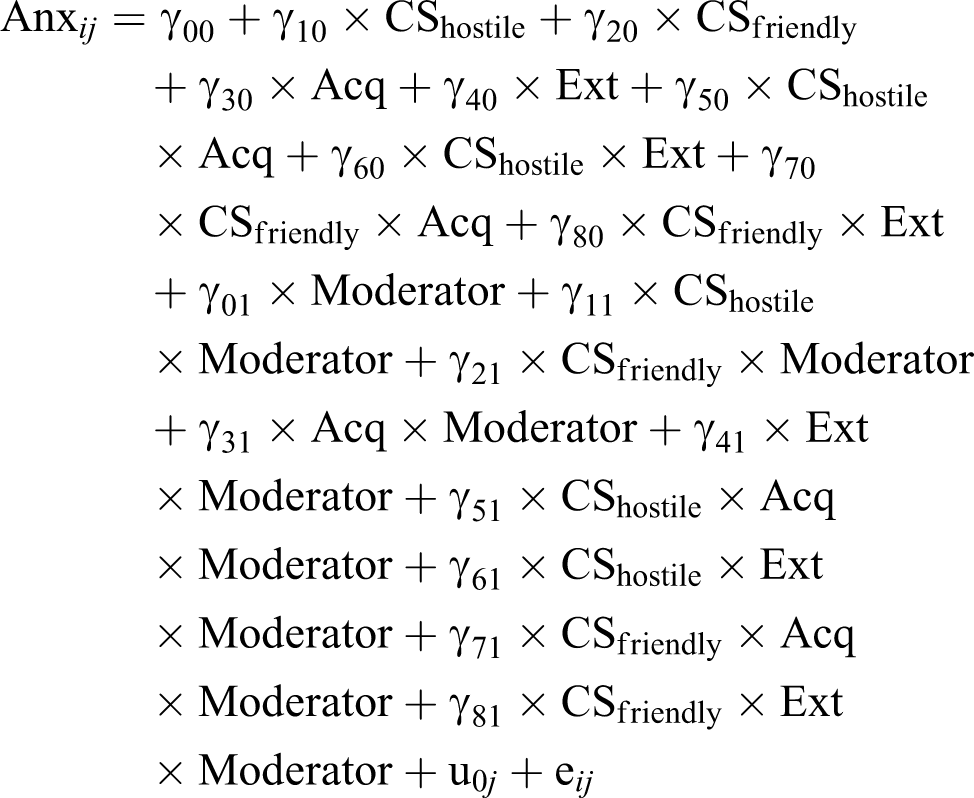
Subjective ratings of anxiety or probability of hostile reaction (subscripted i) were nested within participants (subscripted j). The following dummy codes were used for CShostile (CSneutral = 0, CShostile = 1), CSfriendly (CSneutral = 0, CSfriendly = 1), acquisition (i.e., pre-acquisition = −1, post-acquisition = 0), and extinction (i.e., post-acquisition = 0, post-extinction = 1). Hence, γ00 is the mean for CSneutral at post-acquisition; γ10 and γ20 are the differences in ratings between CShostile and CSneutral, and between CSfriendly and CSneutral, at post-acquisition; γ30 and γ40 are the changes in ratings for CSneutral across acquisition and extinction; γ50, γ60, γ70, and γ80 are interaction representing change in ratings for CShostile compared to CSneutral across acquisition, CSfriendly compared to CSneutral across acquisition, CShostile compared to CSneutral across extinction, and CSfriendly compared to CSneutral across extinction; γ01, γ11, γ21, γ31, γ41, γ51, γ61, γ71, and γ81 are the interactions between the moderator, that is, participant social anxiety or depression, and the respective effects in the order mentioned above; u 0j is between-participant variance; and eij is residual variance. γ51, γ61, γ71, and γ81 were the effects tested for statistical significance.
The model entering social anxiety as the moderator was first examined (Table 3, column A; Figure 2). Social anxiety significantly moderated acquisition for CShostile (i.e., CShostile × Acq × SocialAnxiety), γ51 = .54, SE = .15, t(2,078.80) = 3.60, p < .001. Probing the interaction suggested that, for participants with social anxiety one standard deviation above the mean, ratings for CShostile increased 19.32, SE = 2.11, t(2,078.80) = 9.17, p < .001, and ratings for CSneutral decreased 3.01, SE = 2.11, t(2,078.80) = −1.43, p = .076, across acquisition. For participants with mean social anxiety, ratings for CShostile increased 14.92, SE = 1.50, t(2,078.80) = 4.98, p < .001, and ratings for CSneutral increased .19, SE = 1.49, t(2,078.80) = 0.13, p = .55. For participants with social anxiety one standard deviation below the mean, ratings for CShostile increased 10.52, SE = 2.12, t(2,078.80) = 4.95, p < .001, and ratings for CSneutral increased 3.40, SE = 2.12, t(2,078.80) = 1.61, p = .054.

Subjective ratings of anxiety across acquisition and extinction as predicted by the multivariate multilevel model. Note. CS = conditioned stimulus. aSocial anxiety was significantly associated, and depression was marginally significantly associated with greater increase in anxiety for CShostile compared to CSneutral (i.e., enhanced acquisition) when entered as moderators separately.
Results for multilevel regression analyses.
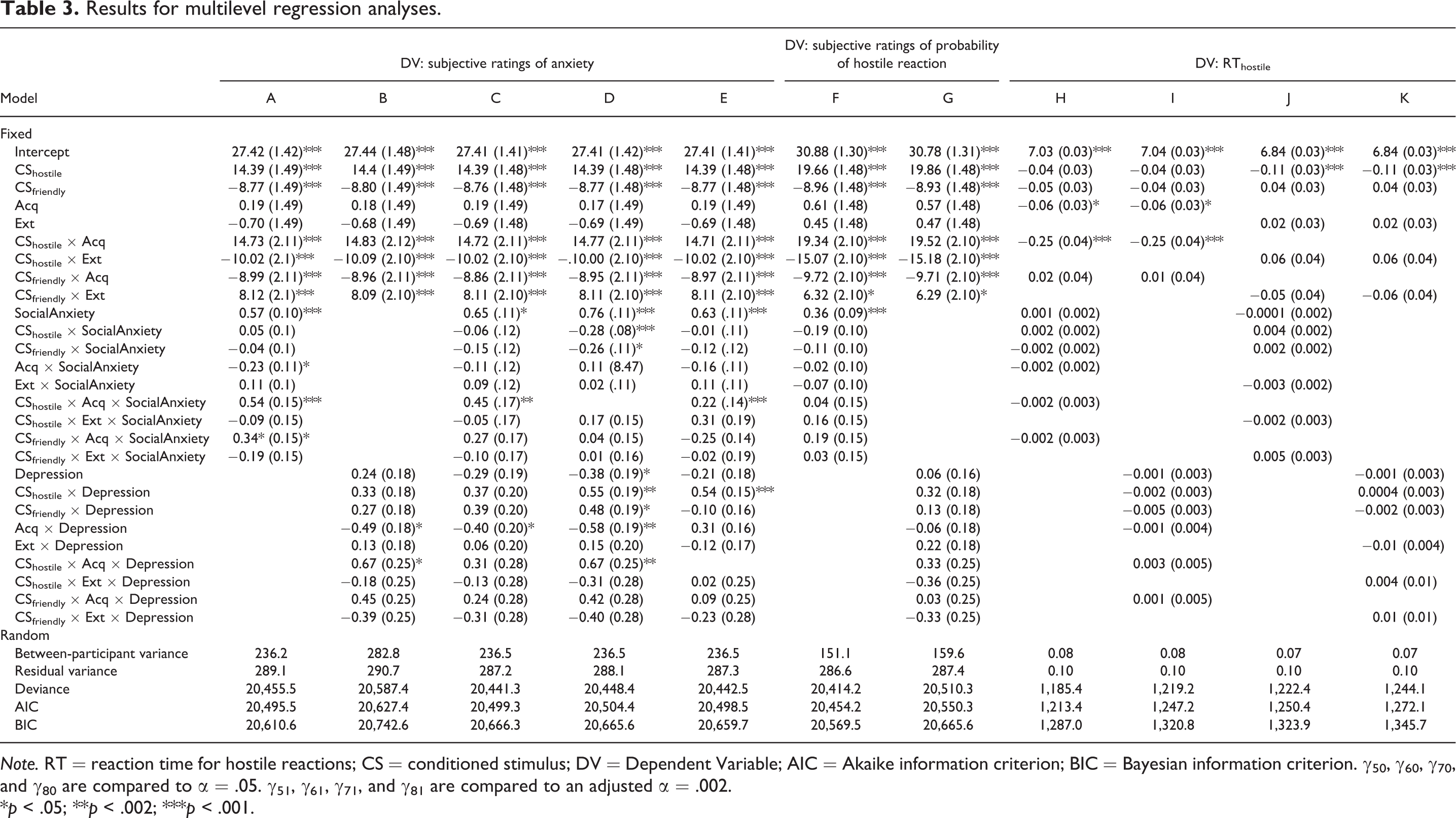
Note. RT = reaction time for hostile reactions; CS = conditioned stimulus; DV = Dependent Variable; AIC = Akaike information criterion; BIC = Bayesian information criterion. γ50, γ60, γ70, and γ80 are compared to α = .05. γ51, γ61, γ71, and γ81 are compared to an adjusted α = .002.
*p < .05; **p < .002; ***p < .001.
In the model entering depression as the moderator (Table 3, column B), the moderation of depression on acquisition for CShostile compared to CSneutral (i.e., CShostile × Acq × Depression) was marginally significant, γ51 = .67, SE = .25, t(2,086.40) = 2.67, p = .008. Follow-up analyses were conducted to examine whether social anxiety better accounted for greater increases in ratings toward CShostile compared to CSneutral after acquisition over and above the effects of depression, and vice versa. First, the full model simultaneously entering interactions with social anxiety and depression as moderators was examined (Table 3, column C). The effects of social anxiety on acquisition for CShostile compared to CSneutral (i.e., CShostile × Acq × SocialAnxiety) remained significant when adjusted for depression in the full model. The full model then was compared a reduced model without the CShostile × Acq × SocialAnxiety interaction (Table 3, column D), and results suggested that the full model provided significantly better model fit, χ2(1) = 7.04, p = .008. The full model was compared to another reduced model without the CShostile × Acq × Depression interaction (Table 3, column E), and results suggested that the full model did not significantly improve fit, χ2(1) = 1.15, p = .28.
As expected, for the sample as a whole, there were significant effects of extinction for CShostile (i.e., CShostile × Ext), as well as acquisition and extinction for CSfriendly (i.e., CSfriendly × Acq, CSfriendly × Ext). Social anxiety and depression did not moderate any of the effects in their respective models, ps > .024 (Table 3, columns A and B).
Subjective ratings of probability of hostile reaction as the dependent variable
The same exclusion criteria for out-of-range and nonsensical values for subjective ratings was applied based on the same rationale, and 2,358 of the 2,367 original responses were analyzed. The same models as above were used to analyze the data except that the dependent variable is subjective ratings of probability of reaction and the same effects were tested for significance.
As expected and shown in Figure 3, there were significant effects of acquisition and extinction for CShostile (i.e., CShostile × Acq, CShostile × Ext) and CSfriendly (i.e., CSfriendly × Acq, CSfriendly × Ext). Social anxiety and depression did not moderate any of the effects in their respective models, ps > .15 (Table 3, columns F and G).

Subjective ratings of probability of hostile reaction across acquisition and extinction as predicted by the multivariate multilevel model.
Reaction time for hostile reaction (RThostile) as the dependent variable
Incorrect responses, that is, responses indicating the hostile reaction as neutral or friendly, were removed. Of 3,156 responses, 2,835, that is, 90%, were accurate. The effects of acquisition and extinction were analyzed in two separate models. First, the following model was used to analyze acquisition:

The following model was used to analyze extinction:
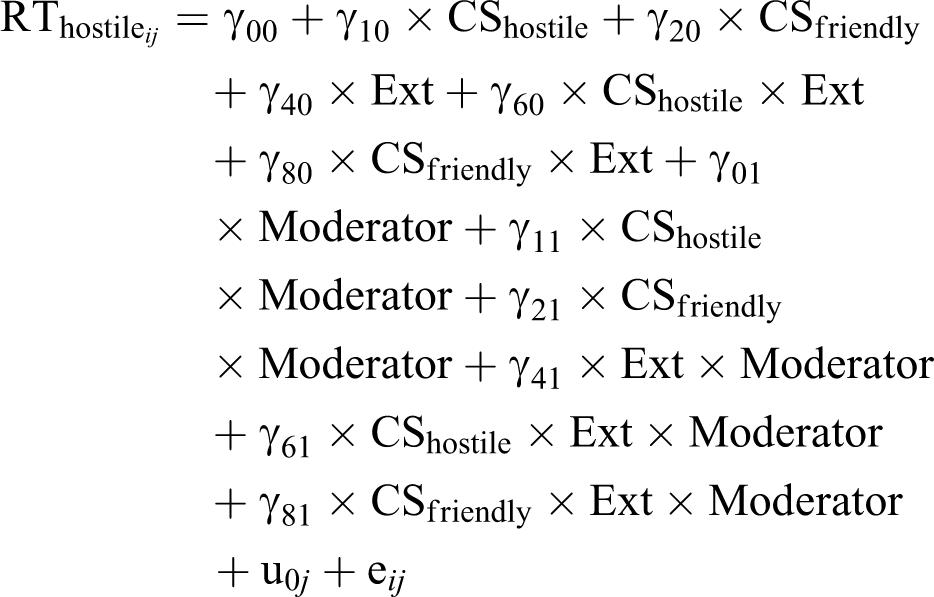
Log transformed RThostile (subscripted i) were nested within participants (subscripted j). Raw RThostile was not used, because it was positively skewed and the resulting model would violate the assumption of homoscedasticity. The following dummy codes were used for CShostile (CSneutral = 0, CShostile = 1), CSfriendly (CSneutral = 0, CSfriendly = 1), acquisition (i.e., pre-acquisition = 0, post-acquisition = 1), and extinction (i.e., pre-extinction = 0, post-extinction = 1). Hence, γ00 is the mean for log RThostile at pre-acquisition or pre-extinction; γ10 and γ20 are the differences in ratings between CShostile and CSneutral, and between CSfriendly and CSneutral, at pre-acquisition or pre-extinction; γ30 and γ40 are the changes in ratings for CSneutral across acquisition and extinction; γ50, γ60, γ70, and γ80 are interactions representing change in ratings for CShostile compared to CSneutral across acquisition, CSfriendly compared to CSneutral across acquisition, CShostile compared to CSneutral across extinction, and CSfriendly compared to CSneutral across extinction; γ01, γ11, γ21, γ31, γ41, γ51, γ61, γ71, and γ81 are the interactions between the moderator, that is, participant social anxiety or depression, and the respective effects in the order mentioned above; u 0j is between-participant variance; and eij is residual variance. γ51, γ61, γ71, and γ81 were the effects tested for statistical significance.
As shown in Figure 4, there was a significant effect of acquisition (CShostile × Acq) but insignificant trend of extinction (i.e., CShostile × Ext) for CShostile. Social anxiety and depression did not moderate any of the effects in their respective models, ps > .13 (Table 3, columns H, I, J, and K).

log RThostile across acquisition and extinction predicted by the multilevel model. RT = reaction time.
Post hoc power analysis
Much of the literature suggests that power for a multilevel model interaction is difficult to determine, because it requires the estimation of the interaction coefficient’s standard error, which in turn depends on several other parameters unknown to the researchers before the study (e.g., Hox, 2010). Hence, sample size was determined based on a coarse analysis before the study. The analyses were treated as the correlational effect of social anxiety and depression on acquisition and extinction. Analyses suggested that a sample of 200 had power of .92 to detect moderate effects (i.e., r = .30) after adjusting for the 20 comparisons. Data for 200 participants were collected, but data collection continued after the goal was reached until the end of the university term, which resulted in the current sample.
Post hoc power analyses were conducted following recommendations by Hox (2010, equation 12.3) using standard errors for the interaction estimated from the models above, that is, those for CShostile × Acq × SocialAnxiety, CShostile × Ext × SocialAnxiety, CSfriendly × Acq × SocialAnxiety, CSfriendly × Ext × SocialAnxiety, CShostile × Acq × Depression, CShostile × Ext × Depression, CSfriendly × Acq × Depression, and CSfriendly × Ext × Depression and adjusting for multiple comparisons. Results suggested that the current study had .80 power to detect interactions with sizes of .54 for social anxiety moderation on subjective ratings of anxiety and probability of hostile reaction, .91 for depression moderation on subjective ratings of anxiety and probability of hostile reaction, .01 for social anxiety moderation on log RThostile, and .02 for depression moderation on log RThostile, which converted to standardized coefficients in the range of .31–.35.
Discussion
These results replicated earlier findings that social anxiety was associated with enhanced acquisition, that is, social anxiety was associated with greater increases in anxiety for the conditioned stimulus paired with hostile reaction relative to changes paired with neutral reaction (Lissek et al., 2008; Pejic et al., 2013; cf. Tinoco-González et al., 2015). Notably, the current study used a sample size greater than the combined total used in past studies (Lissek et al., 2008; Pejic et al., 2013; Tinoco-González et al., 2015), and had adequate power (i.e., .80) to detect moderate effects even after adjusting for multiple comparisons. Effects that were marginally significant in the current study, for example, that social anxiety was associated with smaller decreases in anxiety toward the conditioned stimulus paired with friendly reaction (Table 3, column A), suggest that there may be smaller effects that did not achieve significance. These effects can be pursued through future studies involving an even larger sample. One question regarding the conditioning framework of anxiety is that only a subset of individuals who experience acquisition-like events involving negative evaluation develop social anxiety. The current findings provide preliminary support for the explanation that individuals who acquire anxiety more readily from negative evaluation may be at risk for developing social anxiety (Mineka & Zinbarg, 2006). However, only future studies using longitudinal designs would provide more definitive answers (e.g., Lonsdorf & Merz, 2017).
Expectancy of negative evaluation was evaluated as a potential mechanism of the acquisition effect. Subjective ratings and reaction time toward negative evaluation were measured. Results suggested that acquisition and extinction, respectively, increased and decreased expectancy, although the latter effect was insignificant for the reaction time measure. It is worth noting that other studies have also found that extinction was not observed on measures, such as fear-potentiated startle (e.g., Lissek et al., 2008). Social anxiety was not associated with increased expectancy for negative evaluation on either measure. Thus, the results tentatively suggest that, although expectancy of the unconditioned stimulus may underlie anxiety toward the conditioned stimulus (e.g., Pearce & Hall, 1980; Rescorla & Wagner, 1972), the enhanced acquisition effect for social anxiety was not likely due to differences in learning expectancy of negative evaluation. Combining these findings with past work, the results tentatively suggest that the effect of social anxiety on enhanced acquisition is not due to reactivity to the negative evaluation (Lissek et al., 2008; Pejic et al., 2013) or expectancy of negative evaluation from the conditioned stimulus. Future studies could investigate other mechanisms, for example, the salience of the conditioned stimulus (Pearce & Hall, 1980; Rescorla & Wagner, 1972), or the input of higher order cognitive processes (Thorwart & Livesey, 2016).
Depression displayed a marginal significant moderation of enhanced acquisition, which was not surprising given its correlation and shared neural patterns, symptoms, biased-information processing of social threats, and contributor of social rejection. The follow-up analyses resulted in an important finding that depression was no longer a significant moderator of acquisition when social anxiety was controlled, but that the effect of social anxiety on enhanced acquisition remained significant even accounting for depression. These results suggested that the effect of social anxiety on enhanced acquisition was not due to depression, but vice versa. The findings support the diagnostic validity of social anxiety on enhanced acquisition and may also contribute to understanding the relation between social anxiety and depression in future research.
The desire to make a good impression on others has been proposed to be a crucial factor underlying social anxiety (Schlenker & Leary, 1982). Hence, the absence of an actual or perceived audience in the current study presents a potential limitation to generalizing the results to naturalistic settings. Another difference between social conditioning tasks and naturalistic environments is the intensity of negative evaluation. In laboratory studies, negative evaluation is confined to hostile facial expressions and statements from pictures of strangers because of consideration for experimental control and participant well-being, whereas negative evaluation in naturalistic settings can involve more severe embarrassment or humiliation (e.g., McCabe, Antony, Summerfeldt, Liss, & Swinson, 2003). Be that as it may, the operationalization of negative evaluation in conditioning tasks is certainly not trivial, considering its impact on neurophysiological indices of anxiety (Lissek et al., 2008; Pejic et al., 2013) and its long-lasting effects (Wiggert et al., 2017).
In sum, the current study replicated the association between social anxiety and enhanced acquisition of anxiety toward socially threatening stimuli and showed that social anxiety accounted for the effect over and above the effect of depression. Socially anxious participants did not show differences in learning about the expectancy of negative evaluation, and the results tentatively suggest that expectations are not likely to be a mechanism underlying enhanced acquisition.
Footnotes
Author’s note
Detailed information not reported in the main text is available upon request from the first author.
Acknowledgments
The authors would like to thank Cindy Choi, Sarah Lillemo, and Jasmine Veark for their help in data collection, and Rachel Hueller, Taylyn Jameson, and Priyam Joshi for their help in creating the stimuli.
Data accessibility statement

Declaration of Conflicting Interests
The author(s) declared no potential conflicts of interest with respect to the research, authorship, and/or publication of this article.
Funding
The author(s) disclosed receipt of the following financial support for the research, authorship, and/or publication of this article: This work was supported by the University of British Columbia Faculty of Graduate Studies Doctoral Four Year Fellowship, and Canadian Psychological Association Ken Bowers Award awarded to Klint Fung, and the Social Sciences and Humanities Research Council of Canada (SSHRC) 435-2012-0350 awarded to Lynn E. Alden.