




Abstract
The current study is the first substantial investigation to determine whether tinnitus perception mediates the relationship between physiological and psychological problems (PP). Simple random sampling, with a cross-sectional design, was used to collect data from 100 adult patients (males = 60; females = 40) diagnosed with chronic tinnitus. Subjects were approached through various public and private hospitals, at their respective Audiology and Ear, Nose, and Throat departments in Rawalpindi and Lahore, Pakistan. Participants underwent complete physiological and psychological tinnitus evaluations, such as tinnitus matching and audiometry, as well as assessments using standardized tinnitus instruments. The mediation analyses revealed an indirect relationship with hearing loss (HL) and PP (e.g., anxiety, stress, depression, mood swings) in tinnitus patients. These findings suggest that physiological problems such as tinnitus and HL might contribute to the development of psychological symptoms.
Highlights
Tinnitus perception mediates relationship between physiological problem and PP among patients.
Four instruments are applied to assess hearing impairment, stress, anxiety, depression, and positive and negative mood swings in patients with tinnitus.
Hearing impairment and tinnitus perception significantly positively predicted PP. Tinnitus perception significantly and fully mediated the relationship of hearing impairment with anxiety, stress, and depression for male patients with tinnitus.
Among females, tinnitus perception mediated the relationship of hearing impairment with PA and NA.
This research study is novel in Pakistani society and cultural context. Experimental and cross-sectional studies with diversified large sample size will explain the mechanism of tinnitus that affects PP across genders.
Introduction
Tinnitus is a common disease in patients with neurological problems. However, it is often undiagnosed or unreported within the general population, especially in Pakistan (Andersson, Kaldo, Strömgren, & Ström, 2009; Schmidt, Zimmerman, Bido Medina, Carpenter-Thompson, & Husain, 2018; Sunwoo et al., 2018). The term “tinnitus” originates from “tinnire,” which comes from the Latin for “jingling” (Andersson et al., 2009; Jastreboff & Hazell, 1993; Schweitzer, 2016). Globally, individuals experience assorted magnitudes of tinnitus, of varied frequencies and intensities (Baguley, Andersson, McFerran, & McKenna, 2012; Heller, 2003; K. Lee, Makino, & Yamahara, 2018). Tinnitus has been described as an auditory hallucination (i.e., perception without external stimuli) and has been associated with mental health problems (Holmes & Padgham, 2009; Ibarra, Tavira-Sanchez, Recuero-Lopez, & Anthony, 2018; Jun & Park, 2013; K. Lee et al., 2018). Tinnitus affects nearly 15% of the global population, with prevalence increasing 33% in the last six decades, making it an important health challenge (Coelho, Sanchez, & Bento, 2004; Michiels, Van de Heyning, Truijen, Hallemans, & De Hertogh, 2017; Pinto, Sanchez, & Tomita, 2010).
In 2004, the World Health Organization warned that physiological problems associated with hearing loss (HL) and tinnitus would likely be among the top 10 most common diseases of the future (Alpini & Cesarani, 2006; Aytac et al., 2017; Bogo et al., 2017; Langguth & De Ridder, 2013). Many researchers have examined the possible relationship between tinnitus and different psychological factors, such as coping styles, personality traits, and social support (Aytac et al., 2017; D. Y. Lee, Lee, & Kim, 2017; K. Lee et al., 2018; Møller, Langguth, DeRidder, & Kleinjung, 2010; Neff et al., 2019; Watts et al., 2018). Currently, identifying and understanding the antecedents, consequences, and modifiable aspects of tinnitus in Pakistan are essential to the development of new intervention strategies to address this issue (Alpini & Cesarani, 2006; Aqeel & Ahmed, 2018; Aqeel et al., 2017; McCormack et al., 2015; Michiels et al., 2017; Scholes & Ramakrishnan, 2015; Udupi, Uppunda, Mohan, Alex, & Mahendra, 2013). As such, it is possible that psychosocial factors may directly/indirectly affect the occurrence of tinnitus and its comorbid symptoms, including various psychological disorders.
The present study aimed to determine whether tinnitus perception mediates the relationship between physiological and psychological problems (PP) (Scholes & Ramakrishnan, 2015; Eggermont, Zeng, Popper, & Fay, 2012). There is a consensus among researchers that tinnitus is a severe global health issue that has harmful effects on every socioeconomic group, causing a variety of health issues. Further, previous studies have shown a relationship between tinnitus and various psychological/biological factors, such as HL, stress, depression, anxiety, and mood swings (Andersson, 2005; Boi et al., 2012; Eggermont, Zeng, Popper, & Fay, 2012). Similarly, multiple scholars, including Gilain and Garin (2017), Langguth and De Ridder (2013), and Eggermont, Zeng, Popper, & Fay (2012), have found that female patients suffering from tinnitus and HL show a higher occurrence of PP, including mood swings, stress, anxiety, and depression, over their lifetime (Langguth & De Ridder, 2013; Van Damme, Heylen, Gilain, & Garin, 2017; Eggermont, Zeng, Popper, & Fay, 2012). Numerous previous studies have documented gender differences in the occurrence of tinnitus (Andersson, 2005; Dineen, Doyle, & Bench, 1997; Jun & Park, 2013; Shargorodsky, Curhan, & Farwell, 2010). Specifically, male patients have been found to be less prone to tinnitus than their female counterparts, with tinnitus prevalence observed to be slightly higher among females (Alpini & Cesarani, 2006; Andersson, 2005; Axelsson & Ringdahl, 1989; Baguley, Andersson, McFerran, & McKenna, 2013; Baiduc, Lee, & Dhar, 2014).
Additionally, a number of studies conducted in several different cultures have reported that 10–15% of tinnitus cases are associated with diverse age groups (Axelsson & Ringdahl, 1989; Danesh, Shahnaz, & Hall, 2018; Rosenhall & Karlsson, 1991). However, tinnitus prevalence increases with age (Alpini & Cesarani, 2006; Axelsson & Ringdahl, 1989; Cima, van Breukelen, & Vlaeyen, 2018; Scholes & Ramakrishnan, 2015), as HL is an essential physiological antecedent of tinnitus (Andersson, 2005; Baguley et al., 2013; Irvine, Rajan, & Brown, 2001; Schlee et al., 2011; Van Damme et al., 2017). Moreover, impairments in the sensory neural system, especially those due to cochlear or retro-cochlear complications, produce auditory hallucinations in the form of a specific noise/sound (Alpini & Cesarani, 2006; Axelsson & Ringdahl, 1989; Cima et al., 2018; Danesh et al., 2018; Eggermont, 2012). According to several studies, tinnitus can also exist in individuals with average hearing levels. Interestingly, patients with tinnitus experience differing levels of discomfort, which is typically dependent on how each individual understands the condition and manages it (Andersson, 2005; Baiduc et al., 2014; Bauer, Berry, & Brozoski, 2017; Cima et al., 2018).
The prevalence of tinnitus in different regions is associated with various issues that affect the auditory system, including HL after infection-induced otosclerosis, middle ear dysfunction, impairment due to cochlear presbycusis (van Sonsbeek, Pullens, & van Benthem, 2015; Zhang, Liu, Wang, Jia, & Gu, 2016), sensorineural HL, and Meniérè’s disease (Alpini & Cesarani, 2006; Axelsson & Ringdahl, 1989; Bauer et al., 2017; Cima et al., 2018; Møller et al., 2010; Scholes & Ramakrishnan, 2015; Eggermont, Zeng, Popper, & Fay, 2012; Zoger, Svedlund, & Holgers, 2006). Therefore, tinnitus is now viewed as a complex phenomenon compounded by other factors. Assessment of the concurrent role of biological, physiological, and psychological factors in the exacerbation of chronic diseases like tinnitus is necessary (Andersson et al., 2009; Belli, Belli, Oktay, & Ural, 2012; Boi et al., 2012; Cima et al., 2018). In this regard, one study found that PP, such as personality traits, dysfunctional coping strategies, anxiety, and depression, may trigger biological problems, such as tinnitus (Andersson et al., 2009; Aytac et al., 2017; Lin, Chen, Chou, & Chung, 2018; McCormack et al., 2015). Meanwhile, psychological, genetic, and other physiological factors are commonly found to contribute to the development of tinnitus (Langguth, Landgrebe, Kleinjung, Sand, & Hajak, 2011; Yıldız, Şahin, Batmaz, Songur, & Kutlutürk, 2017). A study that examined this reciprocal relationship found that depression symptoms and traumatic experiences might lead to tinnitus; however, this topic remains controversial in many different cultures and countries (Hinton, Chhean, Pich, Hofmann, & Barlow, 2006; Neigh, Gillespie, & Nemeroff, 2009). Interestingly, a separate study has suggested that, apart from limbic activity, many other factors contribute to tinnitus severity (Rauschecker, Leaver, & Muhlau, 2010). Prior studies have revealed that chronic tinnitus is positively associated with mental issues, such as anxiety, obsessive behavior, and neuroticism (Abbas, Aqeel, Wenhong, Aman, & Zahra, 2018; Halford & Anderson, 1991a, 1991b). Furthermore, anxiety has been found to be a crucial and independent risk factor related to the incidence of tinnitus (Andersson, 2005; Aytac et al., 2017; Møller, Langguth, DeRidder, & Kleinjung, 2016; Langguth & De Ridder, 2013).
Moreover, tinnitus patients tend to present anxiety symptoms and are more prone to stress than individuals without tinnitus (Miaskowski et al., 2018; Park et al., 2017; Raffetto, 2018; Scholes & Ramakrishnan, 2015). This topic remains open to debate, because it is not yet clear whether tinnitus induces PP, or vice versa (Raffetto, 2018; Seydel, Haupt, Szczepek, Klapp, & Mazurek, 2010). Currently, audiologists and otologists believe that patients with tinnitus frequently report psychological/mental complaints after symptom onset. A reciprocal relationship between biological and psychological factors is evident in these cases (Gard & Kring, 2007; Halford & Anderson, 1991a, 1991b; Hebert & Lupien, 2007). For instance, a study found that patients with tinnitus who had high basal levels of salivary cortisol tended to exhibit more PP (Hebert & Lupien, 2007; Henry, 2016).
Many similar studies have reported epidemiological information on tinnitus and its relationship with mental health disorders. For instance, research has found that patients with tinnitus experience high levels of stress and/or occupational noise and that psychosocial factors exacerbate tinnitus symptoms (Danesh et al., 2018; Domino, Baldor, Golding, & Stephens, 2017). This fascinating evidence supports the notion that PP lead to tinnitus (Eggermont, 2012; Ibarra et al., 2018; Lin et al., 2018; Scholes & Ramakrishnan, 2015). Some studies have shown evidence that patients with chronic tinnitus are more prone to stress and tension compared to individuals without tinnitus (Axelsson & Ringdahl, 1989; Cohen et al., 2017; Danesh et al., 2018; Mazurek, Haupt, Olze, & Szczepek, 2012; Møller et al., 2010; Scholes & Ramakrishnan, 2015; Schweitzer, 2016).
Figure 1 presents the role of tinnitus in stress as illustrated by Ming & Kelly-Campbell (2018).

The role of tinnitus in stress as illustrated by Ming & Kelly-Campbell (2018).
Figure 1 depicts how patients with tinnitus experience a vicious cycle of negative thinking. Specifically, they experience feelings of hopelessness, loss of enjoyment, and sadness; believe that they will never recover; and assume that no one will be able to fully understand how they feel or help them. Patients may abhor the enduring tinnitus and may desire desperately to run away from the pathological condition, which, in turn, may lead to further PP and physiological problems. Additionally, negative thinking patterns are typically related to stress, either directly or indirectly (Ming & Kelly-Campbell, 2018). Interestingly, several mental and physical factors are connected directly to the onset of tinnitus. However, the relationships among these factors are not well understood. Thus, the topic is open to debate, as it is still unclear whether psychological factors cause tinnitus among patients.
Within the context of Pakistani culture, this study sought to understand the fundamental contributing factors in the relationship between (theoretically appropriate) psychological and biological variables and the development of tinnitus. Specifically, this unique study examines the impact of formerly unobserved variables of patients of both genders with tinnitus, within the Pakistani context (Abbas et al., 2019). In this indigenous culture, understanding the consequences, causes, and modifiable factors associated with tinnitus is imperative to aid in the development of new prevention and intervention strategies to successfully address this problem (Azhar, Abbas, Wenhong, Akhtar, & Aqeel, 2018). This study also examined the potential mediation pathways among HL, tinnitus perception, anxiety, stress, depression, and negative/positive mood swings among male and female patients with tinnitus. No study to date has examined these variables within the Pakistani context. Additionally, the current study was the first to test instances of positive affect (PA) and negative affect (NA; i.e., mood swings) in a sample of Pakistani patients with tinnitus.
Methodology section
Objective
In this study, the principal objective is to examine tinnitus perception and how it mediates the relationships between HL, and the development of anxiety, depression, stress, and mood swings among patients of both genders.
Hypotheses
Sample
A cross-sectional design and simple random sampling method were employed in this study. The sample consisted of 100 patients diagnosed with tinnitus, with 60 males and 40 females, aged 18–60 years (M = 45.38 years, SD = 19.67 years). Participants were recruited from Ear, Nose, and Throat (ENT) and Audiology departments of three hospitals in Rawalpindi and Lahore, Pakistan, in 2016. Inclusion criteria were a diagnosis of tinnitus, with symptoms for ≥3 months, and the persistent experience of bilateral or unilateral tinnitus during this period. Exclusion criteria were being diagnosed with ongoing acute or otitis externa or chronic otitis media; recognized hypersensitivity, allergy, or intolerance to prescribed medications that have specific temporary side effects; and/or any history of severe or abnormal drug reactions.
Instruments
In this section, the authors calculated a Cronbach’s α value for each item of the scales utilized. All calculated values were satisfactory.
Tinnitus Handicap Inventory
The Tinnitus Handicap Inventory (THI) was used to measure the levels of tinnitus perception in all participants. The THI is a 25-item scale, with three subscales, developed by Newman, Sandridge, and Jacobson (1998) and translated into Urdu by Aqeel and Ahmed (2018). This scale requires individuals to mark/rate their agreement with each item of the questionnaire, for example, 1 (No) to 3 (Yes). The three subscales are catastrophic tinnitus, emotional tinnitus, and physical functioning (Newman, Sandridge, & Jacobson, 1998). A higher score on each subscale indicates a higher prevalence. THI scores are presented in Table 1. The THI exhibited excellent reliability (α = .97) in this study.
Classification of scores on the THI.

The Depression Anxiety Stress Scale (DASS-42)
Lovibond and Lovibond (1995) developed this scale, while Zafar and Khalily (2015) translated it into Urdu. The current study utilized this scale to measure depression, stress, and anxiety in male and female patients with tinnitus. It is a 42-item tool that asks patients to rate their agreement with each item on the questionnaire/scale, ranging from 0 (does not apply to me at all) to 3 (applies to me very much). Higher scores indicate higher levels of stress, anxiety, and/or depression. The Depression Anxiety Stress Scale exhibited excellent reliability (α = .92) in this study.
Positive and Negative Affect Scale
The Positive and Negative Affect Scale (PANAS) was established by Watson, Tellegen, and Clark (1988) and translated into Urdu by Hussein and Vostanis (2008) to assess mood swings. It comprises 20 items that asks patients to provide their agreement level with each item, ranging from 1 (very slightly or not at all applicable) to 5 (extremely applicable). It assesses two aspects of mood, namely, NA and PA (Hussein & Vostanis, 2008; Watson, Clark, & Tellegen, 1988). A higher score on each subscale denotes a higher prevalence of NA or PA, respectively. The PANAS exhibited acceptable reliability (α = .78) in this study.
Audiometric evaluation and tinnitus assessment
Ear examination was conducted using a Welch Allyn™ otoscope (Rich & Rich, 2005) to rule out any biological symptoms. Audiometric measurements were performed using an Interacoustic AA-222 Clinical Audiometer (Kasho, Emin, & Dabbagh, 2019) to measure tinnitus intensity and rule out HL. This study measured air and bone conduction thresholds by applying a TDH39P supra-aural earphone/headphone and a Type B-71 bone vibrator, respectively. The latter was tested on the mastoid bone area of both ears to assess sensorineural HL. Tympanometry examination was performed using an inner acoustics middle ear analyzer to evaluate middle ear effusion and other medical conditions associated with the inner ear. All evaluations were conducted in sound-treated approved lab room under the supervision of an audiologist. Instruments were calibrated in accordance with IEC international guidelines (60645-1/ANSI S.3.6).
Procedure
The sample comprised 100 adults (males = 60, females = 40), with ages ranging from 18 years to 60 years (M = 45.38 years, SD = 19.67 years). Subjects were recruited through the ENT and Audiology departments of private and public hospitals in Rawalpindi and Lahore, Pakistan, from January 2016 to January 2017. Approval to conduct this study was obtained from hospital administration following an explanation of the study purpose and providing assurance that all data would be kept confidential. In this study, only patients with tinnitus who expressed willingness to participate were recruited. In addition to measurement with standardized tinnitus instruments, participants underwent physiological and psychological assessments, including bilateral tinnitus matching to determine the dominant side/severity, and audiometry to evaluate the psychoacoustic measurements of the reported tinnitus. Two independent professionals, an audiologist and a psychiatrist/psychologist, completed the screening. The audiologist conducted the physiological assessments, including audiological tests, to measure air–bone damage, acoustic reflexes, middle-ear pressure, audiometry values, and compliance. The psychiatrist/psychologist administered the psychological instruments to confirm tinnitus problems in the patients and rule out assumptions of tinnitus in healthy individuals. Study protocol was approved by the ethics review committee of Shanghai Jiao Tong University.
Mediation model
This study examined mediation between the independent variable (IV; HL) and dependent variable (DV; PP), proposed a mediating variable, and checked how this variable influenced the mediation model. We hypothesized that “tinnitus perception” (as measured by the THI) would mediate the pathway between HL, stress, anxiety, depression, and mood swings in male and female patients with tinnitus. A mediation model seeks to explain the underlying mechanisms of the observed relationship between the IV (HL) and the DV (PP) through the addition of a third hypothetical intervening/intermediary variable, called a mediator (THI) (Hayes, 2017; MacKinnon, 2012). Rather than a causal relationship directly associated between HL (IV) and PP (DV), the mediation model proposes that the IV (HL) affects the intervening or intermediary variable (THI), which in turn, affect the DV (PP) (Bellavia, James-Todd, & Williams, 2019). Therefore, the intermediary variable (THI) clarifies the nature of the relationship between the proposed model’s IV (HL) and DV (PP) (Lu et al., 2019). The mediation model helps researchers obtain a clearer understanding of the relationship between the selected IV (HL) and DV (PP) (Abbas, Aman, Nurunnabi, & Bano, 2019; Abbas, Aqeel, et al., 2019; Abbas, Aqeel, Wenhong, Aman, & Zahra, 2018; Abbas, Raza, Nurunnabi, Minai, & Bano, 2019).
Analysis plan
Data analysis was conducted with SPSS (IBM). After receiving data, an emphasis was placed on finding and addressing missing values for stress, anxiety, depression, and NA/PA scores. After this, the product-moment correlation method proposed by Field (2009) was utilized to examine any possible relationships among THI and PP. This study applied the Sequential Bonferroni method to correct significant at the level of α (Holm, 1979). We employed Spearman’s test for all correlations because of the non-normality of the data received, and further used the Shapiro–Wilk analysis of normality. We have verified the significance of correlational values by applying the method of sequential Bonferroni to control for the increased risk of Type 1 errors and by avoiding parallel inflating the risk of Type II errors at the same time in this current study (Holm, 1979). The results in Table 2 present the correlation analysis. Next, a mediation analysis was conducted to identify potential mediation pathways among HL, THI, and PP (Baron & Kenny, 1986), by applying structural equation model software. Multilevel regression models were applied to examine assumptions. Results revealed that HL was indirectly linked to the increased levels of PP in both male and female tinnitus patients, which was attributable to higher levels of THI.
Mean, standard deviation, α coefficient, and correlations of tinnitus perception, stress, anxiety, depression, positive affect, and negative affect in tinnitus patients (N = 100).

Note. THI = Tinnitus Handicap Index, tinnitus perception; THI_TF = functional tinnitus score; THI_TE = emotional tinnitus score; THI_TC = catastrophic tinnitus score; DASS = score on the Depression Anxiety Stress Scale; PANAS = score on the Positive and Negative Affect Scale; NA = negative affect score; PA = positive affect score; HL = hearing loss score. Bold values of correlation analysis present correct significant at alpha (α) level through sequential Bonferroni method (Holm, 1979).
*p < .05; **p < .01; ***p < .001.
Results
Results of analyses are reported in Table 2. Results showed that THI was positively and significantly associated with PP. Additionally, stress, anxiety, and depression were positively and significantly associated with PA/NA. Results of mediation analyses are reported in Table 3. Results indicate good model fit, χ2 (18) = 41.630, p < .001, χ2/df = 2.310, The Root Mean Square Error of Approximation (RMSEA) = .080 (.060, .150), Comparative Fit Index (CFI) = .950, Normed Fit Index (NFI) = .920, Incremental Fit Index (IFI) = .960, Tucker Lewis index (TLI) = .90. It was found that HL predicted PA (β = .22, p < .05) in female patients. Additionally, HL was found to predict THI (β = .36, p < .01) in male patients. Furthermore, the model showed that THI predicted PA (β = .80, p < .000) in male patients. However, THI also predicted depression (β = .591, p < .001), anxiety (β = .66, p < .001), and stress (β = .54, p < .001) in female patients. The findings of this research showed that THI mediated the relationship between HL and PP in male patients with tinnitus. Conversely, THI was also found to mediate the relationship between HL and PA/NA in female patients suffering from tinnitus. Results revealed that HL was indirectly linked to a higher level of PP, including anxiety, stress, depression, and PA/NA in both male and female tinnitus patients, as it favors higher levels of THI. Results of male and female interactions are shown in Figures 2 and 3, respectively.
The mediating role of tinnitus perception on the relationship of HL with stress, anxiety, depression, negative affect, and positive affect in male (n = 60) and female (n = 40) patients with tinnitus (N = 100).

Note. HL = Hearing loss score; THI = Tinnitus Handicap Index, tinnitus perception score.
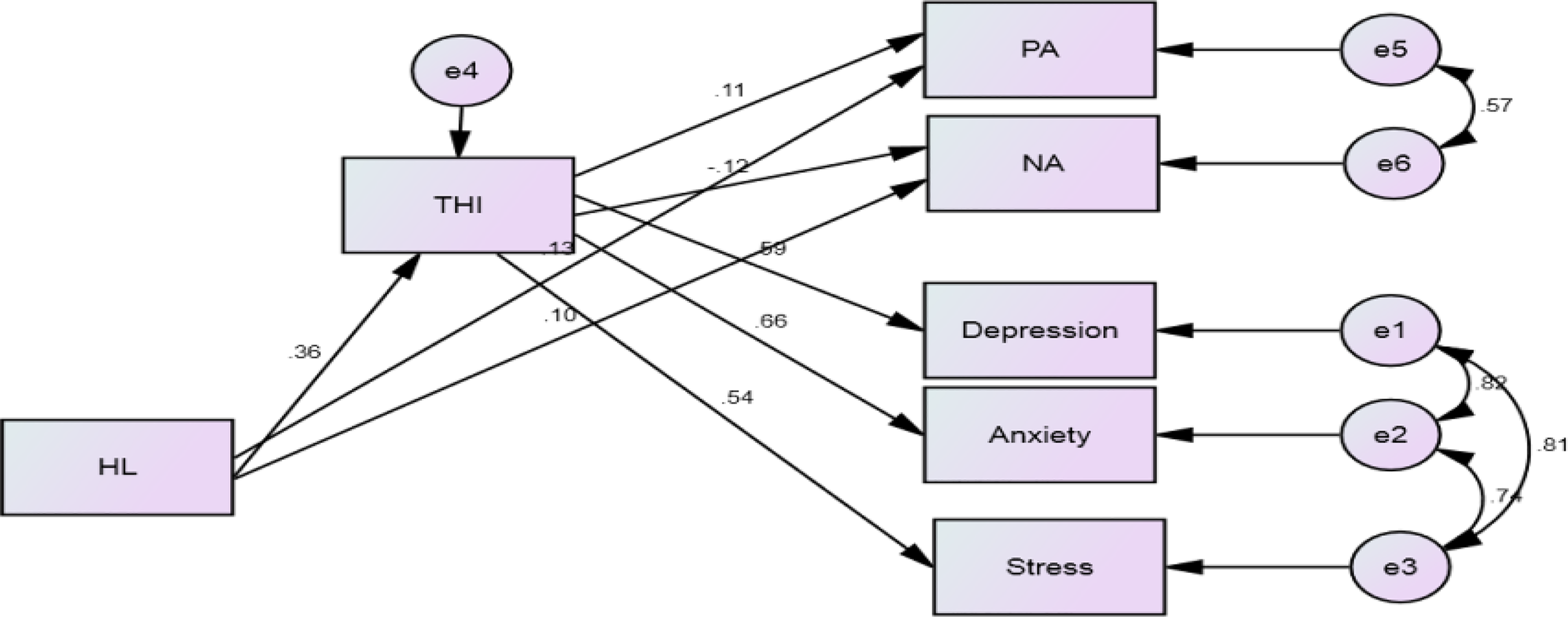
The mediating role of THI on the relationships among HL and PP in male patients with tinnitus (n = 60). Note. HL = hearing loss, measure of hearing impairment; THI = Tinnitus Handicap Inventory, measure of tinnitus perception; NA = negative affect; PA = positive affect. Structural equation modeling and analysis of a moment structures (AMOS) were applied to measure relationships among THI scores, HL, PA, NA, depression, anxiety, and stress.

The mediating role of THI on the relationships among HL and PP in female patients with tinnitus (n = 40). Specifically, figure displays female patients with tinnitus; HL and THI scale relationships with PA, NA, depression, anxiety, and stress, demonstrated by Durai et al. (2017) and Pedemonte (2018). Note. HL = hearing loss, measure of hearing impairment; THI = Tinnitus Handicap Inventory, measure of tinnitus perception; NA = negative affect; PA = positive affect. Structural equation modeling and AMOS were applied to measure relationships among THI scores, HL, PA, NA, depression, anxiety, and stress.
Specifically, figure displays female patients with tinnitus; HL and THI scale relationships with PA, NA, depression, anxiety, and stress, demonstrated by Durai, O’Keeffe, & Searchfield (2017) and Pedemonte (2018).
Discussion
This study examined the potential mediation pathways among HL, tinnitus perception (as assessed via the THI), anxiety, stress, depression, NA, and PA in male and female patients with tinnitus (Alpini & Cesarani, 2006; Aqeel & Ahmed, 2018; Aqeel et al., 2017; Axelsson & Ringdahl, 1989; Coelho et al., 2004; Danesh et al., 2018; Scholes & Ramakrishnan, 2015; Vanneste, Alsalman, & De Ridder, 2018). This study focused on the relationships between tinnitus and depression, stress, and anxiety in patients of both genders. Additionally, this study assessed NA and PA, which are novel variables to examine in the study of male and female Pakistani patients with tinnitus. The present findings indicate that tinnitus perception was positively and significantly associated with anxiety, stress, depression, NA, and PA in both female and male tinnitus patients (Aytac et al., 2017; Sasidharan, Rai, & Somayaji, 2017; Schmidt et al., 2018; Sunwoo et al., 2018). These findings support hypotheses 1 and 2. Moreover, the results revealed that tinnitus perception (as evidenced by the THI score) fully mediated the relationships between HL and anxiety, stress, and depression in male patients with tinnitus, but only partially mediated the relationships between HL and PA/NA in female patients with tinnitus. The present findings support our study objective and are consistent with the results of similar studies (Cima et al., 2018; Eggermont, 2012; Yıldız et al., 2017; Zoger et al., 2006).
Previous research has debated the relationship between tinnitus and PP (Alpini & Cesarani, 2006; Aqeel & Ahmed, 2018; Aqeel et al., 2017; Axelsson & Ringdahl, 1989; Coelho et al., 2004; Danesh et al., 2018; Scholes & Ramakrishnan, 2015; Vanneste et al., 2018). While some studies have shown that patients with HL and tinnitus were more inclined to mood swings, stress, anxiety, and depression than those who had tinnitus without HL (Bauer et al., 2017; Cima et al., 2018; Ibarra et al., 2018; Van Damme et al., 2017). Previous studies have also reported that tinnitus is often associated with significant psychological adjustment problems and mood swings (Alpini & Cesarani, 2006; Baguley et al., 2012; Cima et al., 2018; Ridner, 2004; Van Damme et al., 2017; Zoger et al., 2006). However, by contrast, studies have also shown that patients who experienced PP, such as irritability, hopelessness, sleep deprivation, and aggression gradually developed tinnitus symptoms (Acikalin, Haci, Altin, & Alimaoglu, 2019; D. M. Baguley & Fagelson, 2015; Abbas et al., 2018; Aqeel & Ahmed, 2018; McFerran, 2014; Scholes & Ramakrishnan, 2015; Suzuki, Suzuki, Onishi, & Penido, 2018). Additional studies have described that tinnitus patients faced more PP over the years because of the fear of ambiguous noise (Cima et al., 2018; Schmidt et al., 2018; Scholes & Ramakrishnan, 2015). Similarly, various researchers have debated on gender differences of tinnitus patients and revealed that female patient behaviors were different from their male counterparts.
Similar study findings have illustrated that female patients with tinnitus are more likely to exhibit anxiety, depression, and mood swings when compared to males (Alpini & Cesarani, 2006; Andersson, 2005; Axelsson & Ringdahl, 1989; Baguley et al., 2013; Baiduc et al., 2014). Furthermore, studies have also demonstrated that female patients facing a tinnitus problem showed a higher degree of stress, anxiety, and depression when compared to males (Andersson, 2005; Raffetto, 2018; Schmidt et al., 2018; Scholes & Ramakrishnan, 2015; Schweitzer, 2016; Zoger et al., 2006).
Research has shown that several deleterious factors lead to the prolongation of tinnitus. For instance, patients of both genders with tinnitus who also demonstrated cognitive impairments experienced more emotional problems (Miaskowski et al., 2018; Park et al., 2017; Yenigun, Dogan, Aksoy, Akyuz, & Dabak, 2014; Yıldız et al., 2017; Zajanckauskaite, 2017; Zoger et al., 2006). Additionally, patients with tinnitus who experienced psychological symptoms were more prone to problems in their social and occupational life. For example, these individuals may often appear apathetic and lethargic, leading to social isolation.
Several patients with tinnitus are susceptible to certain noises, ranging from stable talking to loud music. Therefore, they try to avoid such various social situations. Consequently, these individuals begin to feel isolated and believe that tinnitus is a massive problem in their social life (Domino et al., 2017; Henry, 2016; K. Lee et al., 2018; Lin et al., 2018; Scholes & Ramakrishnan, 2015; Schweitzer, 2016), indicating the possibility of an unhealthy vicious cycle of tinnitus severity, maladaptive coping, depression, anxiety, and stress. Thus, psychological intervention is essential to mitigate the effects of tinnitus on the lives of patients (Budd & Pugh, 1996; Hameed, Eleue, & Al Mosawi, 2018; Marciano et al., 2009; Møller et al., 2010; Scholes & Ramakrishnan, 2015; Trevis, McLachlan, & Wilson, 2018).
Implications
This study has opened several avenues for future research. The present findings could be used to spread knowledge and provide guidance for patients with tinnitus, including ways to tackle the emerging issue in Pakistani society, via new psychological interventions and preventive strategies. This study also highlights that patients with severe tinnitus might be at risk of high levels of psychological distress. Although this finding suggests that they are appropriate targets for future research on this topic, the present results also imply that it is vital to control the influence of HL and consider the impact of coping styles on tinnitus severity. This unique research examined the relationship between tinnitus severity and the degree of psychological distress in tinnitus patients. Moreover, possible ways of working with patients to reduce psychological distress have been highlighted, including directly working with patients to manage sleep or mood problems and working with partners of patients to alleviate suffering and enhance coping.
Conclusion
This study concluded that physiological problems, such as tinnitus and HL, can stimulate psychological symptoms, such as stress, anxiety, depression, and negative/positive mood swings in female and male adult tinnitus patients. Likewise, the interaction between tinnitus and HL brings an exciting and crucial explanation for the prolongation of psychological issues in tinnitus patients of both genders. Previous research has debated the relationship between tinnitus problems and PP (Alpini & Cesarani, 2006; Aqeel & Ahmed, 2018; Axelsson & Ringdahl, 1989; Danesh et al., 2018; Scholes & Ramakrishnan, 2015; Vanneste et al., 2018; Vanneste, Joos, & De Ridder, 2012). Some studies have provided evidence that male and female patients with tinnitus show higher tendencies toward anxiety, stress, and depression (Alpini & Cesarani, 2006; Andersson, 2005; Danesh et al., 2018). The findings affirmed that there was direct evidence of a causal directional relationship between tinnitus/HL and psychological symptoms. Thus, these findings reveal that demographic variables, especially gender, lead to different PP related to HL. For instance, female patients facing the challenge of tinnitus and HL were more prone to mood swings. In contrast, male patients suffering tinnitus and HL tended to experience depression, stress, and anxiety. Finally, this research has shown that the incidence of PP was affected by the interaction between tinnitus perception and HL. Therefore, the potential for a vicious cycle among HL, tinnitus perception, and physiological problems is possible in adult patients with tinnitus of both genders, suggesting early intervention is necessary. Thus, treatment of mood disorders, depression, stress, and anxiety at the initial stage of tinnitus development is recommended.
Limitations and future directions
The sample of the current study was selected only from Pakistani urban areas. Consequently, the findings of this research study may not be generalizable to the entire population of Pakistan. Additionally, it is possible that the audiologist and psychiatrist/psychologist may have required more time to appropriately screen and evaluate the patients. Thus, several uncertainties could relate the assessment, treatment, and diagnosis of tinnitus. We recommend additional methods to assess tinnitus, primarily focusing on neuronal dysfunction, as this can cause tinnitus and it might lower resistance to psychological issues (e.g., anxiety, depression, and stress), or vice versa.
The specific findings might be advantageous for health professionals, such as rehabilitation psychologists in the clinical setting, as they might assist in the development of strategies and therapies to effectively treat patients with tinnitus problems in Pakistani society. This study is also beneficial to researchers, psychologists, audiologists, and health professionals to help them better understand patients with tinnitus in other communities around the globe. Further descriptive and experimental research studies are recommended to examine the underlying mechanisms of tinnitus in greater depth across both genders. This measurement may be more effective if aspects of local culture are considered and integrated.
Footnotes
Acknowledgments
Special thanks to professional language editing service for ensuring English grammar is free of mistakes for this manuscript. Prof. Dr. Jinzu Ling and Prof. Dr. Ben-qian Li supervised the project. The authors also acknowledge the support from BSE Lab, Prince Sultan University.
Declaration of Conflicting Interests
The author(s) declared no potential conflicts of interest with respect to the research, authorship, and/or publication of this article.
Funding
The author(s) received no financial support for the research, authorship, and/or publication of this article.
