




Abstract
Global intersecting crises, such as the COVID-19 pandemic, the climate emergency, and the shrinking of civic space, increasingly unveil and amplify deep systemic inequalities. A growing body of literature shows that the COVID-19 pandemic has significantly disrupted the learning and development of young children, especially for those already experiencing inequalities. This article draws on a critical discourse analysis of a literature review commissioned by the Scottish COVID-19 Inquiry. It operationalises a critical epistemic justice lens to consider the epistemic politics in research literature and wider social discourses about early childhood education, during and in the aftermath of the COVID-19 pandemic. Our analysis shows that young children, particularly from minoritised groups, are routinely excluded from knowledge production processes. We suggest reevaluating how ‘evidence gaps’ are framed and avoiding reductionist, individualistic approaches to generating knowledge about complex social issues. We discuss how emotional constructions of childhood as a site of social intervention and control, amplified by alarmist narratives about childhoods in decline, further undermine children’s epistemic agency.
Introduction
In countries across the world, the COVID-19 pandemic has significantly disrupted the lives and education of young children. In Scotland, as elsewhere, a well-rehearsed narrative has been established about its longstanding impacts on young children’s learning and development, on deepening social inequalities, and on structural challenges for the early childhood education sector (Davies and La Valle, 2025; Kustatscher et al., 2023; Tisdall and Morrison, 2022).
This article builds on desk-based research commissioned by the Scottish COVID-19 Inquiry, carried out by the authors (Kustatscher et al., 2023). Rather than summarising the substantive findings of this report (i.e. the impact of the pandemic on children’s learning and development, and on the early childhood sector), we present a critical analysis of the epistemic politics in this literature and wider social discourses, and their repercussions for early childhood education policy and practice.
In doing so, our article contributes to debates on epistemic justice in educational research and policy-making (Bowen et al., 2009; Davies et al., 2024; Knezevic, 2020; Nxumalo, 2019). We develop a theoretical framework that builds on critiques and additions (Mason, 2011; Pohlhaus, 2012, 2020) to Fricker’s (2007) work on epistemic justice, combined with childhood studies scholarship that centres the epistemic agency of minoritised children (Pérez and Saavedra, 2017).
We operationalise this ‘critical epistemic justice’ lens to analyse the generation and legitimisation of knowledges in the early childhood education landscape during and after the COVID-19 pandemic. As systemic inequalities have increased with the pandemic, we suggest that this also brings the epistemic injustices in early childhood education knowledge and policy landscapes into sharper focus.
Our analysis highlights the knowledge politics about what counts as ‘evidence’ and the silences and exclusions within this knowledge landscape. We discuss affective dimensions of how children’s learning and development during and post-pandemic has been constructed, and how alarmist narratives about childhoods in decline serve to justify policy approaches which increase children’s protection and regulation at the expense of their participation. We conclude the article with a call to consider more carefully and critically how ‘evidence’ surrounding early childhood education is constructed in the wake of the COVID-19 pandemic, and how these constructions are fuelled by emotional dynamics that risk sanitising or obscuring what is already known about young children’s unequal lives. We end with recommendations to rethink the parameters of how knowledge is being generated and who counts as knowledgeable, and how acts of ‘willful hermeneutical ignorance’ (Pohlhaus, 2012) can enable those in power to disengage from knowledge that is already available.
Epistemic power struggles and the framing of knowledge agendas
What counts as ‘knowledge’ is not neutral or universal, but is shaped by contexts, histories and power relations, and is constantly reified through social and political discourses, including those in media, education, and academia (Smith, 2021). Numerous scholars – especially Black feminist and decolonial writers – have pointed out the links between such epistemic struggles and wider social justice struggles (Hill Collins, 2000; Mignolo, 2009; Smith, 2021).
Within such debates about the politics of knowledge production and influence, Fricker’s (2007) concept of epistemic justice has recently gained traction in childhood studies research (Cheney, 2018; Davies et al., 2024; Sato, 2023; Steele and Nicholson, 2019). Fricker suggests that epistemic injustice takes place when people are wronged in their capacity as knowers. She distinguishes between testimonial injustice and hermeneutical injustice. Testimonial injustice occurs when a person’s credibility is undermined because of their social location or identity, that is, in relation to their age, race, gender or other such categories. Testimonial injustice can also include pre-emptive silencing, that is, excluding groups from contributing their knowledge in the first place (Fricker, 2007; Greenblatt et al., 2024). For childhood studies researchers, this resonates when children are deemed ‘too young’ or ‘incapable’ to contribute valuable knowledge, or when their knowledges are trivialised or disregarded. Hermeneutic injustice occurs when there is a gap of shared understanding between those who share knowledge and those who listen, and these gaps are shaped by power relations. For example, when a person does not have access to the same language or interpretive resources as the person they are listening to, they will only be able to hear what they are saying through a distorted frame (Davies et al., 2024; Fricker, 2007). This could be the case, for example, when people of colour explain experiences of racism to white people, or when a child’s experiences within the education system are not understood by teachers because of their age, or because they are a girl, migrant, working class etc. (Walker, 2019).
Fricker’s work has been critiqued for neglecting, and even perpetuating, certain dimensions of power. Mason (2011) suggests that Fricker’s description of the ‘gap’ between knowledges and understandings of those who are marginalised and those who are in power fails to acknowledge sufficiently that this gap is far from neutral, but in fact exemplifies how some knowledges are held superior to others. The idea that minoritised groups have to make sense of their experiences, and relay them, within the knowledge parameters of dominant groups, neglects their own ‘epistemic agency’ (Mason, 2011, p. 295). Minoritised groups can fully understand and express their own social experiences, but will still be silenced by dominant groups. For example, in their work on minority women’s organising in Europe, Bassel and Emejulu (2017, p. 30) suggest that the fact that these women’s voices are routinely ignored in mainstream policy and practice is not accidental or due to oversight by those in power, but is part of the ‘project of domination and exploitation of white supremacy’. Thus, the goal should not be to provide minoritised groups with the frameworks and tools to communicate their experiences to those in power whilst maintaining established power-knowledge hierarchies, but to centre and assert their own knowledges based on their lived experiences. This will inevitably require an upheaval of what is generally considered legitimate knowledge in dominant knowledge paradigms.
Pohlhaus (2012) critiques Fricker’s model by adding ‘willful hermeneutical ignorance’ as a third dimension to it. This ‘willful hermeneutical ignorance’ occurs when those in power actively refuse to engage with available knowledges that would help them to address the gaps of shared understanding. This takes place, for example, when Indigenous people’s knowledges are excluded from developing climate policies despite being disproportionately affected by climate change impacts (Byskov and Hyams, 2022).
Researchers’ own positionality shapes how they conceptualise such knowledge politics, and which intersectional categories of power they foreground in their own work (Mügge et al., 2018). Consequently, the underrepresentation of groups who are minoritised based on their age, gender, race, class and so on in academic and policy spaces impacts on how knowledges are constructed, legitimised and taken up (Mügge et al., 2018). Academic knowledge agendas are further mediated by epistemological struggles over what constitutes the ‘best’ types of research evidence – from small scale qualitative case studies to randomised controlled trials or systematic reviews. These evidence hierarchies are legitimised by empiricist and positivist paradigms, rooted in colonial histories of knowledge production (Smith, 2021).
Which children, whose childhoods? Epistemic debates in childhood studies
Epistemic debates have been central to the emergence of childhood studies as a field. Scholars have stressed that children are knowledgeable, that they should be centrally involved in creating knowledges about their own lives, and that researchers should reflect on (and question) how such knowledges continue to reify the very category of childhood (Cuevas-Parra and Tisdall, 2019; Spyrou, 2018). In recent years, this debate has advanced to highlight how childhood continues to be a frame imposed by Eurocentric knowledge politics (Balagopalan, 2019; Burman, 2017). This produces a normalised idea of childhood as white, middle-class and heterosexual against which ‘other’ childhoods are viewed as deficient (Pérez and Saavedra, 2017). Such normative, idealised childhoods tend to dominate policy discourses and priorities, with ‘other’ children being excluded from processes of knowledge-making (Breslow, 2021). Additionally, the politics of evidence-based policy-making – with its emphasis on positivist discourses and certain types of ‘evidence’ – creates an inherent asymmetrical epistemic status between children and adults: children’s knowledges may be seen as inferior due to their assumed ‘immaturity’ or ‘unreliability’, especially when juxtaposed with adult, professional perspectives (Knezevic, 2020).
Our analysis in this article is informed by a ‘critical epistemic justice’ theoretical framework. This combines critiques and additions to Fricker’s (2007) concept of epistemic justice with childhood studies scholarship that challenges hegemonic ideals of childhood and centres the knowledges and epistemic agency of minoritised children (Pérez and Saavedra, 2017). This theoretical combination enables us to evaluate critically discourses and languages surrounding early childhood education policies during and after the COVID-19 pandemic in Scotland, highlighting their affective nature, and how particular types of ‘evidence’ have contributed to silencing the experiences of some groups of children.
Background and methods
The underlying work for this article was a scoping review commissioned by the Scottish COVID-19 Inquiry (Kustatscher et al., 2023). The Scottish COVID-19 Inquiry is a statutory public inquiry, set up and funded by the Scottish Government, tasked with independently investigating the strategic response to the coronavirus pandemic in Scotland and presenting its findings and recommendations to Scottish Ministers. 1 The scoping review addressed three research questions, as agreed with the Scottish COVID-19 Inquiry:
How has the COVID-19 pandemic, and the policy responses to it, impacted on the delivery of education for children under five in Scotland?
How has the COVID-19 pandemic, and the policy responses to it, impacted the education for children under five in Scotland?
How have these impacts been distributed and experienced by children under five who face disadvantages based on socio-economic exclusion, disability, race/ethnicity, and other intersecting inequalities?
In this article, we address a fourth research question:
4. What are the key themes and absences in the literature and wider social discourses about the pandemic’s impacts on early childhood education, and what are the epistemic implications for research and policy-making?
Thus, the contribution of this article does not lie in adding substantive findings to the literature on the impact of the pandemic on early childhood education (as our original report sought to do). Drawing on the same data as in our original report, we apply a new conceptual lens to analyse the epistemic practices and gaps in this literature, and their implications for early childhood education policy and practice.
As laid out by the PRISMA-ScR guidelines (Tricco et al., 2018), which were developed particularly for scoping reviews to enhance methodological transparency and reporting quality, we identified eligibility criteria, information sources and search strategy, screening and a data extraction process. The rapid review searched for academic and grey literature (‘the research literature’), that addressed the research questions. To be included, the research literature needed to meet the following eligibility criteria:
Literature published in the English language since March 2020, and by October 2023, relevant to Scotland. The starting date of March 2020 was determined by the pandemic’s timing, and October 2023 was a cut-off date to meet the funder’s deadline.
Literature focused on children under five.
Literature focused on the delivery of education and childcare / early learning and childcare to children under five.
Literature focused on the structural context of education for under-fives, for example, workforce, expansion of funded childcare, integrated working.
Literature focused on experiences and outcomes of children under five who face particular disadvantages based on socio-economic exclusion, disability, race/ethnicity, and other intersecting inequalities.
Literature dated before March 2020 and beyond Scotland (UK and international) was included for contextualisation and/or in the absence of Scottish-focused studies, but was not the main focus of the search. For example, where there were no studies from Scotland available, we included studies from across the UK and elsewhere.
Information sources included national surveys and statistical datasets, peer-reviewed academic and grey literature, empirical research (qualitative and quantitative), meta-analyses, relevant policy guidance and briefings, trades union and professional association documents (for details on our Boolean search technique, search terms, and academic and non-academic databases, see Kustatscher et al., 2023). Additionally, the research team reached out by email to key experts, stakeholders and professional associations working in the field of education for under-fives in Scotland to gather additional evidence in the form of unpublished research and data sets.
To establish rigour and reliability of the resources included, we scrutinised the methods employed and potential reporting bias. We undertook a reflexive thematic analysis of the research literature following Braun and Clarke (2019). The research team developed a coding frame, that then was used to review all the literature. Emerging themes and sub-themes were cross-checked against our search criteria and, through team discussion, finally developed into the report’s findings. As a result of our search criteria and sifting, we included 166 documents in the review (for full details on our methodology, see Kustatscher et al., 2023).
We consulted with the Ethics Committee of the Moray House School of Education and Sport, who confirmed that no ethics approval was required for this study as it was a literature review. Ethical considerations focused on whether the included studies were conducted ethically, on seeking to be respectful of authors, research teams and research participants, and on being sensitive in discussing how children, their families and the early years workforce deal with the repercussions of the COVID-19 pandemic.
Our approach undertaken for the original scoping review exemplifies some of the knowledge struggles highlighted in the previous section, in terms of whose perspectives were included or excluded in the reviewed research literature. As discussed later on, there were large gaps in the reviewed literature with regards to research on young children’s own perspectives, on the experiences of particular groups of children, and of early childhood practitioners. This presented an ethical issue, in terms of establishing ‘research findings’ with clear limitations. We recognised tensions in setting the boundaries on what was ‘rigorous and reliable’ evidence to be included in a scoping review, which risked accepting conventional academic assumptions that privilege peer-reviewed academic outputs and quantitative methodologies at the expense of ‘grey’ literature, qualitative methodologies and ‘anecdotal’ evidence (Zawacki-Richter et al., 2020). Our approach was to set an expansive boundary, while detailing in the review the origins and potential imitations of literature included. Additionally, our research team was composed of a group of white, middle class, female academic researchers, and whilst we made every effort to reflexively address the impact of our positionalities on the report’s findings, it further exemplifies the perpetuation of epistemic power relations highlighted in our theoretical sections.
For this article, we revisited our thematic analysis of the original report’s literature review with a view to identifying themes and silences in how the impacts of the pandemic on young children’s education are constructed, and what the implications of these constructions are for early childhood policy and practice. This re-analysis was informed by critical discourse analysis, specifically in terms of how language reflects and reinforces power dynamics and emotional tropes (Fairclough, 2013). We also scrutinised a number of British media articles, in order to complement the discursive analysis of existing literature with how these themes are represented in wider popular discourse. Our analysis identified four themes, which we discuss in the following sections: constructions of ‘evidence’ and gaps in knowledge (Section ‘Constructing ‘evidence’: Missing knowledges on COVID-19 and young children’s education’), affective narratives of childhoods in decline (Section ‘Affective discourses and the loss of ‘good childhoods’: Alarmist narratives’), increasing tendencies of surveillance, protection and regulation of children’s and families’ lives (Section ‘Surveillance, protectionism and regulation’), and deficit language such as ‘vulnerability’ and ‘losing out’ and its implications for early childhood education (Section ‘‘Vulnerability’, ‘losing out’ and ‘school readiness’: How language shapes problems – and solutions’).
Constructing ‘evidence’: Missing knowledges on COVID-19 and young children’s education
What counts as reliable evidence for early childhood education policy-making is contested, and ‘hard sciences’ (e.g. brain imagery) or cost-benefit analyses-based studies tend to be especially influential (Bowen et al., 2009). Evidence hierarchies privilege systematic reviews, randomised controlled trails (RCTs), large-scale quantitative surveys and norm-referenced questionnaires, and tend to prioritise quantitative over qualitative paradigms, with the latter positioned as inadequate tools to measuring generalisable ‘impact’ (Nutley et al., 2013). For early childhood education, undervaluing the strength of qualitative research risks missing out on children’s own views and experiences, and on the rich and nuanced details of situated early childhood practice (Parra and Edwards, 2024).
These knowledge hierarchies were evident in the literature we reviewed for the Scottish COVID-19 Inquiry. Specifically, there were few studies that focused on the lived experiences of young children themselves (Cuevas-Parra and Stephano, 2020; Holt and Murray, 2022; Petretto et al., 2020). Most studies were based on surveys with teachers or caregivers. Where there was evidence of children being asked directly about their experiences of the pandemic, this tended to be biased towards older, school-aged children and young people (Children’s Commissioner, 2020; Stewart et al., 2023). This illustrates underlying assumptions that younger children are not able to articulate reliable insights into their experiences, arising from exclusionary developmental perspectives (Moss, 2018). It can be interpreted as a form of testimonial injustice (Fricker, 2007), which excludes young children’s views because they are considered unimportant or unreliable, and thus denies their epistemic agency (Mason, 2011).
The denial of epistemic agency is further amplified for minoritised groups of children. Our review found significant gaps in the available literature related to specific groups of children, such as Gypsy, Roma and Traveller children, 2 as well as the views and experiences of the early childhood workforce who were responsible for implementing the continuously changing policy interventions (Kustatscher et al., 2023).
Even where evidence was available, it was oftentimes limited and skewed. For example, the Public Health Scotland (PHS) COVID-19 Early Years Resilience and Impact Survey (CEYRIS) study, carried out in four rounds between 2020 and 2023, looked at the experiences and impacts of COVID-19 on children aged 2–7 years old, via their caregivers. The 11,228 caregiver responses were obtained from open recruitment, making it one of the largest surveys undertaken in Scotland. However, PHS acknowledged that the findings needed to be interpreted with care as they were only representative of the views and parents and carers who completed the online survey. The CEYRIS sample had a greater number of white, wealthier parents respondents and insufficient data to analyse the experiences of children from minority ethnic households and those from households where a parent was under 25 years of age. This point is echoed by Andrew et al. (2020), who observed a bias towards more affluent and well-educated families in self-selecting online surveys during the COVID-19 pandemic, and an absence of families who speak languages other than English at home.
Where research is limited, there can be a tendency to fill gaps with unsubstantiated information or anecdotal ‘expert opinion’. At the time of writing our report for the Scottish COVID-19 Inquiry, a number of debates occupied public discussion, but no substantive research had yet been conducted around these issues: the need for a recovery curriculum, the crisis of ‘lockdown babies’ and a perceived increase in the number of children starting nursery and school still wearing nappies. Such public discourses can lead to an informal and institutional legacy, including an impact on educational policy (Goode and Ben-Yehuda, 1994). Whilst studies are now emerging into developmental outcomes of babies born during COVID-19 lockdowns (UKRI, 2024), caveats persist if they remain grounded in exclusively developmental understandings of childhood and construct a perceived ‘new’ problem rather than paying attention to pre-existing structural inequalities.
Thus, whilst there had already been a tendency pre-pandemic of prioritising certain (positivist) types of research studies in the framing of early childhood policies, as well as a tendency to exclude certain groups (young children, and minoritised young children specifically), the pandemic has further amplified these tendencies – with implications for whose children’s views are prioritised in academic and policy discourses. We now turn to the role of emotions in shaping social and policy discourses around childhood, particularly the alarmist notions around the decline of childhood produced by the COVID-19 pandemic.
Affective discourses and the loss of ‘good childhoods’: Alarmist narratives
Constructions of childhood are highly emotive – often polarised and ambivalent – which shapes media and policy discourses. In mainstream campaigns and reporting, an universal image of childhood tends to be composed – one that draws on normative ideas around white, middle-class, ‘Global North’ childhoods – which evokes particular affective registers (Breslow, 2021; Sinervo and Cheney, 2019). Most often, such dominant perspectives conceive of childhood as a time of innocence and vulnerability, where children’s lives need to be sheltered from hardship and crisis in order to preserve a period of protection and unfurling. If such constructions are threatened, emotional responses range from pity and protectionism to outrage and anxiety about lost opportunities – the latter extending beyond concern for individual children and feeding into moral panics about societal futures (Rinaldi et al., 2025). Children are simultaneously redemptive agents – enabling society’s future flourishing – and threats – if education and interventions targeted at enabling their development into future citizens fail (Moss and Petrie, 2005).
Childhood media reports during the COVID-19 pandemic were characterised in large part by alarmist tendencies (see Table 1), raising concerns about children’s developmental outcomes and general health and wellbeing.
Examples of news headlines during the COVID-19 pandemic.
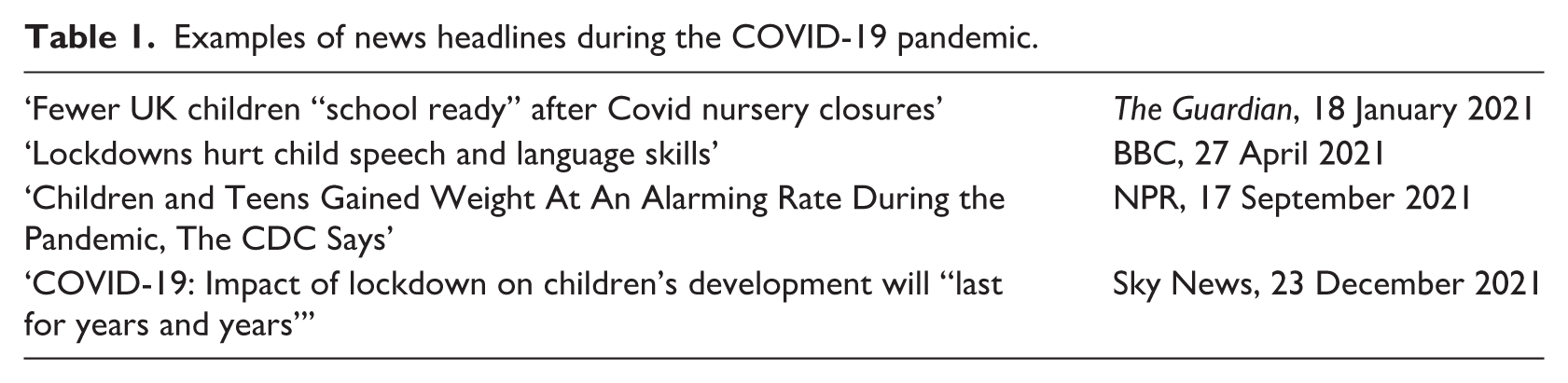
It is noteworthy that many of these headlines did not distinguish between different groups of children, and how they were affected by the COVID-19 pandemic and its policy responses, but rather constructed universally detrimental impacts for all children. However, our report highlighted that the pandemic’s impacts on young children’s education and developmental outcomes were nuanced, and significantly depended on their socio-economic backgrounds, ethnicity, dis/ability and gender (Kustatscher et al., 2023): children living in poverty, at risk of domestic violence, or with a disability were much more likely to experience negative impacts on their education, development and general health and wellbeing than other children. Minority ethnic children and families reported increased levels of racism and discrimination, especially those of Asian backgrounds. Shielding advice, restricted access to settings, and changing practices within settings posed challenges for children with additional support needs. In contrast, some children benefitted from improved family relationships due to more time spent together, although this was mostly experienced by families in higher income brackets (Kustatscher et al., 2023).
One particularly emotive topic, recurringly reported in media outlets, is on young children’s ability to use a toilet (see Table 2). While systematic research into children’s delayed toilet use is currently lacking, research during the pandemic highlighted that most low-income families struggled to afford nappies and other core child-related costs (Child Poverty Action Group, 2020).
Examples of news headlines relating to children’s toileting habits during and after the COVID-19 pandemic.
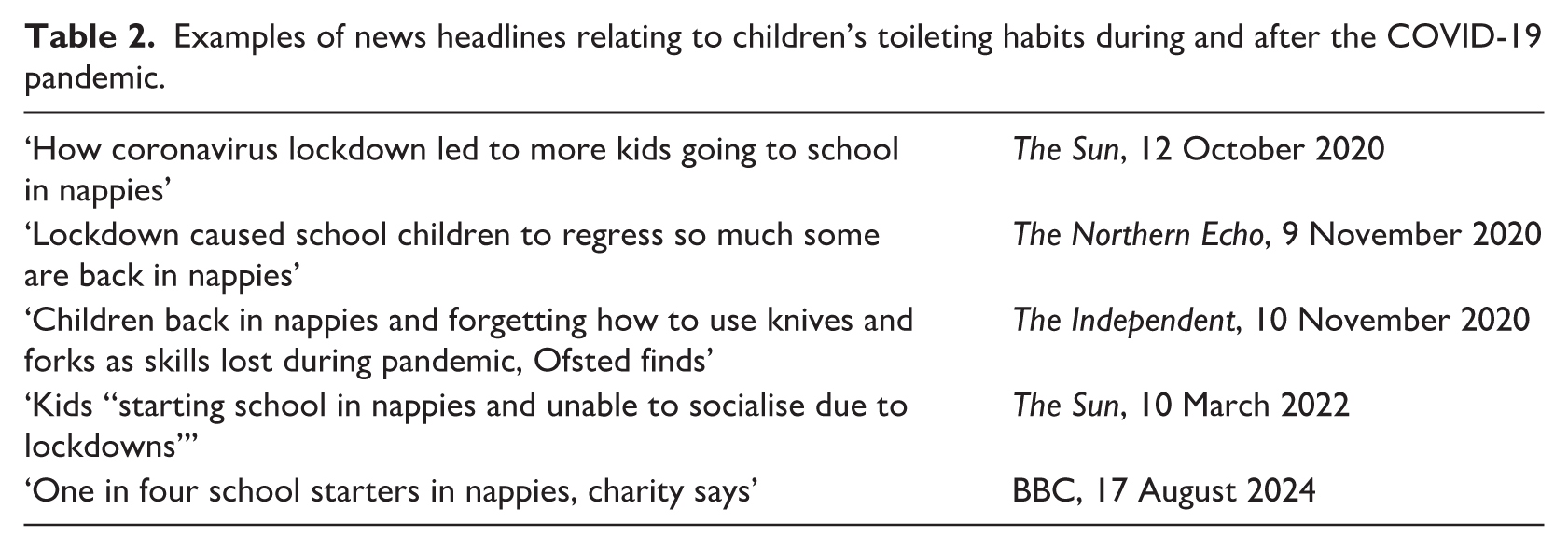
Many media reports fail to recognise the structural and economic dimensions behind children’s use of nappies, implying instead individualised failures associated with changed ‘parenting’ habits. This feeds into generalised anxieties about the loss of ‘good childhoods’ and, by extension, concerns for the social and economic future of society. However, such narratives ignore that these ‘good childhoods’ were never experienced by all children in the first place.
Crises – such as the climate crisis, institutional racism, ever-increasing socio-economic inequalities, Brexit and the cost-of-living crisis – destabilise people’s ontological security (Wright et al., 2021). Despite the COVID-19 pandemic sometimes being described as a ‘great leveller’ (Dennison, 2021), death and illness, financial damages, and losses to freedoms, movements and interactions brought on by the pandemic have not been experienced equally. In fact, newly experienced ontological insecurity can be a signifier of (white, middle class) privilege to date, as minoritised groups have historically had to grapple with precarity and uncertainty. Our analysis suggests that a widespread sense of ontological insecurity, expressed through alarmist narratives during and following the COVID-19 pandemic, has reinvigorated an increase in surveillant, protectionist, and regulatory practices in early childhood education, as discussed in the following section.
Surveillance, protectionism and regulation
In the UK, including Scotland, a key capitalist neoliberal focus is on producing ‘economically and socially active citizens’ (White, 2017, p. 429) so that children can ‘fulfil their potential’ (Gillies et al., 2017, p. 157). In the decades preceding the pandemic, this focus on children as sites of investment had, amidst the erosion of the welfare state, led to a focus on target setting, monitoring and surveillance of individual families and children (Featherstone et al., 2014; White, 2017).
Scottish Government policies such as ‘Getting It Right For Every Child’ (Scottish Government, 2006), alongside attainment and development tracking and monitoring, place responsibilities on practitioners for the surveillance and assessment of young children and their families. During the pandemic, this surveillance was to a large degree curtailed; schools and early childhood settings were closed to most children, and social work services were only available to a small number of families who were already known to services. People were discouraged from accessing healthcare settings except in emergencies, and routine appointments were cancelled for most people. The frequency of contacts with services therefore dramatically decreased for most families, leading to concerns about ‘hidden harms’ for families who did not meet the threshold for child protection registration but required more support than universal services could provide (McTier and Sills, 2021). Early years closures effectively removed access to low-threshold child and family support services that many low-income families prefer due to the pre-existing relationships of trust and non-stigmatising support that they can provide (Public Health Scotland, 2023). This rendered many of these families even less visible on the policy landscape due to less knowledge available from their interactions with services.
In Scotland, in practice and policy planning, early years settings during the pandemic shifted towards protecting children rather than enabling their participation. Through setting closures and segregation practices, children’s right to survival was prioritised over the enabling of other rights (Reid et al., 2022). Even once it became apparent that young children themselves were less likely to be infected, and to experience serious symptoms from COVID-19, restrictions placed on their education were continued to protect the survival of other age groups (Adami and Dineen, 2021; Picton-Howell, 2022).
Heightened regulatory discourses were exemplified in the release of standardised resources for tracking and monitoring children’s development (Education Scotland, 2023). Our report highlighted a tendency among policymakers, and some researchers, to focus on young children’s ‘learning losses’ during early childhood setting closures, and to compensate through ‘catch up’ agendas suggesting an intense focus on children’s academic learning (Kustatscher et al., 2023; Silistire, 2023), despite wide-spread criticism of such trackers within the early childhood workforce and academic field (McNair et al., 2021; Tyrie et al., 2021). Increasingly stringent developmental tracking approaches across Scottish local authorities can be seen as affective efforts to manage adult anxieties about uncertainty, loss, and lack of progress or stability, rather than being borne out of listening to children’s own views, rights or needs.
‘Vulnerability’, ‘losing out’ and ‘school readiness’: How language shapes problems – and solutions
The language used to describe children and their families and communities during and after the acute phase of the COVID-19 pandemic both reflects and constitutes dominant narratives and policy frameworks. The term ‘vulnerable’, for example, can fulfil various functions; it can stigmatise and ‘other’ those who are already marginalised, but can also serve to indicate who is deemed worthy of empathy and support (Brown, 2011). It can individualise the difficulties faced by families, obscuring the structural factors that make some groups of people more likely to experience these difficulties and become categorised as ‘vulnerable’, while simultaneously denying the agency of children and families (Cheney, 2010; Kamenarac, 2021; Tisdall and Morrison, 2025).
The term ‘vulnerable’ was already widely used in Scotland pre-pandemic – although there was no unified definition – but took on a new significance during lockdowns, when children who were categorised as ‘vulnerable’ by local authorities could in theory attend early childhood education and school pandemic Hubs. 3 The term ‘vulnerable’ was broadly defined by Scottish Government but varied in detail between local authorities, and may in part have been defined by the resources available. In practice, uptake of Hub places for children defined as ‘vulnerable’ was far lower than expected, especially when compared with the higher uptake for the children of key workers (Scottish Children’s Services Coalition, 2020; Sibieta and Cottell, 2020). It is likely that this low uptake was in part caused by families resisting the stigma of being defined as ‘vulnerable’, combined with confusion about who was eligible for a place due to criteria that varied between local authorities, and worries about increased exposure to COVID-19 for those attending Hubs (Barnardo’s Scotland, 2020; Observatory of Children’s Human Rights Scotland, 2020; Scottish Women’s Aid, 2020). Furthermore, a linguistic focus on the ‘positive’ impact of being in early years settings implied a ‘negative’ at-home experience, thus further compounding the stigmatisation of families.
Much of the policy and media language around children’s access to education during the pandemic centred on notions of ‘losing out’, ‘falling behind’, and needing to ‘catch up’ to be ‘ready for school’. These ideas reflect child development perspectives, and centre formal education systems as the most important sites of learning and development (Casey and McKendrick, 2022; Rogers, 2022). Viewed through the lens of children as sites of investment, this is unsurprising; if children are potential future productive citizens who must be prepared for work, and whose worth as adults will be measured by their economic contributions to society, rather than agentic knowledge holders in and of themselves, then the focus on ‘readiness for school’, ‘falling behind’ and ‘catching up’ makes sense. Positioning the problem as ‘missed learning’ suggests that the solution is a strong focus on formal learning, speeding up development, and increased tracking and monitoring. It is, however, possible to approach the ‘problem’, and therefore the ‘solution’, in a different way. Although children were clearly affected by the pandemic and its associated restrictions, the available research highlights that children were not all affected in the same ways or to the same extent, and that some groups of children were disproportionately affected. The pandemic compounded existing disadvantage and marginalisation, rather than creating an entirely new problem. Seeing the problem in this way, as a problem of structural inequality, positions the solution as working towards greater fairness and equity, eradicating poverty, listening to children and their families and attempting to meet their needs. To disregard the available evidence on pre-existing structural inequalities and advocating instead for individualised ‘catching-up’ educational policies can be interpreted as an act of ‘willful hermeneutical ignorance’ (Pohlhaus, 2012), with severe consequences for the lives of minoritised children and families.
Conclusion
In this article, we have considered the epistemic politics in research literature and wider social discourses surrounding early childhood education during and in the aftermath of the COVID-19 pandemic. We now outline the implications, and resulting recommendations, of these epistemic politics for researchers and policy-makers, in terms of how ‘evidence’ is understood, produced and utilised.
First, our analysis has highlighted that young children in general, and minoritised groups of young children in particular, are routinely denied epistemic agency and excluded from knowledge production. Our review has highlighted a lack of research that involves young children themselves, and especially children from racialised and Gypsy, Roma and Traveller groups. A critical epistemic justice lens means rethinking the parameters of what counts as knowledge and who counts as knowledgeable, and thus enabling and respecting the epistemic agency (Mason, 2011) of young children as a group, and especially of minoritised young children and their families. We do not want to minimise the challenges that researchers, and research organisations, encountered especially in the early stages of the pandemic – in terms of restrictions to movement and access to settings and participants. However, in times of polycrises, where we can expect to be dealing with deep structural disruption to our ‘usual’ research practices more often, there is a need for better preparedness to gather contextualised and timeous data from those directly affected, particularly in such times of crises.
Second, critically considering epistemic justice does not only require challenging what Fricker (2007) calls testimonial injustice (seeing children’s knowledges as less credible because they are assumed to be untrustworthy or incompetent) and hermeneutic injustice (not understanding children’s views because they do not share adult knowledge frames). Building on Pohlhaus (2020), epistemic agency goes beyond the ‘epistemic inclusion’ of minoritised groups into established knowledge systems – which can be epistemically tokenistic or even exploitative – and requires dismantling an epistemic system that actively excludes minoritised children and their families. This may involve providing opportunities for children to shape knowledge practices, by rethinking our methodologies and approaches to established research and policy-making practices. It also means making visible and challenging relations of power in research and policy-making, and preventing ‘those systems to fade into the background as ideal or universal structures necessary for knowing in general while hiding the manner in which those same systems enlist all knowers toward the interests of only some’ (Pohlhaus, 2020, p. 247, original emphasis).
Third, our analysis calls for pause and reflection in terms of how research ‘gaps’ are framed in the first place. Crises and persistent inequalities are often met with a call for more, and ‘better’ (often meaning quantitative), data – a trend that can be seen in Scotland’s framing of the ‘attainment gap’ and the introduction of widespread standardised testing in the education system (Kintrea, 2020). These tests can take valuable time away from meaningful educational practice, individualise social inequalities, and run the risk of reinforcing rather than challenging existing biases and inequalities (Bradbury, 2021). Simplistic calls for further ‘evidence’ may constitute reductionist approaches to complex social issues, and neglect considerations of how our established knowledge systems will often result in evidence that confirms our assumptions and worldviews (including racist, sexist, ableist and childist paradigms). There exists extensive evidence (both prior, during and after the COVID-19 pandemic) on how deep structural inequalities shape experiences and outcomes for young children. To explain worsening outcomes for some groups of children solely through the effects of the COVID-19 pandemic constitutes a form of willful hermeneutical ignorance: a refusal by those in power to engage with relevant, available knowledges. This is exhibited in research, media and policy discourses focused on individualised, academically-focused educational interventions at the expense of challenging persistent structural inequalities – a momentous task that is not achieved by simply providing ‘more’ or ‘better’ data.
Fourth, we have highlighted how epistemic politics are deeply intertwined with emotions. Our analysis has showed how discussions of young children’s learning and development, both during and after the pandemic, are characterised by highly emotive language. This language paints a picture of childhood in decline (‘learning losses’ and ‘falling behind’) and serves to promote protectionist and regulatory – over participatory – policies and practices. Affective constructions of early childhood as a site of social and economic investment position young children as passive, in need of intervention and control, and this further undermines their epistemic agency.
In conclusion, a critical epistemic justice lens requires researchers and policy-makers to diversify accepted approaches to knowledge production in terms of methodologies, participant groups, and who carries out the research. This includes interrogating how ‘evidence’, and research needs and gaps, are constructed, and who benefits from and who is harmed by established epistemic systems.
Footnotes

Ethical considerations
As this article is based on a review of published literature, the Research Ethics Committee of the Moray House School of Education and Sport confirmed that no ethics approval was required for this study.
Funding
The authors disclosed receipt of the following financial support for the research, authorship, and/or publication of this article: The article draws on desk-based research commissioned by the Scottish COVID-19 Inquiry.
Declaration of conflicting interests
The authors declared no potential conflicts of interest with respect to the research, authorship, and/or publication of this article.
Data availability statement
This article is based on desk-based review of previously published material, commissioned by the Scottish COVID-19 Inquiry and carried out by the authors. No raw data were used to generate the findings of the article.