



Abstract
This article discusses the interplay between artivism and media literacy in plural Global South(s) and its fight against marginalisation. It reflects on the production of an experimental animation Portrait of Marielle by Kenyan and Brazilian young media activists and artivists. This animated film honours the legacy of Marielle Franco, a Brazilian human rights activist and politician murdered in 2018. The article explores how creative media practices can be used as tools for youth movement building in the Global South. It achieves this by analysing creative experiences that take place in ‘third spaces’ and considering how the application of creative techniques can establish South-to-South dialogical spaces for young people and mobilise memories and histories. Embracing an ethnographic approach, we trace the journeys of these artivists and their animated film, analysing the creative production processes and the exhibition of the animations’ frames in venues across both countries. This enables us to document the development of a collective ‘we’, nurtured by a dialogue between the young artivists and mediated by the creative artefacts, moving from individual to collective experiences. By following these journeys, we unpack how the spaces created by these interactions interplay with an agentive theory of change for media literacy, composed of four elements: Access, Awareness, Capability and Consequences. The focus is on the latter two: Capability, which involves young people using their media literacy for particular purposes in their lives, and Consequences, which occur when media literacy capabilities are combined with an active desire for a media environment that is conducive to equality and social justice. We suggest that working across these domains offers two important contributions to our field: a conceptual framework for digital and networked artivism that is intertwined with media literacy and a shift of the frames of reference for media literacy towards activism and social change.
Introduction
The ‘eVoices: Redressing Marginality’ project (2018–2019) was an international network, funded by the Arts and Humanities Research Council (AHRC), bringing together scholars and media activists and artivists from the United Kingdom, Brazil, Kenya and Syria. The aim was to explore how marginalised communities leverage affordances of digital arts and media to fight for social justice. This fight includes challenging simplistic mainstream media representations of disenfranchised groups and echoing these groups’ voices within and beyond the borders of their communities. The activities promoted by eVoices consisted of a sequence of events with creative media practices. The first event took place in May 2018 in Rio de Janeiro, in Museu da Maré, one of the few Brazilian museums to be located in a favela area, Complexo da Maré, in Rio de Janeiro. It started with a roundtable about state repression organised as part of the International Research Seminar of Media and Everyday Life by the Federal Fluminense University’s postgraduate programme in Media and Everyday Life. The participants included 10 favela activists between the ages of 20 and 35, 15 favela residents between the age of 18 and 60, 30 undergraduate and postgraduate students of both genders, 10 university lecturers and members of the eVoices network. The Brazilian community of activists and scholars participating in this roundtable were shaken by the murder of Marielle Franco, which had happened in March that year. Born and raised in Complexo da Maré, Marielle was one of the most prominent human right activists in Rio de Janeiro. She was a ‘cria da favela’ (Souza, 2018), a favela offspring, fighting against police brutality targeted against the Black marginalised youth. She was also the only Rio de Janeiro City Councillor to identify as a Black woman at the time of her murder. Mariele was murdered on 14 March 2018, 18 months after being elected. This encounter with young media activists in Museu da Maré shaped the idea for the experimental animation workshop that took place in the second event of the eVoices Network, hosted at PAWA254 in Nairobi, Kenya, which is the focus of this article. The workshop gathered a group of young artivists affiliated to PAWA 254, a youth-led non-profit organisation funded by Boniface and Njeri Mwangi in 2009, which serves as an artistic collaborative hub. Artivism combines activism with arts. Duncombe and Lambert (2018) words define it as a form of action that combines activities with a specific outcome – an ‘effect’, with arts – and affect, and the production of an affective impact.
The workshop led by Paula Callus and Ng’endo Mukii gathered 17 young artists, with expertise in a wide range of artistic practices. The workshop lasted 4 days and resulted in the production of a digital artefact, an experimental animation, as a tribute to Marielle Franco. The digital animation, together with a sample of 900 printed frames (used in the animation) travelled to Brazil and became an exhibition at Museu da Maré. The opening of the exhibition included an inaugural screening event in which Ng’endo Mukii had a conversation with the young activists and residents of Maré. Five years after the completion of the eVoices project, after establishing a partnership with Museu da Maré, Museu da República, a large museum located in the upper-middle class neighbourhood of Catete, in Rio, incorporated ‘Portrait of Marielle’ into a larger exhibition about Marielle Franco titled ‘Marielle, Marés’.
This article provides a reflective account about these experiences embracing a participatory and ethnographic approach to analysis. It reflects upon how third spaces (McDougall and Potter, 2019) offer a dynamic and fluid conceptualisation for media literacy. It also unpacks how each of the spaces mobilised or created by the above-mentioned interactions interplays with an agentive theory of change for media literacy (Rega and McDougall, 2023). This has a focus on capability (i.e. how the young activists involved took part in a process to improve and combine their media and creative skills for broadening the range of actions of their artistic expression and their activism scope), and on the consequences that emerge by combining these capabilities with their desire for positive change (by promoting a dialogical movement between people, histories, and creative artefacts across the Global South).
When talking about Global South in this article we do not refer simply to a geographical location, but we understand it as a metaphor for oppression and human suffering under capitalism (de Sousa Santos, 2015; Mignolo, 2008): Global Souths, in plural, can exist in Global North countries and vice-versa, adopting a core-periphery perspective that is itself distributed in the contemporary world. We also acknowledge that the term is problematic because it can reinforce an othering dichotomy between ‘Non-Western’/‘Non-Northern’ others and neglecting a plurality of socio-cultural contexts by grouping them all together. At same time the term ‘Global South’ can be strategic by connecting marginalised realities and enabling important conversations about oppression so that those who are oppressed (Freire, 1972) can get together and fight inequalities (Medrado and Rega, 2023). Thus, the concept of ‘Global South’ is intertwined with the concept of ‘dialogue’ in a sense that both refer to a willingness to explore mutuality through conversation.
Agentive media literacy
This research is situated in a stream of research on media literacy that combines it with digital and artistic activism in the Global South, calling for a more diverse and plural conceptualisation of the field, from an epistemological and methodological perspective (Bruinenberg et al., 2021). In this way, ‘the field can start to better understand how activism for social justice can be mobilised through g/local application of media literacy’ (Rega and McDougall, 2023: 2).
This article discusses media literacy from the standpoint of it being a dynamic, fluid and living concept which needs to be discussed and analysed in synergies with the cultural, geo-political and media ecosystem contexts in which it flourishes. When doing this, we challenge the assumption underpinning the competence models of media literacy that assume that positive impact and outcomes automatically derive from the development of media literacy skills. In recent years we have gathered evidence that competence-based models offer insufficient answers. The idea of using media literacy skill acquisition as a ‘fix’ to a distorted media ecosystem is simply not working: it is often media literate people who are responsible of producing and nurturing misinformation, polarising discourses and othering narratives (McDougall and Rega, 2022). By considering media literacy projects that combine artistic practices and activism, we can shift the focus to self-representation and self-expression, encompassing individual perspective and collective practices, and therefore moving away from a solutionist and competence based model. This shift enables media literacy to become a conduit for civic capacity as defined by young people themselves (Rega and McDougall, 2023).
As discussed by Mihailidis et al. (2021: 9), ‘discourses and practices around media literacy operate from three core assumptions: it (media literacy) creates knowledgeable individuals, it empowers communities, and it encourages democratic participation’. However, often such initiatives do not lead to practices that prioritise social justice. Rather, the focus is on skills acquisition on an individual level, with top-down initiatives that receive limited inputs from marginalised communities, and with initiatives that aim to promoting democratic participation but disregard structural inequalities and take for granted Western Eurocentric approaches (Melki, 2018; Mihailidis et al., 2021).
This research tackles this issue by focusing on the circumstances in which media literacy can become a conduit for positive social change. We analyse an experience in which Kenyan young artivists participated in an experimental animation workshop that led to the production of an animated film, Portrait of Marielle, and two artistic installations, Portrait of Marielle (using the same name as the film), exhibited at Museu da Maré and Marielle Marés, exhibited at Museu da República in Rio de Janeiro. We apply a theory of change for agentive media literacy to these experiences. This theory is composed of four interrelated elements through which change occurs: from access to awareness to capability and to consequences (McDougall and Rega, 2022). Access occurs when citizens are literate enough to make informed decisions about what to access within the media ecosystem and possess the necessary skills to use the media and digital technologies available to them. Awareness occurs when media literacy enables people to have a critical perspective of how media and information represent people, events, issues and places. Media literacy helps to understand how the media environment we engage with is constructed, who owns or controls different media sources and how digital and social media is governed, designed and manipulated. Capability refers to the use of media literacy more actively for particular purposes in our lives, rather than as passive consumers of information and content. This includes getting directly involved in the media ecosystem as media content creators. Increases in media literacy level, thus, can also lead to new capabilities for civic engagement through digital media and increased employability through the gaining of creative and/or digital skills. Finally, consequences relate to the contributions that media literacy can make to bringing positive social changes. Consequences occur when people engage in media literacy actions that can make a constructive and positive impact on the media ecosystem, in their lives and on the lives of others.
The consequences level represents the most socially engaged element of the agentive media literacy theory. Thus, we argue that the field of media literacy has a lot to benefit from analysing capability and consequences by incorporating a deeper understanding of the affordances of media activism and artivism for social change. In the following sections, we exemplify this interplay by exploring how the experimental animation workshop was designed and implemented to nurture media and young artivists’ creative capability. We also analyse the consequences that the process of participating in the experimental animation workshop with its outputs (the film and the exhibitions) had on the participants and their communities by creating South-to-South dialogues and connections.
Methodology and contexts
The ethnographic approach applied in this study (Medrado, Rega and Paulla, 2022) encompasses both the methods and product of researching and writing about personal lived experiences on the margins and their relationship to the cultural, social and political context (Ellis, 2004). An ethnographic inward gaze on the self was coupled with and outward ethnographic gaze towards the context in which the activities and experiences took place (Boylorn and Orbe, 2014) to produce a collaborative account, made possible by the creative of the artistic output, the animation ‘Portrait of Marielle’. The animation engaged multiple authors and perspectives and located our own multiple loci of enunciation or lugares de fala (Ribeiro, 2018) in the different spaces of project. The data collection methods included (1) audio diaries entries recorded by Medrado during the workshop and capturing her own reflections as well as the one of the young artivists, transformed in ethnographic fieldnotes at the end of the trip; (2) production notes produced by Callus in the planning stage of the animation workshop; and (3) in-depth interviews with two female artivists (Judy Lumumba and Nancy Chela) and with Ng’endo Mukii. Seventeen young artivists participated in the experimental animation workshop, 11 males and 6 females, chosen among the 40 applications received. The call for participation was disseminated through the project’s and the hosting organisation’s, PAWA254, social media profiles. Four members of the eVoices team screened the applications and selected the workshop participants. Candidates were asked to submit a sample of their work and a brief statement answering to the question ‘In your opinion, why is Marielle Franco an important voice to marginalised communities across the world?’. The call for applications remained opened for a window of 2 weeks.
This article analyses the creative media making experiences that take place on ‘third spaces’ (McDougall and Potter 2019) enabled by the eVoices Network. When doing this, it delves into two key second spaces brought together in this endeavour that enable us to understand the project’s dialogical aspects. The first one is Museu da Maré, the place where Marielle Franco’s activism was born and a point of reference for many media activist groups in Rio’s favelas. The museum also hosted the first exhibition ‘Portrait of Marielle’. The second space is PAWA254, a Kenyan creative hub that gathers young artivists who fight for political and social justice in Nairobi. PAWA254 hosted the experimental animation workshop which led to the production of ‘Portrait of Marielle’.
Museu da Maré: Community communication, popular education and popular memories
Museu da Maré is one of the few Brazilian museums to be located in a favela area, Complexo da Maré in the North Zone of Rio de Janeiro. The museum was founded in May 2006 by community members who had a long history of involvement with left-wing Catholic movements working on community projects related to alternative media and education. As noted by Claudia Rose Ribeiro da Silva, director of Museu da Maré, it was challenging to work with favela children and youth who had low self-esteem and suffered the trauma of being stigmatised and discriminated against due to their favela origins. They asked: ‘How can we learn about the world if we know so little about ourselves, our birthplaces, the favelas, and about those who came before us?’ This is when the idea of building a community museum to share the histories of Favela da Maré and its residents was born. Favela museums like Museu da Maré operate within a tradition of social museology, focused on insurgent memories, or: Memories of resistance that affirm the right to remember, to (re)articulate their identities, to exist and stay on their lands . . . these are memories that combat prejudice, discrimination, cycles of social domination, and that favour cultural differences, encouraging and exercising the right to difference. (Chisholm, 2019: 153; Gouveia, 2018: 9)
The museum’s philosophy revolves around personal histories as sources and tools for dialogue. The museum reflects a history of community projects that focus on three pillars – community communication, popular (as of the people) education and popular memory. In this way, the museum plays an important role in supporting the struggles and maintaining the legacies of those who fight for social justice by sharing their stories from the margins (Rodriguez, 2017).
Pawa 254: Artivism as a tool for social mobilisation
PAWA 254 is a youth-led non-profit organisation funded by Boniface and Njeri Mwangi in 2009. Located at the heart of Nairobi, it serves as an artistic and cultural collaborative hub that houses, fosters and catalyses creative and community-driven projects for social change. Boniface Mwangi is an award-winning photojournalist who documented the violence in Kenya in the aftermath of the national elections in 2007. After this life changing experience, he and his wife Njeri created an organisation that aimed to use art as a political and social tool for social change. The name combines the acronym ‘PAWA’, the Swahili slang for ‘power’ and the number 254, Kenya’s international telephone code.
PAWA 254 works in four main axes: (1) it uses artivism and its mobilisation strength to rally citizens around human rights issues; (2) it mainstreams good governance at all levels of government while exposing and shining focus on poor governance practices for both individual and state action; (3) it works with artists to develop and disseminate all forms of art (music, spoken word, visual art etc) to raise social awareness and foster citizen engagement; (4) it focuses on economic empowerment, talent and skills development to enhance education opportunities for youths, increasing their participation in governance processes.
The first key component of PAWA254’s work is the capacity-building of emerging artists and the integration of artistic expression for livelihood development. PAWA254 offers a state-of-the-art co-working space and actively creates, promotes and shares opportunities for arts skill transfer, mentorship and partnerships. The second component revolves around working collaboratively with like-minded groups and individuals in their local communities with the idea that citizen-led action is an important aspect of holding public officials accountable in relation to their use of public resources. For PAWA254, artivism represents a tool for dialogues about important issues, such as human rights, governance, citizen engagement and youth unemployment. 1
Capability: The experimental workshop
What holds all uses of ‘workshop’ together is that there is an element of transformation: of materials, of ideas or of people. (Graham et al., 2015: 404)
The group of young artists that convened together in 2018 at the PAWA254 arts centre in Nairobi came from diverse artistic backgrounds: photographers, cartoonists, musicians, poets and graffiti artists. Attending the centre to participate in a workshop, these artists shared an interest in animation but also personal experiences in grassroots activism. As makers they understood artistic process albeit in their own fields and had an implicit recognition of the importance of connectedness and collaboration within creative activities. The workshop was designed to connect academic knowledge of activism and media literacy with different artistic practices utilising animation as a vehicle to do so. Utilising found objects and everyday materials ensured that there was no need to rely upon specialist tools and that participants would be able to replicate these techniques using their own personal devices such as mobile phones beyond their time at the workshop as creative prod-users (Bruns, 2007).
Many animation scholars (Callus, 2015, Husbands, 2019; Ward, 2006, Wells, 1998) have argued that animation has the ability to combine methods from across different practices; drawing, illustration, sculpture, collage, filmmaking. 2 In this instance, the materials, processes, actions and experiments became a vehicle to present a portrait of Marielle Franco and in turn the platform through which these young artists shared experiences of activism. The animation workshop was designed by Kenyan animation artist Ng’endo Mukii and African animation scholar Paula Callus, and took place over 4 days. Andrea Medrado offered participants a personal account of Marielle Franco’s biography; who she was, her life, her activism. Participants then considered this information with a view to collaborate to create an animated portrait of Marielle Franco. This was an essential step to promote connection between the lived experiences of young activists across the ocean, and to create investment in the project of producing a digital creative artefact about Marielle, whose fight for human rights and against police brutality of marginalised communities resonate deeply with the struggle and fights of the Kenyan young artivists.
Animation is a laborious task and to produce only 5 seconds of movement on screen, artists must create at least 60 individual images. To facilitate this process and illustrate the premise of animation (that a sequence of still images viewed in succession can appear to ‘come alive’ or move) we decided to use found footage as a basis for the workshop. The footage consisted of found clips of Marielle Franco from online sources, and various sequences of news footage of the protests that took place around the world as a response to her assassination. The footage was then converted to individual sequences of digital still images and printed as a series of on A4 paper that was numbered accordingly. The process of sourcing these sequences online through digital media platforms such as YouTube, presupposed a degree of media literacy and awareness that also recognised how images exist and are circulated within these online spaces and the networks that inform them.
This method of using video as a basis was identified for two reasons; firstly, it allowed the artists to explore processes that included different media such as ink, crayon, chalk, painting, collage, found objects, beads, feathers, paper and illustrated a process that did not rely upon specialist equipment, digital technologies or software; secondly it expedited the process of animation without requiring expert craftsmanship through the use of the underlying prints. This process derived in part from rotoscoping, which is an animation technique that includes ‘the use of the tracing of lines over live-action footage’ to achieve realistic movement, enabled participants to rapidly grasp the concept of animation process and consider aesthetic decisions whereby they interjected directly upon the image (Pierson, 2019: 115). It ensured that individual participants were still able to contribute in a meaningful way to the process, without the risk of being intimidated by the more specialist skills that could be required working from a blank page.
Mark making and a tacit engagement with this process enabled the artists to interject their own voice upon the image as Collins states ‘making an artwork is a territorial gesture, since mark making inscribes territory, whilst it is also a method of thinking with and handling materials that results in “tacit” knowledge’ (Collins, 2014: 121). The literal interweaving and overlaying of the Kenyan artivists’ voices within the images of the marches in Brazil, for example, was critical in inspiring a sense of the collective ‘we’, imprinting their own call to activism. At the same time, the resonances that were established through this portrait between artists in Kenya and artists in Brazil catalysed conversations about activism.
Similarly, other artistic interjections included the actual physical erasure of an image using the scratching of the surface of the image to erase the image of Marielle. This reflexive process is often found in ‘direct animation, [whereby]the “human imprint” is quite literally the physical marks left by artists on strips of celluloid [or paper] as scratches, drawings, paint brush strokes, stamps, tyre tracks, finger or footprints’ (Husbands, 2019: 51). Echoing Carter’s discussions on material thinking, the artist here ‘uses, manipulates, and collaborates with the material forms of their medium as a method of creative research’ (Collins, 2014), participants were able to expand upon their own practice and consider combinations of this through animation. For example, the connections between the concept of the indexical image as recorded photographically (a record of the person, documentation of the marches and people affected by her) and the actions such as drawing over, rubbing out, scratching, erasing, combining text and drawings, and sound or poetry illustrated the performative aspects of these processes and affect through transformation. These processes foregrounded a concern with subjectivity and recognised this knowledge as opposed to ‘objective knowledge’. On its very surface, the animated image makes visible the subjective (as opposed the objective).
Finally, the animation process was presented not as an individual process of creation and authorship but rather as a chain of consequences where each artist created sequences that needed to connect to a body of work produced by others in the room. The ‘pipeline’ as it is often referred to in commercial animation, implicitly embeds a dependence amongst the artists where one sequence of drawings is connected to another, or in this case to those of the person sitting left or right of you. The process that we adopted was staged, first giving each participant only two frames from a sequence to work on that were combined then screened at the end of the day, then the following days we would repeat the process and increase the images created from 12 (1 second), and then to 24 (2 seconds) and so on. This process led to the recognition that the animation produced was the result of a collective (as opposed to a singular) effort 3 (Figure 1).
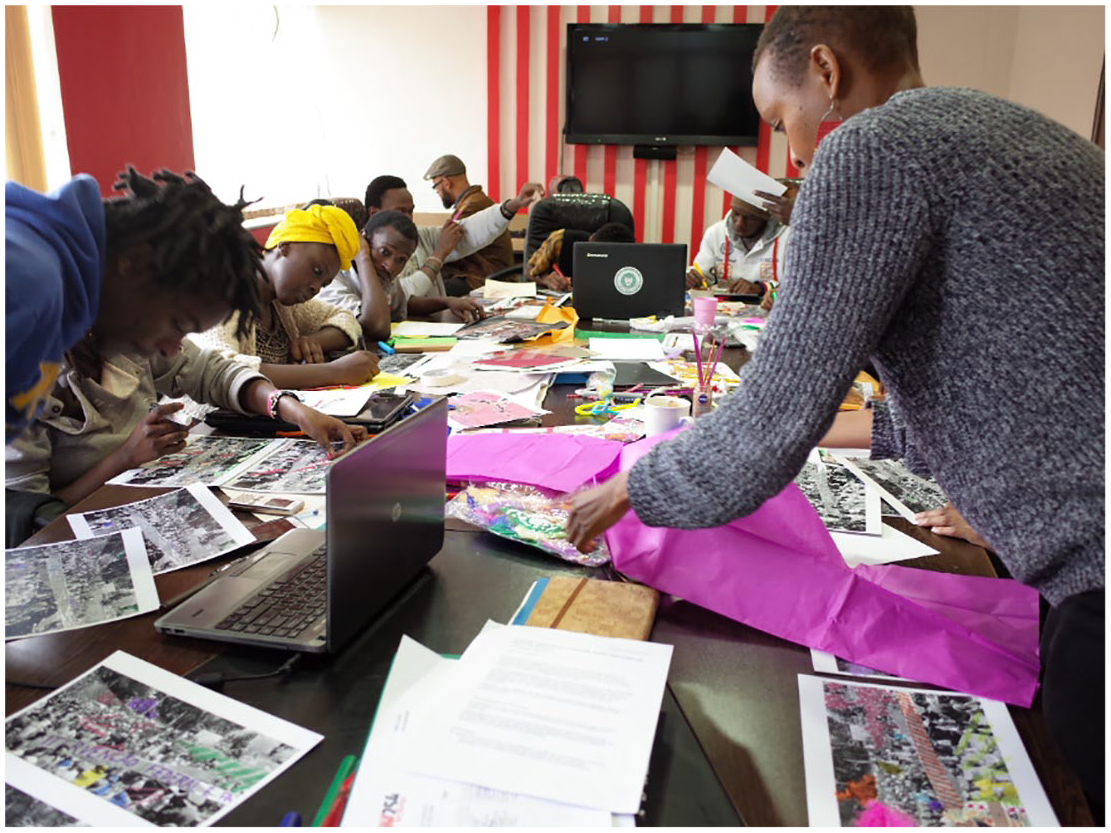
Young artivists at work during the experimental animation workshop held at PAWA254 with artist Ng’endo Mukii in the foreground right.
Consequences: Media literacy and artivism as creators of dialogues and collective memories
As we discussed earlier, media literacy can contribute to significant changes in the media ecosystems that represent integral parts of our lives and on the lives of others. Such consequences may include challenging misinformation by sharing trustworthy content on social media, producing media content that is meaningful and increasing or contributing to more nuanced representations of people who are marginalised in the media. In this section, we discuss the consequences of media literacy in the framework of this project that combines artistic and digital capabilities of young people with a clear social justice desire. Three aspects, in terms of consequences, emerged:
Establishing dialogical spaces for young people
Here we are inspired by the idea of personal histories and stories as tools for dialogue. This is the case, for instance, of Museu da Maré, with its sharing of testimonies, images and personal artefacts of favela residents. Here, we have popular communication, education and memory as the three pillars of community projects that are socially transformative. Such transformations are consequences of the media skills acquired by favela residents in terms of curating and making creative artefacts that carry their own stories in their terms. These artefacts, as we discussed in relation to the making of Portrait of Marielle, also carry the stories of marginalised others in empathetic ways with South-to-South solidarity (Medrado and Rega, 2023). Here we draw from Freire’s (1972) understanding of empathy as more than putting oneself in other people’s shoes. Empathy represents a political solidarity project in which we take the side of the oppressed. The making of Portrait of Marielle was empathetic in a Freirean sense as the Kenyan artivists had to be open to listen to the other - in this case, Marielle Franco’s story – and to each other as others – finding points of connection with their own social realities. The animation workshop allowed the Kenyan artists to establish a close dialogue with each other, which then provided opportunities for a deeper level of empathy with the Brazilian artivists who were dealing with the loss of an advocate for their rights. They were able to establish empathy through an emotional journey that started with feelings of fear and despair, which were then transformed to hope. Such shared emotions have surfaced from Ng’endo Mukii’s own evaluation of the workshop process as a ‘collective loss’ with a shared broken heart for Marielle in Rio (Ng’endo Mukii, discussion during the screening session of Portrait of Marielle, 23/08/2018). This shared grief, Mukii added, led people to the realisation that they were not alone in their struggles.
Mobilising memories and histories
Marielle Franco’s story represented what it meant to be marginalised in Brazilian society on many intersectional levels. She was a cria de favela (someone born and raised in a favela, a favela offspring), a Black woman and a lesbian who later became a human rights advocate and a rising star in politics at the time of her assassination. Thus, Marielle’s life and fight against marginalisation provided a narrative thread that could connect the plights of Brazilian and Kenyan artivists. After Andrea Medrado presented Marielle’s story to the Kenyan artivists, they were able to establish several parallels between their lives and the lives of people from marginalised communities in Brazil. These parallels included the daily struggles of crowded buses and precarious public transportation systems, the stark social inequalities affecting their lives, the lack of opportunities and extra judicial killings victimising economically vulnerable youths. One of the participants, Nancy Chela, a single mother, represented such connections by drawing a symbol of a sunflower over a photo/frame of Marielle’s face. This made her reflect on how ‘whether you are in the slums of Nairobi or Rio, as a single mum, you need to be always resilient, always chasing the light’ (group discussion, animation workshop, 21 August 2018, Medrado and Rega, 2023: 138). This meant that the artist manually intervened upon the animation image until she transformed it into something meaningful for her reality. Another young woman, Judy Lumumba, expressed that taking part in the workshop helped her better understand activism as a social justice narrative. To quote Lumumba, ‘activism is not about shouting on the street, activism is like Marielle’s story, activists are educated. They can come out and stand for the rights of the people. Activism is really going to the grassroots where our communities can share their stories and see and learn what we are doing’ (group discussion, animation workshop, 21 August 2018, Medrado and Rega, 2023: 136). Here we can conclude that one of the transformative media literacy consequences of the animation workshop was that Kenyan artivists re-signified the meaning of activism inspired by Marielle’s memory and story. Additionally, working together on the animation to achieve a collective coherent goal, they created a new collective memory about what it meant to turn grief (luto, in Portuguese) into struggle (luta, in Portuguese).
Dialogue between people, through creative artefacts: ‘The word is connectio’
The journey of the animation ‘Portrait of Marielle’ completed its circle by returning to Complexo da Maré, the place where Marielle was from. Ng’endo Mukii, the animation director, was in the city of Salvador for an artistic residency programme and managed to fly to Rio and present the animation to a group of favela residents, activists, and academics. In addition to the screening, the staff at Museu da Maré organised an exhibition with the 900 frames with interventions of Kenyan artists on the letter-sized papers with images used to produce the animation. The experience felt like an emotional catharsis with Mukii declaring that she was touched to ‘meet her babies again across the Ocean’ and having the opportunity to meet close friends of Marielle’s. One of them, Tatiana Lima, raised her hand after the screening of the film and spoke with a trembling voice: There have been many films made about Marielle. I confess that this is the only one that does not make me feel uncomfortable. I was trying to think about why this is the case. The thing is many of these films that honour Marielle, they say things like: Marielle, present! Marielle, alive! And, of course, I understand what Marielle represents now, how she has become larger than life. They mean to say that her struggle is alive. But the truth is, as her close friend, I know that she is no longer present, she is no longer alive. She is not here with us anymore and that really hurts. But this film is about connection. And if I can use one word to describe Marielle, that word is connection. She was really good at connecting people and connecting with people, and making things happen. I find it consoling that some young people across the planet, people who never met her, were able to connect to her story and to her struggle. The way that they were able to print their own realities in her images. . . the Kenyan language in the Brazilian song . . . This connection shows all over the film. (Ethnographic field notes, 08/12/2018).
Her words echo how artivism can enhance the transformative consequences of media literacy by transforming feelings of fear, which can be paralysing, into feelings of connection, which can be mobilising. Although the grieving for Marielle and for what her struggle means for marginalised communities remains as an open wound, such affective connections have helped people carry on fighting. Here, it is important to mention that in 2018, four Black women from marginalised backgrounds in Rio put their names forward for State and National elections. Often referred to as sunflowers, all of them were elected. The seeds of Marielle are blossoming. As A’zee Coptel wrote in the soundtrack song of Portrait of Marielle, ‘nina hope’, so we can still see. 4 Such transformative consequences cannot be dissociated from the more positive and poetic media representations that are made possible by the collective crafting of creative artefacts. Portrait of Marielle represents one example of these positive and more nuanced representations of favela residents and their struggles.
Furthermore, the experience of producing the animation Portrait of Marielle but also the creative artefacts themselves, such as the animated film and the artistic installations in museums taught us an important lesson: stories are powerful channels for dialogues. As the creative artefacts carried Marielle’s, and indirectly, the stories of marginalised communities across Brazil and Kenya, plural Global Souths, we have learned that dialogues take place between people, but also the dialogical properties of the artefacts themselves. This happens when the creative artefacts themselves become media territories for dialogue. Here, media territories can be defined as: ‘The combination of varying assemblages of media platforms, devices and contents. Each element is mobilised, often temporarily, because it grants certain resources (cognitive, emotive, symbolic, etc) as well as carrying a specific meaning or connotation. Using a spatial metaphor, such temporary assemblages can be understood as media territories’ (Tosoni and Tarantino, 2013: 577).
We argue that what enables these media territories to be assembled is their carrying of dialogical properties. This was the case with the creative artefacts (film and exhibitions) produced. In 2023, 5 years after the Exhibition Portrait of Marielle was originally installed in the times of Future space of Museu da Maré, the museum’s director was contacted by a curator at Museu da Republica, a large museum located in the upper-middle class of Catete, in Rio de Janeiro. The museum has an impressive collection of art and artefacts from the Republican period. After establishing an agreement with Museu da Maré, on 20 March 2023, the Museu da República curators set up the exhibition ‘Marielle, Marés’ (in addition to naming the favela, maré means tide in Portuguese. Marés means tides, in the plural). The exhibition consisted of the frames used to make the animation Portrait of Marielle, with a dedicated space to the screening of the animation, as well as photographs and paintings of Marielle produced by artists from Maré and other favelas. Marielle Marés was one of the most popular exhibitions in the history of Museu da Republica, attracting over 300,000 visitors in 6 months 5 (Figure 2).
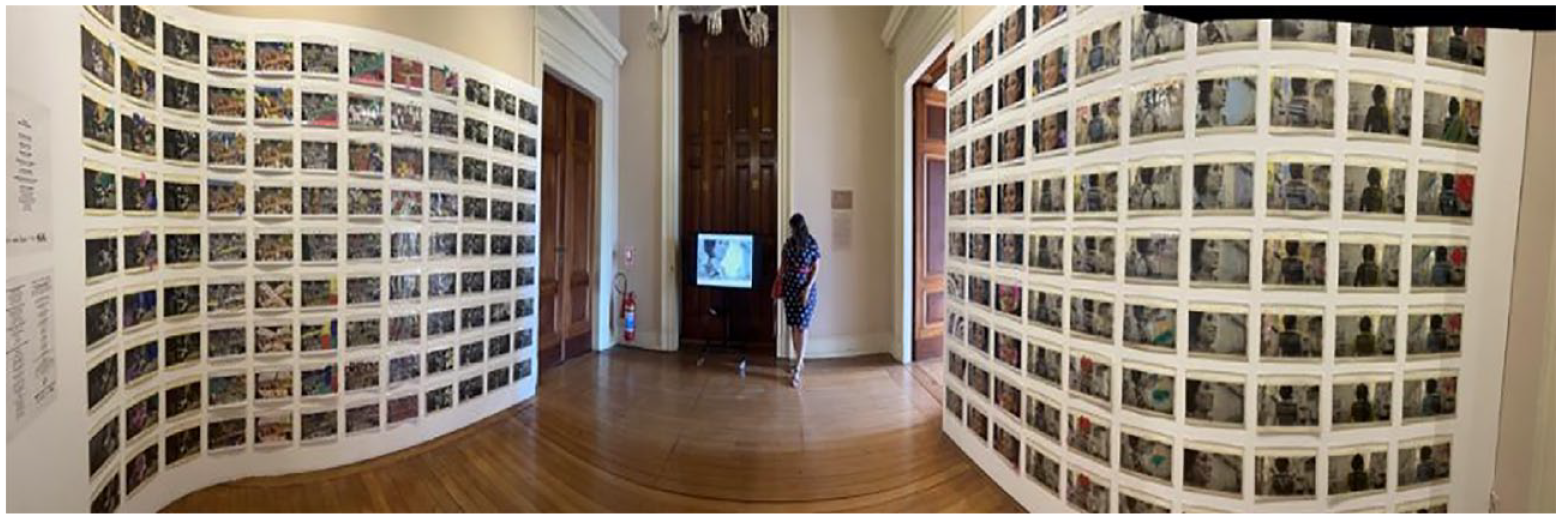
The exhibition ‘Marielle, Marés’ at Museu da Republica, featuring the animation ‘Portrait of Marielle’ and a sample of the 900 frames used to create it, Rio de Janeiro, August 2023.
In conclusion, the dialogical aspects of these experiences manifested as follows: a debate at Museu da Maré transformed into an animation workshop, an animation workshop transformed into an animated film and an artistic installation/exhibition, the artistic installation transformed into a much larger installation, and this transformative cycle is likely to be continued into further transformations that we cannot even predict. Here, it is interesting to note that some of these creative artefacts were produced after the eVoices project was completed. In a way, it is as if these artefacts’ dialogical properties – expressed in multiple assemblages of media territories (Tosoni and Tarantino, 2013) – acquired a life of their own.
Limitations and lessons learnt
The experience described in this article, although transformative in many different ways, does not come without limitations, which are worth to mention as they informed our subsequent research practice.
First of all, the eVoices project was a short-term project of 12 months, so once the dialogical space between activists in Nairobi and Rio de Janeiro was established, the project funds run over and we did not have the resources to promote it and consolidate it within the boundaries of the project. Nevertheless, we kept the connection with the young activists involved in the project and we keep looking for venues of dialogue and exchange in international events. For example, within the last Media Education Summit, that took place in Vancouver in 2023, we have organised a hybrid round table, connecting participants of the workshop with artivists in Salvador who participated in a similar animation workshop led by Ng’endo Mukii and supported by the Goethe Institute.
Another related limitation relates to the fact that young activists on the two sides of the ocean were not able to meet during the lifespan of the project. Both Kenyan and Brazilian artivists felt this issue and expressed the desire to be able to have the possibility to connect also in presence. This was not possible for time and financial constraints, but we have learnt to always factor in our following research bids this important element of exchange.
Finally, language was certainly an issue that hindered a more direct and less mediated connection between the two groups of activists; these are not easy issues to solve in international and multicultural collaborations and initiatives; in this project we used animation as a methodological tool to overcome this barrier and shape a common language made of music and images and a resonating story beyond the linguist competences of the people involved.
Concluding thoughts
In this article, we have demonstrated the ways in which the fields of artivism and media literacy could be explored in consonance. Creative media practices have emerged as tools for fostering South-to-South solidarity between young artivists in Brazil and Kenya. This happened when a sense of collective loss was nurtured by Kenyan artivists’ making of an animated film about Marielle Franco. As these creative practices created a sense of bonding across the South(s) in Brazil and Kenya, the capabilities enabled by the and the consequences of media literacy went beyond instrumental aspects such as learning technical media skills. They included deeply affective dimensions, which are often neglected, in the media literacy field. The concept of ‘dororidad’, (Piedade, 2017) becomes useful here. The term results from the merging of the words ‘do’, (pain, in Portuguese) with ‘sororidad’, (sorority). According to Piedade (2017: 160), ‘dororidad’, contains the shadows, the emptiness, the absence, the silenced voices of those who are vocal against marginalisation as it was the case with Marielle and many other human rights fighters in Brazil, Kenya, and other countries. This ‘dororidad’, reflects the artivists’ acquired media literacy capability to empathise with each other across the Souths. It also brings media literacy consequences in terms of experiencing, imagining and identifying other pains and the pains of others that the workshop participants/film makers have not directly felt. This sharing of ‘dororidades’, we argue, allows for relation building across Souths and inequalities.
Artivism, with is aeffective capabilities (combining affect and effect) enhances our understandings of media literacy, leading the latter into pathways that are connective and affective rather than solely instrumental and/or geared towards solving media ecosystem problems. To put it simply, as it emerges as a consequence for media literacy, artivism can enhance the latter’s transformative properties, connecting them to an agenda of social justice and social change that is infused with ‘dororidade’ (Piedade, 2017). In this way, media literacy becomes more than a field: it becomes a living concept, one that is explicitly political, infused with pain, but also with transformative possibilities and healing. As it happens in an animation, when young people learn and make media creatively and empathetically, drawing from a shared story and history of marginalisation, this has transformative consequences. Such consequences include the connecting and linking of plural knowledges and experiences, which, just as it happens in an animation, produce integrated sequences, come into motion and, in a moment of shared grief, come to life.
Thus, we can conclude that artistic media literacies had transformative consequences, enabling Brazilian and Kenyan artivists to establish empathic dialogues about state violence and inequality in both countries. Given the language barriers, animation and artistic installations emerged as methodological tools and as a common language for these dialogues (and transformations). As we demonstrated earlier, the music, the images, and Marielle’s life story were able to strike a chord on people affected by issues of marginalisation, inequality and injustice in both countries, whether people spoke Swahili, English, Sheng or Portuguese. However, given the countries colonial legacies, which have historically fostered unfamiliarity about each other’s suffering and struggle in both the African and Latin American continents, we must admit that such dialogues are hard to operationalise and to sustain. However, just as it happened with the black Brazilian female politicians elected, here, some seeds of dialogue were planted as transformative consequences within contexts of acquiring, fostering and expanding media literacies.
Footnotes
Funding
The author(s) disclosed receipt of the following financial support for the research, authorship, and/or publication of this article: This work was supported by the UK Arts and Humanities Research Council (grant number: AH/R003785/1).
