




Abstract
According to the national framing of the Swedish preschool system, educators are expected to act as mediators of the dominant language while simultaneously promoting multilingualism. Previous research shows that educators display an insecurity as well as a lack of knowledge of how to implement this dual undertaking. This article examines educators’ dual undertaking of linguistic diversity (changeability), on the one hand, and a national standard (stability) on the other, based on ethnographic data from three preschools with socioeconomic differences. The data are analysed employing concepts from pedagogic theory and linguistic diversity. Bernstein’s competence model with weak classification and framing accommodates translanguaging, giving room for the children’s own linguistic initiatives. Translanguaging is understood from a local as well as a global perspective; the local is based on global norms and global norms relate to local practices. The results show that educators support children as linguistic and multilingual beings. Unlike previous studies showing that middle-class children benefit from the competence model, this study shows how children with different socio-economic backgrounds benefit from the competence model. The diversity of language practice in Swedish pre-schools has the potential to create opportunities for new forms of agency and identity for children.
Introduction
In everyday pedagogical practice in a Swedish pre-school an educator asks a child ‘Can you teach me a little Urdu?’ This is one empirical example in which an educator handles linguistic diversity by inviting a child to teach him some expressions in a language (Urdu) that he himself doesn’t command. In so doing he creates a space where the child is viewed as an expert and there is a weak framing of the roles where the outcome of the activity is not predefined in time and space (Bernstein, 2000). We interpret this as the educator adopting a translanguaging stance (García et al., 2017) in pedagogical practice (Bernstein, 2000). A translanguaging stance refers to the educator’s belief that the inclusion of children’s linguistic experiences and competences benefits their language acquisition and learning. Bernstein (2000) defines pedagogic practice in a broad sense to include a fundamental social context in which cultural reproduction takes place.
In a Swedish pre-school setting, the educator from the example above is expected to function both as mediator of the national language (Swedish) and, at the same time, promote multilingualism. This dual undertaking, to provide children with different linguistic backgrounds access to both the national language and their mother tongues (Curriculum for the Preschool, Lpfö18) is often presented as difficult and challenging for the educators. Some studies show that they feel insecure about how to support children’s language development (Åkerblom and Harju, 2021; Björk Willén, 2018; Straszer et al., 2020). Other studies show that education in multilingual contexts is bound to convey tensions between norms of monolingualism and multilingualism (Daugaard, 2022; Jaspers, 2022). According to Jaspers (2022), much research either focuses on critical discourse analyses showing that teachers either practise a monolingual norm or ‘praise’ multilingualism. However, in actual fact, educators are bound to navigate different and often contradictory discourses and language norms brought to school by children, parents and politics etc. Thus, educators do not merely suppress children by forcing monolingualism on them or celebrating multilingualism. Rather, they navigate between different language norms.
When pre-school educators, like the one from the example above, view children as experts, they create a weak framing of roles and refrain from predefining the outcome of a pedagogical activity. In other words, they actualise what Bernstein (2000) has labelled the competence model. Previous research (Catucci, 2021; Smith, 2019) argues that this competence model mainly benefits children from middle-class backgrounds. However, as shown in this article, this is not necessarily the case.
This article investigates how pre-school educators handle the dual undertaking of goals for the Swedish ECE in pedagogic practices situated in the tension between local language practice and globally constructed ideas of language as distinct and separate entities. Linguistic diversity is seen as a translanguaging language practice rather than with a focus on languages as delimited entities (García et al., 2017). We are interested in the framing of the pedagogic practice. Framing, in the article refers to the ‘controls on communication in local interactional pedagogic relations’ (Bernstein, 2000: 12). Although the dual undertaking is likely to create tensions between norms of monolingualism and multilingualism, educators may also navigate different language norms as an unproblematic aspect of their professional duties in everyday pedagogical practice. We show how educators take on the role as the primary agents in recontextualising current language policies and pedagogic theory into learning processes, because educators’ ways of framing the pedagogic practice is crucial to children’s language acquisition and learning.
Globally circulated ideas and norms of how language education should be understood and practised influences local language practices. When local language practices in preschool can be characterised as linguistically diverse, as in our case, we need to analyse it from a global perspective, and to understand global ideas and norms of language we need to study different local practices. Therefore, we view local and global language practices as two sides of the same coin. The global aspect relates to the embeddedness of language in culture, society and nation, and connects with political and moral interests which have their basis in European Enlightenment nation-building and national language becoming the starting point for standardised definitions of language (Pennycook, 2010). Thus, rather than contrasting global and local aspects of language practice, in the article, we view language as comprising local practices that need to be understood in the context of more global epistemological, political and socio-historical developments. Inspired by Pennycook (2007), we refrain from treating language as delimited entities and, instead, focus on translanguaging practices. We believe that the translanguaging practises the educators of our study create in everyday pedagogic practices illustrate a promising pathway to enhancing young children’s language acquisition and learning.
This article aims to investigate educators’ dual undertaking of relating to linguistic diversity (changeability), on the one hand, and a national standard (stability), on the other, in order to create opportunities for children. This aim requires analytical sensitivity to how global and national language norms intertwine in everyday preschool practice. Drawing from ethnographic data in three preschools in Sweden, we ask:
How do preschool educators navigate linguistic diversity in pedagogic practice, and how does that practice create space for children’s multilingual languaging?
Data are analysed through the lenses of both theory of pedagogy and language in order to connect the level of local language practices to language diversity at the global level. The combination of the conceptual frameworks of translanguaging (García et al., 2017; Wei, 2011) and the competence model (Bernstein, 2000) are well suited to the investigation of how pre-school educators navigate linguistic diversity, including multilingual and monolingual norms in the framing of the pedagogic practice. This dual theoretical lens enables us to both address language as social practice and focus on how educators can create educational opportunities for children.
The article shows how everyday pedagogic practices convey linguistic diversity through the use of competence models that entail a particular social logic emphasising difference rather than deficit of language use (Bernstein, 2000). We argue that the way educators navigate conflicting language norms with a competence model approach strives to minimise inequalities and deficit perspectives of multilingualism. The article contributes to previous research by indicating the similarities in how children from diverse socio-economic backgrounds benefit from the competence model. Below we present research in ECE that examines the ways in which social difference and inequalities are constructed and relayed in pedagogic practice.
Competence model prevalent in early childhood education
Bernstein’s theoretical concepts have been applied in previous research to critique pedagogic practices that tend to reproduce social inequalities. This research has to a large extent focused on the negative effects of dominant norms and assumptions underlying pedagogic policy and practice (Neaum, 2016). Assumptions about the type of child and what kind of childhood is considered desirable are not openly stated but constructed and conveyed in the pedagogic practices and communication with children and families (Brooker, 2003; Emilson and Johansson, 2009; Smith, 2019). These expectations of children are unstated but have been shown to be disadvantageous in their effects (Brooker, 2003). Research shows that assumptions and norms about the ideal child and appropriate pedagogic practice exacerbates social inequalities and deficit perspectives of working-class and minority children and families (Brooker, 2003; Palludan, 2007; Smith, 2019).
Bernstein’s (2000) pedagogical models of competence and performance can both have advantages and disadvantages (Brooker, 2003). The competence model foregrounds child-centred pedagogy, exploratory play, social relations and self-regulation. Performance models, on the other hand, foreground acquisition of official knowledge through imitation, copying, memorisation and repetition in relation to pre-established learning criteria (Brooker, 2003; Neaum, 2016). Children who attend pre-schools in which the pedagogic practice is characterised by a competence model have the advantage that they can recognise and manifest their own learning and development through self-regulated activities. Some studies show that the competence model has benefitted middle-class children and families who already practise the ideas of children as agentic and constructing their own knowledge (Catucci, 2021; Smith, 2019).
Drawing from this previous research, the article accounts for how pre-school children can manifest their linguistic ability and knowledge about language when encouraged by educators. Children from both middle class and working-class socio-economic areas can benefit from pedagogic practice that aligns with the competence model. In alignment with the previous research and Bernstein’s theory, we examine the tacit preferences embedded in the pedagogic practice and how this plays out in different socio-economic contexts and varying degrees of linguistic diversity.
Theoretical preliminaries
First, the competence model is described with reference to Bernstein and then how pedagogical translanguaging is used in the pre-school’s everyday language practice.
Competence model
Overall, we employ a sociology of knowledge perspective to exemplify and interpret how educators create and construct multilingual practices in which the competence model, that is, the social logic underlying the way knowledge and social relations are organised, both relate to local and global language practices. Our analyses draw on the concept of the competence model (Bernstein, 2000). While a performance model focuses on results and what is missing in children’s behaviour or knowledge, the competence model foregrounds what children can do, what knowledge and how children are tacitly guided by educators to actualise these skills in the moment of different pre-school activities. The competence model encourages children to be self-regulating and there is a healthy scepticism towards hierarchical relations and overt positional control. This enhances differences rather than deficits. This results in learning content and contexts which are child-centred and, building on children’s interests and perspectives, strives towards individual empowerment and is evaluated in relation to the individual’s personal development.
The competence model is characterised by weak classification and framing of knowledge and skills. Classification refers to the degree in which categorisation, demarcation and the separation of knowledge occurs. Framing refers to who controls what in the social relation, the punctuation of time, and the use of materials in physical space. According to Bernstein the competence model in the liberal/progressive mode works towards individuals’ social and cognitive empowerment by way of ‘similar to’ relations that are seen as located within the individual and refer to commonalities that all individuals share. The liberal/progressive mode is constructed on the idea that all people share a common humanity and opposes repressive forms of authority.
Bernstein’s pedagogic theory is useful for understanding how pedagogical philosophies and policies compete for symbolic control of learning spaces and in doing so are able to shape and transform the consciousness, dispositions and desires of young children. This approach is interesting because it helps us understand what principles guide the pedagogic practice and the educator’s actions in the classroom from a nuanced perspective of social and language practices employed by early childhood educators in the Swedish context.
Linguistic diversity and translanguaging stance
Our analyses address linguistic diversity among multilingual as well as monolingual speakers in the pre-schools, but with a focus on how educators take a translanguaging stance in the pedagogic practice. Along with the multilingual turn (May, 2014), based on a view of language that emphasises changeability, linguistic diversity is understood in contrast to perceptions of language as something stable. Linguistic diversity thus becomes an ideological issue. Wedin and Rosén (2021) emphasise the ideological stance of the standard language concept that is based on a monolingual norm that distinguishes between what is designated as normal and what is deviant. In a society with increased mobility the dominant language paradigm is based on European notions of nationalism and colonialism (Wedin and Rosén, 2021: 4–5). Based on this language-ideological tension we use the concept of translanguaging.
The term translanguaging was originally used to describe everyday language practices among multilinguals (Baker, 2001) and for a specific view of language as activity or practice, languaging. However, Wei (2011) argues that translanguaging can be used as a theory of language practice; that is, to analyse what is going on in practice. This study focuses on the pedagogical direction of translanguaging connected to how languages are used in a pedagogical practice by educators. Translanguaging pedagogy (García et al., 2017) contains three dimensions: ‘stance’, ‘design’ and ‘shift’. Stance refers to the educator’s fundamental understanding that children acquire and use language through languaging practices in which they draw from their entire linguistic repertoire to learn and develop. Thus, education must draw from the children’s various linguistic experiences and resources as a resource in education. In brief, design refers to how this is organised in teaching practice and shift refers to the educator’s pedagogical judgement in relation to stance and design, as expressed in the actual moment of teaching. Our analyses mainly focus on stance.
Åkerblom (2011) highlights the concept of languaging to make visible the open and dynamic side of language and she emphasises the actual use of language that includes meaning making and the shaping of experiences (see also Lundqvist, 2015). Pedagogical translanguaging is a worldwide research field and includes a plethora of terms in the scientific literature. According to Juvonen and Källkvist (2021), the pedagogical concept of translanguaging is about teaching methods that involve intentional and planned use of students’ multilingual resources in language and content subjects. Thus, pedagogical translanguaging begins from a language-ideological stance on the social justice agenda we consider in our analyses. Besides the focus on social practice, when it comes to combining Bernstein’s competence model and translanguaging as a theory of language practice, translanguaging is characterised by weak classification and framing of languages.
Monolingual and multilingual language norms are inscribed in the national curriculum as well as in the social practice of Swedish pre-school practice. Norms are embedded in the selection of the content and in the regulation of the social order. We will analyse how educators and children’s interaction can be understood as examples of the competence model which facilitates multilingual and monolingual norms conjunctively. Bernstein’s understanding of the competence model allows for ambiguity at the level of knowledge and social relationships to coexist (Bernstein, 1975).
Methodology
Research setting and participants
Falling within ethnography (Blommaert and Jie, 2020), this study draws on 3 months of fieldwork. Between 2019 and 2020, the first author conducted ethnographic fieldwork in three pre-schools situated in three different urban settings in Sweden. The pre-schools were selected for the study because they engaged in multilingual, intercultural or norm-critical pedagogy. We refer to the pre-school sites as Saturnus, Mercurius and Neptunus. In total, 20 days of observations were conducted at each pre-school for a period of 238 hours overall. Hence, there were many occasions in which the social and pedagogical practices of languaging were observed.
The data consist of observations in mixed age departments for children of 3–5 years old. Each teaching team consisted of at least one pre-school educator and two childcare assistants. In all there were five licenced pre-school educators, four childcare assistants and two substitute educators. Of these, two were male and nine females. Nine of the 11 educators spoke another mother tongue language other than Swedish. The languages spoken by the educators included: Arabic, Albanian, Bosnian, Spanish and German. Two pre-schools were in multi-racial, low-income socio-economic areas where over 50%–60% of the population have migrant backgrounds. The third pre-school was in a socio-economically privileged area where over 70% of the population can be racialised as white and native-born.
Data analysis
The analysis of the pedagogic practice was conducted with a theoretically driven analysis of language and social relations negotiated within daily routines and activities. The analysis occurred in four iterative phases using critical ethnographic analysis (Beach and Vigo-Arrazola, 2021; Carspecken, 1996; Thomas, 1993). The four phases of analysis pertain to the following: (1) data production and choice of analytical constructs, (2) analysis of raw data as to what is occurring in the present moment, distribution of power and control in the social relations, children’s self-regulation and initiative, (3) selection of critical events and translanguaging practices occurring in the competence model (Bernstein, 2000) and (4) primary results and conclusions drawn from the analysis. The examples, in this article, were selected to illustrate how the educators facilitated multilingualism.
Ethics
This study has been approved by the Swedish Ethical Review Authority (2019-02363). Ethical principles recommended by The Swedish Research Council (Good Research Practice [God forskningssed], 2017) were implemented throughout the research process. All people and place names are pseudonyms.
Results
This section analyses how the educators navigate linguistic diversity, including multilingual and monolingual norms, in the pedagogic practice. Examples that are representative of ordinary everyday preschool practices frequently occurring at all three sites are analysed. We analyse examples from all the three preschools, beginning with Saturnus.
Preschool Saturnus
Of the 23 children who attend Saturnus, only one child has Swedish as her/his first mother tongue. The other children speak Swedish along with one, two or three other languages. English is also used extensively by children. The two Somali-speaking children are newly arrived at the school. Five children speak Arabic, one Albanian, five Bosnian, one Bulgarian, one Congolese, one French, one Gambian and English, one Hindi, one Lithuanian, two Romani, two Spanish, one Slovenian, two Somali and one Vietnamese. The staff comprises three preschool educators, a childminder and substitutes. Of the preschool educators, one is a native speaker of Bosnian. Two childminders are native speakers of Arabic. Others have Swedish as their mother tongue.
Below is a transcript of a video observation. There are five girls, Denice, Lindsey, Amy, Jane and Nancy (ages 4–6), painting, cutting and pasting in the craft room together. In the room there is also the regular substitute educator Heidi. Denice has recently returned to Sweden after spending time away with her parents in South America. Although she was born in Sweden, her Swedish is a bit rusty after being away for several months. This example shows how the pedagogic practice is characterised by weak classification and framing.
Excerpt 1
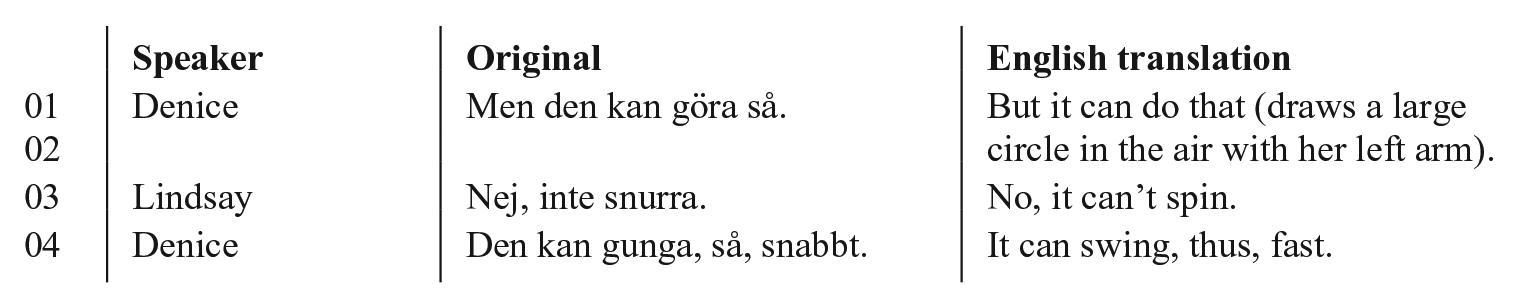
Excerpt 1 illustrates how Denice and Lindsey practise their language skills about their shared experience and continue observing and making other kinds of comparisons. The weak classification of the pedagogical practice is apparent in the distribution of power between the children. Weak classification in the pedagogical practice accommodates the children’s own initiatives of language development. The children have power and control over what type of language skill is actualised and how this language skill is being constructed. The children have freely chosen to participate in cutting and pasting in the arts and crafts room, and they have the freedom to carry out this self-selected activity in a manner that is within the norms and rules for this space. The children engage in a spontaneous conversation about swings. In lines 1–2, Denice says, ‘It can do that’, and draws a circle in the air. Lindsey responds with a correction (line 3). Denice then adds that ‘it’ can swing ‘fast’ (line 4). Lindsey understands that Denice is referring to a large type of swing set they shared earlier that morning. Denice is sharing with Lindsey her description and reflections of this experience. This activity allows the children to continue to reflect upon, practise their communication and develop their language about what has previously occurred. A moment later, the educator Heidi joins the interaction.
Excerpt 2
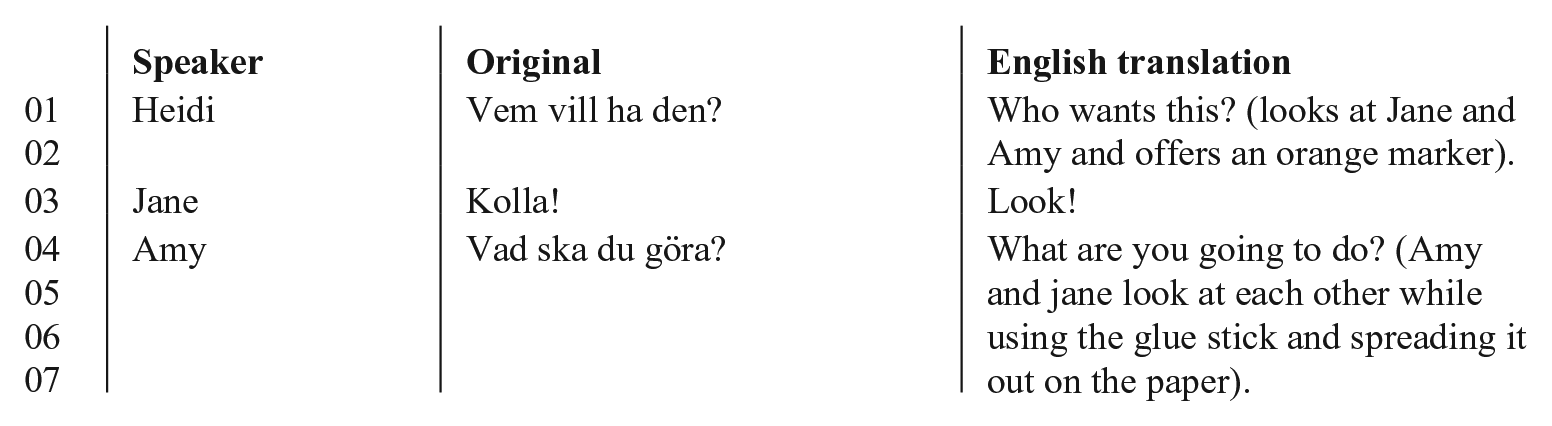
This excerpt shows the importance of the children’s spontaneous self-discovery. Jane and Amy (who are still sitting at the same table as Lindsey and Denice) focus on each other and on what they can do with the materials at hand. They ignore the educator’s offer of using an orange marker. Instead, Jane takes the initiative and uses the glue stick on her drawing. Amy asks what Jane is doing and imitates her behaviour by also applying glue to her drawing (lines 4–7). The girls are not explicitly instructed to use the markers or glue stick in any particular manner. Heidi does not admonish or interfere with the children’s glue stick use. Neither does she inquire any further into Jane’s discovery or interest with this method. In this excerpt, the competence model is illustrated in an activity that allows for the children’s own observations, creativity and discovery. The educator’s pedagogic control is subtle and indirect which can be seen as the educator’s signal to the girls to take further initiative in their questioning and exploration. Jane shares her discovery with the others. In doing so her personal reflections are acknowledged and reaffirmed. While excerpts 1 and 2 illustrate the competence model, the pedagogic practice in excerpt 3 conveys the navigation of linguistic norms. Below the children illustrate what they can do and Heidi indirectly assists in their actualisations of multilingualism.
Excerpt 3
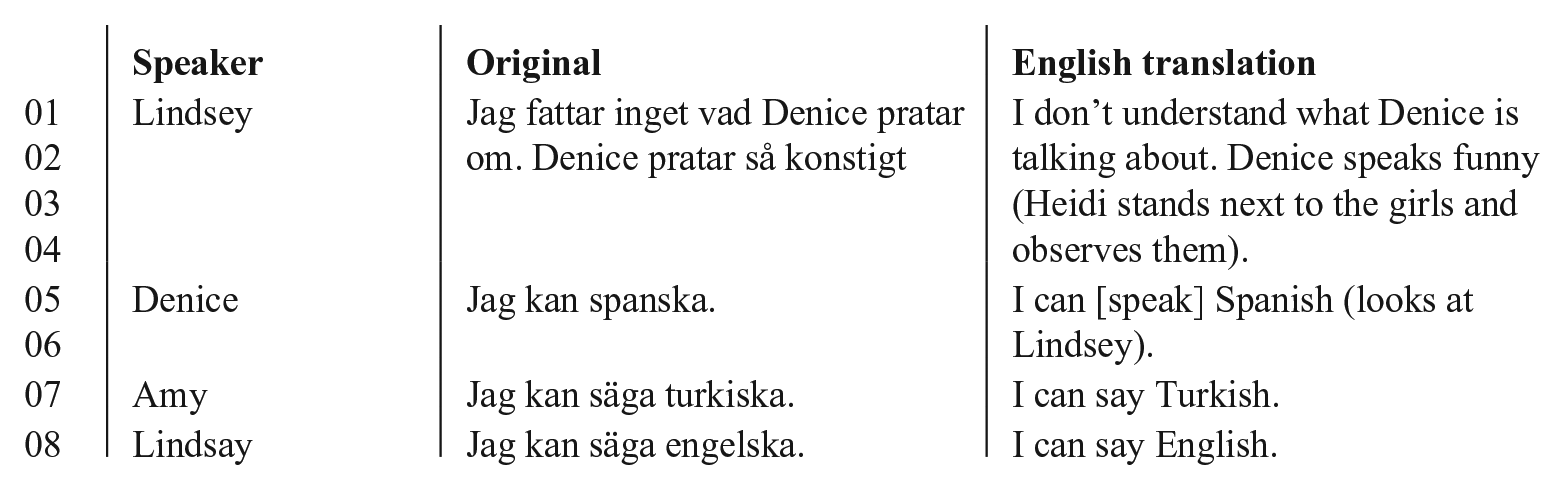
Lindsay’s comments on Denice’s speech as unintelligible and ‘funny’ can be interpreted as a pejorative evaluation on Denice’s ability to speak Swedish (line 1). However, Heidi does not intervene on behalf of Denice, nor does she admonish Lindsey. Denice asserts herself by acknowledging her own linguistic knowledge and skills (line 5). The lack of intervention and inaction on behalf of Heidi allows Denice to assert herself and explain to Lindsey that she is a speaker of Spanish. The educator’s emphasis on self-regulation in the pedagogic practice accommodates translanguaging by giving space for Denice’s assertion, ‘I can [speak] Spanish’.
Denise’s assertion can be seen as a reflection of the underlying assumptions of the competence model (Bernstein, 2000); that all people share a common humanity which is visible in ‘similar to’ relations within the individual and refers to commonalities that all individuals share. Translanguaging is a shared commonality that is given space in the pedagogic practice. Although Denice does not conform to monolingual normative standards of speech, she claims her rights and commonality as an individual who can communicate in a language that is not the dominant language. Denice’s assertion is then countered by Amy’s assertion that she can ‘say Turkish’ and Lindsey who can ‘say English’ (lines 7–8). The way that Amy and Lindsay speak about language could be interpreted as they focus on the activity of using a language. Thus, norms of multilingualism are encouraged and legitimated through translanguaging practices. In the following seconds the children continue to acknowledge and affirm multilingualism as both a reality and a source of contention.
Excerpt 4
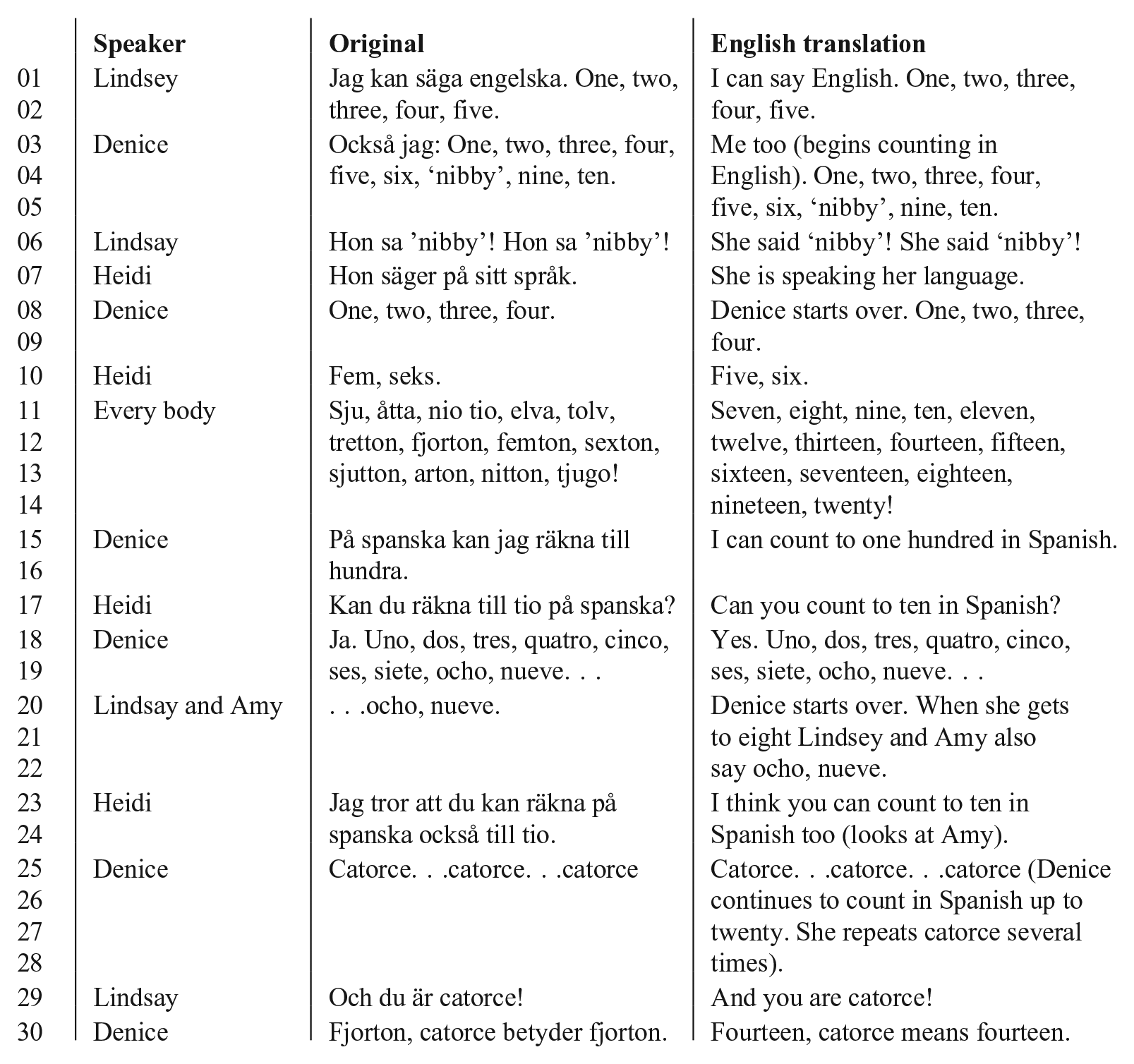
In response to Denice’s assertion as a Spanish speaker (excerpt 3), Lindsey begins to demonstrate her ability to count in English (line 1). Denice chimes in but makes a mispronunciation, ‘nibby’ (line 4). Lindsey is quick to point out Denice’s pronunciation (line 6). Heidi responds to Lindsay by allowing for linguistic differences ‘She is speaking her language’ (line 7). This somehow reflects an understanding of language as a phenomenon linked to a person. Although ‘nibby’ is neither correct for the English or Spanish word for eight, Heidi maintains a space for differences and variations of language. Thus, the educator takes a translanguaging stance. This stance is in alignment with the competence model which focuses on differences, not deficits. Thereby, Heidi invites the children to draw from whatever linguistic resources that comes to mind without expecting them to belong to certain languages.
Denice is not deterred and begins counting in English again (line 8). This time Heidi chimes in on number five as do the other girls, Amy and Lindsey, who collectively reach a joyous climax of 20 (lines 11–14). The competence model accommodates translanguaging in the pedagogic practice through active interest and support of the use of the girls’ spontaneous contributions, not at the request of the educator, or in measure to predefined external standards, but by the educator’s indirect pedagogic control and support of what the girls can say and do in the present moment.
Heidi’s comment facilitates a mutual comparison of language. Denice continues to assert her knowledge of language and numbers (lines 15–16). Noticeably, Heidi simultaneously affirms and defers to Denice’s counting ability by responding, ‘Can you count to ten in Spanish?’. This gives Denice a new opportunity to demonstrate her knowledge of Spanish and maintain the other children’s attention. Amy and Lindsey listen to Denice count in Spanish and chime in (line 20–22). Heidi affirms Amy’s attempt to imitate Denice. Denice continues counting but has difficulty when she gets to catorce (line 25). Lindsey offers an evaluation, ‘You are catorce!’. Denice clarifies that catorce means 14. Here it can be observed how weak classification and framing of the pedagogic practice allows for self-regulation by the children to observe and clarify their own language use and misunderstandings. Thus, the competence model opens for the children’s translanguaging practices.
In summary, these four excerpts illustrate how the children in Saturnus are mainly in control of regulating the conversation through their own personal contributions and reflections. The educator facilitates their contributions and subtly guides the conversation with questions that encourage and affirm the children’s linguistic and social competence. This is reflective of the competence model in that it focuses on what the children can do in the present moment. The pedagogic control is neither stratifying, demonstrative nor explicit. The weak classification contributes to the children’s consciousness as active agents who can contribute to a collective sharing and knowledge building and meaning making around diversity of language. Herein lies the opportunity and space for other, alternative forms of pedagogic practices, that is, translanguaging practices that are not clearly predefined or outlined in time and space.
Preschool Mercurius
The 21 children who attend Mercurius speak Swedish to varying degrees of proficiency and several other languages at home. The children’s languages spoken at home include the following: Albanian, Urdu, Abo, English, Turkish, Arabic, Somalian and Macedonian. The staff includes a licenced preschool teacher and two child minders. The staff members at Mercurius are fluent speakers of Spanish and Albanian. The following example includes Simon, the educator, and four children: Anja, Karen, Dolores and Hamid (ages 3–5). It is early afternoon and the children and Simon are seated around a large table. The children and educator are colouring with whiteboard markers on clear CDs which allow for illustrations to be quickly erased and redone. Dolores speaks to Simon in Albanian and a discussion about language arises. Original Arabic is transcribed into Italic Latin letters.
Excerpt 5
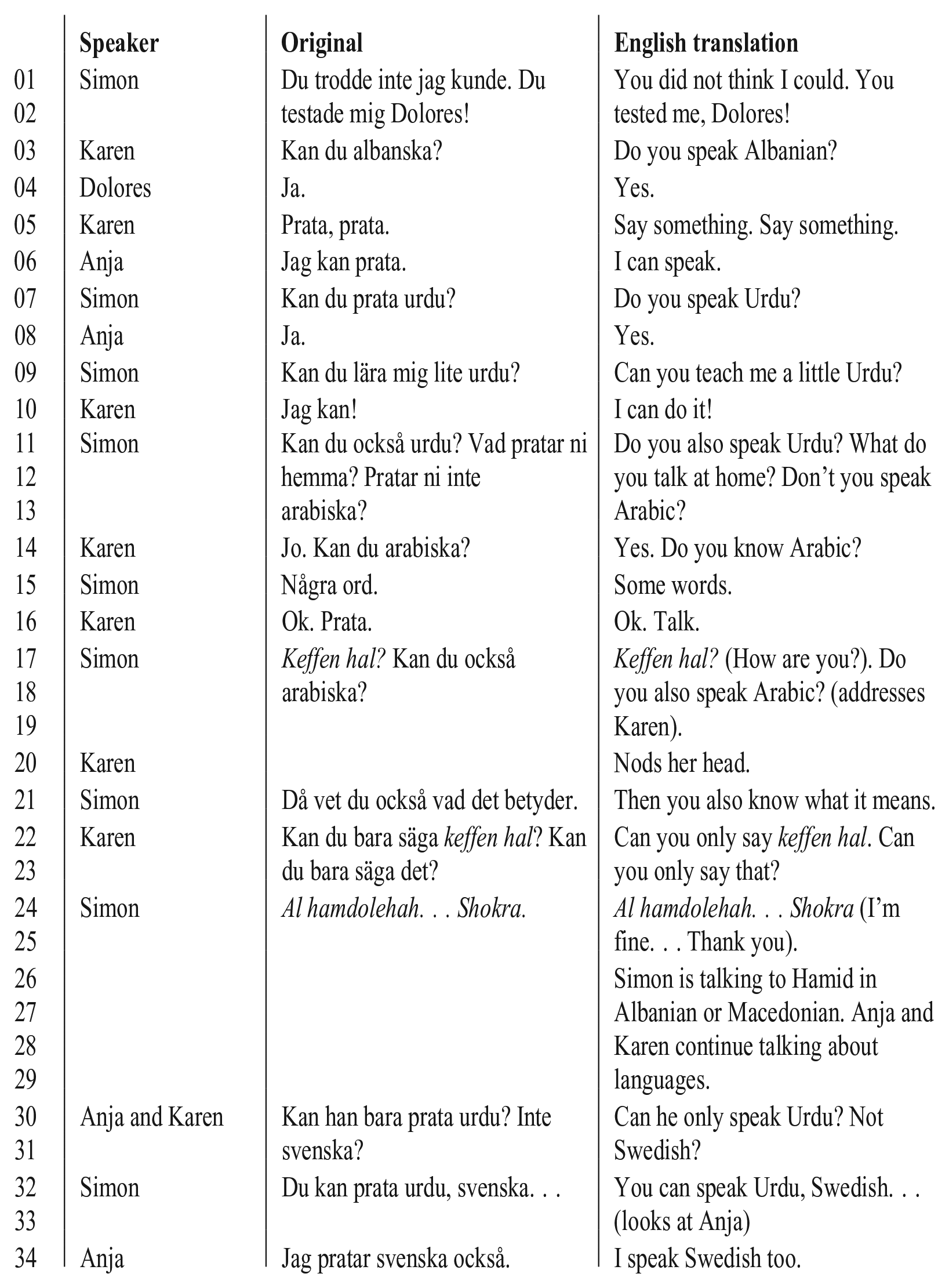
The pedagogic practice in excerpt 5 is characterised by the children’s voluntary participation in a collective group activity that does not require any specific product or skill. Simon facilitates an interaction that enables the children to participate with their interests and demonstrate social and cognitive skills through their contributions (lines 7–9 and 32–33). The children choose freely how they wish to engage or not engage in the conversation. The educator does not explicitly state the aim of the activity or explicitly regulate the children’s conduct or behaviour. How the children participate, what they produce and how they contribute is self-regulated. The realisation rules and regulative criteria are implicit. The pedagogical practice here accommodates translanguaging through the use of an open-ended activity.
The educator does not make any kind of explicit assessment or evaluations of the children’s performance. The children produce legitimate language use through their interactions, communication and participation in a social group activity that creates a space for them to develop their knowledge and skills about language and communication as social beings. In this communication the pedagogic practice supports and encourages the children to develop awareness and understanding of language diversity.
On the one hand, Simon expresses how one person belongs to one language (lines 11–13) and, on the other, does the opposite by speaking some Arabic words (line 17–19 and 24–25). He evokes an inclusive pedagogic practice by asking ‘could you teach me some Urdu’ and through this translanguaging stance he positions himself as the learner. The dialogue continues and Karen becomes the one asking Simon questions. How much Arabic does Simon really know? (lines 20–23). When Simon then switches to Albanian, the children continue to talk about languages. In the conversation between Simon and the children, it also becomes clear that there are different levels of language proficiency. Simon replies that he knows a few words of Arabic, not a complete command of the language (line 15).
Similarly, to the forgoing analysis of Saturnus, this excerpt also illustrates weak classification and framing. The selection, sequence, pace, time and space are not strictly punctuated or predetermined. The educator, Simon, facilitates and guides the children’s spontaneous sharing as valuable contributions in a collective construction of knowledge about linguistic diversity.
The dialogue also reveals that monolingualism is spoken of as knowing ‘only’ one language, in this case Urdu (lines 30–31). Then it turns out that Anja also speaks Swedish and thus another linguistic competence (line 34). Simon takes a translanguaging stance by introducing a positive attitude to language diversity. He draws from the children’s language skills to create a meta-linguistic understanding of multilingualism. Pedagogic practices that accommodate translanguaging are visible in the educator’s positive support and encouragement of the children’s contributions and understandings of language on a local level and that incorporate global diversity.
Preschool Neptunus
All the 17 children at Neptunus are native speakers of Swedish except for one newly arrived child who emigrated from another European country. Three children also speak another mother tongue than Swedish (Turkish, Arabic and Bosnian). The staff includes two licenced preschool educators, and substitute educators who are fluent in Swedish; two of whom also speak German and Spanish. Below is an example of a circle time conversation between the educator Camilla and two children, James and Samantha. In the following excerpt, an educator and nine children of ages 3–6 years participate. It is early morning and the participants have gathered for morning circle time which typically involves rituals of greeting and counting who is there, saying the day and date, going through the day’s agenda and other kinds of communicative activities such as singing and sharing.
Excerpt 6
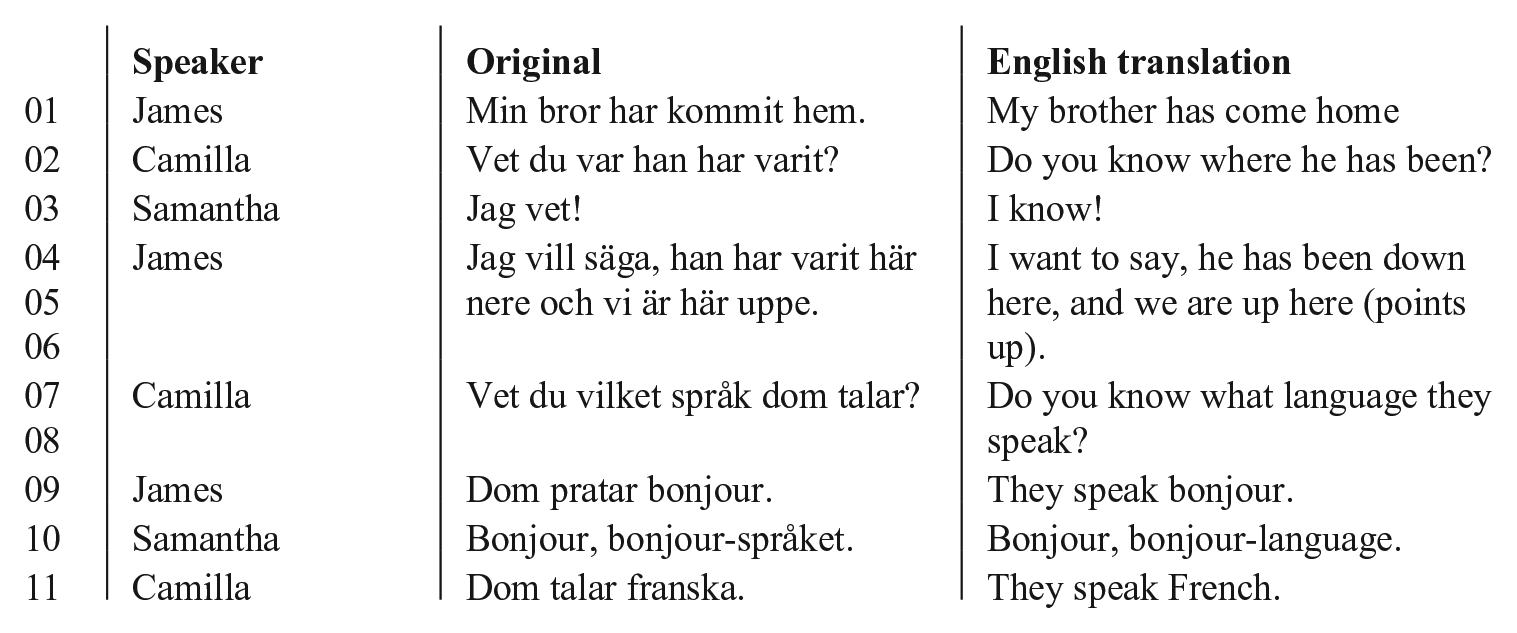
In this example, the pedagogical practice is characterised by weak classification and framing. The selection of events is structured through the daily routine of circle time. There is an explicit sequencing of events to the morning circle time communication. The children and educators greet one another and go through the day’s agenda. The pacing of events is led by the educator and shared in short turn-taking sequences with the children. The space in which circle time occurs is quite open and not used exclusively for circle time gatherings. In this instance, the physical space is used for a group activity, morning rituals and sharing. The focus of sharing is on current events.
James takes the initiative to share with the group about his brother’s homecoming. Camilla invites James to elaborate his narrative (line 2). Samantha indicates that she knows the desired answer (line 3). James shares his geographic knowledge by pointing to an invisible map in the air. He demonstrates his cognitive understanding of Sweden being ‘up here’ and the location of France as being ‘down here’. Camilla seems to understand what James is trying to say but does not correct or provide the precise terminology. Instead, she seizes the opportunity to initiate a conversation about language (line 7).
The educator’s question allows for James and Samantha to contribute with ‘bonjour’, a common word for greeting people in French. The children are given the opportunity to demonstrate and share their knowledge collectively. The emphasis here is on what the child can do, not what is missing or deficient. Pedagogic control is observed through the routines of time and space and the educator’s guiding questions. Camilla’s evaluation of the children’s contributions is not on the correct answer to the questions at hand, but rather on their social and cognitive ability to make a legitimate kind of contribution to the circle time activity, to listen to others, understand a question, make a reflection and provide an answer. Samantha contributes with ‘Bonjour, bonjour language’. After this brief exchange the educator provides the answer. Although there is a right answer, this communication and sequencing of events is less about the product (i.e. giving the right answer to the question) and has more to do with the child’s competence development as a social being. Camilla adopts a positive attitude and is aware of the linguistic capabilities among the children.
However, it is also possible to see her comments as a monolinguistic view of language as she defines language in singular (Do you know what language they speak? They speak French). The pedagogic practice accommodates translanguaging in the acknowledgement and interest in other languages other than the dominant language. Swedish is the national norm. Yet, viewed from a competence model perspective, the children’s perceptions, and awareness of languages other than Swedish are welcomed as significant. The pedagogic practice encourages the children’s perceptions and knowledge about languages, not just mastery of a singular language.
Conclusion and discussion
This article investigated how preschool educators navigate linguistic diversity in pedagogic practice and how that practice creates space for children’s multilingual languaging. We have seen how preschool educators handle the dual undertaking of language in the Swedish ECE situated in the intertwining of local (national) and global language practices and norms. The findings show that educators navigate both norms of monolingualism (local stability) and multilingualism (global changeability) in pedagogic practices characterised by a competence model. A monolinguistic norm is maintained when specific languages are connected to specific nations or persons. Yet, at the same time, the competence model enables a multilingual norm when children agentic acknowledge and affirm multilingualism as both a reality and as a source of contention. The low assertion of the educators’ positional power and control creates a space for the children’s own assertions and translanguaging as communicative social beings. Thus, the educators shape translanguaging spaces in the pedagogic practice which strengthen children’s languaging.
This article contributes to the international research on ECE and multilingualism by empirically accounting for how preschool educators navigate linguistic diversity through pedagogical practices in which monolingual and multilingual norms intertwine (cf. Jaspers, 2022). Moreover, we have seen how the educators created translanguaging spaces, in comparable ways, in pedagogical practice to the three pre-school sites, despite socio-economic differences. In all the cases, the pedagogic practices accommodate translanguaging through subtle, yet indirect control, positive support and encouragement of children’s own spontaneous initiatives and through freedom in the pedagogic practice to allow space for spontaneous, child-centred contributions and acknowledgement of the children’s languages that sought to include local and global diversity of language.
Our findings indicate that the dual undertaking of mediating the national language and multilingualism may serve as a catalyst for learning and socialisation for children from different socio-economic backgrounds, by employing the competence model. This result reaffirms Bernstein’s pedagogic theory that there are preferences and biases in the pedagogic practice which cannot be attributed to inherent characteristics of a social group (Chiang et al., 2021). The multitude of language practices in Swedish preschools have the potential to create opportunities for new forms of agency and identity formations in everyday pedagogical practices.
Footnotes
Author contributions
Osa Lundberg: Data production, conceptualisation, method, analysis, writing major parts. Ulla Lundqvist: Responsibility for organising the research dissemination and writing process, including writing together the text contributions in drafts and final version, conceptualisation, method, analysis and writing major parts. Annika Åkerblom: conceptualisation, method, analysis, writing major parts. Signild Risenfors: conceptualisation, method, analysis, writing some parts, commentary revisions.
Funding
The author(s) received no financial support for the research, authorship, and/or publication of this article.
