




Abstract
Leading in an early childhood education (ECE) centre is complex. Successful leadership is influenced by how leaders make decisions. This article illustrates how a contextual examination of the factors influencing leadership in an Australian ECE centre led to a research project focused on the centre director enacting distributed pedagogical leadership (DPL). DPL was facilitated through provocations, engaging educators in sharing and responding to practice, and resulted in the re-development of the centre philosophy. It also redefined the director's role in leadership. Motivation for change came from the director's passion for engaging with educators to think more deeply about practice and to increase willingness to share their pedagogical expertise. Critical participatory action research (CPAR) and the theory of practice architectures (TPA) guided the project. Two findings revealed firstly, the importance of DPL in transformative change and secondly, how provocations were tailored to support the development of educator pedagogical leadership, with the goal of re-developing the centre philosophy.
Keywords
Introduction
Leading for positive change is challenging in early childhood education (ECE) settings. The complexities of managing the daily running of services tasked with caring for children, engaging families, and ensuring that staff–child ratios are met, are significant (Nicholson et al., 2020; Kristiansen et al., 2021). Centre directors work in dynamic ways, connecting with children, families and educators, often blurring the lines between leading by keeping ‘things’ running, as distinctive to leading in a way that is connected to the leader's values and beliefs (Kristiansen et al., 2021; Schmidt and Mussman, 2023). This article provides an example of a regional Australian ECE centre emerging from COVID lockdown restrictions and shifting from surviving as a centre to serving children and families through a collective educator voice (Neilsen-Hewett et al., 2022; Stamopoulos and Barblett, 2018; White et al., 2023). The centre was awarded a ‘Meeting’ quality rating by the Australian Children's Education and Care Quality Authority (ACECQA) in 2023, which is the mid-point on a scale of five (the highest). Ratings are determined following assessment of the seven quality areas of the National Quality Standard (NQS) (Australian Children's Education and Care Quality Authority [ACECQA], n.d.). The project focused on connecting to Quality Area 1: Educational programme and practice and aimed at shifting leadership from a ‘crisis’ mode of responding to critical incidents to a combination of ‘innovative’ and ‘transformative change’ (Rodd, 2013: 186–187).
The National Quality Framework (NQF) sets the benchmark for quality in ECE across Australia, and seven areas are assessed by ACECQA (ACECQA, n.d.). The NQF includes the NQS, which outlines the standards and regulations. Within this framework, educational leaders guide and support educators in their pedagogical practices (Australian Government Department of Education [AGDE], 2022). The role of educational leader can be held by individuals who hold a Diploma or Bachelor qualification in ECE. The NQF does not specify years of experience, as it emphasises the significance of having relevant qualifications and expertise (ACECQA, n.d.). An educational leader's need for practical knowledge and leadership skills highlights the importance of experience in driving quality and innovation (Waniganayake et al., 2017).
The director, a Bachelor qualified ECE teacher, engaged with the educator team and a university researcher to plan and enact the leadership change. The director led a team of 40 staff, 4 of whom were Bachelor of early childhood qualified teachers, with the remainder an approximate split of Diploma of ECE and Certificate III in ECE-qualified educators. Their years of experience in the field ranged from recent appointments to 20 years. Educators worked in smaller teams of 3 to 4 educators with children aged birth to 20 months (Nursery), 20 months to 3 years (Toddler), and 3 to 5 years (Kinder). The number of educators in each team varied depending on full or part time employment. The research team (university academic and director) explored perspectives of ECE and leadership practice (Rodd, 2013) to identify how innovative and transformative change might happen (Davidson and Edwards-Groves, 2020). This included investigating policy, curriculum frameworks, recent research and practice, and the director's leadership practice at the service. The insights gained from this exploration were organised analytically according to the theory of practice architectures (TPA) as a framework for understanding practice (Gibbs et al., 2022). As a result, the research team identified provocations as a way to support the director to enact distributed pedagogical leadership (DPL). The DPL approach is focused on the intentional distribution of pedagogical leadership within an ECE setting, enabling collaborative professional learning and shared decision,making (Heikka, 2014; Heikka et al., 2021). Within the project, DPL encouraged educator pedagogical leadership (Fabry, 2024) by affording opportunities for educators to lead (Heikka et al., 2021).
Early childhood leaders increasingly recognise the importance of DPL in fostering innovative practice (Fonsén et al., 2023; Heikka et al., 2021; Yang and Lim, 2023). Various approaches to leadership in ECE have been explored, including distributed leadership (Heikka et al., 2013), DPL (Heikka et al., 2021), leadership as leading practices (Boyle and Wilkinson, 2018), early childhood curriculum leadership (Castner, 2020), organisational leadership (Davis et al., 2023), early childhood pedagogical leaders in schools (Fabry et al., 2022), pedagogical leadership (Fonsén et al., 2023), and leadership emergence (Gibbs, 2022). However little attention has been paid to context specific DPL and how it can be developed through intentional provocations and the collaborative engagement of educators. Collaborative engagement involves educators sharing their pedagogical approaches through critical reflection to improve practice.
Data reported here are drawn from a larger critical participatory action research (CPAR) project, a methodology through which participants collaboratively and critically investigate and transform practice within its context (Kemmis et al., 2014a). The article begins by considering literature that examines leadership in ECE. The methodology details how the TPA served as a framework for considering educator sayings, doings and relatings (Kemmis et al., 2014b) in conjunction with provocations, which were used intentionally to foster educator pedagogical leadership. The findings reflect how DPL was used for transformative change, and how educator pedagogical leadership was encouraged through the collaborative re-development of the philosophy.
Leadership in early childhood education
The literature concerning leadership is wide ranging and here we consider the complexity of leadership and DPL, followed by approaches that similarly emphasise change, including pedagogical leadership (Fabry et al., 2022), collaborative leadership (Halpern et al., 2021), and leadership emergence (Gibbs, 2020, 2022). Successfully transforming educational practice is entwined with contextual factors and requires careful consideration of both the practice landscape and the environments in which practice unfolds (Kemmis et al., 2014a). Leadership in such situations is complex and requires nuanced reciprocity.
Distributed pedagogical leadership
DPL emerged from the broader framework of distributed leadership (Douglass, 2019), which challenges traditional hierarchical leadership models (Heikka, 2014). As defined by Heikka et al. (2013), DPL in ECE encompasses five dimensions: ‘enhancing shared consciousness of visions and strategies between the stakeholders, distributing responsibilities for pedagogical leadership, distributing and clarifying power relationships between the stakeholders, distributing the enactment of pedagogical improvement within centres, and developing strategy for distributed pedagogical leadership’ (p. 80). The first two dimensions focus on building a shared vision within the ECE team, while ensuring leadership responsibilities are distributed appropriately across the organisation. The third-dimension addresses power relationships, emphasising the importance of clearly defining and refining power relationships to effect successful DPL. The final two dimensions deal with practical implementation and developing strategies for distributing pedagogical leadership. Together, these dimensions create a framework that promotes shared responsibility for pedagogical quality and continuous improvement (Heikka, 2014; Heikka et al., 2021).
Part of the process of leading is engaging all staff collaboratively so that DPL becomes integral to the culture (Waniganayake et al., 2017). Addressing power relationships is a necessary aspect of successful collaboration, and in this project focused on facilitating a willingness for educators to share their pedagogical practices as a way to work towards distributing pedagogical decision making. Other aspects deemed fundamental to change processes included affirming the differing levels of support and guidance needed by individual educators (Fonsén et al., 2023) and recognising that leadership involves providing scaffolds to support pedagogical practice (Fabry et al., 2022). Enacting DPL can include creating opportunities for educators to identify the value of sharing pedagogical practice (Fonsén et al., 2023) in safe workspaces (Heikka et al., 2021), which is part of building capacity and essential for developing relational communication and collaboration strategies (Gibbs, 2022; Fabry, 2024). Engaging in DPL can also build the capacity of educators to investigate their own practice and provide experiences where they can develop pedagogical leadership with different age groups and teaching teams (Fonsén et al., 2023). The challenge for leaders is to learn more about how to lead for transformation through leadership that connects all staff meaningfully (Heikka et al., 2021).
DPL (Heikka et al., 2021) was chosen because of its focus on pedagogy and practice, and the collaborative approach to sharing educational leadership, professional learning, and enhancing teaching practices (Yang and Lim, 2023). It can also support educators in justifying practice through shared inquiry and critical thinking (Waniganayake et al., 2017). When supported by intentional provocations, DPL may enable educators to collaboratively explore diverse possibilities of practice. As part of this, provocations can enhance peer connections and critical engagement with pedagogy (Gibbs, 2020). To enact meaningful DPL, leaders can examine the complexities of practice within their contexts, including educators’ varying perspectives and curiosity, and attempt to address power relationships by distributing decision making rather than directing educator thinking (Gibbs, 2020; Heikka et al., 2021). This approach is strengthened by leading practice, openness to sharing experiences, and facilitating communication and collaboration among team members as part of a ‘shared responsibility’ for pedagogy (Fonsén et al., 2023: 3). Overall, enacting DPL requires an informed understanding of pedagogical leadership.
Pedagogical leadership
Pedagogical leadership is defined as enhancing educational quality through professional learning and development that enables educators to critically reflect on their practice, engage in pedagogical discussions and collaboratively strengthen teaching approaches (Fabry, 2024; Fonsén et al., 2023). Leadership can emerge when educators critically examine their practice, challenge established beliefs and practice, engage with others in critical discourse, and enact change to strengthen pedagogical approaches (Fabry et al., 2022). At its heart, pedagogical leadership is driven by the goal of enhancing children's engagement and learning. Pedagogical leadership differs from traditional ideas of leadership in that it is a shared undertaking that succeeds through intentional collaboration and by drawing on collective expertise (Bøe and Hognestad, 2017). This context-specific approach acknowledges that meaningful collaboration must be thoughtfully structured to align with both operational realities and the professional growth of educators (Douglass, 2019). DPL was adopted to cultivate deeper educator engagement with pedagogical thinking and practice (Heikka et al., 2021). By intentionally creating opportunities for educators to exercise leadership in pedagogical discussions through provocations, the project aimed to value and activate professional knowledge within the large educator team. When educators are positioned as pedagogical leaders, they can make meaningful contributions to educational practices such as the re-development of philosophies, leading to richer learning environments for children (Fonsén et al., 2023).
Collaborative leadership and leadership emergence
Collaborative leadership is inclusive, team oriented and not restrained by hierarchies within an organisation (Vijayadevar et al., 2019). In Australia, collaborative leadership is a shared responsibility that involves collective decision making and enhancing professional knowledge (AGDE, 2022). Collaborative leadership engages and values diverse perspectives, recognising that leadership emerges through relationships and shared expertise (Heikka, 2014). Open communication, trust and shared accountability characterise collaborative leadership (Gibbs, 2025). Leaders cultivate environments where educators willingly contribute their insights and expertise to pedagogical discussions and decision-making processes. Collaborative leadership enables the development of shared understandings, collective ownership of educational outcomes and processes involved in leadership emergence.
Leadership emergence describes processes of developing leadership responsibilities (Gibbs, 2020). The focus is growing leadership through daily interactions, pedagogical decisions and providing professional growth opportunities. Leadership emergence is closely tied to educators’ developing professional identity and their growing confidence in pedagogical practice (Gibbs, 2021). It is evident when educators begin to recognise their capacity to influence practice, mentor colleagues and contribute to change. Leadership emergence is supported by specific organisational conditions (Yang and Lim, 2023) including opportunities for professional dialogue, critical reflection on practice, and engagement in collaborative decision making (Gibbs, 2022). Mentoring relationships and supportive professional networks that encourage educators to step into leadership roles are instrumental in supporting the emergence of leadership (Gibbs, 2020).
Distributed Pedagogical Leadership can create conditions where educators develop and exercise their leadership capabilities (Fabry et al., 2022). While collaborative leadership establishes a culture of shared responsibility and collective decision making, leadership emergence describes educator leadership practices (Gibbs, 2021). Together, collaborative leadership and leadership emergence support DPL, fostering environments where educators critically examine practice, contribute to pedagogical discussions and are involved in organisational change. Collaborative leadership creates the space and relationships necessary for meaningful pedagogical discussion, while leadership emergence provides a pathway for educators to develop leadership voice and capabilities (AGDE, 2022; Gibbs, 2022). Considering leadership in this way assists DPL, as educators become more confident in sharing pedagogical thinking, challenging and changing existing practices, and supporting leadership development (Heikka et al., 2021). The combination of these approaches recognises that leadership in ECE settings is influenced by the conditions in which it develops (Gibbs, 2022).
Transforming leadership and enhancing educator pedagogical practice were central to this research, which is why the TPA and CPAR methodology were adopted (Kemmis et al., 2014b). These approaches align with the transformative goals of DPL and its emphasis on creating change (Heikka, 2014). The TPA provided a framework for understanding how practices are shaped by cultural-discursive, material-economic, and social-political arrangements that enable and constrain what is possible within a given site (Kemmis et al., 2014b). These arrangements are present in the ‘sayings’ (how people understand and talk about practices), ‘doings’ (physical actions and resources) and ‘relatings’ (relationships and power dynamics) that characterise DPL. By examining these three interrelated dimensions, the TPA offers a lens through which to analyse how DPL is enabled or constrained by existing structures, while also identifying opportunities for transformation. The TPA framework (Gibbs et al., 2022) identified how educator practices related to developing pedagogical leadership were shaped, and how they could be supported through CPAR.
Methodology
The emphasis of CPAR is collaborative inquiry where researchers and participants engage in cycles of planning, acting, observing, and critically reflecting to examine and transform practices (Kemmis et al., 2014a). This collaborative approach was essential for understanding how DPL and pedagogical leadership practices were enacted within the setting, and for co-constructing new understandings that could lead to meaningful transformational change. The research team collaborated in communicative action (Davidson and Edwards-Groves, 2020), and in exploring perspectives of ECE and leadership practice to inform the research. While the project aimed for collaborative engagement, there were challenges such as varying educator participation and reluctance to share. These limitations were addressed through tailored provocations and ongoing director support, focused on addressing power relationships and scaffolding pedagogical practice. Constraints remained, including variations in qualifications and beliefs, limited time for collaboration, and educator reluctance to share ideas.
The research team maintained a digital collaborative research journal (CRJ) documenting all transcribed meetings, emails, notes, provocations, responses and photos. Researchers met weekly or fortnightly (in person or by Zoom), recording educator responses, pedagogical changes, and the centre philosophy's re-development through responses to the provocations. This documentation, led by the university academic and director with educator contributions, was continuous throughout the year. All educators contributed to the philosophy re-development, with engagement and response depth increasing as the project progressed.
The focus was refined when the team identified specific practices and arrangements operating at the service (Table 1). Through examining practice examples, the team identified three key dimensions: ‘sayings’ (the team's discourse and thinking about practice); ‘doings’ (the team's skills and capabilities); and ‘relatings’ (the team's emotional and relational connections) (Table 1). These dimensions were aligned with their corresponding arrangements: sayings within cultural-discursive arrangements (language and ideas), doings within material-economic arrangements (physical environment and resources), and relatings within social-political arrangements (systems and policy) (Kemmis et al., 2014b). Table 1 presents examples of practice shaped by these arrangements, illustrating how DPL is enabled and/or constrained by the conditions in which it occurs (Gibbs et al., 2022; Reimer et al., 2023). Some entries are framed as reflective questions, capturing the team's inquiry process, while others are statements drawn from observed or enacted practice. While Table 1 presents these elements in a structured format, it is important to note that the practices and arrangements are not linear; rather, they interact fluidly and recursively within the everyday complexities of leadership practice.
Examples of practice and arrangements (created by the research team).
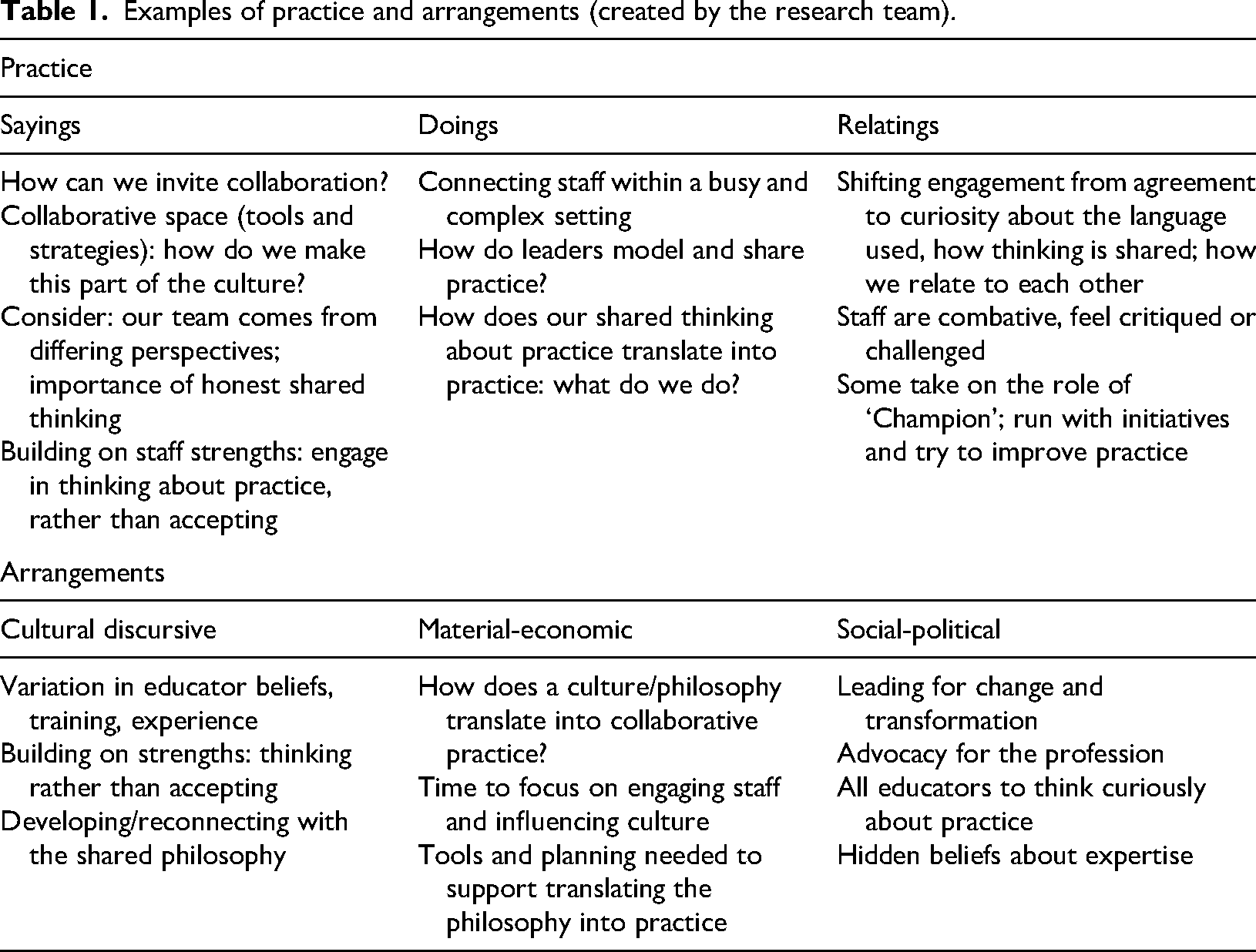
Building on the practice examples in Table 1, the research team used the TPA framework to identify how leadership practices were shaped by the interconnection of cultural-discursive, material-economic and social-political arrangements. The three types of arrangements work together to form the PA and shape leadership practice and represent the broader conditions that enable and/or constrain leadership practice (Kemmis et al., 2014b). Drawing on these arrangements, the team identified nine PA (Table 2), each reflecting specific enablers and/or constraints related to DPL. For example, one PA revealed educator reluctance to share ideas about practice. Initially seen as resistance, further engagement uncovered that this reluctance stemmed from a lack of confidence, shaped by variations in training, personal beliefs, values and assumptions. This deeper understanding of the arrangements shaping practice enabled the team to develop targeted strategies such as creating safe spaces for dialogue, valuing diverse perspectives, and revisiting the service philosophy collaboratively. Seven of the nine PAs were identified as constraints, and this analysis directly informed leadership decisions aimed at supporting meaningful change (Gibbs et al., 2022).
Practice architectures.
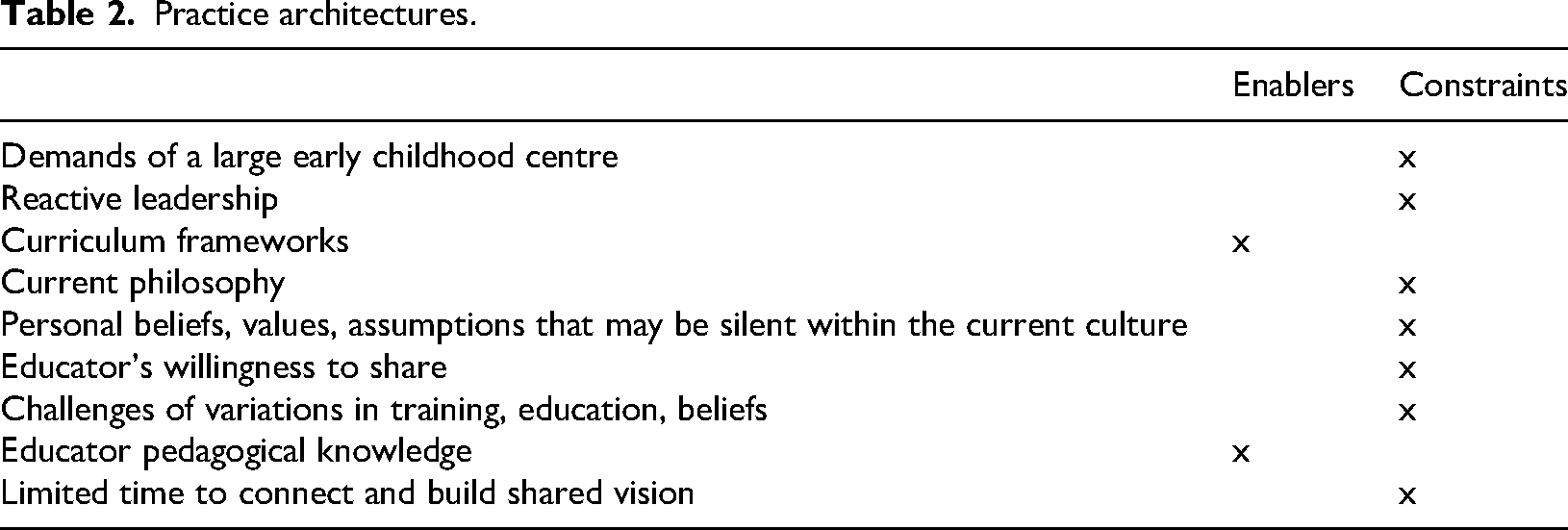
The practice and the PA informed the overarching research question: How do I lead to encourage educators to display courage and curiosity in collaborating, interpreting, understanding and actioning our philosophy? and the two sub questions: How can enacting DPL transform practice; and, How can provocations lead to thinking differently about how educator beliefs translate into practice? To address the research questions, strategies were adopted that could be part of everyday practice. The plan was to enact DPL by providing provocations that engaged staff in collaborating, reflecting critically and responding to practice, with a shared aim of re-developing the philosophy. Data collection focused on the director's use of DPL and its influence on educator pedagogical leadership. To this end, data drawn on here includes educator responses to provocations (Table 3 shows the provocations), and the CRJ kept by the research team over 1 year.
Provocations.
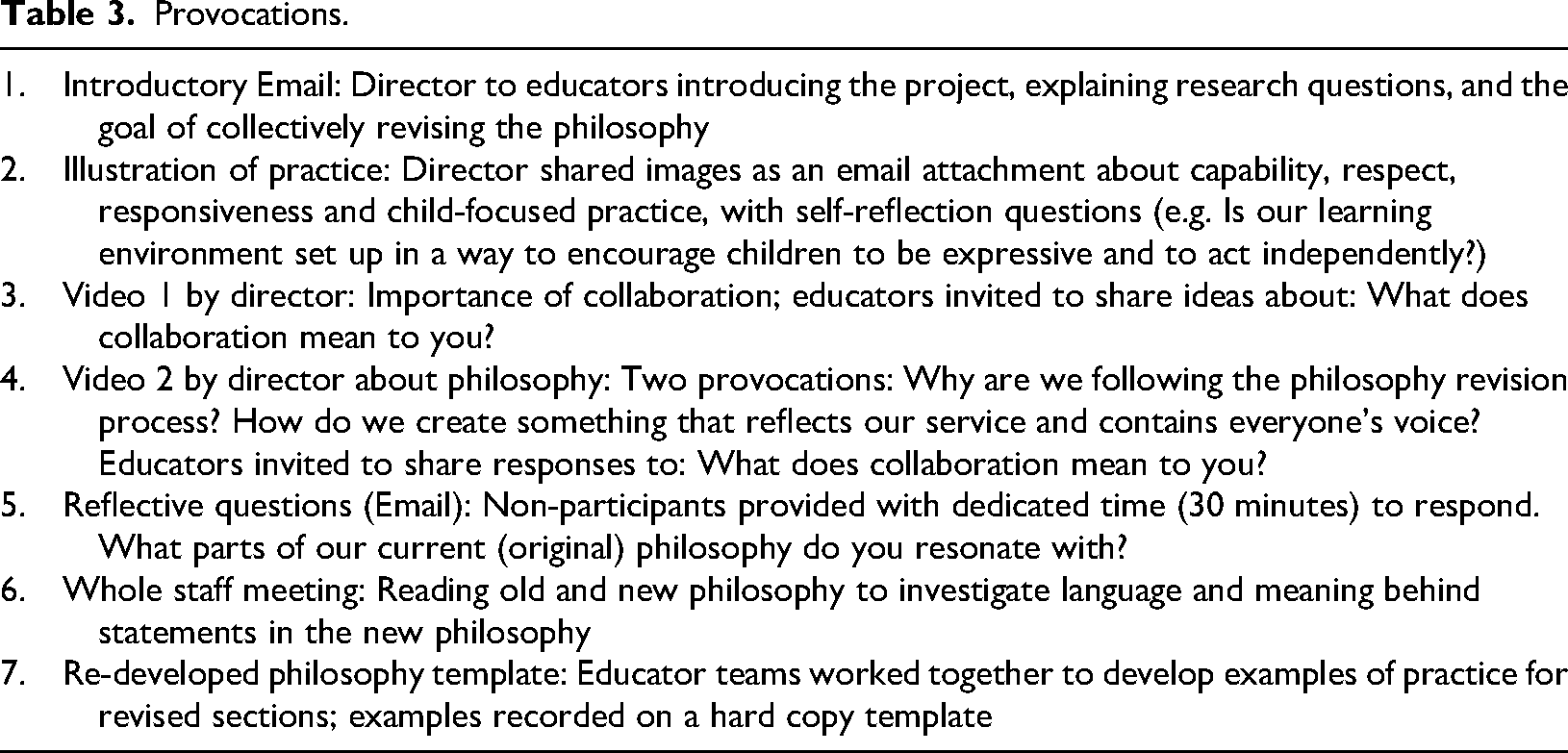
Provocations were shared with educators via email, video, in person and at a whole staff meeting. Educators responded using email, handwritten notes, conversations and images of materials developed. All data was transcribed by the academic researcher and stored in the CRJ. Analysis was informed by a five-phased process (Bingham, 2023; Table 4). Data was coded using inductive and deductive approaches, and detailed memo-ing (recording decisions, thinking and emerging ideas) occurred at each phase. Memo-ing guided the re-examination of data (phases 3 and 4), helping to review and refine the analysis. Documenting these phases provided transparency in decision making and identifying findings.
Phases of data analysis.
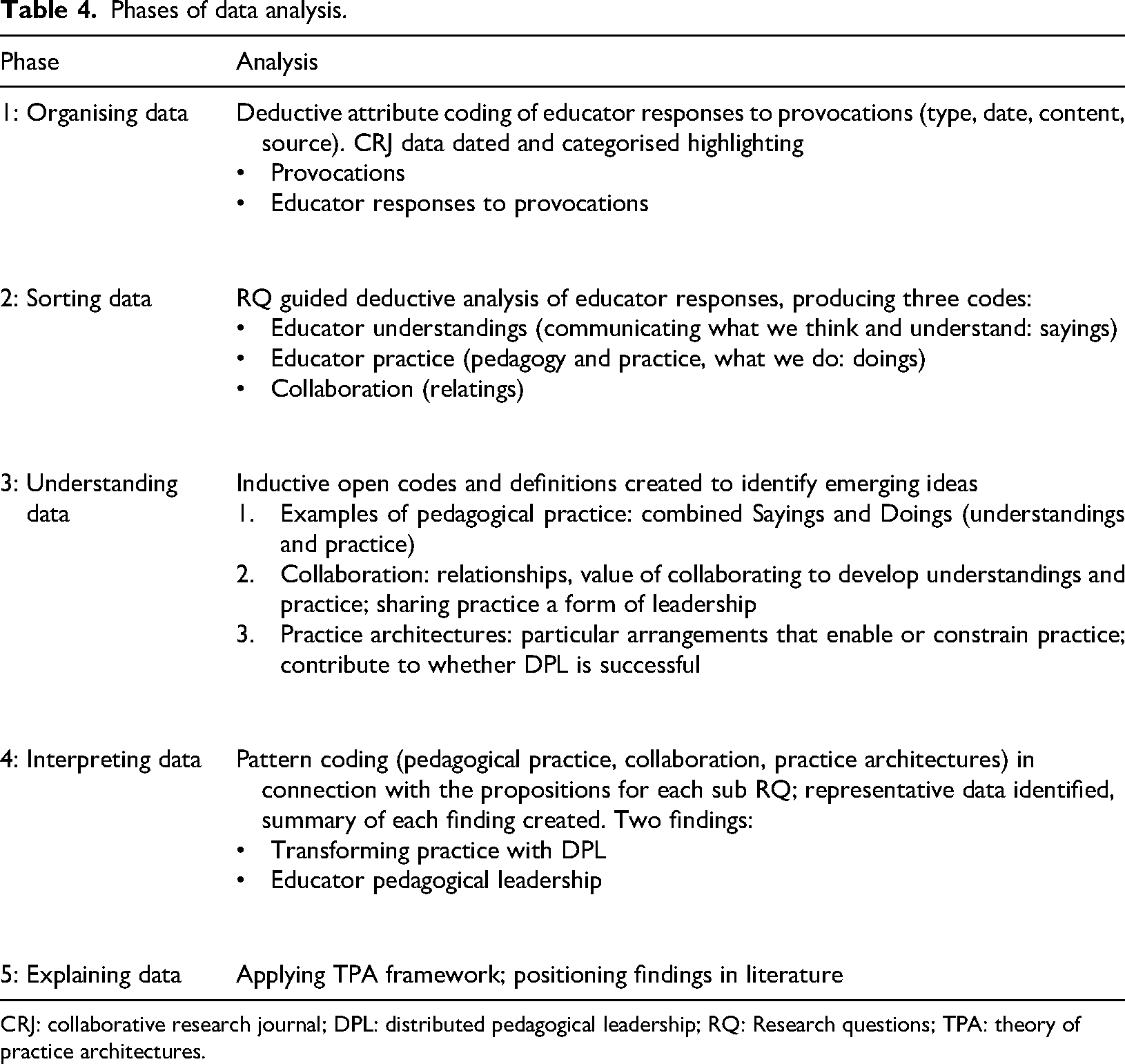
CRJ: collaborative research journal; DPL: distributed pedagogical leadership; RQ: Research questions; TPA: theory of practice architectures.
Findings and discussion
The two research sub-questions and the five dimensions of DPL (Heikka, 2014) (shared consciousness of vision, distributing leadership responsibilities, clarifying power relationships, pedagogical improvement and supportive leadership strategies), frame two findings. The first, Transforming Change with DPL, demonstrates the interconnectedness of the five dimensions as the director deliberately facilitated re-development of the philosophy. The second finding, Educator Pedagogical Leadership, focuses on how the provocations enabled responsibility for pedagogical leadership and pedagogical improvement (Heikka et al., 2021) to be shared as educators connected their beliefs (sayings) with practices (doings) through collaborative relationships (relatings) (Kemmis et al., 2014b).
Transforming change with DPL
Transforming practice with DPL addresses the research sub-question ‘How can DPL transform practice?’ and explains how DPL was enhanced through a multifaceted approach to connecting with educators; educators engaging in critical reflection, sharing practice, and trialling context-specific provocations. These findings emerged from analysing how the director employed interconnected strategies to enact DPL through initiating a collective goal of re-developing the philosophy.
The director established a shared philosophy goal, explaining the importance of educators contributing to the re-development of the philosophy. This can be seen in an excerpt from the first email from the director: Hello educators, I have recently embarked on a teacher as researcher project… investigating this question: How do I lead to encourage educators to display courage and curiosity in collaborating, interpreting, understanding, and actioning our philosophy? … The information gathered from your responses will form the core of our revised… centre philosophy. Our philosophy will highlight the guiding principles that we refer to in relation to every decision we make as educators and as a service… how we communicate … how we respond to challenging situations. The values we articulate in our philosophy will be driven from our shared understandings and beliefs about childhood and children. (1 September 2023)
To address initial limited engagement, the director refined her approach by demonstrating pedagogical leadership through providing concrete examples of practice. She shared her own ideas about children's agency, a matter frequently identified in the mandated learning framework, Belonging, Being, Becoming: The Early Years Learning Framework of Australia (EYLF) (AGDE, 2022), offering an example as part of Provocation 2: ‘I notice you are moving away from me, and your body language suggests you might want some space. Would you like me to come back in a little while?’ This example showed how the concept of agency can be part of everyday interactions with children. The message from the director was that by observing children and responding respectfully to their non-verbal cues, educators can support the development of children's agency, an important outcome in the EYLF and part of children developing a strong sense of identity (AGDE, 2022). Several dimensions of DLP can be discerned from this example: shared pedagogical leadership was evident when the director illustrated how children's agency can be respected; material-economic arrangements were demonstrated by establishing clear connections between the philosophy and practice; organisational leadership was demonstrated by establishing clear connections between philosophy and practice; and educational leadership emerged as the director articulated specific strategies such as the importance of input from all educators to re-develop the philosophy. The example initiated a discussion that aimed to build a shared vision about children's agency. Sharing in this way encouraged educators to engage in critical thinking about children's agency through discussion and questioning.
In line with the cyclical nature of CPAR (Kemmis et al., 2014a), educator responses informed provocations. Early engagement revealed limited responses, with the director noting a week after the first provocation was shared: ‘I…received reflections from one teacher’ (September 11). Later, it was obvious that some provocations resulted in more surface level responses, which presented as sayings (what we think and believe). For example, all responses to Provocation 5 were similar, repeating the language used in the provocation (Are there any parts of the original philosophy that you disagree with, would remove or do not understand?). Educator responses included the following (pseudonyms are used):
‘I feel as though our current philosophy states exactly what and who we are as educators and teachers along with our commitment to support children’. (Lily, October 2023) ‘I don't disagree with the philosophy’. (Thelma, October 2023) ‘I agree with all parts of the current philosophy’. (Natasha, October 2023)
These responses revealed a passive acceptance rather than active engagement with the provocation, highlighting the need for more effective DPL strategies to deepen critical reflection. This response pattern prompted the director to think differently about the purpose of the provocations. An example of developing strategies for DPL is seen in how the director reframed the provocations to provide specific examples (e.g. Provocation 4), encouraging greater engagement and modelling critical thinking by sharing her reflective thinking. Decisions were made to vary the communication methods by encouraging video reflections, group discussions or written narratives. By drawing from the DPL dimensions (Heikka, 2014), the director encouraged sharing visions, invited educators to engage in pedagogical leadership, and valued the input of all, addressing power relationships. Additionally, this reframing facilitated educator pedagogical engagement and thinking, potentially enhancing pedagogical approaches. Implementing these strategies demonstrated how the dimensions of DPL can work together rather than in isolation (Heikka, 2014). The director also used a range of interconnected strategies to promote engagement, including intentional group discussions, shared decision-making opportunities, and innovative visualisation tools. One example was the creation of a wordle capturing key terms from educator responses, which served as both an acknowledgment of collective input, shared responsibility (Fonsén et al., 2023) and a catalyst for critical thinking (Waniganayake et al., 2017).
Additional engagement strategies included sharing educator responses, facilitating Microsoft Teams chats with group leaders, providing a philosophy template for recording practice examples, sharing resources about children's agency, and sharing information from ACECQA (2023) about collaborative leadership. These varied approaches reflect the understanding that DPL requires multiple pathways for engagement to accommodate different comfort levels, communication styles and areas of pedagogical interest (Yang and Lim, 2023). By providing different participation opportunities, the director created a more inclusive DPL process that could capture a wide range of perspectives and expertise.
The director's time-related strategies (material-economic arrangements) were effective. By allocating dedicated time for all educators to engage with provocations and attend whole-staff meetings, she demonstrated how each staff member's contribution was valued. Additionally, establishing an open-ended timeframe for the project (Davis et al., 2023) created time and space for educators to gradually increase their participation. One educator reflected on the value of this approach: ‘…this has given me the opportunity to allocate the time, [something] I have struggled with all along, … that competing list of must do's – to allocate the time and the energy and the thought. That is probably the challenge, this … project has provided the space …[in] everyday practice without it feeling like it is just [an]other job’.
A key approach of DPL was careful handling of educator contributions. The practice of sharing educator responses (with permission) with the entire team highlighted diverse ways of viewing pedagogy and enacting practice (Fabry, 2024). This process reinforced that educator thinking was valued in the philosophy re-development process. It also reflects two dimensions of DPL that relate to addressing power relationships (Heikka et al., 2021): involving all educators in decision making about re-developing the philosophy and seeking permission to share educator responses with the team. These choices are apparent in how the director considered educator comfort and safety before sharing contributions, which is evident in one educator's response: I really liked your video, and I was going to do one as well but when you shared Naomi's answers…I realised I didn't want my video to be shared with everyone else! I'm not quite that brave yet! (Pam, 4 October 2023)
As they engaged with the process, educators began to develop a deeper understanding of translating philosophy into practice through shared inquiry and critical thinking, a process that Waniganayake et al. (2017) identify as important in justifying practice. The iterative design of Provocations 6 and 7 built upon previous educator responses, increasing engagement and resulting in whole-staff participation. This progression reflected the director's nuanced use of DPL (Heikka, 2014) as she adjusted strategies based on ongoing assessment of educator engagement. By learning from each interaction and adapting approaches accordingly, pedagogical conversations gradually deepened.
Increased participation enhanced educator confidence with pedagogical practice, which was evident in the collaborative development of practice examples for the re-developed philosophy. The educator team developed six categories for the Educator section of the philosophy: ‘Educators follow children's needs and interests; Educators scaffold learning; Educators engage with children; Collaborative relationships; Planning for learning, sharing learning, making learning visible; and Child focused’ (Re-developed philosophy, November 2024).
One example of developing pedagogical practice is illustrated in the re-developed philosophy specific to educator actions: ‘Planning for learning, sharing learning, making learning visible’. In this example educators collaboratively created weekly plans that extended children's abilities and interests, fostering positive relationships and engagement. This demonstrated the team's emerging ability to connect philosophy with specific actions: ‘Weekly plans are implemented to extend on children's abilities and interests. These weekly plans contribute to building positive relationships within the space. Each week, the educators take turns in creating the program based on interests, and we support each other while encouraging children to engage’ (14 November 2023). This explanation shows how educators translated philosophy statements into collaborative practices, engaging with cultural-discursive arrangements through ‘a shared language for communicating’ (Waniganayake et al., 2017: 156). The development of shared language was also supported by the creation of a wordle. This wordle visually represented the collective input of the team, highlighting frequently used terms and concepts that were central to the philosophy. By displaying these key terms, the wordle acknowledged the contributions of each educator, reinforced a sense of shared responsibility (Fonsén et al., 2023) and provided a visual tool that facilitated ongoing reflection and dialogue. This occurred before Provocations 6 and 7, contributing to the development of a shared language.
The director's critical reflection on the collaborative process captured the progression from individual contributions to a more cohesive, collaborative approach to planning and reflecting on practice: ‘…this took longer than I expected…because people were wanting to talk about it and go through it – it was great, some people that don't normally participate were contributing words and suggestions… we achieved what we set out to…[to] bring together everybody's thoughts’ (20 November 2024). The increased engagement from all staff to Provocations 6 and 7 represents a shift in team collaboration (Bøe and Hognestad, 2017; Vijayadevar et al., 2019). This transformation, from isolated efforts to a unified, collaborative team dynamic, reflected Yang and Lim's (2023) emphasis on DPL for improving quality by fostering sharing and collaboration. By creating time and space for collaborative dialogue through the provocations, the director facilitated collective meaning-making (social-political arrangements) that enabled educators to articulate connections between philosophy (cultural-discursive arrangements) and practice (material-economic arrangements). This approach is consistent with Yang and Lim's (2023) findings that DPL enhances the quality of educational practices through continuous, collaborative reflection and adaptation. Progressing from philosophy (sayings) to shared examples of practice (doings) laid the foundation for educator pedagogical leadership through collaborative relationships (relatings), which are explored next.
Educator pedagogical leadership
This section discusses how educator pedagogical leadership connected sayings and doings through relating with others (Gibbs et al., 2022). Educator pedagogical leadership was explored through the research sub-question: How can provocations lead to thinking differently about how our beliefs translate into pedagogy and practice? The aim was to enhance educator pedagogical leadership by focusing on collaborative professional learning as a way to strengthen practice (Fabry et al., 2022; Fonsén et al., 2023). This approach involved using provocations to encourage critical reflection (AGDE, 2022; Fabry, 2024) on pedagogical practice by responding to shared ideas and information, engaging in reflective discussions, and articulating responses to the provocations. These strategies provided opportunities for educators to critically reflect on pedagogy and practice, share insights, and collaboratively refine their practices (Bøe and Hognestad, 2017).
While all provocations (Table 3) were designed to encourage critical thinking and collaboration, varying levels of pedagogical practice emerged. The connection between sayings and doings became evident when educators moved beyond stating their beliefs (sayings) to providing specific examples of how these beliefs were enacted in practice (doings). The examples of pedagogical practice indicated educators were moving beyond the broad statements that were common in initial responses to Provocation 2. When these practices were combined with relatings (educators valuing collaboration and sharing with others), pedagogical thinking was shared and educator pedagogical leadership was fostered (Heikka et al., 2021). Educator pedagogical leadership, enabled by the cultural-discursive arrangements, is exemplified by Naomi's response to Provocation 2 (Is our learning environment set up in a way to encourage children to be expressive and to act independently?), which demonstrates the integration of sayings, doings and relatings: We change and adapt the environment to be thought provoking and invite children's ideas. (Sayings) We created volcanos and river out of clay, the extension was to add dinosaurs and invite small world play and explore dinosaurs and numeracy skills at the same time. Instead, the children just wanted to explore how it felt to smash apart the hardened clay. I had to let go of my plans so that the learning they needed more could occur. (Doings) (30 September 2023)
This example from Naomi illustrates how Provocation 2 facilitated connections among understandings (sayings) and practice (doings), particularly when educators engaged in collaborative sharing (relatings). Such critical reflection focused on educator decision making in the moment, as seen in Naomi's statement, ‘the extension was to…’, which is an example of pedagogical leadership (Fabry et al., 2022; Fonsén et al., 2023). By sharing and reflecting on these practices, educators can collectively enhance their pedagogical strategies and leadership skills. This collaborative process represents the principles of DPL by actively involving all educators in leadership roles. For example, when Naomi shared her reflection with the director and the team, it provided opportunities for (distributing) leadership responsibility among the educators, encouraging them to reflect on and adapt their own practices.
Throughout the project, educators moved from describing pedagogical practice (sayings) to engaging in critical reflection, pedagogical discussions and collaboration (relatings), all of which are key to pedagogical leadership (Fabry et al., 2022; Fonsén et al., 2023). This shift was evidenced in the sharing that contributed to the re-developed philosophy and the examples of practice. Key to this move was how the director modified provocations as part of the CPAR approach (Kemmis et al., 2014a), resulting in a shift from general questions about philosophy to targeted prompts that supported educators to explain how their beliefs took shape in practice. Such modifications focused on the development, valuing and sharing of educator pedagogical knowledge, which are important dimensions of DPL related to pedagogical improvement (Heikka et al., 2021) because educators connected their beliefs (sayings) with their practice (doings). For instance, Naomi's response to Provocation 2 demonstrated how educators integrated beliefs with actions and shared these reflections with the team. This sharing prompted discussion and reflection on ways that practice could be adapted, illustrating how Provocation 2 facilitated connections among understandings (sayings) and practice (doings), particularly when educators engaged in collaborative sharing (relatings).
In response to the final provocation (Provocation 7), educators worked in teams (according to the age group/room that they worked in) to identify practices that illustrated elements of the re-developed philosophy. Material-economic arrangements reflected the effectiveness of this approach, which was evident in the collaboratively created philosophy that emerged, representing a shared understanding of pedagogy that incorporated diverse educator perspectives while maintaining shared values. An excerpt from Provocation 7 provides examples of practice connected to the families’ section of the re-developed philosophy (Table 5).
Revised philosophy: ‘In relation to families’: Examples of practice (9 November 2023).
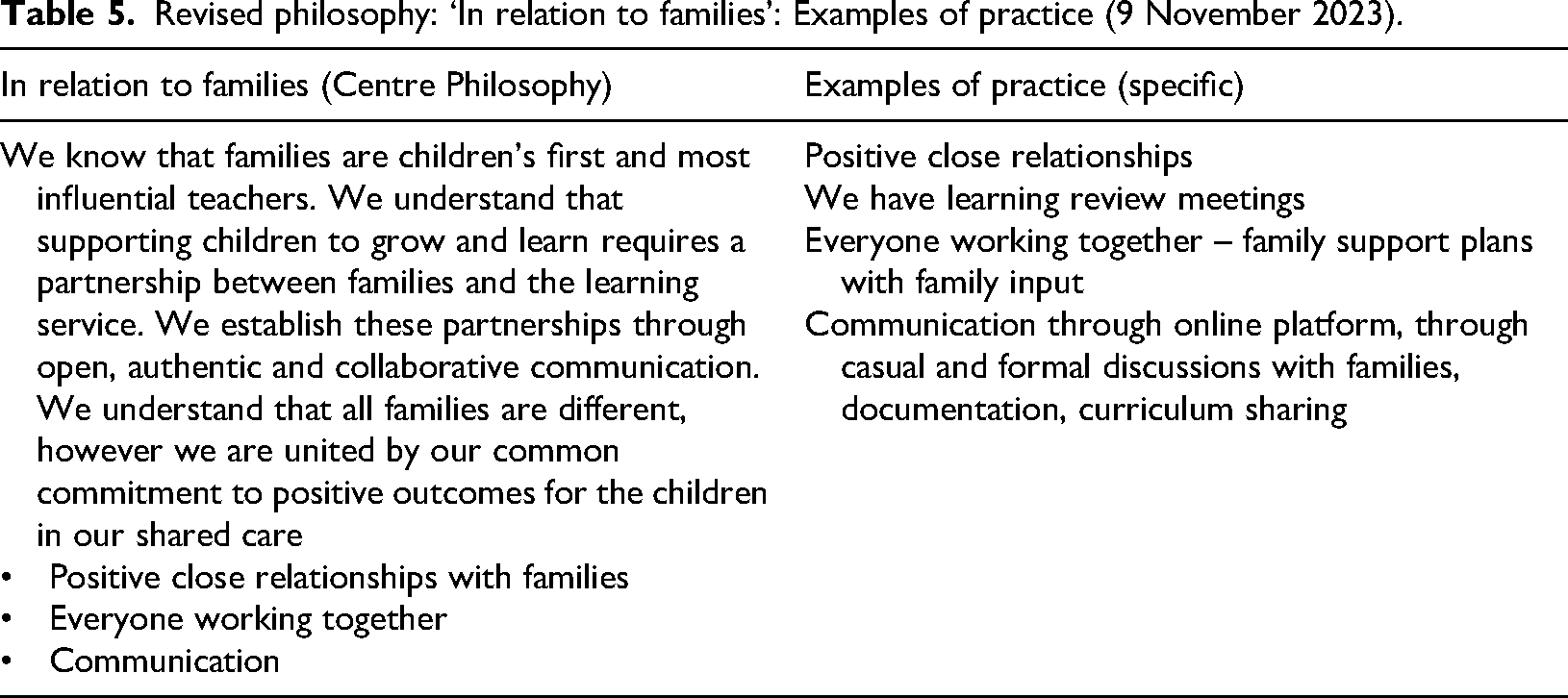
This collaborative response in the examples of practice section (Table 5) demonstrates how educators translated the philosophy of family partnerships into specific practices, something that was not part of the previous version. Moving beyond simply stating their commitment to ‘positive close relationships’, ‘working together’ and ‘communication’, educators identified examples of how these values are to be enacted in their daily interactions with families. Learning review meetings, family support plans with input from families, and communication channels are understandings of how philosophy can be translated into practice. These practices exemplify how the philosophy of family partnerships translates into actionable strategies that enhance pedagogical practice. By integrating family insights and fostering open communication, educators can tailor their approaches to better meet the diverse needs of children, thereby improving educational outcomes. The development of practice examples helped to clarify the connections between educator beliefs and practices and provided examples that could be used by all educators. Sharing pedagogical ideas exemplifies the relating dimension of the TPA (Gibbs et al., 2022), which fosters collaborative relationships that are crucial for pedagogical improvement and innovation (Heikka et al., 2021). Documenting and sharing these examples as part of the director's strategy to enact DPL served as both evidence of current practice and inspiration for future pedagogical practice. Valued pedagogical knowledge was recorded in a resource, a revised philosophy, positioning all educators as potential leaders in pedagogical improvement (Heikka et al., 2021).
Conclusion
The findings suggest important implications for the implementation of DPL in ECE. Firstly, the thoughtful implementation of DPL, which involves balancing responsiveness and consistency, can influence educator engagement and promote collaboration. Transforming practice with DPL demonstrates the interconnectedness of the five dimensions of DPL (Heikka, 2014) as the director deliberately facilitated the re-development of the philosophy. This process exemplifies goal-oriented leadership and the importance of engaging communicative action (Kemmis et al., 2014a) among educators to establish a shared vision and understanding.
The TPA analysis identified both enablers and constraints (Gibbs et al., 2022) influencing DPL, allowing for targeted provocations that refined leadership motivations and positioned DPL as a priority (Fonsén et al., 2023). Cultural-discursive arrangements enabled the connection of beliefs (sayings) with practices (doings) through collaborative relationships (relatings), enhancing leadership capabilities and pedagogical approaches. Material-economic arrangements supported the re-development of the philosophy and leadership strategies. Social-political arrangements fostered pedagogical improvement by creating conditions for collaborative dialogue and shared decision making. Overall, this project demonstrates how DPL can lead to transformational change by fostering sharing and collaboration among educators. These implications provide insights for educational leaders looking to enhance their leadership practices and improve the quality of pedagogy and leadership within ECE.
Footnotes

Ethical approval
Ethical approval for this study was granted by the relevant university and the Victorian Department of Education.
Consent to participate
Participants provided their consent by completing a hard copy consent form.
Author contributions
CPC undertook the research and developed the literature review, methodology, data collection, analysis and findings. SG did close editing, restructuring, reduction in length and provided detailed feedback on all drafts.
Funding
The authors received no financial support for the research, authorship, and/or publication of this article.
Declaration of conflicting interests
The authors declared no potential conflicts of interest with respect to the research, authorship, and/or publication of this article.
Data availability statement
The data that support the findings of this study are not publicly available due to privacy or ethical restrictions. The data have been de-identified to protect participant confidentiality. Examples of the de-identified data are included within the article.