



Abstract
Sustained shared thinking dialogues which focus on teacher talk with preschool learners have long been considered an important route to learning progression. Toddlers, however, seldom engage in dialogues through talk alone, and their encounters are often fleeting. As a consequence, they are often positioned on the periphery of learning dialogues that are granted primacy in the Capitalocene, because they must first acquire adult forms of communication and their meanings before thought becomes possible. Viewed from a dialogic standpoint, however, toddlers offer important clues to co-constituted meaning-making through subtle, fleeting, embodied and interconnected language acts. When stitched together across time and space and in speculative, apperceptive, contemplation of their strategic orientation, these seemingly random utterances can act as a source of shared thinking through interanimating chains of thought that implicate teachers as well as toddlers. In the paper that follows, utterance chains are brought to life through curated video and dialogue with Aotearoa New Zealand teachers who, sought to ‘think with’ toddlers in ECE settings. Paying attention to interconnecting links in meaning across language acts over time and space, utterance chains invoked apperceptive engagement with language and thought. These discoveries invite teachers to expand communicative repertoires to ‘think with’ young learners as optimistic encounters of ‘making-with’ bestowals in and for the Chthulucene.
Introduction
Contemporary early childhood education (ECE) places a great deal of emphasis on ‘thinking-with’ learners as a pedagogical tenet for understanding. The purpose of such engagement is largely informed by conversational approaches to oral dialogue oriented by the expert teacher towards meaningful learning on the part of the novice learner. Intentional strategies to build sustained shared thinking in preschool environments are now a standardised means of analysing the interactional quality of practice that promises to progress learning for children aged 2–5 years of age (see, SSTEW scale developed by Siraj et al., 2015). Across United Kingdom and Australia these scales claim to predict educational outcomes because they extend children’s critical thinking, increase self-regulation and autonomy, and advance developmental outcomes (Howard et al., 2020). Sustained shared thinking places an emphasis on the intentional oral conversational strategies of the ECE teacher who must take a child-centred approach to co-construct meaning with learners whom they know well.
Much less attention has been granted to pedagogical strategies to think-with younger learners between ages 18 months and 2.5 years (hereafter referred to as ‘toddlers’) who do not share the same oral modes of learning (Lokken, 2000). Strategies for interaction in the literature range from observing embodied forms of communication (Xiao and Tobin, 2018, see also Lokken, 2000) and fleeting exchanges (Mitchemore et al., 2020) to oral questioning that ‘tunes in’ to the intentions of under 2-year-olds (Degotardi et al., 2018). Notwithstanding the importance of these avenues for advancing a social platform for learning, they do not offer a route to thinking-with toddlers on their own (corporeal) terms. Nor do they invite teachers to contemplate their sense-bestowing practices for interpreting meaning on these terms.
Haraway (2016) explains that thinking-with humans (and non-humans for that matter) is especially difficult when there are claims to already fully ‘know’ those whom we seek to understand. The origins of such knowable thought are oftentimes drawn from child development which casts toddlers as immature, un-ready and perhaps even incapable of complex thought processes (White, 2021). Such a stance situates young learners as premature interlocuters who need to be enculturated into adult ways of communicating through mimetic or transmissive modes of language transmission. MaCrae and MacClure (2021) suggest that these kinds of viewings fail to take into account the material contexts in which they are embedded, thus limiting the potential for adults to engage with toddlers as strategic language partners on their own terms. This is especially so when thinking-with younger partners who may be concurrently viewed as strangely familiar yet irretrievably elusive or mysterious (Mika and White, 2020), ‘not-quite-there’ (Peters et al., 2020) or ‘infantile’ (Tesar et al., 2021). Toddlers can therefore make significant ‘trouble’ for pedagogies that set out to ‘think-with’ these learners within the geopolitical spaces they now occupy. Indeed, in a survey undertaken in Aotearoa New Zealand (White et al., 2016), several teachers described 2 year-olds as disruptive interlopers who distracted their older peers from ‘real’ learning in their educational settings.
In the paper that follows a dialogic re-route to thinking-with toddlers in ECE is explored through an application of Mikhail Bakhtin’s notion of ‘utterance chains’ and their co-constituted basis as speculative thought. Through this route I invoke a sympoietic means of thinking-with toddlers that responds to Haraway’s Cthulucenic call for the ‘reknitting of doings’ (Haraway, 2016: 55). Reknittings invite polyphonic viewing(s) of language as a series of string-figure-like ‘chainings’ of meaning threaded across culture and time that can disrupt existing linguistic hegemonies, thus granting legitimising spaces for 2-year-old ‘voice’. As such, two-faced attention is paid to language and its meanings over time and on its own terms – opening up spaces for the alteric potential and hegemonic disruption for finalised becomings of ‘other’ (Gasbarrone, 1994). The coupling of Haraway and Bakhtin in this manner takes the view that such renderings are not only ethical, but also answerable for what is produced. A group of ECE teachers in Aotearoa New Zealand (hereafter called ANZ) who applied this approach to their pedagogy opened up possibilities for revised becomings by moving within and beyond prior patterns of attunement to think ‘with’ toddlers over time, and in contemplation of alternative modes of communication. The paper concludes that what lies in the between-ness of communication through such chains, and their dialogic interanimations over time and space, hold great potential to render toddlers as sense-making kin who have much to offer to the Cthulucene in which they might flourish, and implicates teachers for their representations of learners accordingly.
A dialogic re-route to working ‘with’ the trouble through utterance chains ‘. . . an utterance chain is a link in the chain of speech communication, and it cannot be broken off from the preceding links that determine it from both within and from without, giving rise within it to unmediated responsive interactions and dialogic reverberations’ Bakhtin, 1986: 94)
For Bakhtin, a Russian thinker, pedagogue and philologist, the strategic intent of utterance is perceived according to the broader communicative context in which it is offered, not merely its lexical or isolated meaning – thus generating transformative potential for interpreting meaning. In this dialogic re-routing, utterances are irreducibly fluid – renewing over time and across contexts and laden with strategic intent (Bakhtin, 1984a, 1990). This is a slippery contemplation, since meaning can only be tentatively grasped in liminal zones of abstraction ‘in which the human always already finds itself’ (Loft, in Cassirer, 2020: xxxix). In order to grasp, if only fleetingly, the meaning of an utterance it is therefore necessary to first understand its parts (i.e. language forms), their symbolic potential and perceived intentionality, modes of communication (as genre) and the co-constituted locatedness and addressivity of its forms and mode of delivery that, together, generate meanings. To do so calls for a two-faced interpretation – both in terms of the language used and its lived meanings in everyday encounters (Voloshinov, 1979). A de-limiting stance is made possible by paying attention to the transitions that occur as interactions gather meaning over time and space.
Bakhtin’s orientation is therefore the discursive nature of dialogue – not just what is conveyed but with/to whom, why and how it arises within the irreducible life of an utterance as a unit of discourse (Haye and Larrain, 2011). Meaning is interpreted through sense-bestowing modes of communication that ‘form the ensemble of sense that is the life of the objective spirit in which the human always already finds itself’ (Lofts, in Cassirer, 2021: xxxix). Utterance, according to this view, can thus be understood as combinations of language forms that always anticipate a response and are strategically oriented, and intuited accordingly. As Bakhtin (1986) explains, different styles of utterance occur across title, class, rank and age of the person who is ‘speaking’ and their relative position to the dialogue partner. Even when there is an imaginary interlocuter at play or in the absence of conventional forms of language (Junefelt, 2009), communication is never mere rehearsal or mimicry when viewed through this lens. This holds true for toddlers as much as any other speaker and, when contemplated in ECE spaces, sets in motion a view of toddlers as a unique group of learners who warrant further speculation and thought.
Several ECE researchers have taken up this thinking to understand dialogues – as utterance – in the early years. Viewed as observable (Lawrence, 2019), multi-perspective (Lang and Shelley, 2021), carnivalesque (Jennings-Tallant, 2020; White, 2014), generative (Odegaard, 2021), memory-enhancing (Kullenberg, 2019), participatory and democratic (Cao, 2020; Lensmire and White, 2017; Rosen, 2015), the deployment of utterance as a unit of analysis has yielded many speculative insights concerning strategic child communication in ECE contexts. While each implicates adults as interpretive and fully implicated dialogue partners, less attention is granted to ‘the apperceptive background of the addressee’s perception’ (Bakhtin, 1986: 95) which takes into account aspects of familiarity, valued modes of communication in culture, views, sympathies, prejudices, assumptions and values – all of which orient the way meanings can be perceived and responded to over time. A recent exception is noted in the work of Lang and Shelley (2021) whose carnivalesque examination of 7–11-year-old children analysed the temporal and social tensions that existed in adult attempts to represent learning. Their dialogic analysis led them to conclude that a focus on creative processes of meaning-making was necessary so that new genres can be contemplated, arguing that these are only accessible when adults are able to accommodate alternative approaches to such forms of ‘voice’.
Since it is the linking of interaniminating utterances that holds potential to contribute to the greater ‘whole’ of meaning as a dialogic event of becoming over time, an emphasis on utterance chains and their construction seems warranted. Utterance chains generate a series of communicative links as sparks of evaluative insight by connecting intuited forms of language – as utterance – together to generate meaning(s). They can provide portals into otherwise impenetrable linguistic spaces where language is not shared or where interlocuters draw from competing or intersecting cultural and axiologic discourse (see, e.g. Berge and Raanes, 2013; Le Blanc, 2021; Mansfield and Barth, 2021; McBride and Bergen, 2014). A key feature of their analysis is that it pays attention to the lived event of language over time that takes place between interlocuters as discernible ‘. . . only in that chain of speech communion of which the utterance is an inseparable link’ (Bakhtin, 1986: 100). The addressivity and expression of the speaker towards (or conversely away from) their interlocuter are retrievable only by paying attention to related utterances as ‘a link in the chain of speech communication’ (p. 93) which provide clues as to the intentionality of the communication and its dialogic struggles within the discourse:
Despite the potential of utterance chains to contribute to greater speculations concerning very young children, their utility in early years research has yet to be fully realised. Exceptions are noted in a linguistic study by Junefelt (2011) who generated utterance chains as communication units comprising verbal (including babble) and non-verbal (including haptic) language cues to interpret the dialogues of Swedish mothers and their blind infants; and a study by White and Redder (2017)who applied utterance chains to their interpretations of infant-teacher dialogues. The Authors found that when engagements with infants were informed by utterance chains, ECE teachers gained a greater recognition of the co-constituted nature of their representation that exceeded their previous assumptions concerning infants and their communicative capacity.
Utterance chains call adults to account for their interpretations as necessarily partial insights of significance concerning young children that are oriented by their own actions (and inactions), locations and values as much as those they seek to understand. Just as Haraway’s ‘critters’ render one another through moving relations of attunement, so too, do utterance chains invite relational intersubjectivity – advancing the notion of sustained shared thinking as a relational co-constituted effort and authorial gift. For this reason, utterance chains can be conceptualised as a special kind of string-figuring where ‘partial and flawed translations’ (p. 10) are generated within rhythms of shared understanding and alterity. It is here that utterance chains hold much potential to think-with the interanimating modes of thought that take place in dialogues, with and about, with toddlers and their becomings.
Tying the chronotopic knots
From a Bakhtinian standpoint, becoming is an ideological positioning that is discernable only in contemplation of the social milieu in which it takes place (Bakhtin, 1981). In this sense, becoming is a plural concept, since what gets valued within any given context arises through a series of competing ideological positions. Becoming is therefore an event of double-voiced between-ness within and across time and space (White, 2020). Becomings are given life in geopolitical landscapes – in what Bakhtin (1981) calls the chronotope – where ‘the knots of narrative’ (p. 250) are tied. Bakhtin here advances the idea that all meanings are always partial and particular to their lived experience. Intuited meanings are therefore signified within the culture through which they are generated, yet they are also pregnant with symbolic potential (Cassirer, 2021). As Giaxoglou (2021) asserts, time and place play an important role in the structure and positioning of stories that are told, and through which identities are represented and performed. For this reason, the expression of any utterance provides opportunities to think beyond fixed assertions of meaning, since: ‘even the slightest allusion to another’s utterance gives the speech a dialogical turn that cannot be produced by any purely referential theme with its own object’ (Bakhtin, 1986: 94).
The Capitalocene does not hold space for such speculation. Contemporary educational practice asks teachers to unproblematically account for learner progression as if it were possible to know with any certainty how this might play out (Pedersen et al., 2022). Here, learners must be fully known so that their learning progressions – as linear becomings – can be procured by expert teachers orienting to the demands of the state. Expectations placed on ECE teachers to meet these neoliberal aspirations have led to a series of truth claims being asserted about how young children learn, implicating teachers accordingly (White, 2011). Notwithstanding repeated attempts to resist certain thought, ANZ ECE discourse continues to orient the learner towards becoming the future citizen who will grow up to contribute to a static society rather than the learner of the Cthulocene who is ‘not confined to the vanished past’ (Haraway, 2016: 55).
Despite their embedded positioning in the New Zealand curriculum (White and Mika, 2013), the toddlers (defined as 1–3 year-olds) of Te Whāriki: He whāriki mātauranga mō ngā mokopuna o Aotearoa (Ministry of Education, 2017) are caught betwixt and between their ‘infant’ and ‘child’ peers in policies and practices that do not grant them the same status in ANZ ECE (White, 2020; White et al., 2016). In this locale, toddlers and their unique ways of communicating are not served well. The potential for fabrications of new scripts through this route are diminished since toddlers are paradoxically already ‘known’ (Mika and White, 2020). An urgent need thus arises for teachers to engage wholeheartedly with toddler modes and orientations of communication and their intra-active potential for shared meaning-making. Such viewings are consistent with NZ assessment discourse which invites teachers to notice, recognise, respond, and revisit learning as an event that metaphorically situates learning within the ‘horizons’ of possibility (Ministry of Education, 2004: 2):
Bicultural Aotearoa NZ, a cultural landscape that seeks to express the dual heritage of Māori and Western knowledge (Te Tiriti o Waitangi, 1840), grants a special case for thinking-with toddlers on these expansive terms. Mika and White (2020) have therefore argued for retaining the co-constituted nature of becomings in ECE practice, so that representation ‘is materially designated and made up of the All’ (p. 66) that connects all things – past, present, and future. In this viewing, utterance chains find good company in Indigenous thought concerning the ‘papa’ of becoming, giving rise to the dialogic, material nature of learning which defies all certainty, and which may be recognised in symbolic expression. Aligning Māori thought to ANZ ECE curriculum (as is the intent of Te Whāriki) creates opportunities for more imaginative encounters with toddlers who exist beyond the grasp of teacher ‘knowing’. In Māori assessment practices (Ministry of Education, 2009) children (tamariki) in ANZ ECE can be viewed as (amongst other expansive concepts) cunning tricksters (Tinihanga/whakatoi) who possess all that they need already since they exist across dimensions of time and space (Mika and White, 2020; Rameka, 2015). The challenge that arises for teachers in working in these contested spaces, lies in the educational imperative to advance learning progression, while simultaneously staying open to alternative shapes and forms of representation, their origins and co-constituted, relational, becoming(s). Closely aligned to Haraway’s (2016) depiction of a dance where the ‘choreographer is a trickster’ (p. 127) these ‘thinking-with’ pedagogies acknowledge the inadequacy of claims that exist in the absence of intuitive, co-constituted, spiritual, and symbolic thought – inviting alternative temporalities and sympoietic encounters with thought. Utterance chains provide a means of creatively moving amongst this tricky terrain in pedagogical work where it is not possible to invite the toddler-learner into dialogue about their learning in traditional ways. It is here where becomings may take on new meanings.
Introducing the study
Ten fully qualified and highly experienced ANZ teachers [hereafter named ‘kaiako’ in accordance with ANZ curriculum) in two ECE settings set out to understand the toddlers in their centres on these dialogic terms (White et al., 2019). Their quest was to generate pedagogical insights into the ways toddlers engaged in their ECE spaces which had traditionally been wholly located by 3–4-year-old learners. Taking the view that re-visioning toddlers through the additional visual surplus offered by video taken through three visual fields, teachers set out to able to notice language forms beyond verbal communication, to recognise the potential of these insights, and respond to these through more inclusive pedagogical practices. The visual fields were generated through (i) kaiako wearing recorder glasses to record their engagement within the centre; (ii) toddlers who were linked in to swivel cameras via a tracking device they wore in a vest or order to track and record their movements; and (iii) a 360° camera that filmed the wider centre environment – both indoors and outside. Filming took place at intervals over the 2 years of the project, generating 8 hours of combined footage in total.
The three visual fields were synchronised using a polyphonic approach (White, 2016). They were then entered into a V-note software programme (V-note, n.d.) where they were coded by the teachers over a series of weeks. During the first year of the study a series of identified language forms and their meanings were generated based on observable toddler, peer and kaiako initiations and responses; and their potential meanings, granting teachers significant insights concerning toddler language events. Kaiako were invited to account for their interpretations and the assumptions that underpinned their meanings – generating conceptual distance between their prior assumptions about 2-year-olds and their learning.
In year 2 a series of dialogic concepts were introduced to the kaiako in order to expand their interpretative fields, following a further series of filming. A full examination of these is beyond the scope of this paper, but included Bakhtin’s (1984b) concept of carnivalesque which, as Hirschkop (2021) suggests, ‘puts together what the dominant culture traditionally keeps apart’ (p. 130) by granting legitimacy to liminal, material-bodily, intercorporeal, alteric and often de-throwning spaces for becoming. The potential of such spaces to more expanded viewings of becomings are difficult to discern when viewed as moments in time that are remote from their wider meanings. They became visible to the kaiako only when stitched together over time and when kaiako were able to suspend their own dearly held assumptions considering what constitutes valuable learning or not (https://www.waikato.ac.nz/age-responsive/what-do-two-year-olds-say-and-do). Releasing these strongholds to apperceptively ‘think-with’ toddlers through stitchings of utterance allowed kaiako to connect seemingly discrete meanings within the social and cultural milieu in which communication took place. Kaiako were invited to suspend practices of certainty as they shared insights, documentation and analysis that disrupted their allegiance to educative tags or goals (White and Redder 2019a, 2019b). In doing so, they confronted their own prejudices – freeing themselves to learn with toddlers generated over time. Significant shifts in thinking and practice took place over the 2 years – from describing toddlers in deficit, limited ways to a view of toddlers as capable learners and implicating kaiako accordingly.
Ethics
As Sturm (2021) suggests, visual approaches to studies involving children call for a response-ability on the part of the researcher who must maintain specific and constant vigilance – over the life of the project – concerning who is filmed, how that footage is utilised and subsequently disseminated. But an investigation of this nature brings with it additional ethical challenges. Firstly, toddlers are not always able to grant their consent to participate or have their utterances shared with others through the traditional routes offered by the academy. Secondly teachers may be reluctant to open up their practices for scrutiny and challenge, especially through visual modes of inquiry (Cherrington and Loveridge, 2014; Rutanen et al., 2018); and families may feel uncomfortable having their toddler (or any other family member) filmed. The nature of the cameras employed meant that it was impossible to film in ECE centres without capturing the whole environment and the development of a website to convey the discoveries of the kaiako, including video, meant that any permissions gained had to include additional layers of consent. Such a generative process is conducive to dialogic approaches to inquiry that call attention to investments and representations of meaning between subjectivities in dialogue and constitute dialogic validity (Sullivan, 2012). The ECE contexts (including families and kaiako) in which the study took place already used and disseminated video in assessment practices and for pedagogical purposes, so were comfortable with these approaches from the outset. There was only one exception where a kaiako asked for videos of her practice not to be shared in the public domain and whose wishes were upheld.
Thinking-with toddlers via utterance chains
When kaiako started to link what had previously seemed insignificant or unseen utterances over time a series of occurrences confronted their understandings of both toddlers and their pedagogical role. Firstly, kaiako began to recognise the significance of verbal and non-verbal language by connecting language combinations that had previously been viewed as fleeting or incidental. For example, they noticed that toddlers would frequently enter into genre where valued learning took place (e.g. a physical activity or group experience) in phases and sometimes by increments – firstly by watching from a distance, then silently moving alongside others before moving to the centre or discursively participating through their body – sometimes in ways that disrupted the intentions of their older peers. On other occasions toddlers would run from space to space – shouting loudly or humming, interspersed with pauses to rest, tap their feet and watch before returning to the chase – events repeated over time. By focussing on the nuanced details of these utterances as an orienting source of insight, kaiako were able to draw on these as points of connection as opportunities for speculative fabrication that challenged and expanded their own views about how toddlers might learn. Humour played an important role in their discoveries as they began to appreciate the alteric potential of toddler’s artful engagement within ECE spaces, including their peers, that had previously escaped their attention: We have seen and valued underground acts as really important aspects of two year-old engagement in dialogues in the ECE space. They allow them to engage with peers. This concept helps us to recognise the need to tolerate these acts as potential acts of resistance and peer cohesion which allow two year-olds to exercise their agency. We have moved further away from an emphasis on obedience towards an understanding of the importance of creativity and individuality - a modus operandi [Kaiako narrative: https://www.waikato.ac.nz/age-responsive/what-do-two-year-olds-say-and-do]
Kaiako recognised the potential for utterance chains to offer revised ways of understanding and enacting pedagogy in which they, too, were implicated. As they became more aware of the subtle nature of communication, kaiako began to recognise their strategic purpose across contexts and appreciate their significance. For example, through an awareness of the sounds and body-positioning/movements of 2-year-old Cameron his kaiako came to recognise as a rendition of the ‘haka’ (https://www.youtube.com/watch?v=7lhgJXdrWCE) through sounds and body moves. They realised he was using this genre for a variety of strategic purposes over the morning—first to participate as a member of his peer group, next as an act of defiance to having his nose wiped by a teacher, and thirdly as a means of protecting his play space from others. By stitching video excerpts together over time, kaiako were able to interpret these utterance combinations as celebratory acts of defiance which they now recognised as important for toddler agency and celebrated accordingly (see https://www.waikato.ac.nz/age-responsive/what-do-two-year-olds-say-and-do). As one teacher explained: He’ll do that [haka] as an achievement, as a form of resistance and there are so many ways he can utilise this one language act—he’s still doing it now!. . . In the past you have those children who might be doing things that go against the grain but you would never document that whereas with a dialogic perspective you can actually underpin that as crucial learning. We’ve had a good laugh with Cameron’s mum because we talked about how he had basically told me to ‘naff off’ when he did the haka. Now would you have done that in the past? No way! Even just the understanding of the significance of this act in that moment has been key. [Kaiako discussion at final meeting Nov 2018]
Utterance chains were also discerned over significantly longer periods of time once kaiako began to seek them out. Prior to this, their pedagogical orientation had been to look for toddler ‘interests’ which they sought to identify and extend as a source of intersubjectivity. The identification of interests was based on activities the toddlers were observed to engage with, and which kaiako would write up as learning events in a moment of time. For example, 2-year-old Harry featured in a learning story written in September where his teacher – Catherine – asserted his interest in ‘wriggly worms’. She did so because he regularly accompanied her to the worm farm at the bottom of the centre garden with scraps to feed the worms, which she described as ‘wriggly’. Several weeks later Catherine attempted to reassert Harry’s interest in wriggly worms when he joined her outdoors and pointed to the outdoor area. Painstakingly now following his non-verbal and verbal cues as she sat behind him to share the direction of his gaze, Catherine realised that Harry’s orientation lay elsewhere. Further attention to language forms such as pointing, watching, close proximity, the significance of a handmade telescope, and provocations of older peers, Catherine was alerted to Harry’s strategic orientation towards a nearby group of birds. In drawing on their previous experiences observing worms together and utilising a series of language forms that he had previously shared with his teacher, Catherine was able to invite Harry into a sustained interaction that linked meaning across time and space (see https://www.waikato.ac.nz/age-responsive/what-learning-occurs). The following narrative was written by this kaiako immediately after this utterance:
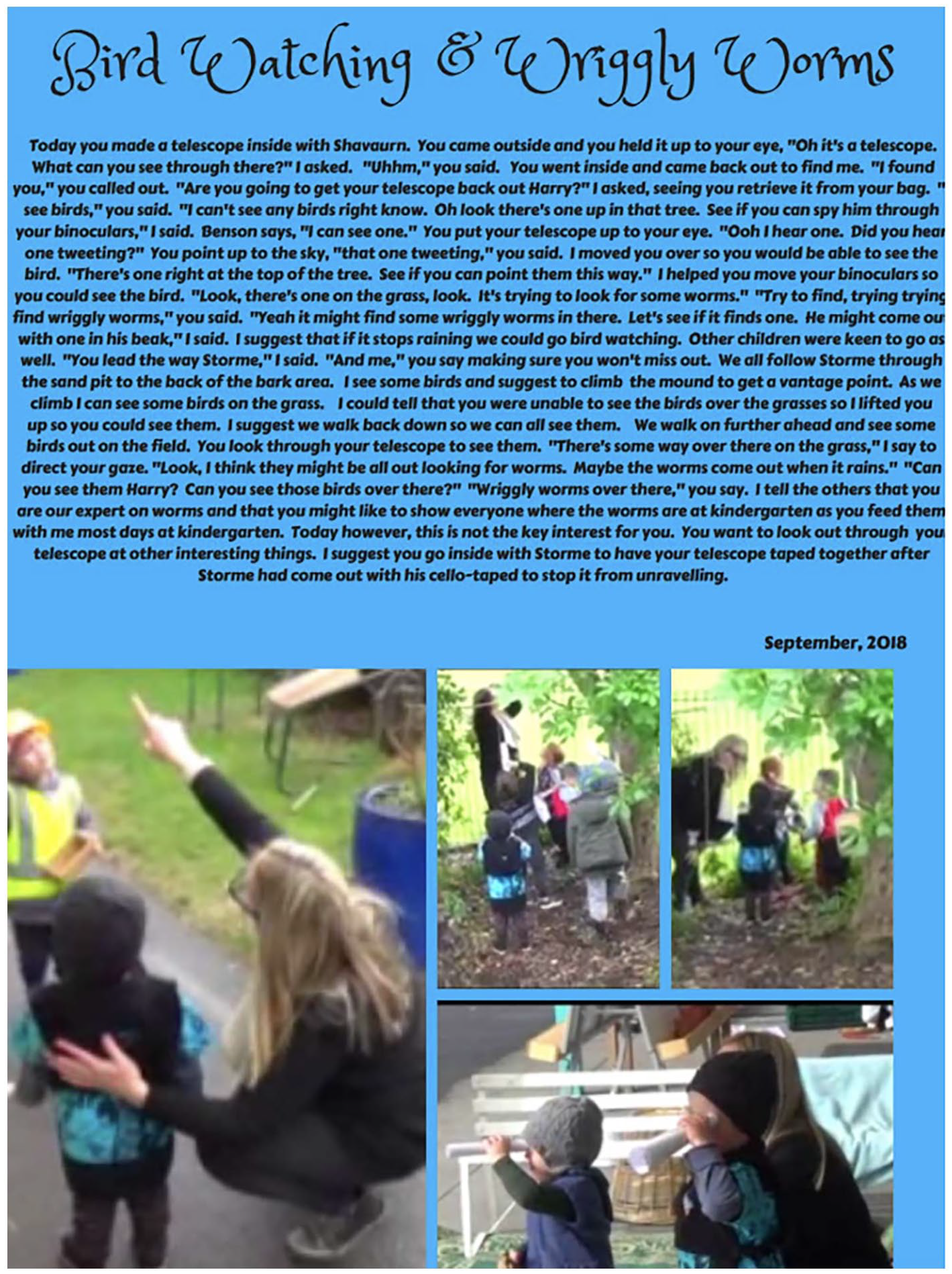
Learning Story written at the time.
In her reflections at subsequent research meetings Catherine articulated the view that her previous attempts to identify the ‘interests’ of toddlers did not do justice to the significance of the subtle nuance of utterances over time or their relationships to more complex learning. In the absence of apperceptive reception such categorisations fail to account for the sense-bestowing potential of these events. The language forms utilised, their history and aftermath, in consideration of their bestowals over time – created chainings that held potential to generate unmediated sustained dialogues across time: Two years ago, I would have shut that down in a heartbeat but now, I let it go as much as I can because I recognize its value to two year-olds as a way in to the genre and what is learnt as a consequence of that [Kaiako discussion at final meeting Nov 2018]
Exploring their shifting perceptions of toddlers through utterance chains did not lead these ECE teachers to certain conclusions about how all toddlers think or, by association, how all teachers ought to respond. Instead, thinking-with toddlers by recognising the dialogic between-ness of seemingly isolated language events over time provided a portal to deeper understandings about them as personalities whose language forms invoked new forms of engagement that did not remain static over time. As one kaiako explained: ‘we value them in their own right, because we have a way of thinking and talking about their ways of becoming’ Such insights led these kaiako to question their existing practices to better reflect the sympoetic, irreducible nature of toddler becoming: We have had the luxury of really seeing diverse forms of language and how they are used strategically by two-year-olds to generate shared meanings with others – peers and teachers alike. But not always with both or at the same time, in fact sometimes in direct opposition.. . .We’ve seen the linking over time, but does it have to then be tagged to some long-term outcome. Can we not just celebrate this for what it is and not in terms of what it might become or what we make it look like it can become? [Kaiako discussions at final meeting Nov 2018].
A speculative becoming?
As Haraway reminds us – ‘it matters how’ [toddlers] are thought about and with – not only in terms of their representations as learners, but also because of the potential for adults to engage in meaning making dialogues that ‘cultivate the wild virtue of curiosity’ (Haraway, 2016: 144). Identifying the utterance chains discerned through creative contemplation gives way to more speculative becomings by thinking ‘with’ toddlers, but it also illuminates the dialogic nature of such thought. These are sustained shared dialogues that take place on co-constituted terms. Comprised of fleeting and nuanced language events that are more characteristic of toddler modes of thought, utterance chains are speculative and partial rather than certain about their meanings. Nonetheless, they hold great potential to grant toddlers legitimate entry into educational spaces on their own terms and in their own way. Exceeding conventional norms for interpreting language by paying attention to forms and their meanings over time disrupts contemporary assessment norms that emphasise the convention of ‘interests’ and the kinds of probing dialogues that orient dominant pedagogical approaches towards outcomes amongst older learners. Here, toddlers, in their mischievous makings with kaiako who are able to unleash themselves from the reductive bounds of the Capitalocene, make significant trouble for contemporary educational thought and practice.
Paying attention to the contexts in which these utterance chains take place, and the extent to which their strategic orientations invoke or rebuke shared meanings demand, invites us to take account of their interanimating role in the dialogue. These are spaces where kaiako (and indeed all teachers) are implicated for their renderings and, importantly, the pedagogies that arise. The extent to which toddler dialogues resonate in educational spaces is therefore not merely an issue of reception but of creative co-constitution in which all parties share responsibility. It is though these utterance stitchings that order may be reknitted to bestow pedagogical renderings that pay heed to the toddler and their fluid becomings in the Chthulucene. Telling stories in this way can not only disrupt the hegemony of adult-centric dialogues, but open up the possibilities for 2-year-olds to be speculatively ‘read’, as much as possible, on their own terms: The chief actors are not restricted to the too-big players in the too-big stories of Capitalism and the Anthropos, both of which invite odd apocalyptic panics and even older disengaged denunciations rather than the attentive practices of love, rage and care. (Haraway, 2016: 55–56)
Viewed as a legitimate form of becoming utterance chains create interanimating opportunities for noticing, recognising and responding to forms of learning that embrace these ideals for 2-year-olds alongside their peers. Such engagement is no less meaningful, but far less certain – requiring us all to pay attention to embodied forms of expression as partial sightings that are pregnant with possibility. It is here where toddlers may at last claim their place in the Chthulucene that demands new forms of speculative thought for un-knowable becomings.
Footnotes
Funding
The author(s) disclosed receipt of the following financial support for the research, authorship, and/or publication of this article: This project was funded by the Teaching & Learning Research Initiative.
