




Abstract
This article details the transformation of an empty store into a gallery honouring youth and others who have passed away from overdoses, and the creation of extensive harm reduction and grief support programming that accompanied the display of artwork. The outpouring of community interest, participation, and emotion that surfaced around heART space clearly shows how art, exhibitions and creative programming can help foster communities of care during times of crisis. Drawing from research into practices of care from harm reduction work, grief studies and participatory arts and curatorial studies, the authors explore how heART space comforted youth and others with direct experiences with overdose and disenfranchised grief while creating dialogues with visitors about the stigma of drug use and homelessness. The authors argue curating heART space produced an opportunity for community healing while nuancing and humanizing the way we see people who use drugs. As such, this youth-driven community project created a safe space to share stories, collaborate, honour trauma and transform grief into action.
healing
does not feel good.
it is a long line up without a book or your phone.
staring agonizingly ahead while you wait for something to happen
in the beginning of healing
my mom told me that
“it won’t hurt as bad, just give it time.”
and there was a big duffel bag, in the corner next the closet
i remember being annoyed with you for leaving it there for so long after you’d moved out.
can you imagine how awful it feels to be annoyed with someone posthumously?
to be angry with a dead person that you loved?
i think that’s the second part of it or something,
yeah, denial is the first.
i remember everything i did the day i found out you died.
i walked around the harbour with a loved one, for dinner i had the same thing that you and i always shared.
i wish i had the grasp on this feeling to properly illustrate it. i would draw a diagram.
i would show you how much i loved you.
after a while i got used to trying to forget you, it seemed like the safest way/
and when i think about it i can remember exactly the temperature my throat was while i screamed.
thinking about those first agonizing hours and days, i can conjure the feeling of the ache
the centre of my chest collapsed
my throat raw from screaming
my head aching and swollen
grief courses through your body and spills out of you like the disgusting mess it is
i’ve never been a conspiracy theorist but when you died i was sure it was the most elaborate and cruel joke anybody had ever played.
healing is not linear,
healing to the left behind, is agonizing.
if i have healed
it was because i was ugly and drunk
and face down in a puddle of purple vomit crying to an audience of three angels who thought i’d been broken.
(i tell our stories all the time
i keep your voice on a dusty shelf for when i need it.
i remember it with ease which makes me feel proud and comforted.
i had no plan to heal from this,
and i didn’t know that losing you would teach me anything worth knowing.)
how it could wedge meaning between every word and memory we shared.
i remember thinking that everything you did seemed like a revolution or a prayer.
tonight i forced myself to remember you so i could finish this.
an act of remembering is a prayer too
Introduction
In 2017, this poem by Sacha hung on the wall of heART space, a month-long pop-up exhibition that transformed an empty store in Victoria, British Columbia (BC), into a community gathering space privileging youths’ experiences of overdose deaths. Showcasing art from current and former street-involved youth, front-line workers and many others affected by the overdose crisis, heART space also hosted open studios, workshops, performances and community conversations to bring people together to talk about issues related to the overdose epidemic. Sacha’s words ache with the pain, loss and suffering that comes with grieving loved ones. Her poetry also illustrates the powerful role that creative expression can play in highlighting the disenfranchised grief that many people, including youth who use drugs (YWUD), experience as a result of the structural violence that underlies the current opioid crisis. Stigma associated with drug use works to mute and complicate the grieving experiences of YWUD, echoing Butler’s (2006) question: ‘whose lives count as lives?. . .what makes for a grievable life’ (p. 20). By centring Sacha’s lived experience with overdose losses, we make connections between the crises of war and the struggle to be recognized as grieving that Butler addresses and the structural vulnerabilities of homelessness and war on drugs by making children and youth’s grief visible. Caring for YWUD, their families, and the front-line workers involved in this crisis requires multiple strategies, including poverty reduction, adequate access to health care, decriminalization of illicit drugs as well as distribution of naloxone (the antidote to opioid overdose). We believe that care in the opioid crisis should also include spaces for reflection, creativity and community. In this article, we address curation as care, exploring how imagining, creating and curating the heART space exhibit was a means for young people to own and narrate the grief, trauma and loss they felt so profoundly, and to foster a community of support.
Research into arts and trauma focused on children and youth indicates the potential for creative projects to provide an outlet for the telling and witnessing of stories, not only to process grief and promote healing but to re-imagine youth as agentive and complicated, ‘as artists, young people who had something important to say’ (Clacherty, 2006: 125). Dyer and Georgis (2017) argue that, in war, the paradigm of childhood innocence obscures the distinctive and skillful ways young people experience profound loss while still navigating life, their awareness of the conditions in which they live, and their political will to change these conditions. The majority of street-involved youth, like children during war, have biographies of childhood trauma (Bender et al., 2010; Hadland et al., 2011) and, for many, homelessness itself involves repeated exposure to traumatic circumstances and chronic stress (Kidd, 2013). This trauma is obscured in what Giroux (2006) describes as the new biopolitics of disposability in that poor and racialized groups ‘not only have to fend for themselves in the face of life’s tragedies but are also supposed to do it without being seen by the dominant society’ (175). In neoliberal restructuring of health care and social welfare, trauma is individualised, defined, for example, as ‘a range of psychological impacts of the experience or threat of violence, injury and loss’ (Kirmayer et al., 2010: 156). We are cautious that this language of trauma ‘sanitises’ the political content of work with children and youth, emphasizing victimhood and individual suffering (Fassin and Rechtman, 2009), while sidelining both the structural violence of poverty and racism and the agentive capacities of young people (Marshall, 2013). In contrast, we believe that foregrounding the experiences that youth have endured as traumatic as well as their strategies to heal that trauma provides important insights into the devastating impact of the opioid crisis and the ‘complex and multi-directional relationship between trauma, substance abuse, mental illness, and homelessness’ (Hopper et al., 2010: 97). Specifically, our experience with heART space demonstrates that curation and creative expression offers youth not only powerful ways of exploring and articulating their concerns (Henderson, 2011), but can generate opportunities to learn from their insights (Kennelly, 2018) about the essential need for social and community responses to trauma which recuperate ‘overdose deaths’ as persons and validate the grief of survivors.
As co-authors, collaborators and friends, we come together in this paper to share the process of creating heART space and the valuable lessons we learned about building a community in a time of crisis. While heART space was not conceptualized as a research project, we draw inspiration from Clacherty’s (2006) writings on art therapy and story-telling among refugee children in South Africa to describe heART space closely, and to inform others who wish to memorialize overdose loss in their own communities (Selfridge and Toombs, 2018). The departure point for our analysis is Gilligan’s (1993) idea of care as ‘an activity of relationship, of seeing and responding to need, taking care of the world by sustaining the web of connection so that no one is left alone’ (p. 62). Our analysis of heART space as an example of curation as care draws from several bodies of work – from ‘practices of care’ in harm reduction work, from grief studies, and from participatory arts and curatorial studies. We explore how heART space enabled youth to welcome and support people experiencing grief while also creating dialogues with visitors about the stigma of drug use. In building a welcoming collective space that included an exhibition, workshops and performances, heART space became a place to grieve, memorialize and witness the lives lost to overdose. We argue that curating heART space created an opportunity for community healing while nuancing and humanizing the way people who use drugs (PWUD) are seen. Further, through the process of curating, powerful practices of care emerged out of youth worlds, meanings and relationships. By providing the tools to create art and a place to sit with and witness grief, heART space created a safe environment for youth to share stories, collaborate, honour trauma and transform grief into action, demonstrating how communities that centre care can be built through curatorial practice.
YWUD, disenfranchised grief and practices of care
The introduction of fentanyl into the illicit drug market has dramatically increased drug-related overdoses and deaths in Canada and the US (Ciccarone, 2017; Rigg et al., 2018). In BC, unintentional illicit drug overdose deaths increased from 211 in 2010 to a staggering 1489 in 2018, with 20% of those who died being under the age of 30 (British Columbia Coroners’ Service, 2020), triggering the Provincial Health Officer to declare a public health emergency (BC Centre for Disease Control, 2017). This crisis takes place in the context of a war on drugs, a war rooted in inequitable drug policies (Lloyd, 2013; United Nations Office on Drugs and Crime, 2018) that criminalizes and stigmatizes youth and other people who use drugs (PWUD), particularly those who are also marginalized by race, poverty and homelessness. Using drugs, especially in public spaces, increases public and institutional targeting and harassment of youth, confiscation of drug equipment and violence by police (Thrane et al., 2008; Ti et al., 2013). This punitive regulation of illicit drug use and homelessness worsens the health and well-being of youth and others (Chesnay et al., 2013; DeBeck et al., 2009; Office of the Provincial Health Officer, n.d.; Werb et al., 2008; Kerr et al., 2005). Particularly in Victoria, a city widely regarded as a touristic or retirement reward for ‘successful’ lives, the struggles of PWUD and YWUD are frequently scrutinized and judged.
The precarious positions of homelessness, poverty and drug use complicated the deep and personal connections to grief among the youth and young people involved in heART space. From the early planning days of heART space, the advisory group spoke openly about the many deaths of clients, friends and street family they were experiencing and their overwhelming grief. Peer workers elsewhere in BC have described this intense stress, grief and trauma from responding daily to staggering number of overdoses (Bardwell et al., 2019; Wallace et al., 2018) and overdose deaths among their peer group, complicated by poverty, criminalization and lack of access to a safer supply of drugs (Kennedy et al., 2019). Insensitive reactions to these overdose deaths based in stereotypes of PWUD as dangerous, different and weak and referred to as ‘junkies’ and ‘addicts’ are often equally traumatizing (Valentine et al., 2016). This stigma creates grief that is disenfranchised: ‘not openly acknowledged, socially validated, or publicly mourned [because there is] no social recognition that the person has a right to grieve or a claim for social sympathy or support’ (Doka, 2008: 224). Thus, many heART space youth were grappling not only with deep sadness but with anger, guilt, helplessness, indignation, shame and unworthiness to grieve (see Templeton et al., 2017 for a similar situation in Great Britain).
While disenfranchised grief and recurring traumatic circumstances weighed heavily on the youth creating heART space, it also made them experts in what Kolla and Strike (2020) and Duff (2015) have called ‘practices of care’. ‘Practices of care’ refers both ‘to the practices used by PWUD to care for the self within larger social and economic contexts that remain hostile to drug use, as well as the ways in which people care for others’ (Kolla and Strike, 2020: 3). Examples include PWUD providing harm reduction supplies or information on drug potency to peers, intervening in overdoses, buying drugs for others or refusing to sell drugs that are deemed too strong. These practices are ‘socially constituted and . . . flexible’ (Hyde and Willis, 2020: 299), and often contested, since some acts are recognized more widely in society as caring while others are excluded from recognition or analysis (Kolla and Strike, 2020). Our reflections build on these ‘practices of care’ by highlighting how acts of care were produced by youth through the process of curating creative works about overdose and grief. Our analysis considers how ‘practices of care are not neutral or uniformly positive acts of affection or attachment’ (Kolla and Strike, 2020: 4), but can also point to deeply rooted stigmas and to asymmetries of power in grieving overdose deaths. Thus, we want to show how this youth-led exhibit engaged practices of care as responses to both their own pain and to state and public indifference to overdose deaths (Stevenson, 2014).
The vernacular of care in response to issues of social justice has increasingly surfaced in the areas of both critical curatorial practice and participatory, collaborative arts-based research. As sites of both social activism and protest, innovative exhibitions and programming can raise critical awareness about pressing and controversial social issues (Kreps, 2003; Message, 2014, 2018; Sandell, 2006; Sandell and Nightingale, 2013; Sandell et al., 2010; Robertson, 2019). As such, they play a pivotal role in the development of human rights and social justice discourses in Canada and elsewhere (Carter, 2015; Robinson, 2018; Sandell, 2017). As important personal and community records of experience, exhibitions can serve as witnesses to important events or moments in time (Lehrer and Milton, 2011; Simon, 2014). In her collaborative work with Residential School Survivors in Canada, Walsh (forthcoming) notes that exhibiting, discussing and repatriating of Survivors’ childhood artwork becomes the departure point for individual’s testimonies about residential school. Guided by ‘taking good care’ as a working methodology, Walsh’s (forthcoming) project ensures that proper protocols are followed, that stories are honoured, and that Survivors are protected from being retraumatized by sharing difficult and often painful memories. Practices of care are also evident in creative projects that centre the experiences of PWUD, homelessness and overdose. One example, Hope in Shadows, is an arts-based project in Vancouver, BC that includes members of the Downtown East Side (DTES), a neighbourhood with a large number of PWUD, who are given materials to create calendars of their artwork and photographs (Hope in Shadows, n.d.). Another example, ‘The Art of Hope’ at the Currier Art Museum in New Hampshire, is a program designed to create support networks around arts programming for families dealing with opioid use and overdose (Small, 2018).
These projects illustrate the value of socially-engaged arts practice (Helguera, 2011; Klanten, 2011; Sholette et al., 2018) and the benefits of working collectively and creatively as a form of art-therapy for grief, trauma and drug use (see Brooke and Miraglia, 2015; Buchalter and Navarro, 2009; Schmanke, 2017; Schouten et al., 2015). In this paper, we emphasize that it is not just the act of producing the works of art that is therapeutic. Our reflections here about this exhibit explore how acts of care were produced by youth through the process of curating this exhibit of their own and other’s artwork. In the context of the setting of a gallery, the opportunity for youth or their families and friends to share stories about the artist adds agency to the experiences that these young people have lived (Clacherty, 2006; Dyer, 2017; Marshall et al., 2020). That heART space specifically addressed the experiences of youth is significant, since many had not found solace through mainstream mental health and bereavement services. Research about children and youths’ grief from overdose is much needed (Winstanley and Stover, 2019), especially as they have an increased risk of developing psychological, physical, social and educational challenges later in life (Titlestad et al., 2019). In this way, heART space has much to offer the scholarship on curating grief and trauma by demonstrating how youth worked to build a shared sense of community in a time of crisis that centred practices of care.
Curating heART space: An invitation
We begin by describing the origin and conceptualization of the exhibit. In doing so we highlight how social relationships, particularly those between youth themselves, were essential to not only heART space as an art exhibition, but to how the very process of creating the exhibition, functioned as a practice of care. Research has demonstrated that curating difficult topics in ways that care for those most affected depends not only on knowledge, resources and skill, but also on sustained social relationships of trust and respect (Robinson, 2018, 2019). The idea for heART space developed through discussions between co-author Marion and an advisory group of young people who guided her dissertation research about how street-involved youth deal with grief and support each other when someone in their life dies (Selfridge, 2017). The key youth organizers of heART space had long-standing relationships from other collaborative projects including More Than One Street (MTOS), a research group of former street-involved youth, Marion, anthropologist and co-author Lisa, and master’s student Thayne. Together this working group met regularly for 2 years to explore and create ways to share youths’ experiences of homelessness. During the launch for the MTOS book of youth artwork, poetry and prose (Matous-Gibbs et al., 2017), Naomi, a local artist, emerging curator and book contributor, approached Marion suggesting, ‘we should do an art show, an art show with art from people who lived on the streets who died’. With provincial funding for dialogues around opioid use that could pay youth, Marion brought together MTOS project members and others to grow Naomi’s seed of an idea into an art show. Recognizing co-author Jennifer’s experience with community-driven curatorial and programming projects on controversial topics, Marion invited her to join in planning heART space.
heART space began as an invitation to the community by youth and young people who know drugs, death and grief intimately. The youth organizers had all been precariously housed or homeless, rubbing shoulders with ‘home bums’ who had shown them the way of street life, panning and playing guitar on the sidewalk, drinking in parks, some hitch-hiking and train hopping, making connections to a huge network across the country. Artists, creators, musicians, poets, queer, trans, parents, bereft, surviving, they had become community organizers and front-line workers in shelters or found solace in rural cabins. They were responding to relentless overdoses in their work and some days Facebook seemed only to be news of one death after another. The invitation they created was for the larger community to experience artwork created by ‘us, our friends, family and people we care about’. This was artwork created by young people who had died from overdose, artwork created to memorialize, honour and remember those that have died from overdose, as well as artwork created by PWUD in the community (Figure 1). Drugs and alcohol figured prominently in how street knowledgeable youth experienced, mourned and survived the deaths of their peers, family and community members (Selfridge, 2017; Selfridge and Mitchell, 2020). While the young people connected to this project had varied histories and relationships with drugs, they were passionate about supporting dialogues around drug use that reduce stigma and inspire compassion and were adamant that PWUD be visible within heART space.
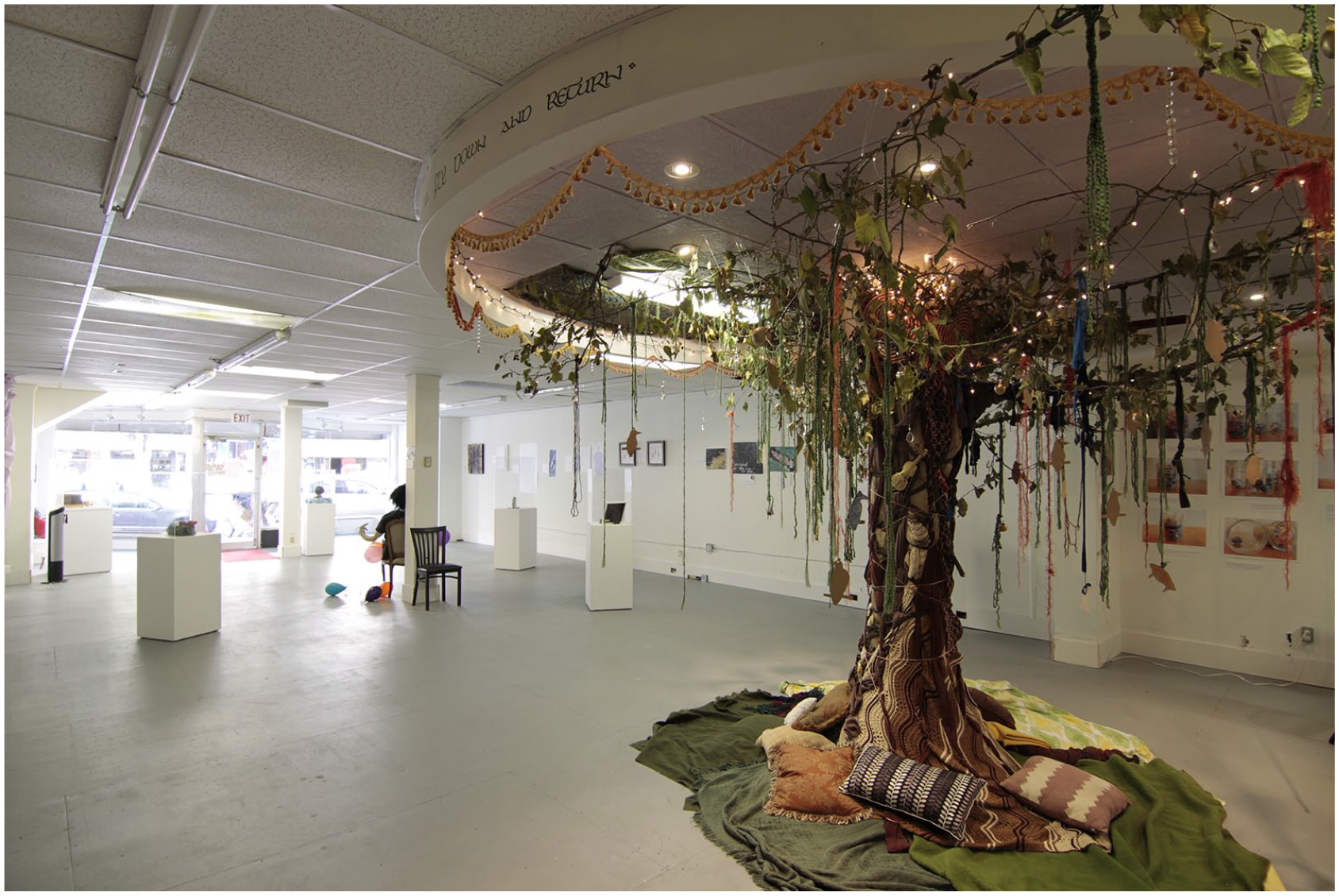
View of heART space gallery with the Yggdrasil the Celtic/Nordic tree of life art installation created by Naomi and Mikel. Photo credit: Trudi Smith.
Creating heART space relied on diverse and sometimes disparate social networks in the city, including friends, families and colleagues from various arts and university connections, as well as health and harm reduction services. Marion coordinated the project logistics, but designing the space, hanging artwork and creating the plan for the month, was guided by Naomi as the youth curator. They and others, including young people whose experiences were being shared, worked together to collect artwork, create labels, organize events and deliver tours through the space. Social media, including a Facebook group was instrumental in spreading interest in the show as were personal networks of the youth advisory group, and event posters created by Meagan and displayed in youth serving agencies, shelters and community organizations. With the help of local news coverage, the word spread to many others who were interested in contributing. It quickly became clear that peer harm reduction staff had been accumulating art and memorials, some created by clients and some by staff, all grappling with the emotional toll of relentless overdose deaths. Having youth curators with personal ties to communities deeply affected by the overdose crisis, especially to artists, Indigenous and street communities, was essential to developing the exhibit as care. Having curators with deep ties of friendship and kinship to community enabled those most affected to open up to public scrutiny their private lives, their use of drugs, their stigmatized deaths and to feel their stories would be cared about and respected. Centring the invitation from youth to participate created a unique opportunity to transform this grief, by gathering the artwork together from various parts of the communities of PWUD and the people who loved them and provides one way to address the gaps in social and emotional supports for peer workers and other local PWUD experiencing grief and trauma identified by Kennedy et al. (2019).
Curation as story-telling
From this invitation, heART space grew into a place to share stories. The physical transformation of what was once an old store into a community gathering space began by curating the space from the outside in. Notably, this space is known in the Victoria arts and downtown communities since it has had several incarnations over the years as a site for grassroots, DIY artistic endeavours. It is located four blocks away from the welfare office, homeless services and methadone clinic that has a familiar vibe of the visible open-air drug market seen in the DTES of Vancouver. In the spring and summer, the street lights just outside are hung with baskets of flowers, where the narrative of Victoria as the ‘garden city’ to tourists contrasts harshly with the reality of unaffordable housing, leaving more people in poverty out in the cold. Prior to the project, the awning on the outside of the store was in bad shape; after discussions the owner offered to pay to have a mural created. Local mural artist Kay collaborated with Colm and Lindsay to spray paint a beautiful design of local plants like lavendar, and Indigenous plants like camas and Garry oak to honour the land and Lekwungen-speaking territories of Victoria. The front entrance of this particular storefront is also significant with the larger story of youth homelessness in this city. Protected from the rain, it is one of a handful of entrances on the street that have not been fenced and locked; youth shared stories of nights spent under this very awning and it was occupied each night of the show.
Understanding the curation of an exhibit like heART space as care engages the idea that its artworks, displayed and created, were more than objects to be viewed for their aesthetic qualities, or even for their emotional force. The art pieces were understood as holding or carrying stories, stories of the deceased individuals, stories of bereavement, love, anger, injustice. Theorized in the study of visual and material culture, objects and belongings, like artwork, have ‘social lives’ (Appadurai, 1986); the inclusion of the various artworks in heART space then becomes part of the narrative of these pieces of art for the friends and family who donated works to the exhibition. Many of the artworks were in some sense ‘biographical objects’ – irreplaceable works embodying some key aspect of the lives of an individual (Hoskins, 1998, 2006), and therefore, as Gell (1998) suggests, having agentive qualities, they are capable of enacting complex intentionalities on the viewer. Following Edwards (2012), we also note the relational qualities of art, especially the ways in which the artworks in heART space were sensory objects; they have been touched, held and cried with. These artworks are wrapped in the care and love of their current owners for the life they represent and the stories they hold and evoke.
In total, over 40 pieces were carefully hung and displayed, including paintings in oil and acrylic, pastels, photographs and videos, carvings, sculptures, hand-made puppets and an exquisite blanket box. The process of giving voice to the lives lived through the sharing of artwork was not easy. The curatorial practice of sharing difficult subject matter must always carry a set of ethics and approaches that are grounded in respect and shared sense of authority over the narrative an exhibition delivers. The obligation and responsibility to accurately document and display the lived experiences of extreme forms of violence and death is itself a form of care (Lehrer and Milton, 2011). As artworks were brought into the gallery space, Marion and Jennifer, along with Naomi and Bradley sat with the deceased person’s friends and family, to hear their stories of those who had died and the ways in which the art was meaningful to them. This process of careful listening recognized the sensitive, emotional and deeply personal nature of the art pieces. Concentrated acts of listening in the context of curating challenging subject matter is a critical form of care that builds bonds of empathy and trust between curators and those sharing difficult life experiences (Lehrer et al., 2011; Munro, 2014; Robinson, 2018). From these intimate conversations with friends and family, Jennifer created labels for each piece of artwork. Other than editing for some clarity, the labels contained exactly what the artists or their families and friends wanted to be said, ensuring that the shared stories remained whole. These labels powerfully conveyed the voices of the bereaved, the mourning suffered over loved ones and an opportunity through an explanation of the art, to speak to the diversity of PWUD, thus creating opportunities for exhibition visitors to see something other than just ‘another overdose death’. Agreeing to allow these pieces to be visible to the public was for some families and individuals a very difficult and brave step in their healing. The decision for participants to publicly share artworks was also an act of care. In making visible their own grief and suffering over the loss of loved ones to overdose, many recognized their ability to help others navigate similar losses.
Two openings took place, each initiated by a blessing from Joan, a local Songhees Elder. A first soft opening for friends and family of people whose work was in the show was an opportunity for healing; Gerry, a Kwakwaka’wakw Elder, and Wayne, from the Snuneymuxw First Nation, did cedar brushing and washing of the tears and a powerful sharing circle took place for the families, friends and supporters of people who died. At the public second opening over 75 people came to listen to the stories of artists and front-line workers who described the profound losses in the community. A manifestation of the ongoing structural violence of colonization, the current overdose crisis in BC has disproportionately affected Indigenous people (First Nations Health Authority, 2017). Given that a number of the participants, both youth and volunteers, identified as Indigenous, and in order to recognize our collective relationship as a community to the Lekwungen-speaking territories in which heART space took place, it was vital to recognize how Indigenous ways of ceremony and ritual are able to help support healing from trauma. An additional example, was the work of one artist in the show, Rick. While Rick was in prison, traditional local carving methods were taught to inmates and Rick’s aunt, who donated the artwork, shared how the salmon on his blanket box, a centre-piece of heART space, represents health and perseverance over obstacles in our lives – teachings he received from Indigenous carvers.
Artwork also included a sculpture made by Naomi of her friend, Ashlie (Figure 2). Naomi described how she made piece after piece about Ashlie while she was in art school, working through her loss by creating and recreating representations of this magical young woman who was loved by all the youth who created heART space. Naomi placed this sculpture just at the entrance-way, welcoming and protecting the space.
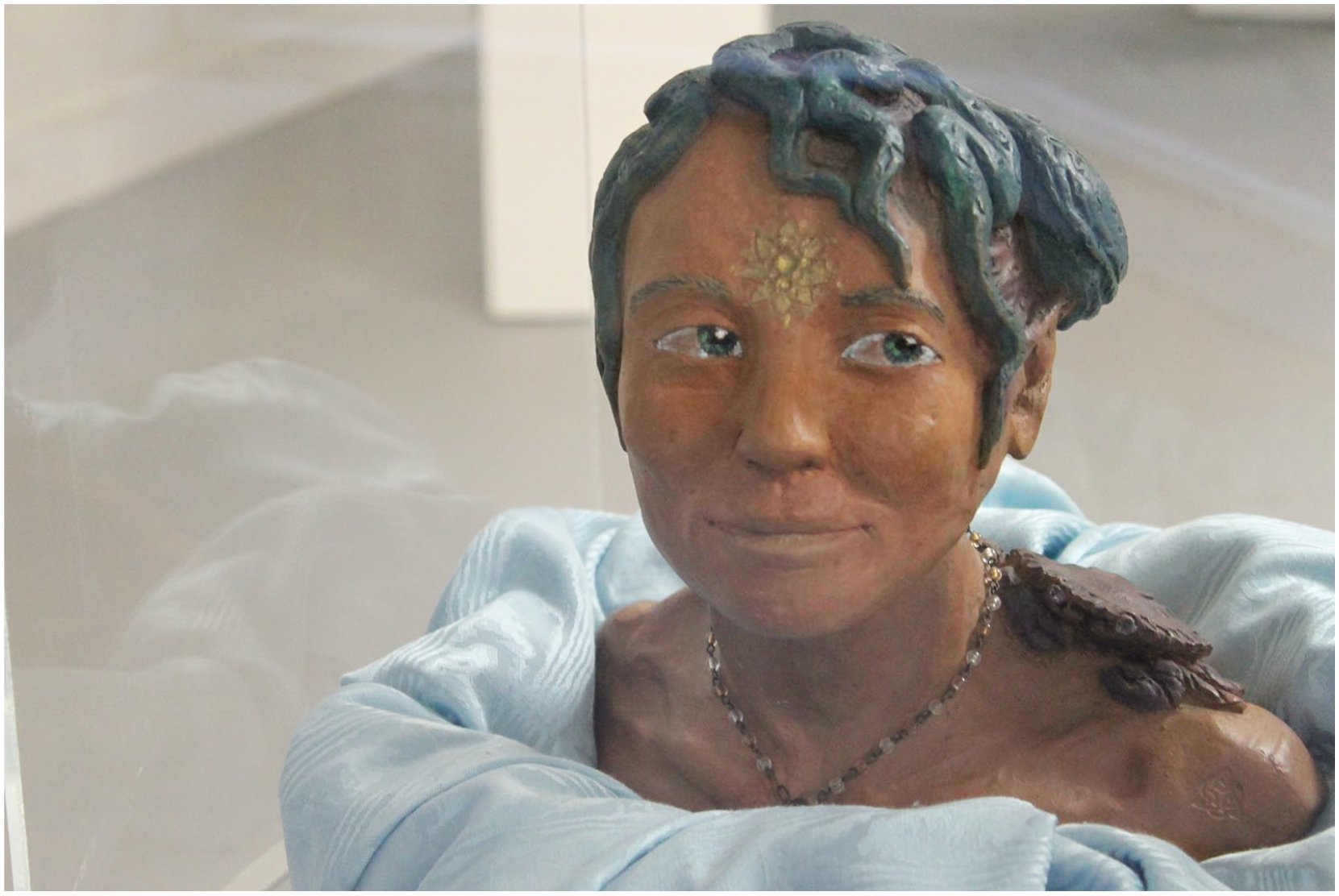
Sculpture Naomi made in honour of her friend Ashlie, a close friend of many youth connected to heART space. Photo credit: Mikel Roos.
Another series of pieces were by Dan (Figure 3), brought in by his parents who gained comfort in being able to share stories of their son through art he had made in drug treatment prior to his passing. Dan’s art created a way for his parents to tell his struggle with drug use and the positive impact he made on the lives of others. During the exhibit, they connected with other parents, finding a space to share their grief that had been so difficult to process as they had felt blame and judgment when others found out their child had died of overdose. Only child suicide compares to the increases in depression, PTSD and other mental health problems for parents whose children have died of overdose (Feigelman et al., 2011). Parents have identified that supporting and helping others advances their own healing (Feigelman et al., 2020). Curatorial research has shown that exhibitions have the potential to create personal, social and emotional connections in the aftermath of tragedy, thereby helping with grief associated with trauma (Melton, 2013; Munro, 2013, 2014). For Dan’s parents and others, the curation and display of their loved one’s art and the safe space of the exhibit helped to transform how stories of overdose are shared. The conversations parents shared brought a new sense of empathy and compassion, helping transform their grief and supporting others in their journey.
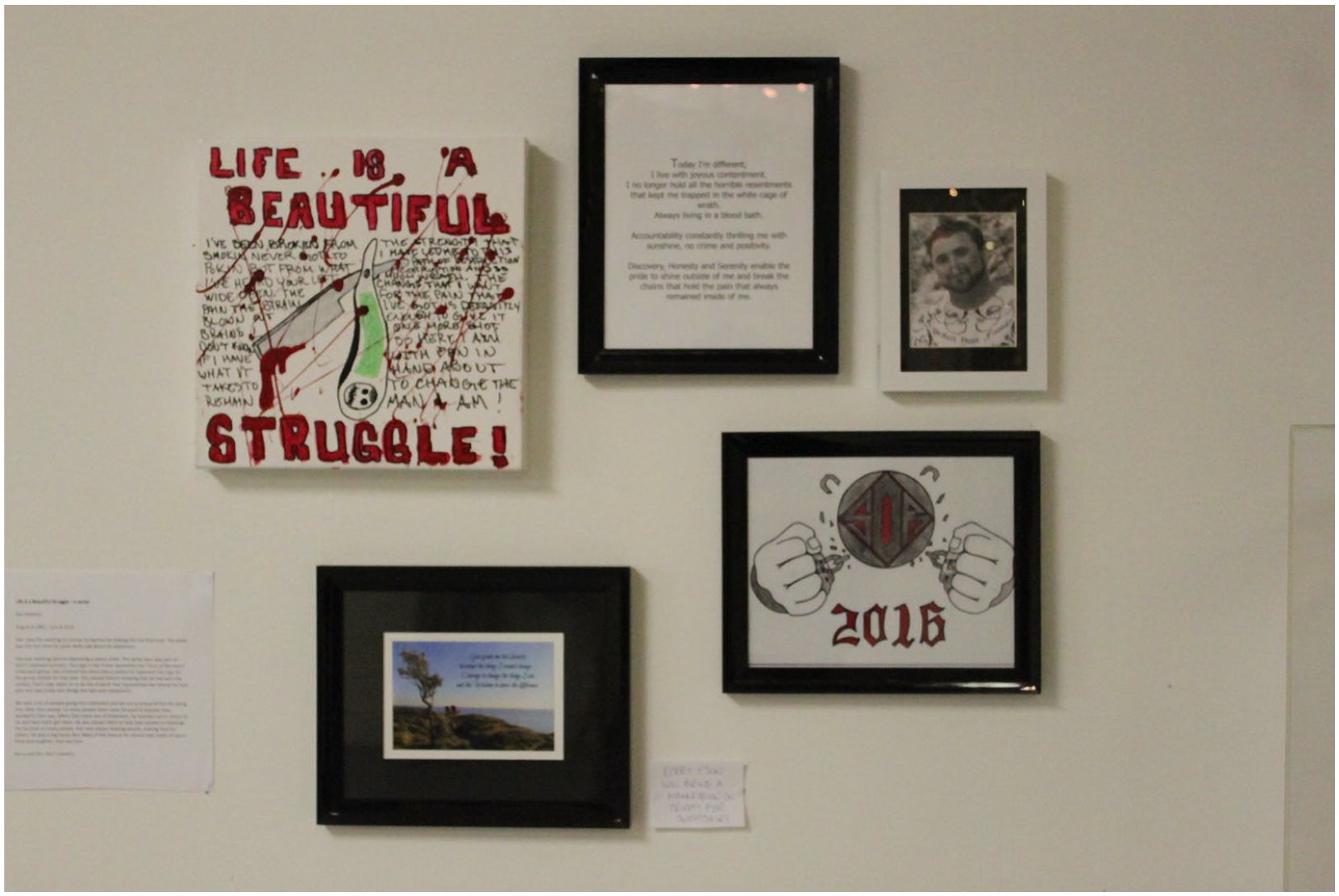
Life is a beautiful struggle – a series by Dan – also known as ‘P’. Photo credit: Mikel Roos.
There were also pieces created to explore the artists’ relationships with those who have died, using materials, varied in colour and texture, to challenge assumptions about PWUD and explore the intricacies of grief and understandings of addiction. One artist saw his pieces as trying to understand the struggles, the abstract and dark thoughts he imagined his friends were experiencing with addiction (Figure 4). A dress maker’s form showed Meagan’s vest covered in patches created to memorialize each death in her street family (Figure 5). The placard read: ‘It is a way to hold on to a little piece of the person and still carry them with you, no matter where you go. Each stitch is a memory shared with the person we lost. The time invested in sewing them on, spent reminiscing about who they were and the impression they left on us. We wear their memories, and show solidarity in loss’. Two videos were shown in the space including a piece by Lindsay Delaronde, the City’s Indigenous artist in residence at the time. ‘We Bring Medicine to the Streets’ depicted Lindsay on hands and knees, just weeks after losing her own partner, washing the pavement with water and medicines, offering prayers and acknowledging poverty, grief and abandonment. Marion displayed a photo essay she created to talk about the complicated, entangled and overwhelming experience of grief and trauma with youth she’d interviewed for her doctoral work. Activist posters and photographs showed key moments of protest in the overdose crisis, including demanding a supervised consumption site, lobbying for the decriminalization of drugs and urging multiple levels of government to provide funding and policies that reflect the seriousness of the overdose death toll.
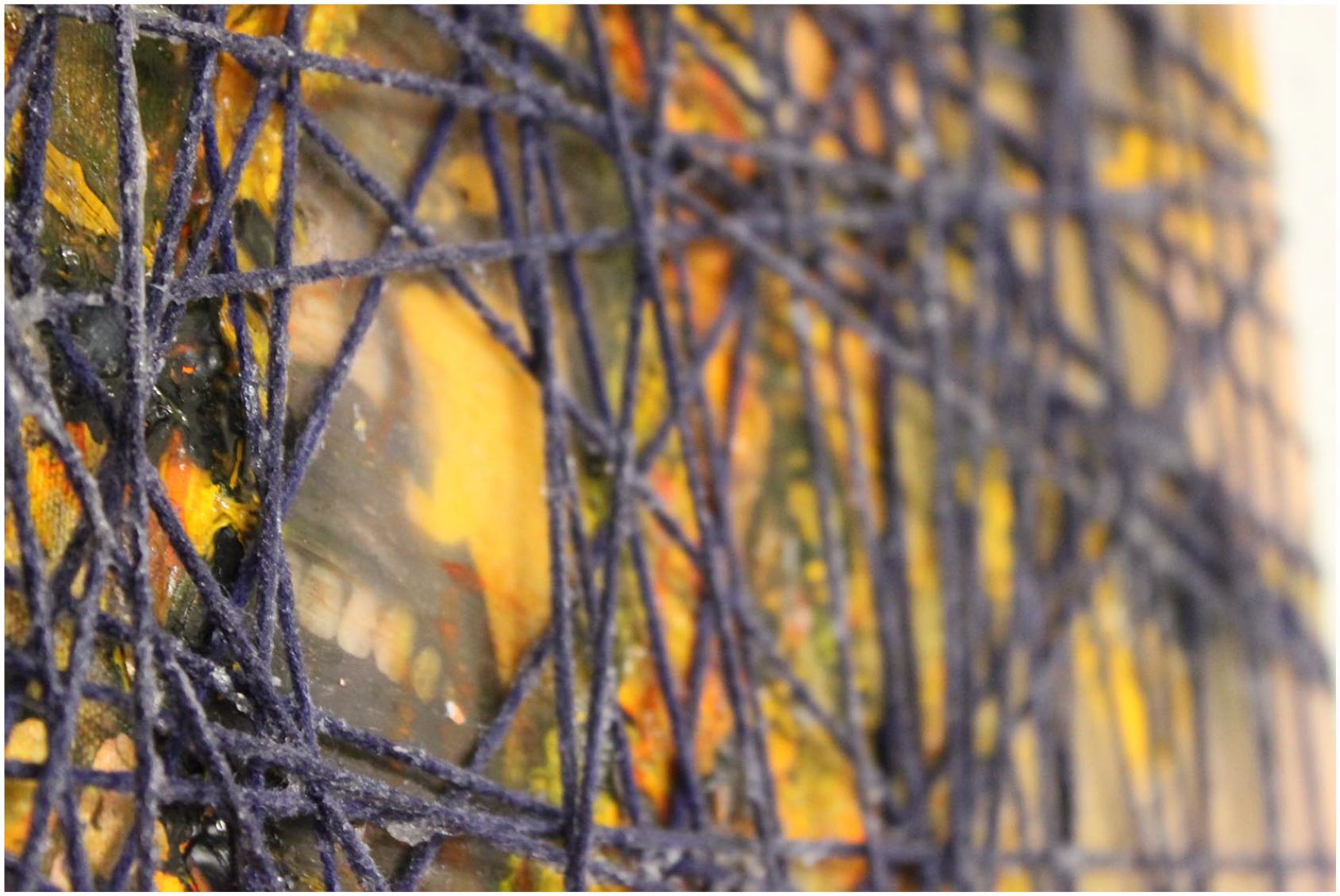
In memory of Ian, Zane, Nykolai By Ryan. Photo credit: Mikel Roos.
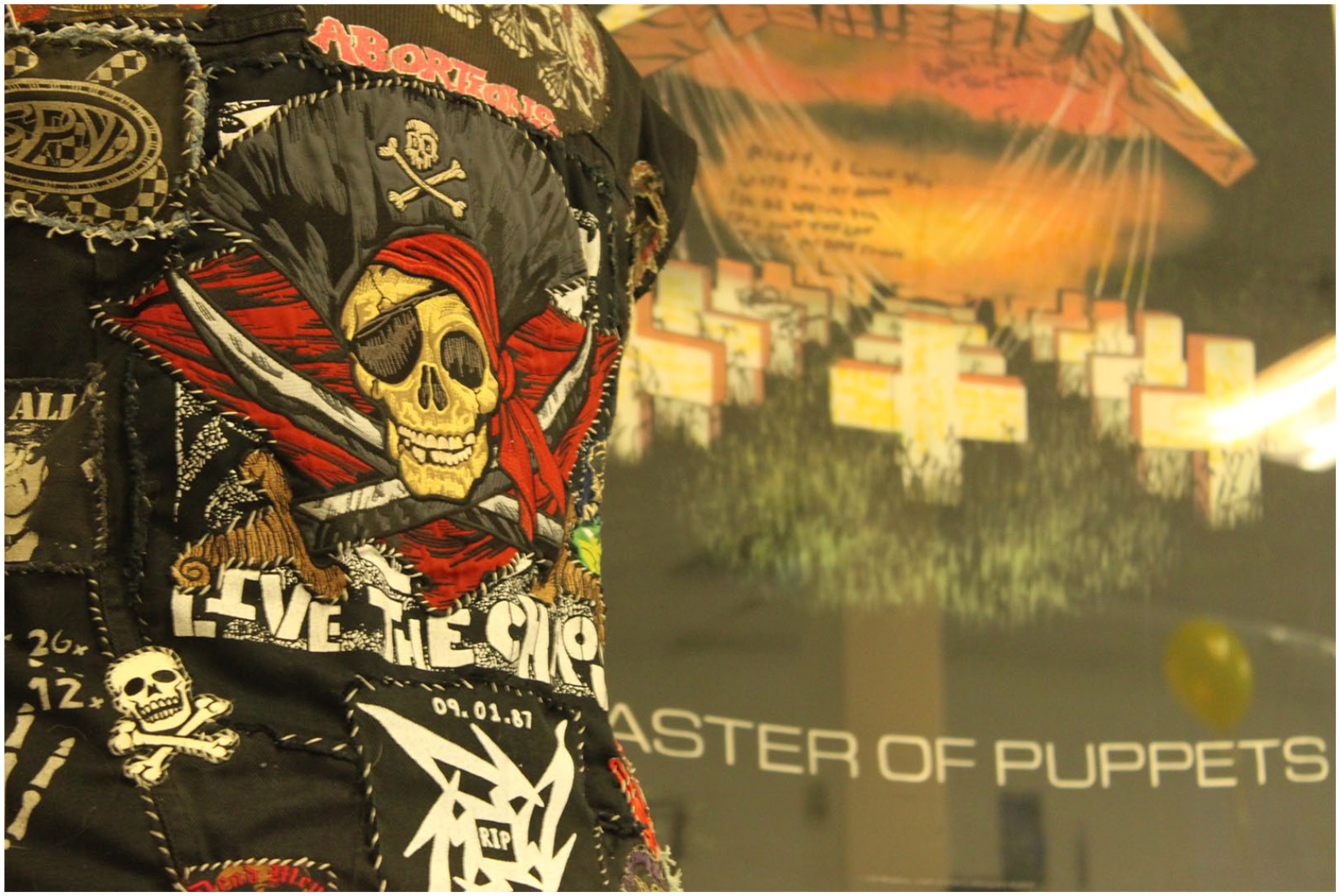
In memory of Mikey from Meagan and friends. Photo credit: Mikel Roos.
Throughout the 3 weeks the space was open, people of various backgrounds and diverse relationships to drugs and overdose wandered in. Some came to read the stories of the artworks, some to get some food, or a coffee, to join a workshop, or to work on an art piece they’d started on another day. As visitors spent time with each piece of artwork on the walls, reading the labels, or talking with youth, they became witnesses to the stories of love and loss told through the art, and to the very real human cost of the opioid crisis. Curating the art enabled care about the artist and lives harmed by overdose, but it also generated practices of care for visitors. As Jackson (2002) suggests, storytelling is ‘a vital human strategy for sustaining a sense of agency in the face of disempowering circumstances’ (p. 15) and ‘a coping strategy . . . [that can entail] changing one’s experience of the world’ (p. 18). Through their interaction with the art and the space, some visitors were able to tell their own stories; stories of shared experience, of connection to an artist, to drugs and overdose, and stories of trauma. Visitors to heART Space were also vital to spreading the word about the exhibition to others, and many returned to the gallery several times to participate in multiple events or to just sit and be in the space. This highlights how visitors come to play an integral role as collaborators in a participatory arts project like heART space, where a sense of ‘creating together’ evolves during the course of the project (Sinner and Conrad, 2015: xvii).
Collaborating as care
As an example of participatory arts and collaborative curating, heART space was a community-driven collaboration where much of the control over the project rested with the youth. Liegghio (2020) highlights how in participatory projects, the community participants have a strong epistemological position about their circumstances, positioning them as the drivers of knowledge about their lives. For Liegghio (2020), this means the researchers, curators or project grant holders, need to take the position of allies in the process of building projects with young people rather than taking control. In the case of heART space, the youth involved had lived experience with grief, drug use and homelessness, which positioned them as drivers of the project. In smaller galleries or museums where full collaboration is possible, these spaces can foster a sense of community (Crooke, 2007; O’Reilly and Parish, 2015; Robertson and Gregory, 2018). Collaborative project development can build both a sense of agency and solidarity amongst community, particularly when members have control over the outcome of the project. HeART space creators were clear from the outset that the space was not to function like a typical art gallery – that is, a formal setting with structured curatorial choices for the arrangement of the art and with no place within the gallery to relax and feel comfortable. They did not want the space to feel cold and rigid with rules that would make certain people feel unwelcome. This collaborative vision for the space becoming a place where other youth felt comfortable was critical to the success of heART space and allowed for acts of care to unfold throughout the month.
Key to the youth vision of the gallery as a place of care was a tree sculpture (Figure 6), created in the centre of the gallery and transforming and enlivening the space. Naomi envisioned the tree as soon as she saw the central pillar and curved ceiling detail. She described the tree: ‘Yggdrasil is an immense mythical tree that connects the nine worlds in Norse cosmology. Most cultures have a sacred tree iconography. The belief with Yggdrasil is that it has three realms, the upper, middle and the lower. The upper realm is where the soul goes to sit and wait to be reincarnated in the form of a bird’. To form the tree, Mikel and Naomi used soft materials such as donated fabric scraps, blankets and pillows sourced from second hand stores so that visitors could hug it or sit below and rest against the trunk. Live branches were strung with lights, and hung with strands of yarn that people touched as they moved through the space. Kage sat and cut out small paper birds to hang from the tree, so that if people felt inspired they could write or draw something on a bird to remember and honour loved ones. The tree is an excellent example of both a participatory, collective arts project created in situ, and collaborative artwork that serves as an act of care, specifically designed to provide physical and emotional comfort (Figure 7). Anyone who entered the space could participate with the tree in curating memories, thoughts and grief, all of which produced a powerful, collective contribution to the overall exhibition.
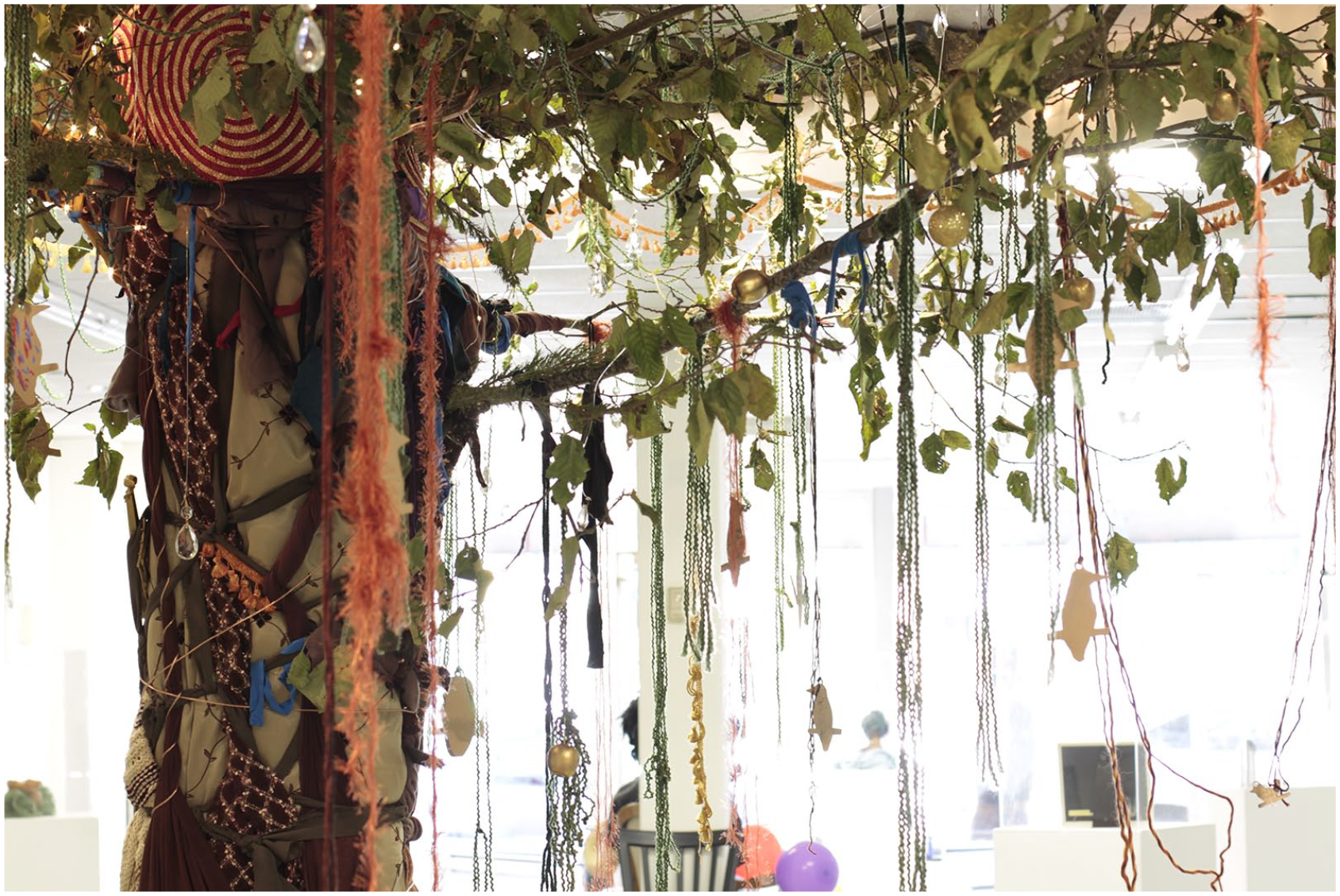
Yggdrasil the Celtic/Nordic tree of life. Created by Naomi and Mikel. Photo credit: Trudi Smith.
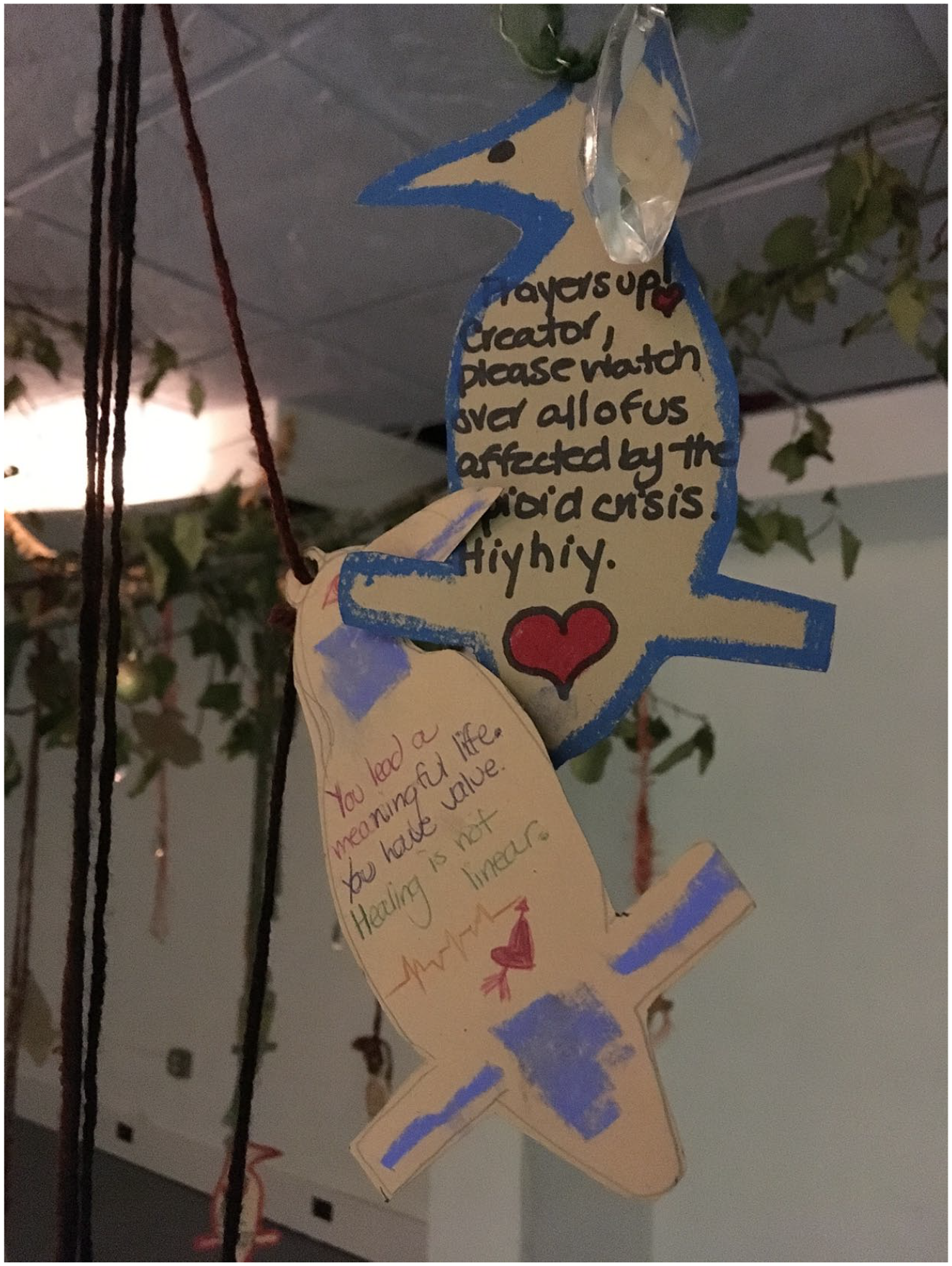
Close up of the birds added to the tree of life. Photo credit: Marion Selfridge.
Curating the space with community participation continued throughout the month, as art work created in weekly open studios, facilitated by local artists with donated art supplies, was added to the walls. Workshops with a specific therapeutic focus produced artwork that honoured emotions and experiences with overdose. As visitors sat and collaged, they talked about people in their life who they worried about, or who worried about them, as they ripped, cut and glued paper. A mask making workshop series culminated in an evening performance by youth and others singing, playing guitar, dancing and doing spoken word. These examples show how artistic creative expression has powerful ways to transform grief and to help make sense of loss.
The success of heART space, like so many grassroots creative projects, relied extensively on the collaboration of volunteers. Many people from the local arts and university community in Victoria came forward to offer their skills. Bradley and Lorilee came from the Legacy Art Gallery to help hang artwork and capture the stories from family and friends for the labels. The Art Gallery of Greater Victoria lent frames and plinths so the artwork could be shown in a professional way. Friend and photographer, Trudi, took beautiful gallery shots of the show. University students, Burning Man memorial temple guardians, various friends and front-line workers came to lend a hand, including Lisa, whose big truck was essential to move furniture. Many people showed up with food and supplies, some came just to sweep the floor. As people came to help, this created a community around the gallery space and in this sense, coming together to work in true collaboration, is also a form of care.
Honouring trauma
Curating an exhibit focussed on overdose deaths meant directly engaging the trauma and deep emotions of the overdose crisis. Curating as care in the context of heART space powerfully showed deep fault lines in society around these deaths since they are so widely stigmatized and regarded as ‘inevitable’ and not deserving of grief and mourning. Thus, creating ways to stay safe when sharing trauma was a key part of the physical design of heART space. Tucked inside the gallery was a cozy space with low lighting and soft furnishings for people to chill, to host conversations and join healing sessions enabling spaces for people to acknowledge and, literally, sit with the trauma they held and were witnessing in the exhibit, in their lives and in the community. Local front-line workers and others skilled in compassionate listening volunteered as Dharma Punk docents, available for visitors wanting to talk about the issues, or tell stories of loss. Nourishing the heART, an event to honour front-line workers, offered free massage, acupuncture, cedar brushings and chocolate to exhibition visitors. A local harm reduction organization held a private meeting for their staff in the space. An alternative girls’ school that had lost one of their classmates to overdose and a social work class on trauma toured the space, each group sitting quietly afterwards, reflecting and decorating birds for the tree. An Indigenous pipe ceremony blessed the space, and candles were lit whenever people were present. Through gentle talk, physical comfort, intimate gestures, tasty food and other ways that touched people’s senses, the space took on a heightened quality – sacred even – to reflect and talk, grieve and heal.
Robertson and Gregory (2018) highlight how the intimacy that can be achieved in smaller gallery spaces versus larger institutional settings creates opportunities for better connection, which then allows for certain forms of work or projects to take place. This intimacy is achieved not only because the design of the gallery feels warm, welcoming and comfortable unlike the typically austere white wall aesthetic of an art gallery, but also because the focus of the gallery is geared more specifically towards certain groups of people, often people that are marginalized (Robertson and Gregory, 2018). Intimacy was crucial in heART space and led to very specific design decisions that met the needs of comfort, safety and creating a general sense of feeling welcome. In her previous research examining how institutional policy affects how arts and research spaces are able to work with difficult histories and emotionally challenging projects related to human rights and social justice issues in Canada, Jennifer found smaller, more participatory and community-focused institutions were the most successful at creating collaborative projects that centre first and foremost, the needs of the community (Robinson, 2018, 2019). Through interviews with curators, she found a high degree of care is critical when working with participants who have experienced trauma so that the possibilities of retraumatizing, that is, participants re-experiencing personal traumatic memories of past events as a result of working on a current project, are minimized by putting into place the required support necessary for the protection of peoples’ wellbeing from the very onset of a project (Robinson, 2018, 2019; see also Walsh, forthcoming). Marion’s experience as a social worker and grief researcher, coupled with the wisdom of lived experiences of youth protecting one another, meant careful design decisions in heART space helped ensure the gallery was safe to share trauma, honour trauma and protect from further trauma.
These careful acts set in place to honour trauma, allowed heART space to become a place where the grief of overdose loss could be witnessed. This is the premise of witnessing life stories through art and exhibitions: to create the space for the stories of experience with overdose to be recognized and legitimized, and to allow for family and friends of those lost to overdose to have the opportunity to reclaim pride in the life of their loved ones. As an event, a marked moment in time when participants, artworks, programming and gallery design come together, an exhibition can have a force and a social impact, shaping how an issue is thought about (Simon, 2014). As an exhibition, heART space created the public space to begin to have difficult and truthful conversations about disenfranchised grief and the stigma of substance use, overdose and homelessness.
Transforming grief into action
Exhibitions can be transformative; they are places where people go to feel and spending time in an exhibition creates affective responses, whether positive or negative. We take our understanding of affect, as defined by Wetherell (2012: 4) as ‘embodied meaning-making’. In the context of heART space, it was very clear that both participants and visitors navigated a series of challenging emotional responses to the content of the artwork. Research indicates emotional reactions to exhibitions containing challenging subject matter can produce feelings of empathy, which can then foster better connections amongst people and create meaningful change in perceptions (Melton 2013; Munro, 2013, 2014; Simon, 2014; Witcomb, 2013). Engaging with an exhibition can also result in transformative learning, a process whereby encountering an experience challenges one’s perspectives; these challenges lead to critical self-reflection and questioning of one’s beliefs pertaining to those perspectives (Kroth and Cranton, 2014). Homelessness and drug use are highly visible and stigmatized experiences and the ability to educate visitors and transform perceptions through heART space about these realities in Victoria was crucial. In this way, reducing stigma through a curatorial project, is also a form of creating care.
More than 20 events took place at heART space, and several were intended specifically to transform awareness, skills and policies related to drug use. Training sessions about naloxone inspired frank conversations among youth about the poisoned illicit drug supply. The Ministry of Mental Health and Addictions and Island Health saw close to 20 PWUD come to the exhibit for a day of discussion and consultation and to experience the art firsthand. Comments from the Ministry were that the cozy and comfortable humanizing environment of heART space was exactly what people said they were looking for in terms of services. A stakeholder meeting of youth agency workers and government policy makers discussed overdose prevention sites for youth under 19. While overdose prevention sites have started to be more available for adults locally (Wallace et al., 2019), making those sites accessible and welcoming for youth, especially those under 16, has been a concerning and unresolved issue.
Through the events held at heART space we worked to transform rage – to create a place to be with anger about the impact of criminalization of drugs on overdose and to acknowledge the profound grief felt by front line workers and the community. As an informal art gallery and event space, heART space helped to translate grief into social action; transforming the isolation of grief into a shared experience of public ritual and remembrance and into collective action. Comments and testimonials from participants and visitors made abundantly clear that heART space also transformed perceptions about PWUD as well as the stigma about overdose and illicit drug use. Finally, heART space helped to transform relationships – the relationships parents have with other parents, the relationships front-line workers had with each other and the relationships between visitors and the youth and others who shared their experiences. In this way, curating heART space provided care to those in need during the opioid crisis and helped to transform helplessness and disconnection, giving people a tangible way to help.
Final thoughts: Curation as care and care through curation
As October ended, participants began to close heART space, taking art down in a way that would continue to build empathy, understanding and care. The ending was emotional and powerful; many hugs and tears were shared as people told stories, gave each other hope and said goodbye. When the space was finally cleared, Naomi came in and carefully took down the tree and all the birds that had been gathered. That night, several of us came together at a Halloween community bonfire to burn the birds and the tree limbs and release the wishes and lives we had celebrated and mourned.
When Marshall (2013: 62) asked children about the beauty they saw in the Palestinian refugee camps in which they lived, one responded: ‘I mean how close people are. How we take care of each other’. Marshall argues that children living through war disrupt the ethics of trauma by identifying how beauty is performed through everyday acts of care. We see the parallels through heART space and the war on drugs, where the stories of daily suffering from youth became a narrative of everyday care and beauty, where noticing and strengthening practices of care in our harm reduction and curatorial work were vital. We also see how heART space serves as an important example of the potential for participatory and community-engaged arts practices to create alternate avenues for support and dialogue concerning drug use, homelessness and grief, a combination that the young people involved in this work know well.
While each community and exhibit will be distinctive, we draw attention here to what we see in retrospect to be important elements in enabling curation as care. We emphasize that heART space was an exhibition about the loss and grieving felt to overdose, and the recognition of the enormous toll this loss has taken on young people in Victoria. This was not an exhibition about drug use and very conscious decisions were made during this project by youth curators not to centre images and artwork of substance use. Curation as care is, first and foremost, a social and relational process, enacted through social networks and operating collaboratively to foreground the knowledge, experiences and needs of those most affected by the exhibit. The curatorial process for heART space was at its core, grassroots, community-driven and experimental; the project took place over just a few months from early planning to the final closing of the exhibition. Given this timing, heART space depended on the mobilization of skills beyond professional training in arts and curation. Even more important was the lived experience and knowledge of the youth and the willingness to learn and offer time that each youth, artist, researcher, curator, volunteer and visitor brought to this project. It is vital that the exhibit space be conceptualized not only as a place to view art but as place to support people witnessing and telling stories of trauma. The objects being curated are in some sense ‘alive’ with recalled and emergent stories that give voice to those who have experienced trauma and as such merit thoughtful, respectful and ethical handling. In sum, we have found that curating as care and with care requires stepping away from preconceived notions of what an exhibition ‘should be’ and what skills are necessary to successfully create safe spaces for healing. In answer to Butler’s question, this exhibition was a reminder that all lives are grievable. What is required at times, is to be given the physical and social space to grieve, to sit with loss and sadness, supported by practices of care which push back against disenfranchised grief, mobilize community and which foster transformations in understanding stigmatized lives.
For those of us that helped with heART space, this project was a profound lesson in what it means to research, collaborate and curate with care and to recognize that our own ways of working were also radically transformed. For Marion, heART space transformed ways to make meaning, share the deep learnings and to process the intense losses from her doctoral work. For Jennifer, the experience of sitting with parents who had lost a child, youth recounting the numbers of friends they have lost and young people sharing challenges has profoundly transformed her own sense of care in community-driven research. Connecting to our own suffering is the way to push change, to nurture compassion, and embrace transformation, and to make visible the experiences of grief of those whose losses are so enormous as to be almost unimaginable.
Footnotes
Acknowledgements
sWe gratefully acknowledge the incredible work from Naomi, Meagan, Mikel, Kay, Kage, Colm, Lindsay and all of the youth involved in heART space, the community agencies and organizations, volunteers and contributors, and especially the artists and friends and families who shared their heart ache, their stories and their art.
Funding
The author(s) received no financial support for the research, authorship and/or publication of this article.
