



Abstract
Drug overdose deaths in pre-teen and adolescent students have risen over the past several years, causing increasing concerns in our society, along with concerns over the rise in availability of more counterfeit pills and illegally manufactured fentanyl. School nurses interface regularly with pre-teen and adolescent students and therefore are in a position to recognize students at risk for illicit drug use and provide important education to students, staff, parents, and the community. The purpose of this article is to briefly discuss risk factors for opioid misuse and to provide recommendations for interventions school nurses can use, including collaboration with other school and community leaders, to help prevent opioid overdose and death in pre-teen and adolescence.
According to new data from the Centers for Disease Control and Prevention’s State Unintentional Drug Overdose Reporting System (SUDORS), drug overdose deaths in pre-teen and adolescent students (aged 10–19 years) in the United States rose 109% from 2019 to 2021 (Tanz et al., 2022). Although deaths from drug overdoses have increased, illicit drug use among pre-teen and adolescent students has declined. The increase in deaths from drug overdoses correlates with more dangerous drug use among students and not more students using illicit drugs (Tanz et al., 2022). Dangerous drugs commonly used by students involve opioids, illicitly manufactured fentanyl, and counterfeit pills (Friedman et al., 2022; Tanz et al., 2022). A majority of pre-teen and adolescent students’ drug overdoses are preventable and do not have to end in student deaths.
Risk Factors for Opioid Misuse
Several risk factors exist for pre-teen and adolescent student opioid overdose and death. These risk factors include biological risks, familial risks, mental and behavioral health problems, and lack of education regarding the dangers of prescription drug misuse. Pre-teen and adolescent students have neurobiological vulnerabilities, such as impulsivity and altered contextualization of potential drug risks, making them more susceptible to opioid overdose and death (Nairn et al., 2022). For instance, some students may incorrectly perceive prescription drugs as safer than illicit ones. Familial risk factors include adverse childhood events (ACEs) such as early repeated trauma, neglect, violence, loss of a family member, and family instability (Centers for Disease Control and Prevention, 2019; Tanz et al., 2022). In addition, students who live with a family member who has a prescription for an opioid (Nairn et al., 2022) and those who have increased conflict with their parents have been found to have an increased risk for opioid overdose and death (Ford et al., 2023).
Researchers suggest pre-teen and adolescent students at greatest risk for drug overdose may reflect a predisposition toward mental illness. For example, more than 40% of students who died from a drug overdose had a history of a mental illness, such as depression, suicide attempts, self-harm behavior, or had been treated for a mental health condition (Tanz et al., 2022). Finally, a lack of accurate information on substance misuse is a risk factor for opioid overdose and death since many students often do not know or understand the dangers of illicitly manufactured fentanyl and counterfeit drugs (Tanz et al., 2022). The increase in pre-teen and adolescent student opioid overdose deaths highlights the need to develop, implement, and expand strategies and interventions to address these risk factors. Due to their frequent interaction with pre-teen and adolescent students in the community setting, school nurses are well positioned to address this critical public health concern.
Recommendations for School Nurses
School nurses can play an essential role in preventing opioid overdose and death in pre-teen and adolescent students through public health collaborations, early identification of students at risk for misusing substances, and general educational interventions focused on reducing substance misuse (Tanz et al., 2022). Public health collaborations might include working with police officers and community agencies to warn teachers, parents, and students when illicitly manufactured fentanyl and counterfeit drug deaths are rising in a community. Early identification of students at risk for opioid misuse is essential in reducing early deaths from overdose and long-term substance use disorders, as nine of 10 adults with substance use disorder start before 18 years of age (Allen et al., 2022). In addition to traditional risk factors for substance abuse, school nurses should be aware that students who are less connected to their school community, at risk for dropping out, have more unstructured social time, and exhibit less connected family behaviors are also at increased risk for substance use (Ford et al., 2023). Finally, school nurses can destigmatize mental health treatment, as a protective factor against drug use or overdose, by providing education and facilitating referrals to mental health providers for pre-teen and adolescent students with underlying mental health disorders (Tanz et al., 2022).
The Role of Education
Researchers strongly suggest education about opioid overdose and death is a helpful barrier in preventing opioid misuse (Tanz et al., 2022). Advocating and providing health education to teachers, parents, and students has always been an essential function of the school nurse. Therefore, school nurses participating and supporting these education efforts are necessary to prevent opioid overdose and death (Table 1) (Bohm & Clayton, 2020).
Educational Resources
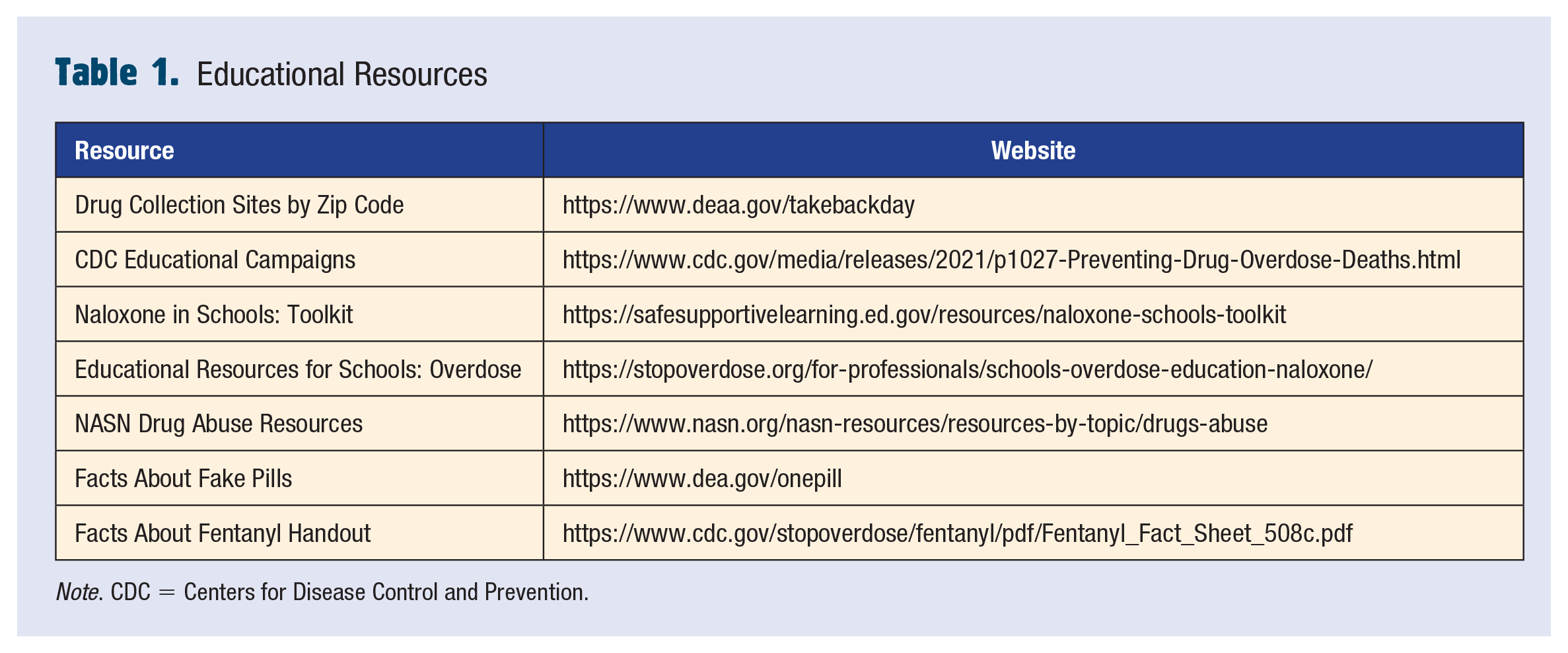
Note. CDC = Centers for Disease Control and Prevention.
Approximately 25% of pre-teen and adolescent student overdose deaths had evidence of the use of counterfeit pills, and counterfeit pills often mimic the appearance of oxycodone or alprazolam but frequently contain illicitly manufactured fentanyl or other counterfeit drugs (Tanz et al., 2022). Hence, to prevent opioid overdose deaths, education provided by school nurses should focus on the dangers of illicitly manufactured fentanyl and counterfeit drugs. School nurses can also teach students to only take pills and medications prescribed to them by a healthcare professional and emphasize they should never take drugs while they are alone (Tanz et al., 2022). Finally, parents should be educated on the risks of keeping unused prescription opioids in the house as a way of preventing opioid addiction from ever starting (Voepel-Lewis et al., 2022). One way school nurses can do this is to promote the U.S. Drug Enforcement Administration’s (DEA) National Prescription Drug Take Back Day, which encourages the public to remove unneeded medications from their homes as a measure of stopping medication misuse and opioid addiction from ever beginning.
School nurses can educate parents, students, and school staff on the signs and symptoms of opioid misuse and overdose and how to respond to an overdose. In addition, school nurses should advocate for increased access to naloxone, a medicine used to reverse an opioid overdose rapidly, to be available throughout the school and not just in the nurses’ office (Friedman et al., 2022; Tanz et al., 2022). The procedure for safely administering naloxone must also be reviewed with school staff and the community.
Conclusion
In the long term, preventing opioid overdose and death in pre-teen and adolescent students requires public health collaborations, early identification of students at risk for misusing substances, and general educational interventions focused on reducing substance misuse. School nurses are well positioned to partner with police offices, intervene early in childhood trauma, and assist in creating communities conducive to mental health, with safe access to comprehensive health care. When school nurses educate teachers, parents, and students about the dangers of opioids, illicitly manufactured fentanyl, and counterfeit pills and ensure access to naloxone in schools, they can save lives. ■
Footnotes

Sarah Oerther Ph.D., RN, ANEF is an Assistant Professor at the Trudy Busch Valentine School of Nursing, Saint Louis University. Previously,Dr. Oerther was a Senior Specialist for Poison Control at Cincinnati Children’s Hospital Medical Center, where she translated evidenced-based practice to diverse interprofessional learners across settings and educational levels to reduce drug overdoses in the community. Dr. Oerther is an elected Fellow of the Academy of Nursing Education of the National League for Nursing as well as a Fellow of the Royal Society for Public Health in the United Kingdom.
Dr. Bultas is on faculty at Saint Louis University School of Nursing and teaches in the Undergraduate and Pre-licensure Nursing Programs. Her expertise is in Pediatric Nursing and working with children and families with chronic illness and developmental delays. She continues to practice as a substitute school nurse.