




Abstract
In Andean countries, the pishtaco is understood as a White-looking man that steals Indigenous people’s organs for money. In contemporary Amazonia, the Shipibo-Konibo people describe the pishtaco as a high-tech murderer, equipped with a sophisticated laser gun that injects electricity inside a victim’s body. This paper looks at this dystopia through Shipibo-Konibo children’s drawings, presenting composite sketches of the pishtaco and maps of the village before and after an attack. Children portrayed White men with syringes and electric guns as weaponry, while discussing whether organ traffickers could also be mestizos nowadays. Meanwhile, the comparison of children’s maps before and after the attack reveals that lit lampposts are paradoxically perceived as a protection at night. The paper examines changing features of pishtacos and the dual capacity of electricity present in children’s drawings. It argues that children know about shifting racial dynamics in the village’s history and recognise development’s oxymoron: the same electricity that can be a weapon is also used as a shield.
Introduction
It was the start of the rain season in Amazonia. A football match had kept the community lively after sunset, and people were slowly starting to return to their homes. Three gunshots echoed into the night – a sign that someone was in danger. The noise scared women and children back into their houses, while men armed themselves and headed to the forest. The victim was a 30-year-old Shipibo-Konibo man who worked as a guard in the community’s lodge for gringos (White tourists, mostly from Europe and the US). 1 He was heading for his night shift when he felt a sudden shock in his back and fell to the ground. As he looked up, he found himself surrounded by White men and fired the alert to the village. He managed to run towards the lodge, where he passed out.
The victim was carried back to the community with a convulsive body movement and dripping sweat. He felt electricity inside his body and experienced shocks whenever he tried to drink water. Women fed him highly sweetened milk instead, but his agony persisted. The community then resorted to the local medical post, provided by the government with Western medicine. The two nurses available declared that the victim’s vitals were normal and there were no signs of violence. Thus, they treated the case as an anxiety crisis, applying a sedative that only worked briefly. Distrusting the nurses’ diagnosis and anxious about the victim’s condition, the community decided to transport the man to a private clinic in Pucallpa, the nearest city. It was the only place with sufficiently advanced technology to remove electricity from a person’s body. After a few days in the hospital, the man was discharged with no clear diagnosis, an expensive bill and fully recovered.
I was living in the village to research children’s experiences of development projects. Although I heard countless testimonies about pishtacos, described by the Shipibo-Konibo as a White man who invaded Indigenous villages at night to extract people’s organs with electric weapons, I struggled to fathom how such an operation could take place in the middle of the forest. Nonetheless, the recurrence of those stories indicated the pervasiveness of this threat. Concerned about a potential network of organ trafficking, as those described by Scheper-Hughes (2000), I collected informal interviews of former victims and eyewitnesses, along with children’s testimonies of the above incident. In this paper, I focus on the analysis of children’s drawings.
The nature of my research led me to spend most of my time interacting with groups of children. As in other child-centred ethnographies (Morelli, 2017; Schwartzman, 1978), play was a powerful research tool. The pishtaco appeared in games (for instance, in a version of catch played in the river), in drawings and in jokes about foreign people that came to the community. While I was attentive to these occurrences, I underestimated the importance of these stories in daily life. In the aftermath of the attack, I looked at the pishtaco through a different lens. That vivid experience, together with children’s illustrations, made me grapple with the tangibility of this rumour.
In this paper, the images conjured by children’s drawing give substance to these raiders and the repercussions of their attack. Based on theory about fantasy and imagination, I approach Shipibo-Konibo children’s artwork as meaningful visual evidence. The analysis is divided into two sets of drawings: composite sketches of the pishtaco and maps of the village. Together, these sections offer perspectives, respectively, from before and after the attack. The ensuing discussions incorporate fieldnotes and other secondary data to emphasise the history in the stories (White, 2000) depicted in children’s art.
Imagining rumours through children’s drawings
Oral testimonies are not stable as a written text. In retelling, a story gains overlapping elements that hinder its apparent ‘realism’. Children’s perspectives have often been dismissed from research for similar reasons, because they lack the palpable veracity of facts (Von Benzon, 2015). Nonetheless, imagination is embedded in a collective symbol-system that is apprehended and transformed through socialisation (Harris and Rapport, 2015). Thus, it is relevant for understanding a culture. Toren (1999) argues that this is why studying children should be central to ethnography, because children’s imagination reveal the ruptures and continuity in cultural transmission.
Researchers have long documented pishtaco stories among different Indigenous nations in Andean countries (Oliver-Smith, 1969; Roe, 1988). However, changes in testimonies, particularly regarding the murderer’s physiognomy and form of attack, impede his identification. The assassin is mostly described as a tall, White doctor that eviscerates Indigenous people (Weismantel, 2001), although in Amazonia he has also gained mestizo features (Santos-Granero and Barclay, 2011). Older reports of his attack describe him as extracting the victim’s fat to produce an ointment, which resonate with European medical practices at the time of invasion (De Pribyl, 2010). But in Amazonia pishtaco attacks are also filled with technological elements. 2
Critical shifts in testimonies are often interpreted as inconsistencies, but are contradictions necessarily unreal? Recalling the work of Lévi-Strauss (1972), oral history preserves knowledge by collating pieces of reality into a memorable narrative of phenomena. In addition, the variations in witnesses’ accounts also convey a unity (White, 2000). Despite changes in the pishtaco’s physiognomy and tactics, reported attacks share the same overarching message about perverse forms of racialised violence towards Indigenous peoples.
If we embrace the diversity in those testimonies as culturally relevant, the fantastic in each account can be investigated as a meaningful social act (Weiss, 2002). An inquisitive attention to imagination expands our comprehension of fieldwork data, going beyond the traditional focus on what makes sense to allow space for paradoxes (Stevenson, 2014). Children’s drawings can serve as visual aids in this exercise: among portraits of the murderer and maps of the village, they illustrate the contradictions of life in developing Amazonia.
Indigenous children’s perspectives are largely absent from research in Amazonia, with very few exceptions (e.g. Da Silva et al., 2002; Morelli, 2017; Peluso, 2015). Their insights remain invisible in research and policy, despite them being among the most vulnerable populations in the Americas (Ames, 2020). This is becoming more critical with the increase of child-centred development projects in the region, which may engender cultural shifts through early intervention in children’s lives. By exploring drawings, this paper moves beyond the common paradigm of children’s voices towards an analysis of children’s silences and unconventional communication (Spyrou, 2016) in their depictions of the pishtaco and his attack. Children’s art and their creative processes expand our comprehension of this dystopia, reinforcing the importance of including their perspectives in research about social change, as argued by Toren (2007).
Methodology
I lived in Peruvian Amazonia from August 2019 to March 2020, when the pandemic abruptly disrupted my research plans. To understand children’s experiences, my methodology consisted mostly of participant observation, which demanded an immersion in children’s context (Bluebond-Langner and Korbin, 2007). I looked for a village that would be willing to host me for an extended period and in proximity to children. My identity as a Brazilian mestiza significantly affected this process. Because the village was close to Brazil, people had questions about the fires in Brazilian Amazonia upon my arrival and were pleased by my position against agribusiness. I was never mistaken by a tourist and I was expected to share women’s responsibilities in the household, which gave me easy access to children of the kin. In a communal assembly organised by the chief to approve my stay, no one opposed my interest in children’s lives; on the contrary, parents expressed dissatisfaction with children’s education and asked me to speak Spanish to the children, for them ‘to learn with me as well’. 3
In my research, I was far from adopting the least-adult role (Mandell, 1988), but made efforts to learn from children (Mayall, 2000). An important marker of this was attending the school as a student. From Monday to Friday, I moved between classrooms of the primary school, sitting among 53 students from ages 6 to 14 (although most of my time was spent with students in the 9–12 age range, where my presence was less disruptive). At school, children could mockingly assist me with Shipibo lessons, and we drew and played together. I approached ludic activities as strategies to develop rapport, but art also led my research to unforeseen directions. After all, through drawings children went beyond the visible or their lived experience to explore fantastical and future possibilities (Morelli, 2015).
Although the value of eliciting image production is well-argued in research with adults (Pink, 2013; Prosser, 1998), Mitchell (2006) warns against the assumption that drawings are quintessentially child-friendly. In fact, one has to be attentive to the cultural understandings of ‘childhood’ that we bring into research with children, as it affects how we listen to informants (Alldred, 2012). In this Shipibo-Konibo village, drawing was in fact an enjoyable activity for children, but mostly restricted to the classroom as coloured pencils and blank notebooks were luxury items. The rarity of art supplies attracted a larger crew to drawing sessions on my porch, which were the most fruitful for my research. At sunset, when boys returned from setting traps in the river and girls had finished all their household chores, they would come asking for the sketchbook.
The porch was a more private setting than the crowded classroom, and children there were eager to work together. If an uninvited group approached the house, they were quickly expelled by the artists-in-charge and would only return later. Because both boys and girls had caring responsibilities, they brought younger kin in these visits. Children would constantly consult with peers about their aesthetic choices and share the same sheet of paper. Most artworks were a collective creation sketched by the oldest of the group. Since I was the only adult and did not speak Shipibo fluently, children chatted freely in both languages, expressing in Spanish only what they wanted to share with me. This collective and bilingual process of creation produced a drawing in mediation between ‘the drawer, the thing drawn and their hypothetical viewers’ (Taussig, 2009: 265). The latter, as Hunleth (2019: 167) wisely noted, are less hypothetical when there is a present audience observing and contributing to the drawing’s creation.
Noting the importance of these encounters, I used the draw-and-tell technique (Driessnack, 2006; Van Leeuwen and Jewitt, 2011) to initiate in-depth conversations. Art served as a buffer to talk about sensitive topics, giving children freedom to direct, elaborate on and limit conversations (Marshall, 2013; Van Leeuwen and Jewitt, 2011). In the ‘momentary stillness’ that drawing requires, children left traces of their emotional and physical state, while juxtaposing present, past and future (Knight, 2013: 255). However, in the collaborative drawings displayed in this paper, the draw-and-tell method was insightful because it encompassed children’s debates. These co-creative processes can contribute to expand the idea that enculturation affects children’s artwork (Alland, 1983; Stokrocki, 1994), by paying special attention to interactional processes in which children’s voices emerge (Spyrou, 2016) and the negotiation of ideas among peers.
In order to safeguard the community, I did not disclose the village location nor people’s names. I only use a few pseudonyms to give authorship to drawings when these were created by a small group of children. Because composite sketches resulted from a lively debate involving over 20 participants, I would not do justice to all contributors if I restricted their authorship.
Composite sketches of the pishtaco
A picture of the pishtaco appeared for the first time when I asked children to draw scary things. Although this was an interesting elicitation for my research purposes, at the time I proposed it as a playful dare. This drawing session happened during a school break, when children were organised by age group (9–12 years old) and gender (as they chose to divide themselves). They drew three pishtacos, two chullachakis and several jaguars, but ascribed them different categories: pishtacos are humans, chullachakis are spirits and jaguars are animals (although some argued that jaguars also had spiritual powers). The pishtaco lacks any spiritual dimension. Differently from other threats, they are not in the depths of the jungle, but invade the community’s territory. In children’s representations of the raider, some features were ubiquitous: they were all outlandish flying men.
This first drawing (Figure 1) was produced by a group of girls after a heated debate about the pishtaco’s weapon, reported as a syringe (although resembling a knife). The medical instrument alludes to his allegiances with surgeons and indicate his covert tactics: children were terrified of having their insides stolen by a needle in their sleep. They claimed that this could be easily done through the holes between floorboards, hence the importance of having beds or thick mattresses. Hiding amid the stilts, the cunning murderer could crawl under people’s homes and extract organs through an imperceptible skin perforation.
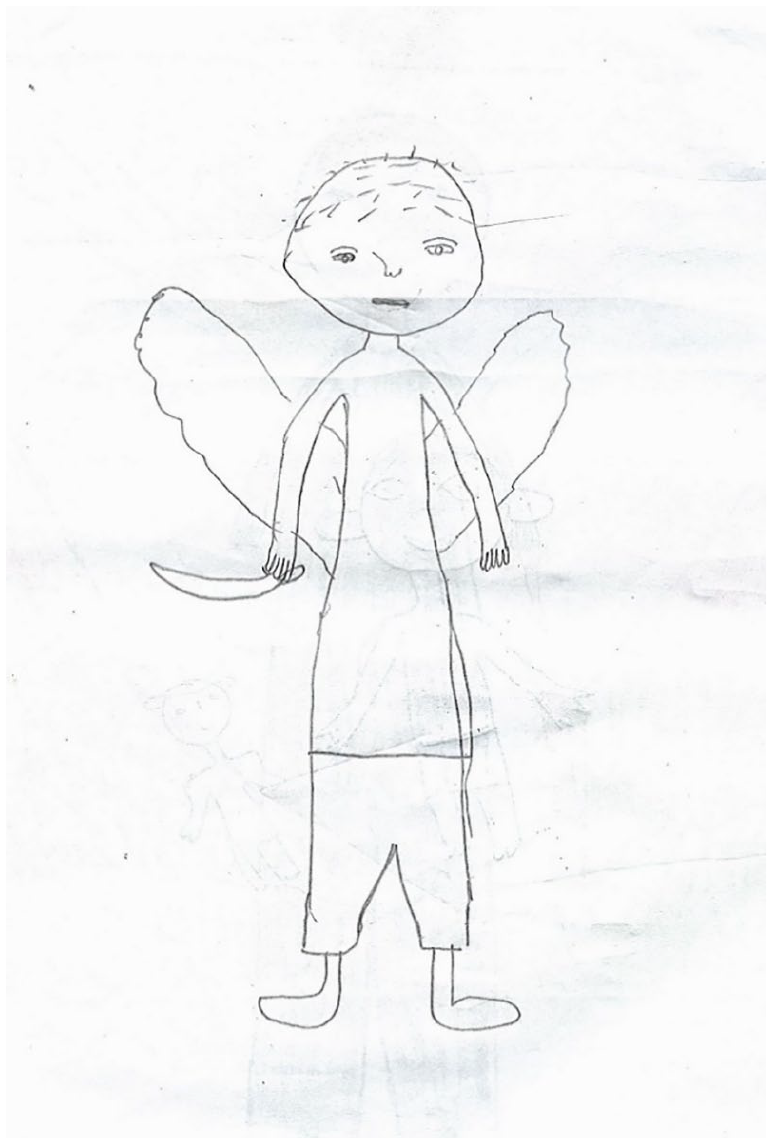
A pishtaco armed with a syringe.
The pishtaco’s role in an international network of organ trafficking was constantly referenced. Witnesses of previous murders claimed that pishtacos worked as government doctors in the regional capital of Pucallpa. Young members of my host family once told me about their aunt who went to the city to give birth and came back eviscerated. Similar stories were told in the informal assembly that decided to transfer the victim to a private clinic, as some women bared mysterious scars after giving birth in public hospitals. Alas, the organ removal in those testimonies were denotative. During the Fujimori government (1990–2000), under the disguise of a family planning programme, more than 270,000 women and 21,000 men were forcibly sterilised in the country. 4 The vast majority of those were rural Indigenous people who did not consent to the procedure (Vasquez del Aguila, 2014). The traumatic policy reinforced the ancient suspicion of Western medical practices.
As in most testimonies about the murderer (Weismantel, 2001), all children portrayed the pishtaco as a foreign man. I asked openly about the possibility of female attackers, but children were adamant that raiders were male. Their experience with foreigners likely reinforced this gendered belief. There were three nawa (foreigner) women in the community, namely two nurses and me, who were friendly with the children. Meanwhile, nawa men that came to evaluate social protection programmes were often verbally abusive and flirtatious, menacing to withhold government-funded cash-transfers to their families if children misbehaved.
Pishtacos acted with the consent of the Peruvian government. According to the community, the State knows about the attacks and profits from this international trade. It was argued that indigenous peoples’ vital organs helped pay off the country’s external debt, a suspicion also voiced by other Amazonian peoples (Santos-Granero and Barclay, 2011). Peru’s growing interest in the extractives may underpin these beliefs. Apart from resulting in land disputes that favour the profit of foreigners, extractives trigger the widespread Amazonian apprehension of unregulated use of natural resources.
According to the Amerindian political economy (Santos-Granero, 2009), the world has a limited vital energy that is unevenly shared by humans, non-humans and objects. From a perspectivist cosmology (Viveiros de Castro, 1998), life’s balance is guaranteed by the fact that all beings are simultaneously predators and prey. The hunter’s practice is regulated because his aggression is reacted against by other species, and this dynamic sustains life’s balance. Reckless predation of substances hinders the transference of vital energy and can have grave consequences for human life. It is thus rendered likely that an extractive government would be involved in the commodification of human organs.
In Amazonia, mestizos are known for profiting with timber trade and mining activities. With the rising interest in the forest’s natural resources, extractive settlements sometimes engulf Indigenous terrains. The village where I was based, for instance, was surrounded by caseríos (mestizo lands). Older children (12-year olds) considered the possibility of a mestizo killer far more likely, insomuch that they drew the pishtaco as one (Figure 2). They stated that the mestizos work for gringos who pay them a lot of money, which is why in their drawing the pishtaco has sunglasses and is covered in gold. The stars set the context for his nightly attacks.
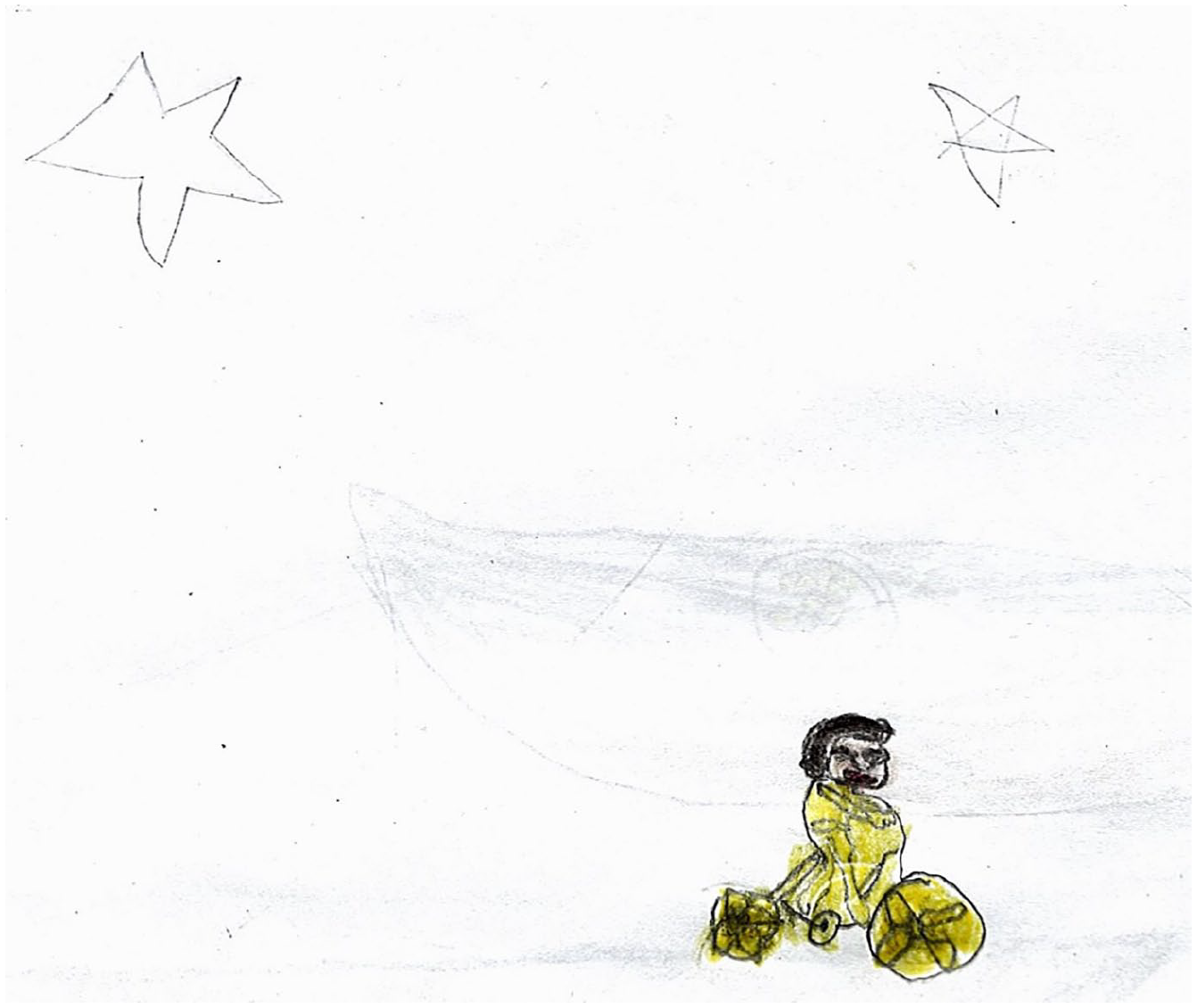
A mestizo pishtaco covered in gold.
The motorcycle in the above drawing is a flying vehicle. The children chose them over a speedy helicopter as the source of pishtacos’ soaring skills, adding that gringos provide mestizos with all sorts of machines. Various other Amazonian nations have spotted the murderer travelling in agile aircrafts (Santos-Granero and Barclay, 2011). While in the first sketch (Figure 1), children drew the pishtaco as a winged man, the majority believed that he flew using some apparatus. In the sketch below, a large group of children portrayed the killer wearing motorised steel wings, which are attached to a full-body black suit. In combination with wheeled boots, the tentative jetpack offers incredible mobility (Figure 3). Testimonies of attacks usually started with the victim perceiving polychromatic sparkles in the night sky or on top of a tree, which emerged from the raider’s night-vision goggles. Whatever the pishtaco’s floating mechanism was, it made him nearly invincible, concealing his presence until he jumped for the attack. The sight of these multicoloured lights was nearly a death sentence.
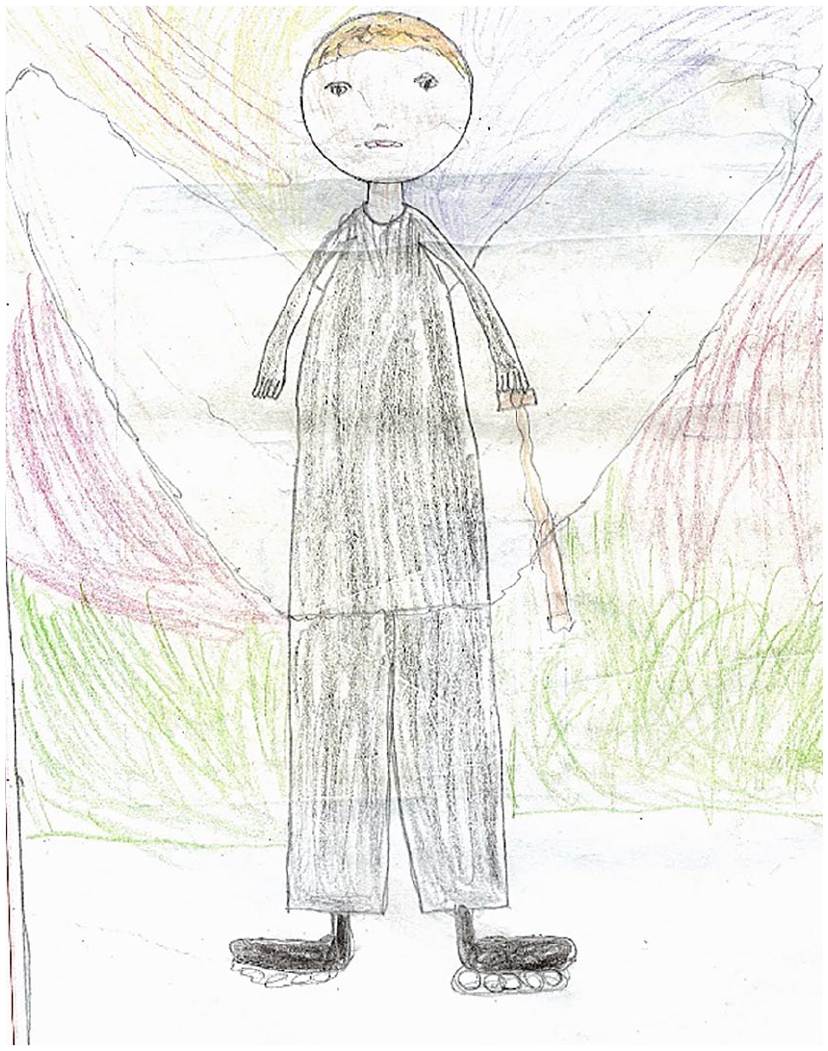
The pishtaco rises amid colourful lights.
The three portraits show some consensus about the pishtaco’s covert tactics of extraction, although with some variation. As described in the village’s attack, pishtacos inject electricity inside their victim’s body. This injection, previously drawn as a medical syringe (Figure 1), here gained a literal shape. It is a corriente, a Spanish word that can either mean metal chain (as in the drawing above) or electric current. The group of 12-year olds, who drew the mestizo raider, mocked the chain as a naïve misrepresentation of a powerful cutting-edge weapon. Nonetheless, they did not disavow the role of electricity in the murders, for their mestizo killer is also armed with a tiny and silent laser gun. When shooting a corriente into his victim’s body, a pishtaco leaves no trace.
Mapping electric light
The white men with electric guns that invaded the community drastically changed the daily dynamics in the village. In attempts to protect itself, the community had frequent security assemblies, but those meetings mainly expressed a ubiquitous feeling of vulnerability in face of an invincible enemy. A few preventive strategies came into place. The street went quieter and people only walked in groups. Men organised themselves into ceaseless patrols of the community’s borders. If they already wore rifles when crossing through the forest, now they hiked heavily armed. Darkness made the village particularly cautious, since attacks happen at night. People returned to their houses as soon as the sun went down and children’s visits to my porch, that typically took place at sunset, became rarer.
In these odd days, I flipped through my sketch notebook and reflected about the pishtaco. Among the other common themes in children’s drawings, one caught my attention. In the many depictions of the village, I was intrigued by the size and frequency of lampposts (Figure 4).
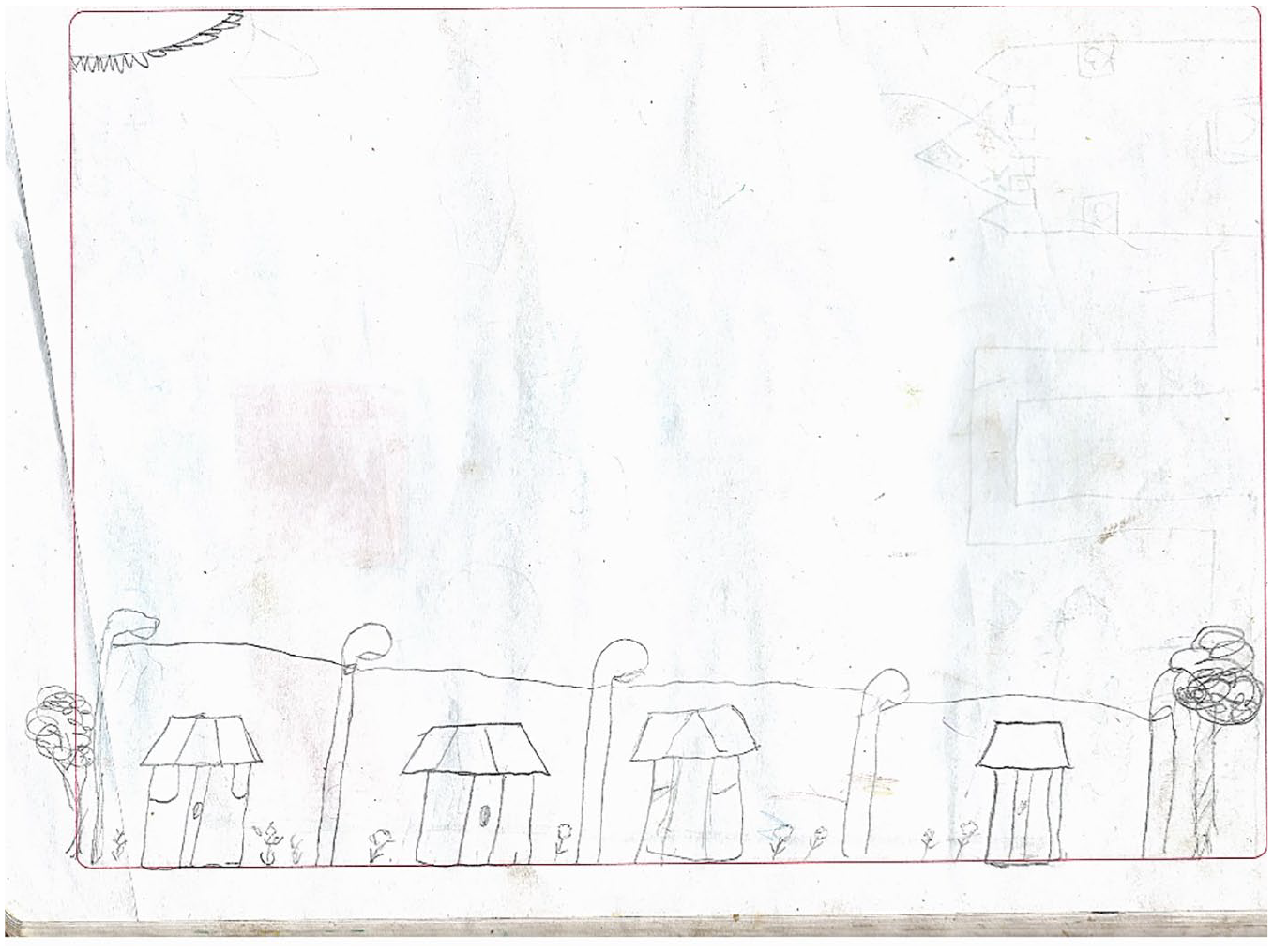
Map made by Luis (age 13) and his cousins, all boys.
In her research in Northern Amazonia, Morelli (2015) also noticed enormous light poles in children’s artwork. She interprets the recurrence of urban elements as a sign that Matses children aspired to a modern way of living, a ‘symbol of the increasing distance of Matses society from the forest world’ (Morelli, 2015: 233). In my first months in the field, impressed by the community’s precarity and dependence on city goods, I also wondered if the Shipibo-Konibo were losing their bonds with the forest. But while giant lampposts seemed relevant for children, the pishtaco attack demonstrated that electricity was a deadly weapon, injected by force. Were children fond or scared of electric lights?
Lampposts were seldom lit in the community. The government did not provide electricity to the village and thus the availability of energy depended on people’s income. Petrol was costly and ended quickly, lasting only for a couple of hours. Nobody knew exactly which night of the week would be illuminated, as it depended on the import of gasoline from Pucallpa, but the arrival of petrol was communicated in a buzz. Electricity was necessary for the phones and lanterns that people depended on during the week. When lampposts suddenly lit, people ran to charge their equipment.
After the attack, the communal budget was dry. The entire money was spent with the victim’s hospitalisation in Pucallpa and the village had dark nights for several weeks. Yet, light poles reappeared in children’s drawings a week after the attack. The drawing above (Figure 5) and the one below (Figure 6) were produced in two different spontaneous drawing sessions in my porch, with distinct groups of girls aged 9–10 (kin-related). The images surprised me for displaying an illuminated nocturnal landscape straight after the electric attack. When asked about their aesthetic choices, both groups explained that the lights scared pishtacos away.
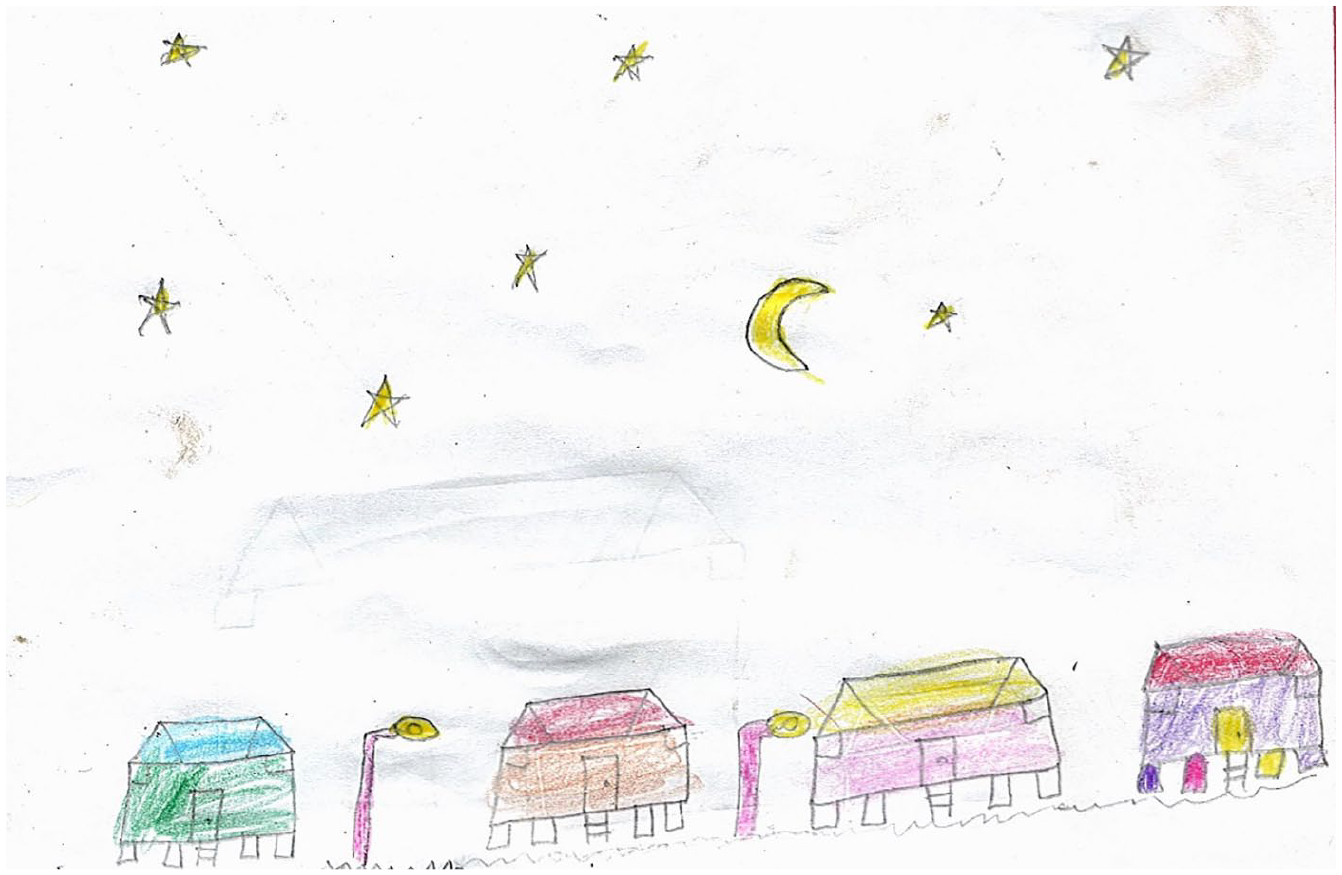
Made by a group of three cousins: Geidy (9), Isabel (9) and Ariana (10).
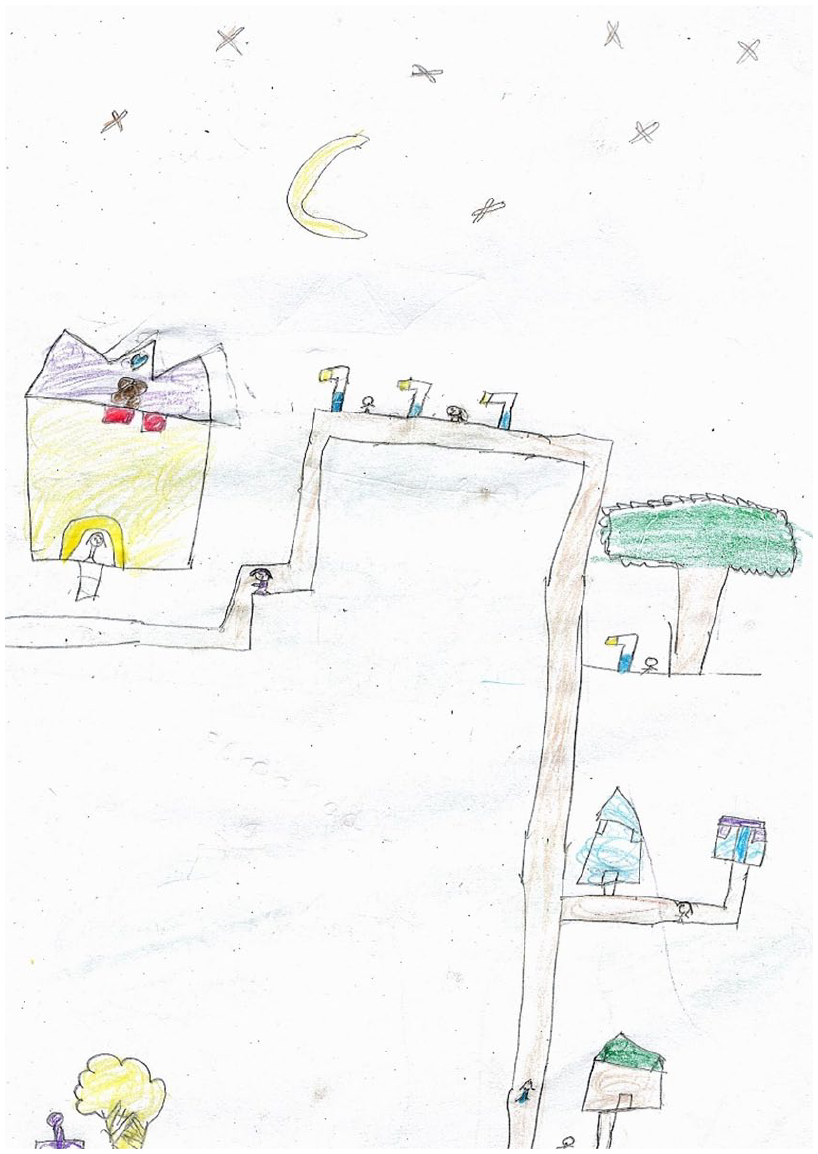
Made by Gabriela (9) while I watched her sisters.
The latter drawing (Figure 6) was one of the very few in which children portrayed people. Tiny shapes circulate alone in the street and there is an odd distance separating houses. Gabriela described this landscape as ‘algo de susto’ (something scary), drawing herself alone in her house (the bigger one in the drawing). She painted the lights in the lampposts straight after this, suddenly deciding to brighten up the village. With a silent but meaningful (Spyrou, 2016) aesthetic choice, Gabriela performs a change from a traumatic landscape into a safe one. The lit landscape recalls the few hours in the week in which the community is shielded from nightly threats.
The radical transformation charged by energy in that drawing (Figure 6) was just as magical as in ‘real’ life, when a light bulb illuminates a dark space (Winther and Wilhite, 2015). Light poles prolonged the day in the village at a time when children had finished all their responsibilities. Freed from their younger siblings, who were then asleep, children massively gathered in late outings. Film sessions were a popular activity. Two houses in the community had televisions and converted into movie theatres dominated by school-age children. They could choose from a collection of pirated action DVDs brought by men who worked in Pucallpa. The energy lasted just enough for a full-length movie, often one of the sequels in the X-Men series, who would be re-enacted in children’s play on the following day.
Since human relationships with objects are inherently cultural, no technology has a sole universal meaning (Wisner, 1979). The perils of electricity rely on the assumption that it necessarily improves human life, as argued by White (1943), while its controversial consequences are overlooked (Anusas and Ingold, 2015). For instance, Zélem (2019) shows how electrification hindered the economic autonomy and health of an indigenous village in Guyanese Amazonia, resulting in an increased commodification of basic needs and the consumption of cheap processed food. In contrast, children’s composite sketches of the pishtaco and the electrified maps after the attack give account of energy’s oxymoron: the same element that inflicts harm can shield the community, and even promote entertainment.
As I write this paper, I am aware that the village became more dependent on electricity during the coronavirus pandemic. In Amazonia, in-person teaching was interrupted for nearly a year as a result of a tougher rain season combined with the global crisis. State-funded classes, translated to several Indigenous languages, were aired through radio, television and the internet to reduce infection rates. 5 In practice, this meant that many children lacked formal study, aggravating inequalities between urban centres and rural villages. Families felt abandoned by the State. Considering the circumstances, various indigenous organisations, including the Shipibo-Konibo council, campaigned for access to these resources. 6 Unstoppable, electricity became a condition for children’s education.
Conclusion
This paper offers insights on pishtaco rumours through children’s imaginings. The interpretation of drawings is based on the experience of an attack and its repercussions in the village’s life. While the physiognomy in children’s portraits of the raider largely reinforce the racial dynamics identified in existing literature, it also indicates particular threats experienced by the Shipibo-Konibo in Amazonia. Rather than reading these stories as a colonial myth, I situate the pishtaco in a postapocalyptic present (Lempert, 2018). This approach considers that the Shipibo-Konibo have endured countless exogenous menaces to their biological and cultural survival since the first invasion of their territories. Nonetheless, the rise of economic interest in Amazonia speeds the predation of the forest’s resources, exposing the lives of native peoples to increasing precarity. In a comprehensive and critical analysis of ethnographic and secondary data, I examine children’s drawings as evidence of the contradictions of life in developing Amazonia.
The collective drawing session about the pishtaco depicted the attacker with different physiognomies, weapons and flying mechanisms. The variation in children’s portraits resonates with patterns in victims’ testimonies and illustrate an autopoiesis in children’s meaning-making (Toren, 2011). Their composite sketches reinvented preceding imaginings of the raider, while adding children’s own impressions of this threat (e.g. the corriente, a metal chain that materialises a literal translation of the deadly electric current). In a classic example of bricolage (Lévi-Strauss, 1972), children’s portraits collate fragments of the community’s history, alerting against various dangers: male gringos, Western medicine, mestizos, extraction and electricity.
This paper paid closer attention to electricity because the element reappeared in maps drawn after the attack. Cartographies displayed lit lampposts, casting light onto children’s joyful nocturnal escapades. In contrast with the pishtaco’s weapon, electrified maps unveil the ambiguous character of energy in the village. Similar paradoxes are found in the incorporation of other Western apparatuses by Amazonian peoples, such as the school (Espinosa, 2012) and the church (Vilaça, 2016). Descaling children’s maps (Ansell, 2009), the micro-analysis of children’s drawings can be expanded towards a reflection on broader development processes in Peruvian Amazonia. Essentially, the pervasiveness of energy serves as an accurate example from which to examine globalised modernity (Winther and Wilhite, 2015). Grappling with the duality of electricity in children’s artwork – its capacity to shield from the very harm it represents – I recall Maria’s paradox (Arsel et al., 2019). Indigenous peoples may be convinced of the negative impact of a modern capitalist mode of living but are relentlessly pushed towards it. It is often the only remaining livelihood strategy.
Footnotes
Funding
The author disclosed receipt of the following financial support for the research, authorship and/or publication of this article: This work has been financed by the Faculty of Social Sciences (SSF) at the University of East Anglia and the Tim Morris Award (Education Development Trust).
