



Abstract
This article introduces and explores the concept of the deficit aesthetic. Particular attention is given to how the deficit aesthetic was made and the extent to which it continues to be sustained in early art education, especially in the United States. For many children, particularly at this time, the deficit aesthetic factors as yet another lingering obstacle to negotiate, one that re-centers the assumption of childhood drawing as a neutral practice for a natural child. As an interpretive frame, the deficit aesthetic distorts the experience of drawing by disempowering the child, decontextualizing their drawing, and re-prioritizing white Western and middle-class subjectivities.
Introduction
Children are submitted to an infantilization which is alien to them. (Deleuze and Foucault, 1977: 210) Attitudes toward children’s art stem from the interplay of two distinct sets of ideas: those having to do with children and childhood, and those having to do with art and aesthetic values. (Leeds, 1989: 93)
In the epigraph above, Deleuze’s claim does well to frame the difficult albeit necessary recognition that “children are always participating in and part of two cultures—children’s and adults’—and these cultures are intricately interwoven” (Corsaro, 1997: 27). This recognition is important because it speaks to the idea that we (adults) have become increasingly reliant on “dominant” frameworks (James, 2012) and discourses (Moss, 2017), which tend to make sense of childhood “through adulthood” (Lee, 2001: 8, emphasis added). And because adulthood is often framed as the de facto end point of children’s developmental journey, the prevailing tendency has been to conceptualize the artistic lives and experiences of children as acts of preparation, a perspective which positions children as “human becomings” instead of “human beings” (p. 5).
In this view, and because children are presumed to lack “the full complement of agentic powers” (Lee, 1998: 461) (see also, e.g. Griffiths and Kandel, 2000; James and James, 2012; Jenks, 2005), which adults are always reputed to have, children are figured as partial or not-quite human. In the United States, this reduction of agency is especially problematic for non-white children, whose bodies, lives, and experiential frames of reference are already given partial treatment or positioned as inferior, as less human (see also, e.g. Pacini-Ketchabaw and Nxumalo, 2014).
In this way, Deleuze’s use of the term infantilization is fitting, not only because it directs us to consider the less-than-human realities children are too often made to occupy, but because it also demands that we attend with greater care to how and why children are always having to “leave the interpretation of their own lives to another age group, whose interests are potentially at odds with those of themselves” (Qvortrup et al., 1994: 6). Moreover, and further complicating this point is the extent to which these interpretations reflect preexisting racialized discourses and hierarchies that exclude many children from the start (Pacini-Ketchabaw and Berikoff, 2008; Robinson and Jones-Diaz, 2006).
As a scholar whose interests center on young children’s drawing, I often find myself thinking about this very issue, devising questions that move me to consider in different ways what those interests might have been and how, specifically, they continue to be used to interpret the lives and practices of children, particularly children’s drawing. Helpful to me in this regard has been the work of Jo Alice Leeds, who in the epigraph above provides a rather useful proposition with which to “examine our own values and attitudes”—an endeavor that, as she optimistically muses, hopefully occurs “with a keener eye and a more open mind” (Leeds, 1989: 103) (see also, e.g. Korzenik, 1981; Wilson, 1997). While Leeds’s framework has proven helpful, particularly for art educators keen to reflect more deeply on their approaches to art teaching, it is especially helpful when you consider Qvortrup’s earlier point, that children’s lives and practices are often interpreted by an age group whose interests are different from their own. Leeds’s framework brings a level of specificity to Qvortrup’s claim, and when used as a lens to question the interests that have mattered most to the study of childhood drawing, raises important questions about the ideas and attitudes adults choose to incorporate into their interpretations of what seems fair, important, and right—regarding both children and their drawing.
The making of a deficit aesthetic
While there is no shortage of positions from which the practice of childhood drawing (and child art, more broadly) has been studied (e.g. Thompson, 2006; Thompson and Schulte, 2019; Wilson, 1997), there is one perspective in particular which continues to endure, that always seems to have the requisite creditability and appeal to outpace or overpower the alternatives. Here, I am referring to the developmental perspective, what Burman (2016) refers to as the developmentalist paradigm. Indeed, despite the increasingly diverse landscape of inquiries related to childhood drawing, which now includes nearly five decades of research and theory dedicated to critiquing the shortcomings of various developmental typologies and their positions regarding children’s drawing, the developmentalist paradigm continues to animate the idea that there is a true nature of childhood drawing.
In the United States, especially in the field of art education, this critique first emerged in the early 1980s (see, e.g. Wilson and Wilson, 1981; Wolf and Perry, 1988) and has continued to garner support from scholars around the world whose work resides in the overlaps of early childhood and visual arts education (e.g. Burton, 2009; Duncum, 1999; Golomb, 1994; Kindler and Darras, 1997; Knight, 2013; McClure, 2011; Osgood and Sakr, 2019; Pacini-Ketchabaw et al., 2016; Park and Schulte, forthcoming; Pearson, 2001; Sakr et al., 2018; Schulte, 2016; Schulte and Thompson, 2018; Tarr, 2003; Thompson, 1999). Yet, despite the widespread nature of this criticism, the developmentalist paradigm continues to operate as a kind of “epistemological unconscious” (Steinmetz, 2005; St. Pierre, 2016) for many adults who work in relation to children’s drawing, be they researchers, teachers, parents, or simply other interested adults. In other words, despite its “trenchant critique” (Burman, 2016: xii), developmentalist models continue to serve as a kind of default imaginary for many art educators in the United States whose professional engagements put them in relation to children’s drawing.
Why is that? What is it about the developmental paradigm and its relationship to childhood drawing that is appealing? What are the developmental paradigm’s key interests and investments? Meaning, what does the developmental paradigm prioritize or center as important, as valuable and right, as worthy of our attention, of our allegiances even? Moreover, how does the developmental paradigm center these things? In what ways does the developmental paradigm direct us to consider certain aspects of children and their drawing, yet also omit from consideration whole networks of activity that may very well be crucial to thinking differently both the child and their drawing? What are the paradigmatic structures and conceptual forces that give shape to the developmental perspective, that keep its interests and investments in place, that sustain them and serve to commodify their appeal? And when children and their drawing do not easily “fit” or readily “align” with the grids of normalcy defined by children’s artistic development, when “what they do” does not adequately serve its’ ideals or reflect its’ values, aesthetic and otherwise, what happens then?
Though partial in scope, I ask these questions not because I seek to engage in a direct critique of the developmental paradigm, though I would be remiss if I didn’t also make clear that doing so continues to be necessary. Rather, I ask these questions because I want to shape a particular line of inquiry, one that is carefully attuned to the relationship between the developmental paradigm and the study of childhood drawing, particularly in the United States. And as part of this line of inquiry, to consider how this relationship—over time—has evolved, to form what I am calling the deficit aesthetic. In general, the deficit aesthetic is an essentialist framework of ideas, attitudes, and values—about children, about art and aesthetics, and about research too. And while these seemingly distinct sets of ideas, attitudes, and values can be viewed as such, as separate considerations, it is precisely the matter of how they have managed to come together that interests me most. After all, it is the manner in which these three sets of ideas have been calibrated, collectively, that gives the deficit aesthetic its “power presence” (Thompson, 2006: 225) in early art education.
Importantly, this article is not the first of its kind. Indeed, there is an extensive body of scholarship dedicated to addressing the developmental discourse and its relationship to the study of children’s art, particularly in Western scholarship (e.g. Kindler, 1997; Tarr, 2003; Wilson and Wilson, 1982/2009; Wolf and Perry, 1988). However, less has been done to address the anatomy of the calibration itself—that is, the matter of how and why the deficit aesthetic was actually made. To do this, it is essential to consider too the antecedents to children’s artistic development—that is, to cultivate “that larger understanding of the various grids of intelligibility” (St. Pierre, 2016: 22) which continue to give the developmental discourse its staying power in early art education. In this regard, one of the more notable antecedents is that of positivism. This is especially true in the United States.
Positivism and the study of childhood drawing
While positivism began in the late 19th century, a beginning commonly attributed to the philosopher Auguste Comte, 1 it continued to develop throughout the early- and mid-20th century, reaching the United States in the early 1930s and eventually gaining international favor within a variety of disciplines, including art education. 2 Also referred to as scientific rationalism, positivism operates under the assumption that the world is comprised of two levels— “a continuously changing surface of events and appearances, and an unchanging foundation of order, expressed in universal terms” (Hughes, 1994: 32). What this means is that positivism “assumes the existence of an objective reality” (Clark, 1998: 1243), which can be explained and predicted by adhering to the “stringent, technical, and impersonal rules of scientific investigation” (Hughes, 1994: 33), also commonly referred to as the scientific method. For those who may be less familiar with the term positivism, especially as it has been articulated in the United States in relation to the study of childhood drawing, it is essentially an instrumentalist approach to doing research, the purpose of which is to proffer more accurate empirical predictions of when and what children will draw.
For many researchers in the United States, especially those who were interested in the visual arts and its education, the leading assumption was that if children’s art could be categorized, then measured and quantified, a capacity for prediction could also be developed. The prevailing logic being, as St. Pierre (2016) describes it, “if we can predict what will happen, we can control it through interventions that will cause a change (p. 26, emphasis original). This sentiment, of interventionist change, was especially appealing to art educators in the United States, who in the mid-20th century had become increasingly focused on the visual arts as a vehicle for understanding children’s social, moral, and cognitive development (more on this later). Indeed, during this time, many researchers and teachers in the field of art education came to accept the idea that natural-science models and the methods of inquiry most commonly associated with them, could help to bear out certain truths regarding childhood drawing, what French philosopher Foucault (1980) termed regimes of truth (see also, e.g. Cohen, 2008; Lincoln and Cannella, 2004; MacNaughton, 2005). As noted by Foucault: Each society has its regime of truth, its ‘general politics’ of truth; that is, the types of discourse which it accepts and makes function as true; the mechanisms and instances which enable one to distinguish true and false statements, the means by which each is sanctioned; the techniques and procedures accorded value in the acquisition of truth; the status of those who charged with saying what counts as true. (p. 131)
For many teachers and researchers in the field of art education, especially those who sought to elaborate a more definitive or truth-inspired project of knowledge regarding children’s drawing, positivism provided the necessary framework to do so. Specifically, positivism both offered up and organized the general politics of truth in children’s drawing. But to place one’s faith in the assumption that a “true” nature of childhood drawing is possible, or that an objectivist and value-free approach (Harvey, 1989; Pence and Pacini-Ketchavaw, 2008) to the study of children’s drawing will inevitably lead to a “lawlike” theory of children’s drawing behavior (Kessler and Blue Swadner, 1992), “someone has to be the ‘object’” (Maxwell and Lincoln, 1990: 502).
For those committed to the study of childhood drawing, this object was the child. The issue here, as Graue and Hawkins (2005) describe it, is that “How we define the object of inquiry in research shapes what we can know, how we plan research strategies, and what literatures we use to support our thinking” (p. 45). In this way, Leeds’s suggestion, that our attitudes are both connected to and conditioned by prevailing cultural beliefs is an important reminder. The issue isn’t only that the child was the object, it was the way in which the child was made to be the object, or rather the type of object the child was made to be.
Positivism’s “penchant for decontextualization” (Kincheloe, 2005: xii) both contributed to and further legitimized the construction of the child as a social object (James, 2012)—that is, as someone who was not only viewed as separate from adults (James and James, 2012), but also dependent on them, and whose participation in the social world was perpetually marked by a presumption of passivity and lack. The result of this view is a child understood primarily in terms of what and who they are not, a perspective that expresses itself on the basis of the child’s relationship to the “process of becoming an adult” (Graue and Hawkins, 2005: 45) (see also James, 2012; Lee, 2001). This, in conjunction with the positivist assumption that knowledge should be developed “only upon that which can be observed or made observable (the empiric)” (Popkewitz, 1984: 36), enabled children’s drawing to be figured as yet another act of “preparation for the future” (Lee, 2001: 8).
Indeed, in the United States, art education’s early embodiment of positivism established a foundation of ideas, attitudes, and values which not only routinized a divestment of complexity from childhood art but actively dispossessed the child of agency and circumstance, an outcome that was intensely problematic for non-white children. Positivism’s appeal—namely, its capacity to position the child as a social object—was furthered by developments in psychology, which in turn popularized the idea that “for all children everywhere, there is a staged and linear progression to adulthood” (p. 40) (see also Hendrick et al., 1997). Sensing the potential to bring what Boundas (1991) calls “common and good sense” (p. 4) to the mysterious, often indeterminate markings and visual works made by so many young people around the world, many teachers and researchers in the field of art education began to explore the impact of certain applications of developmental psychology on our understandings of children’s drawing, particularly the manner in which it could be studied.
Developmental psychology and childhood drawing
Having materialized from the context of the historical development of positivism in the United States, developmental psychology emerged with an increased sense of epistemological authority, which was in turn used by a variety of academic disciplines, including art education, to further legitimize a “staged and linear progression” (James and James, 2012: 39) of children’s social, emotional, and cognitive development. Utilizing the concepts of “age” (Hockey and James, 2003; James, 2004) and “competence” (Alderson, 2008; Landsdown, 2005), along with a “modernist understanding of the origins and functions of art making in human life” (Thompson, 2012: 223), the field of art education began to fashion developmental typologies purposed to more accurately categorize, describe, and ultimately predict children’s art as a measurable act (Siegesmund, 1998). In doing so, the study of children’s drawing quickly earned a place in the “hierarchy of scientific creditability” (James and James, 2012: 40) by supplementing and extending current efforts within the social sciences to normalize the child (Kincheloe, 2005).
This isn’t to suggest that efforts to form discourses of knowledge which normalize children and their drawing are inherently bad. After all, it can be helpful at times to gain a general view of something, for example, a sense of familiarity with what and how children tend to draw. But when this sense of familiarity turns to assumption and children and their drawing begin to fall outside the expressed frame of normalcy, we not only risk marking children’s differences as developmental aberrations, we also risk—by way of this marking—the marginalization of the child (see Sakr et al., 2018). And while a “certain level of variation was considered normal. . .beyond this, individual differences. . .[tended to be]. . .interpreted as deviance, or alternatively, as ‘outliers’ in data sets and were duly ignored” (Hogan, 2005: 32). However, the larger outcome and issue with which to contend, is that art educators in the United States had in large part become reliant on a positivist psychology that not only centered a preconstructed relationship to data (Burman, 2016; Cannella and Viruru, 2004), but in doing so reaffirmed the colonial discourse (Lander, 2000) by prioritizing a white, Eurocentric orientation to social science research.
In effect, childhood drawing was framed as a “single identifiable reality” (Lincoln et al., 2011: 102), one that was not only white, male, and Eurocentric, but also largely motivated by a desire to express a universal link between the drawing of young people and the psychology of child development (e.g. Barnes, 1892; Gardner, 1980; Kerschensteiner, 1905; Lowenfeld, 1947; Lukens, 1896; Mathias, 1929; Perez, 1988; Ricci, 1894; Sully, 1907). This led to the establishment of an optimizing rhetoric (McClure, 2011), which the field of art education used to normalize the idea that drawing is a neutral practice for a natural child.
Visual realism and childhood drawing
Essential to making development and its positivist-inspired rhetoric the reality of childhood drawing was the aesthetic standard of visual realism (Luquet, 1927; Piaget et al., 1969) (see also Freeman and Cox, 1985; Matthews, 1999). In fact, most of what continues to surface in early art education as “conventional wisdom” (Matthews, 1999: 85) with regard to children’s drawing is rooted in the work of French theorist Luquet (1913, 1927), who in the early part of the 20th century identified four modes of drawing common to childhood: scribbling, fortuitous realism, intellectual realism, and visual realism. For Luquet, the four modes of drawing were not intended as a stage theory. However, despite Luquet’s position that each mode of drawing was itself a unique means of representation, Swiss psychologists Piaget et al. (1969) modified Luquet’s work, mapping it onto their own ideas about child development. The result of this hybridizing was a stage-based system in which the child was believed to progress from the less sophisticated stage of scribbling to that of fortuitous realism, then to intellectual realism, and eventually to the more sophisticated endpoint of visual realism.
The inherent assumptions being: (1) that children’s drawing development is a linear path toward visual realism (Golomb, 1992); (2) that children’s drawing is always “realistic in intent” (Barrett and Light, 1976: 202); and (3) that younger children draw what they know, whereas older children draw what they see (Willats, 1997: 288). The tendency of the field of art education to emphasize realistic representation (Golomb, 2002; Thompson, 2006) led to the establishment of various classification schemes, of which the prevailing motivation was to define with greater certainty and ultimately predict the child’s progression from one developmental milestone to the next. In describing this progression, Thompson (2006) writes: Landmarks along the path of artistic development were labelled differently and sometimes described in terms that varied, if only slightly, from one researcher to the next. Puzzling detours and derailments of the process in its later stages were noted. However, the journey’s destination remained constant: Children were developing toward the capacity to draw realistically, to capture visual likeness on the drawing page, to create convincing two-dimensional versions of a three-dimensional world. (p. 226)
What Thompson helps to clarify, beyond the significance of the professed neutrality of the researcher and a longstanding commitment to a linear, stage-based account of children’s artistic development (Kindler, 2003), is the field of art education’s underlying emphasis on visual realism. Even prior to the emergence of Lowenfeld’s (1947) well known typology and its dominating effect on school art practice (Burton, 2009: 326), the field of art education in the United States was partial to natural developmental models (e.g. Kerschensteiner, 1905; Mathias, 1929; Ricci, 1894;), what Atkinson (2002) has referred to as the “natural attitude” (p. 34). Indeed, the traditional perspective of visual realism was not only regarded as the apex of artistic achievement, it was also the basis for making determinations about the cognitive and socio-emotional maturity of children and their drawing, a “hypothesized standard” against which children and their drawing often “fared badly” (Golomb, 1992: 131). Moreover, as the standard of realism continued to be taken up, accepted, and then used as a de facto starting point for research related to childhood drawing, deviations from this assumed and pre-stated reality were often viewed as evidence of children’s artistic and conceptual immaturity (Golomb, 1997, 2002; Matthews, 1999). Thus, the terminological link between deficit and aesthetic, a conjunction that aptly embodies Deleuze’s claim that children are submitted to an infantilization which is alien to them.
Infantilization
That many adults routinely infantilize children isn’t exactly a novel proposition to make, nor is it a secret that is especially well-kept. Indeed, the experience of being “neither seen nor heard” (Cohen, 2005) is an existence that children are both familiar with and accustomed to negotiating. Even when children relinquish control and omit their own concerns in an attempt to be seen and heard, they are too often and too quickly told to do or become something else, something more, something different (e.g. Schulte, 2013, 2016, 2018). The point being, as adults we have a tendency to distort and misconstrue what we don’t understand about children and their drawing, and admittedly even what we do understand, “by forcing it into our own adult perspective” (Corsaro, 2003: 6). This resonates with a point made earlier by Lee (2001), that our principle inclination has been to make sense of childhood through adulthood—that is, to interpret children’s lives and practices on the basis of values that are likely at odds with children themselves.
The broader issue of course is that children are rarely aware of the extent to which their own value and that of their drawing is made to be contingent on “the unquestioned assumptions that render any adult’s account of a situation intrinsically more reliable than any child’s” (Thompson, 2021). The deficit aesthetic not only relies on these uncritical assumptions (which are inherently part of children’s engagements with the visual arts and, importantly, the processes by which adults often come to recognize and understand this work), it also uses these same assumptions to establish and reaffirm its own values and credibility. Of course, this isn’t done as a direct affront to children or to their drawing. But as Pierce and Allen (1975) point out, “The vehicle for most adult action is microaggression: the child is not rendered a gross brutalization but is treated in such a way as to lower his[/her/their] self-esteem, dignity, and worthiness by means of subtle, cumulative, and unceasing adult deprecation” (p. 18). The point being, while it may well be unintentional on the part of the adult, the deficit aesthetic acts as a lens of indignity, calibrated in such a way that it subtly limits and incrementally censures the diversities of children and the specificities of what, how, and why they go about drawing.
Lowenfeld’s developmental typology: An example
When it comes to the work of the deficit aesthetic, there is perhaps no better example than Viktor Lowenfeld’s (1947) stages of artistic development, arguably the most readily used and widely referenced typology of children’s graphic development, even today. In what follows, I provide an analysis of Lowenfeld’s typology, not because I wish to discount the work of Lowenfeld, arguably one of the most important figures in the history of Western art education, especially in the United States, but because Lowenfeld’s typology allows us to bring into view the precise calibration of ideas, attitudes, and values to which the deficit aesthetic is committed.
Importantly, it wasn’t Lowenfeld’s aim to put forth a conception of children’s artistic development that would in effect constitute difference as a deficit, nor do I understand Lowenfeld to be a scholar who would knowingly figure the child in such a delimiting way. Indeed, Lowenfeld himself acknowledges this point, writing in the final pages of Creative and Mental Growth (1987), just prior his presentment of the summary charts: 3
There is no one way that pictures will be drawn at any age. The stages melt into one another and children progress at different paces, depending upon numerous factors. . . The examples, then, should be considered as midpoints, and the stages themselves as convenient labels for a study of children’s art and not as invariant categories. (Lowenfeld and Brittain, 1987: 473)
But for Lowenfeld, this attempt to caution against an attentiveness that stops short, that both begins and ends with the summary charts and largely strikes from consideration other crucial interactions he went to such great lengths to describe, was largely ignored. For many who followed Lowenfeld’s work, especially Pre-K-12 art educators in the United States, the developmental stages (i.e. as expressed in the summary charts) and Lowenfeld’s “quasi-scientific approach” (Youngblood, 1982: 32) were not only appealing, they achieved an almost immediate and unquestionable degree of credibility. And this was (and still is, even today) the problem. While involuntary, what Lowenfeld produced is what Felix and Guattari (1987) call an “apparatus of capture” (p. 423)—that is, an interpretive frame calibrated to cohere, to make knowable, and to predict which way the lines will turn in children’s drawing (Schulte, 2016) (see also, Deleuze and Parnet, 2007). The issue is that Lowenfeld’s typology does more to obscure than it does reveal about children and their drawing (Wilson and Wilson, 1981).
Observation, data, and interpretation
Underlying each of Lowenfeld’s six stages of graphic development is an unyielding emphasis on observation. This is important for a couple of reasons. First, as Slife et al. (1995) write, “The subject matter of science is what is observable, and what is observed is the court of final appeal for establishing the truth or validity of any conception of the world” (p. 177). With regard to Lowenfeld’s typology, we often fail to remember the stages themselves are labels of convenience, not invariant categories. In other words, the stages are essentially a form of shorthand for the wider, more diverse, and certainly more complicated and discursively produced realties of children’s drawing. We also forget that what we are observing is essentially what we have elected to observe. Meaning, while Lowenfeld recognized a wide range of interactional factors in children’s drawing, the stages themselves do not include or account for these factors. Rather, the stages are based entirely on the graphic markings that children leave behind, what Pearson (2001) refers to as the “artifactual residue” (p. 348). And because this residue serves as the final and primary source of knowledge to be considered—that is, as the brute “data” of children’s drawing—the matter of how we choose to recognize this material is of considerable importance. After all, data must always be interpreted, and without this interpretation, “data. . .are just confusion” (Slife et al., 1995: 75). What Slife and Williams say here about data is noteworthy, particularly as it relates to Qvortrup’s early point, that children’s lives and practices are far too often made to succumb to the interpretations of an age group whose interests are different from their own.
Within the context of Lowenfeld’s typology, the interpretation of children’s drawing is twofold, and in both cases reflects a set of interests that are likely different from the interests held by the children whose works were being interpreted. First, it was an interpretive impulse that depended heavily on a biologically determined conception of the child, whereby childhood was viewed as “an apprenticeship for adulthood,” one that could be effectively “charted through stages related to age, physical development, and cognitive ability” (Gabriel, 2017). Here, of particular importance was the link between “age” and “competence,” contributing factors to what is now commonly referred to as age standards or age norms (Turmel, 2008). The point being, within Lowenfeld’s typology, younger children will always be positioned as less competent and less skilled than older children, and especially so in relation to adults whose orientation to drawing is—as Thompson noted earlier—inherently more reliable. Second, for Lowenfeld, the aesthetic standard of visual realism was used as a strategy to further organize this link between age and competence. As a result, Lowenfeld’s typology was structured to value drawings that exhibit a set of characteristics recognizable by adults (e.g. a tree looks like a tree, a person looks like a person, etc.). Further supporting this theme of recognizability is an emphasis placed on drawing characteristics, space representation, and human figure representation. Notably, each of these emphases is grounded in the aesthetic values of visual realism.
As a result, what powers Lowenfled’s typology is the underlying assumption that a style which happens to be revered by a culture—in this case, visual realism—is also a fundamental phase of human development (Golomb, 1992). And while this is undoubtedly a mistaken assumption, it is nonetheless an assumption that continues to animate how many adults in the United States think about and approach children’s drawing. It is for this reason I have referred to the deficit aesthetic as a kind of epistemological unconscious, which is to say that the deficit aesthetic functions as a kind of default for many who work in relation to children’s drawing—that is, as “the norm, the given, the unstated, and true” (St. Pierre, 2016: 22), a logic and lens that always seems to be beyond reproach.
Similar to how Burman (2016) describes the impact and effects of developmental psychology on everyday lives and ways of thinking, the deficit aesthetic is often “imperceptible,” a “taken-for-granted” feature of how we think about and approach ourselves and others, especially children (p. 2). It is for this reason that we must take seriously the act of studying the deficit aesthetic—that is, to “recognize it and its’ language and assumptions, analyze how it is produced and maintained, track how it functions, and study its effects” (St. Pierre, 2016: 22). To do so is to not only acknowledge the “limiting pressures” (McClure, 2011) the deficit aesthetic sets in motion, it is to begin to appreciate the forces that give shape to this pressure, that sustain its’ power and appeal. While Lowenfeld’s typology is assuredly incomplete and misleading, a framework that underscores the tendency of many adults to make sense of childhood through adulthood, it also reveals how a “mainstream, Anglo-US dominated psychology” (Burman, 2012: 2), when paired with a Eurocentric aesthetic like visual realism (see, e.g. Duncum, 1990), authors childhood drawing as a single subject story (Atkinson, 2016; Thompson, 2021).
Anna’s drawing
Take for example, Anna’s drawing. I was a doctoral student at the time, assigned to supervise the teacher candidates in the preschool class of our program’s Saturday art school. On this particular morning, I was sitting beside the youngest member of the class, Anna, who was busily drawing in her sketchbook (see Figure 1). It is a moment I often return to with students. Doing so enables us to consider with greater care the idea that Lowenfeld’s typology—and the deficit aesthetic more broadly—does more to obscure than to reveal.
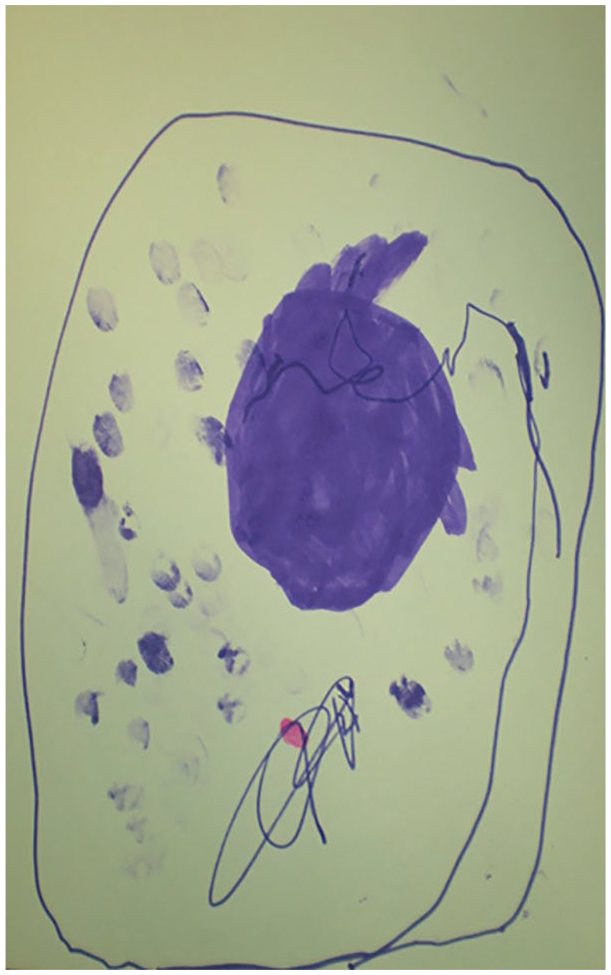
Anna’s drawing.
You see, while it may be true that Anna’s drawing aligns with Lowenfeld’s description of The Scribbling Stage, a drawing largely unrecognizable to adults, the suggestion that these marks are “random” is deeply flawed (Lowenfeld and Brittain, 1987: 187). But because our observations of Anna’s drawing are securely tethered to the graphic marks on the page, we not only limit what gets to be considered, we further reduce this already finite set of considerations by measuring them against an aesthetic standard (i.e. visual realism) that readily dismisses, diminishes, and delegitimizes their significance.
But if we can manage to take pause, to consider with greater care what else might be happening as part of Anna’s drawing (see Figure 2), it becomes clear that what we have elected to include—to count—is far too narrow. Indeed, some of our beliefs about children and their drawing may well be a work of “fiction” (Thompson, 2009: 27). Anna’s drawing is a good reminder of this, that while the deficit aesthetic may never cede the instant creditability and appeal it often enjoys, as adults we have a fundamental obligation to be surprised by what children do and the reasons they have for doing it (Meyer-Drawe, 1986: 48).
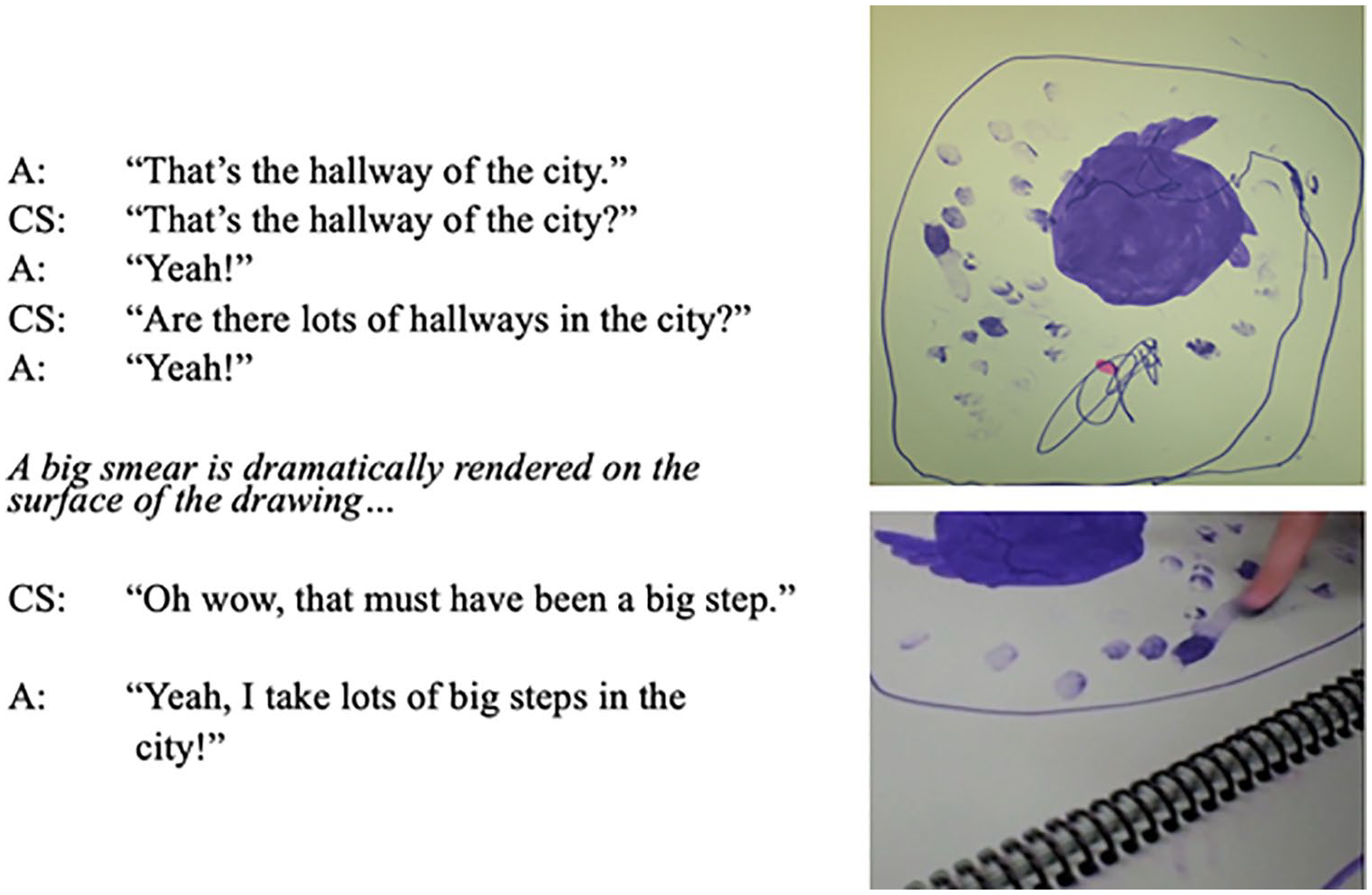
Anna’s drawing, in context.
A call to reflection
For many children who engage in drawing, the deficit aesthetic factors as yet another lingering obstacle to negotiate, one that re-centers the assumption childhood drawing is a neutral practice for a natural child. For me, this is the point. The deficit aesthetic distorts the experience of drawing by disempowering the child, decontextualizing their drawing, and re-prioritizing white Western and middle-class subjectivities. Recognizing the politics of the deficit aesthetic is vital, especially when you pause to consider the broader constellation of social crises children now face. Equally important is the need to foster proximities of care and attention which enable us as adults to be surprised, to encounter and hold space for the lives, interests and experiences of children, no matter how far removed from our own values and sensibilities they may be.
Drawing provides an important opportunity for children to contemplate their relations to the world. Drawing enables children to circle back to experiences which may have been difficult to face or challenging to understand. Drawing offers an occasion for children to work through and toward a particular semblance of who they are and what they hope to become. It is also a time and space of formation, a moment in which children can begin to reclaim the inquisitive and authorial power they are too often made to yield. Adults play a critical role in this work. Not simply because adults have the power to position drawing as a possibility in children’s lives, but because in doing so adults also wield the power to hold space for children as they think and feel their way through the tumult of the social world. As adults, how we choose to accompany children during these moments of creation and repair is of great importance. What we elect to notice says something about what we value, narrating for children a story about our curiosities and concerns, or lack thereof. So too does the presence and absence of our questions reveal to children the many ways in which we are orientated to the world around us, and to them.
While it may seem an insignificant endeavor, it is imperative that as adults we remain willing to recognize and demand more of our own embodiments, enactments, and perpetuations of the deficit aesthetic. In this way, I’ve written this article as a call to reflection, as a prompting to seek out, stay with, and scrutinize the extent to which the deficit aesthetic is “working on us and through us” (Davies, 2014: 35) (see also, Schulte, 2016), even when it may seem subtle or inconsequential. In our current historical moment, especially in the United States, adults can ill-afford to compound or further complicate the crises children face by subjecting them—and their drawing—to an interpretive frame that actively sorts through and inevitably misconstrues, reduces, and delegitimizes what it finds. This too is a crisis, one that can and should be averted, for all children.
Footnotes
Acknowledgements
The author wishes to thank the editors and reviewers for their support and thoughtfulness. The author also wishes to thank Anna, whose drawing, even after all these years, continues to emerge new questions and considerations.
Funding
The author(s) received no financial support for the research, authorship, and/or publication of this article.
