



Abstract
This paper begins a quarter of a century ago with the first visit to the UK of the Reggio Emilia exhibition ‘The Hundred Languages of Children’ and initial interest by some of the early education community in ‘doing Reggio’. Within the same period, the move to introduce a formal curriculum for young children in England and Wales began, initially with the Desirable Outcomes documents in 1996 (SCAA) and more recently with the latest incarnation of the Early Years Foundation Stage. This paper first explores key aspects of the Reggio Emilia approach before turning to the development of the curriculum for young children within England, making visible key differences between these two ways of working. Drawing on Foucauldian discourses, I aim to demonstrate that curricula models are underpinned by socially constructed discourses and that as the discourse of ‘school readiness’ has tightened its stranglehold on early years policy within England, the likelihood of ‘doing Reggio’ has been eroded significantly.
Keywords
Introduction
This paper begins a quarter of a century ago with the first visit to the UK of the Reggio Emilia exhibition ‘The Hundred Languages of Children’ and the initial excitement and interest from the early childhood community in Reggio ways of working. Within the same period, the move to introduce a formal curriculum for young children in England and Wales began, initially with the Desirable Outcomes documents in 1996 (SCAA) and more recently with the latest incarnation of the Early Years Foundation Stage (DFE, 2021). My own professional development has taken place within the same period; in the 90s as a reception teacher of 4-to-5-year-olds in Wales and later as an educator in a Reggio inspired setting in Thailand. During this period, I made a number of visits to Reggio settings in Italy and I began to consider if aspects of Reggio practice could translate into British classrooms. Returning to the UK, I was puzzled as I listened to delegates at a conference where Reggio Emilian pedagogy was foregrounded, discussing how they were already ‘doing Reggio’. Whilst it has never been an official policy to transport Reggio practices into English classrooms wholesale (if at all), over subsequent years, I often heard this phrase in settings with an interest in this way of working with children and always found this perplexing. This was because there seemed to be a disconnect between some of the practices I was observing (particularly the limited agency for children) and the pedagogy of Reggio Emilia as I understood this. Over the past two decades, I have continuously reflected on what ‘doing Reggio’ might mean for practitioners interested in this way of working within the English and Welsh context since this is the context in which I have worked as a teacher, researcher (e.g. Maynard and Chicken, 2010) and an early childhood lecturer.
Drawing upon these reflections, this paper aims to demonstrate the contextually constructed nature of curriculum models (Apple, 1979) through a comparison of Reggio Emilia and the EYFS. These particular pedagogies are the foci because of my personal interest and experiences of working within these frameworks but also because I believe that they are underpinned by fundamentally different philosophical and epistemological standpoints. A second aim is to demonstrate that within the context of the English early years policy landscape that a discourse of school readiness has become both dominant and explicit. When Foucauldian tools are drawn upon, this comparison can be understood as a struggle between competing dominant discourses, which practitioners interested in Reggio Emilia within the English context need to mediate. This paper is offered to readers as a provocation to critically explore their own contextualised practices in order to consider how these have been shaped by situated dominant discourses which impact upon their shifting subjectivities, as Osgood has argued: (through) identifying and problematising the hegemonic discourses through/in which practitioners are positioned, possibilities exist to develop critical consciousness and to challenge current self-understandings (2006, p. 7)
I first explore key aspects of the Reggio Emilia approach, predominantly through literature from Reggio pedagogues, before turning to the development of the curriculum for young children within England, making visible key differences between these two ways of working. Drawing on this evidence, a final aim is to argue that the wholesale transportation of any curriculum from one place to another is never possible since curricula models are underpinned by socially constructed discourses and saturated with implicit messages related to the purpose of education, how the curriculum should be planned and how much autonomy teachers and children should have; however, as the discourse of ‘school readiness’ has tightened its stranglehold on early years policy within England across the last quarter of a century, the likelihood of ‘doing Reggio’ has been eroded significantly.
Foucauldian tools
This paper draws upon some post-structural tools for meaning-making, with a focus upon the Foucauldian concept of ‘discourses’. According to Foucault (1979) each society embraces a politics of truth which is manifested through a number of mechanisms, these include the discourses which are accepted as truth at any given time, the instruments which facilitate judgements to be made and the status of those who are charged with determining such judgements. As Dahlberg et al. (1999) have argued: ‘Knowledge is seen as inscribed in power relations, which determine what is considered as truth or falsity; in short, knowledge is the effect of power and cannot be separated from power’. (p.24)
Central to this understanding is the concept of discourses, viewed as an invisible conceptual frame, a retaining boundary which both constructs and governs the ways in which we describe, think about and consequently operate within specific realms (Hall, 2001). Discourses can be seen as a way of understanding, explaining and justifying a standpoint often through a particular set of associated language and practices (Foucault, 1972).
Foucauldian discourses are intertwined with notions of knowledge and disciplinary power, viewed as omnipresent, silently permeating the spheres in which we operate, disciplining, controlling and shaping subjects, who over time begin to act and reason in analogous ways (Foucault, 1977).
Foucault has questioned how particular discourses subjectify the human subject (McHoul and Grace, 1993; Weedon, 1997) positioning ‘regimes of truth’, as regulatory frameworks which govern our thoughts and actions towards perceptions of ‘correct’ and desirable’ behaviours, sanctioning what is ‘normal’, operating as an indisputable truth, acting as a restraining mechanism, restricting us from operating and thinking about alternative modes of being (Blaise, 2005; Dahlberg et al., 1999). Regimes of truth are impregnated with the dominant discourses of the day, consequently governing our thoughts and actions and operating as a frame of reference impacting upon how we make meaning.
Kenway (1990) has discussed how regimes of truth are privileged through a range of ‘normalising technologies’ which attempt to identify deviations from the accepted norm; these ‘micropractices’, (Gore, 1998), include ‘surveillance’, ‘normalisation’ and ‘exclusion.’ Such mechanisms govern practice towards predefined ‘desirable norms’ and include different classifications and categories, for example, what is deemed as appropriate within pedagogical practice and different curricula models. They are used to judge and describe practice whilst shaping subjectivities in thinking and action at both the level of the individual subject and furthermore at the level of a population (e.g. teachers of young children) as a collective body. As Dahlberg et al. (1999) have proposed: Discourses are [. . .] not just linguistic but are expressed and produced in our actions and practices [. . .]All bear meanings, in the same way as language. (Dahlberg et al., 1999, p. 31).
The schools of Reggio Emilia, Italy
This section sets out some key aspects of the Reggio Emilian philosophy, whilst recognising there is a plethora of literature in this area, I rely on texts either authored by Reggio pedagogues or by those closely associated with them. This is because I do not wish to muddy the waters by examining interpretations of interpretations since as Rinaldi (2005) has argued, even ‘Reggio itself is an interpretation of Reggio!’ (p.197).
The infant toddler centres (for children aged 0–3) and pre-schools (for children aged 3–6) of Reggio Emilia can only be found in one specific location in the north of Italian. During World War II, Italy saw the rise of fascism which ran counter to the traditional socialist values of the region (Gandini, 2012a) and consequently, within the post-war era, there was an explicit rejection of fascism at a community level (Edwards et al., 2012). The strength of this denunciation led to a deep community desire for change, propelling Loris Malaguzzi, parents and educators in the area, to work collaboratively to develop an education system reflective of a particular contextualised value position.
Danaher et al. (2000) have argued that each discourse has a particular value system, associated set of constructions and operates within specific geographical, cultural, political, and historical frames. This can be seen clearly at the starting point of the Reggio schools, where the social democratic discourse drawn upon was instrumental in shaping the subjectivities of practitioners, the resultant local paedagogical practices that emerged over time and associated constructions of teachers and learners (Gandini, 1993). For example, dialogic encounters which emphasise respectful debate between children were viewed as essential, underpinned by a subjective epistemological position which recognised that children (and adults) will have different but equally valid viewpoints (Rinaldi, 2005). These skills, accompanied by a need to respect difference, (as opposed to a fascist desire to eradicate it) were considered as necessary in creating a democratic post-war society (Gandini, 2012b). As such the emergence of these ways of working demonstrate how particular ‘truths’ are circulated through discourses which are value laden, can be localised and can originate from the bottom up level of local communities.
Planning for teaching and learning
The pervading discourses also impacted upon the way that children were viewed and understood, shaping the cornerstone of the Reggio approach, an explicit construction of the child who is viewed as, ‘rich in potential, strong, powerful, competent, and most of all, connected to adults and other children’ (Malaguzzi, 1993, p.10). Reggio pedagogy is built on this overt belief that children are ‘protagonists with unique personal, historical, and cultural identities’ (Edwards, 2012, p.150) possessing unlimited potential and a sense of wonder. Learning is viewed as an active social process of co-construction as children seek out social interactions with others to make sense of their worlds (Malaguzzi, 1998). As Gandini (2011) has proposed, there is: a deep trust in the richness of children’s desire to learn with pleasure and the ability children must acquire initiatives and inventions that come from their shared relationships (7).
Moss (2007) has argued that discourses are underpinned by a particular set of paradigmatic values and assumptions and within Reggio Emilia, a post-modern subjective epistemological stance is embraced and there is a vehement rejection of a desire to meet any prespecified or age-related targets. This view is closely interrelated with the strong construction of the child previously outlined since it is argued that ‘the potential of the child is stunted when the endpoint of their learning is formulated in advance’. (Rinaldi, 1993, p.104). Stemming from this rich view of the child (Moss et al., 2000), children’s interests and developing ‘fascinations’ are used as a stimulus for planning teaching and learning opportunities through progettazione. Whilst this term is often translated as ‘project work’ in English, I want to stress here that progettazione is not a literal translation, as Rinaldi (2005) explains: The concept of progettazione. . . implies a more global and flexible approach in which initial hypotheses are made about classroom work (as well as about staff development and relationships with parents) but are subject to modifications and changes of direction as the actual work progresses. (p.26)
Instead, the choice of progettazione is intentional and used to signal ‘opposition’(ibid.), to the competing modernist discourse of ‘technical rationality’ (Dahlberg et al., 1999, 2007) underpinning a ‘banking concept’ of education (Freire, 1970) when teaching and learning opportunities are planned for in advance often towards a set of age-related targets. Whilst the term progettazione is viewed as a pro-ject-tion – a possibility of what might happen, this is contrasted with planning a predetermined set of skills/ bank of knowledge that has to be acquired within a specific timeframe (Rinaldi, 2005).
In this second scenario planning is viewed as highly structured and aims to pinpoint exactly what is to be learnt beforehand, giving specific objectives for activities (Forman and Fyfe, 2012). This is at variance with a Reggio Emilian pluralist epistemological perspective which views the process of learning as tentative and evolving and is described as ‘rhizomatic’, shooting off in different and often unpredictable directions (Dahlberg et al., 2007) As Malaguzzi has explained: our schools have not had, nor do they have, a planned curriculum with units and sub-units (lesson plans) as the behaviourists would like. These would push our schools towards teaching without learning; we would humiliate the schools and the children by entrusting them to forms, dittos and handbooks. . .the school for young children has to respond to the child. (Malaguzzi, 1993, p.85)
Consequently, Reggio pedagogy has been aligned with a post-foundational constructionist epistemological view (Dahlberg et al., 1999) since any given ‘regime of truth’ is questioned and a predefined curriculum is viewed as problematic.
Progettazione are described as beginning in several ways; from the children’s lines of enquiry (e.g. Rinaldi, 2005), from teacher stimuli (The Desires of a Building’, Vecchi, 2010) or from an ‘ordinary moment’ (Rinaldi, 1993, 1998). The actual starting point appears to be of less significance than the perceived need for a particular ‘fascination’ or question to generate an ‘air of expectation’ which drives the progettazione forward leading to ‘an extraordinary blooming of ideas’ (Gandini, 1998, p. 91) with the learning shooting off in unexpected directions (Rinaldi, 2005).
Planning provision and ‘assessment’ through paedagogical documentation
Foucault has argued that there is no one ‘truth’ but rather, there is always a plurality of ways of reading the world and this view is congruent with the complex process of pedagogical documentation, in which teachers will document the learning process of different groups of children involved in progettazione through close group analysis of symbolic languages such as photographs, children’s drawings, clay and artwork, transcripts of conversations and observations of playful encounters (Gandini, 2012a; Giudici et al., 2001; Reggio Children, 2010) Whilst Vygotsky (1978) made links between spoken language and cognition, a Reggio neo-Vysotskian position views all these symbolic languages as holding the potential for meaning making, exploring ideas, and developing understandings. Through ‘a pedagogy of listening’ (Rinaldi, 2005), educators analyse together these symbolic languages in an attempt to co-construct and reconstruct a shared testimony of the learning journey (Dahlberg, 2012; Vecchi, 1998; Vecchi et al., 2019). Through this process they formulate a theory of the thinking of children (Forman, 2001; Giudici et al., 2001) and plan for future ‘provocations’ and collaborative problem-solving opportunities to extend, consolidate or confront the thinking of children. Pedagogical documentation is understood as: An analysis of communication itself [. . .] a struggle to understand, where speakers constructively confront each other, experience conflict, and seek footing in a constant shift of perspectives (Forman and Fyfe, 1998, p.241)
As such, there is a reinforcement of an epistemological assumption based upon subjectivity and a rejection of a desire to benchmark a child’s progress against prespecified targets.
This focus on subjectivity, deconstructing and reimagining inherent in the process of pedagogical documentation has led Dahlberg et al. (1999) to claim that pedagogical documentation can be likened to what Foucault has termed ‘technologies of the self’, positioned as a tool of resistance from officially sanctioned governmental ‘truths’ where through a reflexive and critical process it becomes conceivable to consider alternative possibilities. This would stand in opposition to systems where there are universal truths to be located and pinned down (which I will later argue can be seen within the EYFS) based around attempts to measure particular constructions of ‘quality’ and where knowledge is viewed as certain and quantifiable within neo-liberalist world views (Dahlberg et al., 2007).
During the process of documentation, alternative possibilities and meanings are considered as teachers justify their own interpretations of ‘data’ through a dialogic process. This often involves a ‘conflict of ideas and argumentation’, between teachers, ‘not a cosy search for consensus’ (Dahlberg and Moss, 2005, p.16). This also highlights a respectful construction of teachers viewed as competent experts, with trust placed in their professional judgement (Edwards, 2012). These documents are viewed as, ‘partial findings, subjective interpretations which, in turn must be re-interpreted and discussed with others’. (Rinaldi, 2005, p.57). Rinaldi has rationalised this way of working, arguing that: the value of subjectivity also means that the subject must take responsibility for her or his point of view; there can be no hiding behind an assumed scientific objectivity or criteria offered by experts. (2005, p.16)
Underpinned by this discourse of plurality (Moss, 2007), the process of pedagogical documentation can never be value neutral since it is always based upon selection; what is documented (and not documented) is viewed as one possibility amongst many, since ‘there is never a single story’ (Dahlberg et al., 1999, p.147). Consequently, whilst making visible the possible theorising of children, the process of padagogical documentation also supports the creation of a culture of collaborative in-depth critical reflection between teachers (Dahlberg et al., 2007) and the theorising and thinking of educators is also made visible and documented, making this also open to debate (Rinaldi, 1998).
The development of a curriculum for young children within England
This section now moves on to outline in chronological order the development of a curriculum for the under-fives within England, whilst also noting the discourses in circulation, and some tensions with the Reggio Emilian pedagogy described above.
Provision for the under-fives within England and Wales has traditionally been based on an implicit set of core values; children are viewed as curious and agentic meaning-makers (Maynard, 2007); learning is regarded as an active process of co-construction with free play seen as the key vehicle for learning; teachers are positioned as guides and facilitators who recognise the interests of children when planning learning opportunities (Kwon, 2002); subject based and teacher led practice have traditionally been rejected in favour of informal and holistic ways of working with young children in which social and emotional development have been foregrounded. These traditional underlying principles hold congruence with a Reggio Emilia way of working with young children, at least on the surface.
This began to change in 1988 with the introduction of the National Curriculum for children aged of 5-16, with learning structured around the ‘core’ subjects of maths, English, and science and ‘foundation’ subjects including art, history, and PE which had been based around government concerns for a need to ‘raise standards’. Although documents did not relate to the under-fives, this move was recognised as significant to those working within the phase since a focus upon subject knowledge did not place the child at the centre of learning and led researchers at the time to argue that this would lead to a ‘head-on clash with the traditions of early childhood education’ (Blenkin and Kelly, 1994, p.37).
Foucault (1978) has described power based on official governmental legislation as ‘sovereign power’ whilst noting the significance of the status of those who are charged with determining judgements. From this position, government sanctioned educational policies and associated mechanisms of judgement can be understood as particularly powerful tools of subjectification which are likely to shape: normal and desirable ways to think, act and feel. . .(until) it is difficult to imagine thinking, acting or feeling in any other way (MacNaughton, 2005, p.32).
Indeed, the Rumbold Report (DES, 1990; Rumbold, 1990) argued that teachers within the early years sector should guard against ‘demands to focus on specific targets and didactic teaching methods’ (p.14) based on fears that policy drivers would subjectify their practice, as later parts of this paper will demonstrate, these comments proved to be prophetic.
Concerns were also raised that plans to use standardised testing to ‘measure’ what had been learned by the age of seven would impact on the provision for 4- and 5-year-olds in these classes since teachers would feel pressure to push practices for older children into settings for the under-fives (Aubrey, 2002). This move towards ‘back to basics’ was mirrored by other Western economies with the aim of raising ‘standards’ in subjects considered essential for the growth of market economies (Soler and Miller, 2003) and has been linked to neoliberalist discourses in which children are constructed and objectified as ‘investments for future economic productivity’ (Sims, 2017, 1). This discourse runs counter to the traditional early childhood field since it implies that the early phase of education is a time for preparing children for more formal stages of schooling and the subsequent world of work and is also at odds with both the construction of children and the purpose of education outlined previously from a post-modernist Reggio perspective.
The later publication of the ‘Desirable Outcomes for Children’s Learning for children from 0 to 5 on Entering Compulsory Education’ (School Curriculum and Assessment Authority [SCAA], 1996) set out the ‘outcomes’ that children should achieve before they started formal education. Mirroring the National Curriculum, which was set out around specific subjects, learning within early years was now to be structured around six indicative areas; Language and Literacy; Mathematics, Personal and Social Development; Knowledge and Understanding of the World and Creative Development and Physical Development. These areas could be mapped against the National Curriculum subjects for older children. Policy makers reasoned that this did not constitute a formal curriculum but this was critiqued by the early childhood community (Anning, 1995; David, 1998) since this indicated a reconstruction of learning from more holistic ways of working with young children, making visible a tension between the theoretical underpinning of traditional early years pedagogy and the direction of the policy discourses in circulation (Wood, 2004).
Foucault (1977) has argued that ‘disciplinary power [. . .] Is exercised rather than possessed’ (p.26) and is both pervasive and invisible as it forces us into a ‘normalised’ way of seeing the world sanctioning our behaviour and thoughts towards a given ‘truth’. In this way we govern our thinking towards what, within the regime of truth, is viewed as the correct way of behaving and ways of thinking and acting, which fall outside of this norm are demonised and ostracised. From this perspective, the findings of the research of Wood and Bennett (2001) are noteworthy since they highlighted a shift at this time in practitioners’ thinking and subsequent practice with a reduction of emphasis on child-initiated learning towards more didactic methods for 4 -to-6-year olds. The researchers (Wood and Bennett, 2001) argued that this stemmed from powerful policy drivers and a consequential perceived necessity to plan provision towards prespecified ‘outcomes’. This change was also reflected in the views of children (Wood and Bennett (2002) in terms of what they described as being of value, for example, desires to improve handwriting skills, write longer sentences or be better at maths (p. 83).
This demonstrates how disciplinary power shapes behaviour, even though we may not be conscious of this process (Ransom, 1998) invisibly circulating within systems, shaping the practices of teachers and further, the expectations, value positions and language of young children also existing within these contexts.
Fears were raised at the time that provision within the indicative areas of learning was to be judged as part of the newly introduced Nursery inspection framework (OFSTED, 1995) which aimed to measure the ‘quality’ of provision with the central aim of raising standards.
From a Foucauldian perspective then, it could be argued that the ‘micro practices’ put in to place to ‘measure’ success became instrumental in shaping pedagogy through policing and surveilling what was deemed as acceptable practice (Gore, 1998). To elucidate his concept of surveillance Foucault utilised the analogy of the ‘panoptic tower’ (1977, p. 202), from which it was possible for warders to observe individual cells. Prisoners would be unaware if they were being observed at any given time and consequently behaved as if they were under constant scrutiny, modifying their behaviour and in so doing, surrendering to self-surveillance. Thus, through surveillance (and self-surveillance) behaviour was monitored, controlled and shaped.
This concept can be applied to practitioners operating within the boundaries of the EYFS at the time as Osgood has argued: through policy, workforce reform and concomitant objectifying practices of constant surveillance and the endeavour for normalised practice, find that the way in which power is exercised is largely invisible. But whether the power is opaque or visible, it is ultimately so sophisticated and seemingly abstract that it becomes impossible to challenge or negotiate. Thus, in a quest to conform to dominant constructions of professionalism, practitioners become regulated and controlled by disciplinary technologies of the self. (2006, p. 7)
In line with Osgood’s poststructuralist theorising, practices which fell outside of government inspection expectations were likely to be viewed as incorrect or ‘deviant’ leading teachers to begin to modify practice through a focus on ‘doing it for Ofsted’, thus a discourse of performativity was shaping the subjectivities of teachers, through a range of ‘normalisation technologies (Gore, 1998) such as ‘surveillance’, ‘normalisation’ and ‘exclusion’ as they succumbed to what Osgood (2006) has termed the ‘regulatory gaze shaped by neo-liberal policy reforms’ (p. 6)
Sims (2014, 2017) has recently made visible a similar move within the Australasian context whilst arguing that: the standardisation of knowledge is reflected in concerns around the push-down curriculum, where academic subjects normally associated with the school years are increasingly being imposed on the early childhood sector (Sims, 2017, p.4).
This move towards the ‘schoolification’ for pre-school children in England and Wales continued at the turn of the millennium with documents such as ‘Early Learning Goals’ (Qualifications and Curriculum Authority [QCA], 1999), the ‘Curriculum Guidance for the Foundation Stage’ (QCA, 2000) and the ‘Planning for learning in the Foundation Stage’ QCA (2001). Whilst there were claims of acknowledgement of the need for playful learning opportunities and that this should be both adult-directed and child-initiated, strong reemphasis was placed upon the significance of developing literacy and numeracy skills (QCA, 2000, Forward) deemed valuable for the neoliberal world of work and national economic success. As a consequence, the curriculum for children aged three to five was justified since it would provide the ‘solid foundations’ for later learning (QCA, 2000) a further indication of the increasing dominance of the school readiness discourse which was increasingly becoming a ‘regime of truth’ (Foucault, 1977) through increasing government documentation and mechanisms of control and surveillance. Practices that fell outside of this discourse were becoming increasingly excluded (Wood, 2004).
Significantly, the guidance outlined ‘stepping stones’ towards ‘goals’ which most children should achieve by the end of the reception year when they would turn five. The main objective of the curriculum was set out as follows: Its principal aim is to help practitioners to plan how their work will contribute to the achievement of the early learning goals. (QCA, 2000, Forward)
This was noteworthy since it placed the planning of teaching and learning opportunities towards the predetermined learning goals at the heart of the teacher’s role.
Thus, a discourse of performativity was shaping the curriculum and moving this further away from the practices and associated epistemological assumptions underpinning a Reggio Emilian position where there is an unfettered rejection of predetermined learning. This led to further protests from the early years sector and later claims that this was rooted in an instrumental view of schooling (Soler and Miller, 2003). During this time period, pedagogy situated within different discourses appeared to be colliding as paradigms began to clash.
The tightening of government policy drivers continued later through ‘The Early Years Foundation Stage’ (EYFS) of September 2008 when the period from birth to two was added with birth to five now presented as a distinctive phase (Robert-Holmes, 2012). Whilst Anning has maintained that EYFS policies at this time constructed children as having ‘power and agency’ (Anning, 2009, p.69), Lewis (2018) has countered this maintaining that whilst the EYFS appears to offer a view of the child as an autonomous individual who should have interests recognised, there is never any articulation of how this might be interpreted in terms of provision for teaching and learning opportunities.
A further issue was the emphasis placed upon Early Learning Goals (ELGs) within each of the six areas of learning. Illustrative of this are the ELGs for Problem Solving, Reasoning and Numeracy which explicitly identified the skills children were perceived as needing to acquire: By the end of the EYFS, children should: Say and use number names in order in familiar contexts; Count reliably up to ten everyday objects. . .. Find one more or one less than a number from one to ten; Begin to relate addition to combining two groups of objects and subtraction to ‘taking away. (2008, p.14)
Educators were subsequently expected to plan provision to ensure that children could meet targets such as early addition and subtraction and counting to 10, thus further constraining practice. Drawing on these policy discourses, Moss (2007) claimed that the government was constructing early childhood settings as ‘technical places where society can apply powerful human technologies to children to produce predetermined outcomes’ (2007, p.7). From a similar position, Anning (2010) described the challenges that teachers faced as they attempted to facilitate pedagogy which was responsive and flexible to the needs of children within a system which was becoming increasingly inflexible based on targets, inspections and accountability. Sims (2017) has argued that such a neoliberalism focus on both standardisation and culpability assumes that ‘quality’ education must be safeguarded through heavily monitored top-down management strategies which position early childhood educators as technicians. As such disciplinary power continued to shape subjectivities through the use of what Foucault has termed ‘simple instruments’ of disciplinary power in which: The examination combines the techniques of an observing hierarchy and those of a normalizing judgment. It is a normalizing gaze, a surveillance that makes it possible to qualify, to classify, and to punish. It establishes over the individuals a visibility through which one differentiates them and judges them. (p. 184).
A further issue was also acknowledged by play theorists at the time (Wood, 2010) claiming that whilst the EYFS documents indicated that play was central to child development (Department for children, schools and families, 2007) it was in danger of being subverted due to the increasing dominance of a target-driven policy discourse. This was likely to lead to the normalising of adult-directed learning, the restriction of agency for children and teachers) and the exclusion of child- directed learning underpinned by child-centred discourses.
The non-statutory guidance ‘Development Matters in the EYFS’ (Early Education, 2012) attempted to support a more holistic view of learning, for example through the inclusion of underlying key principles (the unique child; positive relationships and enabling environments) and characteristics of effective learning (playing and exploring, active learning, creating and thinking critically) which were congruent with traditional early childhood socio-cultural positions. However, there remained tensions. For example, I would argue that it also drew heavily upon a developmental psychological discourse subsequently re-emphasising age-related expectations of what children should be able to do in each area of learning within specified timeframes (e.g. 22–36 months, 30–50 months). Although the bands were deliberately wide, educators began to use these as targets to aim for, leading to further shaping of practice and instrumental ways of working and a tick list approach.
Further documents have followed (DFE, 2012; DFE, 2014, DFE, 2017) and across the last decade, the school readiness rhetoric has been ramped up repeatedly indicative of this is the speech to launch the Office for Standards in Education’s inaugural report for early years provision (Ofsted, 2014a): too much [teaching and learning] is being delivered without a strong enough focus on the essential skills that a child needs to start school’. (p. 3)
The same year saw the release of another Ofsted document called ‘Are you ready? Good practice in school readiness’ (Ofsted 2014b), as can be seen from the title, a school readiness discourse had now explicitly taken centre-stage.
Very recently there has been a whole reform of the EYFS (March, 2021). This has been foregrounded in the Bold Beginnings document (2017) which had also been commissioned by the English Government’s Chief Inspector of Schools and stemmed from policy makers’ concerns of a perceived ‘curricular gap’ between what is offered in the EYFS reception class and statutory schooling for the over fives which has been a result of changes made to the National Curriculum for older children in 2013.
The purpose of the curriculum is clearly set out: The Early Years Foundation Stage (EYFS) sets the standards that all early year’s providers must meet . . .. It promotes teaching and learning to ensure children’s ‘school readiness’ (DFE, 2021, 5, p. 16)
This is significant since, whilst earlier documents may have recognised this implicitly, this document sets out an explicit fundamental intention related to the role of early years provision in preparing the under-fives for formal schooling. Kay (2018) has suggested that this is illustrative of the discourse of school readiness becoming increasingly significant to the curriculum for Early Years. I would go further and argue that whilst school readiness was once an alternative discourse, this is now a powerful dominant and explicit discourse which has had a long history of development which can be traced back to at least Desirable Outcomes of 1996 (SCAA, 1996).
This is indicative of a paradigmatic shift in purpose for provision for the under-fives in England which has had a significant impact on the types of learning opportunities that children are offered (Scott, 2018), leading to ‘enforced’ changes to pedagogy (Neaum, 2016, p. 239). As a consequence, pedagogy has been increasingly shaped by a range of technologies of normalisation including surveillance (from OFSTED and leading to self-surveillance), normalisation (of adult led provision) and exclusion (of child-initiated learning). This has led Basford (2019) to recently claim that: we have. . . witnessed a shift in a responsibility from preparing children to be socially and emotionally ready, to academic readiness. Pedagogically, this has meant a shift in ‘free’ play and self-expression to scripted learning in order to achieve more pre-determined curriculum-based learning outcomes. (Basford, 2019, p.779)
There are also concerns that whilst there has been a process of consultation, this has not focussed upon capturing the voices of early years practitioners; whilst 400 teachers of young children have been consulted, this compares with 1600 teachers who are currently working with older children across the 5–11 age range and 1100 headteachers. This demonstrates the increasing silencing of early years educators and a constraining top-down approach to provision which is at odds with the schools of Reggio Emilia where the voices of teachers and children are amplified.
The complexity of ‘doing Reggio’
Towards the beginning of this paper I outlined how I had been puzzled by notions of ‘doing Reggio’ from some practitioners who were working within the boundaries of the EYFS curriculum. In the process of writing this paper, I have realised that what I mean by ‘Doing Reggio’ is a decontextualised and uncritical process of wholesale transportation which would be congruent with Johnson’s criticisms of American early years educators at the turn of the century, whose ‘fanatism’ led to them making ‘pilgrimages’ to Reggio, ‘presented as a powerful discourse taken on with large-scale adoption . . . with seemingly minimal background knowledge (1999, p. 67).
It has to be noted that this was not all EYFS practitioners and that it was never official government policy to transport Reggio Emilia wholesale into British classrooms. At the same time, for practitioners who may have been concerned by the direction of policy travel, the emergence of Reggio Emilia was likely to be exciting since it offered a counter discourse (and possibly a form of resistance?) which offered some alignment to the traditions of the Early Years field within England and Wales.
It is likely that I began with a possibly harsh view of what may have been happening as Maynard (2007 p.7) cited in Maynard (2007) has argued, the subjectivities of individuals are continually shaped through the competing discourses in circulation at any one time and as a consequence, are in a constant complex and inconsistent state. It would have been necessary for practitioners who were drawn towards Reggio ways of working possibly as a way of resisting the official discourses underpinning the EYFS, to navigate the competing discourses of Reggio Emilia (rooted in social democracy) and school readiness (rooted in neoliberalism), within their contexts whilst under constant surveillance. They would have also been operating within a system of disciplinary power where training and dissemination of ideas related to the curriculum are presented as fact, rather than something to be deconstructed, reconstructed continuously and critiqued. Through the process of such navigation, subjectivities would have been shaped and created, which may have led to ‘doing Reggio’ – a mis-mash hybrid of different practices stemming from opposing paradigmatic positions and as such, there were likely to be contradictions in the unstable self (Maynard, 2007).
The problem with ‘doing Reggio’
Stemming from her work with the schools of Reggio Emilia, Rinaldi (2005) has argued that terms such as pedagogy and curriculum are not neutral but necessitate interpretations which are based upon choices. From a similar constructionist position, the work of curriculum theorists (see e.g. Apple, 1979, 1990, 1996; Young, 1998) have highlighted the complexity of the curriculum as a concept, proposing that there is always a rationale behind the selection of particular material and ways deemed appropriate (and the omission of other material) for inclusion (Lovat and Smith, 2003).
As Dahlberg et al. (1999) have argued: All pedagogical activity can be seen as a social construction by human agents, in which the child, the pedagogue and the whole milieu of the early childhood institution are understood as socially (constructed) (p.144).
Such different understandings will shape the choices made about how teaching and learning is structured, how learning should be ‘assessed’, and what the role of teachers and learners will be in navigating the direction of provision. From this position we cannot treat the development of any curriculum as devoid of context, as ahistorical or apolitical but instead it must be viewed as reflective of the values and dominant discourses of particular societies at particular points in time (Young, 1998).
This can be seen when comparing the Reggio Emilian approach to the development of the curriculum for young children in England since they are situated within very different wider political discourses; Reggio Emilia within democratic socialism and anti-fascism and within the English context, the EYFS within neoliberalist regimes of truth; I would argue that these wider political discourses shape aspects of practice and the subjectivities of educators; in the case of Reggio Emilia, democratic socialism has led to an explicit aim of developing the child’s sense of citizenship, and as this paper has discussed, since the introduction of the Desirable Outcomes in 1996, the aim for the curriculum for young children in England has become more explicitly viewed as a time of preparation first for formal schooling and subsequently for the later world of work, shaped by neoliberalist discourses. This is significant since, from a Reggio perspective, a construction of this stage of learning as preparatory has been absolutely rejected, as Malaguzzi has maintained: If the school for young children has to be preparatory and provide continuity with the elementary school, then we as educators are already prisoners of a model that ends up as a funnel (1993, p.88)
Malaguzzi’s critique of 30 years ago is mirrored by the very recent rhetoric of Marks and Yarker (2018) within the context of England: Should Reception (for 4-5-year olds) be unique, standing alone from what is to come, or is it simply the beginning of the great conveyor belt of education? Are we seeking, Victorian style, to prepare children for, and deliver them into, the next stage of their education, shaping conformist and unquestioning workers, or are we seeking to develop more rounded morally responsible citizens of the future? (p.268)
This demonstrates a lack of consensus between early years scholars and policy makers who are drawing upon positions which are paradigmatically in opposition. Whilst both ways of working centre around teaching and learning for young children, this paper has demonstrated that they appear to be rooted in very different epistemic positions; whilst the progettazione of Reggio view the acquisition of knowledge as ‘rhizomatic and complex’ (Moss, 2004) ‘like a tangle of spaghetti’, (in Dahlberg and Moss, 2005 p. 7); the early learning goals of the EYFS are indicative of a rationalised view of this learning as arboreal, linear, predictable, and ultimately manageable. Within Reggio Emilian settings, views of learning are based on subjectivity and complexity through the ongoing iterative process of pedagogical documentation in a search for meaning making, in the EYFS this is described through a range of instrumental language; outcomes, stepping-stones; goals and foundations based around developmental psychological discourses of age related expectations; a neo-Vygotskian Reggio emphasis upon the 100 languages as tools for socio-cognitive development can be contrasted with the EYFS, where the languages of maths and English (specifically reading and numeracy) have consistently been privileged over all other symbolic languages; this is at variance with a Reggio position, as the rest of Malaguzzi’s quotation illustrates: I think, moreover, that a funnel is a detestable object. . .Its purpose is to narrow down what is big into what is small. This choking device is against nature (1993, p.88).
These differences may account for the difficulties that the early years teachers within the study of Maynard and Chicken (2010) found when attempting to adopt elements of Reggio inspired ways of working within their own practice within the Welsh context. Whilst practitioners expressed a desire to follow the interests of children, they maintained that there was too much risk involved in allowing children agency to explore their own thinking as this was very time consuming and they were steered by their need to ensure that prespecified academic targets were reached. It is also noteworthy that this study was over a decade ago and that over this time within the English context policy drivers have become more constraining, leaving less autonomy for early years practitioners to fully respond to the interests of children.
A comparison of key elements of Reggio Emilia with the EYFS.
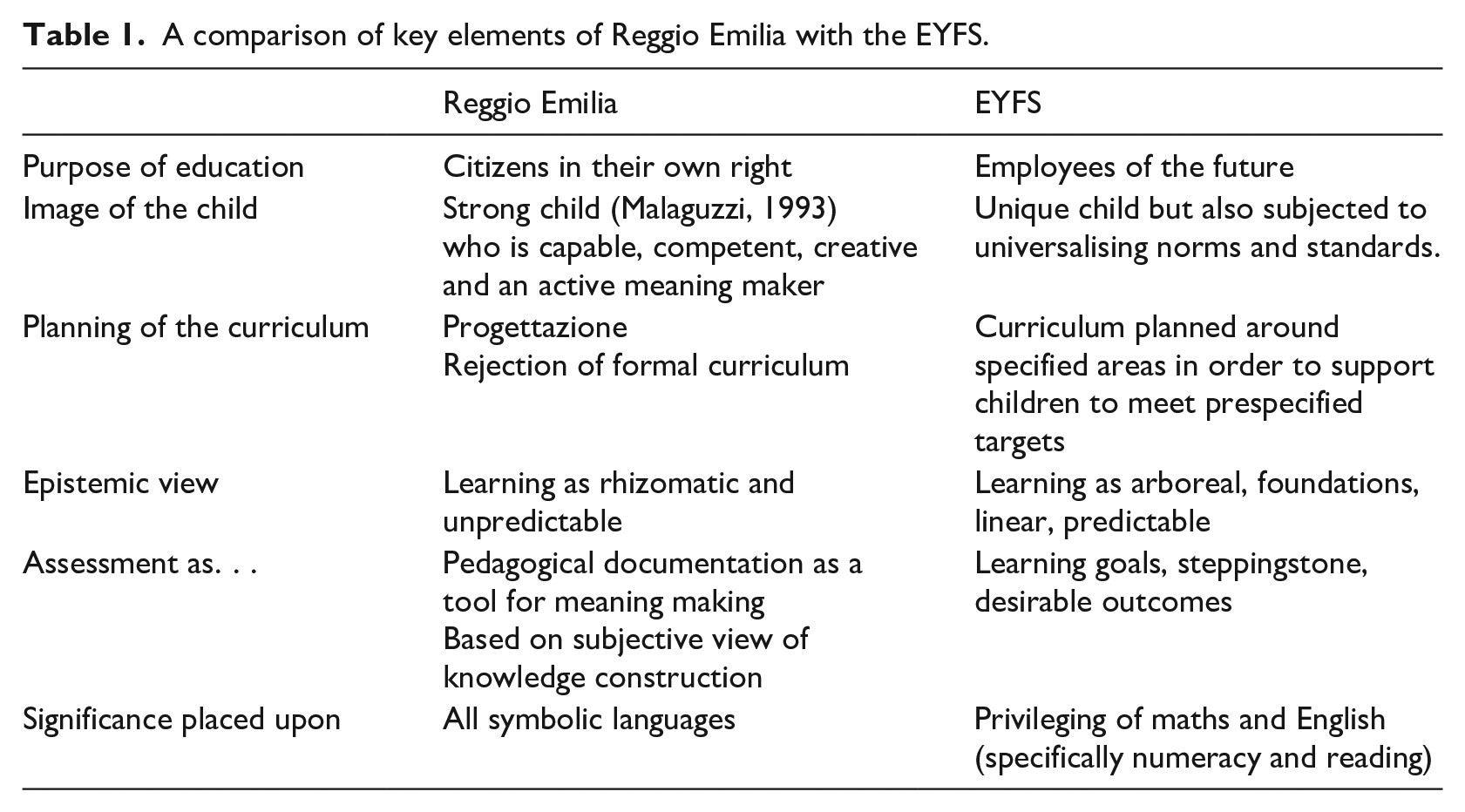
The comparison carried out within this paper indicates that curricula development should be understood as a construct and all curricula as value laden as opposed to value neutral (Apple, 1990). From this perspective, Cannella has consequently proposed that when interpreting curriculum reforms the dominant discourses in circulation act as powerful tools, shaping teacher subjectivity in relation to beliefs and ultimately impacting upon the selection of paedagogical practices deemed as ‘legitimate’ (Cannella, 1997, 2000). Kemmis (1995) has further argued that the introduction of new educational policies can often add to the inherent negations in education because of the competing discourses, ideologies, and agendas in circulation, which shape the thinking of teachers in relation to how ‘curriculum’ and therefore paedagogical practices are constructed (Ball, 1994). It is also noteworthy that whilst curricula models are likely to reflect societal values, the model of the curriculum for young children in England has increasingly been shaped from the top down via a range of government micropractices (Gore, 1998). This contrasts sharply with the schools of Reggio Emilia where there are no government statutes and consequently ‘societal values’ stem from the children and teachers and schools themselves – shaping practices from the ‘bottom-up’.
Conclusion
This paper focussed on a comparison of Reggio Emilia, Italy and the EYFS in order to demonstrate that different curriculum models are rooted in particular social, political and contextual discourses, although Reggio does not have a formal curriculum! It began in the 1990s at a time when I set out on my own teaching career and became aware of the schools of Reggio Emilia and at the same time, government policy on early childhood curriculum was initiated (SCAA, 1996) and I outlined how I had pondered what ‘doing Reggio’ could mean. Moss (2007) has previously theorised that wholesale transportation of curriculum models is particularly problematic when there is a clash of paradigms between post modernism and modernist positions. Drawing on this position, I would add that ‘doing Reggio’, has never been possible since, like all curricula it is rooted in a particular social, cultural and political context; however, drawing on Reggio practices has become consistently more challenging over time within the English early years policy landscape as instrumental discourses have increased dominance, leading to a collision between different ways of working with children.
Whilst I have problematised the uncritical notion that there can be wholesale, transportation of one curriculum model to an unfamiliar context, I offer this paper as a provocation to practitioners and policy makers to critically consider the practices of Reggio Emilia as a reference point. I have found the theorising of Dahlberg et al. (1999) useful here, as they note that whilst our subjectivities are shaped by technologies of normalisation, it is also possible to offer forms of resistance through practising ‘technologies of the self’, through consciously becoming aware of the dominant discourses shaping and producing our practices and critiquing these, and in so doing, creating ways ‘in which alternative discourses and constructions can be produced and new boundaries created’ (p. 34) and as Ball (2013) has argued:
If power acts upon us in and through our subjectivity, then that is where our resistance and struggle to be free should be focussed.
This might be achieved through focussing up some fundamental significant questions related to our own practices, such as:
What is the purpose of early years education within the English policy context?
How is this informed by developing understandings of how children best learn?
How are children and their teachers constructed within the EYFS?
By closely exploring different curricula models it also becomes possible to make visible key societal values, which are often hidden, as Johnson (2007) has maintained: The school curriculum goes to the heart of our conception of ourselves as a civil society. We define the values and the aspirations we hold, collectively, through our choices of what to teach our children. (p.8)
Footnotes
Funding
The author received no financial support for the research, authorship, and/or publication of this article.
