



Abstract
In this colloquium we share stories from two schools located in Western Australia that were inspired from the Reggio Emilia education project. The focus is on a view of children as capable citizens of the now. The examples in practice describe learning scenarios in which educators work as researchers using the ordinary moments of daily classroom life. It is in these ordinary moments where a pedagogy of listening is enacted.
Introduction
The educational project of Reggio Emilia is an example of an organization and pedagogies that reflect the choices of valuing “the common good and an ethic of alliances” as a means “towards the collective construction of a new culture of childhood” (Giamminuti, 2016: 4). Reggio Emilia is a city in Northern Italy where a group of municipal infant-toddler centers and preschools practice democracy, inter-connectedness, wonder, uncertainty, research, and experimentation through pedagogies of relationships and listening (Moss, 2019). With the image of the child as capable and contributing citizen of the now (Rinaldi, 2006) and teachers as researchers, this “civil, cultural, pedagogical, and social project” (Giamminuti, 2016: 4) is world renowned and influences early childhood programs and research around the world.
In Australia, Nido Early Schools are inspired by the principles of the educational project of Reggio Emilia. Each service works to contextualize the approach, providing a unique local experience to children, families, educators and wider community. Nido Early schools provide environments for children’s learning where they are encouraged to create, explore, participate and learn. Central to the Nido philosophy is the belief in the capabilities of young children as active citizens from birth, and a commitment by educators to actively listen to the voices of children as they communicate in a multiplicity of ways. At Nido, children are viewed as active members of their communities who which they belong and capable of meaningfully contributing to society. This image of children is underpinned by a belief that children are naturally included to question, interpret and understand their worlds.
Unique to Nido Early Schools is the role of the Curriculum Leader, a critical role which supports educators to critically reflect on their pedagogical practices and choices and continue the ongoing development of the team. In this way, both the Curriculum Leader and educators are researchers.
The following two stories share these ideas and commitments in action from two early schools located in Western Australia. Central to both stories is the view by educators of an image of the child as a citizen from birth with enormous potential and capabilities and how educators work as researchers within the ordinary moments of daily classroom life. Further, these stories enact teachers as researchers that use pedagogy that is “situated, eventful, generative and response-able” (Vintimilla and Pacini-Ketchabaw, 2020: 8). This creates pedagogy as “life-making” through ordinary moments where “small, everyday, mundane gestures of co-composing through rituals, encounters, exposures, working at dissensus, interrupting hegemony and normativity, working through rather than intervening in problems” (p. 11). Listening, thinking, and acting with is enacted through the pedagogies shared as children and educators encounter death, materials, and their own roles as researchers.
The death of Peanut Brownie: Enacting a pedagogy of listening
Nido Early School at Willetton is located in a suburban area south of Perth and has a strong focus on children’s citizenship and connection to community. Willetton children are part of decision making in relation to service operations and their responsibilities include administrative duties, selecting resources for purchase, planning excursions, attending meetings with the service leadership team and caring for the animals and garden.
In 2018, a “Pedagogy of Listening” (Rinaldi, 2006) project commenced led by Curriculum Leader Anthea Casey. The Pedagogy of Listening is active practice drawn from the educational project in Reggio Emilia, Italy. As a metaphor, this pedagogy disrupts the notion that learning and teaching is based in reproduction and transmission and engages teaching and learning as participation (Dahlberg & Moss, 2006: 8). It is an ethical practice where encounters are practiced and relations with Others–”an openness to difference of the other, to the coming of the Other” (p. 11). Listening is practiced with conceptual and pedagogical understandings as articulated by Rinaldi (2006), Listening is not easy. It requires a deep awareness and at the same time a suspension of our judgments and prejudices; it requires openness to change. It demands that we have clearly in mind the value the unknown and that we are able to overcome the sense of emptiness and precariousness that we experience whenever our certainties are questioned. (p. 49)
With children viewed as capable and teachers as researchers, the project began with educators audio recording sleep time—an ordinary daily moments within the context. These recordings were then used as a basis for critical reflection on educators’ practices during sleep and rest times. As the listening project continued, educators extended this pedagogy of listening to other aspects of the day and noticed that children began requesting to record and listen back to their voices and those of their peers and educators. Children began to voice their opinions about a wide range of matters which were important to them and began to transfer and adapt their experience of being listened to and heard by educators to their play. These relational pedagogies practiced “life-making” (Vintimilla and Pacini-Ketchabaw, 2020) in the everyday (Figure 1).
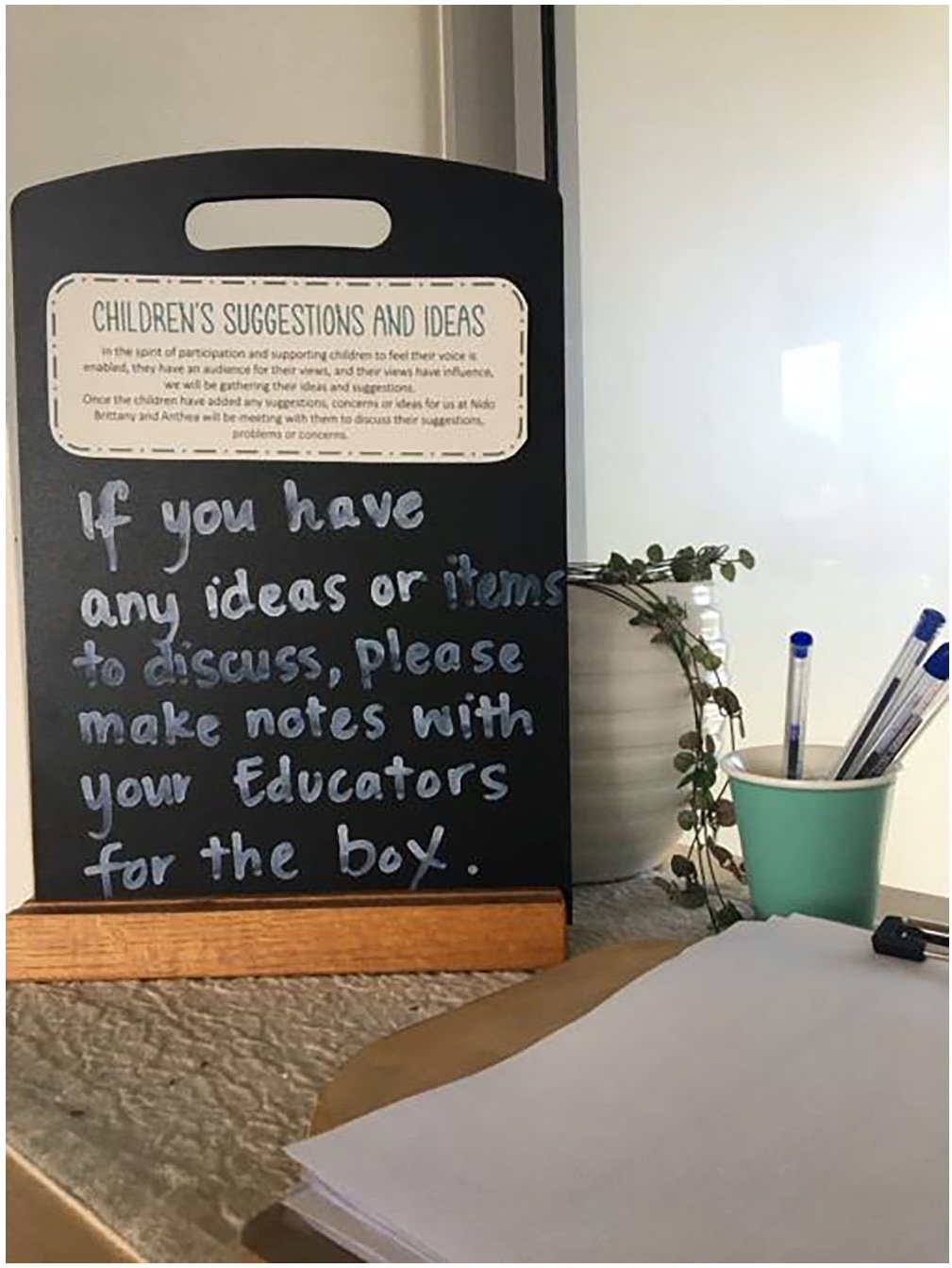
A pedagogy of listening.
Meeting Mondays is an embedded aspect of the Willetton curriculum
The project continued to grow and extend in an organic way from its inception in 2018. Recently, a topic presented itself, unexpectedly—the death of Peanut Brownie, the community’s guinea pig. This event required educators to truly listen with Willetton children’s voices and consider how they interpreted, and responded to, the concept of death. Anthea shared the experience: We knew after returning from the vet our integrity would not allow us to hide this from the children—after the learnings experienced by the educators over the last 2 years, we firmly believed that we could not honestly say that children had autonomy and a voice at our service if they couldn’t participate in a matter about which they cared so deeply. So often we hide the hard parts of life from young children. On this day we knew the children had the right to participate in a ceremony for Peanut Brownie and we had the responsibility to put Peanut Brownie to rest with the children being part of this process. Children aged from 18 months to 4 years attended a ceremony to say goodbye to Peanut Brownie and educators supported them to make meaning from this experience which for some, was their first encounter with death.
During the ceremony, children were asked if they would like to share any words about the life of Peanut Brownie (Figure 2).
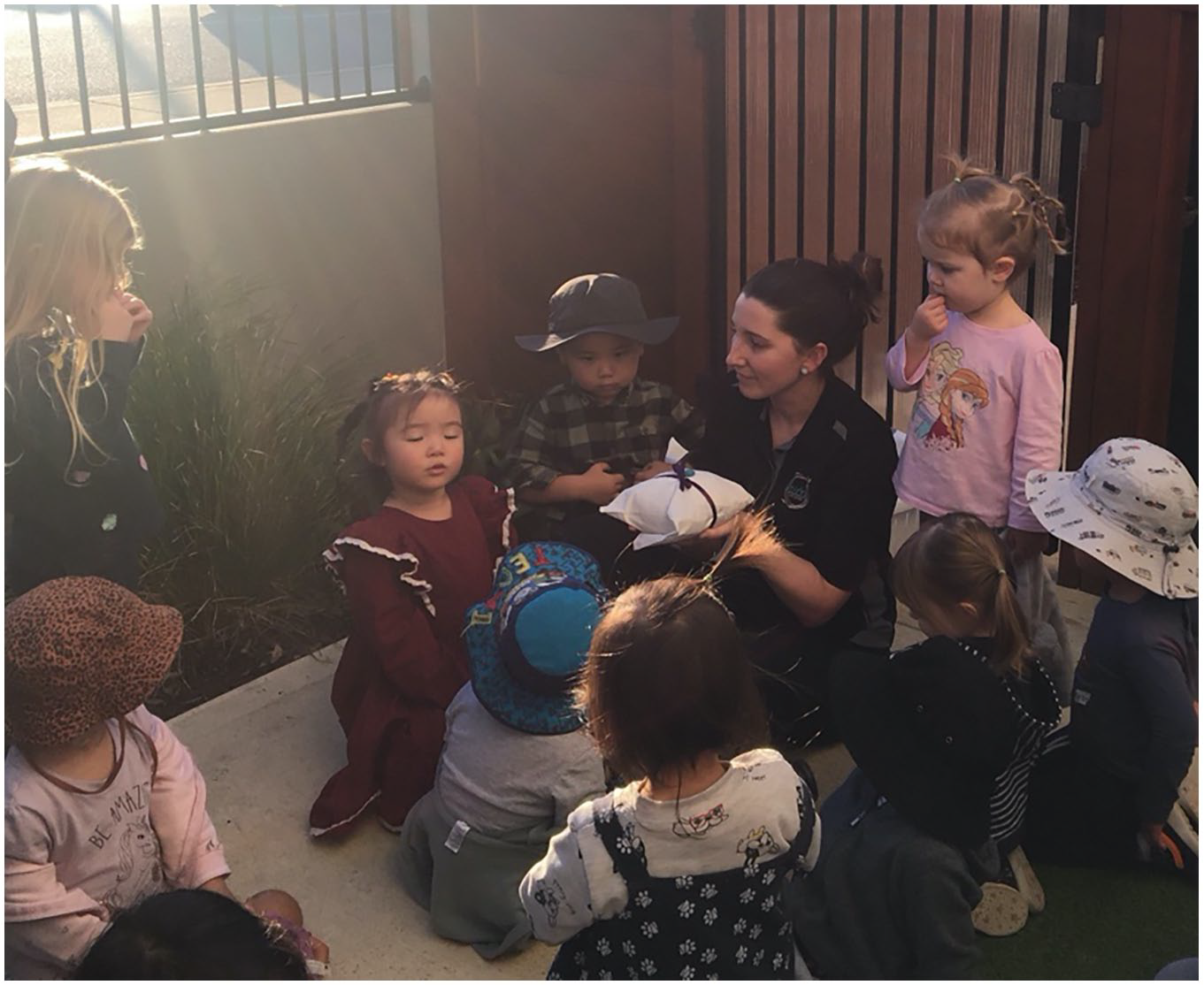
Singing to Peanut and laying him to rest.
“Peanut’s heart was beating for a long time, he was getting old, it was too long, and then it stopped and he died.” The next child added “Peanut, I love paw patrol, goodbye Peanut.” Finally, Jessica contributed “I will sing to Peanut” and sang a beautiful rendition of Let it Go with other children singing along in their own way.
Let it go, let it go I am one with the wind and sky Let it go, let it go You’ll never see me cry Here I stand and here I stay Let the storm rage on Let it go, let it go The cold never bothered me anyway Let it go, let it go Jessica—3 years 7 months
The topic of death and including the children (in the process) was difficult for the educators to come to terms with. Several educators have identified they find it hard to visit Peanut at the pet cemetery with the children as it is very confronting for them. Other team members who feel they can lead the children in this and participate with them will instead go with the children. Our Kinder room educators shared “sometimes we don’t know what to say, so we listen and answer the children’s questions the best we can and in a way they will understand.” By adopting a pedagogy of listening and trusting in children’s capabilities and their own role as researchers, educators created conditions for the children and themselves to find meaning in the experience of the death of their dearly loved friend. Children viewed as capable are trusted with the complex concept of death and teachers as researchers co-participate with the children to create opportunities where uncertainty and inter-connectedness contribute to the connections with the community and beyond (Figure 3).
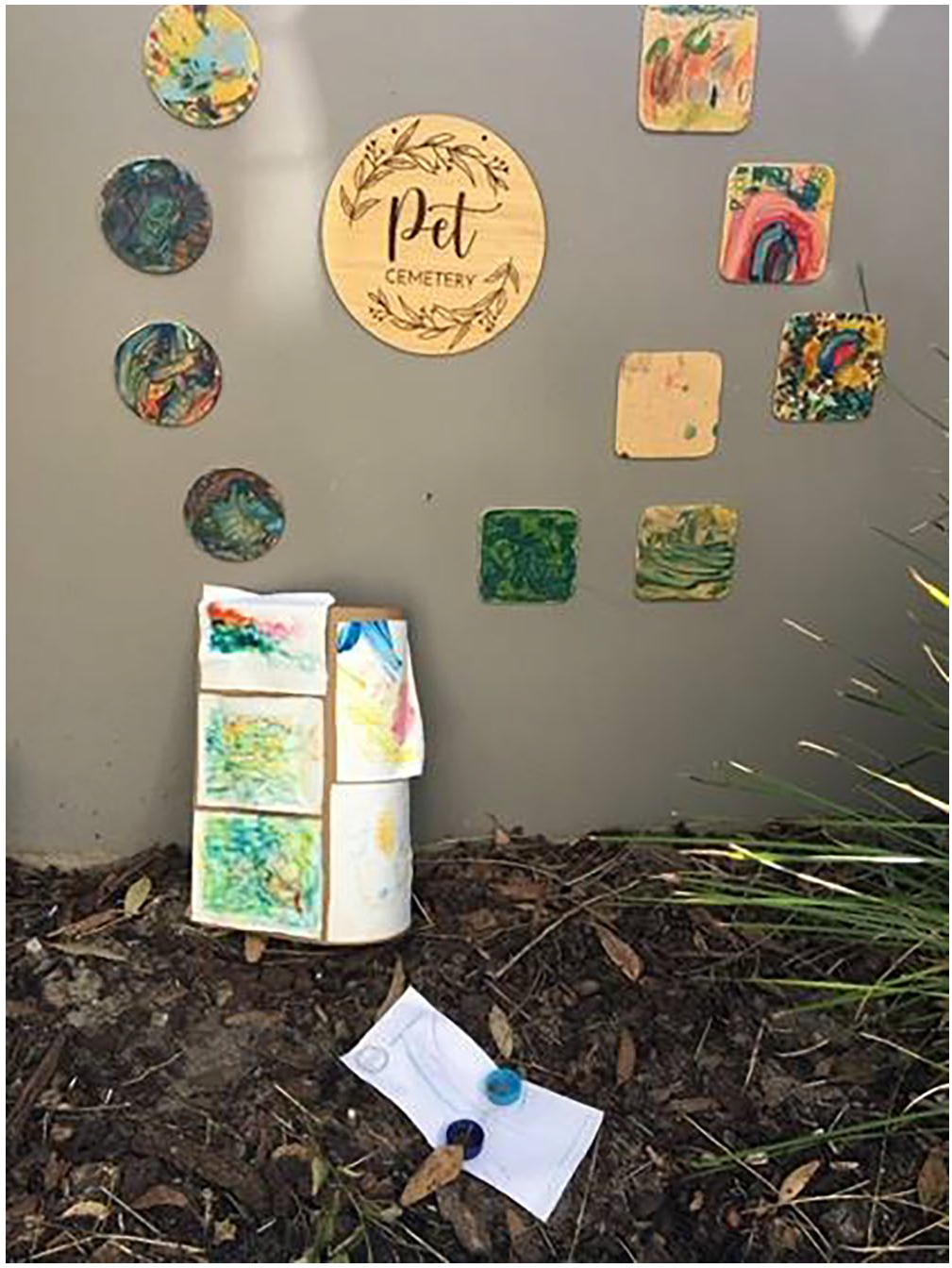
Children’s offerings at the Pet Cemetery in the outdoor learning space where Peanut Brownie was laid to rest.
Making waves: Our atelier, the road to discovery
Nido Early School Belmont defines the Atelier as a creative space for the arts which supports children to explore and make meaning using a variety of materials including multiple resources and media. Early childhood teaching and learning is often full of materials and finding ways in which materials co-participate with thinking, listening, and acting is part of pedagogy. Building on the understanding that pedagogy is active, materials create a “living language” with movements, rhythms, and nuances (Kind et al., 2018: 42). Materials, in this sense, have agency and contribute to how children and educators make meaning of their worlds (Kind et al., 2018; Vecchi, 2010). The doing of materials becomes part of pedagogy as how a material “. . .invents, how it creates realities, and how it proposes particular ways of being” (Kind et al., 2018: 42) is a reality of the everyday (Figure 4).
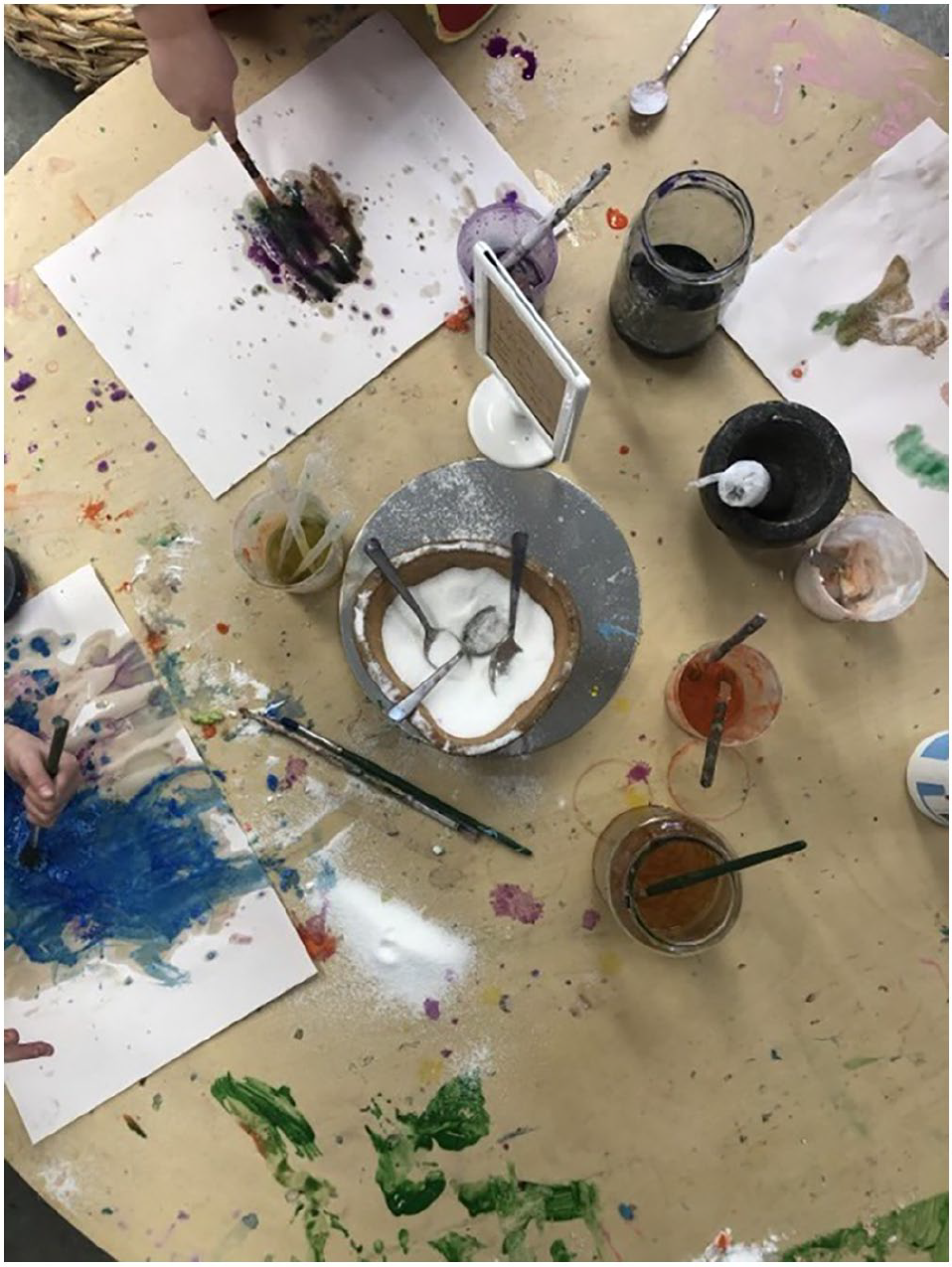
Painting in the atelier.
The Belmont Atelier program is led by Becca, an experienced educator with a passion for creative arts, as an atelierista. (An atelierista works with the educators and usually has an arts background). Becoming the Belmont Atelierista was a new role for Becca, and thus she assumed the role of co-learner in discovering the potential of the space and materials with children. The art of co-learning guides teaching practices and educators are regularly asked “what did you learn?” as they co-participate children on projects. Fourteen months on, “making waves” happened, which provoked Becca and Executive Service Manager Julie, to reflect on the journey of this time (Figure 5).
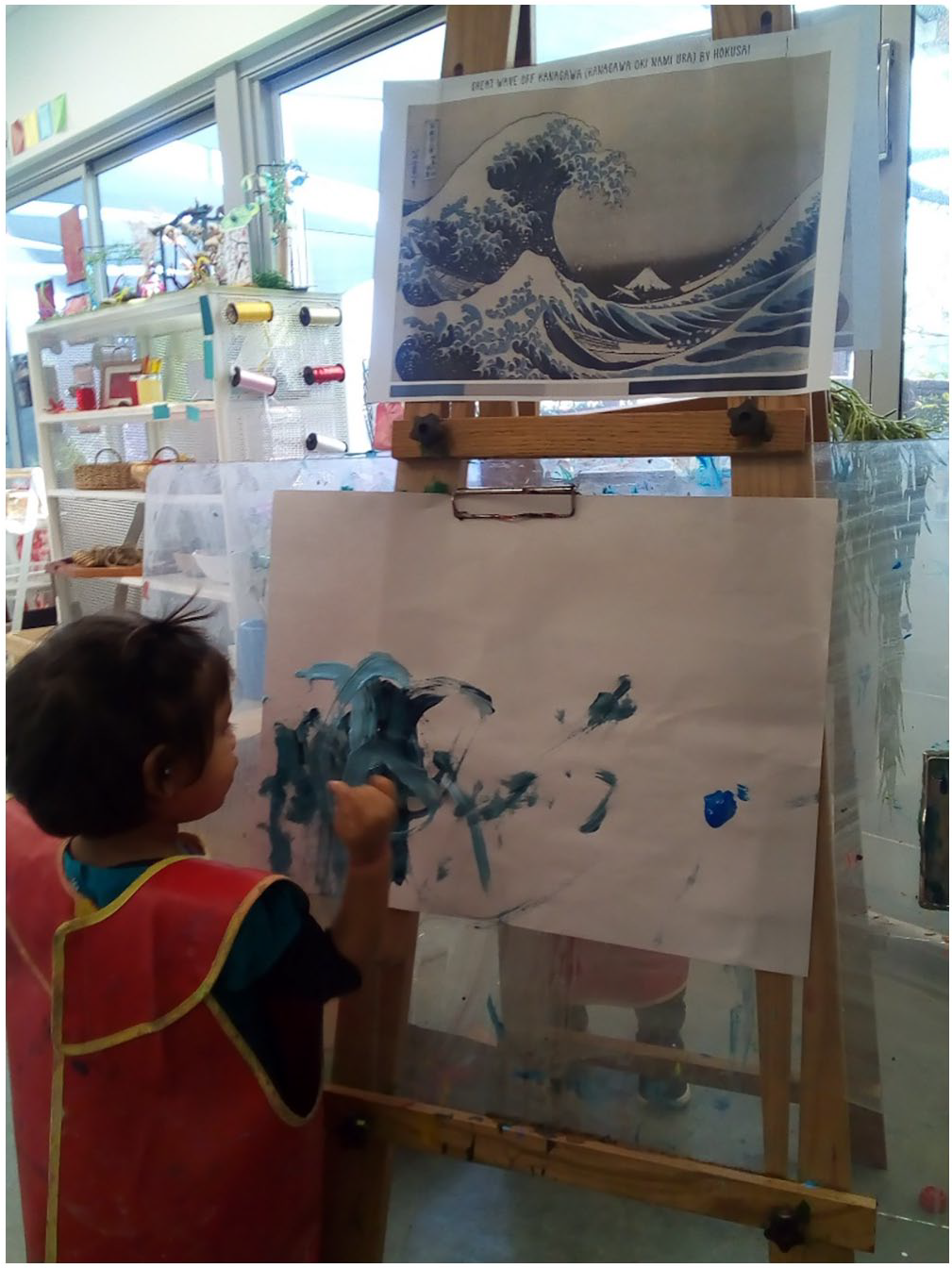
“Making Waves” -Kiara, 1 year 10 months.
Making waves: Perspectives from Becca, Atelierista
People don’t always believe that nursery children are capable, but they are incredibly so. We focus on the process rather than the end result, it doesn’t matter that they rip the paper, they had the experience and exploration and discovering and the sensory—it’s all learning. Working with nursery children changed my mindset. I had to change from thinking that I would do things for nursery children, or remind myself not to hover over them, showing them too much rather than letting them experience or learn for themselves.
Kiara commenced in nursery and began working with clay at 8 months old. From the beginning, Kiara was very interested in painting and loved using her hands to explore the paints and brushes. As she transitioned upstairs where the Atelier was more accessible, she was constantly in the space, sitting with the clay very often. She began with just touching and feeling but can now roll and pinch confidently with pride.
Kiara self-initiated painting the picture “making waves” one day. Once I noticed what she was doing, I stood back and watched, and it was one of those “wow” moments. If someone was interfering and telling her, for example how to hold the brush, then we would have missed the opportunity to allow her to express her own ideas. Kiara was intentionally left to create this painting alone as she responded in the moment when she chose to participate. At this time, I was still setting up the Atelier, I walked over and once I saw what she was doing, I got out of her way so she could continue.
I believe that Kiara was creating her interpretation and inspiration of the picture that was displayed. In that moment, the picture is there, and it is an invitation to participate, or to not participate, and she made a choice in that moment to look at that picture and to act. And when you look at the photo you can see her mind in motion of making the waves and the way in which she positioned the paining on the same side.
Making waves: Perspectives from Julie, Belmont executive service manager
Making waves was a moment where I stood back and viewed from my own perspective, as an educator, student, mother, parent, a manager and art explorer, what it means to give children the Atelier and an Atelierista. Where advocating for arts in all forms gives children more opportunities for learning that is considered, understanding children need the time, space and place.
Kiara’s making waves is an intrinsic expression of learning, one where she feels confident to explore, experiment without hesitation, as she has grown within Nido Early School Belmont, a moment where Kiara seems lost in time, in the moment, giving over to an exploration of movement and flow, to the creative, to play with material, color, tool, and medium. Children grasp the art of becoming when enveloped in their creative exploration.
We have all experienced that moment when so lost in a good book or a creative process, that we feel time had stood still, but the evening had rolled in without us being aware. These are the moments we give to children when we gather, make available time, space, place, and the material and resources in the Atelier,
The Atelier was a new idea, space, and place for Becca and me when we joined the Belmont team. I knew when I first arrived it was a space for magic. Filled with the resources to engage with the arts, ready for the humming of children’s creativity and with the openness to start this journey. I discussed with Becca that we needed to start this journey in an authentic way, growing and learning, organically following the voice of the children, the educators the service community. The experience and exploration we have had through our journey of learning with our Atelier has shaped my experience as an Executive Service Manager and educator. It has shown me the importance of creativity and the arts as an expression and education journey, of authenticity, of the need for educators to be co-learners, and above all reminded me to never lose the magic of learning as an adult.
Within these two stories are ordinary moments within the atelier that become extraordinary moments when teachers listen with children and their experiences. Teachers as researchers think with the data generated through the moments in order to create opportunities and conditions that are responsive to the children and support children and teachers co-participating together. Materials and space come together in a way that offers a provocation for thinking, listening, and act with. This is made visible as Kiara moves with clay or when Julie articulates how the atelier contributes to becoming. The emerging pedagogies in response to every day moments are founded on the image of children as capable and contributing offer ways in which children contribute and participation in their community.
Footnotes
Funding
The author(s) received no financial support for the research, authorship, and/or publication of this article.
Author biographies
Nadia Wilson-Ali is the Director of Education at the Nido Early School and is responsible for developing and implementing the Nido Curriculum nation-wide. She previously has worked as a consultant supporting educators and management to implement quality curriculum for young children. Nadia is passionate about quality early childhood education and care and her interests and research include; implementing the Reggio Emilia approach in an Australian context, evidence-base practice, infant and toddler curriculum, social justice, inclusion and equity.Nicola Yelland is the Professor of Early Childhood Studies in the Melbourne Graduate School of Education at the University of Melbourne. Her teaching and research interests are related to multimodal learning. Nicola has worked in East Asia and examined the culture and curriculum of early childhood settings.Jeanne Marie Iorio, EdD, is a Senior Lecturer in early childhood education at the University of Melbourne. Her research, teaching, and writing focuses on disrupting and rethinking accepted educational practices in early childhood and higher education including learning with place, the practice of hope, and pedagogical documentation informing research practices.