



Abstract
The study examines the role of children as producers, distributors, and consumers in the digital realm. Additionally, it also explores class and gender identities they create and perform in this modality. We focus on young female YouTubers (8–11 years old) from Peru, a country that has experienced significant economic expansion in the first decades of the 21st century. The study analyzes 40 videos created by five girl YouTubers. The discussion addresses the economic role children perform in the digital economy as they produce value through content creation, distribute goods, and engage in globalized consumption. The paper also discusses the ways girls display gender and class identities in their products and their consumption patterns. Throughout the analysis, we use the key concept of children’s agency; the discussion reveals both the concept’s reach and limitations in the context of consumer culture, gender regimes, and neoliberal policies.
Introduction
In recent years, the presence of children in digital environments has become more prominent, and research studies are paying increasing attention to it from a variety of academic perspectives. However, most of this research focuses on children’ consumer cultures in the global North, while children in the majority world countries remain underrepresented in research, especially in their roles as producers, distributors, and consumers in the digital realm. This article focuses on children from Peru, a majority world country which has experienced sustained economic growth during the first decades of the century. More specifically, we focus on Peruvian girl YouTubers and explore the ways in which the Internet is configured as another medium in which children can realize formal and informal economic and commercial activities, while, at the same time, performing gender and class identities through these activities.
We depart from the perspective of Zelizer (2002) that considers children as active economic agents, in an attempt to broaden the discourse on children’s consumption, incorporating their roles in economic production and distribution. We analyze videos created and published on YouTube by young girls (8–11 years old) to address the following questions: What do the videos tell us about the economic activities of girl YouTubers? And how are these economic activities interlinked with performing gender and class identities in a context of economic growth but persisting inequalities?
The analysis of the videos in this article seeks to adopt the perspectives and voices of Peruvian girl YouTubers as they want to represent themselves in their digital cultural products. This material also reflects the social and economic context in which girls are growing up.
Peru is a South American country that has experienced sustained economic growth at the beginning of the century: from 2002 to 2013 the GNP average annual growth rate was 6.1%, one of the highest rates in Latin America. From 2014 to 2019 the economy continued growing, but at a slower pace (3.1%) (World Bank, 2020). 1 This growth has transformed the economic opportunities of Peruvian households, as it has accelerated consumption, especially among new and emergent middle class households. Despite new economic growth, inequalities have persisted and shaped the lives of children. According to the International Labour Organization, Peru has shown for years the highest rate of child work in South America, followed by Bolivia and Paraguay. Studies of child labor in Peru focus on rural children and those from poor urban areas (Ames, 2013; Cavagnoud, 2011), but scarce attention has been paid to children in the middle classes and their economic activity through the Internet. The recent economic growth, along with liberal policies and free markets, have however allowed for increased consumption in middle- and upper-class households. Children from such households have greater access than previous generations to technologies, games, toys, fashion, and all sorts of merchandizing from global brands dedicated to children products, both physically and remotely, through web purchases. Our analysis aims to shed light on the experiences of these children, particularly girls, as they become economic agents in the globalized world and the digital environment.
Results show that YouTuber girls are active producers and consumers in the digital world, enacting their gender and class identities through their performances. They do so in a context of globalization, economic growth, neoliberal policies, and promotion of entrepreneurship and consumer culture that also shapes their digital products, as we discuss in this paper.
Childhood and economic practices in a digital environment
Some scholars have noted that the new paradigm of childhood studies ignores children and their relationship to the market. On one side, Buckingham (2013) attributes this to nostalgia for a pre-commercial “natural” childhood, away from commercial influences. From another perspective, Cook (2013) considers that this is an ideological and political view that values children’s agency only when it is related to an ideal conception of a child and not when it is related to the commercial terrain. In this view, consumption is not considered as a real and central aspect for childhood. Economic and sociological theories of consumption do not incorporate children and their practices and contexts in the economic world (Cook, 2008; Martens et al., 2004). However, Zelizer (2002) review of ethnographies in different scenarios shows how children participate actively in a broad range of economic activities, assuming various roles as producers, distributors, and consumers. Zelizer emphasizes that it is value, beyond remuneration, what is at the center of her definition of economic activity. Although Zelizer does not focus on the digital realm, we consider her perspective useful to examine this domain as well, and adhere to her definition of economic activity.
The relation between childhood and the market in the digital realm, although scarce, is growing in recent years given the intensive use of digital media and the presence of brands online, particularly about children’ consumer culture in digital environments. On the one hand there is a perspective that highlights the agency of children and adolescents in the use of digital media (e.g. Boyd, 2014; Jenkins, 2009), whilst on the other hand scholars also highlight how structures impact on consumer culture through the influence of brand communication (Marôpo et al., 2017; Skaar, 2009). Seeking to overcome this polarization, Willett (2008) attempted to identify and recognize the power of the industry (structure) without denying the active involvement of children (agency) with commercial products: the author finds that children participating in the study have discourses that show a degree of agency by resisting commercial influences and being critical and self-reflective. However, such agency is located inside of a structure of neoliberal discourses of individualism and responsibility, besides social structures such as social class. Here we understand children’s agency as the capacity of all children to make their own decisions and choices that have an impact on their own worlds, conceptualizing children as active agents who reflect on and construct their social worlds (Montreuil and Carnevale, 2016).
In addition to being followers, viewers, and consumers, children also appear as digital content creators, especially in platforms as YouTube. The rationale of economic production on YouTube is based in the so called “attention economy” (Marwick, 2015): “what followers offer in exchange for producers’ content is their own attention, which is readily translatable into metrics of value (e.g. number of subscribers to a YouTube channel); the value of attention in turn drives the monetization potential” (Berryman and Kavka, 2018: 86). Nowadays, YouTube promotes monetization (income obtainment) through the insertion of publicity in the videos created by the users (Ardevol and Marquez, 2017). This way, the publication of videos on YouTube constitutes the creation of value in the attention economy.
Scholars have also discussed the creation of content of children YouTubers as a form of child work (Craig and Cunningham, 2017; Marôpo et al., 2017). Arguments have been presented that (1) the transformation of play to obligation—by demands of sponsors of new content creation, (2) the time dedicated to the activity, (3) the income produced, and (4) the professionalism of children’ actions, transform YouTubers’ activity in work (Marôpo et al., 2017). However, digital content creation is different from traditional media, since YouTubers have more agency and diverse forms of entrepreneurship, led most times by families and not necessarily by commercial interests (Craig and Cunningham, 2017). León (2018) highlights the skills children deploy in the process of video creation. Marôpo et al. (2017), in analyzing the production of girl YouTubers as content creators, highlight that consumer culture is linked to female identity and is related not just to the children’s products, but also to adult products, such as, for example, beauty products. In this paper we follow this emphasis on the importance of taking in account YouTubers’ gender and class identities as part of their creation of content.
In summary, literature shows that children are rarely seen as economic agents but here we suggest that they are. We argue that children’ participation in the digital world involve diverse roles as consumers, followers, viewers, and also as content creators, thus producing and distributing value. As social agents, children exercise agency in various ways, but also find themselves constricted by market and other factors such as social class and gender. It is with these analytical lenses that we approach the study of a particular group of girl YouTubers in the global south.
Methodology
In this article we recognize children in their various roles as economic agents. We focus on girl YouTubers for this paper following similar studies (Jorge et al., 2018; Marôpo et al., 2017), since girls create videos that show a direct relation to the market and with commercial content (such as unboxing or hauls) more frequently than boys. 2 We choose girls from Peru, as children from the global south are less present in studies on this regard.
The research questions that guide the inquiry are: What do videos tell us about the economic activity of Peruvian girl YouTubers as producers, distributors, and consumers? And, how is this economic activity interlinked with performing gender and class identities in a context of economic growth?
We will discuss these questions based on an exploratory study of five Peruvian amateur girl YouTubers between 8 and 11 years old. 3 Identifying amateur children YouTubers is not easy as children sometimes produce some videos and then stop uploading new content to their channels, and they tend to be isolated since they are not connected as older YouTubers (navigation across their links is not possible). Thus, this study is recognized as being exploratory and does not attempt to extrapolate all Peruvian children YouTubers. Selection criteria included age (8–11) and gender (female), as well as (i) having more than 50 videos created and published (as this shows girls are creating context in a sustained way, instead of incidental and infrequent productions); and (ii) having at least one video published in the past 3 months before the beginning of research (as this ensure that girls are active in their role as YouTubers at the moment of research).
Table 1 shows the YouTubers’ age, number of subscribers, and videos online at the time of the fieldwork’s conclusion. We can see some differences among our sample since some girls publish much more than others, although this fact does not always correlates with the number of views they get. Girls’ place in the attention economy is more clearly reflected in the total of views they get or the number of subscribers in their channels rather than in the number of videos produced.
Female children YouTubers and their details.
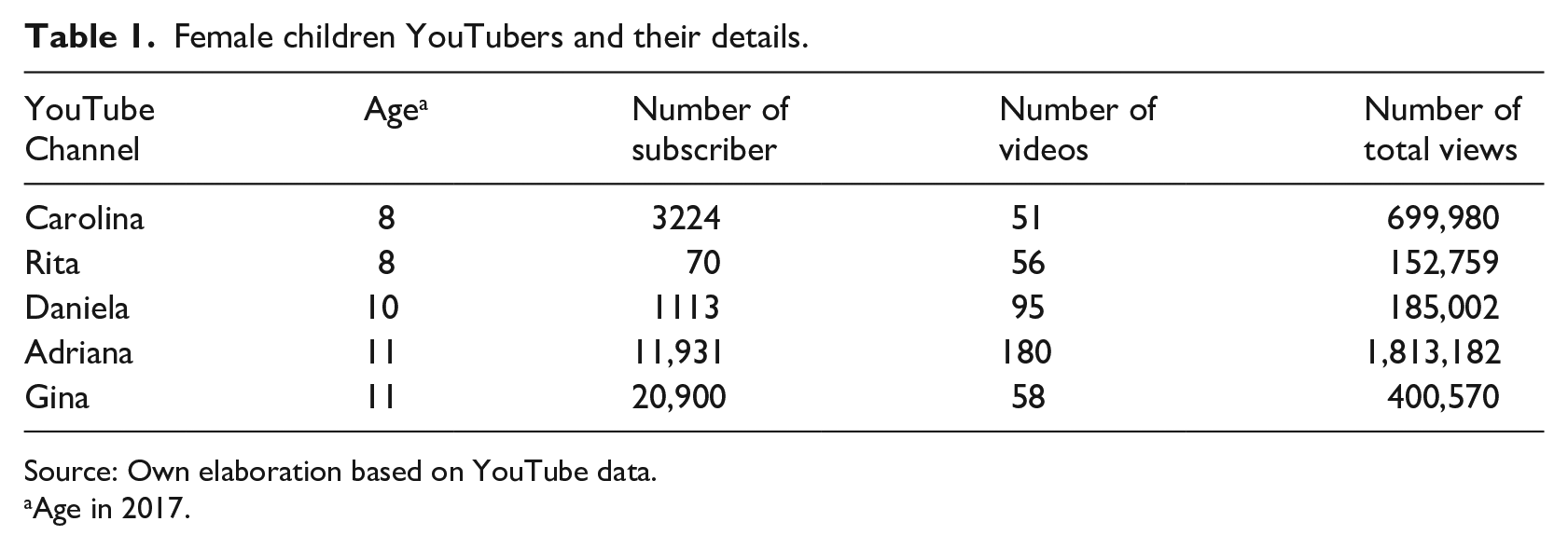
Source: Own elaboration based on YouTube data.
Age in 2017.
We selected 40 videos according to the content shown. As we were interested in the relation of the children with the market, we choose those videos related with the production, consumption, or distribution of products. Thus, we choose videos that have a review format, such as an unboxing (opening up a box and commenting on the product); a haul (showing products recently acquired or used, and explaining what it is and where to buy it); or that simply show or promote commercial products and brands. We did not include comments of the viewers as an object of analysis as our focus was in the girls as producers, rather than in the audience or community.
Both researchers and a research assistant conducted the analysis of videos. One author undertook the first codification under Zelizer’s (2002) three broad categories—children as producers, distributors, and consumers—and added emerging categories such as video formats, product type, and location. In addition, the research assistant analyzed and codified 50% of the sample of videos, coinciding in the codification. The second author coded class and gender markers embodied in the products shown, including girls’ clothes, physical space, places visited, and other objects shown in the videos. Next, both exchanged their codifications for validation.
During the research, ethical guidelines were adhered to for research involving children. Thus, although we only analyzed videos, as public material freely available in the YouTube platform, personal usernames were anonymized to protect girls’ identities (names used here are pseudonyms). We did not include any screenshots where the YouTubers are visible. Also, it was decided not to contact, neither virtually nor physically, the YouTubers.
Results
Results are presented in three sections: the first section analyzes female YouTubers as producers; the second section analyzes them as distributors of goods while the third section is dedicated to YouTubers as consumers. In all three sections we pay attention to how girls perform female identities in their videos, and highlight evidence of class identities in the analysis of YouTubers as consumers, given its importance as observed through our research.
Girl YouTubers as producers
Production undertaken by children is conceptualized in a broad manner as “any effort that creates value” (Tilly and Tilly, 1998 cited in Zelizer, 2002), beyond remunerated work. It includes household support (domestic labor and in family businesses, receiving or not an economic acknowledgment), involvement in external organizations and other homes (taking care of children, gardening, or supermarket support), and the production amongst peers, which many times have been categorized as child play (e.g. the construction of a house in a tree).
Girl YouTubers produce value when creating their videos and publishing them into their YouTube channel. In the first instance it could be seen as a ludic activity, but it is important to frame it within the rationale of economic production on YouTube and the attention economy. As we explained in section 1, there is an exchange of videos produced for attention. Attention is registered in metrics, which at some point are translated into monetization. Beyond monetization however, girl YouTubers are producing a commodity (videos) for the attention economy of the platform (YouTube).
Even though many girl YouTubers we observed do not monetize their videos, their discourse reflects the immersion of the economic rationale and the business model of YouTubers proposed by YouTube. Girls in our sample want their content be consumed, and they want to construct an audience and increase their followers (for e.g.) “Hi! When you subscribe, do not forget to activate the notification, that way you don’t miss any of my videos!” (Carolina, 8 years old). In almost all the videos observed, girls request a “like” and ask for the viewer to subscribe to the channel, explaining that these actions “would help to keep on uploading videos, love you!!!” (Gina, 8 years old). The most popular YouTubers recognize and almost demand the support of the audience to accumulate viewing time, gaining popularity, and to monetize their production (Ardevol and Marquez, 2017).
On the other hand, the brands are at the forefront in terms of appropriating publicity by YouTubers. Brands seek to incorporate their products in the narrative of YouTubers, just as in mass media (Ardevol and Marquez, 2017). Immersed in this system, YouTubers strengthen the business model creating content that generates income.
In the cases of the girl YouTubers we studied, they participate in this phenomenon and produced income through the publicity that they incorporated in their videos to promote in their YouTube channels, or at least they aspired to it in a symbolic manner. The case of Carolina shows how she starts the promotion of products and services through different video formats that included the exhibition of products, interviews with commercial agents, visiting the commercial location. Carolina has some videos in which she presents toys and games, describes them, shows how they work and plays with them: The video is filmed in a park. The girl shows the box of the Pie face game. “This game was sent to us by Hasbro from Peru, and Hasbro: thanks for sending this, I really like it”. She explains that she is going to play the game in a more complicated manner than it is usually played and explains how it works. She also unboxes the game, and her father appears on the scene, helping her. Both put together the device. Then, the girl starts to read the instructions. Father and daughter prepare the toy and the game starts. She occupies one of the places and her dad another. They play and her dad loses and receives a hit of cream to his face. The girl laughs. Then she invites children in the park to play the game. The video ends showing more children playing the game. (Video description.)
Among other video formats, Carolina interviews brand representatives, who recommend products, describing their benefits. She also visits the facilities of commercial establishments, such as a restaurant, a dental clinic, or a bookstore and shows the audience around in the video, as well as the products. In all these videos, she promotes consumption: “Today we’re gonna talk with Aldo about what books he recommends so you can go to Crisol (bookshop) to buy them.” She goes as far as to indicate where to buy some toys: “Guys, remember that this Bloobie can be found in the Jockey Plaza Mall.”
Behind these videos there is a commercial agreement between the producers of the YouTube channel and the brands. 4 The girl has a clearly public discourse and mentions in various videos that the toy or product was delivered by a corporation, or that a brand has given her the products as a disclaimer: “I’ve been invited to the Crisol (bookshop) office. . . they have given me two books.” But even when there is no commercial agreement, videos still show contents that generate value: a publicity value.
The girl YouTubers studied here have the support of their families to pursue this activity in various ways. This is seen in their videos. Sometimes it is their mother (Rita, Anita) or their father (Carolina) who is recording the video. This is especially evident when the video is made outside home. Parents might also appear briefly in the video sometimes when it is filmed in a location outside the home (cinema, park, mall). It is evident that the children are accompanied and transported by their parents/an adult to the “location” selected. Other times, a mother’s voice is heard in the dialog for the video recording. This was noted when Rita’ mother or a father’s voice is heard off camera. Carolina’s father seems to constitute a special case since he is also linked to a business dedicated to promoting social media workshops for adults and children. So, even though Carolina’s channel does not have big numbers in terms of followers or views, her father has managed to establish commercial agreements to receive toys from some brands (explicit in Carolina’s videos) through which she is producing value. The role of parents to mediate commercial agreements and monetization is therefore a key issue that deserves further research.
It is noticeable that the majority of videos produced by girl YouTubers show toys “for girls,” girl’ accessories or, to a lesser extent, girls’ fashion. Only in six videos did we find a gender-neutral objects (crayons, board games, a fidget spinner, books, a dinosaur). Gender specificity has been present in the toy industry for decades, although it has been contested from feminist movements since the sixties, seeking for less conditioning of gender stereotypes from early ages. However, the current toy industry is highly gendered in binary terms as the toys in these videos show: Pink colors are predominant for girls’ toys, as well as dolls and cute little animals, or schools supplies with Disney princesses motifs, emphasizing beauty.
These motifs are repeated in the way female YouTubers dress in their videos with pink being the most frequent color, followed by purple, and t-shirts with popular female cartoons such as Disney’ princesses, Ladybug, and other small creatures are also common. Girls dress in modern fashion items, usually with t-shirts, leggings, jeans, or shorts, but from time to time they also wear dresses, which remain associated as a traditional female fashion. This was illustrated when Carolina said in one of her videos: “. . .as we are going to talk about princesses, I have to dress like one” (changing suddenly from the t-shirt and leggings to a white, classic dress).
Some videos are produced inside girls’ rooms and there we can see similar motifs: pink walls or pink furniture or pink bed linen, flowers, or Disney princess as decorative wall-paper, “girly” toys and dolls beautifully arranged in shelves. The girls present themselves in these videos, with their gender identity firmly framed in mainstream models of girlhood and femininity. This also resonates with the idea of girlhood as depicted in the products they show in their videos. Only in one video can we see a glimpse of non-stereotyped female identity, when Carolina presents her Batgirl doll: Batgirl is a superheroine of DC comics. She started as Batman’ aid, although in Super Hero Girls (movie) she does not like Batman very much (and Batman isn’t there). She is one of the main super heroes (. . .) Bat girl can fly, can talk with bats, but she does not have many powers, she has also super strength, but she uses a lot technology, she spent hours and hours looking at her laptop, her mobile phone, calling Beast Boy, calling everybody, talking to Wonder Woman, talking even with the director, she even talks to herself, I mean she is just like me. (Video transcription)
Carolina identifies with Batgirl as a technology user; an identity far from the female stereotype in a country where less than 27% of university students enrolled in STEM careers are female (SUNEDU, 2020). Although isolated, this example may indicate the beginnings of a critical stance toward a female gender identity that stresses beauty as it predominates in other videos. The fact that being a YouTuber implies a relationship with technology may perhaps open the door to alternative (non-traditional) female identities for these girls.
Girl YouTubers as distributors
Our concept of distribution refers to all transfers of value (Davis, 1992, cited in Zelizer, 2002). In the case of children in this study, they initiate distribution at home and then among their peers and to organizations. An example of distribution among peers is the influence of the girl YouTubers in the selection of children’s gifts for their friends or the transference of skills and information through their videos.
Distribution or economic transfer on YouTube has constituted itself as one of the most popular strategies amongst YouTubers to strengthen and grow their audience in the attention economy. They give away sophisticated technological devices to symbolic actions, like greetings or collaborations. In the same manner, our case study girl YouTubers apply similar strategies at different levels in their videos.
Three of the observed YouTubers distributed or transferred goods from their channels. Their discourse reflects the same interest in expanding their audience, the vision of their videos and the diffusion of their channel among networks of children. In one of these cases, Rita reproduces this discourse: What do you think if . . .when I get to 100 thousand subscribers, I give away one of these dolls? But not this one, because it already has my heart. (. . .) 100 thousand subscribers is a big challenge, right? If we make it, I will, seriously, give away one of these dolls that are very lively and super cute. (Video transcription)
The discourse seeks to promote her channel, asking the audience to contribute, along with her, to reach 100,000 subscribers. Considering that she had a 1000 subscribers at the time of analysis, the transfer was not made. It just remains as a possibility.
It is interesting to observe the case of Adriana, the girl with the greatest number of views in our sample, because it shows transfer of goods as a clear and consistent strategy in the construction of her audience. She gave away many gifts to her followers (a doll, handicraft tools, a mp4 player, among others) in order to celebrate reaching 2000, 3000, 5000, 6000, 9000, and a 10,000 subscribers. She herself chooses the gifts, which she acquires with resources from her parents. In order to distribute them she uses transparent procedures, such as video recording and uploading the face-to-face encounter, in which she rewards the winning follower.
In the case of Carolina, because of her link with brands that advertise on her channel, she has more chances to give away toys and discount vouchers for dental attention; however, we did not gather any information about the results of the giveaways. In one video, she offered 10 discount vouchers to the followers that left a comment. There were only eight comments but there was no information about the winners or what they received.
The goods these girls distribute, in contrast with the ones that they share and promote in their videos, are more varied in nature, and not exclusively directed to girls. This selection shows their interest in constructing a more varied audience, including boys and girls, and thus making room for gender neutral goods and services. Thus, although we have seen an investment in constructing a mainstream female identity in the production of videos, distribution seems to be directed to a greater audience.
In terms of YouTubers as gift recipients, this happens in the context of agreements with brands and, to a lesser extent, among peers. The brands send gifts to the children, such as toys and books, which are afterward displayed in their videos. Only in one case did we observe the gifts (loom crafts) that Adriana had won in the giveaway coming from another YouTuber’ channel from Lima.
Distribution however is not limited to goods or services. Girl YouTubers examined here, also distributed and shared information and skills. Some authors have stressed that unboxing videos for example, are not only promotional, but also could represent forms of product reviews or even pedagogical content (Craig and Cunningham, 2017), distributing then useful information among the audience. Our case studies girls do review the products they show, explain their characteristics, how to use them, and even where to buy them. A special type of videos not included in our selection but common among YouTubers such as Do It Yourself (DIY), that share steps to do something, distribute also skills and ways to do things.
Girl YouTubers as consumers
We understand consumption in a traditional manner, as the acquisition of goods and services (Zelizer, 2002). In the videos analyzed we can see that the products that the girl YouTubers consume are toys, school supplies, and clothes. The first ones are shown in unboxing videos, where the girls unbox a commercial product (Marsh, 2015).
“I am very excited,” says Rita, while she tears the package to open the box. After unpacking the toys, she describes them, puts them together, and plays in front of the camera. (Video description)
Dolls are used a lot in the girls’ videos. As with other toys, these are framed in the consumption of cultural industries at a global level. Many of the products shown in the videos are part of transmedia narratives, part of conglomerates like Disney or DC Entertainment. Toys displayed include Super Hero Girls, such as Wonder Woman and Batgirl, Disney Princesses, and Monster High dolls.
In contrast to the relevance of these narratives and characters, the girls do not show special affection or attention to the brands. These are mentioned in some cases, such as books or supplies, but there seems to be no emotional connection to specific attributes, such as quality, fashion, or status, even in the case of sponsors. In some situations, brands are not even mentioned at all.
Toy collectibles, one of the most popular categories of toys in the North American market (Berger and Moran, 2018), are less often shown in the videos observed. Rita (8 years old) shows her Twozies, Shopkins, and Trolls in unboxing videos.
Marsh (2015) proposes that the unboxing videos on YouTube make the audience participant of an affinity space (Gee, 2004). She concludes that ludic practices of the YouTuber are consumed, more than the products shown in the video. As we have noted in the previous section, other authors such as Craig and Cunningham (2017) also consider that the unboxing videos are not only promotional: It means, children are not just doing publicity but by reviewing products they also advance points of view about them.
The videos of school supplies, accessories, and clothes, such as some of those produced by Gina, Daniela, Adriana, and Rita, have the style of “hauls.” That is, they show products (especially fashion and beauty products) that the girls recently bought and mention how they plan to use them, constructing “looks” (Sykes and Zimmerman, 2014). Some girls are critical of the products. In the case of one of the videos we analyzed, we noted that girls recognize negative characteristics of the products, and show a critical attitude, which they afterward had forgotten about.
An example is Rita who shows a doll bought online: She comments to her mother “Oh, look, it seems strange to me that the face is shinier than the body, do you see it? And whiter. But that doesn’t matter, what matters is that it arrived ok, right?” Then we can see the hands of the girl examining the eyes of the doll. The mom asks, “she doesn’t close her eyes, does she?” and the girl replies “I don’t know how it works. We will see later on, right mom?”
Gina mentions that, very often, buying online facilitates access to products with much lower prices. This could be the reason that she tends to buy in a less than reflexive manner: by impulse. An example of this is the repeated buying of certain products. In one of the videos, she shows us a package of chokers and she mentions “1, 2, 3. . . I don’t even remember how many I bought, 4, 5, 6, 7, 8 chokers.” In several videos, we identify that she buys very similar products.
The videos often show certain aspects of the girls’ consumer experiences. To start with, in most videos, the girls usually consume “girly” products. As explained above, when describing the production of videos, consumption trends reflect gender identities, and products traditionally related to girls are more frequent than gender-neutral toys and games. Thus, girls tend to reinforce traditional female gender identities through the consumption of goods marketed and directed at girls.
Girls also stress their class identities through their consumption choices: they present themselves as part of a social group with the economic capacity to acquire toys, games, fashion and services, all of which are subtly presented in their videos. Locations chosen for the videos also speak to us about their capacity as consumers: modern malls in different parts of the city are shown in Rita and Carolina’s videos, as well as trendy ice cream shops or popular (and international franchise) restaurants, or even cinemas. We consider girls as ethnographers of their own relation with the market when they record and show in their videos the places where they consume and the products they consume, as this performance testifies also the changes experimented by the city and its inhabitants.
The capacity of the girls’ families to purchase goods and services are on display in these videos, showing also how new spaces for family lives and entertainment have opened with the recent economic expansion in the country. In 2017, when many of these videos were produced, Peru had 78 malls and the retail sector was still growing. Other traditional entertainment spaces, such as parks, rarely appear as locations (two videos), while commercial locations are much more frequent.
Another frequent location is the girls’ rooms. These spaces show their consumption capacity—displaying many of the girls’ toys and games—as well as the capacity of families to provide a room of their own, with decorations and goods especially made for girls. Not all Peruvian families can afford to do this, in a country marked by social and economic inequality. Yet, these girls are not part of the richest segment of the population: the places they go to and some details of their rooms and houses indicate they come from middle class households, perhaps from emerging middle classes that have benefited from economic growth in recent years. Families seem to look forward to providing for their children, ensuring education, health and entertainment, but also consumption of the goods the market has to offer. Consumption, in itself, is conspicuous and a way to differentiate socially from others, and girls seem to reproduce this in their videos.
Discussion and conclusions
What do the videos tell us of the economic activity of girl YouTubers? And how does this interlink with their gender and class identities?
The girl YouTubers whose videos we have analyzed came from middle class urban households that can provide for their needs, and beyond. Their videos show us their household’s capacity to consume goods and, thus, their social class status. This is not casual and is part of the message girls transmit in their videos. They do not show off their wealth, but they also make it clear that they are not poor either. In a country of marked social inequality, it might seem that the girls felt compelled to state their social status as part of the identity they perform in the digital world. Although these girls do not have to work for a living, they are able to perform as economic agents, producing and distributing value, beyond consumption.
Indeed, the cultural products we analyzed show the involvement of the girls in the commercial world of a contemporary society. If we consider these YouTuber girls as ethnographers of their own relation with the market, shown in their videos, we can see how in their daily lives, commercial products and locations from which they are not indifferent surround them. We could say that these children have acquired their economic world from the adult world, and have proposed their own role in it, as an expression of agency (Bluebond-Langner, 1978).
As part of such adult world, one can observe the discourse of entrepreneurship is strongly related to neoliberal policies and firmly embraced in Peruvian popular culture (Canepa, 2020). YouTuber girls, as we have said, do not need to work (yet) for a living, but probably would benefit from the need to acquire new abilities and capacities to inhabit the economic world they are growing into. The ability to conduct their own enterprise is frequently promoted by their parents who offer their help with the YouTube videos, showing they value this learning as an asset for their children’s future. In this sense, they are not far removed from rural parents: as Ames (2013: 169) points out in her research on Peruvian rural children “. . .beyond economic necessity, the involvement of children in household and farm work is also valued as a source of learning and developing competence” (for the future). Girl YouTubers examined here likewise are developing digital competences, a familiarity with technology, ability as content producers in the web, communication skills, and a sense of how to lead an entrepreneurship. The support girls get from their parents may indicate this learning is valued as useful for future economic involvement in the adult world.
Regarding consumption, if children have certain influence in the purchasing decisions in families, in the digital world, they are extending their influence beyond the family. They take an active and diverse role, as ambassadors of commercial products, opinion leaders, or digital influencers that have a voice, as an economic agent. Is this children’s agency or market cooptation?
On one hand, children’s agency is shown in the creation of content, the selection or recommendation of products from the market, the search for a place in the attention economy (increasing likes and subscribers), the promotion of products not only as digital publicity, and also as reviews and the use of diverse strategies in order to construct audiences. Agency is also present in the way children narrate their own social worlds, showing subtly the changes in their own society as they occur: an increase of consumer culture due to economic expansion; the transformation of public recreation spaces for families, more linked to consumption; smaller families where children acquire a more central and “priceless” role as Zelizer (1985) would say; and the expansion of the social landscape for children beyond face to face interaction.
Indeed, in contrast to traditional childhood cultures, where relationships amongst peers are confined to physical spaces, such as the school or the neighborhood, or to family, the economic activities exercised in a digital environment overcome this limitation. Through these activities, YouTubers expand their social network, eluding institutional mediation (e.g. school), reaching out to people that share their same interests and constructing social and economic relationships with them.
On the other hand, all economic activity is done in the framework of the promotion of commercial products and global brands and more generally in the contemporary capitalist societies. Most products are clearly gendered, and thus girl YouTubers contribute to the reproduction of a mainstream market view of female identities and girlhood. Girls may feel in a way compelled to perform according to traditional models of femininity in order to gain likes, followers, and subscribers if they want to ensure a place in the attention economy. As in most Latin American countries, there is conservatism around gender roles in Peruvian families, with many supporting a view of “natural” divisions against a progressive trend emphasizing the social construction of gender. 5
Finally, even though agency is also identified in the critical attitude children have toward commercial products (Willett, 2008), in the videos we analyze here, the discourse of the girls does not reach openly critical levels. Even though in some cases they show their dissatisfaction with products, their attitude remains condescending, something that is a feature of female “hauls” (Jeffries, 2011). Moreover, a critical attitude toward gender stereotypes around girlhood is mostly absent, revealing the limitations of girls’ agency. Although, perhaps, their own involvement with technology as YouTubers may become a critical stance to face gender stereotypes, as the case of Carolina seems to suggest in one of the videos we analyzed here.
A limitation of the present study is the methodology used, based only on the videos produced. Future research may integrate offline qualitative techniques in order to obtain information with YouTubers and their families, such as interviews and participant observation, although ethical considerations will need to be revised. This would allow a fuller vision of the perceptions and practices of children in terms of agency and their limitations, as well as the role of parents in supporting this activity.
In conclusion, the analysis of these videos shows girls as active economic agents as they produce, distribute, and consume goods in the digital economy. It shows a co-construction of consumer culture on the part of girls as co-producers in the digital realm. Girls perform gender and class identities that affirm their contemporary social position while, at the same time, seeking approval and “likes” that support their enterprise. They seem to strive for a delicate balance to exemplify how girls’ agency can expresses itself through creation of content and decisions around what they might consume and where to consume it. This occurs inside the limits of a culture of global consumption and social structures where conservative gender norms and social inequality are prevalent. Nevertheless, being a YouTuber itself may be an act of defiance to traditional female roles, as management of technologies allow for new paths yet to be explored.
Footnotes
Acknowledgements
We thank the support of Morelia Moret as a research assistant during the development of this research.
Declaration of Conflicting Interests
The author(s) declared no potential conflicts of interest with respect to the research, authorship, and/or publication of this article
Funding
The author(s) disclosed receipt of the following financial support for the research, authorship, and/or publication of this article: This work was supported by the Instituto de Investigación Científica de la Universidad de Lima.
