



Abstract
Post-qualitative approaches to educational research have taken into account the emergent and unexpected worldings in early childhood. In this paper we explore an event of shared listening in an Early Childhood Education classroom based solely on a sound recording clip and our memories. The limitations presented by the absence of visual data offered an opportunity to reflect on our own research methods and our relationship with the data that guided our analysis. Our reading of the event moves away from the Reggio Emilia-oriented practice of the teacher to the diffractive and emergent ways in which sound interacts with the children. The Deleuzian concept of rhizome helps us to understand the event, and, at the same time, consider the unique ways in which children listen in educational contexts.
Introduction
The current post-qualitative turn in educational research has troubled data collection techniques and treatment of data, provoking a break with the very idea of research data (MacLure, 2016). In the case of sound-based data, this shift has been evident in proposals for data collection that go beyond detailed transcriptions, such as the different ways in which sound is referred to, as explored by Wargo (2020), Gallagher (2016) or Hackett and Somerville (2017). This new direction also questions the power relations that emerge in sound-centred studies (Gershon, 2013), the roles commonly attributed to sound in education and qualitative research (Gershon, 2018), and the value of the voices of those who have not been given voice, thus paying attention to unexpected emergences (Mazzei, 2009).
The current article is framed within a wider project called MATILDA that draws on a neo-materialist and post-humanist approach to childhood. The project focuses on the emergent literacy practices among children aged 4 to 6 years old. The participants are children from public schools located in urban areas in the south of Spain, with a wide diversity of cultural and linguistic backgrounds. As part of the project, diverse actions were designed by the researchers, teachers, families and children.
The one presented in this article enabled the emergence of multimodal and creative embodiments through the reading of silent books, as well as an exploration of early childhood meaning-making processes and relations, or worldings (Malone and Murris, 2022). The action was reported by a journalist from [Radio Nacional de España, a public national broadcasting radio station] who visited the school during the action and interviewed some of the researchers, the children and the teaching staff. The result was a 12-minute-long podcast broadcast on the En Primera Persona web (Proyecto Matilda - En primera persona). Soon after the podcast aired, Ana, one of the teachers participating in the action, listened to the podcast with the children. Her aim was to revisit the action and remember the books, thereby empowering the children and showing them the importance of their daily tasks at school.
Drawing on this event of shared listening, we offer a reflection on listening in the early childhood classroom in a multiple and diffractive way. We start from Reggio Emilia’s concept of pedagogical listening to study emerging listening and its materialisation through some post-structuralist and Deleuzian concepts. Our aim is to invite educators and researchers to re-examine children’s listening in the classroom and the concept of language as embodiment and matter (Pennycook, 2024). In our analysis, listening moves in and out, diffracts and reunifies, showing the complex webs of relationships that are woven in/by/through sound in education.
Theoretical framework
In our research, we approach a classroom event intended as a review of pedagogical documentation involving the children and their teacher and analyse it from the point of view of Reggio Emilia pedagogy. Moving into a posthumanist reading, however, enables us to consider the subtle nuances emerging when we trouble humanist conceptualisations of listening and childhood. For this reason, in our theoretical framework we share the main groundings for our analysis, both from Reggio Emilia and posthumanist sources. Reggio Emilia concepts of pedagogical documentation and pedagogical listening, therefore, face Deleuzian conceptualisations of rhyzome, affect, lines of flight or diffraction. In our method and analysis, we think-with these concepts (Jackson and Mazzei, 2023) in order to attend the minor gestures of children’s listening.
Listening as pedagogical documentation
Listening has been addressed using several methodological approaches, including physiological, phenomenological, interpretive or empirical (Worthington and Bodie, 2020), and has been described as a key competence for success in early childhood education (Lahman, 2020). The act of listening is understood as an activity that has multiple strands that involve both the teacher and the students (Worthington and Bodie, 2020) and is connected to certain forms of sound and body control (Gershon, 2018). When studying the act of listening to children and listening in the classroom, some scholars warn against what they call ‘listening as usual’, understood as ‘repetitive listening, not requiring any thought, and serving to reiterate that which is already known’ (Davies, 2014: 25).
Critical perspectives on listening in the school classroom have associated it with the control of movement, bodies (Kirby, 2020), sound and silence (Gallagher, 2011). Concentration and learning are commonly associated with silence, and listening in the classroom excludes certain sounds while allowing others (Dernikos, 2020). Criticism of specific models of unidirectional listening advocate paying attention to the affective relations that emerge during the act of listening (Gallagher, 2016). Recent reviews of school listening point to the injustice of listening as an act of power, directed by an authority and neglecting the effects/affects emerging in it (Gershon, 2018). For instance, Yoon and Templeton (2019) focus on the injustice of privileging adult expectations over an attentive listening to the children. This kind of power-led listening has also been associated with hegemonic ideologies (white, Western, middle-class, male) that oversee those forms of listening that fail to match this hegemonic model, both in society in general (Stoever, 2016) and in education (Dernikos, 2020).
Pedagogical listening is a key element of Reggio Emilia’s approach to learning and has been described as a dynamic action in which educators and children listen and are listened to (Rinaldi, 2018). This way of listening proposes a shared review of the products, propositions and activities that make visible the learning from classroom tasks in which educators, children and families cooperate (Dahlberg, 2012; Moss, 2019). The aim is to avoid transmission and repetition, promoting knowledge building as a process and not as a closed or definitive product (Moss, 2019). The act of listening and being listened to in the review of learning processes and products implies the democratic participation of teachers, children and families in the design and assessment of learning practices and outcomes (Rinaldi, 2021). Therefore, pedagogical listening equals the roles of the agents when they share, assess and make decisions in the school context.
Troubling (linear) listening
The levelling of adults and children in Reggio Emilia’s listening aligns with posthuman approaches to knowledge building that trouble the hegemonic position of adults over children. The adult’s mastery of linguistic communication underpins this hegemony, manifesting in diverse conceptualisations of children as lacking (Murris, 2016). The posthuman and neo-materialist conceptualisation of childhood has highlighted the relationality of children’s interactions, in which children come-to-be entangled with matter, and the need to overcome the boundaries of linguistic-based meaning-making practices (Hackett, 2021). Posthuman approaches to childhood have regarded children’s worldings as embodied (Lenz Taguchi, 2010) and non-linear (Hackett, 2021) ways of being in the world. In these ways of being in the world, learning and existence resonate with Loris Malaguzzi’s metaphor of knowledge as a bundle of spaghetti where ‘it is often not clear where one string starts and another ends – closely touching and sticking. In this case, the strings are not confined to a bowl. There are no boundaries, there is no map of the territory. The tangle of strings is infinite’ (Murris, 2016: 170).
The posthumanist attention to human and non-human relations helps to expand Reggio Emilia’s pedagogical listening by questioning ‘if it is at all possible to teach without being in a state of a listening dialogue with children as well as with matter, artefacts and environments’ (Lenz Taguchi, 2010: 61). The posthumanist rejection of Cartesian binaries (Braidotti, 2013) promotes the notion of listening to human and non-human worlds and implies a dissolution of the listener/listened to divide (Lenz Taguchi, 2010). In this dissolution, humans and non-humans merge in the more-than-human, and operate in a non-hierarchical way, forming assemblages in which affects and desires emerge as relational forces (Buchanan, 2021). Affect, described as the capacity of affecting and being affected (Dernikos et al., 2020; Massumi, 2015), and desire, a productive and emergent force (Kuby and Rucker, 2016), become essential elements in the bodies’ relationalities. At the intersection of Reggio Emilia and posthumanist proposals, the conceptualisation of listening is open to the creative energies that emerge in the human and non-human (Davies, 2014). This emergent listening is a multisensorial, embodied and relational practice that ‘enables us to approach life, and our encounters with others, as movement, as opening up ways of knowing and being that do not give primacy to category membership within the established social order’ (Davies, 2016: 83). In childhood, emergent listening disrupts the taken-for-granted primacy of adult-led listening over the child and encourages open forms of listening respectfully with children (Yoon and Templeton, 2019).
Emergent listening and Reggio Emilia’s pedagogical listening are open to the unexpected; they share the idea of listening as dynamic and ongoing. In this sense, the unexpected relations, affects and desires that emerge during listening may be described as lines of flight (Kuby and Rucker, 2016), defined by Deleuze and Guattari (1987) as deviations that create breaking points in well-structured and established assemblages. They compare the idea of a tree as an example of the hierarchical structure of roots, trunk and branches, with that of a rhizome, understood as non-hierarchical and unstructured. As pointed by Kuby and Rucker (2016), ‘a node of a rhizome can break off and flourish in numerous directions’ (p. 33) not defined by functions or hierarchies (Lenz Taguchi, 2010). The relation between rhizomes and the Reggio Emilia-inspired view of children’s learning has already been pointed out by Murris (2016), drawing on the horizontality of the connections established among communities. Therefore, rhizomes and lines of flight may help us to reconceptualise listening from a posthuman perspective. In this reconceptualisation we ask ourselves the following: Which relations are established with/through sound and more-than-human bodies? What does the concept of rhizome add to our understanding of listening in childhood? How can we re-think listening and language in school contexts from the children’s perspective?
Our research
A podcast as pedagogical documentation
Our analysis is based on an event that took place in an early childhood classroom where a teacher, Ana, invites her pupils to listen to a podcast recorded in their school. The podcast, as explained above, is a recording of an event in which the children participated along with their teacher and the research team, who had been attending their school weekly for 1 year. Attending to the University of Sevilla’s Ethics Committee the children, their families and teachers gave their informed consent to be part of the research. They were provided full information about the research’s objectives, method and nature of their participation. All the names in this article are pseudonyms.
The moment when Ana and the children listen to the podcast was captured by one of the researchers Charo, in a short video recording (2′18″) of the beginning of the activity, and in an audio recording (12′42″) of the whole event (see Supplementary File). Both recordings were made with her personal mobile phone. During the event, the children were sitting on a cork floor where assemblies are held. Ana stood next to the blackboard and Charo sat among the children. This position, as well as the limitations of the mobile phone, hindered the capture of more distant sounds yet, at the same time, provided sound that was closer to the researcher’s perception. Therefore, our recordings do not represent what happened in the classroom but offer data that count in researchers’ non-objective positions (MacLure, 2013). Our recordings do not contain all that which took place in the classroom, only what reached the researcher’s device, so our event does not claim to be objective and bounded, but rather open to re-creation and building with/by the researchers (Menning et al., 2021).
Our ongoing review of these audio captures was carried out from a post-qualitative perspective and drew on the concept of not-yet-data that ‘can begin anywhere, anytime and by doing so, can create a sense of loss, uncertainty and indeterminacy with regard to those stable, fixed, repetitive, traditional structures of neopositivist qualitative research’ (Benozzo and Gherardi, 2020,148). The recordings shaped our understanding of the event; we modified, interrupted and reconsidered what the recordings and our memories meant to us. In this process, our previous knowledge of the children and the teacher, and our experience of the action, melded with the contrast of the podcast’s neat, edited and post-produced sound, and the classroom’s clutter and rattle. We felt blindfolded in the sense that we had to rely solely on our memories and audio recording. At the same time, we embraced Davies’ idea of the not-yet-known in research to ‘be able to see the rich and infinite variability of any community’ (Davies, 2014: 7). Hence, we were open to divergent ways of building on our data that included a transcription, a diagram and a still image of the classroom.
Visualising non-visual data
The transcription of the audio recording aimed to ease the management of the 12 minutes of the event. In doing so we revisited the sounds within the classroom, identifying children, teachers, researchers, the journalist speaking as well as whispers, laughter and other noises. All of these were part of the classroom sonic environment, none being more relevant than others. The transcription includes the silences in the classroom as gaps or void spaces during which only the podcast was heard.
During the transcription process we felt the need to transcend the linear sequence of sounds inherent in the podcast. As we decentred our attention from the human and moved to the non-human, we were keenly aware of the layers of more-than-human sounds. We aimed to reconsider these layers in a visual way and drew a diagram (Figure 1) containing the linear podcast and its intersections with the classroom during the listening. Our intention was not to represent all the digressions and interruptions, but to visualise those imbued with affects, desires, recognitions and emotions that were leaving traces in ourselves as we reviewed and created our data.
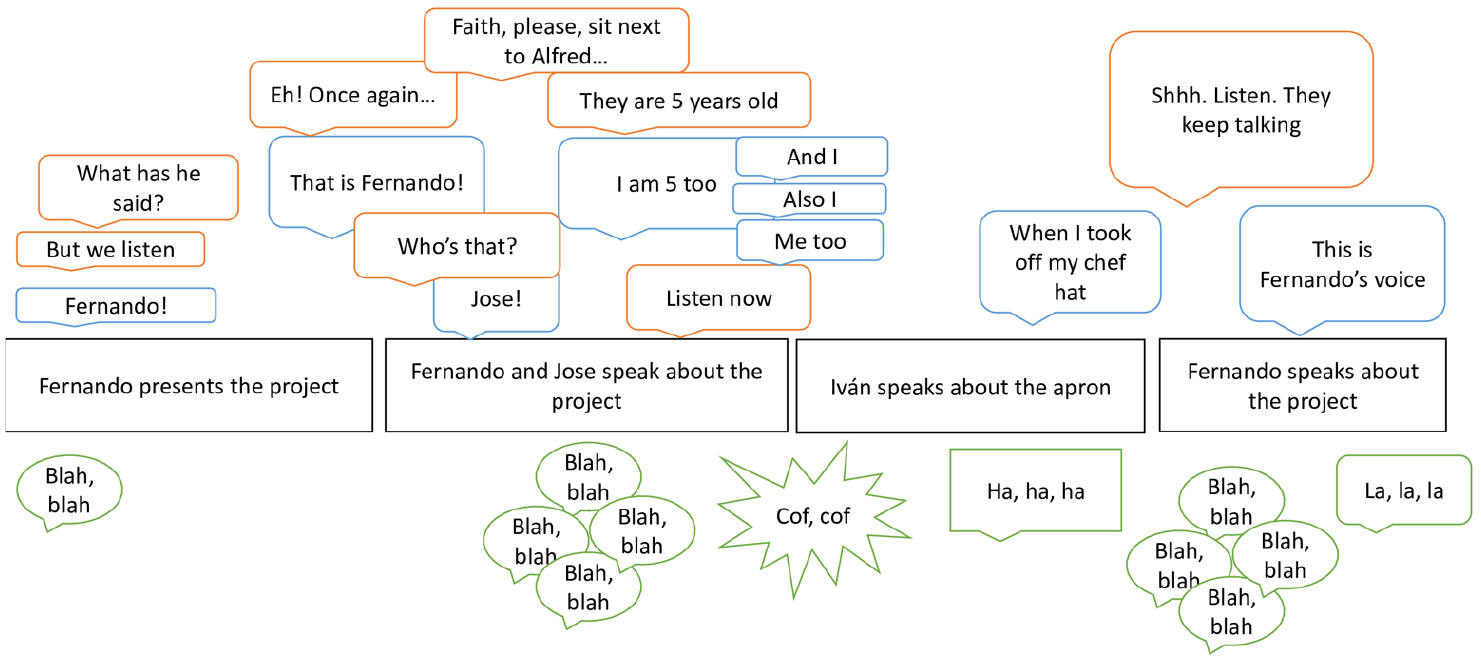
Intersections.
Despite the transcription and the diagram (see https://doi.org/10.12795/11441/170698), we were increasingly aware of the blindness in our listening. When we reviewed our materials, we still felt the classroom, saw the children’s faces, the cork floor and the bench where the teacher sits. Although we had our memories from the event, we found it helpful to share an image (Figure 2) of the group taken from our video recording at the point when they started listening to the podcast.
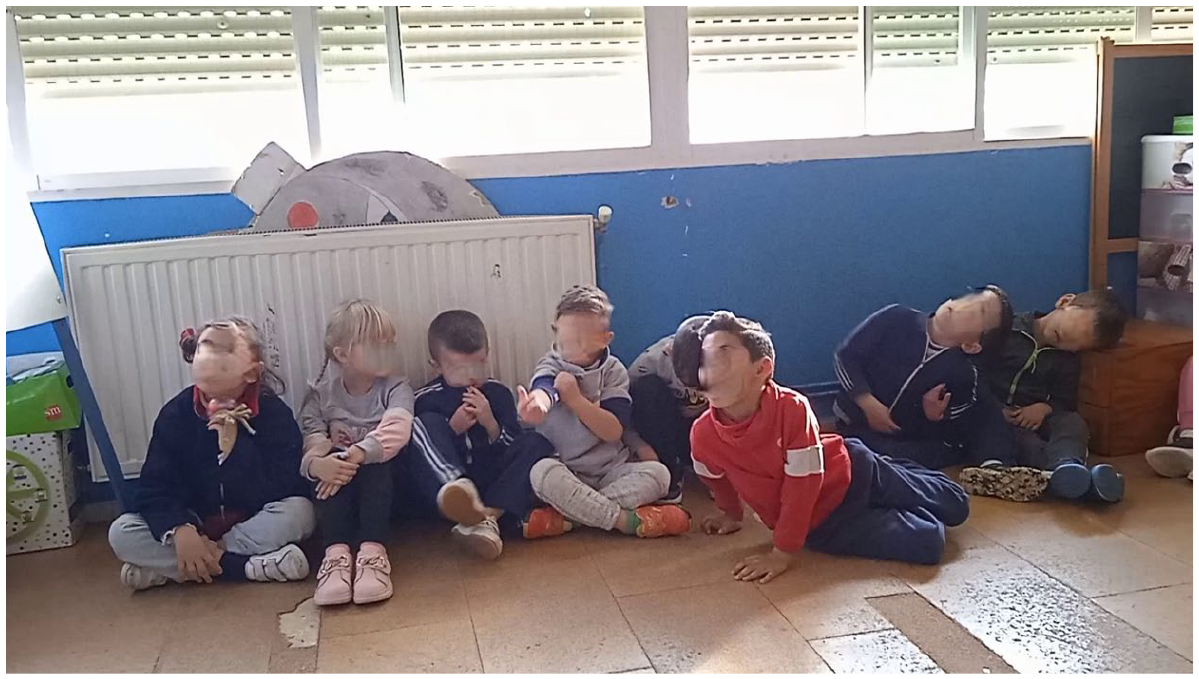
Memories of a classroom.
All these strategies converge in our research as diffractions of a single event and lead us to wonder about the inclination to draw on visual data in research. Although we acknowledge this tendency, we consider our visual references (diagram, figures, transcription) not as objective representations of reality, but as our presence in the not-yet-data. We consider the absence of video recording not as a limitation, but as an opportunity to decentre our taken for granted assumptions about research and data (Menning et al., 2021) and to diffractively think-with-theory (Jackson and Mazzei, 2023).
Children’s listening as a rhizome
The thinking-with-theory (Jackson and Mazzei, 2023) of our event navigates the transition from Reggio Emilia’s pedagogical listening to emergent listening and its integration of Deleuze and Guattari’s thinking. In doing so, we diffract the multiple understandings provided by diverse lenses and viewpoints. We return to our (not-yet) data and open to otherwise glimpses on children’s listening to the podcast.
Listening as pedagogical documentation
The event analysed in this article took place at the beginning of a Friday morning. The children followed their typical routine and sat on a cork floor in the classroom for a shared discussion about themselves and some learning tasks. Charo, one of the researchers, sat with them. Although the children could sit anywhere, they tended to choose the same place every day. As Ana talked, some of the children crawled on the floor, others stared at her, some were sleepy or fidgeted with their clothes or fingers (see Figure 2). After some calls for attention, Ana introduced the podcast to the children and remembered with them the journalist’s visit and the activity about the silent books.
Ana’s aim during this listening is reminiscent of Reggio Emilia’s pedagogical documentation and combines calls for attention and listening (0:45 ‘but we listen’) with an open attitude towards the children’s comments about the podcast’s content. Therefore, at the same time that Ana gives the children voice, the appeal to ‘listen well’ summarises a certain way of listening: linear, progressive, associated with listening in silence or listening while seated in a non-distortive adult (or a well-behaved child) way. It also reflects a model of learning where the child is being called into the world (Biesta, 2017) and where the child needs the help of a competent adult to learn. In opposition to the child, the adult has a prior conception of listening to children (Yoon and Templeton, 2019) that determines the content and the way of transmitting learning in such a way that it should respond to certain characteristics: in silence, with full attention, without noise and exact memory of what happened (Lahman, 2020).
The children have their own way of listening to the podcast and being part of the world (Murris, 2017a), as shown in our transcription and in our diagram of the event (see Figure 1). In this sense, their own memories of the events that took place and their experiences while listening emerge, even when Ana tries to bring them back:
me, me.
I made a thing for Manuel, with tape, like a baker.
but that is at the end, they say it at the end, now they are not talking about that, you’ll see.
But I already know.
Listen. Listen carefully, Soraya, who is that?
The podcast’s listening in the classroom is filled with ongoing patterns such as the identification of the children and the researchers through their voices, the remembrance of the action with the silent books, or the calls to associate the children in the podcast with those in the classroom with us. The recurrence of these elements, through both the teacher’s and the children’s initiative, makes us think about the concept of ‘listening as usual’ when they become fixed ways of listening, embraced by the children in their ongoing return to the already known (Davies, 2014). In this sense, our regarding of this event as a Reggio Emilia-inspired pedagogical documentation in the classroom faces the challenge of transcending the repetition implicit in the idea of listening as usual (Davies, 2016).
Memory is described by Haraway (1988) as situated knowledge that emerges in a particular context, attached to notions of power and subjectivity. The children’s unconnected remembrances face the teacher’s calls to an structured view of the past, where subjectivity challenges power. The embodied and ongoing emergence of traces (Tsing, 2017) in the children’s listening reminds us that memory is a perpetual becoming (Franklin-Phipps and Murris, 2022).
Listening as affect
The analysis of our event may be diffracted when we avoid the inclination to focus only on the human words and move our attention to the relational forces within the classroom. This shift came to us when we noted one of the strategies applied by Ana to call the attention of the children, namely the recognition of the voices that appear in the recorded conversations. Sometimes she asks the children to identify who intervenes to spark their interest on the action around the silent books, and sometimes the children do it spontaneously. The ongoing iteration of this practice navigates from a clear interest in the recognition to a free and playful exercise in which the children regulate who is recognised, and how:
Was that Inés?
Inés, Inés, it was Inés.
No, it’s Elena.
that’s right, Inés comes later.
No. It’s Elena, Elena.
Now is Inés.
This is Inés.
(Podcast)
That is Albert. It is Albert.
The materialisation of the recognition shifts on some occasions to the integration of intonations or repetitions. For example, when the children identify Fernando, one of the researchers, they continue playing with his name, repeating it with different intonations and intensities (0:41 IVAN: Hey, that’s Fernando. ROMEO: Fernando!). The attention to the non-verbal in this passage allows us to notice the network of affects (Massumi, 2015) and relations (Dernikos et al., 2020) established between children and sound, which form links that go beyond the human. In the nuances of pitch, intensity, tone and duration that emerge in this play, the children and the sounds of ‘Fernando’ affect and are affected, reconfiguring an autonomous world that forgets the semantic content of discourse and attends to its material nature (Gershon, 2013) and playful possibilities (Thiel, 2023). ‘Fernando’ becomes matter that may be played with, manipulated and transformed. The affective relation of ‘Fernando’ and the children shows how language cannot be considered static and prefixed, but rather transformable, manipulable, deconstructable and reconstructible (Pennycook, 2024). Language/sound/‘Fernando’/children, in their material relations, come-to-be in the sound, the space or the boundless possibilities of affects (Murris, 2016) far beyond the verbal/non-verbal divide (Pennycook, 2024). Matter and affect intertwine in the children’s ‘re/configuring the world’ (Murris, 2017b: 463).
Listening to the podcast in the classroom merges the children, the adults, the space, the sound equipment, the floor where the children sit, the silence and the rumours that weave around them. All of them may be considered to be vibrant matter (Bennett, 2010) that affects and is affected (Massumi, 2015). The children’s interventions are affected by the podcast, the silences, or the sounds of their peers and the classroom. The podcast is also affected by the children who update, reconceptualise and re-create their worlds while listening. For example, when they discuss the ages of the children in the podcast (2:36 IVAN: I am five years old too. A GIRL: me too. MARY: I am six years. SOME CHILDREN: Me too), they move from the recording into a newly created space of ages that sprouts a lively conversation.
Listening as assemblage
The encounters triggered in this event ‘are articulated within a specific assemblage, formed in a specific event’ (Lenz Taguchi, 2011: 38), in which all its parts come-to-be in their relations. The conceptualisation of language as assemblage implies an expansion from the traditional idea of language as a sum of linguistic elements (syntax, phonetics or semantics) to ‘a much wider range of semiotic and material possibilities, including objects, people, and space’ (Pennycook, 2024: 115). According to this perspective, the podcast’s recording is an active part of the assemblage, where it becomes part of the children and not a foreign or alien object (Wargo, 2018). All the (human) elements in the event (children, teacher, researcher) recognise their voices, their actions and the people they relate to (Hackett, 2021). The podcast’s recording, now edited, cut, pasted and re-organised, comes-to-be again in the assemblage. There is no edited/real sound divide in the event, nor in our memories. On the contrary, all sounds become a single, assembled unit.
Listening-as-usual becomes, in this assemblage, an emergent listening as described by Davies (2014: 35): ‘Listening is not just to oneself and the other, but to the intensities of forces working on us and through us. It listens to changing, emergent thought, and is co-implicated in it, diffracting with it’. This emergent listening troubles Ana’s understanding of listening to the podcast as a linear process in which one section gives space to the next (3:15 ANA: but that is at the end, they say it at the end, now they are not talking about that, you’ll see), following the podcast’s edition narrative.
A non-linear consideration of listening confers desires and affects an essential role in the relationalities (Dernikos et al., 2020), linking bodies that affect and are affected by others. Sound exerts a fundamental power on these affects (Gallagher, 2016) that sometimes contradict the control exerted over sound (Thiel and Dernikos, 2020) and the body (Kirby, 2020) in a school setting. The affects, disruptions and ruptures in the linearity of listening that emerge in this analysis lead us to question adult intentions for listening in formal and non-formal educational environments that tend to neglect the particularities of listening in childhood (Menning et al., 2021). Understanding the podcast as the starting point for a peer-to-peer conversation, the children enter and exit, update, expand and return to the events taking place within the classroom. At one point the teacher points out that the child intervening in the podcast is 5 years old. This gives rise to a series of ages, moments and relationships that are distanced from what happens in the podcast. Thus, a good part of Ana’s indications is oriented to the redirection of the children, bringing them back to listening to what is being said, and not to what emerges in the children in this process:
I am six years.
Me too.
he is six years. . . it is Ivan and Alfred.
2:48 Murmurs
listen now.
The listening jumps from one idea to another, from the children’s ages to their identifying, and the present, past and future are updated in an emergent way that flees any apparent logic. This listening resonates with the concept of rhizome (Deleuze and Guattari, 1987), a biological structure that lies underground and jumps to the surface of the earth in an unexpected way. In our event sounds, voices, conversations and disruptions come and go, tap into the podcast and move away, with no intentionality or order. Facing this event as a rhizome enables us to attend to the subtle lines of flight that emerge and move, the relational forces connecting the podcast and the classroom, or the materiality of language. All of them lie beneath the neat surface of the classroom event, popping out with no deliberate aim. Although Ana tries to maintain an order in the conversation and follow a chronological sequence while the podcast continues to sound, their linearity is defied by the ongoing emergence of lines of flight. The playful manipulation of sound (‘Fernando’), the (im)material presence of the books mentioned, the discussion about the ages, or the moves and laughs, open lines of flight in the classroom assemblage. This continuous rupture of linearity has been described as a main characteristic of worlds’ formation in childhood (Hackett, 2021), which does not respond to a linear structure but is guided by unexpected ways of creating worlds. In this sense, the edited and clean sound of our podcast resembles the human-disturbed forests where the matsutake mushroom grows (Tsing, 2017). There is no divide between the teacher and the children, the ‘listening as usual’ or the rhizomatic listening. They coexist and nurture each other in the same way that pine trees and matsutake mushrooms need each other to survive. In both cases the rational and technical manipulation of matter becomes the soil where rhizomes sprout, and new worlds emerge in the rhizomatic listening to/with the podcast.
Conclusions
The described trajectory from Reggio Emilia’s pedagogy of listening (Rinaldi, 2018) to emergent listening (Davies, 2014) allows us to approach listening in the classroom through the lens of posthumanism in education, framing our final analysis within a paradigm that puts the focus on what sound does (Wargo, 2020) and the affordances of language as matter (Pennycook, 2024). From this perspective, listening to the podcast in the classroom emerges as an assemblage (Buchanan, 2021) that involves the children, the researcher, the teacher, the classroom, the sound equipment, the floor on which the children sit or the silence or the sound around them.
The consideration of a listening from an adult perspective with intentionality, a pedagogical function, and a certain way of ‘listening well’ (Lahman, 2020) conflicts with the rupture of the linearity of the listening that occurs in the event. Moreover, listening as assemblage transcends divides human/non-human, listener/listened, children/podcast. The rhizome’s troubling of human intentionality and chronological order decentres the children as the sole agents in the act of listening. The idea of rhizomatic listening leads us to rethink certain educational strategies based on the linearity of listening and on hierarchy, as the children of our event think and relate to sound from the affective, the material and the rhizomatic (Caetano-Silva et al., 2024). The affects, intensities and breaks in the linearity of listening that emerge in our analysis question adult intentions about listening in formal and non-formal educational settings, intentions that neglect the particularities of listening in childhood (Hackett, 2022).
Ana’s performance in the classroom invites the unexpected in/with the listening. Her position as a facilitator of emergent listening connects us with ethical considerations regarding who is listened to in educational practices. As Yoon and Templeton (2019) propose, research with and about children requires researchers to allow themselves to be led by the unexpected. Response-able listening should therefore attend to the emergent and avoid binaries, such as child/adult or teacher/learner, that lead to differential practices of power determining who listens, and how and when. Listening should instead be part of ‘learning as a process of world-making (worlding)’ (Murris, 2017b: 466). The consideration of listening as a rhizome within the school calls for the emergence of new worlds and opens a door to rhizomatic curriculum development (Kennedy, 2012) in which linear, hierarchical and predetermined ways of listening/learning are challenged.
Footnotes
Acknowledgements
We are grateful to CEIP Almotamid (Spain) and its teacher Eva Sánchez for their collaboration as co-researchers in the framework of the educational cooperation agreement between the Regional Ministry of Education and Sport and the University of Seville for the development of interventions in the field of innovation and research in public non-university educational centres of the Regional Ministry of Education. We would also thank the journalist Sandra Camps and Dr Hillary MacQueen for their careful review of the text.
Author contributions
María-Rosario Leal-Bonmati: Conceptualisation, Data Curation, Methodology, Formal Analysis, Investigation, Supervision, Writing – Original Draft Preparation, Writing – Review & Editing. Alejandra Pacheco-Costa: Conceptualisation, Methodology, Formal Analysis, Investigation, Writing – Original Draft Preparation, Writing – Review & Editing. Concepción Torres Begines: Conceptualisation, Data Curation, Methodology, Formal Analysis, Investigation, Writing – Original Draft Preparation, Writing – Review & Editing.
Data availability statement

Funding
The author(s) disclosed receipt of the following financial support for the research, authorship, and/or publication of this article: This paper is part of research project PID2023-148393NB-I00, funded by MICIU/AEI/ 10.13039/501100011033 and by ERDF/EU.
Ethical approval and informed consent statements
Ethical approval for this study was obtained from Research Ethics Committee of Universidad de Sevilla (SICEIA-2024-002369).