



Abstract
Childhood and adolescence are critical periods for human development, involving an inherent tension between children’s development and autonomy and their safety and well-being. The digital mediation of children’s increasingly autonomous participation in the social world has been one of the most heated issues for parents and policy maker, generally guided more by intuitions and moral panics than actual evidence on children’s online behavior. Based on a representative sample of all Uruguayan kids between 9 and 17 years old (Kids Online Uruguay, N = 948), this article contributes to the understanding of contact-related online behavior by studying how children react to online friendship requests. Ordinal logistic models were fitted to study the factors predicting different responses to friendship requests based on the strength of the ties between the child and the friendship requester. Our model integrates predictors deriving from three sets of literatures. We found that differences in responses to friendship requests are significantly impacted by predictors deriving from computer mediated communications, self-efficacy and digital inequalities studies. Contrary to popular beliefs, most Uruguayan children report only accepting requests if they previously know the requester. Nonetheless, older and more digitally skilled children have particularly higher chances to accept requests from individuals with weaker or non-preexistent ties; but also, boys, children having preexistent episodes of offline risky behaviors and problems related to an excessive use of the Internet. Policy implications are discussed based on simulations of the chances of different types of responses, focusing on the need to contemplate both the risk and benefits involved in different types of digital social interactions according to children’s diverse developmental stages.
Introduction
Childhood and adolescence are critical periods for human development. The transition to adulthood involves breaking a clear dependence on parents or guardians for nurture, safety and affect, to a progressive but constant-growth of psychosocial autonomy (Valkenburg and Peter, 2011), which becomes a matter of concern for all the stakeholders involved in their socialization (UNICEF, 2014). Despite the centrality of the social world in youngsters’ life (Brown, 2004), interactions with new parties are usually associated with risks and negative episodes summarized in the notion of “stranger danger”: fears and moral panics related to the abduction or abuse by someone from outside the family (Stokes, 2009).
In the last decades information and communication technologies (ICTs) have become a key component in children’s social lives (Livingstone et al., 2015). In comparison with adult population, youngsters have a greater use of these communication technologies, and thus, their interactions with others are much more digitally mediated (Valkenburg and Peter, 2011). This process, no doubt, enhances the richness and diversity of their social world, but also entails a new set of potential risks. As Livingstone et al. (2015) argue, there is a need to allow for the realization of children’s potential in the digital world while providing them the tools to cope with risk and minimizing online harms.
Youngsters’ digitally mediated life will inevitably include interactions with people whom they have weak or non-preexistent ties. Nonetheless, whereas most of these online interactions with new people tend to be neutral or even positive for their development, they are perceived as risky-by-default by most parents and policy makers (Cernikova et al., 2018; Valkenburg and Peter, 2011), something problematic in terms of welfare and development. As Livingstone et al. (2015) argue, both the lack of quality data and our reluctancy to hear the voices of youngsters hinder our understanding of the issue. For example, “stranger-danger” contact-related risks are far less prevalent compared to other online risks both in developed and developing economies (Dodel et al., 2020; Livingstone et al., 2019).
Moreover, analysis should pay attention to age and sex differences regarding online contact behaviors. Research from Global Kids Online in Europe, Latin America, Africa and southeast Asia shows that younger kids (9–12 years old) and girls are less likely than adolescents (13–17 years old) and boys to meet someone offline whom they had first got to know online (Dodel et al., 2020; Livingstone et al., 2019). Particularly, in Latin America evidence from Brazil, Costa Rica, Uruguay and Chile shows that teenagers quadruplicate younger kids in online contacts with previously strangers (Dodel et al., 2020).
Additionally, the characteristics of the new contact are relevant to assess the risks of the scenario. For example, some recent research in Chile and Costa Rica (Dodel et al., 2020) has shown that most of the children who met face-to-face with “strangers” stated that, not only they were individuals linked to family or other friends (82% and 62% respectively), but mostly children of the same age or younger (81% and 66% respectively) and no adults (0 and 2 cases respectively).
Contrary to popular beliefs, much of the evidence suggests that kids are neither passive users nor incapable to develop strategies to cope with unpleasant or even harming online events (Livingstone et al., 2015; Valkenburg and Peter, 2011). For example, Lenhart and Madden (2007) asked US teens who have been contacted online by a stranger (32%) how they responded to contacts initiated by unknown persons. The most prevalent response was ignoring or deleting the invitation/message (64%), 8% replied but only to ask to be left alone, and 21% in order to find more about the person. A recent qualitative research by Agosto and Abbas (2017) with 18 years and older adolescents (n = 98) in two US public high schools shows that adolescent express discomfort regarding strangers or unintended audiences accessing to contents directed to friends and acquaintances.
On the other hand, online interactions with strangers can be also extremely positive for youngsters. For example, in 2014 more than half of US teens said they have met a new friend online, and that social network sites (SNS) and online gameplay are the most common digital channels to form new friendships (Lenhart et al., 2015). As Cernikova et al. (2018) argue, contacting strangers online, or even meeting them face-to-face, could have sensible motives even outside the general SNS or dating scenes, such as buying or selling clothes or electronics, school tutoring among peers or playing videogames together.
This is not to say that having small children being contacted by strangers is a desired outcome, nor to ridicule genuine parental concerns regarding ill-intentioned individuals such as scammers or sexually motivated offenders or pedophiles. On the contrary, the understanding of how children respond to contacts initiated by “online strangers” becomes even more critical due to its potential impact for children’s welfare and safety, but that the phenomenon needs to be contextualized within children progressive autonomy and development (Livingstone et al., 2015; UNICEF, 2014).
This article, thus, studies how Uruguayan children react to new exchanges in the digital world, and particularly what factors are associated with acceptances of online friendship requests from individual with weaker or non-preexistent ties. In order to do so, we fit multivariate models integrating three sets of literatures among the multiple perspectives from which children’s online interactions with others have been studied. First, the computer mediated communication (CMC) tradition is useful to understand how the characteristics of the medium change the way children interact with others. Second, the criminological literature, more focused on online risks, signals the role of self-control, psychological vulnerabilities, and offline risky behaviors as predictors of riskier responses. Finally, the digital inequalities’ perspective informs us about gendered-uses of the Internet, gendered parental norms, as well as age disparities and digital skills inequality.
Literature review
Computer mediated communication: Interactions, and the role of others in children’s life
Peer relationships play a critical role for individual development, serving as the bases for emotional, social and cognitive growth (Brown, 2004; Cernikova et al., 2018). Valkenburg and Peter (2011) argue that peers and others play a critical role for key main developmental tasks relating to psychosocial autonomy during adolescence. Youngsters always learnt these and other psychosocial skills in face-to-face interactions, generally with close friends (Valkenburg and Peter, 2011) but also by establishing new relationships (Cernikova et al., 2018). Nowadays ICTs are meditating these interactions.
Compared to face-to-face interactions, computer mediated communication (CMC) presents a set of attractive characteristics for children and adolescents (Valkenburg and Peter, 2011) such as higher degrees of freedom and control of self-presentation and discourse; a comparatively broader, more diverse, and easier access to audiences and information; and the potential of communicating with individuals or—when older—finding romantic partners with more similar experiences and values compared to the limitations of face-to-face social circles (Staksrud et al., 2013; Valkenburg and Peter, 2011; Walther, 2011).
Whereas initial literature argued that that the lack of social cues made digital interactions inherently poorer than face-to-face exchanges (Walther, 2011), more recent evidence suggests that digitally-mediated exchanges could result into more intense or “hyperpersonal” communication compared to offline interactions, primarily due the selectivity of self-presentation enabled by CMC’s asynchronicity and controllability (Staksrud et al., 2013; Walther, 2011). Consequently, CMC present to youngsters several opportunities to enhance diverse aspects of their psychosocial lives: practicing their social skills with higher degrees of control; generation of new friends; strengthening ties with previous friends and family; and—when older—finding romantic and sexual partners and other opportunities for sexual self-exploration (Valkenburg and Peter, 2011).
But evidence also signals that Internet-related online opportunities are intrinsically intertwined with risks (Agosto and Abbas, 2017; Livingstone et al., 2019). Some of these risks include online harassment, sexual solicitation, scams, and even an excessive or problematic use of SNS which could damage other aspects of youngsters’ social lives (Dodel et al., 2020; Valkenburg and Peter, 2011). However, online risks associated with Internet use do not seem to be markedly higher than the ones associated with offline social activities (Agosto and Abbas, 2017).
Responses to contacts initiated by strangers online
Recent research has studied the different stages in the process of youths’ interactions with strangers from internet. For example, Cernikova et al. (2018) found four stages of interactions: (1) pre-contact and non-verbal interactions; (2) the initiation of contact; (3) proper online communication instances; (4) face-to-face meetings. Authors provide evidence that children and adolescents report a variety of positive and negative experiences in each stage, as well as decide to continue or end the interactions—at any stage—based on reactions to those experiences. Our study delves only with the second stage of the interaction, and thus we will focus exclusively on it.
Regarding this second stage, Cernikova et al. (2018) found that friendship requests and private messages are the most frequent ways in which contact are initiated. They identified a diverse set of reactions to the initial contacts: some youngsters almost automatically dismissed requests perceiving the potential interactions as “negative or dangerous by default”; others made some kind of effort to evaluate strangers before replying; and finally, others almost automatically accepted the requests (Cernikova et al., 2018). Our study aims to contribute to the literature by assessing the socioeconomic and psychological determinants of these different sets of responses.
Regarding youngsters who responded positively to the initial contact, Cernikova et al. (2018) highlight a series of factors related to this acceptance: a neutral or positive evaluation of the unknown person based on little available information such as realistic and unaggressive looking photos; similar geographical location; non-substantial age disparities; gender (depending on the preferences of the adolescent); having mutual friends on the service; and cues that suggested similarities between the youngsters and stranger (i.e. similar surnames).
Judgments that resulted in refusing friendship requests—in European adolescents—can be grouped in two main groups according to the latter study. On one hand, certain requests include sexual, vulgar or hateful texts which are refused and sometimes even resulting in blocking or reporting. On the other hand, non-aggressive requests were also rejected when strangers were perceived as “dangerous”, “pedophiles”, offenders, liars, “weird”, older or even foreigners (Cernikova et al., 2018).
Finally, individuals who accepted strangers as an almost de-facto response justified their decision as means to: increase their popularity; gaining in-game bonuses; or even bragging about having higher number of friends (Cernikova et al., 2018). Finding romantic or sexual partners should be added to this list, at least for more grown-up and male teenagers who tend to engage in more online risky behaviors (Sasson and Mesch, 2016).
Socioeconomic and digital disparities as predictors of online risky behaviors
Individual differences in welfare-outcomes have clear links with structural and digital disparities in the 21st century (Dodel and Mesch, 2019). A vast literature shows the effects that gender, age, ethnicity, human capital and income have on digital behaviors, as well as how what children do online have tangible outcomes for their global welfare (Cabello-Hutt et al., 2017; Livingstone et al., 2019). This phenomenon creates a rich-get-richer inequality scenario, where disparities between vulnerable and privileged social groups tend to be exacerbated by and through digital technologies (Dodel and Mesch, 2019).
A more recent wave of studies has focused on how digital inequalities’ impact negatively safety and privacy outcomes for children, signaling the relevance of age, gender, human capital, intensity of Internet use, and digital skills (i.e. Cabello-Hutt et al., 2017; Dodel et al., 2020; Livingstone et al., 2019; Sasson and Mesch, 2016).
Girls tend to be more active in communication-related Internet activities such as SNS compared to boys (El Asam and Katz, 2018; Sasson and Mesch, 2016) but boys tend to engage in more online risks than girls such as contacts with online strangers (Dodel et al., 2020; El Asam and Katz, 2018; Sasson and Mesch, 2016). The mechanisms behind these differences could be related with gendered upbringing, social norms, and even parents’ online gendered-mediation (Cabello-Hutt et al., 2017; El Asam and Katz, 2018; Sasson and Mesch, 2016).
On the other hands, there is a stronger consensus on the links between age and online risky behaviors: the older the kid the higher the chances he or she will engage in this type of activities (El Asam and Katz, 2018; Livingstone et al., 2019). The two usual suspected mechanisms behind this relationship are related to psychosocial development. First, as children grow both their offline and online lives become more autonomous and less monitored, and their online activity increases (Cabello-Hut et al., 2017; El Asam and Katz, 2018). Second, as we will further develop, risky behaviors can be linked to sensation-seeking and more impulsive and deviant conducts, which tend to peak during late adolescence (El Asam and Katz, 2018).
Recent research also shows that having any type of offline vulnerability such as related to family problems, mental health or physical disabilities, increase the chances to experience high-risk online experiences, included contact with strangers-related risks (El Asam and Katz, 2018). Online risks are associated not only with offline inequalities, but also with proper digital ones. For example, based on a random sample study of approximately 1000 internet-using children in 25 European countries, Staksrud et al. (2013) found that digital competence increases online risks rather than decrease them, as digitally skilled children tend to use more the Internet, and thus undertake a wider range of digital activities including risky ones. These findings have been corroborated by several international representative studies on similar populations (Cabello-Hutt et al., 2017; Dodel et al., 2020; El Asam and Katz, 2018; Livingstone et al., 2019). El Asam and Katz (2018) provide a potential mechanism for digital skills’ negative effect in terms of risks, signaling that when vulnerable youngsters have high levels of digital skills, they also may spend long periods of time online, with less parental mediation, lower levels of self-control or socioemotional skills, creating a “cocktail of risks”.
Psychosocial predictors of Internet risky behaviors
One of the more influential criminological theories to explain risky behaviors, deviance and even victimization is self-control theory. Self-control theory predicts that individuals will engage more in risky and deviant behaviors such as substance abuse, interpersonal violence, or sexual risk behaviors during adolescence (Pratt and Cullen, 2000). Additionally, those individuals that are more impulsive, myopic, with less capacity to defer gratification will get more involved in those risky behaviors. This theory has obtained strong empirical support both to explain only offline behaviors (Pratt and Cullen, 2000; Vazsonyi et al., 2017) but also online harmful and behaviors (Vazsonyi et al., 2012).
Some recent research has shown that low self-control can be associated more generally to engagement in online risky conducts such as accepting friendship request from strangers. For example, Gámez-Guadix, Borrajo and Almendros (2016) study, based on a longitudinal study of 1099 Spanish adolescents, present compelling evidence that the frequency of Internet use is not as good as a predictor for meeting with online strangers as problematic or excessive use of the Internet. Gámez-Guadix et al. (2016) characterize problematic Internet use as a digital-specific type of impulsivity related more directly to cyber-risk than general impulsivity-irresponsibility. Their results suggest that “the specific loss of control related to Internet use. . .rather than the overall level of impulsivity–irresponsibility, appears to increase the likelihood of different risky online behaviors” (Gámez-Guadix et al., 2016).
Hypotheses
Based on the presented literature review, we propose that:
H1-Older children tend to accept more friendship from individuals with weaker or non-preexistent ties.
H2-Girls tend to accept less friendship from individuals with weaker or non-preexistent ties.
H3-The higher the level of digital skills, the higher the chances of accepting friendship requests from individuals with weaker or non-preexistent ties.
H4-The pre-existence of offline risky behaviors will correlate with riskier online behaviors such as the acceptance of friendship from individuals with weaker or non-preexistent ties.
H5-An excessive use of the Internet increases the chances to accept more friendship individuals with weaker or non-preexistent ties.
Methods
Data and sample
Based on the Uruguayan version of the Global Kids Online’s questionnaire (KO Uruguay), a nationally representative survey of children between 9- and 17-years old living in private households from urban localities was conducted between August and December of 2017 (N = 948). KO Uruguay aimed to characterize the digital lives of Uruguayan children, focusing both on the risks and benefits of their interconnected lives. Whereas all the sampled children used Internet at least once in their lifetime, differences in quality and quantity of access still prevailed in this cohort.
The survey was collected through computer-assisted personal interviews (CAPI) at children’s households, by a team specially trained to conduct interviews with minors. Along each child, a parent or guardian was also interviewed in to collect socioeconomic data and parental mediation information. Respondents were selected based on a stratified sample of households with children, using the 2011 Uruguayan national census as a list (Dodel et al., 2020); all analyses we conducted are weighted accordingly.
Measures
Dependent variable
First, children were asked if they have a user or an account in any type of social media or chat sites or applications such as Facebook, WhatsApp or any other (yes = 1/no = 0). Among the 80.3% of Uruguayan children comprising this category, their positive answer was followed with the question: “In general, how do you answer when someone asks to be your “friend” online?”. Response categories are ordered according to the strength of the ties between the respondent and the requester, going from stranger-accepting behaviors, to reluctance to engage with any contact who are not well-known by the child (1 = “I generally accept everyone who asks me”, 2 = “I accept only if we have friends in common”, 3 = “I accept only if I know them”, and 4 = “I accept only if I know them very well”) Two categories were recoded as missing values (“Doesn’t know” or “refuse to answer”).
Independent variables
Sociodemographic variables
Sex was coded as 1 for female and 0 for male. Age was recoded into three groups to reduce multicollinearity in the models: 9–12 years old (reference category), 13–15 years old, and 16–17 years old.
Digital skills
Global Kids Online questionnaire includes a reduced version of the Internet Skills Scale (ISS) adapted for children based on the original ISS developed by van Deursen, Helsper and Eynon (2016). This reduced version includes two items per sub-dimension, and previous studies using this version of the ISS point out to a unifactorial solution (Cabello-Hut et al., 2017). A set of 10 statements regarding what kids were able to do online by themselves was asked. All positive answers categories were recoded as 1 (“very true”, “somewhat true”), and negative ones as 0 (“little true”, “not true at all”). “Doesn’t know” responses were also coded as 0 (recommended by the original ISS’ authors, Van Deursen et al., 2016). Finally, a simple sum index was created. To reduce multicollinearity this variable was later recoded into terciles (first tercile: 0 to 6; second: 7 and 8; third: 9 to 10), the lower serving as the reference category.
Risky offline behaviors
Uruguay Global Kids Online questionnaire included five measures which asked children if they participated in several risky offline behaviors. These behaviors or episodes were measured as a binary items (1 = “yes”, 0 = “No”), and asked children if in the past year they did any of these things: “missing school lessons without parents or adults at charge knowing”; “having sexual intercourse”; “drinking a lot of alcohol and getting drunk”; “being in trouble with teachers for bad behavior”; and “being in trouble with the police” (see Currie et al., 2012). Responses were summed and a count index was created. As the objective was to identify youngsters with clearly risky behaviors, we created a new variable coded as 1 for any case were two or more of these behaviors occurred, and 0 if one or less had happened.
Excessive Internet use
The Global Kids Online questionnaire included three binary questions that tapped on tangible consequences of excessive or problematic Internet use: “I have gone without eating or sleeping because of the time I spent on the internet”; “I have experienced conflicts with family or friends because of the time I spent on the internet”; and “My grades have dropped because of the time I spent on the internet”. As most respondents reported no episodes at all, the variable was coded a 0 for no response, and 1 for one or more episodes.
Control variables
Socioeconomic status (SES) of the household was used as a control variable. The measure for SES is based on the INSE (for socioeconomic level index in Spanish). The INSE classifies households in terms of their capacity to consume or purchasing power, based on several household characteristics such as primary access to goods and sociodemographic characteristics (Perera and Cazulo, 2016). The INSE was collapsed into three categories: low (reference category), middle, and high, a common practice in local analyses (Perera and Cazulo, 2016).
Analysis strategy
Given the categorical nature of the dependent variable, with an ordered grade of responses according to the strength of ties with the friendship’s requester, an ordinal logistic regression was selected as the adequate multivariate analysis technique. 1 Additionally, as responses to friendship requests requires dealing with a truncated dependent variable (20% of Uruguayan children did not have an account), a model assessing only friendship request’s responses as dependent variable may be biased. In order to account for this bias, we followed Bucheli and Porzecanski (2011) who operationalized an approach developed by Buchinsky in 1996, based in Heckman’s proposal. Following Bucheli and Porzecanski (2011), we estimated a probit selection model predicting having a social media or chat accounts. Based on the probit results, we used the predicted probability in order to estimate the Inverse Mills Ratio to generate a selectivity correction term (SCT). The SCT was included as an additional predictor of the responses to friendships’ requests in the last model.
Finally, we will conduct a simulation exercise on the probabilities to accept friendship with different ties based on age groups and other children’s attributes in order to discuss the theoretical and policy implications of the model. All analyses were conducted using STATA v 15.1 IC.
Results
Descriptive statistics
Half of the sample was comprised by girls (50.7%) and half of boys (49.3%). Close to half (48.4%) were 9–12 years old, 35.8% 13–15 years old, and 15.7% 16 or 17 years old. Almost a third of children lived in households of the lowest SES level (34.2%), almost half in the middle level (53.8%), and 12.0% of the highest SES.
Whereas all respondents were internet users, they diverge in their level of digital skills: 43.7% had between 0 and 6 of the inquired skills (lowest third), 27.2% between 7 and 8, and 29.1% between 9 and 10 skills (highest third). A quarter of respondents expressed having had at least one negative episode as a consequence of excessive Internet use (25.1%), and 8.7% had at least two episodes of offline risky behavior in the last year. Finally, 80.3% of respondents had accounts on social media sites, chat sites or applications. Among them, 4.9% generally accepted everyone who request them friendship online, 12.4% only accept request if they have friends in common, 60.7% accept only if they know them, and 22% accept only if they know them very well.
Predicting responses to online friendships request
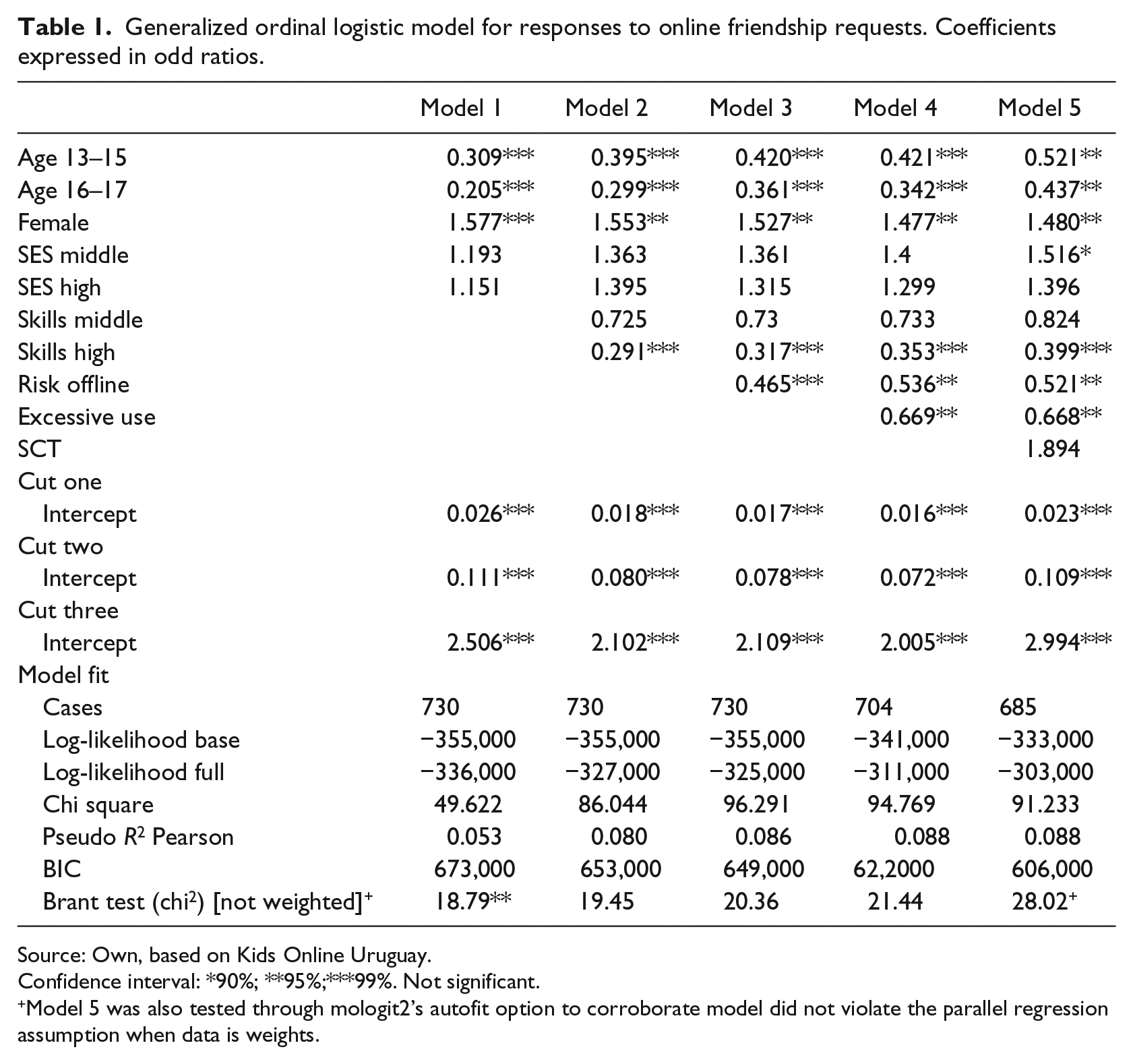
The Table 1 presents the results of five nested ordinal logistic models predicting the probability of different responses to online friendship requests with results expressed in odd ratios. According the Brant test and STATA’s user written command “gologit2” [autofit] methods, whereas some intermediate models violated the proportional odds or parallel regression assumption, the final nested models comply with this assumption.
Generalized ordinal logistic model for responses to online friendship requests. Coefficients expressed in odd ratios.
Source: Own, based on Kids Online Uruguay.
Confidence interval: *90%; **95%;***99%. Not significant.
Model 5 was also tested through mologit2’s autofit option to corroborate model did not violate the parallel regression assumption when data is weights.
Finally, the five nested models show improved successive fit, based both on the higher log-likelihoods, lower Bayesian Information Criterion (BIC), as well as equal or increased pseudo R2s. In other words, model 5—which also controlled for the SCT—was the preferred alternative.
Analyzing the predictors’ odd ratios in model 5, we corroborate H1. Age is one of the strongest predictors of riskier responses: being 13 to 15 years old reduces 48% the odds of accepting requests from individuals with stronger ties (OR = 0.521), whereas being 16 to 17 years old reduces these odds in 56% (OR = 0.437), both compared to being 9–12 years old (p < .01). Being female works in a similar direction and strength, validating H2: being a girl, compared to being a boy, reduces about 48% the odds of accepting requests from individuals with weaker ties (p < .01).
Digital skills are the strongest predictor corroborating previous research, and also validating H3. Our models signal that differences are statistically significant only between the lowest and highest skilled children: compared to lower skilled children (first third), those in the highest third have 60% more odds of accepting requests from individuals with weaker or non-preexistent ties (p < .001).
H4 and H5 were also validated. Those children who reported having engaged in at least two offline risk behaviors (OR = 0.521; p < .01), and those who reported at least one problematic behavior as a consequence of Internet use (OR = 0.668; p < .01), have statistically significant higher odds of accepting friendship requests from individuals with weaker or non-preexistent ties.
Socioeconomic level, used as a control variable, showed no statistically significant effect across most models, but the middle category was statistically significance in model 5 (OR = 1.52; p < .05). Finally, the sample bias correction term, was not statistically significant, signaling that there was not sample bias in our estimations, at least regarding to having social media accounts.
In Graph 1, we present the results of the simulation of the probabilities of accepting friendship requests according for different age groups, and two “extreme” risks profiles. Risk profiles were selected based on the regression coefficients which generated the highest and lowest predicted values of the latent variable.
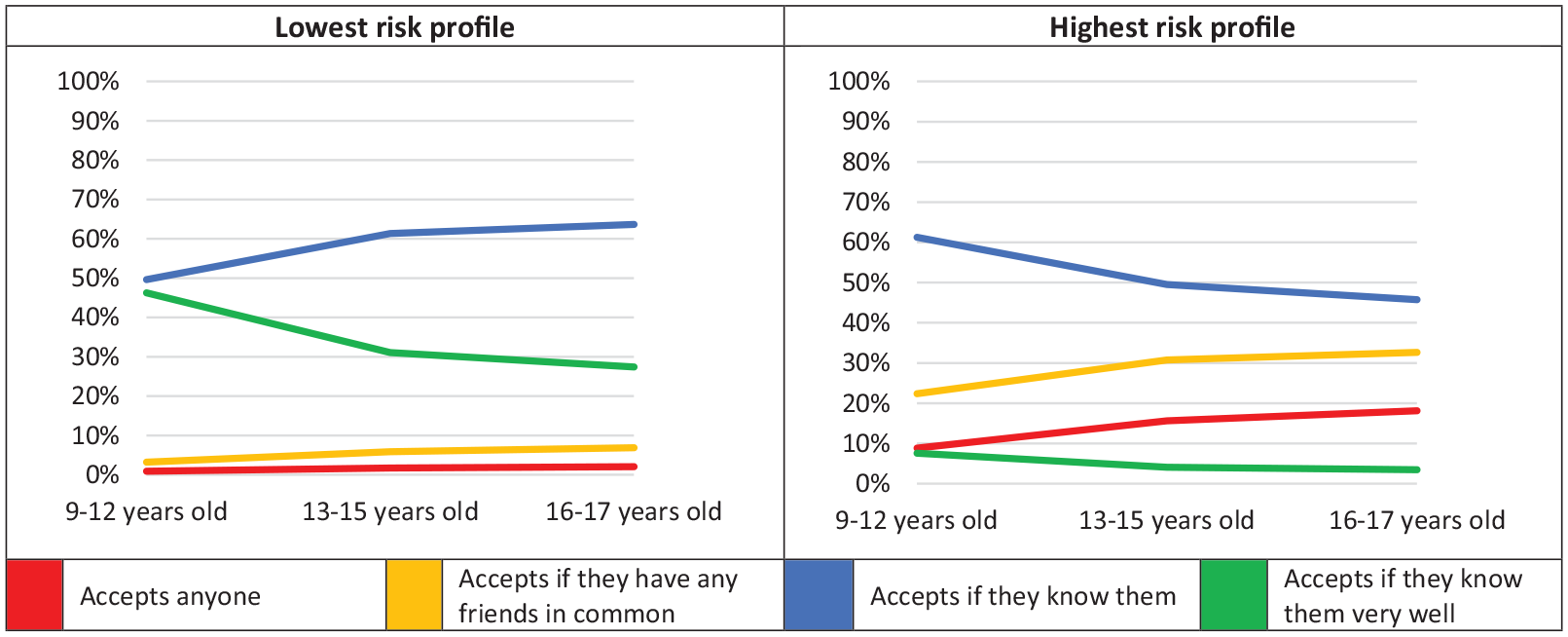
Simulation of estimated probabilities of accepting friendship requests according to age and highest and lowest risk profiles. Highest risk profile: male, with high digital skills level, offline risk behaviors, and problems as a consequence of Internet use. Lowest risk profile: female, with low digital skills level, no offline risk behaviors, and no problems as a consequence of Internet use.
In first place, it is important to notice that most of the children in the sample, disregarding their age and risk profile group, accept friendship requests only if they know the requester (blue line). Whereas the probability of this response changes with age and risk profile, its simulated probabilities are very consistent across all scenarios (always close to or above 50%).
Accepting requests only if the ties are extremely strong or if the respondent knows the requester very well, (green line), is a less likely response for children in the highest risk profile group even for the youngest ones (8%). On the other side, almost half of youngest children in the low risk profile are expected to accept only requests from extremely strong ties (46%). This behavior is far less prevalent in adolescents: 3% in the higher-risk profile and 27% in the low one.
Accepting any online friendship request, and requests from anyone who is friend with friends are far less prevalent in the lowest risk profile than in the highest one, even for adolescents. Whereas adolescents in the former group have 7% of probabilities of accepting anyone who is friend of their friends, the probability rises to 33% in the other group. Regarding children of the youngest age category, there is only a 2% probability for the lowest risk group to accept all friendship requests, increasing to 8% in the highest risk-profile.
Discussion
Based on a nationally representative survey of Uruguayan Kids (Kids Online Uruguay), in this article we analyzed how children respond to online friendship requests. As children grow, tensions between their development, autonomy, and safety are a matter of concern for parents, teachers, and all decision makers. Despite the centrality of others in youngsters’ everyday life interactions, the risk-by-default conceptualization of digital interactions focuses excessively on risks and “stranger danger”-like scenarios compared to positive potentials for their development.
This is not to say that risks are inexistent, nor that policies to prevent and cope with risk and harm-like scenarios should not be a priority, but that we need more empirical evidence of children’s online social lives and behaviors. The understanding of how children react to online friendship requests and the factors associated with their responses need to be the starting point for this discussion.
Contrary to moral panics, our findings show that the most prevalent type of response in Uruguayan children is accepting requests only from individuals whom they know (more than 60%), but differences in responses are significantly impacted by gender, age groups, level of digital skills, previous offline risk behaviors, and previous problems related to an excessive use of the Internet.
Regarding lower risk-biased gendered responses to online friendship requests, they should not be understood as girls being in less vulnerable position than boys. As criminological and psychological literature demonstrate, these responses can be derived from more paternalistic care-practices for girls in relation to boys (Sasson and Mesch, 2016) and from a greater sense of online vulnerability compared to men (Dodel et al., 2020).
Age related disparities in responses, incrementally accepting friendship requests from weaker or non-preexistent ties as children grow older, are also to be expected given their increasingly autonomous participation in the social world (Brown, 2004; Valkenburg and Peter, 2011). Nonetheless, accepting friendship requests indiscriminately entails clear risks for young children, and this response should not be encouraged.
From a policy perspective, age is a critical variable since younger children could be more vulnerable to ill-intentioned strangers as they lack other social and digital skills that may provide adolescents stronger coping mechanisms. However, only accepting friendships requests from individuals with whom the child has strong ties can be detrimental for the socioemotional development of older children. Thus, policies aiming for the development of safer online behaviors should not simply advocate for online social avoiding practices as they are expected to also have detrimental effects for certain children’s welfare.
Our findings also contribute to the digital inequalities literature by providing support for the effect of digital skills (Livingstone et al., 2019; Staksrud et al., 2013). Our findings signal that children with higher levels of skills tends to accept friendship request whom with they have weaker or non-preexistent ties. Whereas in this study differences were found between high skilled kids and the rest, diverse risks could present different thresholds for statistically significant effects. The underlying mechanisms behind digital skills’ effect over risks have been explored by the literature. As Cabello-Hutt et al. (2017) argue, digital skills’ effect over the dependent variable could be attributed to children’s motivation for seeking a more diverse and richer Internet experience, which imply contacting individuals less proximate to their social circles. Thus, digital skills are tools for children that can increase both potential benefits but also risks. This can also be understood under the ‘rich get richer’ model of online communication, were the practice of contacting strangers is part of a wider pattern of very intense communication (Barbovschi et al., 2012).
In line with the criminological theory and self-control hypothesis Gámez-Guadix et al. (2016), we found that preexistent offline risky behaviors and behavioral problems related to the excessive use of the Internet correlated with more permissive responses. This finding is not only in line with studies that shows that low self-control is associated multiple forms of offline and online victimization, but also with specific research on the interactions between offline and online vulnerabilities (El Asam and Katz, 2018).
Additionally, although SES was used as a control in our study, its statistical significance in some models signals a potential role to be played. As the effects of the variable were unstable and close to being non-statistically significant, we argue that more research is required to assess this result.
In sum, our article makes important contributions to the study of online contact-related behaviors. In first place, to our knowledge this is one of the scarce assessments of children’ responses to online friendship request based on a random and nationally-representative sample. As signaled by Valkenburg and Peter (2011), this is one of the key weaknesses of related research, generally based on convenience or self-selected samples. Additionally, by integrating three diverse set of literatures such as CMC, self-control and digital inequalities, our study provides a more nuanced approach to the phenomenon, attesting the relevance of the different insights of each literature for a common understanding of the phenomenon.
Regarding the study’s limitations, the cross-sectional nature of the data, particularly during developmental stages full of changes such as childhood and adolescence, needs to be considered. The interlinks between CMC and psychosocial development are complex and required more sophisticated research designs, not only longitudinal but perhaps also experimental (Valkenburg and Peter, 2011). More research should be conducted both on the effects of digital self-control effect and their interactions with other psychological attributes and parental mediation. Additionally, past studies also signal that specific types of digital skills do contribute to online safety (Dodel and Mesch, 2019) and to better cope with negative life events (van Ingen and Matzat, 2018). More research is needed to better understand alternative and heterogeneous effects of digital skills, not only on risk-related behaviors, but also for their protective role for children. Finally, more studies are required to understand the other roles children can have in these interactions such as friendship request senders or intermediaries between other contacts.
Footnotes
Funding
The author(s) disclosed receipt of the following financial support for the research, authorship, and/or publication of this article: The development of this article is supported by Fondo de investigación fundamental Clemente Estable from Agencia Nacional de Investigación e Innovación (Uruguay), project FCE_3_2018_1_149415.
