



Abstract
Children’s drawings hold a contested place in archives of war. Often portrayed as unfiltered records of psychological impact on innocent young civilians, the same drawings are also sophisticated testimonies of agency. With child-artists creating their work within classrooms, families, and communities, this article offers an alternative reading of their historical significance. Children’s art offers not simply a firsthand view of conflict but also a critical view onto the alliances and ideologies of the adults who guided their creation. Before and after the Spanish Civil War (1936–1939), after which Spain entered into several decades of National-Catholic dictatorship, psychologists and teachers used children’s drawings to further educational projects toward both progressive and conservative ends. Across key nodes of conflict and postwar quietude, I ask how advocacy of children’s art allowed teachers to practice what I call a form of pedagogical postmemory. Centering on Francoist-era education and the artists who created new openings for individual expression, the essay focuses on two educators, namely the artist Ángel Ferrant (1890–1961) and the novelist Josefina Aldecoa (1926–2011). Contrasting their paired views of children’s art as a liberating, imaginative activity with that of the Francoist pedagogue Josefina Álvarez de Cánovas (1898–?), this study exposes how the same fundamental rhetoric of imagination and freedom could result in vastly different archives of children’s drawings under dictatorship. Understanding children’s art as bound up in wider social and political processes, it posits the seemingly neutral sphere of postwar art education as a key vehicle for pedagogical memory and historical recovery.
Let us draw from memory; remembering, reconstructing what we saw with the intention of portraying the impressions it made [. . .] Let us draw what we dream, the stories we are told, what we read, what we hear, what we feel. Draw all that we wish existed.
Before everything else is childhood. The imprint of our first years decides forever what we shall become. Childhoods of heat or cold, hunger or abundance, smells, colors, sounds, sensations pleasant or unpleasant. Childhoods protected by adults’ inexhaustible affection. Or desolate, insecure childhoods, on shaky ground that never comes to rest.
How do children respond to everyday life under dictatorship? When considering children’s art in times of crisis, contexts of war, migration and conflict are justly central. Drawings narrate children’s experiences before they can put their emotions into words. The expressive power of such images jumps off the page and out of the archive. Sketches and scribbles feel at once universal, timeless, the product of any child of any age; yet they are also undeniable testaments to history: to wartime atrocities, deprivations, evacuations, and to earlier memories of peacetime. This dual legacy has always followed children’s art, making it a uniquely compelling source.
The transnational political power of children’s art becomes clear when studying the Spanish Civil War (1936–1939). 1 Teachers, artists and psychologists collected drawings from children’s colonies, camps established to shield children evacuated from cities under siege. Children drew the world they knew: bombings, evacuations, wartime; and the world they had lost: cinemas, schools, neighborhoods (Gallardo Cruz, 2020). Many of these striking images were used and exhibited internationally across pedagogical, therapeutic and propagandistic contexts (Gallardo Cruz, 2012; Padrós Tuneu et al., 2015; Roith, 2009). For even in times of upheaval and violence, still children drew, to paraphrase Aldous Huxley, who introduced these images abroad (Weissberger, 1938). Published by the Spanish Child Welfare Association in New York, children’s wartime drawings were meant to strengthen anti-Fascist sympathies and aid in the international defense of democratic, Republican Spain. Children’s drawings also gave an urgent, firsthand view to a process of emotional and cognitive synthesis, as psychologist Arnheim (2006) in 1962 similarly suggested of Pablo Picasso’s iconic anti-war painting Guernica (1937). Layers of visual impression, memory, light and form came together to convey the sensation of impact—bombings, explosions and death—in graphic and startling form. What Picasso did on the canvas echoed the mental syntheses of children, in drawings that stripped situations down to structural and spatial essentials (Gardner, 1980: 30; Winner, 1993: 32).
Such efforts of visual advocacy through visual art—while ultimately unsuccessful in Spain, which fell to Franco’s right-wing, Nationalist forces in 1939—arguably paved the way for a larger, post-World War II children’s art movement. This effort focused global attention on the horrors of war through the eyes of exiled children (Roberts, 2017), as attention increasingly turned from children’s immediate physical requirements to their more pressing psychological needs (Zahra, 2011: 26). The art that children created under wartime conditions, it was argued, allowed unique access into experiences of individual and collective trauma. It also served as a unifying, universal symbol, as represented by the UNESCO Courier’s 1951 special issue on children’s art. But art’s political and psychological value moved in both directions. Just as children’s drawings were exhibited during wartime as a rebuke of Fascist violence, so too did postwar psychologists in the victorious Francoist dictatorship use children’s drawings to demonstrate and clinicalize the violence committed by a vanquished, demonized left (Gómez Rodríguez, 2019).
Taken together, interest in children’s art contributes to a common goal: to highlight children’s subjectivities as archival sources and to defend the power of their witness. Such a task remains the key challenge of children’s art, which like any primary source, risks being over- or under-read by contemporary observers. As historian Nicholas Stargardt, who has worked extensively on children’s drawings under the Nazis, has argued, it is the “seeming ability of children’s art to reaffirm the spirit of humanity as well as the will to live which has turned these paintings into such potent symbols of resistance.” But, he asks, “can we use this material as a historical source?” (1998: 192), and if so, how? This article proposes one way to do so, using children’s images of distress not as a window onto the devastations of war—which they do offer with an immediacy unlike any other form—but as a way to view the more ambiguous alliances and acts of postwar life.
Spain during the early Francoist period (here taken as 1939–1953) has often been depicted as culturally stagnant, having lost the force of its major cultural and artistic avant-garde to violence, emigration or internal exile. 2 At the same time, as scholars such as Miaowei Weng (2016: 53) have convincingly shown, a contemporary “boom of Franco-era child images” in literature, film and culture has come to stand for a form of “national allegory”, a process of historical reckoning that draws on childhood memories of war and dictatorship. In such a milieu, children’s drawings are uniquely apt as cultural sources, inherently political yet pedagogically acceptable. Seeking to read children’s drawings during the “prohibition on remembering” of the Franco dictatorship (1939–1975) and the “intentional forgetfulness” of democratic transition thereafter (Collelldemont, 2015: 395), this article argues that children’s art functioned as an avenue for resistant pedagogues to revive earlier, progressive educational practices. Marianne Hirsch has theorized postmemory as “a structure of inter- and trans-generational transmission of traumatic knowledge and experience,” in which memories and images are not directly “mediated by recall but by imaginative investment, projection, and creation” (Hirsch, 2008: 106–107). By this definition, children’s drawings themselves could be said to constitute a form of postmemory in one of two ways. They are historical reflections of the world as seen and inherited by a generation of children raised in a totalitarian state. And they are objects of transmission: created and critiqued, saved and selected by successive generations of adult observers. For, as Stargardt’s caution on the historicization of children’s art suggests—along with his encouragement to find a workable model to do so—children always drew within a larger social frame. Thus while children’s art could be called a form of visual postmemory, through the recording and reiteration of traumas and silences, it also fostered practices of pedagogical postmemory as successive generations of teachers transmitted, revived and recuperated practices of expressive, autonomous child art.
First, I show how Spanish artists such as Ángel Ferrant (1890–1961) celebrated children’s drawings before the Spanish Civil War as part of a larger social effort in service of individual expression and self-realization. Second, I illustrate how this effort to popularize children’s art transmogrified under Francoist pedagogy toward acts of nationalist and religious indoctrination. Finally, I look to a postwar revival of a creative philosophy of children’s art though two efforts: Ferrant’s co-editorship of a book of children’s drawings in 1948, and the subsequent scholarship and activism of a younger colleague, Josefina Aldecoa (1926–2011). Through coded alliances, intertextual references and visual analysis, I demonstrate a striking undercurrent of sociopolitical resistance within the neutral confines of children’s art. Examining ambivalent usages of children’s art in a diachronic postwar context, this paper argues for the unique role children’s art played in the communication and transmission of creative values under dictatorship.
Sketches: Ángel Ferrant and the rise of child art in Spain
Children’s drawings, the sculptor Ángel Ferrant declared in 1933, were “eternal, permanent, BIOLOGICAL” (1933: 35). Yet they also reflected children’s surroundings, influences, interests and priorities. During wartime, educators drew on children’s art to track and document their experiences and share an allegedly objective, unfiltered view of brutality and injustice with the wider world. After the Civil War, those avant-garde legacies were silenced. In this vacuum, teachers employed pedagogies of children’s art to further competing agendas of, first, nationalist consolidation, then, with time, cultural recovery and resistance.
A Madrid-born sculptor who began his career in Barcelona in the 1920s, Ferrant’s philosophy of creativity flourished in the avant-garde environment of early twentieth-century Spain. The nation’s ‘Silver Age’ of avant-garde art and literature during the 1920s and 1930s coincided with New Educational reforms at home and abroad, which celebrated the liberty and creativity of children in all their holistic development (Kendrick, 2020). Children’s art became key to that project during both the Primo de Rivera dictatorship (1923–1930) and the Second Spanish Republic (1931–1936). Artists such as Pablo Picasso, Joan Miró and Salvador Dalí represented radical innovation, the return to essential forms, and aesthetic alliances with the free, spontaneous art of children. Likewise, teachers celebrated children’s art as an autonomous, expressive practice. Returning from studies abroad, pedagogues incorporated theories of art and psychology into their practice, integrated with Spanish precedents (Castro Tejerina, 2018). Influenced by pioneers such as Vienna’s Franz Čížek (1865–1946), they described art as a form of visual language, a perfect integration of hand and mind (Freire, s.a.). As has been documented by art historians and historians of education alike, children were seen as possessing uniquely vivid perception. The essentialized “child,” across cultures and borders, was thus elevated to the status of “natural genius” (1934). Avant-garde artists and reformist teachers alike embraced child art, stimulating numerous publications and exhibitions on its cultural significance. 3 It was within this realm of popular fascination that young artists such as the Madrid-born sculptor Ángel Ferrant and the Catalan critic Sebastià Gasch (1897–1980) began to write about children’s art. Today Ferrant is little known beyond Spanish art history, but he proved a key voice commenting, observing and defending art’s critical role in society. His public advocacy imbued children’s art with the power to liberate not only the individual but in turn entire societies under duress, as Spain set out to build a progressive socialist democracy in the early 1930s.
In 1931, Ferrant and Gasch visited the experimental Escola del Mar [School of the Sea], a model school of pavilions and palms located on the Barcelona seafront. Art was central to the school’s philosophy, with pupils’ drawings adorning the covers of the school magazine. In a 1933 article on the “splendor of children’s drawings,” Ferrant lauded how children reflected their experience of the world: “In the little hands of our children at the Escuela de Mar on the Barceloneta, I watched the nib of a tender recording instrument, precise, faithful, refined and sensitive to all imaginative phenomena of line and form” (1933: 34). He depicted their drawings of the world as a manifestation of instinct, a “biological” force mirroring the very nature of childhood. For children, he wrote, drawing was as reflexive as throwing a stone and seeing glass shatter: spontaneous, direct, energetic. Deeply impressed, Ferrant would continue to collect drawings from the Escola del Mar into the 1950s (Ortega Cubero, 2007). In addition, in 1935 Ferrant took a leading role in establishing a club for urban children in Madrid, connecting the city’s Children’s Aid Society and ADLAN [Friends of New Art] (1936: 18). There, Ferrant ran an after-school workshop where children could create freely, for instance by turning donated objects into art. His actions echoed in pedagogical writings, in which he urged the nation to emerge from its political “asphyxiation” after the Primo de Rivera dictatorship and seek “transcendence” through art education. Noting that schools shaped a society’s values, Ferrant suggested that aesthetic practices could help Spain breathe anew (1932: 13).
Such a project would not be realized. With the outbreak of the Civil War in 1936, all efforts were channeled into national defense and propaganda. Given the Second Republic’s intense focus on art and literacy, children’s drawings became more central than ever during the conflict. Throughout the war, Republican pedagogues such as the psychologist Regina Lago (1897–1966) ran art programs at children’s camps and colonies, collecting artwork and studying its psycho-emotional impact. These efforts have been documented and partially recovered (Alted Vigil et al., 2006; García Colmenares, 2010; Gallardo Cruz, 2012), while images of the war through children’s eyes have recently been re-published (Fernández-Fontecha, 2019). After the fall of the Republic, progressive teachers faced execution, imprisonment, and repression. 4 Like many others, Lago went into exile, publishing her research on children’s art in wartime in Mexico (1940). Others undertook psychological studies in the 1940s of Spanish children and teenagers in exile, in France, Great Britain and the United States, looking to understand the lasting impact of war on these developing bodies and minds (Mülberger, 2014). Each of these efforts made clear the central importance of children’s art to a larger project of political and social transformation. The drawings themselves, meanwhile, entered the archives as individual testaments to the ruptures of war and to antifascist acts of resistance.
Scribbles: Uses and abuses of children’s art in early Francoism
The Republican defeat in 1939 put an end to progressive reforms, but Francoist pedagogues were well aware of the power of children’s art. Teachers used children’s art to further ideological ends in Francoist schools even as its creative roots and expressive potential were increasingly celebrated by a postwar generation of educators, thus ultimately serving as a vehicle for reform and revival.
Clearly espousing National-Catholic ideology was the Spanish pedagogue Josefina Álvarez de Cánovas (1898–?), who published several popular manuals of pedagogy after the war (Marín Eced, 1991: 31–33). Her texts build on pre-war developmental psychology, explaining teaching methods and simple psychometric tests. While seemingly scientific, these works are inseparable from Francoist ideology. For instance, she criticized the “errors” of the New Education movement and defended Catholic principles of original sin versus the natural goodness of the child. Further, she asserted children’s “responsibilities,” not “rights,” effectively rejecting the 1924 Geneva Declaration and clarifying the hierarchies of child, teacher, parent, Franco and God (Álvarez de Cánovas, 1941: 330–335). What is intriguing, then, is how and why she promoted children’s drawings. Álvarez claimed that spontaneous drawing must be incorporated in the larger project of strengthening modern pedagogy. She noted: “Among the forms of children’s expression, none is as expressive as their drawing. . . nor as abandoned in recent times” (1941: 158). Given her fierce denunciation of the “errors” of progressive pedagogues, it is perhaps surprising that she defended a psychological model of the mind that started from free drawing, just as Ferrant and others had earlier done. She advocated moving from early-childhood scribbles toward more developed observational drawing, geometric exercises, and decorative arts (1941: 160). In her teaching, she noted, “I have wanted children to draw first as a means of expression and childish release, and only later as a means of knowing the child: for those who can interpret children’s drawings will see clearly the psychological types that are developing” (160). By starting with drawings, she suggested, one would encourage expression, movement and life, while also better assessing and diagnosing the psycho-emotional development of one’s pupils.
But Álvarez defended “free” drawing in name only. Her work celebrates imaginative activity while including a selection of more developed and skillful images, either responding to patriotic themes or representative of a Francoist vision for postwar Spain. Arguing why children’s drawings mattered, she notes that although children had a smaller supply of experiences to draw from, their “lack of reason” allowed them to “[fly] through the imagination as through a world of [their] own” (1941: 44). Yet her alleged celebration of their creativity was limited by her ideological goals, which are embedded in her prompts: One of the most effective ways to cultivate the CREATIVE IMAGINATION or CHILD’S POWER OF INVENTION is SPONTANEOUS DRAWING. We will speak more about this in the corresponding lesson. We note here some themes to cultivate childhood imagination effectively, along with artistic taste, patriotism and RELIGION, the axis of our teaching:
(a) Draw the festivals of your town or neighborhood for me.
(b) Draw your games, the games you play in every season, for me.
(c) Illustrate for me this poem or this story or this recitation.
(d) Illustrate the day of the FIRST COMMUNION in your school or in your parish.
(e) Draw me the processions at Easter.
(f) Draw me a parade of flags.
(g) Draw me the salutation you make to the flag in your school.
(h) Draw me a walk in your neighborhood.
(i) Draw me a passage from the life of Jesus as you imagine it.
(j) Illustrate for me one of Jesus’s parables.
(k) Draw me the biblical scene “Let the children come unto me.”
(l) Draw me the Nativity (1941: 149)
Reading these prompts in one of the first manuals of pedagogy and child psychology to be published after the Civil War, it is clear why postwar archives of children’s art featured countless religious scenes. These typically included the crucifixion, stages of the cross, and the Nativity. Such assignments seem to have become standard practice in the classroom, reflecting less a spontaneous choice by children than a reflection of daily experience and societal expectations. They helped children to integrate teachings, stories, and doctrines not only intellectually but physically, by mind and hand.
As Álvarez looked to children’s drawings to further the state’s National-Catholic teachings, her choices consciously emphasized Spain’s recent violent memory. After all, the war would have dominated the memories of any schoolchildren whose teachers used her texts in the early 1940s. For example, she shares the results of an ink-blot test administered to a child named Mario (whose age was not given). She includes images of six ink blots, which he identified as: “a cannon with machine guns,” “a Howitzer [gun],” “a plane,” “artillery,” a “car with two headlights” and a more neutral “crayfish” (1941: 144). What should one do with the results of such a test? She gives no answer. How do such tests of visual imagination, and in turn, drawing, relate to children’s development? Here, she offers more insight. Children’s drawings, she suggested, revealed the “small tragedies” in their hearts. Arguing for drawings’ affective significance, she explained that a colleague had asked his first-graders in Madrid to depict a memory that stuck with them from the preceding Sunday. He did not understand one drawing so asked the perhaps 5- or 6-year old artist to explain it [Figure 1]. In the boy’s words —This is the table in my house, these are the plates and the bottles on the floor. . . You see, last night, Papa was late, and we were all waiting for him, and he didn’t come. . . and it got later, then he got back and scolded Mama, and hit her and everything fell to the floor. . . and see this, here? This is MY MOTHER, FALLEN (1941: 160)
Álvarez’s casual recitation of domestic violence within an academic manual of pedagogy was followed by no expression of outrage or surprise. The child’s pain was noted, yet isolated. Art in the classroom was seen to draw out the child’s experience and emotions, yet held no defined therapeutic purpose in the National-Catholic school. This story represents again the ambiguous and limited nature of drawings as a historical source, embedded in their archival context. This drawing would have had no power to narrate its story without the intervention of the child—telling their story verbally to another—and the teacher, recounting and recording it. This example of a quasi-official depiction of children’s drawings within an approved manual of pedagogy offers a necessary framework to read these images—not as timeless, universal drawings nor as Ferrant’s “eternal, permanent, biological” scribbles, but as critical sources in the reconstruction of experience.
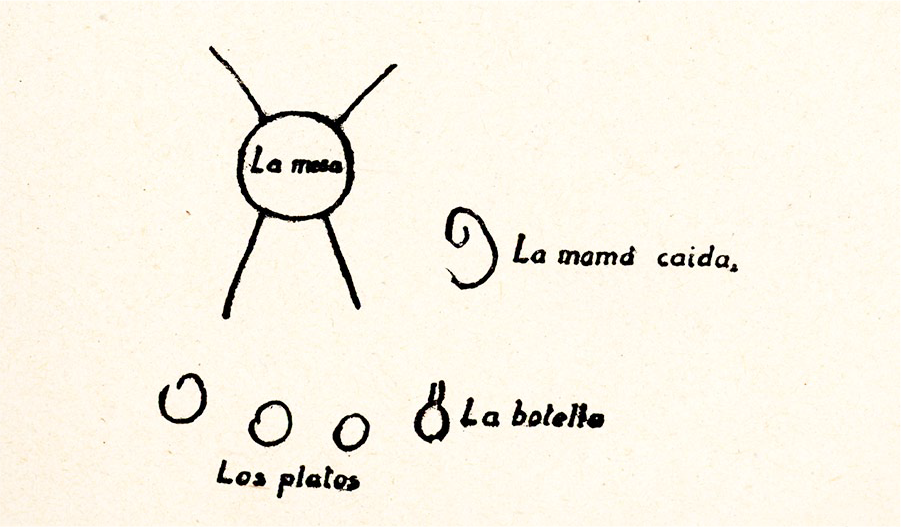
This child’s drawing shows, clockwise from top left, a round table; the beaten mother, seemingly curled up; a bottle and three plates (Álvarez de Cánovas, 1941: 160).
Finally, Álvarez’s selection of drawings privileges those which support a rosy, triumphalist view on postwar Spain. Looking to understand the preoccupations of children in her home region of Asturias, she grouped their drawings into three categories: the “Asturias that works” in the fields, the mines and at sea; the “Asturias that sings and laughs” in festivals and popular celebrations; and the “Asturias that suffered and cried” in the recent Spanish “revolution,” as she biasedly called it. Yet the drawings included present a partial and filtered version of that experience, almost exclusively by child-artists whose art was well-trained and highly developed, seemingly from children around 10–14 years of age. She includes many scenes of peacetime normality and celebration: farmers in fields with their cows, children buying chestnuts, girls on an outing to the countryside, festivals, a ball game, as well as a military parade and—most evocatively—“the liberation of Madrid as seen by a child” [Figure 2]. This drawing shows a complex scene of uniformed, bearded soldiers seizing ragtag men dressed in civilian clothes, all watched by a blond youth in a uniformed cap and surrounded by the tricolors of Spain, the right-wing Falange, and a symbol of Carlism, a traditionalist movement allied with the Nationalist forces. Interestingly, this image is followed by a handwritten essay by a boy, Alejandro, narrating his greatest memory of the final “liberation of Madrid” (or devastating fall, as the defenders of the Second Spanish Republic would have experienced it). He recalled the white flag of surrender flying from Madrid’s towers, Franco’s soldiers flooding to the prisons to liberate their “brothers” imprisoned for their “love of God and Spain,” and “patriots” cheering and singing through the streets, echoing the child’s own closing of “Long live Franco! Arriba España!” (Álvarez de Cánovas, 1941, n.p.). Here is a young person who possesses the developmental ability to tell this story in words, just as others recorded memories that would have echoed their teachings.
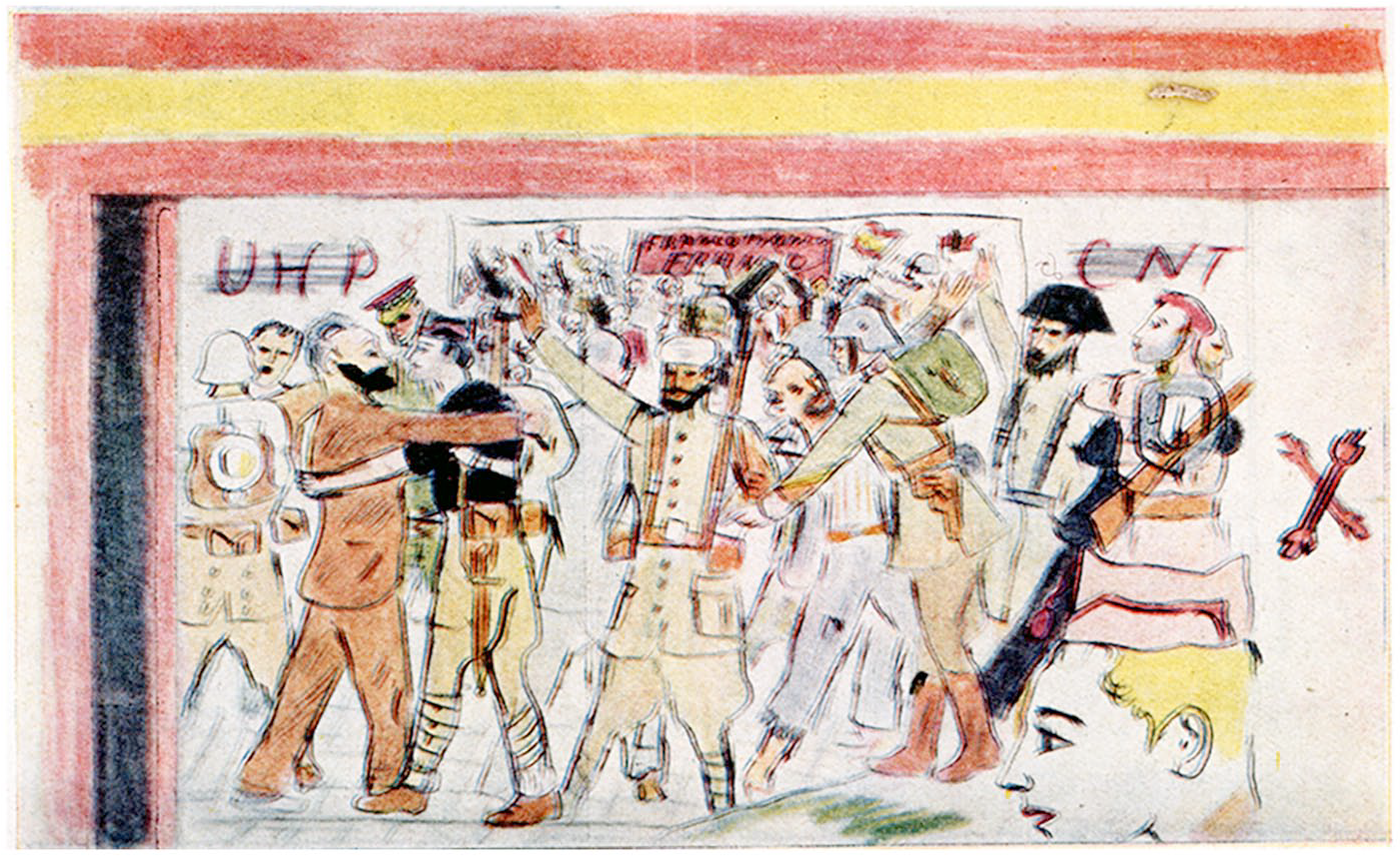
One child’s depiction of the liberation of Madrid, showing the initials of defeated left-wing forces (UHP and CNT) decisively scratched out (Álvarez de Cánovas, 1941, n.p.).
All these examples, thus, draw from children with a level of maturity to synthesize and reproduce their teachings—hardly an entirely free and spontaneous form of therapeutic art. What kinds of images might have been produced by younger children, in a zone of development where their verbal communication had not yet developed in as sophisticated a manner? Or within prompts where violence and everyday patriotism and dogmatism melded with the workings of their imagination? As the victorious Fascist state turned to consolidating its power, Francoist pedagogues such as Álvarez used established pedagogical principles to incorporate drawing as one among many tools of religious and patriotic instruction.
Creations: The School of Altamira and postwar children’s art
Beyond the bounds of dogma, no system is monolithic. What stories can be unearthed from children’s drawings under dictatorship? Ferrant and fellow artists continued to make children’s art central to their mission, while children continued to draw. In this way, one can begin to find pedagogical cracks in Francoist education. Through the 1940s and until his death in 1961, Ferrant remained in the country, an internal exile quietly advancing his career through the Franco regime’s diplomatic elevation of abstract art. 5 While he largely escaped the castigation experienced by so many other left-leaning educators, Ferrant would never again advocate educational reforms as he had done during the early 1930s. What survived was his interest in children’s art. 6 Even after the Civil War, Ferrant continued collecting drawings from Barcelona’s Escola del Mar as well as richly colored, expressionistic acrylic paintings from around the world, particularly Argentina and Japan. It is within this inner-exilic context that I pose children’s drawing as a marker of pedagogical postmemory, standing for the liberty of individual experience and the cultivation of creativity.
Nine years after the end of the war, in 1948, Ferrant joined the exiled German artist Mathias Goeritz (1915–1990) to visit Spain’s paleolithic caves of Altamira. Ever since its vivid cave art had been uncovered in 1879 by the 6-year-old child María Sanz de Sautuola and her father, Altamira had come to be revered as part of the nation’s cultural imaginary. Convening a group of Spanish and international artists and supported by the regional government, Ferrant and Gasch organized a series of meetings in the caves of Altamira and its surroundings. For them, the lifelike animals running across the cave’s ceiling stood for the origins of art and creativity—and thus were inseparable from their interest in children’s art, and vice versa. In this, they followed a Western anthropological tradition that saw children’s earliest markings as giving clues to human culture. 7 According to what Holert and Franke pose as a longstanding, “comprehensive, cross-disciplinary debate about the constructions of the origins of human history and universal laws of cultural development” (2018: 363), artists and psychologists posed children and prehistoric artists—as well as, equally problematically, the mentally ill and non-Western peoples—as prodigious artists, naïf and free of societal influences. Collected by Ferrant in his personal library and cited by Álvarez de Cánovas, this tradition included foundational texts such as Karl Lamprecht’s 1906 “Les Dessins d’enfant comme source historique,” George-Henri Luquet’s 1913 Les Dessins d’un enfant, and Georges Rouma’s Le Langage graphique de l’enfant of the same year. Such texts contributed the sources and illustrations from which artists drew as they connected children’s art with imaginative and primal expression.
As part of what they called the Escuela de Altamira [School of Altamira], Ferrant and Goeritz celebrated children’s art in early Francoist Spain. In 1948 they published a striking volume, Creaciones: Dibujos de niños de uno a siete años [Creations: Drawings by Children from One to Seven Years Old] to showcase these drawings. Fellow Altamira collaborator Gasch would also publish a monograph on children’s art (1953), the same year that an international exposition of children’s art was held in Madrid. 8 Creaciones was composed like the school’s other minimalist volumes dedicated to the work of new Spanish artists. The layout made clear the book’s focus: the child-artists themselves. These drawings could have come from any of the above volumes on the psychology of art, with their human monigotes, geometric houses and stylized suns. Yet their choices say much about the landscape in which the editors worked. Juxtaposing children’s busy depictions of everyday life with religious motifs, the collection also presents subtle signals of resistance.
First and foremost, the cover drawing [Figure 3] tells a story of anti-Fascist contacts. It was credited to Aitana Alberti (Buenos Aires, 1941–), daughter of the exiled Spanish poets Rafael Alberti and María Teresa León [Figure 4] and apparently five years old when she drew the image. Aitana’s parents Rafael Alberti and María Teresa León were two of the most prominent writers of Spain’s Silver Age, noted Communists and cultural advocates during the Second Spanish Republic and Civil War. Aitana, born in Argentina after her parents fled Francoist Spain in 1939, was said to have taken her name from their last glimpse of Spain: the Sierra de Aitana (Hevia, 2013). Years later, Aitana Alberti was asked what she remembered about the sights of her childhood. She recalled the seemingly magical world which surrounded her: I was a little tree that grew innocently where it had been planted: a very small garden in an enormous city, so immense that it was impossible to imagine limits [. . .]. That was my garden, that was my city and my river. In the beginning, how can we realize that there must be other ones, too? How should a girl discover that far from her small world [. . .] there is another country, another city, another river, perhaps another garden? (Guerrero Ruiz, 2002: 9)
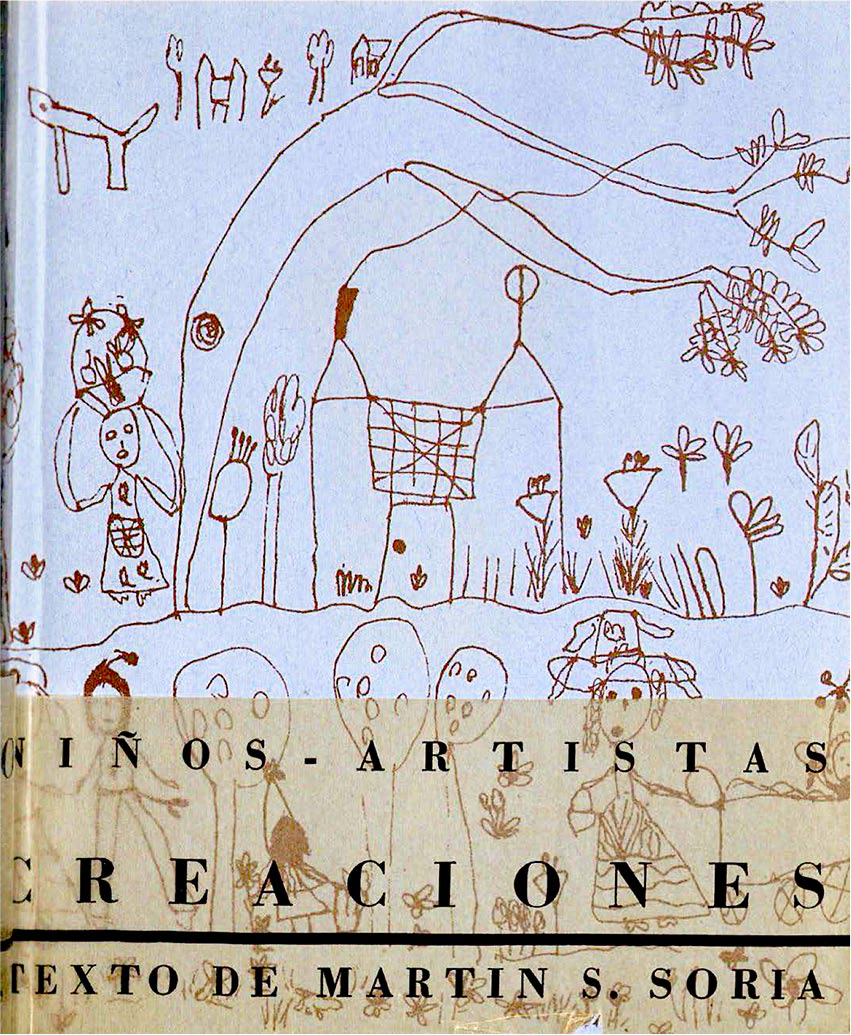
The selection of a cover image drawn by Aitana Alberti, the child of two famous left-wing poets in exile, suggests surprising international networks in Francoist Spain (Ferrant et al, 1948).
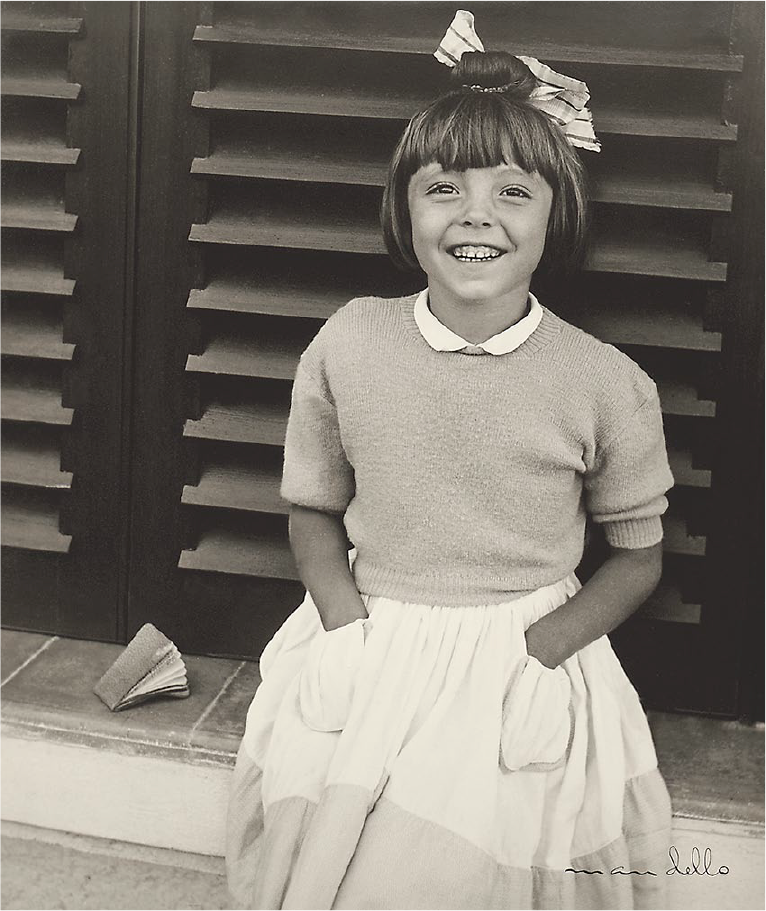
Aitana Alberti at age six, Punta del Este, Uruguay, 1947, photographed by the exiled German-Jewish photographer Jeanne Mandello, Isabel Mandello.
The sense of displacement that Alberti signaled in adulthood, between South American exile and a home which would have been hers in Madrid, resonates with the geographical movement of her drawing from Argentina to postwar Spain. Her sketch invokes the garden of her memory, with quasi-fantastical castle gates and towering, swaying trees. On morning walks at their summer home, her father encouraged the imagination of his daughter and her best friend, telling them tales of “princes, princesses and knights-errant” on a nearby island (2014). Aitana’s drawing combines these aspects of childhood fantasy with historical reality through transmitted imaginaries of loss. Contemporaneous photographs show her father leaning against a paneled door he had painted with simple scenes and dedicated to fellow exiles and friends. The bottom right panel, which depicted a three-turreted castle, flying birds, geometrical dog, waving trees and figures hand-in-hand, mirrors Aitana’s cover drawing and suggests that her artistic imagination was inseparable from her parents’ experience of exile. 9
The fact that, exactly ten years after Rafael Alberti and María Teresa León’s departure from Spain, a drawing of Aitana’s should take pride of place in a government-funded cultural project suggests that limited lines of pre-war artistic and epistolary communication and dialogue remained open—even with the most non-grata opponents of the Francoist state. That Ferrant and Goeritz would feature Aitana’s drawing above all others, with no need for a pseudonym, is thus noteworthy. On the one hand, one might claim a sense of harmless celebration in a 6-year-old child’s energetic view of the world: castles, houses, townspeople, dogs, flowers. On the other hand, one can read a coded reminder of her parents’ towering cultural and political legacies. This latter interpretation suggests that children’s drawings may have been a seemingly neutral, covert place to air subtle attempts at artistic normalization. For Aitana was not the only child of exiles whose work Ferrant collected. Within his personal archive, images by Spanish children in London mark a wider, ongoing exchange with teachers or parents from the Republican exile community during the early 1950s. 10
The epigraph which opens the book deepens its complex alliances. Taking the form of a poem, it was written by Martín S. Soria (1911–1961). Born to a Jewish family in Berlin, his family fled to Madrid from Nazi Germany for several years in the early 1930s. His 1948 contribution can be read as a surrealist celebration of childhood’s pleasures and terrors, internally profound and a refraction of external world: Horse of clouds orange sky blue in a mousetrap two eyes blood dust what a scary bull—coconut at night the father screams the mother laughs crying protect her yellow flowers fly in the garden boy and girl boy (the old ones are too much) cold air sunshine cough everything is new beautiful wordless able to do anything everything possible touch find caress fantasize scribble wet sand. being form color desire you terrible day end of childhood when they said: that’s just not done!
11
Soria’s poem sets the tone for the spirit these artists aimed to capture in children’s drawings of the Spanish postwar period. As children drew from memory, so too did their drawings create a world of “being form color” that represented precisely what made childhood supposedly its own, enclosed world; a world which would come to a sudden end one terrible, distressing day. Soria’s invocation of sun and cold, flowers and screams, clouds and dust suggests the screaming mother of Picasso’s Guernica (1937), as well as the brutal end of an entire country’s innocence through the death and destruction of its children, as in the Chilean poet Pablo Neruda’s wartime poem of his decimated Madrid, “Explico algunas cosas” [I Explain A Few Things]: Treacherous generals: behold my dead house, look upon my broken Spain: from every house bursts burning metal instead of flowers, from every hollow of Spain Spain arises and from every dead child comes a rifle with eyes [. . .]
12
Neruda’s poem, written in the heat of war and with a propagandistic edge, is far from Soria’s essentially playful ode to childhood and its end. Yet it evokes a wider field of references—both political and pedagogical—not far removed from Ferrant and his fellow artists. Elsewhere in the poem, Neruda speaks to several friends and comrades directly connected to Ferrant and the Republican resistance: Rafael Alberti, the father of Aitana, and the murdered poet Federico García Lorca, with whom Ferrant collaborated artistically before the Spanish Civil War. 13
As the regional cultural project of the Escuela de Altamira found official support, so too did publications like Creaciones offer a more complex view of the Spanish child. Its inclusions suggest a more unsettling aesthetic than that found in Álvarez de Cánovas’ classroom, arguably reverberating with emotional currents in postwar society. In Spanish cultural studies, the term tremendismo refers to a postwar literary trend marked by an undercurrent of violence and featuring the brutish and brutal aspects of life. 14 The distress visible in Spanish children’s drawings serves as a reminder that children, in particular—whether acting as Ferrant’s “precise recorders of reality” or as Neruda’s “rifle with eyes”—were seen as witnesses of society. They were understood to absorb and reflect the emotional impact of joy and despair, fear and pleasure; stories, memories, and the everyday, however guileless and innocent their drawings might have seemed.
Any reading of these images is shaped by their conservation and display. In Ferrant’s archive of postwar children’s drawings, collected today at the Museo Patio Herreriano in Valladolid, it becomes clear that his school correspondents conducted a work of selection through what was solicited and saved. The Catalan “Escola del Mar”, from which he collected drawings, was destroyed by an aerial bombardment during the war but reopened afterwards. At that point, it was rebranded decisively in Castilian Spanish, the language of centralist power, as the “Antigua Escuela del Mar” – and blessed by an angel in its logo. The children’s drawings that Ferrant received during the 1940s and early 1950s (complete with Franco’s visage on the stamps) suggest that, while the school conformed with Francoist education, the school placed a strong emphasis on individual artistic and creative development that long pre-dated Francoist ideology. Ferrant received dozens of sketches of everyday life ranging from soldiers to boxing rings, spectator sports to puppet shows, as well as depictions of Biblical or religious images of angels, the Nativity, Palm Sunday, and the crucifixion. Yet despite the explicit hierarchies of National-Catholic education, these images demonstrate a fond familiarity with Ferrant, in line with progressive pedagogy’s emphasis on the mutual relationship between child and teacher. Several drawings, for instance, are labeled “Ángel,” his first name written in a child’s hand. 15
In these drawings, one finds glimpses of mundane postwar environs as well as their shadows. The children drew crowds, puppet shows, sports and street scenes of the Passeig de Gràcia in Barcelona. The postwar city was reflected by the children-artists in ways that emphasize the interpenetration of home and school. The classroom is always “diluted” by the external world, while the “life of the streets, with its slogans, anxieties and preoccupations, filters into the classroom” (Collelldemont, 2015: 396).
In this respect, some drawings can be read with an eye to postmemorial social critique or witness. Rosario Formés’ 1948 “Danza y matanza salvaje” [Savage Dance and Massacre] [Figure 5] is a sharp, busy, black and white formulation of human figures showing an attack with arrow and spears. Such an image is unambiguous in its violence, yet unlike children’s wartime images of aerial bombardments and slain civilians, it seems more likely an extrapolation of Westerns or exoticized, xenophobic adventure films than any kind of firsthand memory of war [Figure 5].
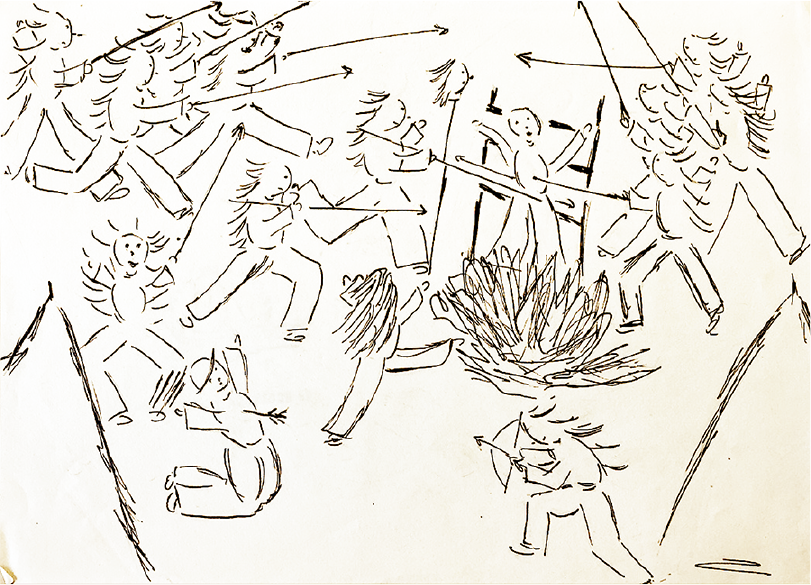
Rosario Formés’ “Danza y matanza salvaje” portrays a brutal conflict (Archivo Ferrant, Valladolid, FF-DiB 52-2730).
Other images show battles between what look like American settlers and native peoples, attacks by Roman soldiers, and other violent scenes like drawn from stories, movies and children’s books. Ramón Roca’s untitled depiction of a rack with three hanging figures, and a fourth figure walking away with what appears to be an axe, presents a yet darker vision. Without narration, the line between memory, state violence, or perhaps simply a young boy’s boundless imagination becomes chilling and harder to disentangle [Figure 6].
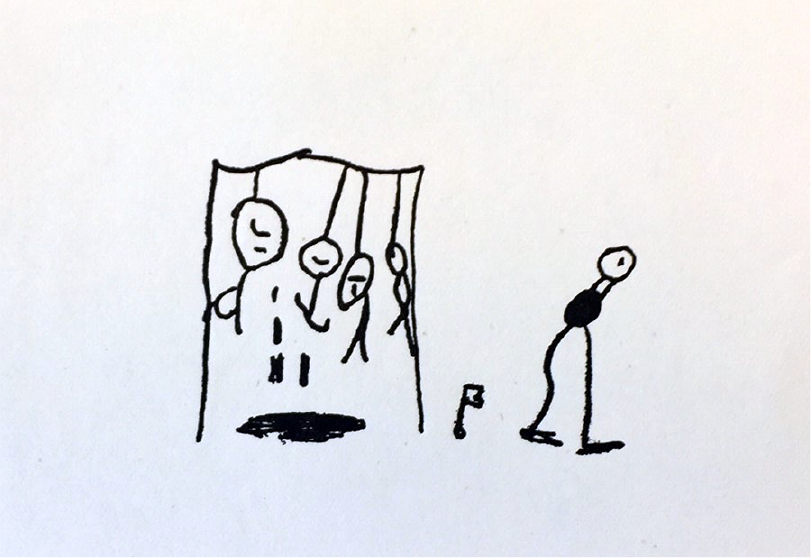
Ramón Roca’s unsettling Untitled offers no clear context or narrative for its violence (Archivo Ferrant, Valladolid, FF-DiB162-2840).
Finally, as in Álvarez de Cánovas’s classroom, many drawings exhibit a strong religious, Catholic strain. Various such drawings in Ferrant’s archives made it into Creaciones. These include 6-year-old Marieta Puig’s Los Reyes Magos, a depiction of the three kings advancing toward the family in the manger in Bethlehem—actually drawn as early as 1935, before the war—, or 7-year-old Isabel Llort’s postwar Cuando le clavan en la cruz [When they nail him to the cross] [Figure 7]. Vergés’ school had long published a monthly magazine, Garbí, whose covers featured pupils’ drawings. 16 The final issue before the war, published in May of 1936, featured 6-year-old Dolors Ibarra’s “demon,” whose blank expression and expansive extremities clearly appealed to Ferrant, given that he featured it as the final, haunting image in Creaciones twelve years later [Figure 8]. In the postwar Escuela del Mar, children’s drawings took pride of place in ways that echoed public religious ceremony. For Christmas in 1944, for instance, a handsomely designed program for an evening of prayer, readings and carols featured Miguel Carbonell’s El Nacimiento [The Nativity], a mature work employing wood-block and other print techniques. It cannot be argued that all religious drawings generated in Francoist-era classrooms were direct manifestations of Francoist ideological indoctrination. But their continued production and publication—explicitly solicited by teachers—reflected larger social priorities.
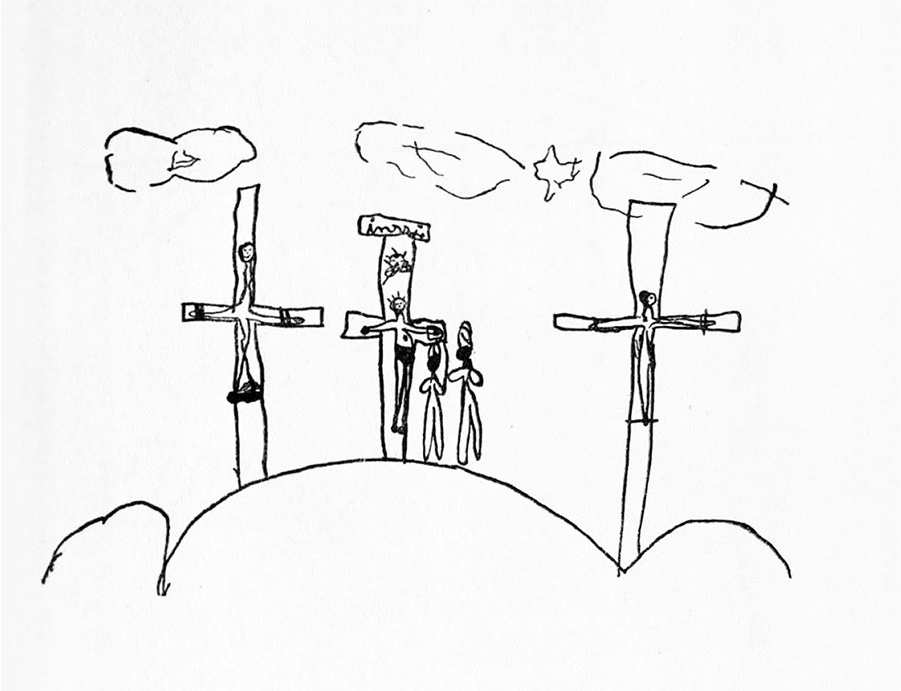
Isabel Llort’s drawing depicts the nailing of Jesus to the cross (Ferrant et al., 1948: n.p.).
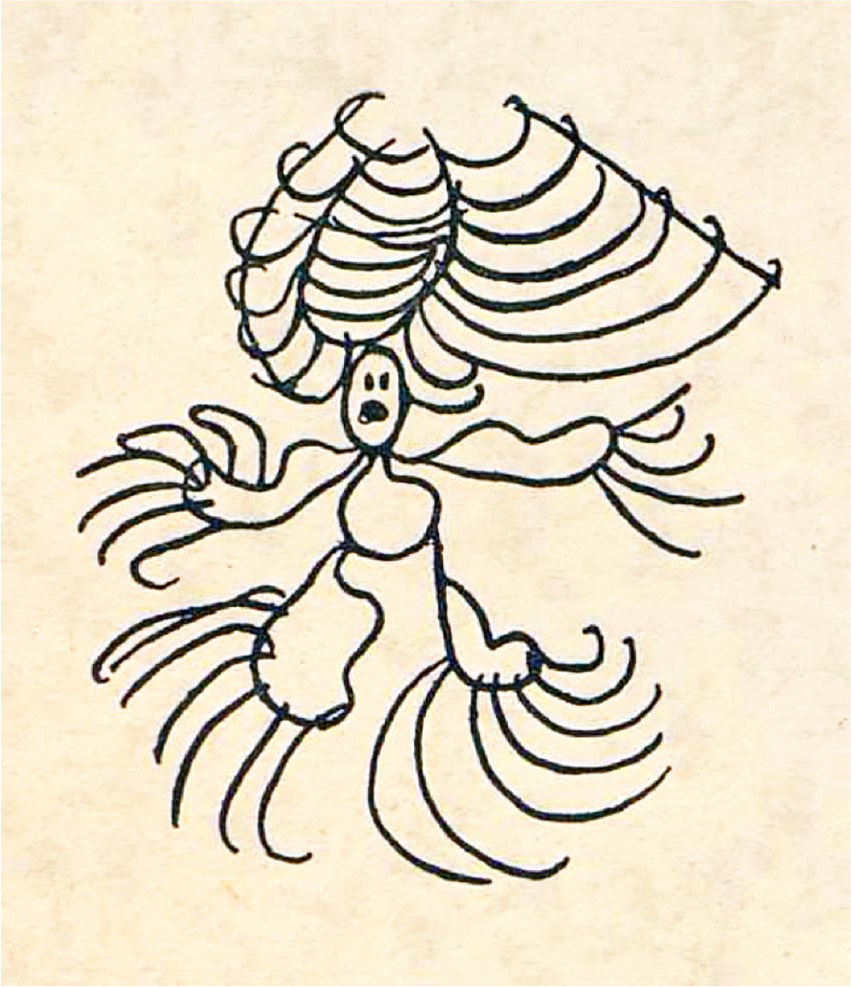
Dolors Ibarra’s “demon,” drawn on the eve of Civil War, returns as a specter to close the book (Ferrant et at., 1948: n.p.).
These examples suggest that while drawing was central to pedagogical practice, children’s art was in and of itself neither an inherent vehicle of resistance nor repression. Drawing was, as Ferrant once wrote, a natural, “biological” phenomenon: children drew irrepressibly. But the themes, subjects and preoccupations in archives of drawings reflected their surroundings and prompts. As archival material, children’s drawings from this period are both critical and compromised. They allow us to view and read postwar scenes of reality or imagination, while suffering a kind of deformation through their very selection and use—including by the present article. As Stargardt has suggested in his work on the lives of children under National Socialism, as “witnesses of war,” children created images that offer viewers a firsthand view of what they saw and experienced. Writing history from a child’s point of view, through exclusively visual sources, remains “a historical problem for which there are no models” (2005: xii). What children could neither write nor verbally testify must be sought through the visual traces they produced. Yet that art cannot be read apart from the social and political uses adults made of it, arguably telling us as much about its production as its protagonists.
Restorations: Josefina Aldecoa and the liberty of children’s art
As the Spanish ‘postwar’ turned into decades lived under dictatorship, when and how did more open counternarratives begin to push up against ideological uses of art? When a 20-year old student named Josefina Rodríguez Álvarez entered the University of Madrid in 1945, she found a “gray” landscape of education, with no trace of the vibrant pedagogies championed by figures like Ferrant before the Civil War. The daughter of Republican teachers, Aldecoa (as she would be known from 1969) experienced the start of the war as a 10-year-old child. While she became better known as a novelist, she chose to study pedagogy to avoid the censorship in literature and to further her parents’ legacies (2004: 41–42). 17 By 1959 she would open a primary school centered on innovative practices of art. Influenced in part by Ferrant, her work recuperated pre-war progressive pedagogy and made space for innovative forms of resistance in Spain’s transition to democracy.
Studying in the insular Madrid of 1949, Aldecoa heard of an opportunity to spend a summer working in London. “To leave Spain, to see other countries,” she recalled half a century later, “was my recurring desire, undercut with distress and desperation” (2004: 48.) Despite the obstacles, her family arranged the journey, one she saw as improbable as a “trip to the moon” (49). By June 1950 she had arrived, finally taking in “the liberty long dreamed of, idealized, anxiously absent from our adolescence” (50). In London, she came into contact with Spanish exiles who had been deeply involved in Republican education reforms. For the first time she laid hands on books and ideas that had left the country with them. As part of her “auto-didactic” stay, she visited every exhibition she could, including one on children’s art. Thrilled, she began researching pedagogies of art and expression, suddenly seeing “a free path” toward a more intuitive form of instruction than that practiced in Spain. She encountered Čížek’s work and unearthed a field previously unknown to her: In Spain, as I discovered upon my return, only the great sculptor Ángel Ferrant had arrived at similar discoveries. He gave me a few drawings from his splendid collection of international children’s art and once wrote to me: “Children of every country are like drops of water. And, like water, they are transparent; nevertheless, in this same transparency hides a multitude of meanings of which they are unaware [. . .].” Ferrant was right. The cries of children, their pain, are reflected in their drawings. Haunting, heartbreaking drawings, as children live through the wars and misery and suffering all around them (2004: 60).
By invoking Ferrant, Aldecoa’s memoir suggests a line of descent for reading the production of children’s art under conflict. Aldecoa returned with armfuls of books and began doctoral studies on the pedagogy of children’s art at Madrid’s Instituto de Pedagogía San José de Calasanz, where she found “nothing on the topic. Only a few books on children’s drawings and manual work with a didactic aim, subordinate to other pedagogical goals: perfection, exactitude, mastery. All very straight-laced” (2004: 67).
Yet by 1951, Aldecoa was running interactive workshops with small groups of children at the Instituto in Madrid. They had free rein to draw and paint in liberty, as well as to model and sculpt. The results informed her doctoral thesis, El arte del niño [Children’s Art], published in 1959. In addition to striking full-color paintings from Ferrant’s collection, she also unearthed the pre-war work of Spanish pedagogues, giving credit to the educator Elisa López Velasco (1884–1936[?]) for being the first educator in Spain to methodologically foster a “spirit of art education” (Aldecoa 1959: 26). Under López Velasco’s pedagogy, art was an intuitive language that reflected the child’s self-expression and innermost spirit. A leading New Education teacher at one of Madrid’s most progressive schools and the first woman to serve on the Spanish trade union’s educational committee (FETE-UGT), López Velasco’s archival tracks stop at the Civil War, suggesting her likely death shortly before or very early on in the conflict. Perhaps given these ‘compromised’ pedagogical and political affiliations, Aldecoa held something back, hedging that while aspects of her predecessor’s work had not yet been proven in practice, her innovative ideas and writings filled a critical gap.
Aldecoa’s and Ferrant’s writings suggest why children’s art occupied an ambivalent place in Francoist practice. It was upheld as a spiritual and expressive necessity, yet contained the roots of something more radical and less contained. For instance, she and Ferrant both contributed to a special issue on children’s art published by a psychology journal in 1953. Her piece, “To Suggest or to Teach?,” the earliest writing I have found from her on the topic, rejects authoritarian, technical instruction for a form of self-guided, consultative activity. The teacher is a critical facilitator and support, but does not interfere actively in the child’s creative independence (Aldecoa, 1953). As Ferrant wrote in the same issue, there was no wrong approach to children’s art except for that which corrects or “deceives” them in some way, by “using” lies or falsehoods to lead the child to the end in which we intend to “use” him. Every truth to which he arrives by his own steps will be a reality that he himself discovers. It will be enough to point out the path so that he, with open eyes, intuits its continuation. And, by not being led, but guided, by continually asserting himself, taking his own steps, instead of suffering disillusionment he will see that illusion can be one of many realities, as reality is one of many illusions (Ferrant, 1953: 572)
This statement posed drawing as a form of truth-making within a complex world: a powerful, primary form of personal expression. Independent thought and action supported the child’s developing mind and character. It was not by telling children what to draw and how that they would learn, but by giving them space and asking thoughtful questions. Further, recalling the School of Altamira’s assertions that art was a primal cultural force, Aldecoa later suggested that children’s “painting responds to a necessity of expression such that the force of emotion vivifies the image and destroys its limitations. The expressive possibilities overflow in the prodigious ‘language-image’ achieved in the caves of Altamira and in the paintings of the young child” (1959: 47). Drawing from avant-garde notions of the subconscious and individual expression and building on Ferrant’s work, Aldecoa celebrated art for children as an unparalleled way to bring together radicality, memory and the imagination.
Aldecoa was determined to yoke such creativity to educational practice. As her daughter, Susana, reached school age, Aldecoa was eager for an alternative to the mainstream National-Catholic school. With the support of fellow intellectuals and friends, she opened the Colegio Estilo in Madrid’s El Viso district in 1959. In fact, the small school was mere steps from Ferrant’s studio at Calles Tormes 4. Bringing to mind the workshops that Ferrant ran before the war, Aldecoa’s school aimed to counter dogmatic applications of theory through free, intuitive and open creative practice.
18
Founded on principles of art and creativity, the school’s goal was to create a space for individual exploration. It responded to Aldecoa’s assertion that, as Čížek had discovered, education must capture the child’s entire personhood: The individual, as the possessor of a unique personality, different from all others, must also be educated in a way that is unique and differentiated, giving him all opportunities to develop completely, to find his deepest self through any means. And what this conception means: the absence of single molds, disdain for mechanization in teaching, equilibrium between intellectualism and the abuse of sensorial education (1959: 22; cited in Castilla, 2002: 125).
Against what could be argued to be a prevailing ideological “abuse” of artistic education, to which Ferrant (above) hinted, Aldecoa’s work began to rehabilitate a more child-centered legacy of artmaking. Melding educational renewal and experimental practice in workshops and the classroom, Aldecoa and colleagues formally enacted the kinds of creative education Ferrant and others had long advocated. During the height of the Francoist dictatorship, progressive educators defended the agency and power of children’s art.
Aldecoa was, of course, not the only educator in Spain intent on incorporating creative pedagogies in the classroom. 19 Though the Francoist regime would last through 1975, the late 1960s and early 1970s were a time of increasing openness and experimentation among a younger generation of teachers. As Groves (2012) has shown in her work on anti-Francoist resistance within civil society, teachers were one crucial pole contributing to the “transformation of Spain from an authoritarian society [. . .] to a pluralistic polity” in the 1970s. Aldecoa (2005: 7–8) herself wrote an introduction to a book profiling the contributions of thirty Spanish female teachers, many of whom worked under the “difficult times” of Francoism. Yet Aldecoa symbolizes a unique intergenerational conversation on children’s art. Her early scholarship implicitly rejected the National-Catholic practices that turned children’s art into a tool of ideological perpetuation. Her workshops and school philosophy served as a generational bridge to pre-war artists and scholars of children’s art, most notably Ángel Ferrant, whom she portrayed as a kind of elder statesman of creative expression in Madrid. It is by reading these figures, together with the children’s drawings that motivated them, that one finds a line of descent across political regimes. Doing so opens a new place for children’s art to serve not only as testaments to wartime conflict but as evidence of ongoing, remembered and inherited efforts to reform and re-open society.
Imprints: Legacies of children’s art in postwar practice
Amidst a system of National-Catholic education in which teachers used children’s drawings to further patriotic and religious sentiment, reformers revived an alternative legacy of child-centered creative expression. By recovering pre-war artistic pedagogies in workshops and classrooms, Ferrant, Aldecoa and their colleagues began the work of normalizing an open, reciprocal form of children’s art under dictatorship. Each of these efforts of recovery was, as in Ferrant’s metaphor of children, like drops of water: individually small, reaching a tiny fraction of students, often with parents who were actively seeking an alternative to mainstream Francoist education. But together, they began the work of collecting models, recovering critical predecessors, and celebrating the imagination as a force for autonomy and self-expression. This work of transmission is what I have proposed as a form of pedagogical postmemory: the recuperation of methods and practices that have subsisted across generations under the surface of ideology. As children ever drew, these possibilities were always there. The difference was in how and why their work was solicited, interpreted, and archived.
From popular to political uses, children’s art was used across dictatorship and postwar society in ways that reflected its multivalent nature. Before the Spanish Civil War, children were framed as the aesthetic face of a modernizing nation, celebrated by avant-garde artists and progressive teachers for their allegedly direct, vivid approach to reality. During wartime, children’s art served most famously abroad as a visual protest against fascist violence. In the war’s aftermath, under the National-Catholic dictatorship, drawing became one among many tools of ideological penetration. It was against this politicized legacy that a group of artists in Francoist Spain began to celebrate children’s art officially from the late 1940s, in collections such as Creaciones. Revealing international and resistant alliances, their project resists simple interpretation, as do the collected children’s drawings themselves. Children’s art could be neutrally innocent or bracingly realist, psychologically expressive or as impenetrable as the ages-old paintings of Altamira. Yet through an active project of reinvention and recovery, successive generations of educators and artists sought to pose children’s drawings not as a tool of indoctrination, but as an open process by which to develop children’s agency and autonomy.
Footnotes
Acknowledgements
The author wishes to thank the two anonymous reviewers of this article as well as the NYU History of Education writing group for their thoughtful and substantive comments. The author is grateful to Alfredo Valverde at the Residencia de Estudiantes, Madrid for reprographic assistance. Finally, Molly Rogers, Uli Baer and the 2019–20 NYU Center for the Humanities Faculty Fellowship cohort provided critical intellectual fellowship during the COVID-crisis semester during which this article was written.
Funding
The author received no financial support for the research, authorship, and/or publication of this article.
