



Abstract
Drawing from a 3-year ethnographic project in one elementary school in the United States, this article examines how a group of 43 first graders perceived and constructed Brazil and the U.S. during a drawing and writing activity in their bilingual (Portuguese-English) classroom. The majority of the participating children (81.4%) either migrated from Brazil to the U.S. or were born in the U.S. of Brazilian parents. Data analysis reveals that Brazil was frequently portrayed as an idyllic landscape that included several relatives and friends and a range of activities with loved ones, while the U.S. involved immediate family members, material goods, and places for leisure. Grounded in a relational understanding of place and placemaking, we argue that the children engaged in a range of place-based moves to construct Brazil and the United States during the activity. These acts of placemaking included evocations of transnational memories, ongoing activities and aspirations, social relationships, and local institutional expectations, particularly the school curriculum and teachers’ discourse about Brazil. The findings suggest that immigrant children’s construction of place is multifaceted, dynamic, and situated.
Children are actively involved in global migration processes not only by shaping their families’ migration patterns (Dreby, 2007; Orellana et al., 2001) but also by crossing borders themselves, either physically or through their imaginaries (Oliveira, 2018, 2019; Moskal, 2014). Recent studies have explored children’s complex experiences of home across transnational social fields and how they developed identities and a sense of belonging (Akesson, 2015; Mand, 2010; Mok and Saltmarsh, 2014; Moskal, 2014; Tereshchenko and Araújo, 2011; Varvantakis et al., 2019). To expand these understandings, it is crucial to also examine how immigrant children construct and perceive the places where they have navigated in their lifespan. Foregrounding immigrant children’s relationship with places may further illuminate how they grapple with global processes and local structures, including education and schooling. This is particularly relevant considering that children’s transnational experiences and perspectives have been historically underemphasized in education (Sánchez and Machado-Casas, 2009) and migration research (Dobson, 2009; White et al., 2011).
Considering the enduring importance of place in understanding children and youth’s daily lives and experiences (Farrugia, 2014), this article explores how a group of first graders expressed ideas about Brazil and the United States through a drawing and writing activity in their U.S. bilingual (Portuguese-English) classrooms. We examine children’s drawings and narratives created during their instructional time when they were asked to share how they imagined Brazil and the U.S. The two first-grade classrooms where this activity took place brought together 43 children from a variety of immigrant backgrounds and levels of familiarity and attachment to Brazil and the U.S., including Brazilian newcomers in the U.S., children who were born in Brazil and migrated to the U.S. at a younger age with family members, children who were born in the U.S. of Brazilian parents, and U.S.-born children with no familial connection to Brazil.
Our analysis of children’s drawings and short written narratives was guided by prior conceptualizations of place as relational (Massey, 1991, 1995; Relph, 1993). Moreover, we assume placemaking to consist of multiple acts and moves to establish connections with others, creating a sense of community and belonging, and to (re)produce the social and physical spaces one has navigated (Denov and Akesson, 2013). By foregrounding young children’s critical roles in maintaining and changing the places they have traversed, this piece aligns with the scholarship that acknowledges the socially constructed nature of childhoods and sees children as agents of social transformation in their own right (Orellana, 2009; Pufall and Unsworth, 2004). This article contributes to the fields of education and migration studies by foregrounding the experiences of a largely understudied population, Brazilian immigrant children in the U.S., and by problematizing the role of the school curriculum and teacher discourse in children’s construction of place.
This article begins with a brief overview of Brazilian immigration to the United States. This is followed by a discussion of place and placemaking and a review of prior studies that have documented children’s engagement with these constructs. The next section explains the research methods used in this study, followed by the findings, which detail how landscapes, transnational memories, present activities, social relationships, and institutional discourses were mobilized by the children to construct Brazil and the U.S. The article ends with a conclusion that revisits key findings and points to the implications of this work for migration studies and education research.
Brazilian immigration to the United States
The Brazilian Ministry of Foreign Relations estimated that 1410,000 Brazilians resided in the U.S. in 2015 (Carneiro, 2018). Accounts of Brazilians in the U.S. date back to the beginning of the 20th century, with a small influx of artists, politicians, and upper-middle-class tourists (Tosta, 2005). However, Brazilian migration soon grew exponentially in connection to U.S. military and commercial interests in Brazilian resources during World War II, and economic and political events in the late 20th century that deteriorated the living conditions in Brazil (Levitt, 1999; Marcus, 2009).
According to the U.S. Department of Homeland Security, there has been a steady rise in the number of lawful permanent residents of Brazilian origin in the U.S. between 2014 and 2018 (Department of Homeland Security, 2020). Concurrently, the number of Brazilian “deportable aliens” apprehended by the U.S. Border Patrol at the southern border has also increased, reaching 17,893 in the 2019 fiscal year (U.S. Customs and Border Patrol, 2019). Furthermore, ongoing reductions in tourist visas issued to Brazilians (Reuters, 2020), intensified scrutiny at airports, and stricter border procedures have led to a shift from Brazilians’ traditional circular migration toward permanent settlement in the U.S. (Margolis, 2008; Sales, 2002). This deeply affects the U.S. educational landscape, as more Portuguese-speaking Brazilian children enter U.S. public schools to pursue an education.
Transnational children’s placemaking
Although a contested construct in times of intensified globalization, migration, and technological and cultural dissemination, “place” remains a powerful component of human experience (Relph, 1993). A focus on place has been found critical to understand contemporary children and youth’s identities and everyday lives (Farrugia, 2014; Moskal, 2014). Defying static notions based upon bounded territory or internalized history, Massey (1991) proposed an interpretation of place that stresses broader constellations of social relationships. She posited that places are “articulated moments in networks of social relations and understandings” (p. 8) assembled on a larger scale than what is perceived at a given moment. Relph (1993) argued that place, although impalpable and impossible to delineate, is grounded on three basic components: a specific landscape, social activities, and webs of personal and shared meanings. From this view, a focus on physical spaces is insufficient to understand place-related processes and practices, or placemaking (Denov and Akesson, 2013). Illuminating another facet of the concept, Massey (1995) explored the associations between past and present in places. She argued that the present is punctured by a multi-vocal presence of the past through, for example, material manifestations (e.g. repurposed buildings) and individuals’ memories. Here, the past of places is not purely preserved through memories or material forms, but is actively constructed in the present and transforms it, just as the present creates and changes the past (Massey, 1995). Drawing from this literature, this article assumes “place” to be social and relational, referring to sites of human activity, interaction, and meaning-making (Denov and Akesson, 2013; Relph, 1993).
According to Farrugia (2014), central dimensions of childhood and youth such as play, education, and work are situated in places that are unavoidably embedded in local social structures, such as family economies and education systems, and broader global processes. However, rather than victims of these structures and processes, children actively make sense of these interlocking dynamics, including maternal migration and transnational families (Oliveira, 2018; Dreby and Adkins, 2011), material inequalities (Oliveira, 2019; Tereshchenko and Araújo, 2011), and the physicality of national borders (Gallo et al., 2019; Soto and Garza, 2011). Children also actively forge identities through the construction and negotiation of places and encounter and resist social exclusion and control within such places (Farrugia, 2014). This stance allows us to see young people as actors of placemaking, or agents who transform and maintain the social and physical spaces that they navigate and make connections with others, creating a sense of community (Denov and Akesson, 2013). These placemaking practices have become increasingly transnational, as children and youth traverse multiple physical terrains and create social networks that transcend geopolitical borders.
Several studies shed light on children and youth’s placemaking in the context of mobility and displacement. For example, Denov and Akesson’s (2013) work with separated children in Canada demonstrated that the youth accomplished the act of placemaking through connecting identity with places, engaging with social networks, and evoking and practicing cultural traditions. Moskal (2014), studying the experiences of Polish immigrant children in Scotland, illustrated how these children’s construction of place was complex and dynamic, an ongoing process of “turning the unknown into the known, by turning spaces into places” (p. 149). Here, the gradual establishment of quotidian routines and routes in the receiving context was key in children’s construction of a new place and was often juxtaposed to other daily routines (e.g. phone calls to Poland) that cultivated multiple degrees of attachments to various physical terrains.
In addition to these place-based practices, fewer studies have also hinted at the important role of schooling and school-based discourses in children’s placemaking (Christou and Spyrou, 2012; Welply, 2015). Christou and Spyrou (2012) provided crucial insights in their investigation of Greek Cypriot children’s construction of ethnic difference and a sense of place when crossing the Green Line into the occupied part of Cyprus. They found that the children expressed feelings of distrust, anxiety, and fear before and during their visit north, suggesting that their prior understandings of Turks and Turkish Cypriots were influenced by mass media, teachers’ discourse and school curricula, and familial stories about the Turkish invasion of Cyprus. The role of school curricula, teacher discourse, and didactic materials, mentioned by Christou and Spyrou, has been largely underexplored in connection to immigrant children’s understanding of place and placemaking. This article addresses this gap by problematizing the reflections and refractions of the school curriculum and teacher discourse in children’s ideas of Brazil.
Kin relations also seem to play a significant role in children’s placemaking practices in the context of migration and displacement. Akesson (2015) drew upon family interviews, mapmaking, and drawings to understand how Palestinian children constructed identities in relation to place, particularly Palestine as a nation-state. This study revealed children’s strong connection to the place that parents and grandparents identified as home and believed to be fundamental for a sense of family and national history. Pictorial representations and narratives often blended frustration and awareness of the impacts of the Israeli occupation, idealized symbols of freedom (e.g. trees, flowers), and signs of hope for Palestinians as a people and a nation-state. Orellana (1999) examined immigrant children’s photographs, drawings, and narratives about the urban places where they lived in the U.S. The author pointed to the role of personal experiences and social relationships in the meanings that children attached to the urban landscapes they navigated daily. Trees and plants, often cultivated behind the fences of private properties in this urban locale, were also drawn and photographed by the children in the study. This suggested their attention to facets of the urban landscape that remained invisible to many, a co-constructed focus on the neighborhood greenery, and their aesthetic orientation to their surroundings. Signs of immigrant children’s bicultural worlds were also discussed in relation to the people’s poses in the photos and the presence in the images of material symbols of prosperity in the U.S., such as cars. These previous findings inform the analysis that follows in that they stressed children’s agency and their multifaceted perceptions and constructions of place.
Methodology
Data for this study comes from a larger 3-year ethnographic research project that focuses on how children, parents, and teachers navigate the cultural complexities related to Brazilian immigration in a public elementary school in the U.S. northeast. The larger project focused on the experiences of 84 students and their teachers in a dual language bilingual education (DLBE) program nested within the school. Created in response to the high influx of Brazilian immigrants in the city, this DLBE program followed a language distribution model in which 70% of first graders’ school day took place in Portuguese and 30% in English. Data sources from the larger ethnographic project included: (i) field notes from biweekly classroom observations (over 600 hours); (ii) interviews with the four classroom teachers, thirteen school staff members, twelve focal students and their parents, and other community members (56 participants); (iii) student home visits (12); (iv) observations of school events and professional training sessions (26 events); (v) artifacts (e.g. drawings); and (vi) academic achievement data.
This article is centered on a collection of drawings and their accompanying written narratives created by 1st graders in the bilingual program. We understand these drawings to be expressions of participating children’s imaginations (Dreby and Adkins, 2011) embedded in the context in which they were produced (Knight, 2013). In May 2019, we proposed to two DLBE first grade teachers to conduct an in-class drawing activity about children’s perceptions of Brazil and the U.S. The educators accepted our idea and led the activity at their own pace in their respective classrooms during their Portuguese literacy morning blocks, on different days of the week and time slots. The researchers were not present in the classrooms at the time of the activity, but provided the teachers with the materials needed: each classroom received a set of 50 sheets of white construction paper and 1 set of Tempera paint with 144 paint sticks (12 colors). For this activity, each student received one to two sheets of construction paper for individual use. All students sat at their regularly assigned desks, in groups of three to five, and each group shared 20 paint sticks. The teachers reported giving minimal instructions by asking students to make two drawings; one of how they imagined Brazil and one of how they imagined the United States. No labeling was required, but many students opted to add labels. The first-grade teachers also asked their students to write a short narrative to explain their drawings; either on the drawing itself, on the back of the sheet, or on a separate piece of paper. They guaranteed that minimal instructions were given to students in the writing portion of the activity: write about how you imagine Brazil and how you imagine the United States. This article focuses on the pictorial and written texts of the 43 first graders distributed in two classrooms, one with 21 students and another with 22. These students’ parents signed consent forms that were sent home in the children’s backpacks at the beginning of the school year (August–October 2018) authorizing them to participate in the ethnographic study.
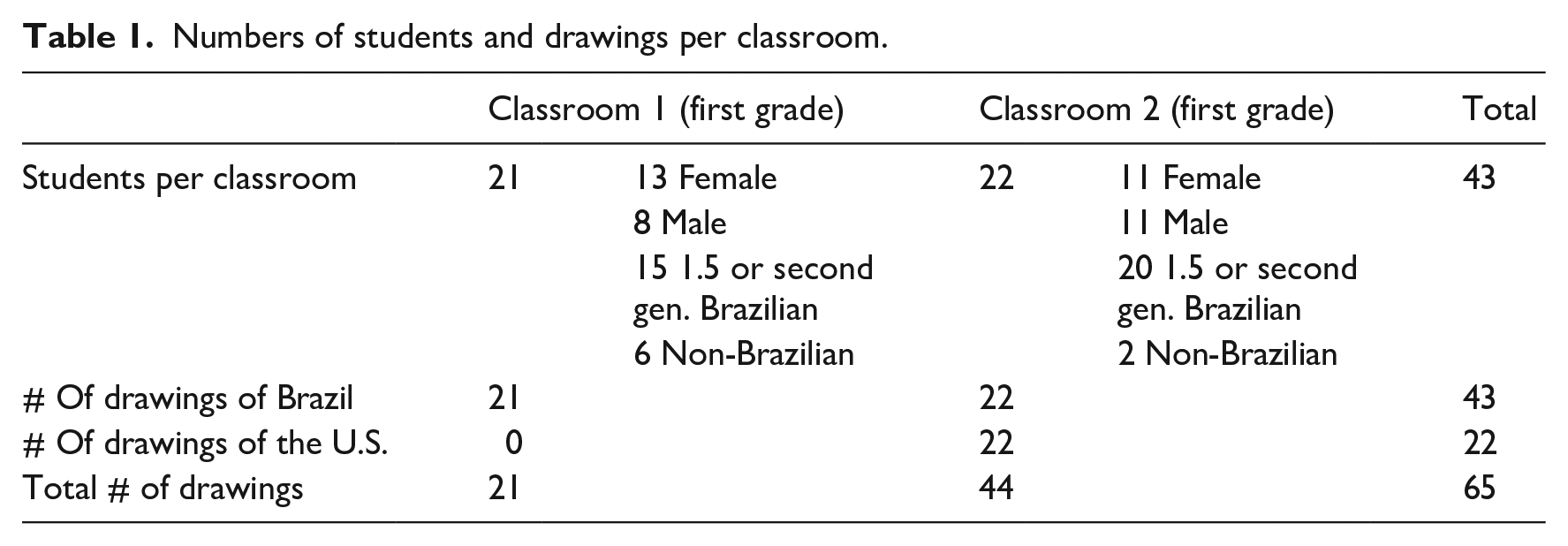
From the total of 43 students participating in the activity, all of them drew and wrote about Brazil, and 22 students drew and wrote about the United States, as displayed in Table 1. This occurred because one first grade teacher only asked students to draw and write about Brazil due to time constraints. The children who did not attend school on the days the teachers conducted the activity are missing from the pool of drawings and narratives. Furthermore, from the 43 students, 24 were female and 19 were male, and their ages ranged from 6 to 7 years old. Thirty-five children came to the United States from Brazil at a younger age (i.e. 1.5 generation immigrants) or were born in the U.S. of Brazilian parents (i.e. 2nd generation immigrants). The remaining eight children in these classrooms did not present immediate links to Brazil. These estimates are based on our longstanding engagement with the children and their families during our fieldwork, reports from the classroom teachers, and reviewing school documents. Although the dual-language model expects majority and minority student groups to be distributed equally in classrooms, the low enrollment of majority students, along with the high influx of Brazilian immigrants in the local community, led to the disproportionate representation of children with a Brazilian immigrant background in this program. In the 2018–2019 school year, these first graders were part of a school population in which 50.5% of the students had a first language other than English, 51.4% presented high needs, 1 and 22.7% were economically disadvantaged (Massachusetts Department of Elementary and Secondary Education, 2020).
Numbers of students and drawings per classroom.
Analyzing the drawings
Once the drawings were collected from the teachers, we used an inductive approach to the content analysis of the drawings (Dreby and Adkins, 2011). In the first round of analysis, we reviewed all 65 drawings (43 of Brazil and 22 of the U.S.), which generated a list of 23 codes. The drawings were then separated into two broad groups based on the country drawn: “representations of Brazil” and “representations of the United States.” A second round of content analysis and coding was conducted in which all drawings were carefully reviewed again according to the inductive codes from the first round. Using Excel, all results were computed by assigning “yes” or “no” values per code for each drawing. In this process, three prior inductive codes were eliminated for their small representation in the overall total of drawings (e.g. sky, monster), and four new codes emerged (i.e. rain, food, animals, hearts). A third and final round of analysis was conducted to ensure the accuracy of prior coding. The results were aggregated to compute frequency counts for each code. After obtaining the frequency counts of each group of drawings, related codes were grouped into broad themes. For this paper, we drew upon 14 codes that were grouped into four main themes due to their connection to our research questions. These themes and codes are displayed in italics in Table 2.
Themes and codes used in this article.
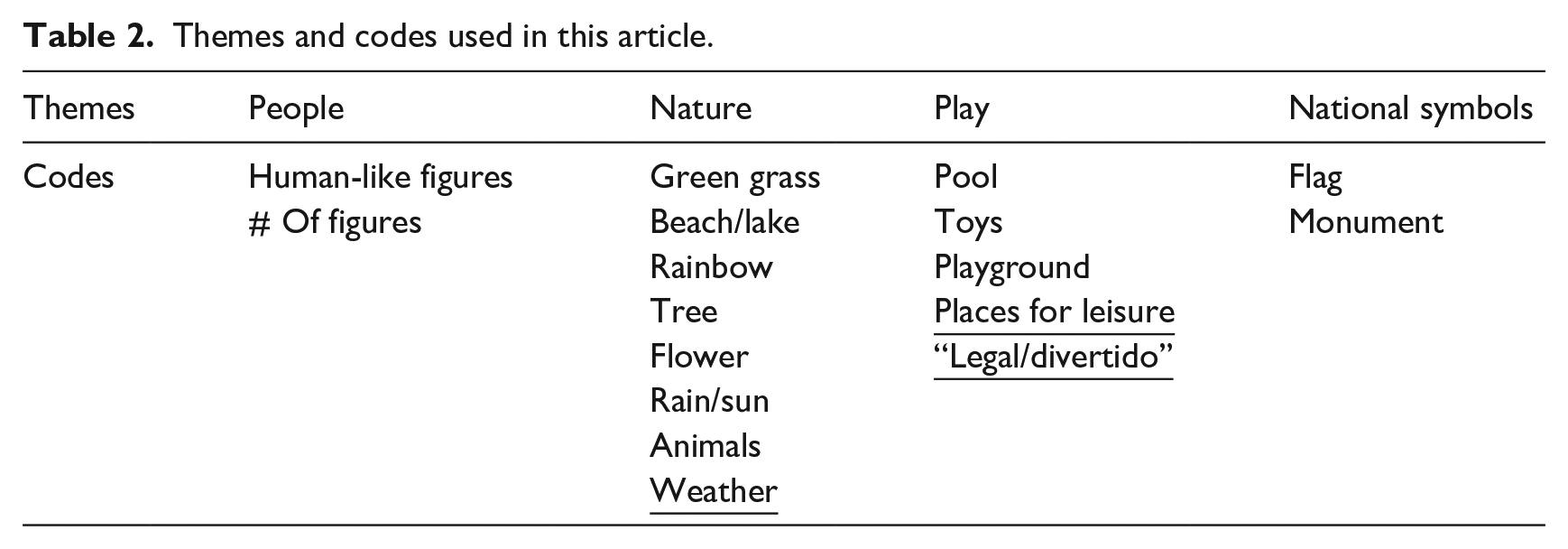
First graders’ narratives were initially coded separately from their drawings. Similarly to the analysis process of the drawings, we took on a grounded approach in which inductive codes emerged from the first cycle of reading and analysis of the narratives. In writings about Brazil, inductive codes included: nature, weather, flag, family, action, and food. In writings about the United States, codes were: flag, family, toys, places for leisure, and the use of the words legal and divertido (cool; fun). The novel codes that emerged from children’s written passages were then incorporated under the broad themes that emerged from the analysis of the drawings. Codes from children’s narratives strengthened existing trends found in the drawings (e.g. people and flag appeared in drawings and narratives) while others added new codes to the broad themes (i.e. weather, places for leisure, “legal/divertido” [cool/fun]) (see
Limitations
As mentioned above, the drawing/writing activity that generated the data for this study was conducted by the first-grade classroom teachers and the researchers were not present. While this approach was mindful of the time constraints, curricular goals, and administrative demands that these teachers managed daily, it also generated limitations. First, although student participation in the activity was optional and the teachers reported relaying this information to their students, the activity occurred during regular class time, was led by classroom teachers, and was presented as an in-class task. This setup may have compelled first graders to participate in the activity as opposed to inviting their volunteered participation. Moreover, since first-grade teachers implemented the focal activity in ways that were most feasible in their classrooms, one teacher did not ask students to represent the U.S., and thus an uneven number of drawings and narratives were collected. Finally, since we were not present during the activity, there are limitations in our personal ability to ensure that, for example, the children did not imitate each other in their drawings. Here, we rely on the supervision of our collaborators, the classroom teachers, who led the activity and guaranteed its integrity. Therefore, we assume that the trends identified in our data analysis—rather than indicative of widespread imitation—demonstrates the interplay between student’s agency in placemaking and the influence of the local social structures of schooling, including discourses about Brazil in the dual-language program.
Family, fields, and flags: First graders’ representations of Brazil
In this section, we focus on first-graders’ pictorial representations of Brazil in addition to the labels and written narratives attached to or embedded in these images. In their representations of Brazil, we found a trend among the children to depict people, elements related to nature, and representations of the Brazilian flag. Regarding the presence of people, from the 43 drawings of Brazil made by first graders in two classrooms, 32 children drew a total of 121 people-like figures. The number of people-like figures portrayed in each of the 32 drawings ranged from 1 to 16, at times including identifying labels above/below these characters, such as “eu” (me), “madrinha” (godmother), “amigas” (friends), “primas” (cousins), “vovó” (grandma), and people’s first names. In 11 drawings, there are at least four people included, depicting Brazil as a highly populated locale. The high number of people and their close physical proximity resembled a sense of closeness and collectivity, as captured in the two examples below. Figure 1 was created by Lenny, a 2nd generation Brazilian student who had been to Brazil several times to visit relatives. In her drawing, she depicted 16 people including adults and children. Figure 2, in turn, was created by the 1.5 generation student Carla, and portrayed 10 people with hands connected.
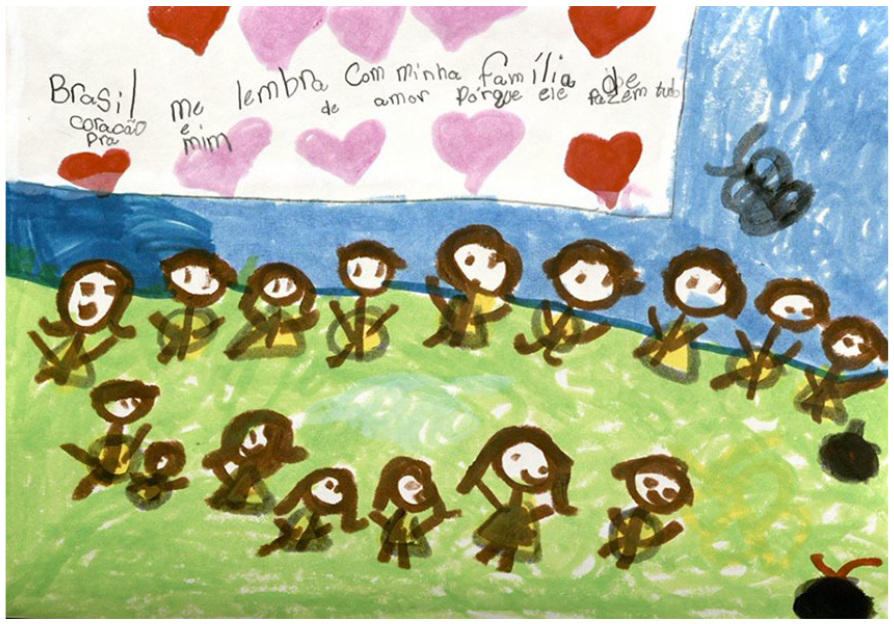
“Brazil reminds me with my family of heart and of love because they do everything for me.”
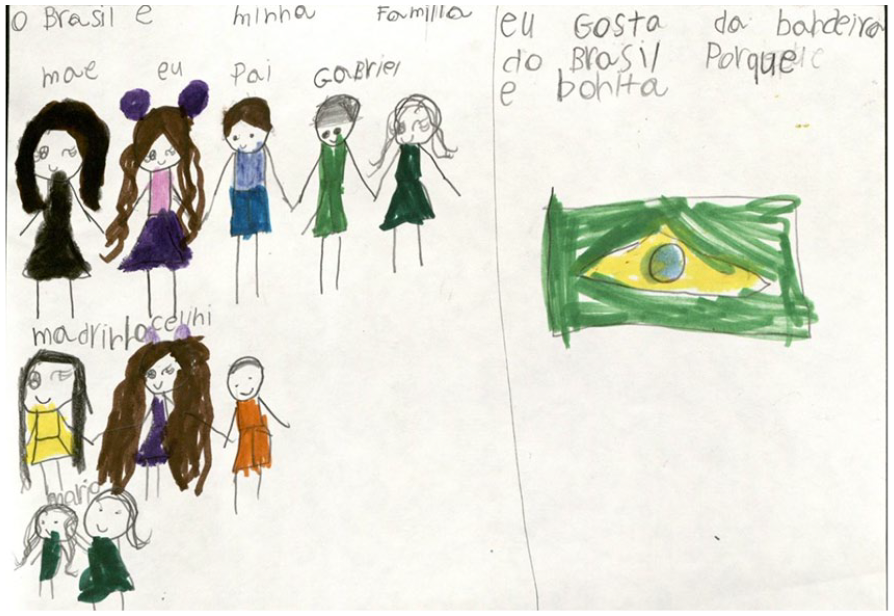
“Brazil is my family.” “I like the flag of Brazil because it is pretty.”
In 20 written narratives, as in the examples above, the children directly connected their understandings of Brazil to relatives and friends who were currently there. For example, one first-grader who had recently immigrated with his family from Brazil shared, “Quando eu penso no brasil eu penso que minha vovô e vovó e tmbe eu pensa que minha tia” (when I think about Brazil I think that my grandma and grandpa and also I think that my aunt). Similarly, a 1.5 generation child who has resided in the U.S. for years explained, “O Brasil me lembro vê meus amigs i amigs i a mia tio, meu priminho” (Brazil reminds me of seeing my friends and friends and my uncle and my little cousin). Blurring the lines between relationships and places, children in the bilingual program tapped into their transnational memories to construct understandings of Brazil. This was further illustrated in Figure 3, where a newcomer Brazilian student, Marta, also shared her perception of Brazil as attached to relatives who stayed there.
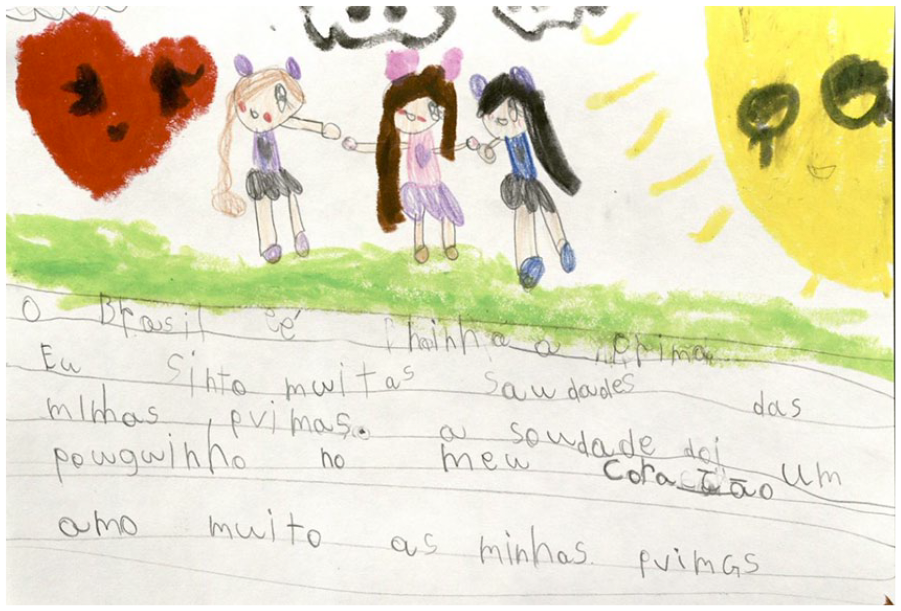
“Brazil is my cousin. I miss my cousins very much. This longing hurts a bit in my heart, I love my cousins very much.”
In this example, a cousin(s) was described as representing Brazil in the imaginary of the child. Thus, while in the drawing family members were all close in proximity, in the narrative this child was explicit ‘Brazil is my cousin’, acknowledging that her cousin was far away from her physically. She continued the narrative by bringing in feelings of longing or the Portuguese word ‘saudade’. The memories of family collided with what Brazil represented for her. In other narratives and drawings, while Brazil was still characterized by the presence of family members, the children also blended people with specific locales and activities that were part of their daily life. For example, five children explicitly described Brazil as the place where their grandmothers cooked, as in the following narrative by a second-generation child: “Brasil me lembra de meu vó fazendo pão de queijo e coxinha e eu praticando fotebol lá” (Brazil reminds me of my grandma making cheese bread and coxinha and me practicing soccer there). Similarly, other children described Brazil as playing with friends, such as in this example by a newcomer child: “Quando eu penso em Brasil Eu penso da os meus doces para minha vovó. i Brica com minha amiga. Eu era muito felis no Brasil” (when I think in Brazil I think about giving sweets to my grandma and playing with my friend. I was very happy in Brazil). Other entanglements of people and activities included fishing with family members, as in this narrative by a 2nd generation Brazilian child: “Brasil me lembra meu pai pescano com meu tiu” (Brazil reminds me of my dad fishing with my uncle) and in Figure 4, drawn by the 1.5 generation child, Juliana.
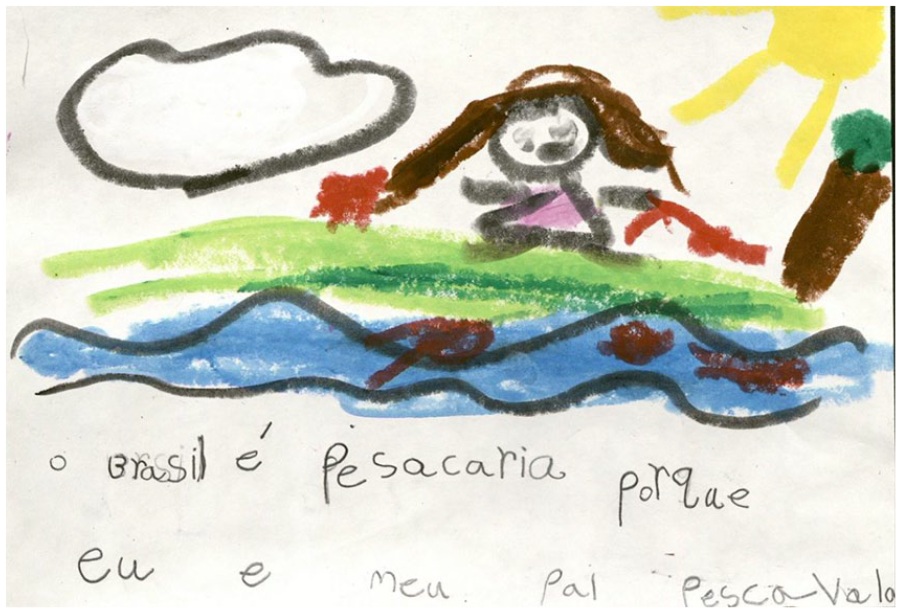
“Brazil is fishing because me and my dad used to fish there.”
These examples highlight the centrality of embodied experiences with family members and friends in these first graders’ conceptualization and construction of Brazil. Through their drawings and narratives, the children tapped into their memories, making past activities in Brazil meaningful to their current perceptions of place. This demonstrates not only their continued involvement in transnational constellations of social relationships (Orellana et al., 2001) but also the various moves and resources mobilized by them when constructing place.
Nature and place
First graders’ representations of Brazil presented several elements connected to nature. Codes that emerged from these drawings included green grass (present in 27 drawings), beach or lake (13), rainbows (17), trees (18), flowers (14), sun/rain (38), and animals (11). Allusions to these codes were also found in the written narratives (22), along with mentions of weather (9). We argue that students’ perceptions of Brazil as an idyllic landscape were connected to the dual language program curriculum. From our classroom observations over approximately 3 years, we witnessed daily morning circles where students had to identify the day’s weather, read-aloud activities where classroom teachers read Brazilian books whose plots unfolded in forests and soccer fields, and unit projects in which students had to research about Brazil’s fauna and flora. While there seems to be a relationship, in this case, between the school curriculum and the children’s drawings and narratives, it is not a causal association. Instead, children in this bilingual program seemed to tap into a constellation of transnational lived experiences, including those at their U.S. school, to assemble ideas about Brazil.
The connections between the DLBE curriculum and children’s imaginaries of place was evident in instances where they evoked the “sumaúma,” a tropical tree studied extensively in first grade. Several children drew trees and labeled them “sumaúma” as in Figure 5.
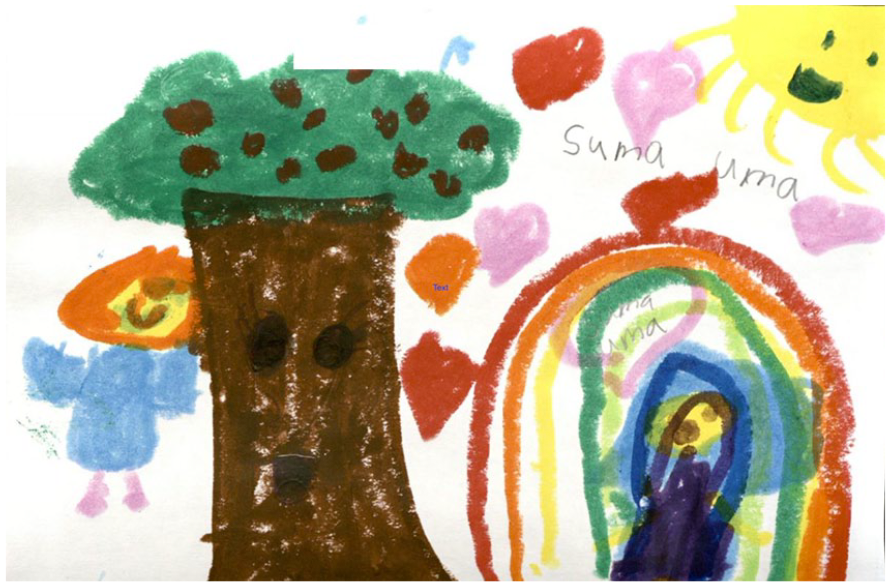
““Suma uma”tree.”
The student who drew Figure 5, a 1.5 generation Brazilian child named Mirtes, also shared the narrative: “No Brasil esiste sumauma. No Brasil esiste pessoas com cabelos azuis. No Brasil esiste fazenda com lago. No Brasil esiste froresta tropical” (In Brazil there is sumauma. In Brazil there is people with blue hair. In Brazil there is farm with lake). Four other children also wrote about the sumaúma in their narratives. For example, another 1.5 generation Brazilian child, Beatriz, shared: “Quando eu penso no Brasil eu penso na sumauma no pão de queijo coxinha biscoito e na Rute rocha pouvo” (When I think about Brazil I think about the sumauma about cheesy bread coxinha cookies and about Rute Rocha octopus). Here, besides the tree, Beatriz also evoked a famous Brazilian writer, Ruth Rocha, whose children’s books were often read in the dual-language classroom.
Other verbal and pictorial representations of Brazil as an idyllic landscape reflected and refracted the broader curricular orientation and teachers’ discourse about Brazil that emphasized its natural resources. This orientation aligns with larger circulating images of Brazil in the U.S. society focused on the Amazon jungle, beaches, wildlife, and natural parks (Rezende-Parker et al., 2002). Idyllic images of Latin American countries more broadly have also been disseminated by the U.S. cultural industry, fixating prototypes of place and exotic identity labels while hiding the complex realities and problems in these contexts (Dorfman and Mattelart, 1975). As it can be seen in Figures 6 and 7, Brazil was constructed by two different 1.5 generation Brazilian children, Tatiana and Valter, as a space where trees, rainbows, people, and animals cohabitate in great harmony.
Immigrant children’s narratives also captured this trend to emphasize nature, as in the words of the 1.5 generation Brazilian child, Nilson: “Quando eu penso no Brasil eu penso na praia” (When I think about Brazil I think about the beach); the newcomer, Érico, who recently migrated with his parents to the U.S.: “Quando eu pnso no Brasil eu penso no sol no lago na praia. As perereca” (When I think about Brazil I think about the sun the lake the beach. The frogs); and the 2nd generation Brazilian student, Ermelindo: “Quando eu penso no Brasil, eu penso floresta tropical” (When I think about Brazil, I think rainforest).
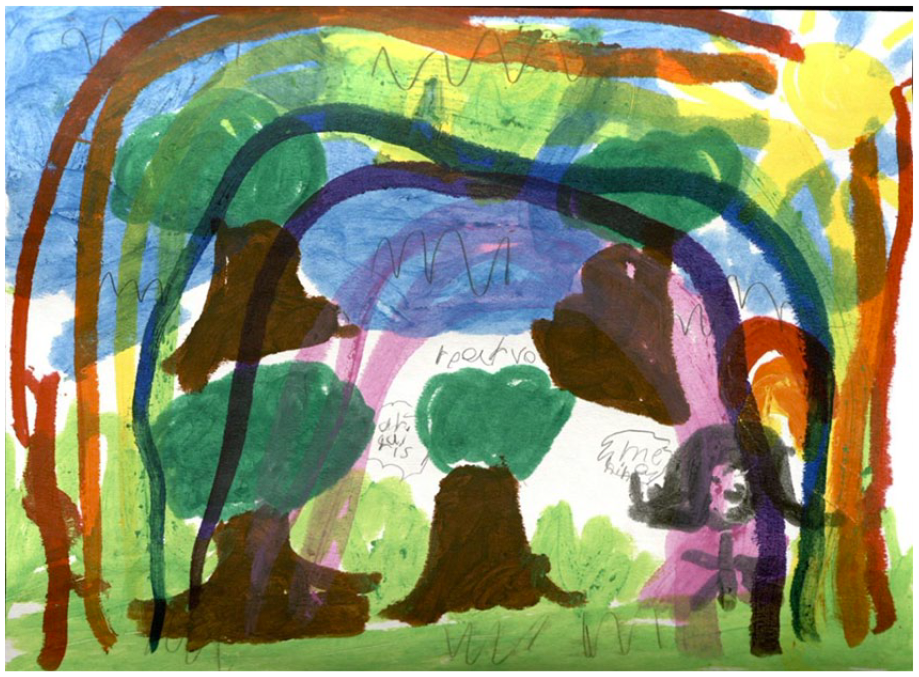
“Tree” and “girl.”
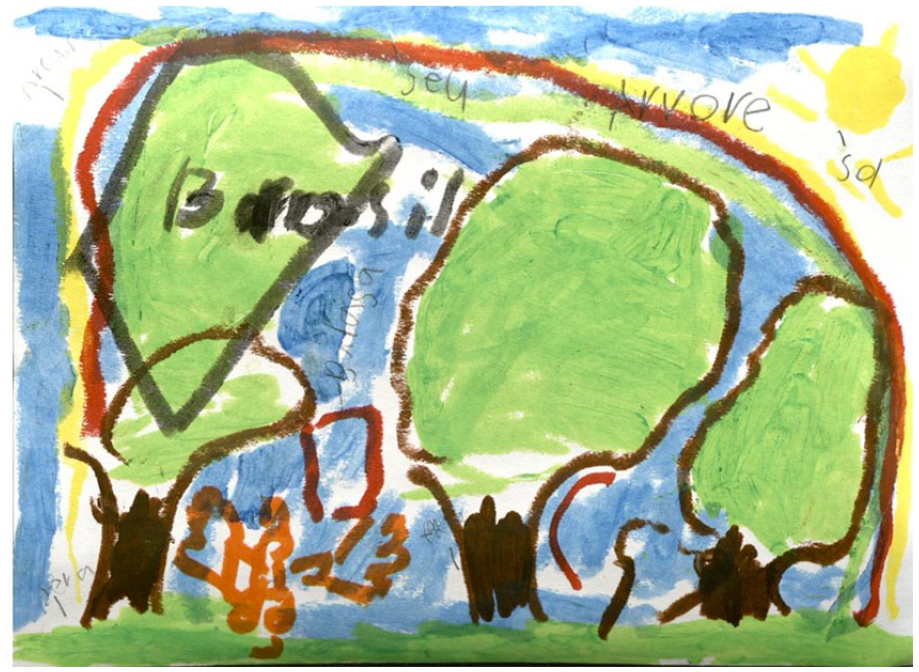
“Tree” and “Brazil.”
National flag
From the 43 children in first grade, 17 drew the Brazilian national flag. Five of them also mentioned the flag in their narratives. While Brazilian immigrant children may have come to learn about the flag in their classrooms, homes, places of leisure, or athletic events, teachers in the bilingual program regularly used the national flag as a teaching artifact. In the drawings, children often drew the flag in addition to people and/or nature, as in Figure 8.
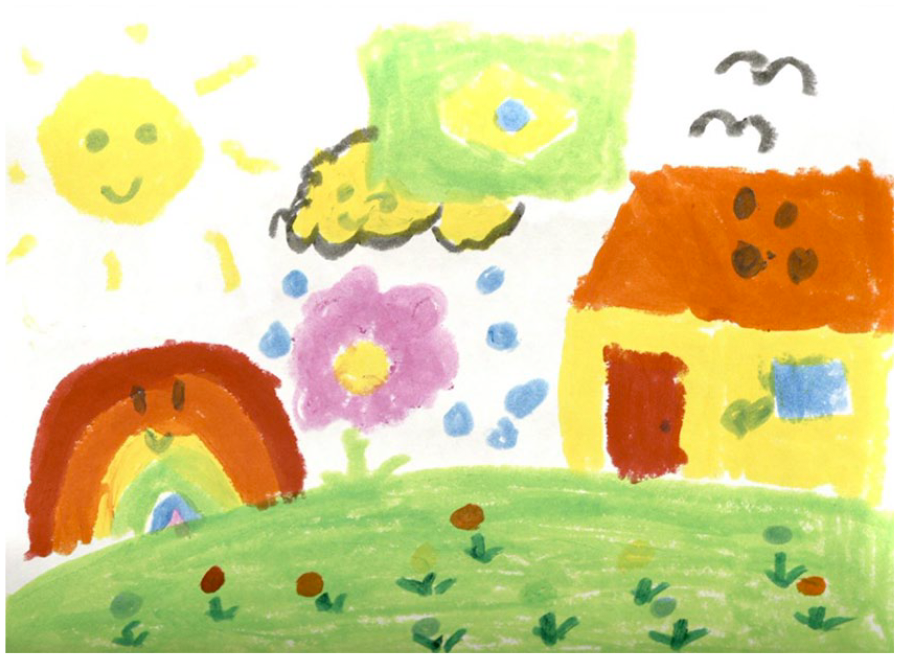
“Brazilian flag and nature.”
In their narratives, the children who evoked the Brazilian national flag also did so in conjunction with other elements related to family or nature, as in the written passage created by a second-generation Brazilian student: “Quando eu penso no Brasil, eu penso de Bandeira e cachoeira” (When I think about Brazil, I think of Flag and waterfall); and another narrative by a non-Brazilian child: “Quando eu penso no Brasil, eu penso nos lagos bonitos e a bandeira do Brasil” (When I think about Brazil, I think about the beautiful lakes and the Brazilian flag). In sum, the children in the DLBE program assembled complex representations of Brazil by tapping into their social networks, transnational memories, the content and orientation available in the curriculum, and possibly the expectations and discourses of their teachers. This points to how children’s construction of place is multifaceted, dynamic, and situated.
People, presents, and places: First graders’ representations of the United States
Overall, representations of people were prominent in depictions of the United States. From the 22 drawings made by first graders, 20 students drew a total of 47 people-like figures. Moreover, drawings and narratives about the U.S. were permeated by the theme of “fun” with toys and leisure-related spaces (e.g. playground, shopping mall). In what follows, we draw upon a collection of 22 first-grade children’s drawings and written narratives about the United States to further understand how they engaged in placemaking during the focal in-class activity.
Apart from 2 drawings that did not include people-like figures and 1 drawing that had 8 of them, the remaining 19 drawings included 1–3 human-like figures, allowing for spacious and thinly populated landscapes. From the 20 drawings that included these figures, 5 added labels to identify 1 or more of these individuals: “eu” (me), “o meu pai” (my dad), “mãe” (mom), “Ms. Campos,” “tio” (uncle), and “tia” (aunt). There was no label for grandparents, names of friends, and only two students explicitly mentioned extended family by kinship titles (uncles and aunts). In their brief narratives, first-grade children mentioned their teacher Ms. Campos (2), friends (3), parents (6), and relatives (3). The weak representation of extended family, and the presence of few individuals per drawing, reflected these children’s current engagements and relationships. Extended family and friends seemed to be experienced and remembered in connection to Brazil, while the U.S. offered a more restricted circle of close relationships. For example, in Figure 9, we see that the student Dario, a second-generation Brazilian immigrant, drew himself with his father (the labels translate as “me” and “my dad”):
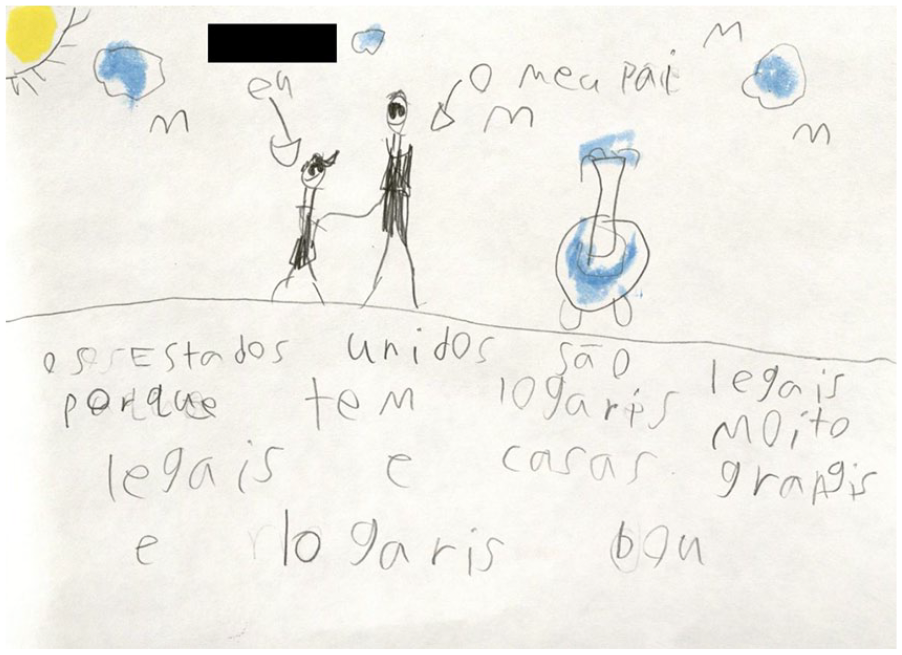
“The United States are cool because there are very cool places and big houses and good places.”
This example illustrates the portrayal of fewer individuals that were part of a tighter circle of immediate familial ties and points to the child’s perception of “cool” places in the U.S., a theme that cuts across several other drawings and narratives. Precisely, first graders centered their drawings and narratives about the United States on “fun,” with words like “legal” (cool) and/or “divertido” (fun) being used 10 times by 7 children. In our analysis, “fun” was seen as embodied in drawings of toys and/or playground sets (11) and narratives about various material objects, such as dolls and videogames (8). Moreover, “fun” was also represented in allusions to specific leisure locations in written passages, such as their school, shopping malls, parks, and playgrounds. For example, entanglements of locations, leisure, and perceptions of the United States can be found in the narrative of a 1.5 generation Brazilian student: “Os Estados unidos me lembra —— que tem parques” (The United States reminds me —— that there are parks); and in the words of a 2nd generation first-grader, “Os Estados Unidos são parque aquático neiricimou e parqis e chuva e escola e vijogeimie camisa e shortie lua e arco-iris” (The United States are waterpark Nexus Mall and parks and rain and school and video game shirt and shorts moon and rainbow). Below, two children who recently immigrated from Brazil, Ruan (Figure 10) and Marta (Figure 11, see also Figure 3), directly linked their imaginaries of the U.S. to play-related objects and fun.
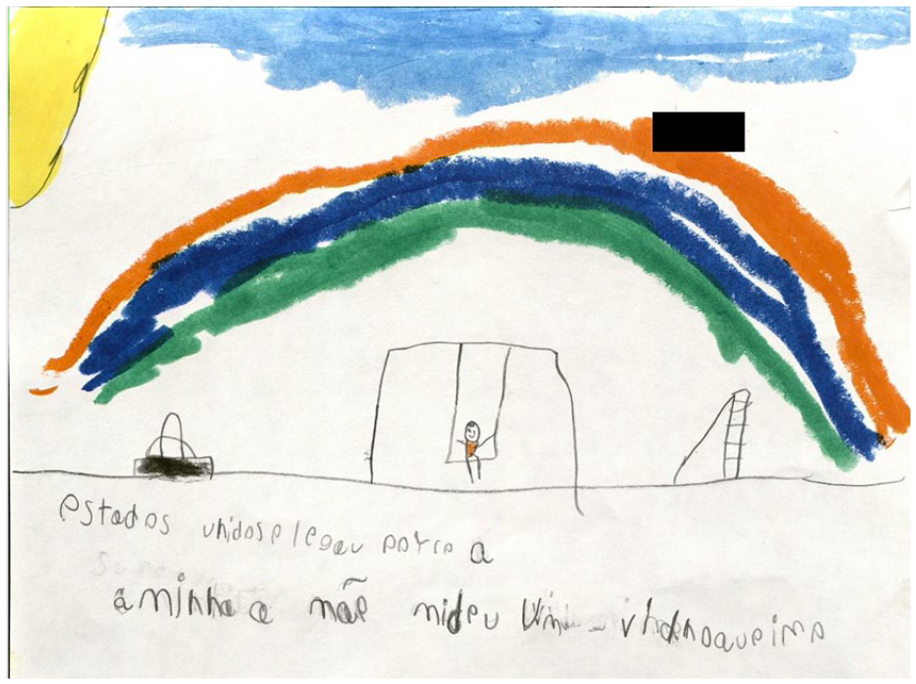
“The United States is cool because my mother gave me a videogame.”
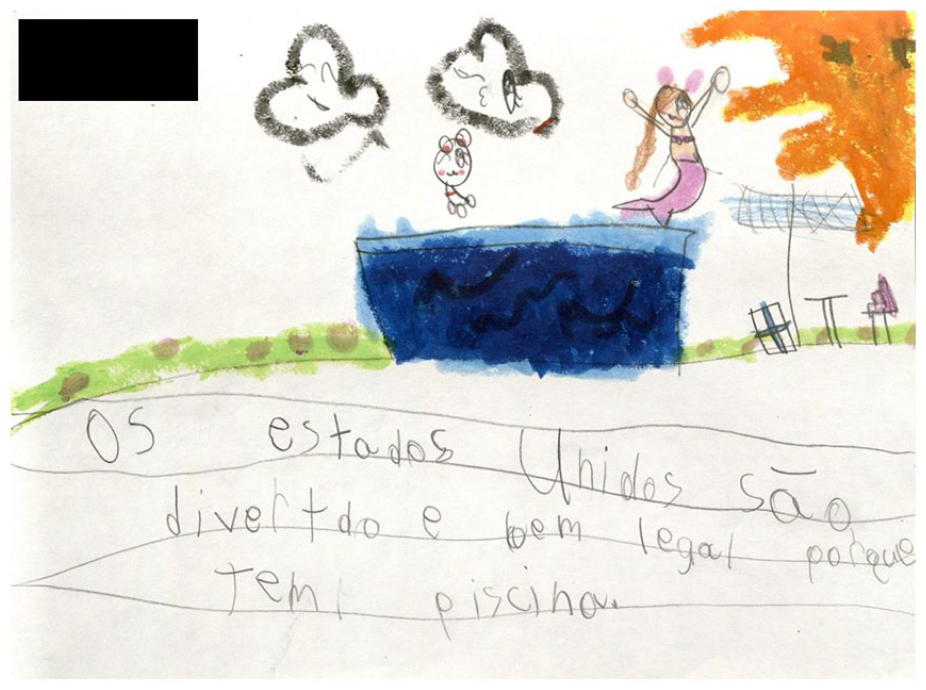
“The United States are fun and very cool because there is pool.”
In the images above, children constructed the United States on the grounds of fun and material objects: a gift (videogame) and a swimming pool. The human-like figures in both drawings were engaged in “fun” activities alone, which further foregrounded the centrality of the material objects. Importantly, the actual material conditions of the children seemed to contrast to the images and narratives portrayed in the drawings, where they were surrounded by spacious landscapes and expensive material goods. We argue that these Brazilian immigrant children’s placemaking of the United States reflected and engaged with widespread discourses that justify migration on the basis of pursuing a better life with more economical stability and gains. The “sacrifice” of physically leaving relatives, friends, and engagements with loved ones—embodied in drawings of memories and experiences in Brazil—was juxtaposed with the (promised) space and material goods depicted in representations of the U.S. In connection to or spite of, their lived experiences in the United States, first-grade children constructed this country as a place where the promised rewards of migration were fulfilled.
Conclusion
For the first graders in the focal bilingual program, past activities, present experiences, and social networks and relationships were prominent features in how they assembled Brazil and the U.S. during a drawing and writing activity. While these elements have been located in the meanings that children attached to the local landscapes they traversed (Orellana, 1999), the data analyzed here suggests the centrality of people and personal experiences in the meanings that immigrant children construct for places beyond their local context. Brazil, a physical terrain that is, for many students, their own and/or their parents’ homeland, was constructed as a moment in meaningful networks of social relationships (Massey, 1991, 1995). Children described Brazil as an extended family member (e.g. a cousin, a grandparent) or as a point in time when they were in activity with others. Moreover, the U.S., or the local landscape where they currently live, was also characterized in connection to meaningful social relations, but these relations were restricted to a tighter circle of individuals—parents, peers, and teachers. Depictions of personal experiences and activities in the U.S. emphasized material objects and leisure (e.g. video games, visiting a McDonald’s). Thus, while the children constructed Brazil and the U.S. as entanglements of landscapes, social activities, and social relationships (Relph, 1993), how these elements were mobilized was qualitatively different in the depiction of each country.
The analysis of children’s drawings and narratives of Brazil and the United States also sheds light on the complex and situated nature of their placemaking processes and practices. For example, depictions of Brazil as an idyllic landscape point to the interplay between the local social structures of schooling—particularly institutional discourses, documents, and teachers’ practices—that emphasized Brazilian natural resources, and children’s agency. On one hand, the children engaged with these normative discourses in their drawings and written narratives, evoking symbols that were valued in the bilingual program (e.g. flags, weather, fauna, flora). This move was particularly relevant in the social context of the drawing activity, which took place in their regular classroom and was led by their teachers. On the other hand, the children also saturated these normative representations with their own transnational memories, lived experiences, attachments, and aspirations.
Moreover, our classroom observations over several months before the activity tell a more complex story about children’s perceptions and construction of Brazil. Specifically, in stark contrast to the idyllic representations in their drawings and narratives, we recorded about 30 instances in which Brazilian immigrant children in the DLBE program talked to each other or us about Brazil in connection to fear, violence, and poverty. The tension between idyllic depictions of Brazil in their drawings and narratives and the everyday talk about harsh conditions there suggests the dynamicity and situatedness of immigrant children’s construction of place.
This article contributes to the fields of education and migration studies by foregrounding the experiences of a largely understudied population, Brazilian immigrant children in the U.S., and the insights they offer into the complexity of placemaking across transnational social fields. For migration studies, this study stresses that immigrant children’s relationships with places also illuminate how they grapple with global processes—such as transnational migration and family separation—and local structures, including education and schooling. However, to grasp these relationships, researchers are compelled to follow children’s lead as they engage in place-based processes and practices in different social contexts and points in time. Although listening to children in research and following their lead is fraught with challenges, it is crucial to involve children in research about their lives and center inquiry on how they interpret and voice their social worlds (Yoon and Templeton, 2019).
Furthermore, this study adds to education research and practice by suggesting that school curriculum and teacher discourse shape immigrant children’s situated constructions of place, a topic that is seldom addressed in the literature. For educators, inviting students to draw and narrate the places of their lives can initiate important dialogues about immigrant children’s memories, experiences, attachments, and aspirations. In neoliberal contexts, where teachers have narrow opportunities to listen to children’s inquiries and interpretations (Yoon and Templeton, 2019), drawings and open-ended writing activities can encourage educators to face and address critical issues in children’ lives (e.g. immigration) that are often silenced or considered taboo in schools and to learn from these students’ funds of knowledge (Gallo and Link, 2016).
Footnotes
Funding
The author(s) disclosed receipt of the following financial support for the research, authorship, and/or publication of this article: This article stems from a project that received financial support from Boston College for the purposes of research.
