




Abstract
Early childhood/educational environmental imaginations transmit national, global and planetary views of the world through texts, visual representations and material objects. These representations produce politics, including nationalism and globalism, and play a part in policy making as well as in how children learn to view and relate to the world. Education, however, needs a new political attractor during anthropogenic climate change that differently orients political engagement with the world for education. In this article, we think with the four political attractors Latour describes: the national, global, planetary and Earth, and Cobb’s notion of the child’s primary relatedness to the world. We explore children’s environmental imagination in their drawings and associated stories to highlight the kinds of politics present in their views promoted by current imaginations. Then, we spin these stories further with speculative experiences our own relation with the world with Latour’s ideas and point to a new political object the Earth and Earthly politics for education.
Keywords
Introduction
When I got off the plane in Perth, Western Australia, I felt at home as the shimmering sky blinded my eyes and the sun pierced my skin. The fine dust particles acted as crystals reflecting the sunrays in the air blanketing the world in a silver glow vitalising everything around me. If I was asked to draw this place, I do not know what colour I would use or what shapes, objects or shades could express the embodied sensations that accompanied my arrival, the distinctiveness of place and the feeling of belonging after crossing the globe from Europe. Yet as part of an ethnographic study, I asked 5- and 6-year-old children in preschool to draw and tell stories about their place. I was hoping to understand what emerges for children from their local places spotted with global and national imaginaries in trying to make sense of the world. Children’s spatial meaning making is significant for sustainability education (Somerville and Green, 2015). At the same time these environmental imaginaries and the accompanying discourses educate us about the world, positioning the viewer as independent from the world and looking at and making sense of it from nowhere. This ‘looking from nowhere’ gaze is prevalent in national, global and planetary images of the world and in abundant circulation in various media and in education. They contribute to political expressions, such as nationalism or globalism, in which the world is viewed as something to act upon from an independent stance, where the Earth is a backdrop to human action and serves human intentions (Millei, 2018). These imaginaries as well as our relation with the world need to be “unlearned” during our new epoch.
Many initiatives in education today have in common a profound concern for the ecological devastation caused by humans and the possible extinction of all kinds of species, including humans (Colebrook, 2015). Questioning the desire for relentless progress and development devastating earth systems, the nature/culture divide and human exceptionalism, initiatives aim to “shift beyond the social, or beyond the exclusively human” in education (Taylor & Pacini-Ketchabaw, 2015: 507). Adding to this critical work, in this paper we point to the operation of environmental and social imaginaries tied to 19th-century industrial nation-state modernity and 20th-century neoliberal globalisation processes. In our view, these discourses are omnipresent in education and schooling and construct the world and future on exclusively human terms and with a preoccupation with human freedom (even from life-defining conditions such as clean air and water) as the proper ends of education (Gleason, 2019). Moreover, there is a connection between schooling and the nation that firmly ties education to progress and national economic development, depending on the exploitation of Earth resources. Studies since the 1970s have clearly shown that the Earth has exceeded multiple times its capacity to sustain humanity in its current numbers and levels of consumption, thus there is ample evidence that this kind of progress is unsustainable (Ivanova et al., 2016).
A new education also necessitates the ontological rethinking of the human, the Modern human, that has been viewed either a natural being or a “being par excellence capable of extricating itself from nature”, hence humans’ viewing position of the world from nowhere (Latour, 2018: 85). Following Latour (2018), we propose to understand the human as ‘terrestrial’ or as “of the world” (Barad, 2007: 185), dependent on and attached to the soil and participating in the inhabited lifeworld (Gilbert et al., 2012; Ingold, 2017; Margulis, 2008; Ryan, 2012: 450). It is not only that the human is of the lifeworld, the human child is “an assemblage composed not only of somatic cells but also of many symbiotic species” – a holobiont (Costello et al., 2012, p. 1255), thus the child as a bio-social being is a member of a community assembly (Costello et al., 2012). In other words, the child is a human microbial ecosystem where the diversity of this ecosystem is the key to health, im/balance, competition and change, reflective also of the large-scale need for the diversity of living and life processes on Earth. The notion of the child as a holobiont dwelling in the lifeworld brings into education other than cultural or symbolic terms, including biological and ecological aspects, processes and capacities (Margulis, 2008) and their ethics and politics, which notion we will later explicate (Latour, 2018; Stengers, 2013). Politics, if orientated to life, has been thought of as biopower controlling life and modifying its processes (Foucault, 1994), “a unilateral, nondialectical and unreciprocated” power. Historical and discursive analyses of education policy and politics have explored extensively the ways in which life became differently targeted by education politics to enhance wellbeing and the production of healthy citizens for the nation-state and global economies (e.g. Millei, 2015; Peters, 2007; Wright & Harwood 2009). This kind of biopolitics, however, focuses on “symbolic life” (e. g. national politics with its discourses and prescribed cultural practices) over biological life. Moreover it does not consider biological life capable of resistance (Malabou, 2016: 431). Our aim here is to bring biological life and related politics into view in education.
I invited my colleague Sirpa Lappalainen to take issue with environmental imaginaries that conjure up nationalism and globalism and to explicate their emancipatory politics and world-making power reinstating humans’ separation from the life-creating processes of Earth. We are motivated to bring to the fore biological life and related ways of being in the world together with what Latour (2018) terms Earthly politics. As we are also “of the world, we experiment with using our capacities of “knowing in being” for our explorations here (Barad, 2007: 185), since our biosocial ecologies/biological lives are also situated in ecological relations, reliant on and mutually entangled in Earth’ life processes as well as the inherited cultural world. We use children’s drawings of the world to open storylines that highlight environmental images representing a socio-geopolitical view of the world and re-story those as bio-social landscapes by paying attention to children and researchers’ sensory capacities of ‘knowing in being’ and to re-open politics for education. Before that, we first describe in more detail our view of the child, then continue by highlighting some aspects of environmental imaginaries omnipresent in education and then turn to explore related being and knowing in politics.
‘The child’ and dwelling in the lifeworld
In national schooling, education intends to shape child citizens for the nation-state which is an imagined social community (Anderson, 1991) residing on the territory of the nation-state (e.g. Bereketeab, 2020; Gordon et al., 2000). In social scientific studies of children, critical childhood studies and education, the exploration of children’s learning, development, agency and voice also emphasizes the social and downplays the child’s biological nature except in physical development) (Lee, 2013). Focusing predominantly on socio-cultural-historical differences and multiple and dynamically changing childhoods left the biological as the universal and standard way of being and developing as humans (“old, homogeneous and slow to change” (Lee, 2013: 13)). The human genome and microbiome projects, however, point to human biological diversity. For example, research shows how biosocial events are intimately interconnected, for example, in the variation of the timing of menarche, which is dependent on ‘local biologies’ (Lock and Kaufert, 2001). Socio-economic development and hence rich food sources and the absence of infectious and non-communicable diseases bring the menarche earlier. Adopting this kind of biosocial view, we can better decipher our mutual interdependencies and position humans as diverse biological species among other diverse species with cultures of their own. To emphasise this view, we understand the child as bio-socially dwelling in a lifeworld and acquiring a cultural heritage through language and images, including those portraying the world (Cobb, 1977: 17; Ingold, 2011, 2017).
Children dwell in the lifeworld with biological/sensory capacities and socio-cultural understandings to orient actions with or without intentionality. For example, it is now well understood that human life has microbial origins and that we are symbiotically interdependent “on microbes for core bodily functions, including cognition” (Lorimer, 2020: 72). Thus, biology/environment/nature and society/culture are inseparable because, besides cognition and “beneath the body-that-you-are is a thing of flesh and blood, exercising certain basic respiratory and metabolic functions” (Ingold, 2017: 22). The question is how to connect ‘local biologies’ with cultural heritage through discourses and images portraying the world. Exploring adults’ memories of childhood experiences in nature, Cobb (1977) developed a theory of how children connect their sensory perceptions of the physical/biological experience of the world and experience of their bodies’ biological processes. Cobb explains that children’s ecological connectedness undergoes a “genetically motivated process of learning” (Cobb, 1977: 18). In this process, children’s capacities emerge that connect their dwelling in and perceptions of their participation in the lifeworld with symbolic thought (Cobb, 1977).
Cobb paid attention to how a child develops cultural knowledge of the lifeworld which she called an ecology of imagination in childhood. Cobb (1977: 18) theorised about how the “little human animal” is “learning to transcend his [sic] biological nature in order to acquire cultural heritage”. In her decades-long observations and studies of childhood memories, she describes the child’s primary relatedness to earth and universe as the ‘natural genius of the child’, a generating spirit, which later evolves into creative activities within ‘world-building’ play integrating body sensations and image with world image and knowledge to know where and who one is (Cobb, 1977: 17, italics is ours). As Cobb (1977: 51) explains: “A child is a human being, whose development is regulated by the meanings of nature imparted to him (sic) by the culture of his (sic) particular period in history, the particular mode in which he (sic) is taught to see and know himself (sic) in time and space”. The child, as well as other living things, are part of a web of related, interacting, dynamic energy ecosystems of which they make sense through cultural knowledge. By considering humans as ‘ecologies’ we do not seek to elevate the biological to epistemic privilege in uncovering reality. Rather, we seek to combine biological life and cultural imaginaries that dominantly shape educational approaches and to highlight their epistemic tensions in education and research. We now turn to how cultural knowledge of place and the environment is presented in education.
Presentations of the world in education
Presentations of the world, such as maps, globes, pictures of far away and nearby places often decorate school environments. They are playthings, educational materials, they partake in imaginary play and teach children normative views of the world to orient themselves in symbolic terms (Millei, 2018). On political or ‘reference maps’, a national view of the world appears. Nations compose the world, neatly divided into different coloured areas, where lines seemingly separate homogeneous groups of people speaking different tongues and having different cultures and histories (Paasi, 1999). Physical maps show natural landscape features of the earth and important political boundaries, such as state and country borders dividing landscapes, ecologies and flora and fauna into native and alien, creating exclusion and inclusion through the nationalisation of nature (Antonsich, 2021). ‘The country’, ‘the land’, ‘blood and soil’ are terms used as synonyms for ‘nation’ and to be rooted in those is the ‘normal’ condition for a child to learn (Malkki, 1992: 26). Depending on these imposed national divisions, some flora and fauna are deemed native, and are often used as icons of the nation, belonging and rootedness to and of children (Taylor, 2013). Cartographic imaginaries encode and teach about the world by imposing multiple separations, such as between groups of humans, humans and more-than-humans, homeland and foreign landscapes and land and soil, where soil is an inert social signifier of national territory as opposed to being alive and teaming with creatures that are themselves the soil and life (Puig de la Bellacasa, 2017).
Topographical maps portray in different colours the earth’s surface, roads connecting different cultures and places on the globe, cities and national parks, economies and transport hubs. These are symbolic representations of the world that guide discussions on national and global politics. Space travel during the 1960s and early 1970s produced the first images of the Earth from space, bringing into humanity’s view a small planet with a fragile ecosystem. The nuclear threat during the Cold War was projected onto this fragile planet, which expanded geopolitics into cosmopolitics, by merging this powerful vision of the global and the potentials of new science and advanced technologies. They also created popular slogans such as ‘Think globally, act locally’ (Heise, 2008: 20; Latour, 2018). Images of Earth from space inspired a wealth of ecological and eco-spiritual thinking and pedagogical approaches that help to get more in touch with what supports our existence. While bringing to the fore creative approaches highlighting our dependence on this ‘fragile planet’, these space images also represented the world as an object or backdrop to human activities and exploitation (see Heise, 2008). This is because distancing the viewer’s position from Earth, planetary images distance the planet from everyday human experience and contribute to the feeling of human domination over and separateness from a sentient Earth. In these images, Earth appears as a resource for human, national and global developments emphasizing human sociality and politics that leaves the other than human out of concern.
In ‘real’ places (`local biologies’) sustaining life on earth, landscapes are shaped by geological forces, living organisms and their soil forming actions in which all living creatures dwell. The Earth is a sentient superorganism constituting a single overarching feedback system and sustaining the circularity of life itself. Life matter has been the life matter of something else circulating from the soil into ecologies to create everything, humans included (Latour, 2018; Puig de la Bellacasa, 2017). Representations of the global and planetary views of the world capture the world in “transcendent, definitive mappings, transparent knowledge systems” providing “confident epistemologies” by positioning the knower outside earth systems and at the same time within protective national borders (Alaimo, 2016: 3). They distance humans, making them onlookers instead of ecological dwellers interdependent on multispecies communities.
Nation, globe, planet and earth as objects of politics
Representations of the world are also political sites, since politics emerges from “how we see and how we learn to see, how we suppose the world works, how we suppose that it matters, and what we feel we have at stake in it. It is an implicit, everyday metaphysics, the bold speculations buried in our ordinary lives” (Purdy, 2015: 16; Ryan, 2020). Hence, a view of the world is related to action about what is worth researching and saving and what education and multispecies futures are worth creating. Confident epistemologies make up the view of the world in education which are also “particular political sites that make up the massive temporal and geographical expanse of the Anthropocene” (Alaimo, 2016: 1). Popular world representations as well as the development of modern schooling have their roots in the establishment of modern nation-states and their institutions, such as modern schooling and childhood (Millei and Imre, 2015). One of the tasks of national education systems since their inception has been, and still is, to educate child citizens for the nation-state (e. g. Bereketeab, 2020; Gordon et al., 2000). The nation-state is imagined as a human community, bound together as a constructed community with a common identity, bordered within a territory and situated on the national soil/land (Anderson, 1991). National school systems thus carry an inherent national bias and demand that children link their sense of subjectivity to the nation imagined mostly as a human collectivity against the backdrop of a nationalised environment (Silova et al, 2014). The national view, in general, encompasses the attachments to territory or land, identity and belonging of certain humans (Paasi, 1999). Hence, it is an inherently a human centred view where territory and land appear as the subject of symbolic attachment and a national resource.
Globalisation created a new space for social life beyond the nation and promoted a global imagination (Appadurai, 2001). It has also contributed to the proliferation of images that represented the world as an inert object with connections crisscrossing it. Cosmopolitan imaginaries also troubled the national bias and proposed ‘new forms of collaborations that were no longer confined to local communities but spanned across national boundaries’ (Rizvi, 2006: 193). In an increasingly mobile, interconnected and ‘borderless world’ (Beck, 2006), cosmopolitan theorising explored new forms of experience and sociability (Skey, 2012). Expanding Kantian theorising and an ethical stance, proponents emphasised a common humanity over more parochial interests (Appiah, 2006; Nussbaum, 1996), an openness towards and engagements with other people and drew on ‘broad notions of (global) sociability, involvement and responsibility’ (Skey, 2012: 473). This type of globalisation and cosmopolitanism is evaluated by Latour (2018) as positive globalisation in opposition to what Beck (2010) terms the dark side of a negatively globalised planet, referring to the rapid growth of global free markets, corporate legal systems and the mobility of international capital concentrated in the hands of a miniscule elite. Negative globalisation universalised neoliberal capitalism and its singular notion of being.
Representations of the world are tied to forms of politics. To understand the focus on politics attached to different views of the world, we draw on Latour’s (2018) four attractors: nation, globe, planet and Earth. Gleason (2019: 980) summarises Latour’s ideas about the nation as the local and the global as follows: The Local-plus captures the importance of history, of the basic right to feel safe at home, and to cultivate care and attachments to the soil, while the -minus is easily coopted by nationalism and rigid concepts of identity and borders. The Global-plus has the potential to provide a framework for ‘multiplying viewpoints, registering a greater number of varieties, taking into account a larger number of beings, cultures, phenomena, organisms, people’ (Latour, 2018: 12–13) – in short, the pluralism . . .
Politics, if orientated to the local/nation, globe or planet, manifest in nationalism and globalism, raising national and global subjects/citizens attached in symbolical terms to the world. Earthly politics emphasises the biological or ecological, the thin crust of the Earth, hummus, water and air that sustain life and stretch between a few kilometres from the soil surface to the outer end of the atmosphere (shield from the energies of the cosmos). Latour (2018) terms this the Critical Zone, which term emphasises its importance for life. The Critical Zone is the Earth or lifeworld, the attractor for an ‘earthly politics’ which orients to all forms of life on Earth with interdependent ecologies of multispecies communities. In this paper, we explore Earthly politics for education as dwelling in the lifeworld, which is a ‘life giving and life-living’ practice (Kruger, 2021: 731).
The ‘life giving and life-living’ practice of education and research
With accelerated global heating of the earth and mass extinction, we have no time for confidence (Alaimo, 2016) in education and research. We need to pay a different attention to ‘ecosystems [that] support communities, which, in turn, consist of many different populations of organisms living together’ (Ulmer, 2020: 783). Educational processes, in this view, are a collection of actions that are not in isolation but affect and are affected by participants of the ecosystems in the ongoingness of life (Ingold, 2011; Kruger, 2021; Ulmer, 2020). We will speculate in this research with this kind of expanded attention to the lifeworld and take ourselves as researchers, as well as the research process, as part of the lifeworld. As researchers, we seek to ‘read the world around us from our embodiment and being a part of the world and being in an equal state among other organisms and matter’ (Lenz Taguchi, 2011: 40, citing Barad, 2007). We start from children’s drawings and attempt speculatively to expand our attention to diverse ecosystems as an analytical move in which we draw on our own capacities as ecological dwellers in the lifeworld. As we read children’s stories, we pay attention to, sense and perceive the world with our world ‘generating spirit’ as we highlight how these are interspersed with vexed issues of and imaginaries (representations) of the national, global and planetary views and might be reoriented towards the Critical Zone with Earthly politics. We acknowledge that as we explicate our dwelling in the lifeworld, we still rely on biological and scientific knowledge and associated discourses through which we ‘distance’ ourselves from embodied experiences. We try to keep this epistemic dilemma in sight and adopt a creative approach that plays with (rather than tries to solve) these epistemic tensions.
The two drawings were created by children at Kurri Kurri preschool in New South Wales, Australia. During the period 2013–2014, we implemented an inquiry to explore how place-making happens in a preschool within the global flows of people, knowledge and things and how an interconnected world conjures up place in children’s sense-making and experiences. We took the preschool as a location where multiple trajectories intersect creating a global sense of place (Massey, 2005; also see more in Millei, 2018). In the preschool, nation, world and planetary representations were readily available in the form of maps, globes, picture books, mass media available through the internet and so on. These images were creatively reproduced in children’s drawings to represent their place in the world.
Here, we reread the original research through a new theoretical and epistemological lens. We open the storylines with the visual and storied world representations of the drawings as told by children (Barker and Smith, 2012) and follow up with Edwards’ (2012: 22) suggestion to add ‘an embodied engagement’ speculating about expressed biological, ecological, biospheric and cultural relations by relying on our own dwelling in the lifeworld and its cultural (biological) knowledge. We write these engagements and use poems as the ‘remaking of nature and the recognition of anthropogenic climate change are subjects intuitively suited to poetry, which has rarely posited a strong separation of the human from the natural’ (Hunter, 2019: 90). While we do not wish to claim that we are poets nor that our poems have the literary quality of planetary anthropogenic poesis, our intentions were to express an absence of remedy for global heating and the limits of reducing its effects and at the same time to ‘insist on life and song under these conditions’ (Hunter, 2019: 95). The poems were created from the inquiry – our interpretations of the drawing linking those to imaginaries of the world and the possible sensations of the child and researchers – by cutting it down to its bare bones for a poetic tone to emerge. Besides our capacities attuning to the lifeworld, we intended to give ‘recognition to everyday (more-than-human) materialities, occurrences and experiences and how these move and change’ us (Kruger, 2021: 731). We aim to criticise (and also keep in sight) those symbolic framings of the world that take it as an inert object of national, global and planetary politics and to orient towards Earthly politics.
The stories . . .
As we started our explorations of place, children found the globe in the preschool. They often played with it identifying countries and locating them on the globe. Once, a small group of children looked at a toy globe together with their teacher. One child after another received the small rod with which they could press on certain spots on the globe. Touching these spots initiated short, recorded vocal information portraying significant icons or cultural knowledge about those locations. After playing with this toy, the children were asked to draw their places with black marker pens on a transparent plastic sheet rolled out on the floor.
This is me on earth, I made me on there.
. . .
I’m on top of the world.
What can you see from the top of the earth.
Every different country.
What country? Can you name them?
Australia, (inaudible) and South America . . .
Are those the only places that you can see?
I can also see the planets, moon and the sun and I can see those three places.
How do you know those places?
I can see those with the winds around it and the sun and the moon, and the spaceship.
So how do you know about the planets with the sun with the winds around it and the spaceship?
. . . hm . . .
Did you see it somewhere?
I saw it at the museum . . . saw skeleton of dinosaurs as well.
During the drawing, the discussion continued and other children added their descriptions of place: ‘I am drawing the southern cross’ . . . ‘I draw the world’. . . ‘I draw a big sun’ . . . ‘that is the big earth where I am living’ . . .
‘tell me about your little place’
it is Mars.
Re-storying 1. Geocosmic forces
In the drawings created while the above discussion took place and, in the drawing below (Figure 1), the world is represented as circles, below the world is depicted with a light blue circle. The lines leading to the other circles are anchors fixing the earth in Space. Light blue circles in the middle of the world represent Australia. The child’s story goes . . .
This blue circle is my world. The green part is Australia, where I live. The anchors are holding onto the world ‘cause there is rubbish on Australia. The world is supposed to move slowly but it is moving really fast to get rid of all the rubbish so the anchors have to hold it in place and only the rubbish will fly off. (Clayton)
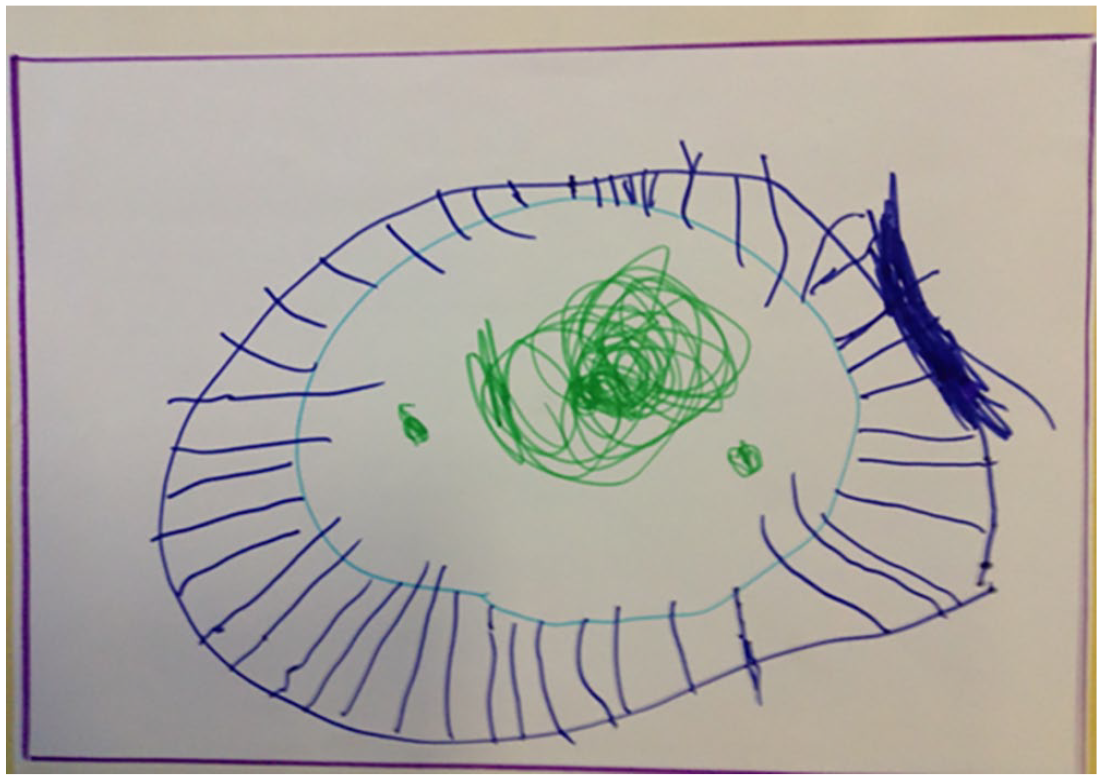
The world, Australia, anchors and rubbish by Clayton.
Nation state and technofix
The nation state, And Planet earth Dominate the view of the world. Earth as human is agentic, sensing rubbish and spins to clean it ———– out. Anchors, a techno fix, protect the Earth with human mastery. The Australian manchild sends the rubbish to Space. The Earth was in trouble, technology saved the day.
Re-storying
Spinning around, the body loses its balance with speed and gets out of balance, the body drops to the ground. Something needs to hold onto the body to keep it in place. Centrifugal, gravitational and body forces compete. Objects may fly out the hand with the force of acceleration and fly off to S/space. The agency of the body with earth forces is felt as they spin in S/space. Objects thrown out into Space remain within the earth’s orbit as gravitation keeps them in place, circling as defunct human-made objects, as micrometeorites. Debris may move to lower altitudes affected by gravitational fields but still take millennia to disintegrate. Earth exists in cosmic and human made power fields.
Geo-cosmic life with its energies and minerals deposited matter on earth that created life. The fluctuating solar wind, the earth’s geomagnetic force and the interplanetary magnetic fields vitalise life on earth. In human bodies, geo-cosmic forces alter heart rhythms, the strength of the beat, exacerbate pain and ecologies are affected by their manifesting in the growth of violent actions (Wahbeh et al., 2021). Metabolisms and emotions are moved by geo-cosmic forces, a feeling of bad mood or palpitations in the chest are the responses. Geo-cosmic forces affect the ever-changing ongoingness of matter. Everything in earthly ecologies is matter, made by matter and a part of the circulation of matter from the soil into creaturely bodies, into the cosmos and back, matter that has been the matter of something else (Puig de la Bellacasa, 2017). Matter also includes pollution, microplastics, engineered substances seeking to alter life processes.
In one moment, the human mind may experience a fleeting mastery or control and imagine shooting the rubbish (matter) from earth into space or leaving earth for another planet. The onlooker from space sees the human and the rubbish with national character located on the national land, Australia. The onlooker’s moment of separateness from cosmic and earthly energies may be interrupted with a surge of pain, a change in heart rhythm and mood swing, giving evidence of cosmic connectedness and affects forged across geological times between living ecologies and matter. We are all ‘of this world’ (Barad, 2007).
Mattering politics
Bodies held by gravitation. Holding, releasing, bind. Geocosmic matter creates life. The body and ‘genius of the child’ experiment with forces, as planetary, and national images go by. Coming to know the world as holding and releasing, binds the fragility of our bodies, and the fragility of Earth. National and earth-space boundaries no longer protect against undesirable matters. As all matter, rubbish is being recycled through earthly and planetary ecologies. Toxicity ends up in living cells in child ecologies, altering life, and the lifeworld forever. Fragility of Earthbody as new education ontology, a target for earthly politics emerge.
Story 2. Being in flow
After the summer holidays, the teacher asked the children to draw their experiences. The child’s story accompanying the second drawing (Figure 2) goes as follows: I am on the boat, arriving in Australia after travelling on the ocean. I am happy to come home. On my head are happy sparkles (Peter) Large red cheeks eyes at me sailing into Sydney. Happy sparkles adorn his gaze Opera House and Harbor signal his place. Bag on deck, shirt and hat protect from elements.
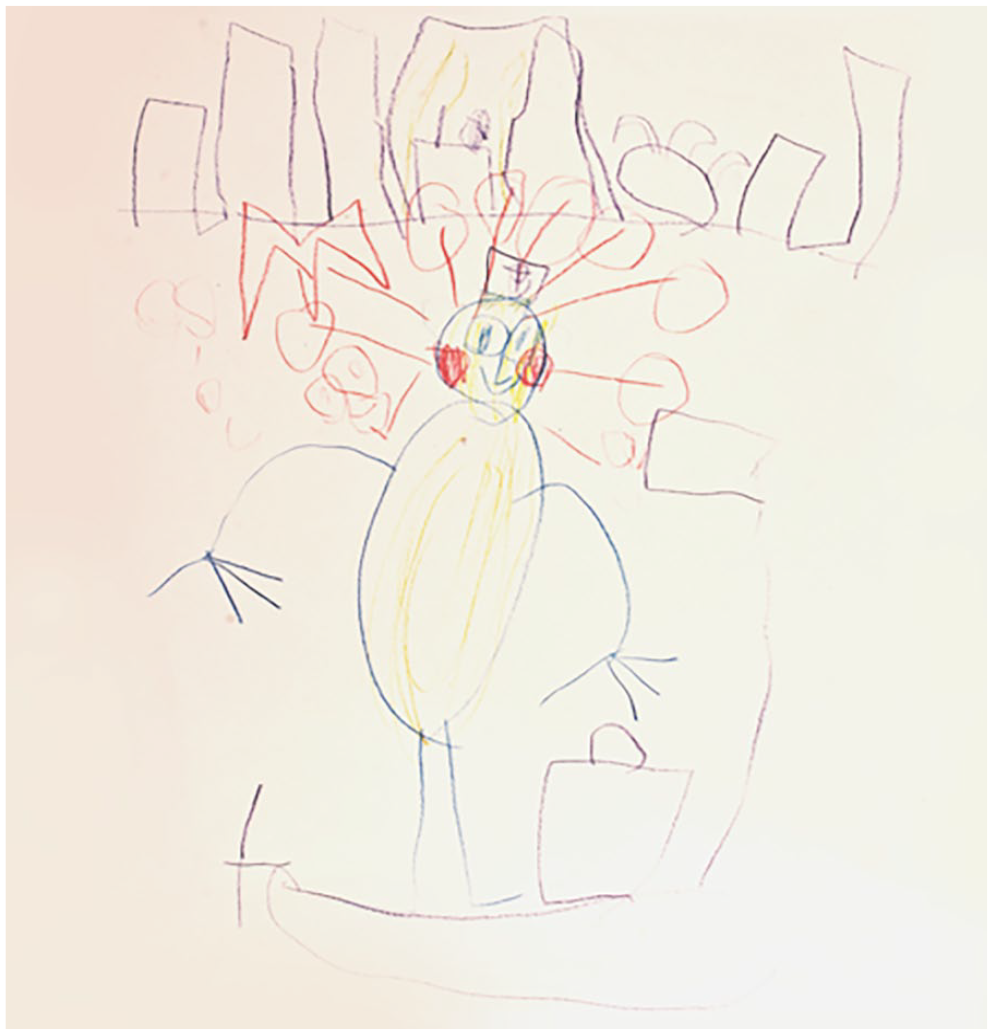
Arriving by boat and bag in Sydney Harbour by Peter.
Homecoming to Sydney and Australia is represented as an emotional moment in the drawing, full of joy and enthusiasm. It does not seem to matter from where the traveller arrives, the importance is in coming back home. The world-famous iconic cultural artefact appears in the background, the Sydney Opera House, giving a location on the map – Sydney Harbour and symbolising both the city and Australia. The iconic Sydney Opera House and the harbour where the traveller embarks in the drawing represents homecoming with a national symbol and expresses feelings for the nation as a form of banal nationalism (Billig, 1995).
The sails are set in the wind. The natural elements, water, wind and sun, are cleverly suggested yet do not appear. We see the boat (on water), sails set (wind) and means to protect the body from the sun and wind (hat). The rosy cheeks also indicate the sun and excitement. The bodily sensation of gliding through water and wind, feeling the sun on one’s cheeks feels like being in ‘flow’. Csikszentmihalyi (1990) describes the state of ‘flow’ as a feeling of great absorption, engagement and fulfilment, and during which temporal concerns, such as the passing of time, basic needs and the self itself are suspended. Bernard Berenson’s autobiography analysed by Cobb (1977: 21) describes a parallel experience: As I look back on fully seven years of awareness and recall the moments of greatest happiness, they were for the most part, moments when I lost myself all but completely in some instant of perfect harmony. In consciousness this was due not to me but to the not-me, of which I was scarcely more than the subject in the grammatical sense. . . . In childhood and boyhood this ecstasy overtook me when I was happy out of doors. Was I five or six? Certainly not seven. It was a morning in early summer. A silver haze shimmered and trembled over the lime trees. The air was laden with their fragrance. The temperature was like a caress. I remember—I need not recall—that I climbed up a tree stump and felt suddenly immersed in Itness. I did not call it by that name. I had no need for words. It and I were one.
The experience of the body being exposed to the elements and gliding across the sea resembles the feeling of ‘It and I were one’. The drawing brings the experience of the ‘nonpersonal order of nature’ (Cobb, 1977: 21) to a representation of being in flow, dwelling in the lifeworld in complete harmony. To the feeling of harmony in the lifeworld, the symbolic national image is attached. The nation becomes the idea of belonging and feeling at home instead of the lifeworld.
An Earthly belonging could be represented by being at home in the ecologies. Escobar (2016: 17) describes how inhabitants know the mangrove forest intimately. As they traverse with great ease the ‘fractal estuaries’ created by the rivers and the ever moving sea, connections with the moon and the tides enacting a circular temporality emerge. Other connections with the mangrove forest are the ‘many relational entities involving what we might call minerals, molluscs, nutrients, algae, microorganisms, birds, plant, and insects – an entire assemblage of underwater, surface, and areal life’ (Escobar, 2016: 17).
William Worthworth’s famous poem titled ‘I wandered lonely as a cloud’ generally known as ‘The Daffodils’ expresses a similar event with a heightened emotional state. The poem expresses a feeling of ‘floating’ which captures a purposeless drifting (instead of a structured arrival at a national space), and rhyming (the ‘crowd’ (of daffodils) and ‘cloud’) point to a kinship within the lifeworld, and where the poet’s isolation and mood are lifted with the image of the dancing daffodils. What brings the poet to earth from a cosmic space is the sight of the dancing daffodils like waves of water invoking tranquillity and joy in his spirit. The sight of the host of dancing daffodils represents the rich earth with life and joy inducing energies, as the attractor, Earthly politics. I wandered lonely as a cloud That floats on high o’er vales and hills, When all at once I saw a crowd, A host, of golden daffodils; Beside the lake, beneath the trees, Fluttering and dancing in the breeze. Continuous as the stars that shine And twinkle on the Milky Way, They stretched in never-ending line Along the margin of a bay: Ten thousand saw I at a glance, Tossing their heads in sprightly dance. The waves beside them danced; but they Outdid the sparkling waves in glee: A poet could not but be gay, In such a jocund company: I gazed – and gazed – but little thought What wealth the show to me had brought: For oft, when on my couch I lie In vacant or in pensive mood, They flash upon that inward eye Which is the bliss of solitude; And then my heart with pleasure fills, And dances with the daffodils.
Towards the lifeworld with Earthly politics
Education and research in our new epoch require us to go beyond intellectual imaginaries, passing even those imaginaries that seek the restoration of humans’ relationship with the environment and promote related pedagogies (Blaise et al., 2013). It requires us to pay attention to the lifeworld and engender it in politics (Tsing, 2015: 37). A new sense of place emerges from paying attention to the lifeworld, including an attention to global connectedness (as a merger of the technological and the ecological); the geo-material history of place together with its domesticated narratives of nation and land; human mastery in past, present and future and the biological and ecological ways place exceeds these things (Ingold, 2017; Somerville and Green, 2015). As Kimmerer (2015) proposes, it requires to braid science, indigenous science and the teaching of the plant and animal world together with art and Indigenous cosmologies. This more inclusive sense of place can grasp our biological and biospheric dependencies.
In the drawings and stories, the child’s experiences are represented by culturally inherited symbolic knowledge systems: images of the Earth from above divided into nations and represented with iconic or banal national symbols (Billig 1995). The sensemaking offered by these imaginaries positions the artists outside the lifeworld, high above in Space or in the symbolic space of the nation. At the same time, they locate the body in the local within national borders and surrounded by national iconic places. Sensations, such as the wind caressing the face, the air entering the lungs (with its oxygen produced by algae, the microbial life from the ocean), the sun piercing the skin, the gravitational force as it pulls on the body are not represented. This is perhaps due to missing cultural imaginaries. As we tried to show through the children’s stories, there is a “plasticity of response to environment in childhood”, the child ecology has the capacity to become attuned to the world and respond by organising the “temporal and spatial relations [which] takes on a deeper dimension” (Cobb 1977: 24). To express dwelling in the lifeworld, better suited cultural imaginaries need to be available. But how can we represent these attunements to earth-bound ecologies and cosmic matter or forces in education? Education can engender these relations, dependency among humans and non-humans alike, acknowledge them and orient to them with scientific and indigenous knowing (as we have shown) of the lifeworld, representations of ecological interdependencies promoting an Earthly politics. (For example, for an alternative imaginary of the world see the Feral Atlas’ depiction of Terra Forma https://feralatlas.supdigital.org/index?text=terra-forma-mapping-ruined-soils&ttype=essay&cd=true).
In our analysis, we sought to challenge the division between symbolic life and the lifeworld and the national, global and planetary symbolic organisation of the world as passed on to children in education. Recognising and representing the ways in which the child (and researchers) undergo, are attuned to and sustained by Earthly ecologies also requires the renewal of politics and biopolitics that seek to socialize children with normative national and global imaginaries as national and global citizens and improve their bodily health as resources for a national economy. These images reproduce modern and anthropocentric education politics reinstating human exceptionalism. Modern institutions were established to educate modern citizens as part of nation-building efforts, and therefore their socialisation efforts, politics, pedagogy and practices are inextricably linked with a nation-bound teleology. Globalisation during the 1990s brought to education a new focus on politics which went beyond the nation-state and sought to create world citizens by inculcating a political philosophy, international human rights, and law (see Beck 2006). However, even Beck (2010: 256) argues later that, in seeking to create a `Green Modernity’, the role of sociology in `climate politics’ is “not about climate but about transforming the basic concepts and institutions of first, industrial, nation-state modernity”. Including biological and ecological representations of the world and the human in education is only a small step in this direction. Referring to the human as terrestrial, as an ecology and interdependent on ecologies, dwelling in the lifeworld is one way to reimagine education.
Addressing human domination as characteristic of the Anthropocene, Isabelle Stengers (1996) proposes cosmopolitics. Cosmos for Stengers (2013) is more than a human association. Politics in cosmopolitics is oriented to resisting the tendency of cosmos to mean a finite list of entities that must be considered. Both Cosmo and Earthly politics go beyond the liberal political project proceeding towards achieving freedom and autonomy through the acquisition of knowledge about the world with a view of human freedom and progress. Instead, they focus on including a finite list of entities that amass the experience of dwelling in the lifeworld to rework what it means `to belong’ or `to pertain’ (Stengers, 2013). Knowledge and ethics for this kind of politics of education may emerge from dwelling in the lifeworld (Ingold, 2017; Common World Research Collective 2020). Reimagining education could possibly follow Kruger’s (2021: 735) explanation of what inquiry might look like if it comes “down to earth” and researchers as ecologies themselves “engage with and attend to . . . qualitative inquiry as a practice of artfulness. When practices of inquiry are not understood and validated in terms of the objects (knowledge) they produce, they enable the researcher, the teacher and the student child to dwell in the process” “in-the-world and in-time”. As well as inquiry, education can become a practice of dwelling in the conviviality of the ‘life giving and life-living’ practice of living on Earth.
Earthly or cosmopolitics at least requires the reconstruction of social and environmental imagination through which futures are dominantly re/produced in education. As we tried to illustrate, children’s experiences of the lifeworld do not align with smooth rational stories, maps, imaginaries and knowledge offered in educational institutions and in the variety of media. Imagining and experiencing Earthly communities as an ecosystem would shift away from national imaginaries to imagining the social anew as `more-than-human socialities’ (Tsing, 2013). Anna Tsing re-imagines these socialities as made in entangling relations with significant others that are grounded in `how we live in the world’ and `how to create conditions for life’ in an interdependent manner. Education could be enlivened by such Earthly relation makings, “the recommunalizing, reconnecting, relocalizing, de-individualizing, in short, re-realizing ourselves otherwise” with this new kind of Earthly politics of relationality (Escobar, 2021: 8).
The Anthropocene is also about the alteration of life processes in response to heating, the loss of biodiversity, toxicity and consequent rapid environmental changes. Ecological processes entangled with these changes affect the social, thus the social and ecological change reciprocally. Looking more closely at these types of biosocial events (Lee, 2013) as they are entangled with national schooling and global political economies would be an important research agenda. With social and ecological life dynamically and mutually changing, our hope is that life might to an extent aid in capacitating the social. For example, changes in the human microbiome due to biodiversity loss, increasing numbers and severity of allergies and autoimmune diseases, the growing toxicity in living bodies, as well as the wider prevalence of zootrophic diseases might provide impetus to understand education as a biosocial event (Lee, 2013).
Footnotes
Declaration of conflicting interests
The author(s) declared no potential conflicts of interest with respect to the research, authorship, and/or publication of this article.
Funding
The author(s) received no financial support for the research, authorship, and/or publication of this article.
Author biographies
 . Banal and Everyday Nationalisms in children’s mundane and institutional lives’ in the journal of Children’s Geographies.