




Abstract
During the COVID-19 pandemic, the lives of children and adolescents in resource-limited countries have been significantly impacted in complex ways, while largely having their interests overlooked. The purpose of this colloquium is to examine these impacts across seven resource-limited nations and apply an ethical lens to examine the ways in which children and adolescents have been treated impermissibly. We finish with recommendations and calls to action for key stakeholders to consider.
Introduction
In light of the COVID-19 pandemic, health systems and economies around the world have faced significant resource constraints, impacting individuals and communities in critical ways – this is especially true in resource-limited nations. Additionally, responses to the pandemic in both resource-limited and resource-rich settings illustrate that the interests of children and adolescents (henceforth, young people) are too frequently subordinated to the interests of adults. As a result, young people have been positioned as the ‘invisible victims’ of the pandemic, as the impact from the pandemic on their lives will be felt far into their futures (Cheng et al., 2020). For the purposes of this analysis, we selectively focus on young people living in seven nations defined as resource-limited (i.e. Brazil, India, Iran, Lebanon, Mexico, Nigeria and Syria) 1 to examine how young people in globalized contexts have been impacted by both the pandemic and pandemic responses, and to provide an ethical analysis of these impacts utilizing a children’s rights and justice-based lens. In addition, this work represents a synthesis of the work we’ve done that is posted elsewhere (Campbell et al., 2020), with the intention of reaching a broader audience to raise the level of awareness about different aspects and mobilizing this knowledge in distinctive ways.
Assessing pandemic impacts on young people
For young people in each of the aforementioned countries, literature scans undertaken by our team have revealed that the adverse impacts experienced due to the COVID-19 pandemic have been tied to 2 : increased rates of or exposure to abuse (Ejiofor, 2020; El-Khatib et al., 2020; United Nation, 2020b), physical and mental health challenges (Guillén, 2020; Thakur et al., 2020), social and behavioural changes (Dolce, 2020; United Nation, 2020b), internet usage (Deslandes and Coutinho, 2020; Thakur et al., 2020), education (Núñez Castellanos, 2020; Zermeño, 2020) and food insecurity (Fore et al., 2020; United Nation, 2020a). Pre-existing social, class and economic disparities have added additional vulnerabilities to immediate and long-term impacts (Dolce, 2020; Núñez Castellanos, 2020; United Nation, 2020b). Those without parents (Umukoro, 2020), boys in Nigeria following Almajiri Islamic practices (Amanambu, 2020), those with pre-existing conditions (Vasquez et al., 2020), and displaced children living in Nigeria and Syria (El-Khatib et al., 2020; Njoku, 2020) are examples of several groups of young people that have experienced an amplified impact from the lack of sufficient support from government and other authoritative agencies and face a greater risk of infection. Many of these findings reiterate what has been found in a commentary examining the ways young people in Canada and the US have been impacted by the pandemic (Campbell and Carnevale, 2020), but the globalized lens highlights new emphases prioritized in resource-limited countries.
While impacts have been largely adverse, there have been some ‘positive’ outcomes. For example, Mexican authorities have developed solutions for providing education to students that does not depend on having a stable internet connection, but utilizes television or radio as a medium to offer academic support based on evidence indicating that most citizens and families in the country have access to a television or radio (Zermeño, 2020). Additionally, COVID-19 has generated an opportunity for young people to spend more time with their parents, caregivers, or families and most (though not all) have enjoyed this experience, as narratives from Iran indicate (Ahmadi, 2020).
Taken together, findings from each country illustrate several areas of overlap and highlight underlying themes. Specifically:
There is significant concern about the violence that young people are facing and/or witnessing as a result of pandemic measures (e.g. confinement). This was mentioned in evidence analysed from each of the included jurisdictions, and is likely associated with heightened familial stress resulting from the pandemic.
In resource-limited areas, budgets for children’s health and welfare are already problematic and, thus, financial investment in the well-being of children during the pandemic has not been a priority. In fact, child welfare budgets in most countries have seen a decline in funding.
There are emphasized pandemic impacts that those in poor socioeconomic positions face in resource-limited countries, aligning with widening health inequalities linked to socioeconomic disparities present in these areas (Fotso, 2006). Recognition of these heightened risks has also not been meaningfully and consistently incorporated into the pandemic response plans in these countries.
The crucial role of community-based support, as a means to improve the well-being of young people and their families, is inherent to all discussions assessing the impacts young people are facing in the pandemic. By extension, harm and risk is seen as a collective and relational experience in resource-limited nations and efforts to redress these impacts need to take this underlying relationality seriously.
There tends to be an implicit temporal feature that traverses pandemic discussions and a government’s rationale for their pandemic response plans. While impacts affecting adults (particularly, and with good reason, older adults) are positioned as those requiring immediate rectification, impacts affecting young people are perceived as being longer-term. As such, narratives have emerged to justify diverting resources towards more immediate impacts rather than investing into areas that benefit young people. As a result, young people’s lives have become valued for what will come later rather than recognizing the young person in the moment.
Finally, while findings in a recent Canadian- and US-based analysis emphasized the importance of young people’s voices and participation (Campbell and Carnevale, 2020), the same participatory priority was not present here. This distinction indicates an important difference between the two approaches, and should inform future research to examine why the voices of young people are not recognized as requiring urgent attention in resource-limited countries.
The task of acknowledging these areas of overlap is important to understand how responses could be shaped and where the priorities lie in the eyes of all stakeholders. However, an analysis pertaining to the impacts on young people in resource-limited settings that employs an ethical lens has not been completed to date. This is problematic as it results in a lack of theoretically-driven claims regarding the normative dimensions of these impacts and appropriate ways forward. Our analysis is an attempt to fill this gap.
Ethical analysis of pandemic impacts on young people
Moral permissibility of impacts from a consequentialist position
While COVID-19 has undeniably challenged health systems around the world, especially in resource-limited nations, there are some scholars who would claim that the responses have been suitable – particularly those relying on consequentialist theories. Efforts to decrease transmission through use of, for example, quarantine, ubiquitous personal protective equipment and increased sanitation have reduced health system stressors and ‘flattened the curve’ (Matrajt and Leung, 2020). While these efforts have been successful in protecting members of society perceived as vulnerable, young people have continued to silently suffer impacts associated with pandemic precautionary measures, leading to morally problematic consequences.
Moral impermissibility of impacts based on children’s rights literature
Most prominently, each resource-limited country’s response to COVID-19 has failed to acknowledge the many rights that young people have; this finding is also apparent in the Canadian context (Suleman et al., 2020). Decisions about the relative importance of particular pandemic impacts systematically dismiss what is really at stake for young people – namely, their rights. Children’s rights, as outlined by the 1989 United Nations Convention on the Rights of the Child (CRC) (UN General Assembly, 1989), generally fall into three main categories: (a) participation, (b) protection from and prevention of abuse, neglect, discrimination, exploitation and other harms and (c) provision of assistance to support young people’s basic needs (Carnevale and Manjavidze, 2016; UNICEF, no date).
At its core, the CRC relies on an ‘interests’ conception of rights, whereby the young person’s best interests are at the centre of all actions pertaining to them (Carnevale and Manjavidze, 2016). However, defining a young person’s best interests is a complex, contested task. The conceptualization of best interests employed here draws from advances in childhood ethics, whereby young people are seen as moral agents with voice and capacities (Carnevale et al., 2020). Agency, under this view, aims to incorporate the engrained relationality of young people’s lives and the environments that young people can be embedded in, as these factor orient how young people attribute meaning (Carnevale et al., 2020). Therefore, a focus on the best interests of a young person that aligns with these advances in childhood ethics entails authentically listening to the perspectives, experiences and interests of all young people, while also being attentive to the individuals and communities that are involved in their lives. This conceptualization is justified for use in this analysis, based on the inherent community-centredness of the included jurisdictions.
Pandemic response plans, in the countries examined within this analysis, have demonstrated that children’s rights, likely unintentionally, have not been adequately considered. Essentially the ‘three p’ rights categories aforementioned have been largely ignored or violated by pandemic response plans. First, young people have not been able to consistently and meaningfully ‘participate’ in pandemic planning efforts. According to Article 12 in the CRC young people have a ‘right to express [their] views freely in all matters affecting [them]’ and for their views to be ‘given due weight in accordance with the age and maturity of the child’ (UN General Assembly, 1989). As such, the exclusion of children’s voices from COVID-19 related policy discussions indicates disregard for these rights. Second, the precautionary measures used to reduce transmission have undermined the young people’s rights to be ‘protected’ from all forms of harm. Implementation of measures to redress these harms have not been adequately prioritized in the pandemic, especially compared to the attention towards reducing transmission. Finally, young people’s rights to being ‘provided’ adequate supports and information have been challenged in the pandemic context because they continue to be lack resources to receive satisfactory support, education, and acknowledgement by government, organizations and media. Overall, responses in the pandemic continue to disregard all categories of children’s rights despite the strong normative force that the CRC generally has (Denburg, 2010). However, given that pandemic responses are, largely, paternalistic in nature for the purpose of protecting public health of the whole, some might ask why children’s rights matter in the context of a global pandemic, especially in light of existing critiques arguing that language used in the CRC creates an individualistic discourse and focus (Sunstein, 1995).
The incorporation of a justice lens with the ‘capability approach’
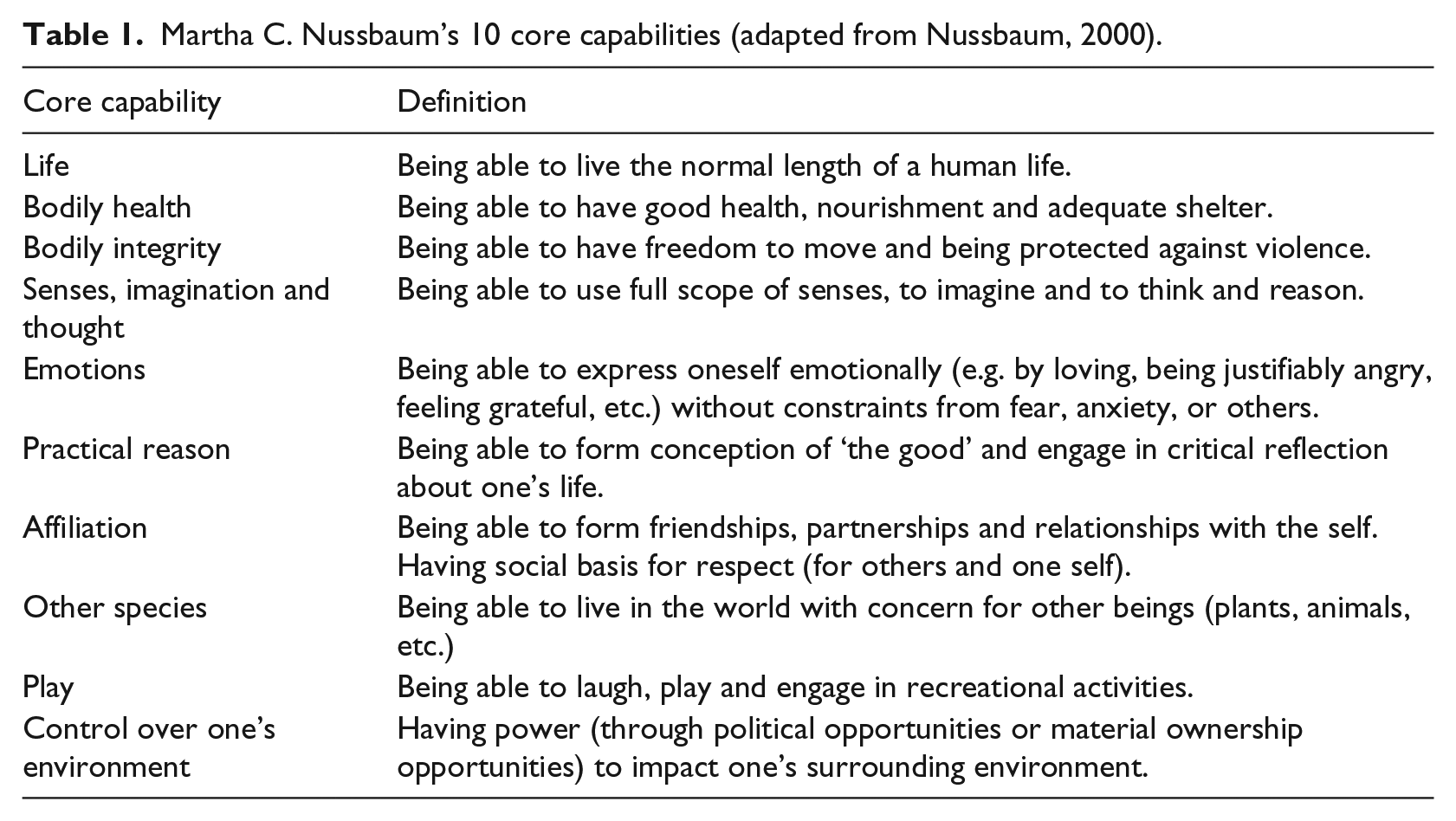
Responding to this issue, requires us to illustrate where the moral thrust of children’s rights emerges from and whether the clearest approach aligns with the Capability Approach (CA) to justice (as defined by Nussbaum (Nussbaum, 2006) and Venkatapuram (Venkatapuram, 2007)) to allow for an additional layer of rigor to be added to our analysis. CA asserts ‘supporting [. . .] the capabilities of individuals to conceive, pursue, and revise their life plans’ to a minimum threshold (Venkatapuram, 2007: 90). While Nussbaum’s account of CA is distinguished by ten ‘core capabilities’ (see Table 1) that she claims apply to all citizens (Nussbaum, 2000), she also claims that CA is considered a ‘partial theory of justice’. This means that it does not provide a comprehensive list of the requirements of justice, but rather relies on a minimum threshold (Venkatapuram, 2007: 90) – in this case, the minimum threshold to reach a sufficient level of dignity (Nussbaum, 2006).
Martha C. Nussbaum’s 10 core capabilities (adapted from Nussbaum, 2000).
The CA has also been extended to children by various scholars (Ballet et al., 2011; Biggeri et al., 2010; Dixon and Nussbaum, 2012; Domínguez-Serrano et al., 2019; Hart et al., 2014; Hart and Brando, 2018; Schweiger and Graf, 2015). While some proponents have argued that answering questions about children’s entitlements is necessarily connected to the CA, as young people are entitled to the achievement of important ‘functionings’ that eventually become ‘capabilities’ (Schweiger and Graf, 2015), others have argued that children are rational agents and, as a result, likely have similar capabilities to adults that ought to be determined through deliberation with young people and ought to be met to a sufficient degree (Hart and Brando, 2018). And yet others have challenged the applicability of the CA to young people based on the assumption that these individuals wholly lack sufficient cognitive frameworks that allow for freedoms and, as a result, they have no right to have their assumed freedoms (i.e. capabilities) taken seriously. Based on the advances in childhood and childhood ethics that are foundational to our work (Carnevale et al., 2020), we believe that this tendency to overlook the heterogeneity of childhood and the wide variety of capabilities that young people have – ranging from having preferences without being able to effectively express those preferences to having similar rational processes as adults–is a harmful position that has been driven by dominant societal paradigms and remains ignorant of evidence indicating that young people can have differing degrees of agential capacities (Bluebond-Langner, 1980; Dedding et al., 2015; Montreuil and Carnevale, 2016; Mortlock, 1987). As others have said, ‘when thinking about children, we should not be talking about static capabilities, but dynamic capabilities captured by the notion of evolving capabilities’ (Ballet et al., 2011: 34).
As such, the connection between CA and children’s rights is clear, as capabilities have been positioned as a means to ‘a clarification that enhances the connection between human rights [and children’s rights] and human dignity’ as dignity is inherent to the ten capabilities (Franchini, 2013). Capabilities are granted the status of being affiliated with a basic human right following global deliberation (Venkatapuram, 2016), and this is true when we examine the ways in which the rights within the CRC were determined. As such, just action requires the actualization of children’s rights, as these rights allow the capacities of young people to be safeguarded and, by extension, the dignity of young people to be secured. As others have stated, ‘the capability approach is used to inspire us on dimensions to look at when it comes to implementing formals rights as the ones contained in the [CRC]. It attracts our attention to the fact that there is a gap between children’s formal liberties (rights) and their real freedom (capability)’ (Bonvin and Stoecklin, 2014: 1). Even in the context of a pandemic, these basic tenets of human life deserve proportional protection and ought only to be overridden if sufficient justification is provided (Thompson et al., 2006). In a context where various rights of children are not being upheld or prioritized in the face of mandatory choices about resource allocation, young people’s capabilities and dignity are also not protected. As a result, this pandemic has exposed the significant injustices that young people are forced to confront, especially in resource-limited contexts.
Recommendation and conclusion
Based on the harms young people face, various calls to action exist for core stakeholders and decision-makers (governments, NGOs, policymakers and parents) in light of this pandemic, including:
Investing sufficient resources, personnel and economic supports to secure the well-being of young people, their families, and institutions that assist them;
Generate opportunities for young people and their families, especially those from less privileged positions, to be more actively involved in providing policy-related feedback to ensure pandemic policies are young person-centred;
Promote scholarly advancement related to the field of ‘global’ pandemic child ethics, which has had insufficient attention when compared to the more individualized concerns of young people (e.g. autonomy concerns or paternalism concerns) or the concerns of young people in resource-rich countries;
Develop educational resources and strategies that are informed by the actual identified needs of young people and their families from diverse socioeconomic positions in resource-limited countries;
Work with professionals in the field of mental health to establish evidence-informed and affordable solutions to provide relief for the psychosocial and behavioural impacts that young people have experienced, especially related to ways to mitigate risk of violence and mental destress during times of social isolation and confinement; and
Learn from compassionate community models to develop more robust community health frameworks that support the collectivist values and needs of families in these countries, even in times of a pandemic.
Though pandemic responses have adopted a protective tone and are not intended to be perfect solutions, employing a child rights and justice-based lens illustrates the ways in which young people have been treated impermissibly during the COVID-19 pandemic. Aligned with what other scholars have said, the right to health and well-being is ‘related to and dependent on the realization of other rights’ (Raman et al., 2020). Importantly, though, rights, including those outlined in the CRC, are only one vehicle for driving ‘social transformation’ (Hunt, 1990) and our intention in this paper was to utilize a child rights and justice frame to examine how young people have been ethically harmed in resource-limited countries during the COVID-19 pandemic and reflect on next steps that comprise a broader strategy aiming to mitigate those harms. As such, our role as child ethics scholars is to advance the dignity of young people and to build a stronger ‘transformative strategy’ for children, while calling for stakeholder action that is aligned with this vision too.
Footnotes
Declaration of conflicting interests
The author(s) declared no potential conflicts of interest with respect to the research, authorship, and/or publication of this article.
Funding
The author(s) received no financial support for the research, authorship, and/or publication of this article.
