




Abstract
Previous research demonstrates that ADHD is considered a risk factor for COVID-19. The current study attempts to investigate the relationships between infection, mortality and recovery rates from coronavirus and the prevalence of ADHD at the US statewide level. Based on information from 2011 regarding the prevalence of ADHD across the US by state, findings suggest that, while there are no correlations between ADHD and population size, infection and mortality rates from coronavirus, recovery rates (recovery-population ratio) rise with the prevalence of ADHD. Consequently, a possible explanation is that in coping with the disease, ADHD might provide an evolutionary advantage. An example of this phenomenon can be found in the gene that causes sickle-cell disease, which, as a non-dominant gene, helps cope with infection from malaria. If corroborated, research findings may support the conclusion that coronavirus limitations in special educational frameworks for ADHD would not be required or could be relaxed.
JEL Codes: H75, I12
Introduction
Attention-Deficit / Hyperactivity Disorder (ADHD) is considered one the most common neurodevelopmental disorders of childhood, often extending into adulthood. Children with ADHD typically have trouble paying attention, controlling impulsive behavior, acting without fully considering expected results, or exhibit over-active behavior (Center for Disease Control and Prevention (CDC), available at: https://www.cdc.gov/ncbddd/adhd/facts.html).
Following the COVID-19 pandemic, the recent emerging research views ADHD solely as an additional risk factor for COVID-19. This is explained by the difficulties of those with ADHD to comply fully with recommendations to prevent infection from the virus (Merzon et al., 2020). Yet, one possibility that was not considered is the presence of an evolutionary advantage that ADHD might provide, similar to the natural immunity that sickle-cell disease provides from infection from malaria. 1 This approach stresses the theory that hemoglobinopathies protect from severe life-threatening manifestation of malaria and view one of the most important examples as: “the mutation that causes sickle cell disease (SCD) which leads to a 90% risk reduction of severe Plasmodium falciparum malaria in sub-Saharan African children”. (p. 2—background section). In that context, some of the ADHD literature indicates an evolutionary advantage to ADHD, such as: creativity, high energy levels and preference to risk. Referring to these advantages, Shelley-Tremblay and Rosén (1996) mention that: “This is a dramatic departure from viewing ADHD only as a set of behaviors that are disruptive to academic, social and career sucsess” (pp. 443–444).
Following Arbel et al. (2020), we test the correlation between infection, mortality and recovery from coronavirus (divided by the total population)—based on information from August 11, 2020; and prevalence of ADHD in 2011 at a US statewide-level. Findings suggest that, while contrary to previous studies, there are no correlations between ADHD and population size, and infection and mortality rates from coronavirus, recovery rates (recovery-population ratio) rise with the prevalence of ADHD. These outcomes support the theory that ADHD may promote evolutionary advantages, which provide assistance in recovery.
Methodology
Consider the following two competing fractional probit models (e.g., Johnston & DiNardo, 1997, pp. 424–426; Papke & Wooldridge, 1996; Wooldridge, 2010):


where j=1,2,3;
Results
Figure 1 describes the projected probability of recovery vs. the prevalence of ADHD in 2011 based on the regression outcomes reported in column (4) of Table 1, the only column that yields a significant coefficient (p = .0391). Due to missing observations regarding recovery cases from coronavirus, 34 US states are included. The X = ADHD2011 variable (the horizontal axis) runs between the minimum (approx. 0.03 of the state’s population) and the maximum (approx. 0.13 of the state’s population).
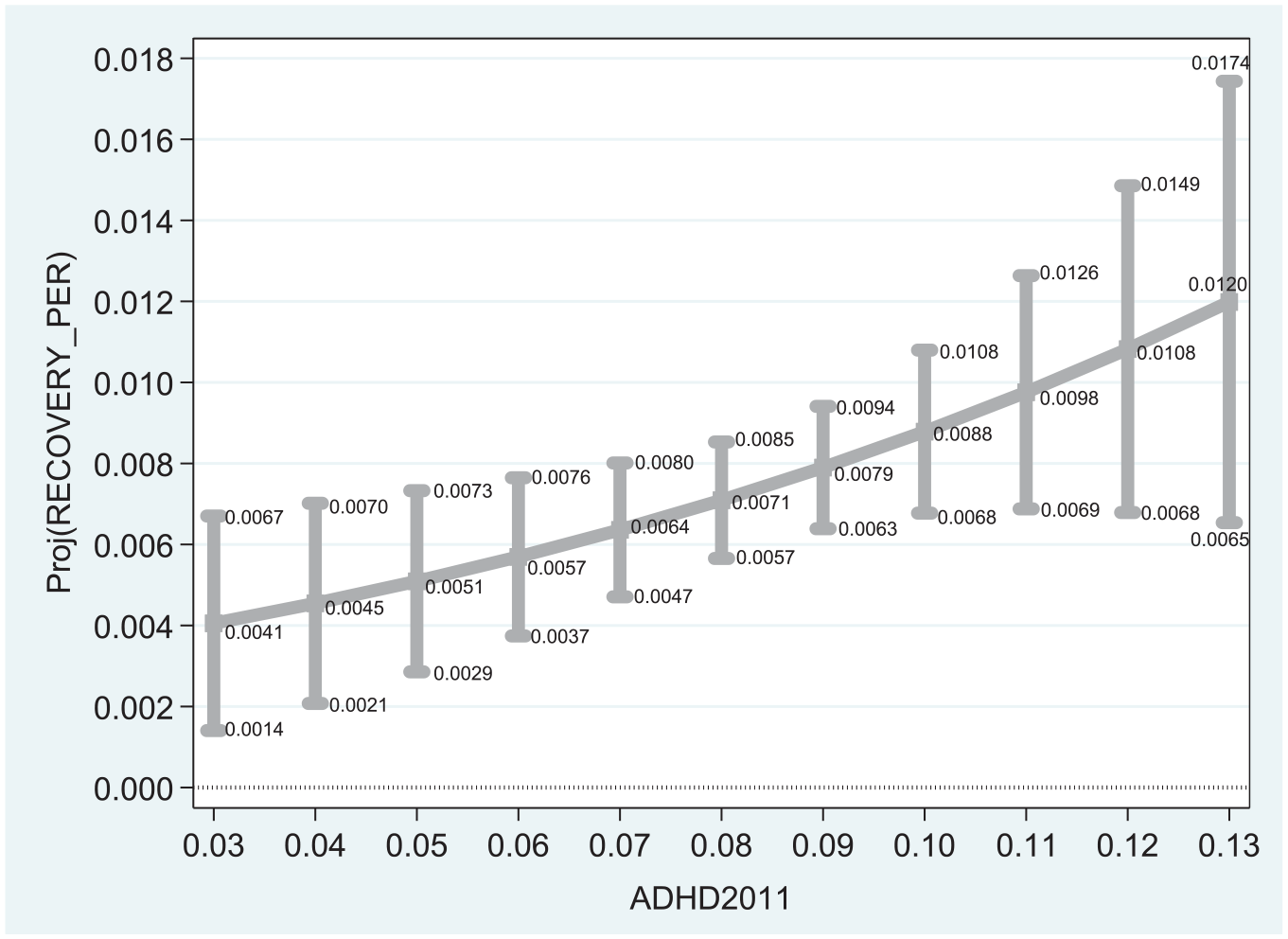
Projected recovery rates versus prevalence of ADHD in 2011.
Relationship between Coronavirus Indicators and Prevalence of ADHD.
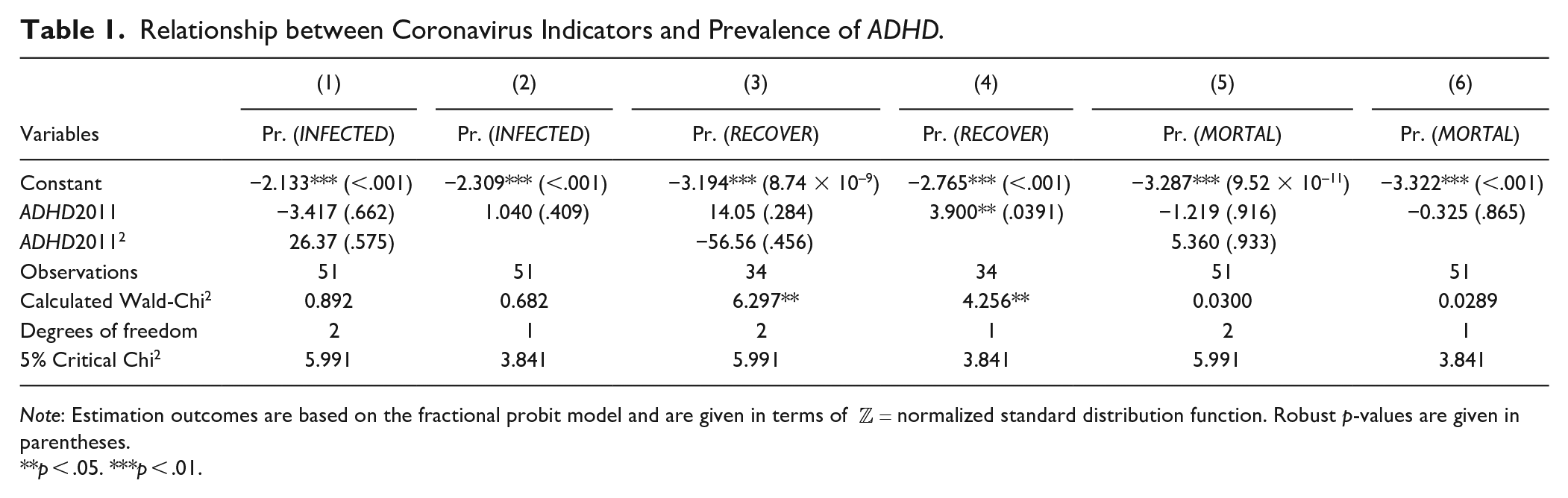
Note: Estimation outcomes are based on the fractional probit model and are given in terms of
p < .05. ***p < .01.
Findings demonstrate that the projected probability of recovery rises from 0.41% for states with the minimum prevalence of ADHD (3%) to 1.20% for states with the maximum prevalence of ADHD (13%). Referring to Table 1, and in contrast to the conventional classification of ADHD as a coronavirus risk factor (e.g., Merzon et al., 2020), no correlation was found between elevated prevalence of ADHD and infection or mortality from coronavirus with respect to the population size of the state.
Finally, we test the possibility that these outcomes are not spurious and may be simply attributed to potential positive relationships between each of the two variables per se and the population size in the state. 2 To rule out this possiblity, we provide a Pearson correlation matrix in Table 2 and test the possibility to reject the null hypothesis of zero correlation for each pair of variables. Findings support the possibility of zero correlations between ADHD2011 and POPULATION (p = .4688) and RECOVER and POPULATION (p = .356). Moreover, despite the high Pearson correlations between coronavirus indicators, ADHD2011 is found to be correlated only with RECOVER (p = .029).
Pearson Correlation Matrix.
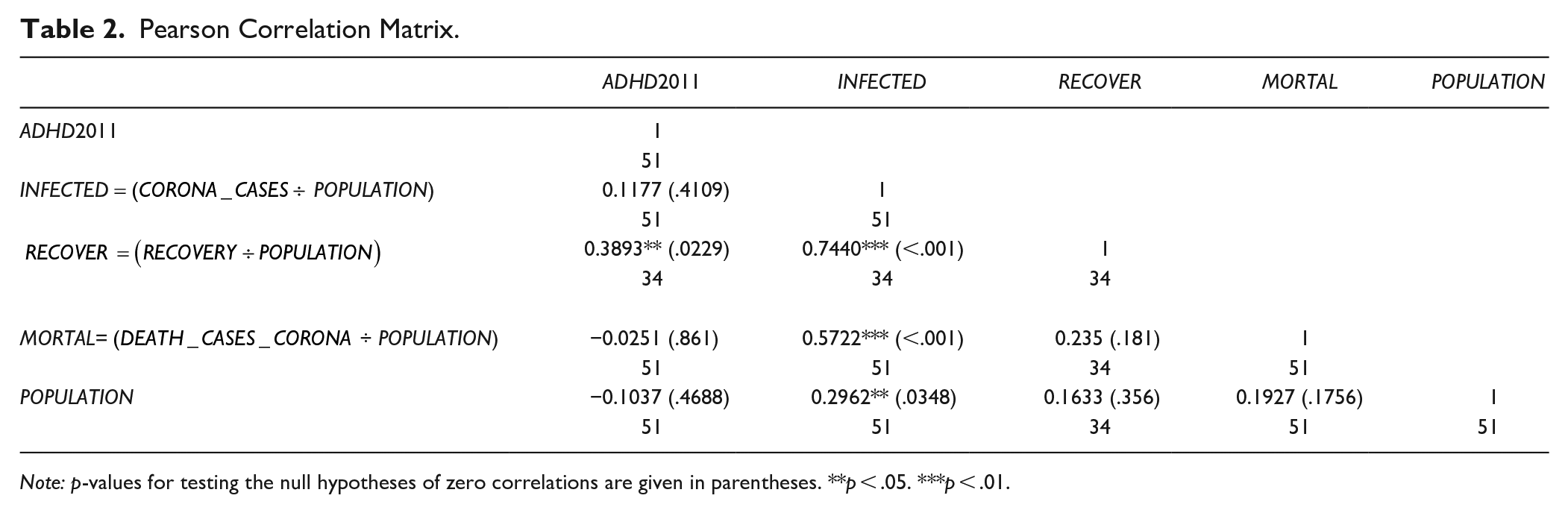
Note: p-values for testing the null hypotheses of zero correlations are given in parentheses. **p < .05. ***p < .01.
Summary and Conclusions
Coronavirus disease 2019 (COVID-19) is a declared global pandemic with multiple risk factors (WHO report: coronavirus). Referring to the relationship between ADHD and COVID-19 pandemic, and based on the assumption ADHD limits the ability to comply with COVID-19 prevention recommendations (Merzon et al., 2020), the convential wisdom among researchers is that ADHD poses an additional risk factor for COVID-19.
The current study suggests an intriguing possibility. Rather than being a risk factor, when coping with coronavirus, ADHD also provides evolutionary advantages. This possibility was previously proposed both in the ADHD literature (e.g., Shelley-Tremblay and Rosén (1996) suggest that ADHD promotes creativity, high energy and willingness to take risks) as well as in a different context—the same gene that causes sickle cell anemia—also provides a natural vaccination against the Plasmodium parasite causing malaria (Eleonore et al., 2020).
Following Arbel et al. (2020), the objective of the current study is to test the correlation between infection, mortality and recovery from coronavirus (divided by the total population)—based on information from August 11, 2020; and prevalence of ADHD in 2011 in the US at the statewide-level. Findings suggest that, while contrary to previous studies, there are no correlations between ADHD and population size, and infection and mortality rates from coronavirus, recovery rates (recovery-population ratio) rise with the prevalence of ADHD. These outcomes support the theory that ADHD may promote evolutionary advantages, which are of assistance in promoting recovery.
Our findings may be of assistance in dealing with coronavirus by public health systems. If corroborated, research findings might lead to the conclusion that coronavirus limitations in special educational frameworks for ADHD might not be required or could be reduced.
Footnotes
Acknowledgements
The authors are grateful to Yifat Arbel for helpful comments.
Declaration of Conflicting Interests
The author(s) declared no potential conflicts of interest with respect to the research, authorship, and/or publication of this article.
Funding
The author(s) received no financial support for the research, authorship, and/or publication of this article.
