




Abstract
This article is based on a school experiment of three local makerspaces that connected and turned into a global makerspace online. The three municipal schools were from Australia, United Kingdom and Denmark and participated in the Global Makerspace project, which was a part of the European Union project Makerspaces in the early years: Enhancing digital literacy and creativity. The Global Makerspace project was conducted over 4 days in the Autumn 2018. The schools’ participating teachers and pupils belonged to the first years of primary level. In this article, the Danish experiences from the project are explored. The data collection analysed draws on a micro-ethnographic study of the experiences from the Danish makerspace completed by the Danish facilitator from the project Makerspaces in the early years: Enhancing digital literacy and creativity. The article identifies the teachers’ and pupils’ maker activities out from a play cultural point of view and reckon making as connecting to describe how offline maker communities connected into one online maker community. The baseline of the school experiment was to explore and stress the potential of how communities like teachers and pupils across time and space in collaboration can transform and develop play cultures with different combinations of technologies by sharing local maker activities into global activities online.
The Global Makerspace project outlined
The focal point of the Global Makerspace project was to connect three makerspaces with each other on a digital platform: a Google+ group, where persons and groups can share images, videos and text and comment on each other and organise discussions on topics. This software has been replaced, but other kinds of software can today be found to have a similar structure. Throughout constructing, sharing and transforming different physical and virtual materials with both analogue and digital tools, and posting these processes on the digital platform, a cyclic web of similarities and differences of the makerspaces’ individual play cultures emerged. Hereby, the project highlighted how different makerspaces over time could be connected, share and transform ideas of and with each other. The overall main finding is that these three makerspaces began to develop a culture and communication around play, which constituted a global makerspace manifested on the Google+ group.
The research methods were based upon action research and consisted both of making observations, taking images and planning and conducting actual pedagogical processes in an interchange between research and action (Dick, 2007; Townsend, 2013). The author was anchored in the processes as a constructivist grounded researcher, where theory is built and understood as a construction made through the researcher’s associations to the data (Charmaz, 2016). That has also the purpose to understand and interpret the meanings that connect the participants with their locations (Gulløv and Højlund, 2006). Cameras were used by both the author and the children as a reflective practice by the researcher (Pink, 2013). A part of this was to build up an extensive field diary consisting of handwritten observations and images as the basis for the further analysis of the observations. The handwritten observations were transcribed and images were stored into a digital version of a field diary, which enabled an ongoing reflective and dynamic documentation process (Pedersen, 2018).
One school in Aarhus, Denmark, one in Melbourne, Australia, and finally, one school in Sheffield, United Kingdom, were part of the project. The pupils were all in pre-school. Approximately 70 children were involved. For 1 week, there were posting and exchanges between the schools that constituted the maker activities both online and offline. In Denmark, the preparations started in the weeks before, where the teachers tried to make posts on the Google+ group. A theme was also decided, as the Danish school at that time already was teaching on planets and the universe. The theme was considered so open in content that many different narratives could be developed and many different spaceships and types of planets could be built. It would be possible to go in many directions from this starting point, and the intention was it would be easier for all three schools to inspire each other. The Danish perspective is demonstrated in this article, but elements of the experiences of the other two schools can be found elsewhere (Velicu et al., 2019) and briefly in Marsh et al. (2019).
The Next Practice Labs approach: towards a trans-glocal play culture
The Global Makerspace project strived to expand the notion of makerspaces and was inspired by the combined research and pedagogical approach named Next Practice Labs (Thestrup et al., 2015). Like makerspaces, the main activities of this very approach are based on children’s exploration and creation with both analogue and digital technologies. The approach stresses that makerspaces often become individual-driven and product-focused. Whereas, the Next Practice Labs approach focusses on collaboration and explorative processes, which are described as experimenting communities and open laboratories; in this approach, a space that might be a physical or virtual one, or a combination, is reckoned as an open laboratory in which collaborative and situated activities are conducted by an experimenting community. An experimenting community consists of a group of children and adults playing together by asking and investigating questions to and with all kinds of technologies. But the openness of the laboratory depends on how much the experimenting community incorporate digital communication, like connecting the laboratory with other laboratories or people around the world.
The digital communication outside the physical space of each laboratory is the very core of the open laboratory. It works as a mode of being open to the world (Sandvik, 2017; Sandvik and Thestrup, 2017; Thestrup, 2019). Based on the experiences from the Global Makerspace project, this description has been further expanded into what might be formulated as the beginning of a trans-glocal play culture (Thestrup and Pedersen, 2020). The term is based on the idea of glocalisation, where the local and the global are two simultaneous existing forces (Robertson, 1992) and where social change can be understood in a similar way (Hemer and Tufte, 2005). The local is influenced by the global, but also makes its own version of the global, but the process can also go the other way through local forces being more active on the Internet and through this, in principle, influence the global forces. The local makerspaces connect and influence each other through playing in a global makerspace. This process can be a process of transformation, where expressions are being changed in the encounter and for that reason, the expanding of the term into trans-glocal. To talk about this, a number of examples below will be visualised and described.
The makerspaces in Australia, United Kingdom and Denmark
In the Global Makerspace project, temporary makerspaces were established locally at the schools. Based either in a classroom, common room or creative workshop the different makerspaces were connected onto the common Google+ group online. Supported by teachers and researchers, the pupils exchanged their local play cultures of their maker activities by using various analogue and digital technologies.
Every makerspace had different types of materials and technologies available. The common theme was the Universe, which the pupils created from their intuitive knowledge and explored together with researchers and teachers. This was done in different ways in the three participating countries.
United Kingdom: connecting via virtual reality and tablets making universes for spaceships
In United Kingdom, researchers, teachers and pupils used tablets and virtual reality (VR) equipment to draw digital universes, whereas they blended analogue materials with digital ones. They would take a photograph of an analogue material and expand this creation by drawing in the VR. For instance, they worked with clay and silver paper and other analogue materials to create spaceships. Afterwards, these spaceships were scanned into a software for the VR, in which the pupils drew spaces to and then shared onto the Google+ group. Otherwise, they would draw on different software on tablets. They worked in a creative workshop with a smart board in the very same room. The smartboard was turned onto the Google+ group, so one could follow the movements on the group and use it for inspiration to their own creations, which they could choose to share again.
Australia: connecting via tablets making cardboard universes
In Australia, the researchers, teachers and pupils built small universes from cardboard boxes, where low-tech electronics as chain of lights were used. High-tech devices as tablets were used to draw in different software and share their creations on the Google+ group. The maker activities would shift between a classroom and a larger common room. The classroom had a smart board that was used to follow the Google+ group. Otherwise, tablets were used to write comments and questions on the platform, take photographs or make drawings on a software, then selected and shared on the digital platform.
Denmark: connecting via cameras and computers making recycle-based spaceships and paper-based universes
In Denmark, the makerspace took place in the school’s common room; a large room with two walls mostly covered with great windows from floor to ceiling. The digital technologies consisted of digital cameras, computers and projectors. One of the main activities was large paper rolls placed and taped onto the floor, and transparent A4 paper was hang up on the windows, so the children could draw their own universe on the floor and walls. Another activity was creating objects to their paper-made universe, such as spaceships, that were made out of recycled materials brought from the pupils’ home. This material consisted of non-working technologies like mobile phones and computer components. Projectors were used to introduce the Google+ group and afterwards used as a motivator, a source of motivation and a medium for sharing and communicating the researchers’, teachers’ and pupils’ curiosity and ideas with the two other makerspaces. Projectors would be in the classrooms and also in the common room and logged-on the group, while the pupils were creating objects or taking images of their objects and sharing it on the computer, so they could see it shown on the platform and watch for comments or posts from the other makerspaces.
Connecting play cultures across local makerspaces
Maker communities often describe a makerspace as a playground and activities of making as play (Davies, 2017). Activities of making can take place in facilities termed makerspaces that are socially constituted in a physical or a digital space. In a makerspace, one can develop and experiment with ideas, create and share personal or common projects in a community (Peppler et al., 2016). A digital space works like a playground as well, where play consists in the socialisation of connections that are mediated within the digital platform; also termed connected play (Kafai and Fields, 2013). The online environments offer digital spaces for maker culture and making to produce creativity in social networks (Rafalow, 2016). Connecting in an online community can be understood as making in itself, whereas the digital space is working as a platform of creativity. An online community is connecting through making; such as sharing a common interest one expresses by posting ideas and creations with each other (Gauntlett, 2018). The online part is a way to connect cultures of creativity (Gauntlett and Thomsen, 2013).
Cultural transformation in local and global play communities
It seems that the notion of connecting can be synonymous for making when talking child culture and play with digital technologies. One can emphasise that play works as connecting in itself; play can be a key card to connect cultures of play on the same digital platform, whereby children can express and exchange similarities and differences of their individual and common understandings of play cultures. The communication process facilitates what can be termed as transformation that is characterised by a varying change of one cultural expression into another cultural expression, such as transforming a common play culture (Thestrup, 2019).
In relation to the connection of local play cultures in online communities, the Danish researcher in child culture and play, Flemming Mouritsen (2002) from the Southern University of Denmark, highlights the cultural aspect in play: Play culture is at once completely local and extremely global. Children play everywhere; it is a characteristic a human form of expression; and they play differently everywhere. [. . .] Through the medium of play culture even the three-year old in the local kindergarten is in contact with the wide world. At the same time the three-year old is entirely local and tied to the situation and the local tradition. (pp. 25–26)
Play culture is local, but when connected to the Internet, it also becomes global. The Internet offers the opportunity for exchanging and transforming various local play cultures into a connected play culture online. This can also be termed as trans-glocal play culture, where children works and forms global, local and transformative contexts in-between physical and virtual locations as in makerspaces. This is understood to be manifested in a makerspace’s offline practices and online practices becomes interconnected (Thestrup and Pedersen, 2020).
The play culture is not expressed in a fixed form or as a product but is manifested in situations that depend on the children’s participation, activity and acquisition of skills to produce play. ‘Play is thus not simply something children know. Many of these expressive forms and especially their staging may require years of daily practice. [. . .] Play is something one practices by taking part’, (Mouritsen, 2002: 23). To play, one needs practice to enable the required skills to participate in the play activity. This refers to the cultural knowledge within a play culture. Mouritsen terms this cultural knowledge a formula that requires practice before one can improvise. One has to learn to play by playing; then the play can be improvised and transformed differently; adding a rule or a rhythm and so on. A formula works as a material (can also be an immaterial form as a song) to inform a play with techniques and information, whereas the improvisation is a technique that transforms a formula like changing the lyrics in a song or changing the rhythm in a song. The formulas to be improvised upon can be derived from many sources, such as film, TV series, computer games, toys, cartoons, music and literature (Mouritsen, 2002). Content and form become raw material for playing and turns into formulas one can improvise upon.
Traditions such as certain rituals, norms and values within a play culture are usually orally transmitted from children to children; as Mouritsen (2002) describes, ‘Play culture is a medium which enables children to “cultivat”, themselves and their surroundings; they create form and patterns, they form material (language, body, motions, one another) aesthetically’ (p. 24). Play is a cultural form of expression and communication with others; one shares and gains knowledge of certain ways to participate in a play activity. A play culture has ways to incorporate media like digital tools; they are internalised into the special forum of play and are used by the children to express themselves and relate to each other. Likewise, places are adopted into the play culture; children can through their production of play situations, transform spaces into special arenas (Mouritsen, 2002: 17).
Connecting the Danish makerspace to the global makerspace
In the Danish makerspace, two pre-school classes participated. On the first 2 days of the experiment, I presented the Google+ group to the pupils in one of the classes, while a teacher presented it in the second classroom. We would log onto the platform and show some of the posts to encourage the pupils to create something they could share as well on the platform. The purpose was to make a relation to why they were supposed to go into the common room and tape it with paper all over the surfaces – which they excitedly agreed to do.
Establishing the connection to the global makerspace
On the first day, I presented one class scattered in small groups of 10 pupils in 10 minutes to the Google+ group. Yet, the introduction turned out to be too soon; the pupils were more interested in taping the paper onto different surfaces in the common room than looking at the digital platform. On the second day, I tried to present the google+ group to a small group of 10 children in over 40 minutes, so we could investigate the platform and make some posts together; the pupils selected the photographs from the day before, taken by the pupils and myself, and they would tell me what to write on their own posts and also comments on the other makerspaces posts. I would ask them what they thought we should share with other pupils in Australia and United Kingdom, and what we could ask them based on the photos the children from these two countries had posted on the group. I would also read out loud if the pupils were curious about what was written in the posts and comments. I started the presentation by showing a post of a painting that the pupils from United Kingdom had made upon one of their paper drawings they had shared online the day before. At that moment, the Danish pupils became interested in what the other pupils did in their makerspaces. It motivated them to share their own work with the other pupils on the group.
It turned out the table-activity did not offer the ease for the pupils to interact in the selection of images before we could make a post together. First, we tried sitting at a table with the computer, but it turned out to work best to sit on the floor with the computer while the pupils were sitting or standing in a semicircle. In that way, the pupils could co-direct and follow the movements of my actions; we talked about what we could show to the other makerspaces of what we did in Denmark. Soon four posts were made with descriptions and questions from Denmark on the Google Group. But this activity only kept two pupils occupied, while the others went into the common room to create objects or take photographs. This stresses the difficulty of making a posting activity into a community-based production process.
The emerging interconnection of the local and global makerspace
After my presentation the second day, I tried to show posts from the group by using a projector, so the pupils could see their own posts, while they constructed spaceships and so on. Here, some pupils helped me in selecting what posts we should show on the canvas as inspiration. We chose a post from the United Kingdom, where the pupils had selected a photograph from Denmark with a spaceship on and painted different universes with the spaceship in VR (see Figure 3).
The playful post exchanges of turning local into global maker activities exemplified
On the third day, the presenting of the Google+ group took place in the common room by using the projector; the teachers showed what have been posted after they had been offline. Afterwards, I tried to explore how to use the projector showing the Google+ group in a playful manner together with the pupils, so they could experiment with the connection between the local and global space in the common room. Thus, my intention was that pupils be offered an opportunity to associate connections between what they created in their own common room with what they shared on the group.
The projector was connected to a computer in the room logged-on the Google+ group during the day. It evolved into a play with a computer and cameras. The pupils used the cameras and explored the activities in the common room by taking images and came back to me, when they wanted to select a photograph and create a post to share on the group. The pupils with cameras would go around the room, asking the other pupils if they could take a photograph of their construction. Together, the pupils would stage the constructions several times and taking different photographs of it. Then, the pupils with the cameras would return to me and try to insert the memory card from the camera to the computer, and together, we would look through the photographs, while some of the pupils joined, watched and commented on our activity of creating a post.
It was evident how the flexibility and mobility of the materials and tools had a significant meaning for the pupils to get a sense of sharing their ideas with other pupils far away. That is the reason why I chose to encourage the pupils to use cameras in the common room, so they could get a sense of experimenting with the connection itself: making something locally in the common room to sharing something globally on the group, and also chose to respond, if they received questions or comments from the other two makerspaces.
The case example below illustrates a number of aspects of the activities on the Global Makerspace group that was shared between all three makerspaces (Figure 1).
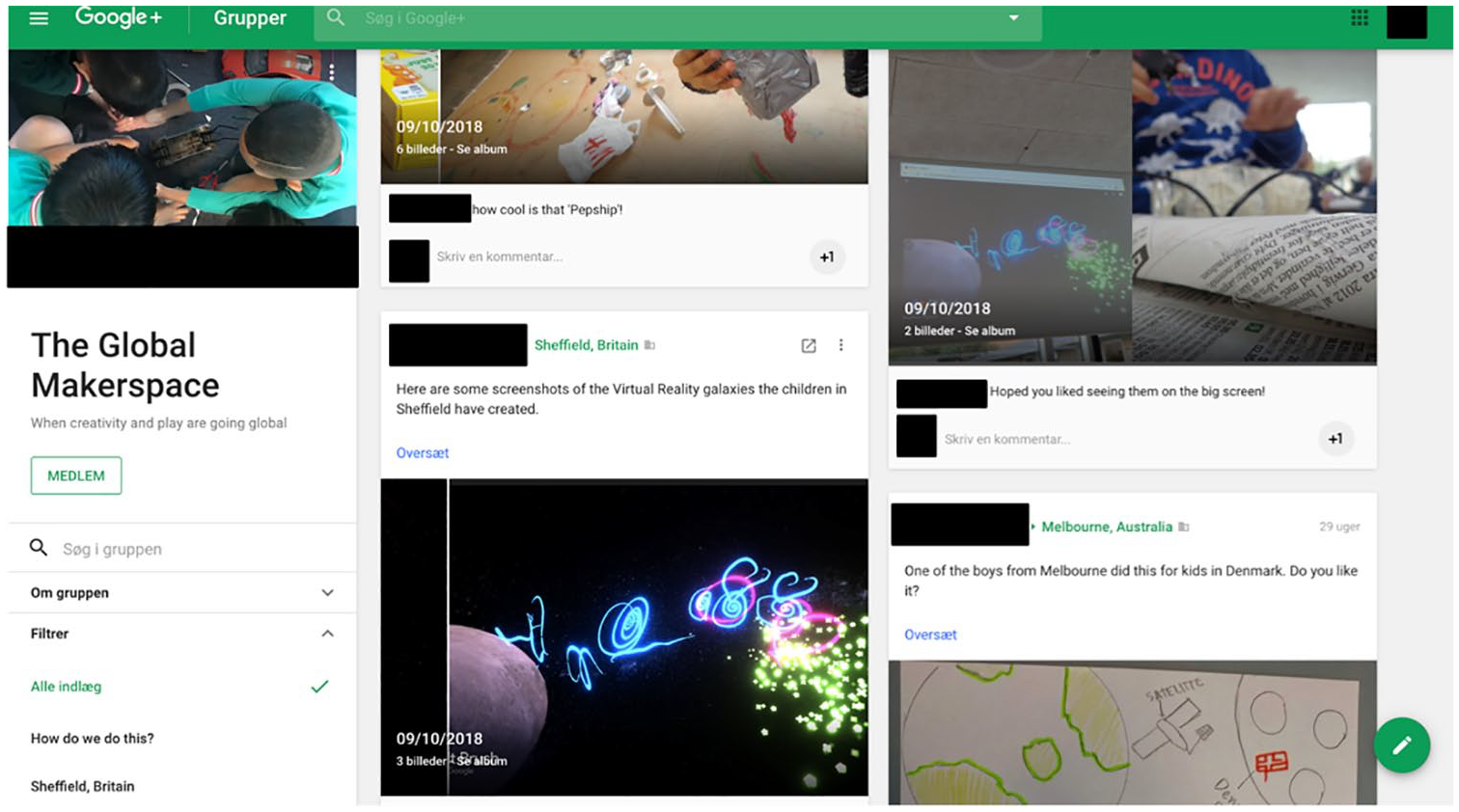
Extract from the GM platform.
The UK makerspace had posted a universe that had been drawn in VR; including three other drawings of universes also made in VR. The Danish makerspace has posted how this very UK post is shown in the common room in Denmark and use it as an inspirational source for the pupils’ creation processes, which is shown by the photograph of one gluing a spaceship together, next to the photo of the projector with the Google+ group shown. One could say that that the expressions presented by one group of people in one place in the world became formulas that were hard to copy by someone somewhere else. One simply had to improvise upon what was presented.
The next case example is the transformation of a Danish spaceship drawn on the transparent paper on the windows in the common room. A post with the images below has been shared to show the other makerspaces how the Danish pupils transformed the common room into a universe, and how they among other things drew spaceships on the paper-wrapped surfaces (Figure 2).
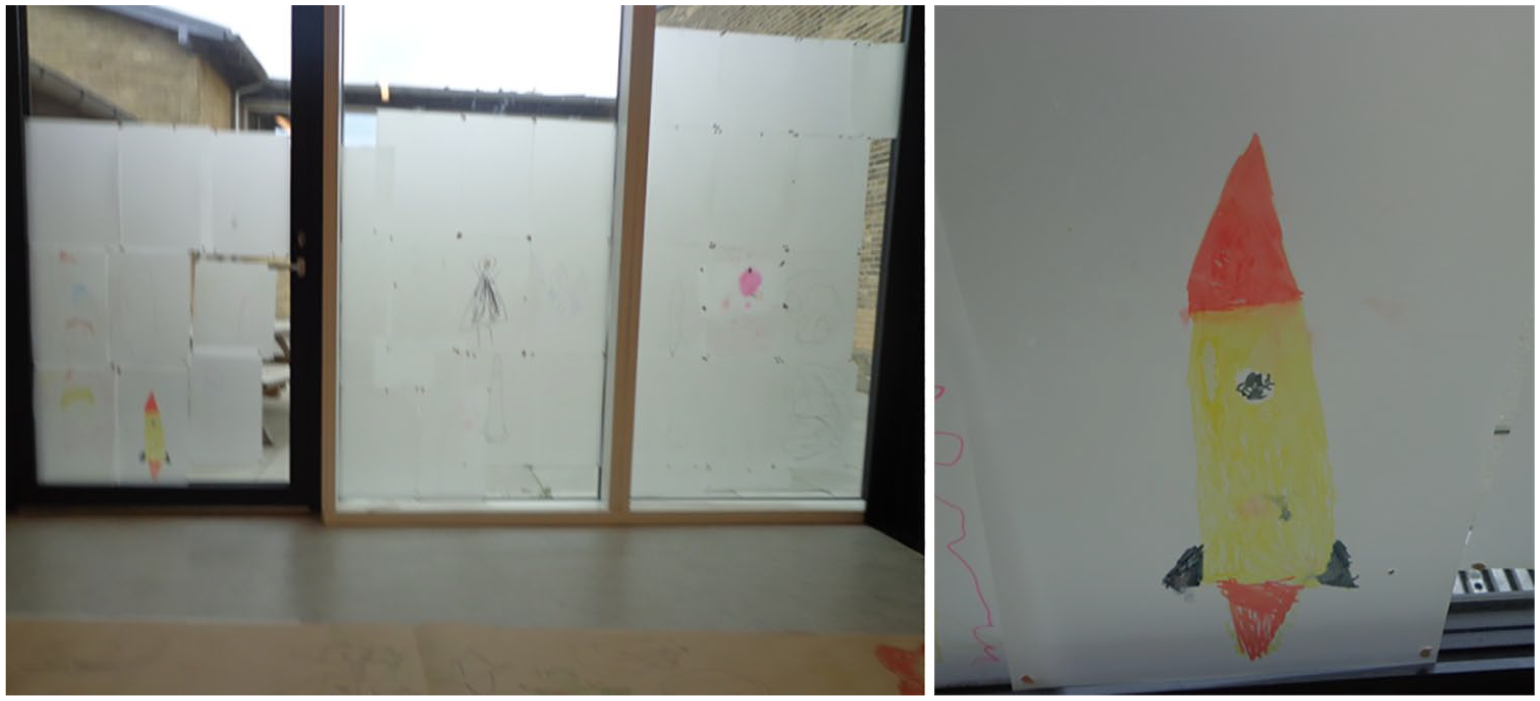
Two photos of the spaceship drawing that were posted on GM.
Afterwards, the UK makerspace posted a transformed version of the spaceship adopted into a VR universe. Pupils from the United Kingdom had selected the spaceship from the post and expanded the creation by adopting it into a VR version and added more to the drawing. The two analogues and digital universes had been blended into one universe. The two images below illustrate this transformation (Figures 3 and 4).
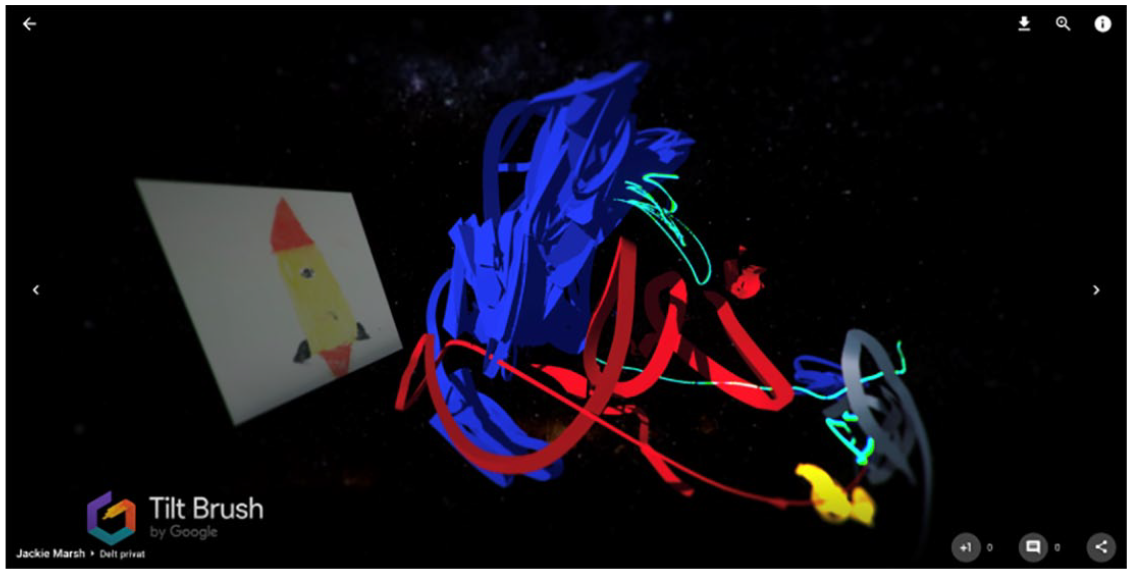
Spaceship 1 made by Danish pupils transformed in VR by UK pupils.
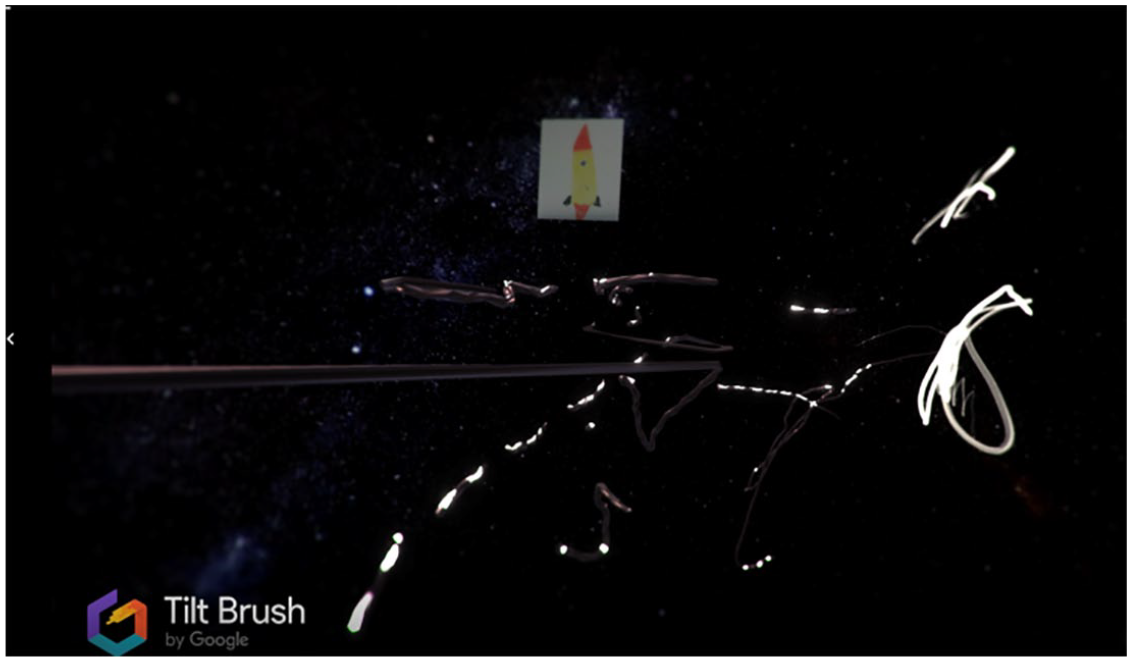
Spaceship 2 made by Danish pupils transformed in VR by UK pupils.
When these images were posted, the Danish pupils found it interesting to see that something from their own local makerspace was transformed by someone else and into something else.
This exchange demonstrates a playful strategy to connect the local and global makerspace by sharing posts of their creations and activities, when the UK pupils transformed and shared their adoption of the Denmark pupils’ posts and creations. In that way, the pupils explored and experimented with the idea of a local makerspace together with the global makerspace. The pupils could play and create with materials and then share it informed by their local play culture. The way the pupils could play with materials and tools reflected an experimentation of the local tools and materials, which was also manifested in the way the pupils participated in the playful activities within the online community and creation of digital materials as creating posts. In the Danish case, the tool available to create with was the digital camera for photographing their creations and the computer to make posts of their activities.
Another example is the transformation made between all three makerspaces. It started with a post from a Danish student from Aarhus University (Figure 5). A group of students from the master ICT-based Educational Design followed and supported the project with creative inputs as posts or comments on the group. This group represented a class affliated to a course led by Klaus Thestrup
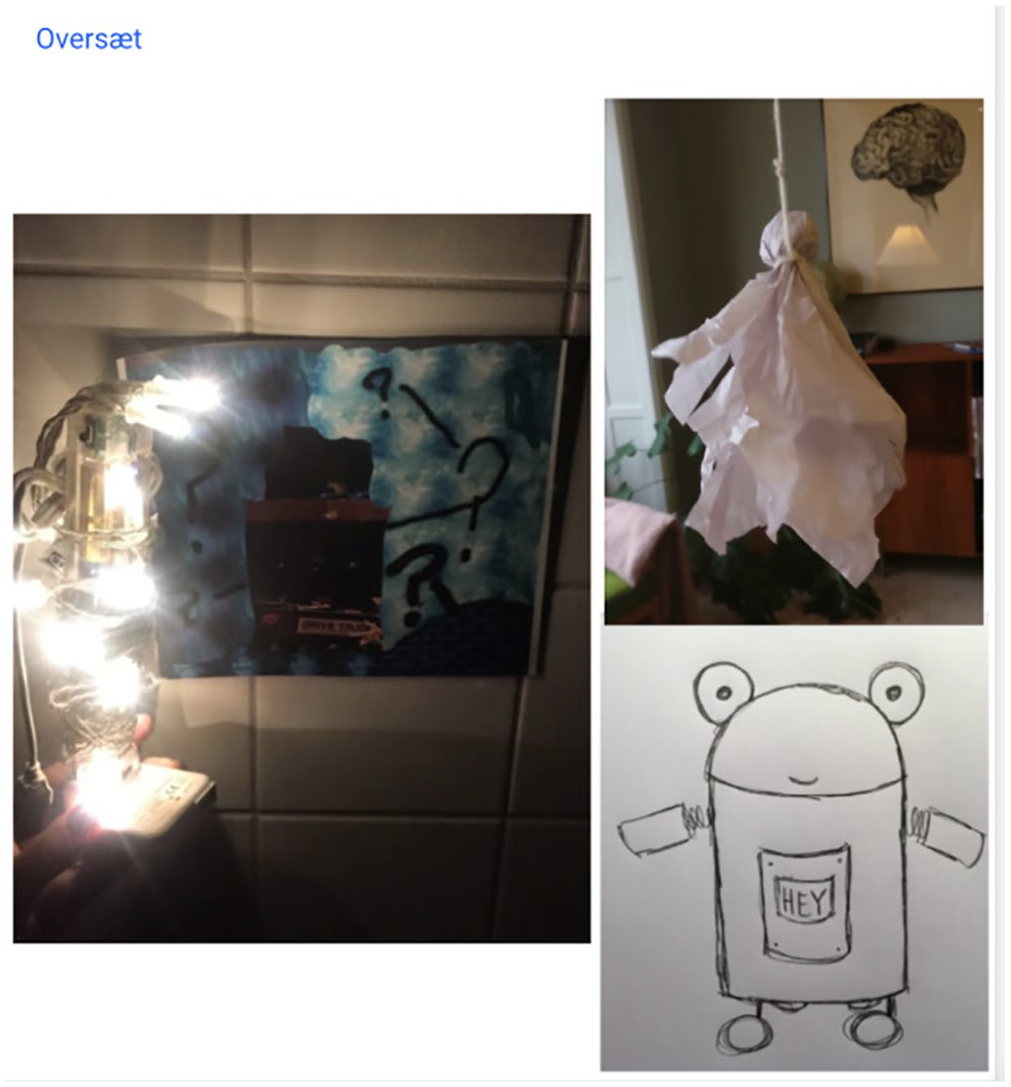
Post by Danish student from Aarhus University.
One of the Danish teachers decided to print the image of the drawn figure from the post. The teacher transforms this individual image into a bigger version and prints it, so the pupils were able to colour it and turn it into their own version. In that way, the pupils demonstrated how they transformed this image into a template to interpret the content and express their own ideas by using different combination of colours. Then, the picture below was shared on the group (Figure 6).
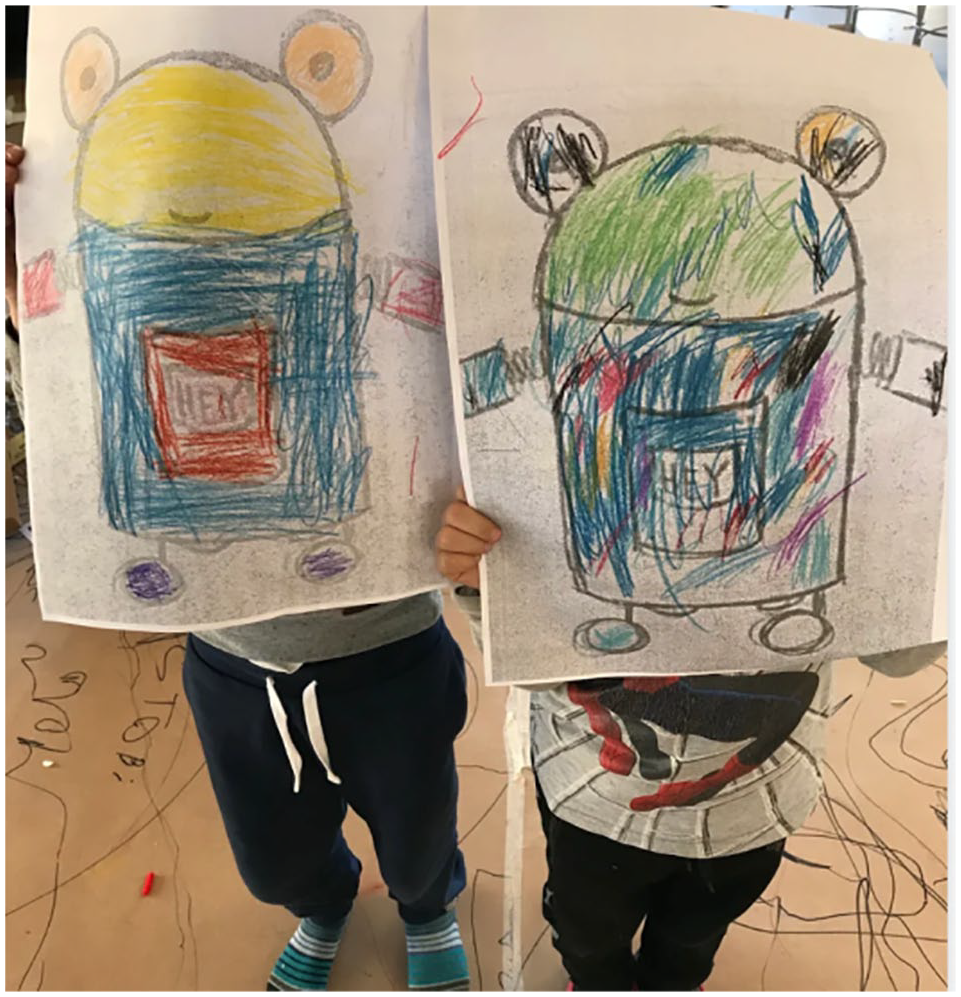
Transformed figure by Danish pupils.
This idea inspired the Australian pupils, who were curious about how the Danish pupils have been able to transform one post into physical drawing. Between the Danish pupils, this figure was understood as an alien, whereas the Australian pupils had another interpretation of the same figure which the next picture shows (Figure 7).
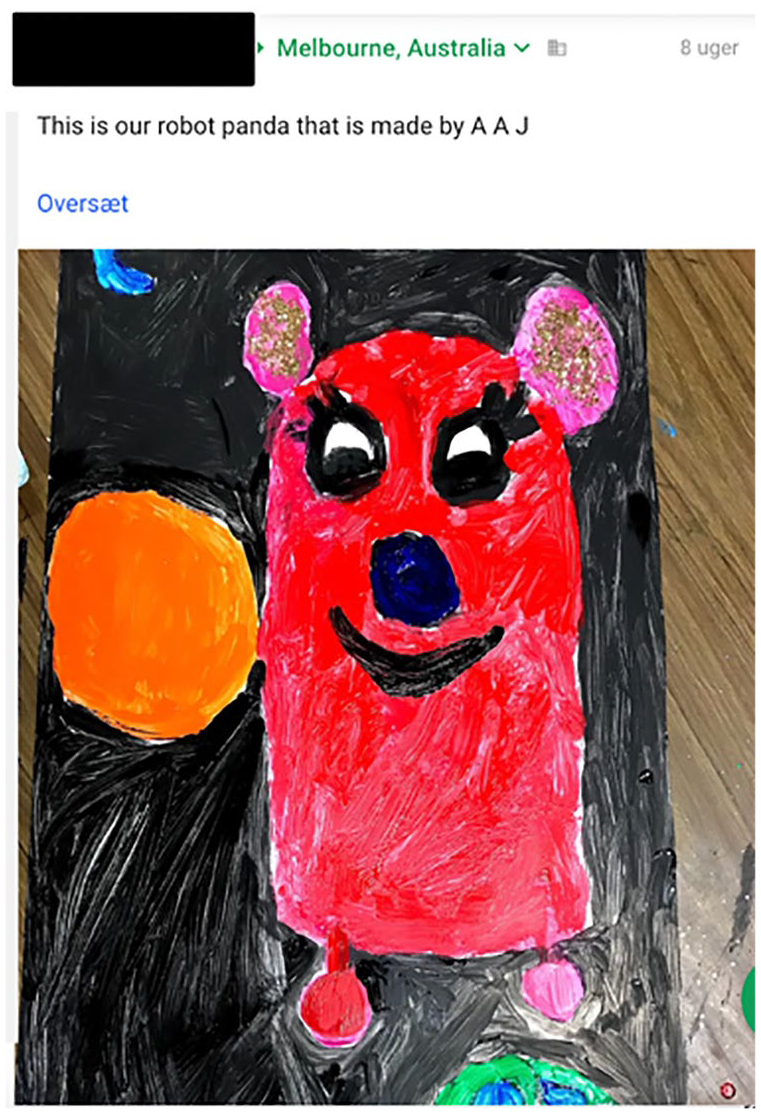
Transformed figure by Australian pupils.
The Australian pupils transformed the figure into ‘a robot panda’ as described in the post (Figure 8). The post also shows the Australian pupils transformed it with paint and not marker pens like in Denmark. Then, this transformation inspires the pupils in the United Kingdom, who also decided to create a robot.
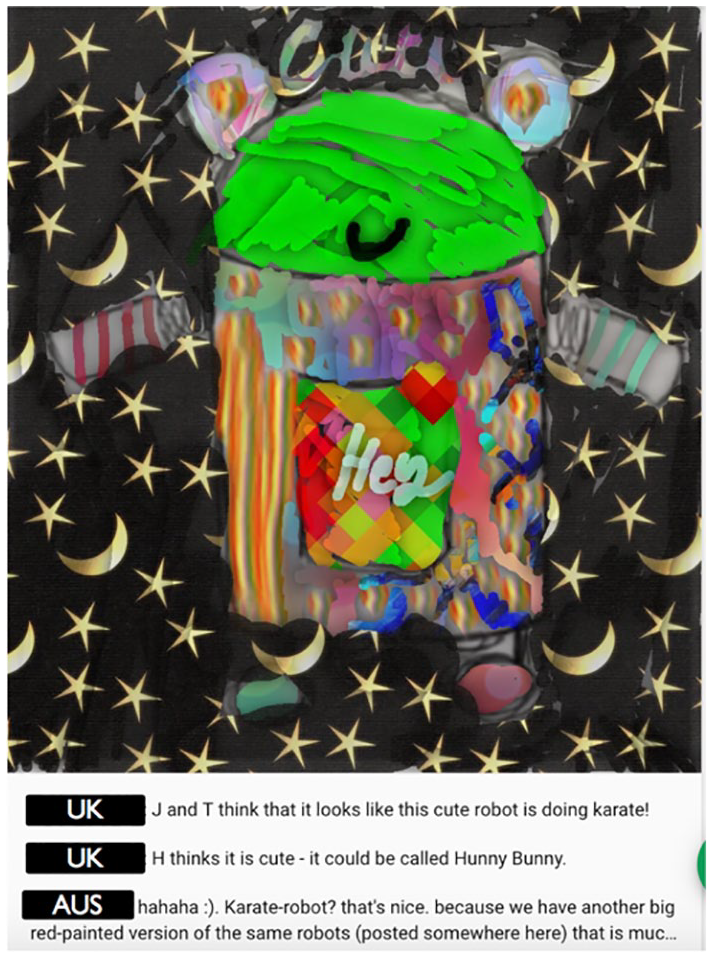
Transformed figure by UK pupils.
This time the figure has been transformed with a drawing software on a tablet and has been transformed with digital elements by a pupil. This activated a conversation between UK and Australian pupils; one comment about two pupils’ imagination about what the robot does and a third one suggests a name for it. The Australian makerspace answers that they also have made a robot based on the same figure.
These case examples from the project demonstrate how the connections between the local and global makerspace emerged. Despite different tools and maker activities in the three makerspaces, similarities also came to light. All of them had a tendency to transform digital and analogue materials via visual creations as images and drawings. Likewise, the post-activity about creating posts and the social aspect as commenting and sharing ideas seemed to influence the local activities, because the global makerspace appeared to work as a kind of storage of knowledge and content for play, which the pupils, teachers and researcher used to inform their individual local play communities.
The play strategies for local making to connect with a global maker community exemplified
During the week, most of the pupils sat in smaller groups and worked on individual constructions and would share ideas and tools with each other. Materials and tools were kept on the tables placed in the common room. The pupils would go and take some materials and return back to their group. In these small groups, all pupils sat on the paper. The case example shows a spaceship blended together with non-working technological devices and other recycle materials (Figure 9).
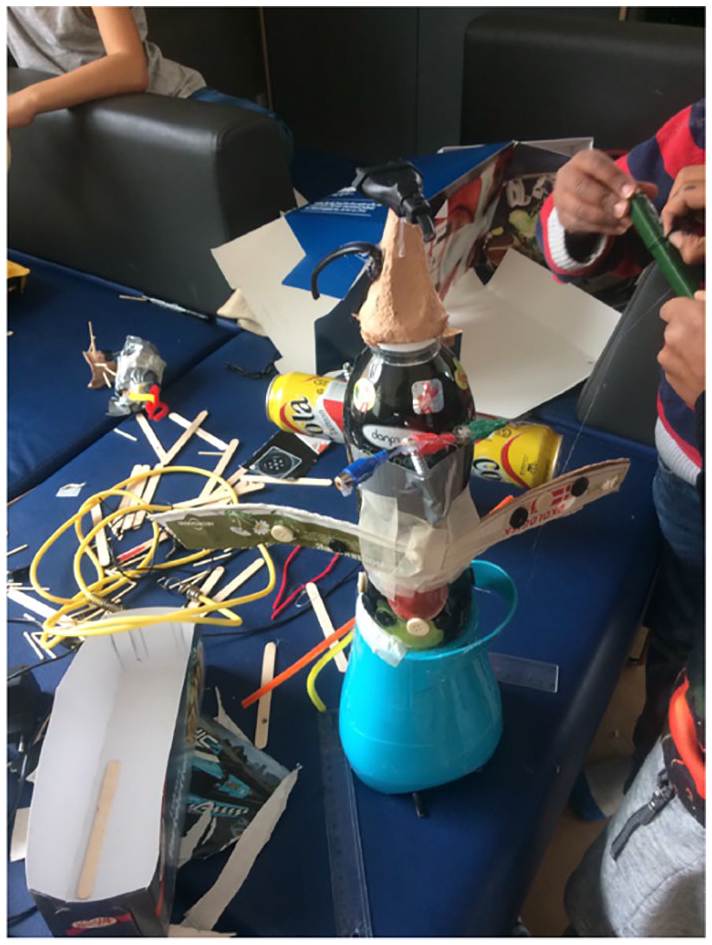
Spaceship.
The spaceship has been glued together. A group of pupils worked in this corner on their respective spaceship on all 4 days in the project. This corner constitutes an arena, where the pupils exchange materials and ideas from pupil to pupil to make their creations. This worked as a special arena, where the pupils expressed and practised their own local play culture. The image shows the materials are strewn all over a blue sofa, which works as a mobile creator workshop made by the pupils themselves. Materials have been moved from the tables to their own place, where the pupils could experiment and create on their own terms with peers (Figure 10).
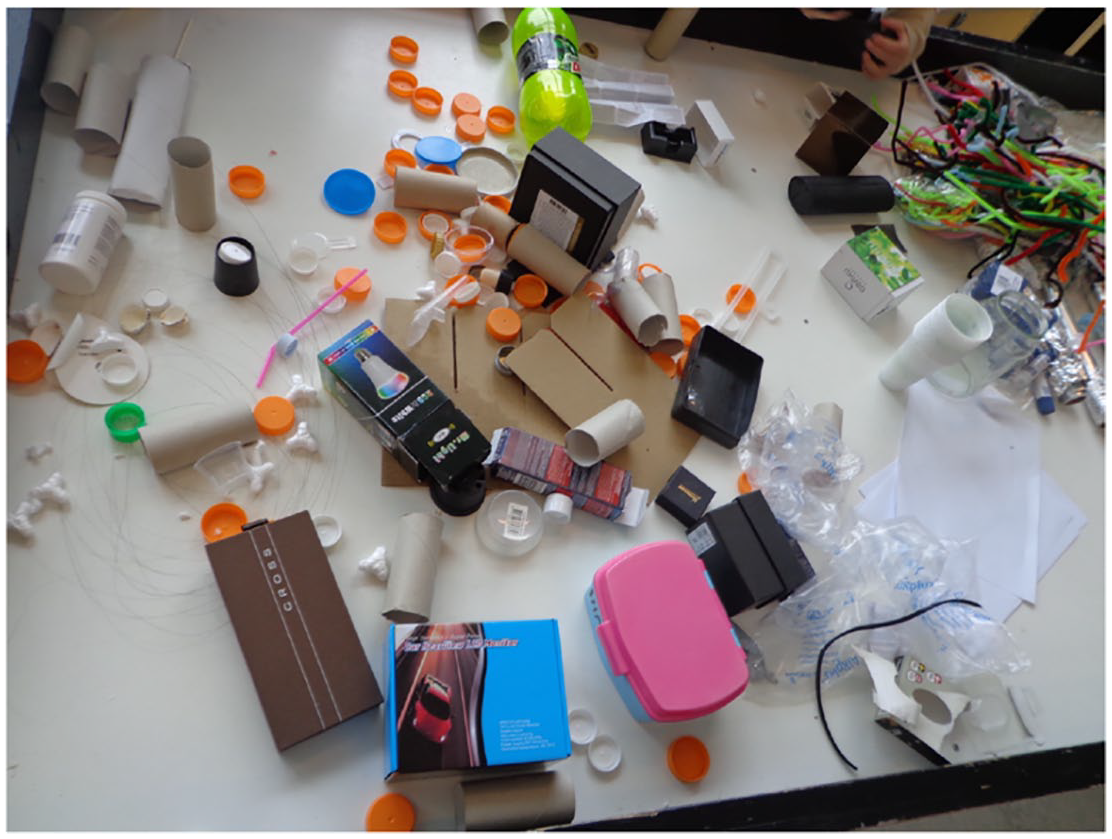
Material station.
This was one of the stations with materials, where pupils could take whatever they wanted and use it to create with. Furthermore, the activities would shift between working with peers in small groups around the common room to sit and create at two tables, whereas the teachers guided the use of tools as glue guns and paint. These two tables worked as two small fabrication stations, where a variety of creations were glued and painted. The picture below shows the glue gun station in action (Figure 11).
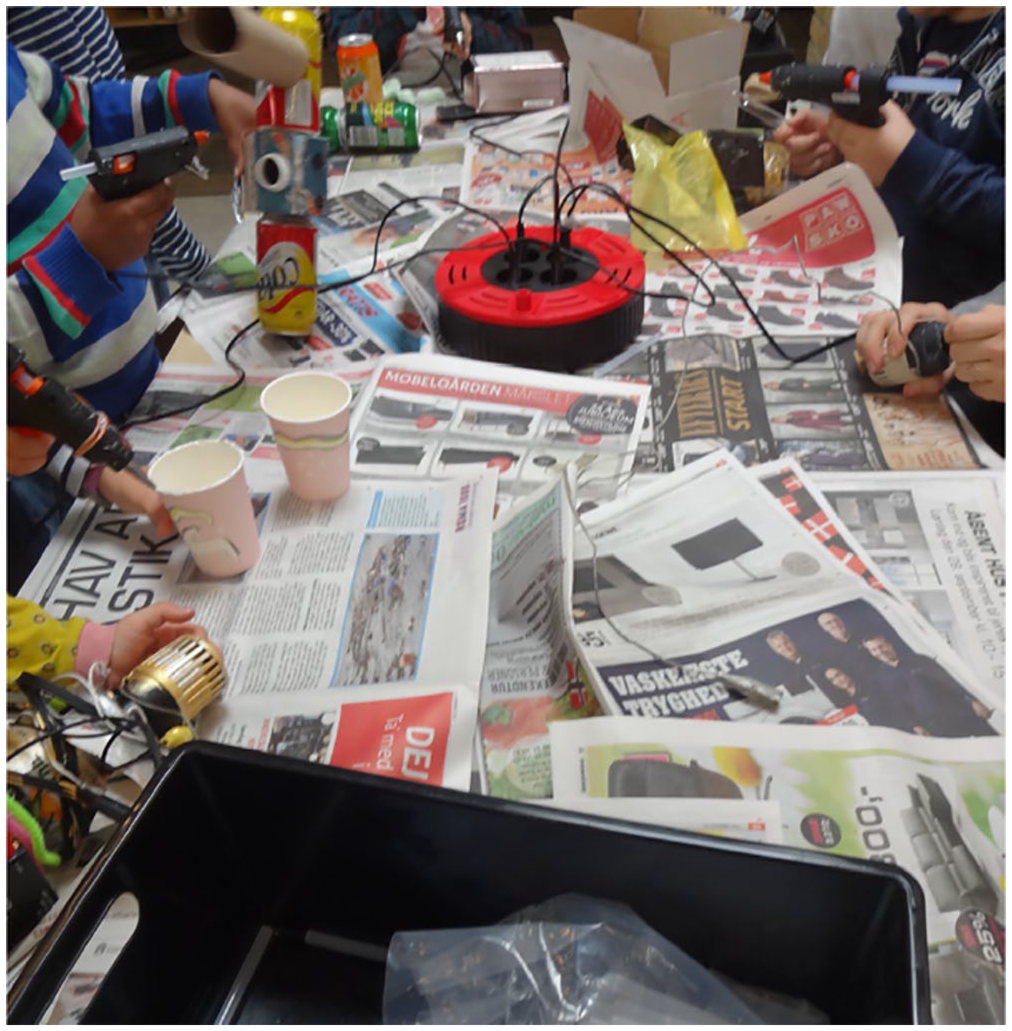
Glue gun fabrication station.
The pupils transformed recycle materials into spaceship creations. These would have many different forms, but still be inspired from one another. For instance, the case example shows the same spaceship creation from before, but now being painted and transformed into another spaceship, which turned out to be a gold spaceship (Figure 12).
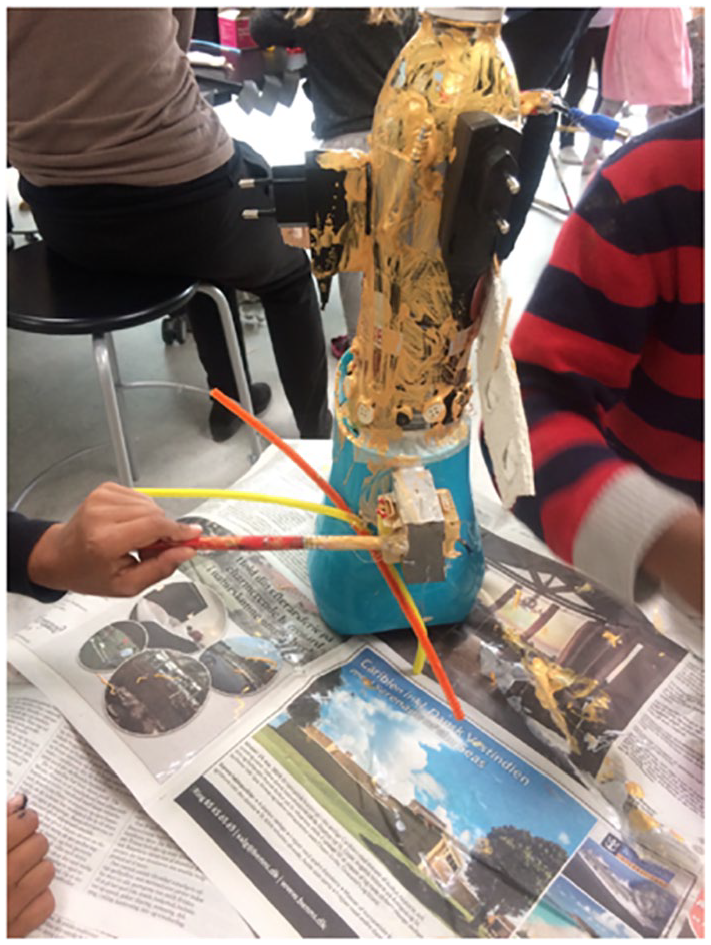
Transforming the spaceship.
These case examples show how the local play culture worked in the Danish makerspace in relation to what the pupils had made locally and highlighted what they wanted to share with the other pupils locally and globally. The examples further highlight similarities with the play culture that manifested on the global makerspace platform in relation to inspiring, experimenting and transforming physical and virtual creations in playful manners. Overall, this indicated an interesting way to practice and interact between the different makerspaces.
The local maker community making posts into a global maker creation exemplified
On the final day, the teachers created a story together with the pupils based on the posts on the Google+ group in the common room. All the pupils sat and watched the Google+ group shown from the projector as illustrated in Figure 13.
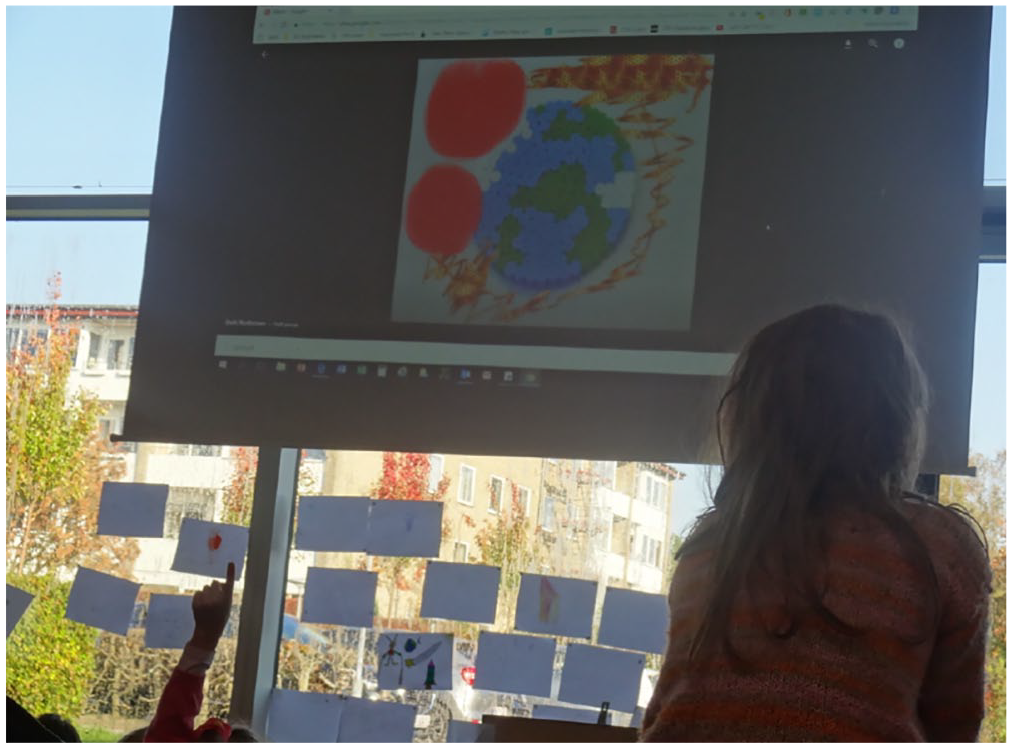
Improvising a story based on posts.
First, one of the teachers told what was happening on the group: the teacher commented on the posts and then explained that teachers intended to collaborate with the pupils to create a story based on the existing posts to make a new post with their story and share it on the group. Another teacher sat with a computer and scrolled through the group, while the other teacher stood in front of the canvas showing the Google+ group and who also organised creating a start, middle and end of the story. The teacher would ask the other teacher to stop scrolling, and then asked the pupils to give their inputs to the story-creation based on what ideas they got from the posts. Afterwards, the teacher sitting with the computer translated the story and posted it on the group.
This form of maker activity highlights a playful strategy to use the posts as raw material to create a story. Furthermore, this activity demonstrates a way to combine and connect a local activity with a global community, where the posts are transformed into another product: a story that afterwards is shared with the global community on the Google+ group.
Towards the potential of global play communities: making trans-glocal play culture
The visual case examples in this article show different versions of the process of improvising upon what Mouritsen terms as formulas. For instance, the thread of posts of the robots represents a visual example of a formula being used and, at the same time, improvised upon. The robot as drawn lines on a piece of paper are used by all parties and also differed in some way. It seems that even on the level of choosing materials and tools, there was some kind of similarity. It could all be used to draw or paint the robot on paper, though a robot painted with brushes or pens in different colours does not give the same result. The one who uses a pen and the one who uses a brush has to improvise in relation to the formula they chose to use as content. Moreover, the spaceship that suddenly travels from a piece of paper in Denmark into VR in United Kingdom exemplify that the transformation can take a different form, as one technology used to express something is replaced by another. The actual drawing of the spaceship is intact, but the technological setting and the narrative appears to change the meaning of the context of how the drawing is understood. The story-creation mentioned above further points towards the possibility that the existing posts uploaded by others can be used either as formulas or as raw materials, which can be used to improvise into new formulas.
The transformation process seems to be constituted by the variety of Mouritsen’s terminology of raw material, formula and improvisation. The use of the different play cultural strategies appears to highlight that the form and content can be transformed in various playful manners. The creativity become evident as no direct copying takes place without any additions from the one who reproduces a content or form from the posts. As the image with the robot seems to indicate there is no need to have access to the exact same materials and tools used in the same processes to maintain an interaction. In that way, the local makerspace decides what to do and also decide where to take a story, a character or a chosen theme. It is more a question of using the inspiration from the others as raw material or as already existing formulas and in this process establish new formulas and improvise upon them. Any formula presented somewhere in the communication through partners in a global makerspace seems to be accessible to change into new formulas, because the potential difference on materials, tools and even processes of production opens up for the flexibility of actions and expressions, which are at the same time the same and different.
The Global Makerspace project highlighted potential strategies to establish and practice an online and local makerspace with several other local makerspaces. The interactions and communication demonstrated the parties on group connected by creating and sharing various projects on the digital space that constituted an online maker community. Moreover, the project shows that play cultural strategies supported the production of maker activities and practices across the local and global maker communities. The similarities and differences appeared to inform the maker activities, which produced connectional practices online. For example, the Danish pupils compared and transformed the creations based on what the other makerspaces shared on the group. It worked as a motivation for the Danish pupils to create a local creation or a post itself to connect with the other makerspaces.
The Google+ group was to a high degree a text-based software, so the consequence was that the pupils who could not read or write were not able to produce their own posts without help from teachers and researchers. However, this issue turned into a fruitful activity between researchers, teachers and pupils. This appeared to work as an experimenting community, where adults together with children collaborated and explored the group. Together they were producing, commenting or asking questions to the posts and making activities in the local makerspace inspired from the posts online. Another issue was the language barrier of two different languages: Danish and English. For instance, the Danish pupils were not able to understand the posts unless the teachers translated for them. The matter of time was also important to consider as the three schools were not in the same time zone and for that reason had to communicate asynchronously more than synchronously. However, this turned out to be an advantage as it was possible to look at what others had posted, reflect upon it and make a choice on how to respond.
Furthermore, the pupils remained interested in the activities on the group online as long as the text-based aspect was translated into Danish. Also, it turned out the visual aspect of the communication served great importance to maintain the correspondence between the pupils from the different makerspaces; the pupils could see the posts and images of the other pupils’ creations and activities for themselves and interpret what they saw and adopt the information into their own play and participate in the online play culture at the same time. The platform and the creation of posts worked as formulas the pupils practised for participating in the activities online. Also, the pupils would improvise, when they selected photographs they wanted to share and when they composed the posts with descriptions and questions.
Trans-glocal play culture is a concept that was developed based on the experiences from this project with future opportunities and has merely been presented as a possibility that obviously requires more research. The experiences from the project highlight pupils’ transformative practices when a physical makerspace is connected with an online software. Together with other makerspaces across countries, they turn a regular software and local makerspaces into a global arena for maker activities. The potential of a global makerspace would be important to examine closer in a variety of settings such as both inside and outside educational contexts and also, explore what pupils do, when they play globally themselves using what software. The trans-glocal play culture is manifested in the ways the global and local appears to be adopted and used to maintain and also develop a certain kind of playing. This also suggests a potential for a closer investigation of the combinations of physical and the virtual tools and materials. But it seems that this kind of trans-glocal play culture imply that play can be unfolded and maintained beyond time and space and also different play cultures can connect through play cultural practices online.
Footnotes
Funding
The author(s) disclosed receipt of the following financial support for the research, authorship and/or publication of this article: This project received funding from the European Union’s Horizon 2020 research and innovation programme under grant agreement No 734720.
