




Abstract
This research investigates how children located in separate homes use the psychological function of imagination to engage in sociodramatic play using networked digital technologies. Specifically, it examines how 7- to 8-year-old children create imaginary play situations in the same Minecraft: Education Edition digitally-mediated environment whilst synchronously using the FaceTime video-communication tool to discuss their play. Drawing on cultural-historical conceptualizations of play, findings identified in this study describe how children reworked and combined elements of reality via imagination to enable online sociodramatic play. This study provides theoretical insight into how adults may best foster children’s imagination in digitally-mediated environments to support online sociodramatic play, of especial benefit to children during periods of lockdown associated with the global pandemic.
Keywords
Introduction
Imagination is an important psychological function facilitating children’s engagement in their everyday social and cultural worlds via sociodramatic play. Sociodramatic play sees children adopting roles and creating rule-bound imaginary play situations using symbolic actions, objects, and language (El’Konin, 2005). For example, children playing ‘shops’ adopt roles as customers or shopkeepers and adhere to behavioural rules dictated by these roles (e.g., customers buy goods from shopkeepers) using symbolic actions (e.g., ‘paying’ for items), symbolic objects (e.g., using pebbles for coins), and symbolic language (e.g., saying, “Can I pay with these [pebbles–coins]?”). Engaging in sociodramatic play in childhood is transformative as it fosters important cognitive processes (e.g., reflective- and abstract thought) and promotes self-regulatory behaviours (El’Konin, 2005) significantly influencing a child’s potential for future learning (Vygotsky, 2004). Traditionally, sociodramatic play is physically dependent on children playing together in co-located spaces using material elements within the context of the play. In the current digital age, however, children in separate homes can engage in sociodramatic play through a digitally-mediated environment.
A digitally-mediated environment is one in which networked digital technologies are used synchronously by people in different physical locations to engage in collaborative, meaningful interactions. Digitally-mediated environments expand children’s social worlds as they can interact in online spaces with separately located family members and peers. Access to a digitally-mediated environment in the home is typical for many children in technologically-advanced societies (Wernholm, 2021). Recently, children’s use of home-based digitally-mediated environments increased exponentially as schools worldwide introduced remote learning programs for their students in response to Covid-19 pandemic lockdown measures. During lockdown periods, many children also used digitally-mediated environments in the home to engage in social (Luo et al., 2021) and imaginary play (Quinones and Adams, 2020) with separately located peers. The suggestion that digitally-mediated environments are likely to provide sociodramatic play opportunities for separately located children has significant implications for the adults in children’s lives, such as their parents and educators, and those adults who design the games children use. This is because adults are instrumental in facilitating and supporting children’s engagement in sociodramatic play (Karpov, 2005; Vygotsky, 1978), including the provision of materials for play, time for play, and access to peers for play.
This paper explores how children in separate homes engage in sociodramatic play in a virtual, online space characterized as a digitally-mediated environment. Children playing together in digitally-mediated environments is an established area of research showing that children enjoy social interactions, participate in complex shared decision-making, and engage in problem-solving behaviours (Dezuanni, 2018). However, while research has shed light on children’s behaviours and activities in digitally-mediated environments, little is known about how children’s imagination is constituted for sociodramatic play in these environments. This lack of knowledge impedes the capacity of adults, including parents, educators, and game designers, to support sociodramatic play in digitally-mediated environments in ways that are productive for child development. This paper begins with a brief overview of digital play relative to the development of imagination as an informant to sociodramatic play. Next, Minecraft and FaceTime are introduced as the digitally-mediated environment used in this study. The theoretical framework defining imagination and sociodramatic play is then explained. Finally, findings describing how imagination as a basis for sociodramatic play in a digitally-mediated environment is enacted between two children who are geographically separate are presented and discussed.
Digital play, imagination, and sociodramatic play
Digital play as a descriptive construct first emerged in the research literature in response to the increasingly widespread use of digital technologies by children in the early childhood years (birth to age 8) with the advent of touchscreen computing and the Internet of Things (including networked toys) (Edwards, 2021). Since first appearing in the literature, digital play has been conceptualized in a variety of ways. For example, early research concerning digital play drew upon existing theories of play to describe how young children use technologies for exploratory play (Bird and Edwards, 2015), social play (Arnott, 2016), and imaginative play (Fleer, 2016). Such studies were revelatory in highlighting key features of technologies (e.g., game designs, physical properties) enabling or constraining children’s digital play activities. Later, the scholarly emphasis shifted towards understanding the relationships between children’s interactions with digital technologies and non-digital materials in their play (Marsh, 2019). This movement effectively erased the notion of a definitive boundary existing between digital and physical aspects of children’s play (Wernholm, 2021). Digital play was increasingly conceptualized as a ‘multimodal playscape’ (Palaiologou et al., 2021). As this occurred, greater importance was attributed to how children used a variety of multimodal elements within a range of contexts to inform their digital play. Marsh (2019) described this variety of elements and contexts as spanning material/immaterial artefacts, online/offline spaces, non-digital/digital tools, local/global communities, and/or real-world/virtual environments. Current thinking about digital play encompasses the notion of the post-digital, suggesting that the digital is now so integrated with the non-digital that these are considered jointly evident in the activities, including children’s play, in which people participate every day (Knox, 2019).
During childhood, imagination arises from children’s consciousness of the social situations in which they participate (Vygotsky, 2004). For example, a child pretends to ‘talk’ to grandparents using a toy smartphone because they are aware that this is a valued social activity. Recent studies suggest digital play enables imagination when children use technologies as “motivational conduits” (Palaiologou et al., 2021: 16) in their play. For example, Verenikina et al. (2018) have shown that children co-construct rule-bound imaginary play scenarios whilst synchronously using the same app on individual tablet devices. Fleer (2018) has suggested that children assign new symbolic meaning to actions and objects that cater for virtual contexts whilst recreating familiar narratives using digital animation tools. Meanwhile, Leung et al. (2020) found children use symbolic objects, actions, and language to generate and film imaginary scenarios using their favourite toys and video recording cameras. From a post-digital perspective, it appears non-working (Bird, 2020; Vogt and Hollenstein, 2021) and digitally-networked (i.e., Internet of Toys) (Palaiologou et al., 2021) technologies are equally powerful in supporting children’s ability to re-enact adult behaviours drawn from their everyday social and cultural realities through imaginary play.
In terms of the affordances of digital play for imagination, a recent Korean study found 3–7-year-old children with access to digitally augmented toys were more likely to engage in imaginary play scenarios than children accessing non-digitally augmented toys (Hong et al., 2019). Digitally augmented toys were found to heighten children’s ability to draw on real-life experiences to inform their imaginary play; include a wider range of topics in their play; and engage in imaginary play situations for longer periods of time compared to non-digitally augmented toys. Of specific interest, children using digitally augmented toys were more likely than children not using such toys to use ‘substitution’ during their play with peers. Substitution is a process which sees children transforming concrete thinking (e.g., a box can only be a box) to abstract thinking by assigning new meanings to objects (e.g., a box can be a boat) and actions (e.g., using a box to ‘go fishing’). According to cultural-historical theory, substitution is cognitively significant because it provides limitless opportunities for children to reimagine everyday objects and actions in uniquely creative ways (Leontyev, 2009; Vygotsky, 1978). The reviewed studies collectively highlight the potential for digital play to enable children’s imagination whilst foregrounding the importance of using technologies in ways that facilitate open-ended play opportunities.
Minecraft and Facetime as a digitally-mediated environment
In this investigation, Minecraft and Facetime were used synchronously by two children (aged 7 and 8) in geographically separate homes. The combined use of Minecraft and Facetime represented what is defined in this study as a digitally-mediated environment. Minecraft is an immersive simulated online space where users represent themselves as customizable, graphically embodied icons, known as avatars. Minecraft is enormously popular amongst children and is also enjoyed by adults, with 140 million monthly users reported for 2021 (Video Game Statistics, 2021). A significant body of research has examined the educational value of Minecraft, finding that it supports content acquisition, problem-solving, and collaborative behaviours (Baek et al., 2020). Minecraft allows children to build structures and enact roles with other users via avatars (Dezuanni et al., 2015). Facetime is a video-communication tool enabling real-time social interaction between separately located users. Research shows that children can use Facetime and other video chat platforms to participate in imaginary play with their peers even when geographically separated (Quinones and Adams, 2020). In this study, children engaged with their avatars from a first-person perspective within Minecraft using FaceTime on the same screen for talking with each other (Figure 1). Minecraft and Facetime used synchronously by participating children constituting a digitally-mediated environment.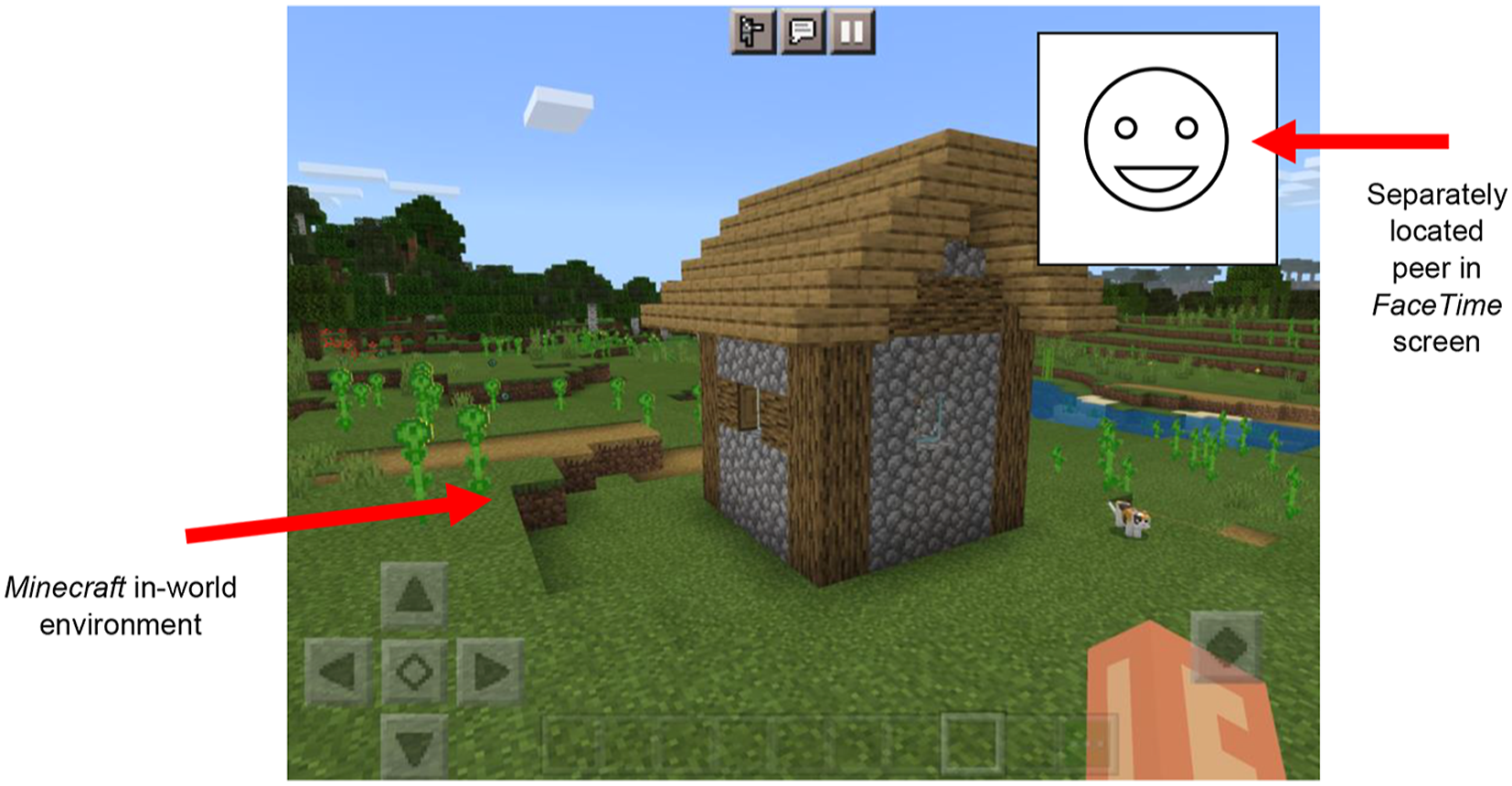
Theoretical framework
This research was framed using cultural-historical theory to conceptualize how a traditional form of imaginary play might manifest in a contemporary, digital context. According to cultural-historical theory, sociodramatic play operates as a ‘leading activity’ during childhood (Vygotsky, 1978). Leading activities help children move from one central psychological function to another. Central psychological functions are core mental structures (e.g., perception, emotions, memory) enabling humans to participate in their everyday social and cultural settings (Kravtsov and Kravtsova, 2010). In early childhood, play as a leading activity is informed by imagination which bridges the psychological functions of emotion and memory (Edwards, 2011). Three ideas are important in this process: imagination, leading activity, and the social situation of development.
Imagination
In cultural-historical theory, imagination acts as a new psychological function informing children’s sociodramatic play. Mastery of play as a leading activity changes the social situation of development so that the next psychological function may be realized. Vygotsky (2004) theorizes imagination as a cyclical pattern characterized by four combinatorial activities (see for more detail: Edwards and Cutter-Mackenzie, 2013). First, imagination connects to reality, so children’s real-life experiences inspire products of imagination. This means children’s activity is established and developed according to their life experiences in concentrated form. For example, a fishing trip inspires children to imagine a patch of grass as the ‘ocean’ – the ‘ocean’ being recognizable as a product of imagination. In the second activity, products of imagination connect with reality in a meaningful way, leading the child to a heightened understanding of real-life concepts. Products of imagination represent reworked concepts derived from previous real-life experiences with others. Reworked concepts allow children to assign meaning to real-life phenomena to inform imaginary activities. For example, children who have experienced a fishing trip might place symbolic objects, such as leaves, on grass to represent ‘fish’ demonstrating a conceptual understanding that fish live in the ocean.
The third combinatorial activity sees children connecting emotionally to products of their imagination. For example, children who are fishing in their ‘ocean’ smile and laugh when they catch a ‘fish’ demonstrating genuine excitement. Finally, in the fourth activity, the products of imagination return to the ‘real world’ in some form. For example, children who have been fishing have created an imaginative product that is now available in the ‘real world’ for other children to join. Imagination, therefore, arises from a combination of external realities, conceptual understandings, emotions, and ‘new’ contributions to the world. Through these combinational activities, children’s play, especially sociodramatic play, is enabled. According to cultural-historical theory, combinatorial activities are wholly dependent on children’s sociocultural environments. Historically, Vygotsky (2004) proposed this conceptualization of imagination and play prior to digital technologies being used by children. At the time of his work, children were viewed as interacting with the material objects available within physical environments to engage in imagination as an informant to sociodramatic play. However, now that children also participate in digitally-mediated environments, understanding how combinatorial activities work in these settings to enable imagination relative to sociodramatic play is necessary.
Leading activities
From a cultural-historical perspective, leading activities operate as generators of human consciousness by bridging one central psychological function to the next (McLean, 2021). During childhood, leading activities are built on the development of new cognitive functions, (e.g., speech, imagination, attention) stemming from a child’s evolving ability to become conscious of their environmental surrounds (Leontyev, 2009). As new cognitive functions appear, children become psychologically capable of participating in emerging social situations of development (Kravtsova, 2006). For example, when imagination (new cognitive function) appears in psychological development, children become cognitively capable of engaging in play (leading activity) by acting in imaginary situations (social situation of development) with other children. Leading activities are considered ‘mastered’ when children can verbally recall and reflect on their involvement in a specific leading activity to adults. This prompts a change in their social situation of development and gives rise to a new cognitive function that supports the next leading activity. Leading activities vary according to the cultural practices of members of a society at any given point in time. This may include participating in digitally-mediated environments with others. Despite cultural variation in the practice, leading activities are considered universal in that they sequentially build on each other over time to contribute to the ongoing psychological development of an individual.
Social situation of development
The ‘social situation of development’ (Kravtsova, 2006) provides the sociocultural context from which new psychological functions emerge with these, in turn, informing leading activities. The changing conditions of a social situation of development is core to the theory of leading activities because social situations correspond with a child’s psychological stage of development at a particular age. For play to operate as a leading activity in childhood, children must be cognitively capable of transforming imaginative thought into action, thus creating a new social situation of development, known as collective theorizing (Edwards, 2011). Acting in imaginary situations requires children to mutually maintain the make-believe nature of the play, and mastering this capacity allows them to effectively participate in a social situation characterized by shared thinking with other people. Fundamentally, sociodramatic play is significant in a child’s psychological development as the nature of the social situation from which it derives, known as imagination in action, requires children to create pretend play scenarios reflective of adult behaviours and interactions through role-play, substituted objects, and intentional, purposeful behaviours (El’Konin, 1999). Thus, imagination in action as a social situation informs imagination as a key psychological function characterized by four combinatorial activities, with these in turn enabling play as a leading activity. As play is mastered, children reach a new social situation of development – that of collective theorizing. It is important, therefore, to explore how digitally-mediated environments scaffold social situations of development so the cognitive potential of the current (and future) generation of children might be optimized.
Methodology
This research was conducted as a qualitative single case study to enable in-depth insight into a contemporary, unique, social phenomenon (Yin, 2014). Single case study design is a bounded system where the case is represented by one unit of analysis defined by set variables that cannot be separated from the context in which they occur. Bounding a case is important because it ensures the subject of the case (e.g., a cultural activity) is distinct from the context of the case (e.g., the real-life setting in which it occurs). In this study, the case is identified as ‘play as a leading activity’ and defined as a cultural activity in a digitally-mediated environment occurring within the family home as a specific setting.
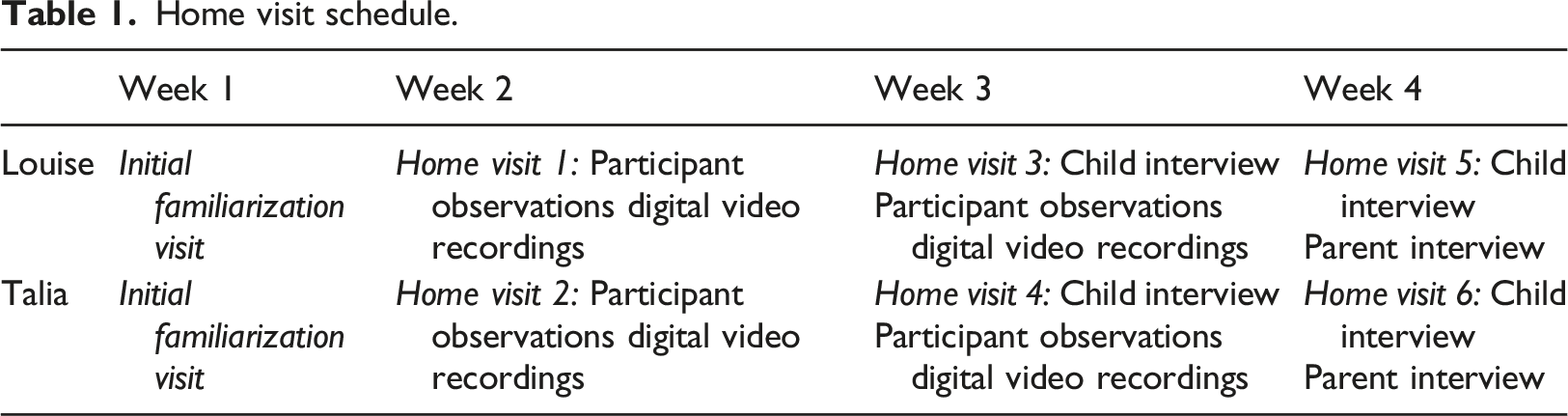
Sample
Home visit schedule.
Ethics
The study received approval from the [Australian Catholic University] Human Research Ethics Committee (approval number 2019-203H). Participating families and the first author were not previously known to each other, so arrangements were made for them to meet at a local playground prior to home visits. Consent was an iterative, dialogical process, garnered from parents before each home visit and from child participants before data collection procedures commenced.
Research methods
Record of children’s play episodes.
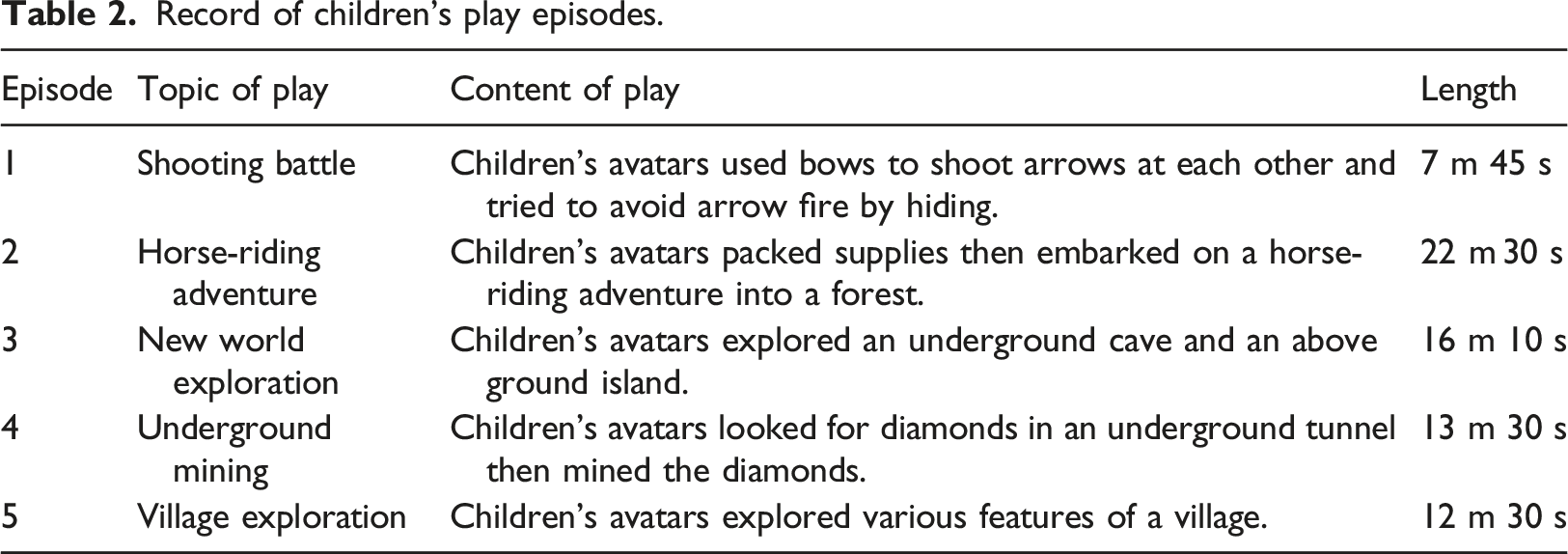
A single digital video recording device (iPad) secured on a tripod was positioned to capture in-world activities of children’s avatars, verbal discourse between children, and non-verbal gestures and facial expressions of the physically present child participant. This method was integral in heightening the accuracy and comprehensiveness of observational fieldnotes. Audio recorded semi-structured interviews were conducted with each child whilst viewing 10–13 excerpts of video recorded footage of children’s in-world activities selected by the first author to elicit their perspectives about what was occurring in the digitally-mediated environment. These semi-structured interviews enabled theoretical insight into children’s combinatorial activities during the imaginative cycle informing their sociodramatic play. For example, in the first two episodes, children’s avatars rode virtual horses, so they were asked in their separate interviews if they had ever ridden real-life horses. Semi-structured interviews were also conducted with children’s parents to gain insight into factors affecting the availability and provision of the digitally-mediated environment to the children. For example, parents were asked how their children gained access to FaceTime. All video recorded and interview data were transcribed by the first author.
Analysis
Analysis was conducted in three phases using the dialectical-interactive interpretation scheme (Hedegaard, 2008). This scheme represents a structured, cultural-historical approach to analysing data generated from observing children’s activities in real-world settings. First, observational and video recorded data were used to identify activity occurring between children during play. For example, Children’s avatars are riding horses near a virtual forest; Louise asks Talia if she wants to go on an adventure. Second, observational and video recorded data generated over separate home visits were linked and interpreted according to deductive codes based on Vygotsky’s (2004) combinatorial processes. These codes were: (1) Life experiences inspire products of imagination; (2) Products of imagination connect to reality in meaningful ways; (3) Emotional connections are made to products of imagination; and (4) Products of imagination manifest in real ways. Data relating to these codes were then analysed drawing upon the Australian Curriculum (Australian Curriculum, Assessment, and Reporting Authority, 2018) Science, Mathematics, English, and Humanities and Social Sciences documents (e.g., Children use directional language to navigate the horse-riding adventure) to establish any identified content (e.g., real-world) knowledge within the combinatorial activities. Initial findings from the first two phases of analysis were then validated and/or adjusted during child interviews. Finally, in phase 3, interview data were used to provide contextual information about combinatorial activities children used during sociodramatic play according to established codes (e.g., Louise and Talia have ridden real-life horses). The coding process was conducted using NVivo® data analysis software.
Findings
Consistent with the theoretical framework for this study, four key findings were identified. These were: 1. Life experiences in the real and virtual world inspire products of imagination 2. Products of imagination in a virtual world connect to reality in meaningful ways 3. Emotional connections are made to products of imagination in a virtual world 4. Products of imagination in a virtual world manifest in intangible and tangible ways.
These findings are now reported relative to Vygotsky’s (2004) four combinatorial activities and suggest the data may be read as enabling the imaginative cycle giving rise to a form of online sociodramatic play enacted by Talia and Louise in a digitally-mediated environment.
Life experiences in the real and virtual world inspire products of imagination
This finding is based on the first combinatorial activity in the cycle of imagination, this being, that products of imagination are inspired by children’s previous life experiences. This means children use and combine elements of their social and cultural realities to create imaginary situations. Data in this study suggests children used real-world experiences in the digitally-mediated environment. For example, during several episodes, Talia and Louise named, cared for, and/or rode virtual horses. Interview data revealed Louise attends weekly horse-riding lessons and Talia has previously ridden a pony. Further data indicates children’s real-world experiences of popular culture (e.g., books, movies) also inspired their products of imagination. For example, Louise, a Harry Potter™ fan, made her avatar fly and become invisible (magical feats Harry can achieve) and Talia, who enjoys watching Disney Princess™ movies, adopted a princess role. Interestingly, data indicates children also used virtual experiences to inspire products of imagination in the digitally-mediated environment. For example, Louise initiated a ‘shooting battle’ when she saw Talia’s avatar holding a graphical bow and arrow (Episode 1) and riding horses near a sprawling forest prompted Louise to ask, “Talia, do you want to go on an adventure?” (Episode 2). Video transcript data also captured how Louise, after encountering a large in-world structure, dressed her avatar in a queen-like ‘skin’ (an image used to dress an avatar a certain way) and went on to create an imaginary situation with Talia (Episode 5):
Products of imagination in a virtual world connect to reality in meaningful ways
The second finding is based on the second combinatorial activity in the imaginative cycle, that children meaningfully connect knowledge of real-life phenomena to products of imagination. This means children use conceptual understandings acquired through social interactions in different cultural settings to inform sociodramatic play. Findings suggest children meaningfully connected knowledge of various real-life concepts to their products of imagination in the digitally-mediated environment. First, data indicates Talia and Louise linked knowledge of natural science concepts to imaginary play scenarios. For example, they connected knowledge about the effects of force and sources of energy by using pickaxes to break up underground cave walls (Episode 4) and lanterns to light up dark underground spaces (Episode 3). Moreover, children packed supplies (e.g., bread, campfire) and embarked on a horse-riding adventure into a virtual forest in search of a ‘place to live’ suggesting they connected understandings that living things (e.g., humans, animals) have basic needs (e.g., food, warmth, shelter) and can be used for specific purposes (e.g., horses are used for transport) to a product of imagination (Episode 2). Interestingly, before embarking on the horse-riding adventure, Talia changed her avatar’s skin from a pink dress to pants and a shirt indicating she drew upon her knowledge of the properties of clothing materials to the physical requirements of this imaginary scenario:
Talia’s real-world experiences of dressing up in princess dresses at her grandmother’s house, as evidenced in interview data, may have informed her knowledge of the limitations of dress material for horse-riding. This data also illustrates how Talia connected real-life understandings about the natural science concept of ‘camouflage’ to a product of imagination. Talia further demonstrated this knowledge when she noticed her avatar was packing supplies in a magenta ‘shulker box’ (a graphical storage cube – Figure 2) whilst viewing video playback. “I need to look for a dark blue instead of magenta,” she said, “it’s got no camouflage.” An example of a magenta shulker box.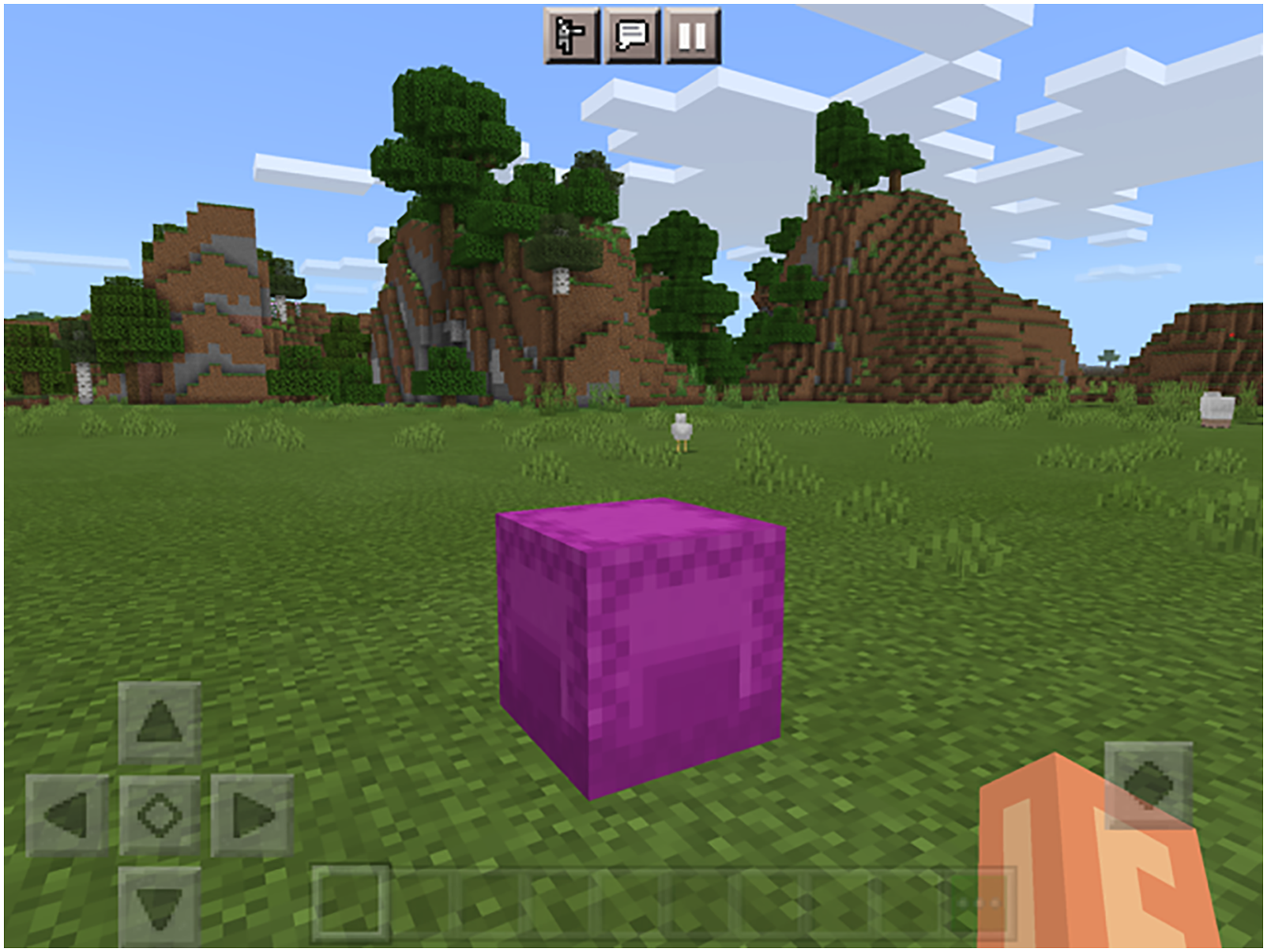
Children also connected mathematical concepts to products of imagination during play. For example, video transcript data illustrates how they used knowledge of real-life navigational tools to inform their imaginary horse-riding adventure:
In terms of mathematical concepts, children also used and interpreted directional language (e.g., under, behind, beside) to identify the location of their own and each other’s avatars within in-world environments and built ‘Nether portals’ (vertical, rectangular structures that transport avatars to an underground world known as the ‘Nether’) using three-dimensional cubed blocks. Further data indicates children connected literacy-based understandings to products of imagination. For example, they interpreted visual, written, and digital texts to select symbolic objects (e.g., saddles, pickaxes) required for play from the in-built Minecraft inventory and search engine. Louise also used knowledge about creating visual texts when she posed her avatar to take a ‘selfie’ (Episode 3) as evidenced in interview data:
Data indicates social science concepts were also connected by children to products of imagination. For example, Talia drew on knowledge of societal roles by referring to herself as a ‘doctor’ and a ‘princess’ (Episode 2), and Louise connected conceptual understandings about sites of significance by identifying an in-world structure as a ‘castle’ (Episode 5).
Emotional connections are made to products of imagination in a virtual world
The link between imagination and emotion represents the third activity in the imaginative cycle. This activity sees children making emotional connections to products of imagination in similar ways as they would to actual real-life experiences. In this study, data indicates Talia and Louise expressed happiness, excitement, frustration, and apprehension during imaginary play scenarios suggesting children may connect emotionally to products of imagination in digitally-mediated environments. The first emotion, happiness, was predominantly expressed through children’s interactions with each other. For example, Talia and Louise smiled and laughed when they turned their avatars invisible to hide from each other (Episode 1) and whilst watching each other’s avatars perform tricks on horses (Episode 2). Children also expressed happiness when they interacted with NPCs, such as dogs and horses. Video transcript data captured how children connected with feelings of happiness and fear to a product of imagination when Louise put a dragon’s head on her avatar to surprise Talia (Episode 5):
A further emotion, excitement, was also expressed whilst children interacted with each other. For example, they both cried excitedly, “Let’s go!” when embarking on the horse-riding adventure and expressed enthusiasm when discovering new and interesting in-world phenomena, such as unfamiliar environments (e.g., village), NPCs (e.g., dolphin), and objects (e.g., gold). The third emotion expressed by children during this combinatorial activity was frustration. For example, Talia became frustrated when she couldn’t see Louise’s avatar whilst it was invisible, and Louise became frustrated when Talia accidently broke blocks she needed to build a Nether Portal. Children also expressed frustration when they were unable to achieve certain goals in play due to software limitations. For example, when Talia had difficulty mounting a horse to remove her avatar from a perceived threat in play, she frowned and swiped her finger forcefully across the screen and said, “C’mon ride! Why can’t I just ride you?” Similarly, Louise became frustrated when she was unable to take a ‘selfie’ whilst swimming underwater. “I can’t!” she said in an exasperated tone while frowning and tapping her screen repeatedly, “Oh, why am I not allowed to do it?”
The fourth emotion, apprehension, was expressed by children when they felt concerned about the safety of their avatars. For example, Louise turned her avatar invisible to escape arrow fire from Talia’s avatar (Episode 1) and Talia packed armour to protect her avatar before embarking on the horse-riding adventure (Episode 2). When asked why she packed armour, Talia responded, “To keep myself safe.” Interestingly, during this episode, Louise suggested changing the game mode from Creative to Survival. Talia’s reaction, “No! I don’t want to!” indicated she was concerned about her avatar being attacked by hostile NPCs in Survival mode. Interview data provided further insight into this finding when Talia admitted she prefers playing in indoor spaces in Minecraft. “Inside is safer,” she explained, “because there’s like monsters outside.”
Products of imagination manifest in real ways
The final finding is based on the fourth activity in the imaginative cycle, that children construct external, visible products of imagination to extend and enhance sociodramatic play. This means products of imagination manifest in ways that are as real to children as the actual object the product represents. Data indicates children constructed intangible manifestations of imagination in the digitally-mediated environment. For example, video transcript data captured how Louise reimagined a shulker box (Figure 2) as a ‘backpack’ in which to pack supplies for the horse-riding adventure:
In this example, the shulker box is reimagined and contributed to the online play as a backpack. Further interview data suggests products of children’s imagination in digitally-mediated environments manifest materially in real-world settings. For example, in her second interview, Louise described how she often uses ideas from Minecraft during real-world play with her toys. “It gives me ideas, like school, doctors, and things,” she said. Louise’s mother, Michelle, believes Louise and her younger brother recreate what they see and experience within Minecraft in-world environments when they build ‘worlds’ together using traditional construction blocks. Similarly, Talia’s father, John, thinks Talia may be drawing on Minecraft-related game design features (e.g., labelling systems) to enhance her imaginative activity in real-world settings. “She has friends over or she’s building something, pretending to do a shop or something, she’s really good at having a label and instructions and maps,” John explained.
Discussion
Key findings in this study suggest evidence of combinatorial activity as per Vygotsky’s (2004) conceptualizations of these four activities in imagination. As imagination informs children’s sociodramatic play as a leading activity, these findings indicate digitally-mediated environments may be considered supportive of children’s transition from play as a leading activity to collective theorizing as a social situation of development. While the generalizability of the findings is limited due to sample size and data-collection period, they are reported according to theoretically-based, deductive codes to gain insight into the play activity itself, not child participants or the length of their play episodes. The first finding suggests children draw on real-life and virtual experiences in digitally-mediated environments to inspire products of imagination. According to Vygotsky (2004), a broader range of life experiences leads to a more productive, richer imagination as children rework elements of these experiences in new and creative ways. Such elements might be drawn from real-life activities (e.g., a bow shoots arrows), and/or those available via digital media (e.g., wizards can become invisible), and combined by children in ways they have not actually encountered (e.g., turning an avatar invisible to escape arrow fire). While real-world elements are firmly based in experiences, virtual elements may also derive from impressions made on the child through aspects of popular culture, such as books or films. Such elements can be selectively reinterpreted by children in culturally significant ways (Edwards, 2011) within the imaginative cycle. Hence, children who encounter a wider variety of experiences have access to a broader range of elements to rework into more complex combinations during the imaginative process, thus leading to potentially richer online sociodramatic play. Given children’s experiences enrich their imagination and consequently inform sociodramatic play, adults in children’s lives can provide opportunities for real-life and virtual activities that can be drawn upon to inform products of imagination, while game designers should consider the extent to which their digital environments allow children the flexibility to combine or rework real-world and virtual experiences.
The second finding suggests children make complex, meaningful associations between their conceptual understandings and products of imagination when participating in digitally-mediated environments. In cultural-historical theory, connecting knowledge acquired through sociocultural experiences is essential for establishing meaning relative to the product of imagination. For example, a child connects knowledge about the properties of clothing materials acquired through playing dress-ups at Grandma’s house to select a suitable skin for their avatar to wear whilst riding a horse in a virtual world. This finding is important because it could apprise game designers about including a wide variety of real-life concepts in their digital environments to heighten children’s meaning making in terms of combinatorial activity. The third key finding is significant as it illuminates how 7- to 8-year-old children experience emotions in a digitally-mediated environment relative to their concept-informed products of imagination. Data suggests Talia and Louise experienced several emotions in the digitally-mediated environment, such as happiness, excitement, and apprehension, enjoying many aspects of the environment, becoming frustrated with each other, and worrying about the safety of their avatars.
In the fourth key finding, data suggests children’s products of imagination, informed by concepts and generating emotional responses, are recontributed to the world, in both real and digital terms. This finding is interesting as children evidenced the contribution of virtual objects (e.g., shulker box) to their digital world which contributed to the enactment of their sociodramatic play (e.g., shulker box as backpack). This finding also suggests children may use products of imagination from within digitally-mediated contexts to reimagine material objects during their sociodramatic play in real-world settings (e.g., from using Minecraft blocks to building with traditional hands-on blocks). The finding concerning the contribution of children’s products of imagination to their real-world and digitally-mediated play supports current understandings about the reflexive, sophisticated, and complex relationship between digital and non-digital play (e.g., Marsh, 2019). Findings reported in this research suggest the four combinatorial activities (Vygotsky, 2004) associated with imagination as an informant to online sociodramatic play as a leading activity are evident in digitally-mediated environments used by children. Importantly, these four activities may be aligned with actions taken by the adults in children’s lives to ensure they contribute to rich and productive online sociodramatic play, thus benefitting children’s overall development as per the notion of play as a leading activity. For example, each combinatorial activity within the imaginative cycle, may entail specific actions taken by adults (e.g., parents, educators) and game designers (Figure 3). The imaginative cycle in a digitally-mediated environment, with suggested actions for the adults in children’s lives and game designers to take in supporting online sociodramatic play.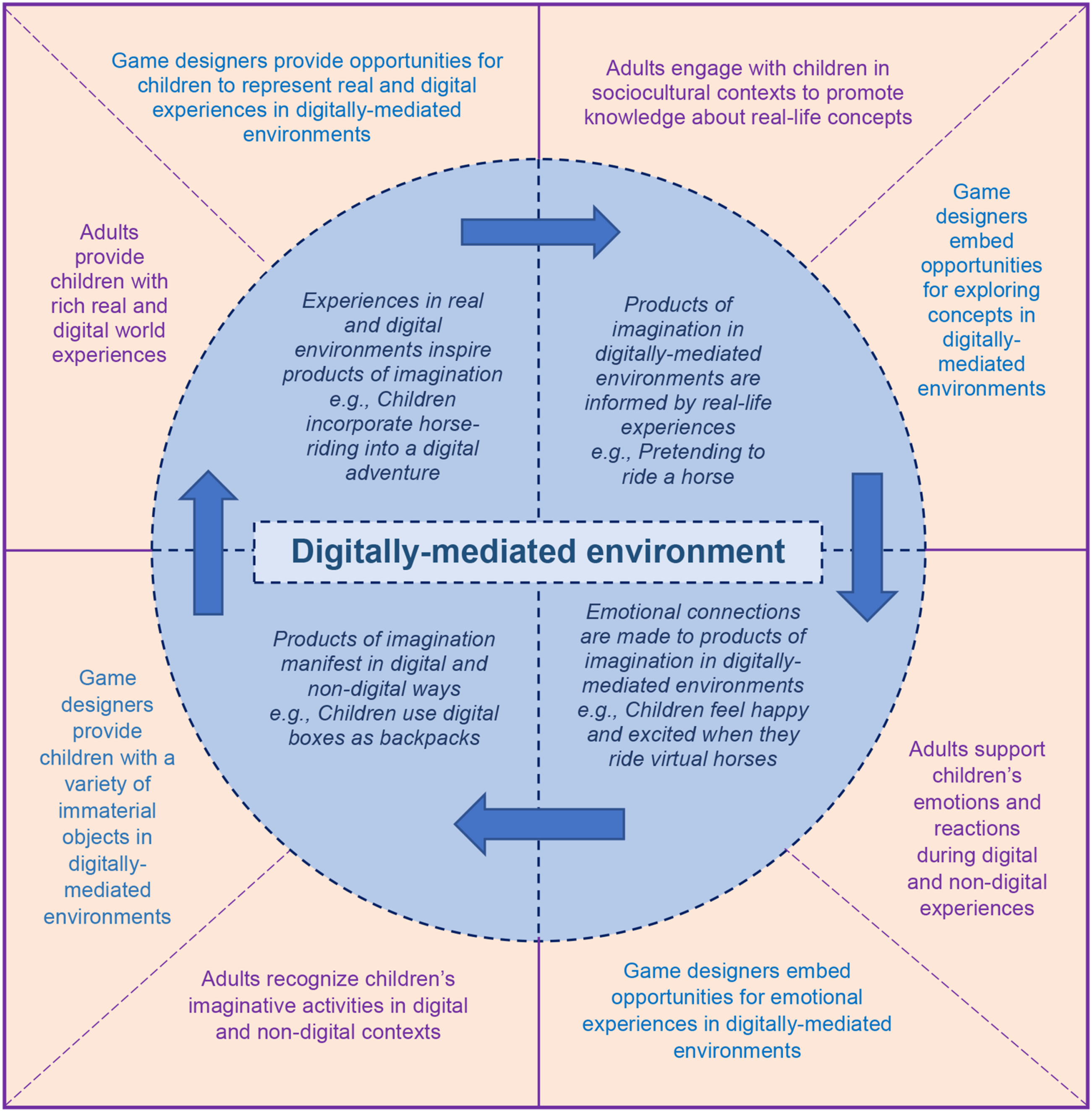
Understanding the imaginative cycle in a digitally-mediated environment is important because it shows that sociodramatic play is not reliant on children being physically co-located. Instead, the digitally-mediated environment affords sufficient opportunity for the four combinatorial activities constituting the imaginative cycle to be realized, enabling online sociodramatic play. Given cultural-historical theory considers such play a form of leading activity supporting the realization of collective theorization as the next social situation of development for children, this is an important insight during a time of rapid social digitalization in which children are increasingly engaged in digital play (Vogt and Hollenstein, 2021). Likewise, with research showing that children are relying on digital technologies for play with peers during the global pandemic (Luo et al., 2021; Quinones and Adams, 2020). If imagination is enabled in a digitally-mediated environment, so too should sociodramatic play be theoretically able to continue operating as a leading activity, enabling children’s development as they reach collective theorizing as the next social situation of development. As concerns for the limitations of digital play are expressed in some literature as inferior to traditional play (e.g., see Güneş, 2020) these may be challenged whereby digitally-mediated environments that are sufficiently flexible for imagination, such as Minecraft (combined with FaceTime), support online sociodramatic play. With this being the case, adult actions in supporting such imaginative activity for children, both digital and non-digital, are indicated. For adults in children’s lives, this suggests supporting children’s engagement with real-world concepts, fostering children’s emotional reactions, recognizing children’s imaginative activities, and providing rich digital and non-digital activities. For game designers, this suggests embedding concepts and opportunities for emotional experiences in digital environments, providing a variety of immaterial objects for imaginative activity, and providing children with opportunities to represent real and virtual experiences in digital environments. As these adult actions (e.g., parents and game designers) come together, the imaginative cycle will be most productively realized for children so as to enable online sociodramatic play.
Conclusion
This study contributes new knowledge about how children in geographically separate homes are able to enact the imaginative cycle in digitally-mediated environments to realize online sociodramatic play. While research has established that digital play helps children explore their worlds, research has not previously identified imagination as an informant to children’s online sociodramatic play in digitally-mediated environments. Using the Vygotsky (2004) notion of imagination as a psychological function informing play as a leading activity, this study found four combinatorial activities characteristic of imagination in a digitally-mediated environment comprising Minecraft and video-communication. These four activities are: 1. Life experiences in the real and virtual world inspire products of imagination; 2. Products of imagination in a virtual world connect to reality in meaningful ways; 3. Emotional connections are made to products of imagination in a virtual world; 4. Products of imagination in a virtual world manifest in intangible and tangible ways. In combination, these activities comprise imagination as a basis for online sociodramatic play, suggesting that such digitally situated play may not necessarily be counterproductive for children, and indeed may be of value during the pandemic. Adults can take definitive actions for supporting children’s imaginative activities within digitally-mediated environments, including most notably recognizing that engaging experiences inform the richness of imaginative activity in digital environments and vice-versa.
Footnotes
Declaration of conflicting interests
The author(s) declared no potential conflicts of interest with respect to the research, authorship, and/or publication of this article.
Funding
The author(s) received no financial support for the research, authorship, and/or publication of this article.
