




Abstract
We will present a framework for establishing distance education in schools by combining Networked Learning and media ecologies seen as both environments and as relations between media. Our model for such a framework is called The Flexible Meeting Place and can be used in schools that lack teachers in certain subjects, and also in schools that want to extend their teaching to other schools in the world around them. The school can become an arena, where children as part of their schooling start to communicate globally. The study is rounded in the project Assisted Distance Teaching in Primary Schools (Forsøg Med Assisteret Fjernundervisning i folkeskolen: ASSIST, 2018) that developed tools to ensure appropriate vocational levels in school classes where there was a lack of teachers educated in the specific subject. This project involved 12 Danish schools, with 2 partner schools in Kenya and Greenland. The focus was on the development of pedagogical methods and technical experimentation. In Assisted Distance Teaching in Primary Schools, the thesis was that a teacher who knew about either the subject, the pedagogy or the technology could support a teaching assistant through a digital mediated connection. It turned out that everybody involved, teachers, children and citizens, began to collaborate through network mediated by online app, tools and services and adapt to the circumstances according to their actual knowledge and to develop new knowledge in collaboration. Based on the above, we will present a pedagogical model with a number of challenges and questions that suggests ways to establishing networked learning through a networked school. The theoretical framework, the model and the reflections around it are meant to support the further development of processes, a preschool teacher or teacher in a school can organise together with the children in her or his class. It is an attempt to push school systems into becoming networked and giving children the opportunity to act locally and globally. This development of schools are supported by an organisation like World Economic Forum, who in their recommendations for a future school system, talks about global citizenship, learning using digital technologies and even make education possible without one having to have access to school buildings.
Keywords
Introduction
This article presents a framework, that we have chosen to call The Flexible Meeting Place, that can be used as a model for schools’, classes’ and pupil’s general collaboration mediated by technology. The framework draws heavily on inspiration from the notions of Networked Learning (Goodyear et al., 2004; Jones, 2015) and Media Ecologies (Postman, 2000; Scolari, 2012; Strate, 2006). It is grounded in a project, which purpose was to alleviate a lack of qualified teachers in the primary schools in rural and depopulated areas of Denmark with the use of Distance Education. Technological mediated collaboration is often chosen when the participants are geographically misaligned and thus carried out over a distance. When the context for collaboration is a scholastic one, it is reasonable to resort to Distance Education, but this often results in practices that resemble one way broadcasts of knowledge (Keegan, 2013), something that did not resonate well with the activities, planned and carried out by the teachers, that we observed on the schools that were part of the project. In our investigations, two things in particular stood out; Learning in networks and apps, tools and services aggregated in an ecology.
First, when a challenge or a problem arose, the participants reached out in the network for help, for knowledge or to discuss the nature of the problem. Both teachers and pupils utilised these connections in their collaboration across schools and classes. Using Baran’s (1964) descriptions of communication networks, one could claim that Distance Education resembles the centralised network, where a central node broadcasts to recipients located as satellites without any mutual connections. Whereas, the teaching and learning we observed resembled in some cases, the decentralised and in even more cases, the distributed network, where several central nodes interact with a small amount of surrounding nodes or where all nodes in the network engages and interact with each other.
Second, when utilising their network, the participants did not just rely on the official laid out channels for communication. Instead, they used a plethora of different online tools, services and digital devices. Some of them were made available due to a specific educational design, but with another purpose than communication in the network, others were introduced to the network by the participants. We describe this everchanging entanglement of online apps, tools and services, by using Postman’s (2000) concept of Media Ecology that regards media as an environment wherein practices and culture grows (Postman, 2000; Postman and Weingartner, 1971).
Setting the scene: assisted distance teaching in primary schools (ASSIST)
Rural depopulation is seen all over Europe, 1 where rural and remote areas especially are experiencing a decline in population numbers. The backdrop for the project was a political initiative that sought to bring focus to rural and remote regions like that in Denmark. Despite Denmark being a small country, both in terms of population (approx. 6 million) and in terms of area (approx. 16500 square miles), there are people in villages and on islands, that are experiencing depopulation, low growth rates and a low level of public service, compared to the rest of the country’s more dense populated cities. To counter this development, the Danish government launched a number of initiatives, 2 where access to attractive educational opportunities no matter where in the country you might live was one, and that provided a foundation to inquire into Distance Education in primary school.
The project was initially conceived within the Danish Ministry of Education as a reaction to an experienced lack of teachers in the rural and remote areas and islands of Denmark. This was especially the case with teachers with certain areas of expertise for example science and foreign languages. As an answer to this challenge, the ministry commissioned the Assisted Distance Teaching in Primary Schools-project (2019) (hereby ASSIST) to study Distance Teaching as an approach to deal with this lack of teachers. The initial commission was to have a teacher, with expert knowledge through vocational education in the subject at hand, teaching a class through the means of Distance Education, but with that difference that there would be an assistant present in the class to help make things come along smoothly.
This local assistant could be another teacher, but with a different vocational education, it could be a pedagogue, in Danish schools pedagogues are commonly used to support teaching in grades 1–4, or it could to some lesser extend, be someone with non-educational training, that were more or less relevant for subject at hand (artist, engineer, etc.). Yet, common for most of these assistants were that they were trained teachers or pedagogues, that they taught in subjects where they did not possess the formal qualifications. The project was interesting in the sense, that there actually was one or more persons at each small or bigger school that could cooperate with each other through networks. It was not only a teacher placed centrally that broadcasted to local and smaller schools in the periphery or that the children had to use programmes and platforms to be taught by.
The project consisted of four subprojects, and the schools involved in the subprojects were appointed by the ministry after an application procedure. The subjects, the classes involved and the technologies to be used initially were chosen by the schools, which in most cases meant by the teachers and school management together. In Denmark, schools are organised and run by the municipalities. In this project, three of the four subprojects were organised with schools inside a municipality. The schools had access to productivity suites 3 and Learning Management System (LMS) made available to them by the local municipality, and these tools became part of a larger and more flexible system, as the article will show. The choice of technologies was somewhat advised by the research team, but mainly determined by local factors, such as which classes the participating teachers had access to through their daily teaching, what subjects the teachers were teaching and what kind of technologies the schools had access to.
The research team connected to the project did interviews (Kvale and Brinkmann, 2009), observed the different examples of teaching using video (Pink, 2013) and in some cases, took an active and practical part in the development of these examples and joined the teaching themselves inspired by action research (Bradbury, 2015). They published videos on the blog connected to the project and conducted online sessions where the teachers discussed the project. These data were stored safely based upon the guidelines of General Data Protection Regulation (GDPR). 4 Across all these methods, the researchers were also in a dialogue with the different practitioners being inspired by them and also discussing the practitioners’ learning designs.
The northern subproject
The objective of the northern project was to experiment with Distance Education used in science class in the early grades. The core idea was to use a computer game (Minecraft) 5 as space for collaboration, where the pupils could meet and interact. The participants were teachers and kindergarten teachers from two schools, as well as one first grade class from each school. Even though the two schools are located only 60 km apart in the same northern region of Denmark, they are situated in rather different natural settings; one being a fishing town on the west coast, and the other being a rural village inland in the eastern part of the region. These differences in the local nature were sought to be utilised in the project.
The eastern subproject
In the eastern project, the objective was to experiment with distance education in science classes in seventh grade on three different schools within the same municipality. Here, the core idea was to use the LMS and a productivity suite made available by the municipality’s school administration, and only those. Two of the schools are average primary schools located in eastern Denmark, but the third school is small (only 21 pupils in total) and located on a tiny island just off the coast.
The western subproject
The western project initially consisted of further two subprojects that were tied together due to similar challenges, and the fact that a lot of the practitioners and some of the pupils were involved in both projects. The first subproject’s core idea revolved around dealing with a concrete lack of qualified language (English) teachers on a small island school with just six pupils just off the coast. This school was, due to its size subordinated a larger school, located close by on the mainland, and the pupils from this small school even had the possibility to visit the main school once a week. The objective was to explore language Distance Education as a collaboration between a traditional grade 5 class and its English teacher on the mainland, and two pupils in the same age range and their pedagogue on the island. The second subproject was a larger scale collaboration between the mainland school, the subordinated island school, another island school in a different municipality, a small Greenlandic village school, a native English speaking assistant teacher located in Kenya, and a representative of a Danish coffee distributor also located in Kenya. The project’s overall theme was coffee and how coffee is understood in different cultures. In both projects, the starting point was to use the digital technologies made available by the municipality, but especially in the second project, this notion were challenged by the fact that the project span schools in different municipalities and even different countries. In total, this project maintained and developed their own globalised network.
The southern subproject
In the southern project, the objective was to experiment with Distance Education in the Danish classes, where the theme was going to school in the old times. Here, the practitioners would invite local senior citizens to come to class and talk about their lives when they were children. Two grade 5 classes, each located in average schools in the same municipality, collaborated in the project. There was a profound focus on video conference systems, which was used, not only to communication among the pupils, but also to transmit presentations from one class to the other.
Learning through a network
Traditionally, Distance Education can be characterised as the separation of, not only the teacher and learner, but also of the learner and the rest of the learning community (Keegan, 2013). When the participants of a learning community are geographically situated in different places, there arises a need to replace the physical dialogue of the traditional classroom, with another, and technology mediated, mode of communication.
Emphasis on this notion of technology mediated communication has lead to some scholars thinking categories of Distance Education in terms of technologies used for delivery (Anderson and Dron, 2011; Garrison, 2016; Keegan, 2013). This rather technological deterministic approach categorises Distance Education in three generations defined by the communication technology used to connect the learner and the teacher and, later on, the learner and the educational resources. The first generation uses the postal (or similar) services to establish a one-to-many and one-to-one asynchronous mode of communication. Initially, the only practically sound solution, and one that works at a comfortable pace, however, leaving limited room for interaction. The second generation uses mass media, such as radio and TV that maintain the same one-to-many approach as the first generation, but adds the possibility of a synchronous mode of communication, and expand the palette of available modalities by more than merely text. The third generation uses the Information and Communication Technologies that emerged with the advent of the Internet, to establish spaces for interaction, both synchronous and asynchronous, between the learner and the teacher, and furthermore, between the learner and educational resources. In addition to these technological advancements, we can add a still increasing personalisation of learning and use of learning analytics, that has developed in the recent years (Luckin, 2018), a development which may point towards a fourth or even fifth generation of Distance Education.
While the technology used for distribution might be the most common way of categorising approaches to Distance Education, it might, however, not be the only appropriate. Anderson and Dron (2011) argue that the learning designs of Distance Education encapsulate the understanding of education and views of the world of the designers (Anderson and Dron, 2011), which leads to the concept of categorising Distance Education based upon the approach to pedagogy instead of technology. This entails three categories that, even though they had their advent in different eras, are still widely used in Distance Education settings (Anderson and Dron, 2011); Cognitive-Behaviourist pedagogy with the notion of learning as change in behaviour as a result of response to stimuli. An approach fitting for one-to-many modes of communication and with a high level of learner freedom regarding space and pace. Social-Constructivist pedagogy that recognises the social nature of knowledge and the ties of learning to contexts and relationships. This approach exploits the possibilities of both synchronous and asynchronous interaction between the learner and the teacher made possible by certain digital media. And finally, Connectivist pedagogy that perceive the learner as being able to learn through having access to a powerful networks, which can provide the learner with new knowledge. This draws on a notion that the learner is adequate literate and possesses enough self-efficacy to manage oneself in an open, accessible and persistent networked environment. The arena of Connectivist pedagogy is the Internet and tools to search, filter, catalogue and store information for processing (Anderson and Dron, 2011).
Even though the original task of the project was to explore Distance Education, and while the common models for Distance Education have their strengths, we argue that they are not adequate to describe the complex practises that we observed emerging from the four projects. In the traditional Distance Education setting, there is one teacher or teaching entity and everything from a single learner over a small group of learners to possible hundreds of thousands of learners, albeit organised in different social forms (Dron and Anderson, 2014), they are all one-way transmissions in different shapes and forms. In Distance Education learning is viewed as an outcome of a teachers instructional design, whether learning is regarded as a product or as a process. Regardless of learning theoretical positions and chosen technologies, the objective of Distance Education is first and foremost the cognitive development of the learner (Garrison, 2016; Keegan, 2013), the development of the teacher is rarely mentioned in the literature.
In the four projects, the relations between the participants showed a resemblance towards connections more than towards transmissions. It was evident early on that the suggested asymmetry in the project commission between the teacher with expert knowledge and assistant did not play out as first expected. The one who knew something on a subject, a technology, the pupils or the context at hand suggested it and added it to the common pool of knowledge. There was also a clear tendency to spread out the different tasks depending on who knew what. All involved had to adapt everything to their local contexts. No matter how the teacher with the knowledge wanted the tasks to be presented, the local assistant or teacher had to adapt to the spaces, tools, time and materials available and the children in question.
In reality, the assistant acted as a teacher in the local circumstances. The teacher was also teaching where she was situated and not only framing what others have to do and when. In all this, the children were also in contact with each other and with assistants and teachers solving the tasks given. They, for instance, had to form groups across schools or being taught by someone who is not physically at another school and that could just as well be a teacher as an assistant. Normally, the teacher or the assistant had to in advance or during the actual sessions to explain to other teachers, assistants and children, how the technology should be used or discuss how it could be used. As the teachers and the assistants and the children got more experienced, it became a natural part of the pedagogy to integrate the technological possibilities in the teaching and change the teaching accordingly.
All the local challenges and possibilities stepped into the distance teaching and change it from being solely transmission to more common exchange. Therefore, the framework presented in this article draws on Networked Learning as a notion to describe and understand the processes of learning and knowledge exchange that took place in the different projects. Networked Learning can be defined as, . . . learning in which information and communications (ICT) is used to promote connections: between one learner and other learners, between learners and tutors; between a learning community and its learning resources. (Goodyear et al., 2004: 2)
In Networked Learning promoting connections is a key concept that encompasses several aspects of individuals connecting with other individuals, individuals connecting in a community, communities connecting with each other and individuals and communities connecting with artefacts and learning resources, all mediated by information and communication technologies (Goodyear et al., 2004). The emphasis is on interactions between people and between people and resources, across different contexts through the means of digital technologies (Jones, 2015).
Connected through a media ecology
Initially, it was an expectation, to use the different learning platforms available to the schools in the Distance Education designs. But quite early on in the project it became clear, that the learning platforms alone could not support the practitioners and the pupils need for communication and collaboration.
Both the educational- and the technological matters became aspects of the same common affair for all involved participants when they began inquiring into distance education. Initially, the practitioners did not acknowledge the transforming nature of the technologies, and as a result they tried to copy their practices from the physical classroom, directly to the new digital media, which resulted in frustrations founded both in technological and educational issues.
In the western project, there was a profound need for being able to coordinate in real time between the practitioners. With a learning design requiring teachers and pupils from five schools, in three countries, across several time zones, to meet in a common online synchronous space at the same time, you just cannot rely on email as your primary mode of communication. Thus, part of the emerging practise was the practitioners use of a text messaging app for quick and reliable text communication. After the connection was established, the communication changed from coordination to also including exchange of ideas and discussing the project and from exchange of practical information to establishing a conversation.
In the Northern project, the learning design put the pupils’ groups in Minecraft where they were to collaborate with other groups around solving different tasks. Also here, communication was a challenge, Minecraft only supports text chat, which did not prove sufficient for the task at hand. And so, a practice of using a lightweight video conference app, parallel to Minecraft emerged. In all four projects collaboration around solving tasks, writing text, or building presentations demanded for a more flexible practice than merely exchanging various types of document by email. This leads to the use of shared folders and documents in a cloud-based productivity suite.
It is no simple feat to include technology into one’s educational practice. Technology transforms practises, and this is also true for educational practises mediated by digital technologies. It is reasonable to expect that the constraints and affordances of the digital technologies at hand have an impact on how the interactions between people and resources in the network play out (Dron and Anderson, 2014). We observed the practitioners engage with the media, test and try it, sometimes including it, letting it transform their practice, sometimes discarding it if they deemed it incompatible with the sought for practise. Over time, new technologies emerged, while others were discarded either deliberately or by a cease of use.
To describe this phenomenon, we draw on Postman’s (2000) concept of media ecology, which is the study of media as environment (Scolari, 2012; Strate, 2006). This encompasses a concern of how media affects human perception, understanding, feeling and value and how interaction with media creates new practices and transform existing ones (Strate, 2006, 2008). To paraphrase Postman, we regard media ecologies as a dynamic and everchanging aggregation of media wherein existing practices transform or new practices emerge.
Its commonly known that the educational situation is dependent of the context in which it takes place. But the context was constantly changing due to the participants shifting in and out of different technologies. This created a demand for the participants understanding and knowledge of digital media, and a demand of the participants being able to master the digital tools and a demand of the participant awareness of the everchanging pedagogical situation in which they act. The participants did not just use the technological setups during the course of the lessons. They further developed and redesigned them through use. A very complex situation of pedagogy and technology as intertwined and inseparable actors in a networked setting.
The flexible meeting place
The model presented below is based upon the different four minor subprojects in the ASSIST-project, but it can add to more general discussions on networked learning and how partners can establish cooperation between different schools or other kind of educational institutions (Figure 1). This model may also inform future designs of learning related online meetups between stakeholders organised in different social forms.
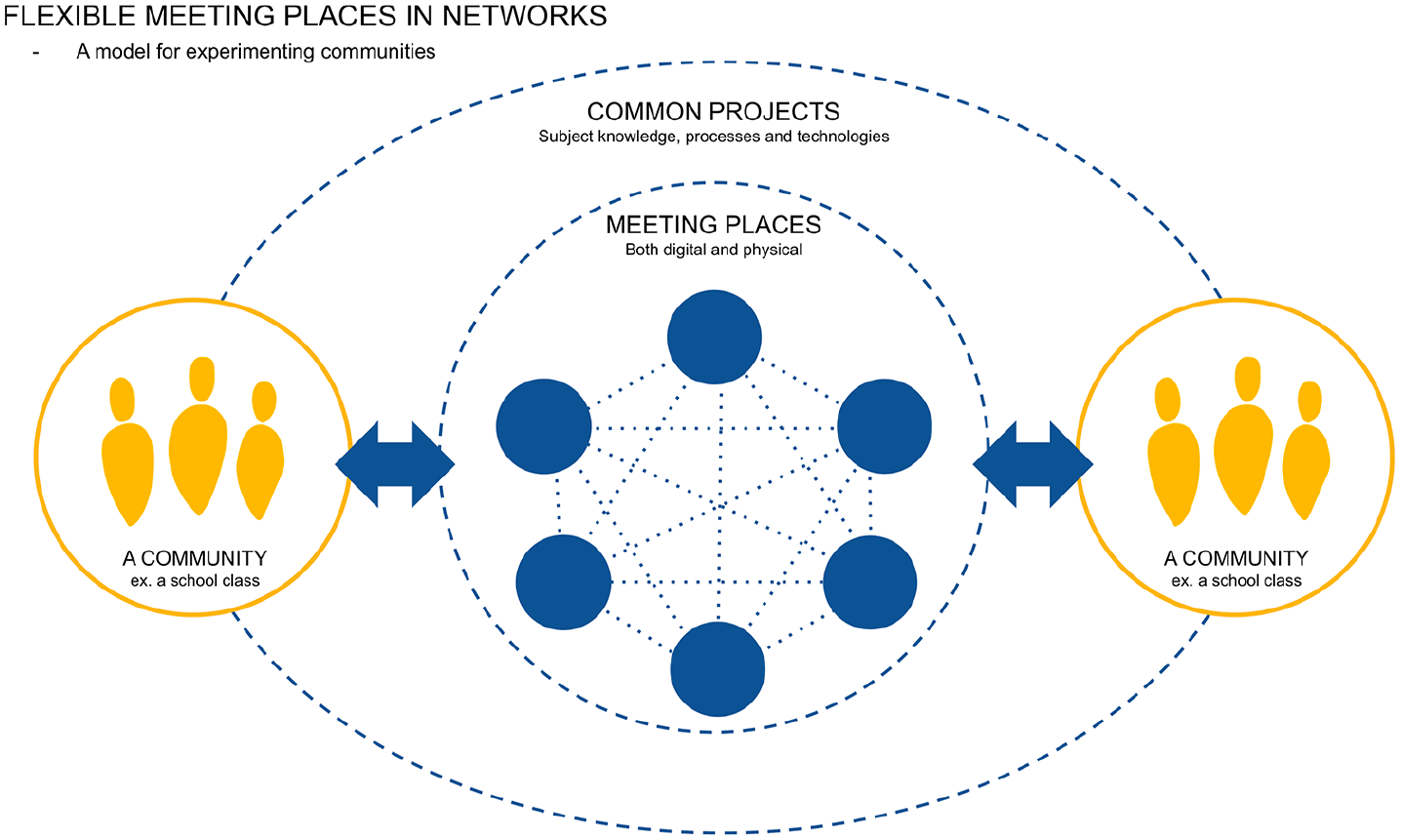
The flexible meeting place (Forsøg Med Assisteret Fjernundervisning i folkeskolen: ASSIST, 2018; Thestrup et al., 2018).
We call the model for The Flexible Meeting Place (Thestrup et al., 2018). To the left and to the right we have in total two communities. It can be a school class, a group in a preschool or another entity. These two communities are connected in a small network of in this case simply two partners. They do have some projects together that they have agreed upon doing. The themes they are working with include also how and when to use technologies to communicate, experiment and produce together between the two school classes.
Notice that the outer circle goes directly down in the middle of each community. It is because we recognise that each community are working with the themes, the tools, the materials and spaces in ways, that are both locally based and sometimes only meant for themselves and sometimes in ways, that are in direct communication with the other partner. The outer circle consists of dots to indicate, that these themes or questions, that are to be investigated, might change over time, because the experiments with tools, materials and spaces might take the process in other and new directions.
The inner circle represents the actual media ecology, that the cooperation takes place through. Notice that this cooperation can take place in both physical and virtual spaces, if the communities do have the possibility to be in direct contact either through visiting each other or meeting each other in the same physical location somewhere between them. The six blue smaller circles indicate six spaces where the cooperation takes place. It is not because there only exists six different ways of doing this. The number is indefinite and depends on the situation. The same goes for who is communicating through what spaces. This means that children can exchange with other children with or without assistants and teachers and during this both play and experiment. In principle, all the different spaces can be communicating, experimenting and producing together. It requires an ongoing reflection by the participants on what to do and how to make that happen. Some spaces in the media ecology might even not be used anymore and new ones might present themselves during the projects. The inner circle is dotted to indicate exactly that.
During the ASSIST-project, we realised that the model not necessarily represent as starting point for networked learning. It represents a visualisation of how one could understand and organise a media ecology for networked cooperation. The starting point might be quite different, if one is not in a project developing networked learning. Therefore, one could place the flexible meeting place in a process of four different phases. We, therefore, placed The Flexible Meeting Place in a process where a school develops its contact with other schools around the world. The process we name Flexible Meeting Places in Networks and visualised it in the following model (Figure 2).
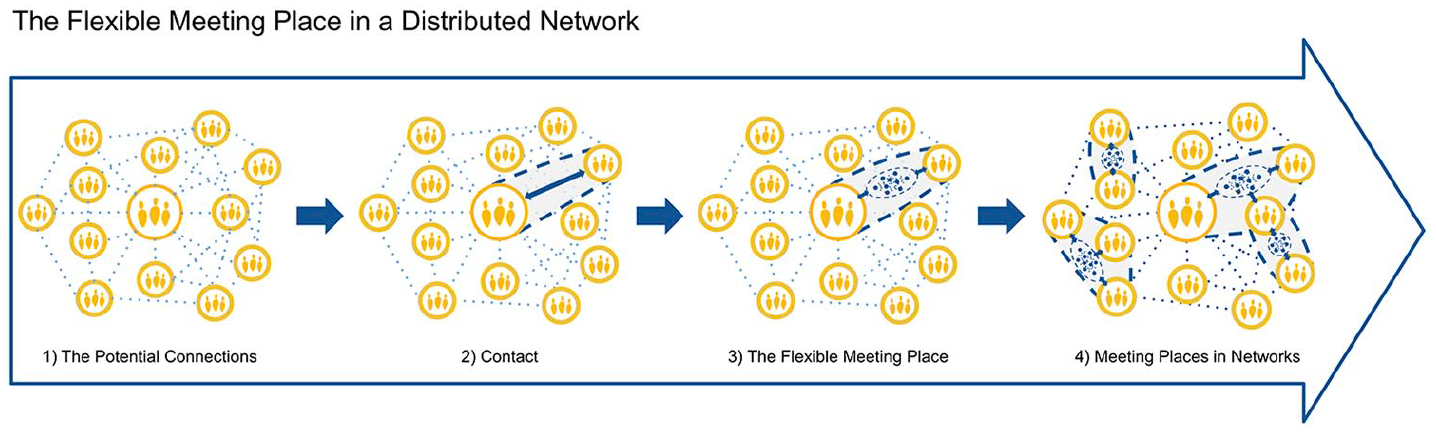
The flexible meeting place in a distributed network.
In the first phase, a given class or school might not experience, that they are part of any networks, even though individual teachers and children are due to their own use of mobile phones, tablets or laptops. Some teachers might even have started using the Internet while teaching, but the school administration does not know this. As there exists a vast and global network around the school or the class, but might call this first phase The Potential Connections. The teacher and children in the school class need to find someone to establish contact with or something to be inspired or challenged by. In this phase, the teacher and the class are probably quite occupied by looking for someone or something. Probably, the first attempt is simply to follow somebody on one or another kind of social media.
The second phase called Contact would then be when the teacher or the class actually get some kind of contact and start establishing some kind of collaboration through a very limited set of communication possibilities. An example of this could be talking together on a video channel. Probably one cannot talk about a media ecology, as it is too early to establish a practice. But there is some kind of exchange happening between two partners, and a media ecology can become a possibility. The third phase is then The Flexible Meeting Place, with a media ecology defined, used and changed by the partners in this particular network. But there is a fourth phase, as the flexible meeting place might be or become a limited network functioning separated from other networks.
The fourth phase could be called Meeting Places in Networks. Here, the teacher and the class and school have many different collaborations in many different networks. In some situations, the class is still searching for information as in the first phase. In others, they have established contact and in others yet, they have developed a flexible meeting place. The four phases are constituted of the establishing of one or more media ecologies, but also an awareness of being part of a global, vast and everchanging network. The teacher and class simply see themselves as individuals and as a class as part of this network of possibilities. Some of these possibilities, they create themselves, others they take part in and develop further. The awareness changes from phase 1 to phase 4, even though the teacher and the children might experience many situations in the future, where they have to start from the beginning establishing collaboration. A part of being in this fourth phase is that they play different roles in different networks. They are always physical and local centres as explained further down in this text, but they are also global and part of teaching that goes on several places at once and not only at one physical place.
The four phases, of course, also have some potentials and challenges regarding teaching methods. We suggest understanding the teacher and the children in the class as an experimenting community (Thestrup and Caprani, 2010), that at the core of the pedagogy and culture has the experiment. The class is together in investigation and trying to find answers to important questions on both what themes to work with and how to use the technology for the media ecology both in class and in collaboration. A class going from phase 1 to phase 4 simply needs to be reflective and ready for changes and the establishing of new practises around different kinds of technology. The class also needs to understand itself as a local experimenting community that might be part of other experimenting communities in the different networks they are involved in or on the verge of being involved in. The class is also a community, as they might come across other groups of people, who are not in an educational system, but with whom they can form a community around common interests and questions. The community can become an important node in a distributed network of nodes, that engage and interact with each other and not only a node in a centralised network broadcasting to a number of recipients.
Further development of the flexible meeting place
Based upon the above a series of future questions arise, when the media ecology becomes the centre of the possible connections between schools or kindergartens or for that matter between educational institutions and all other kind of encounters with individuals, groups or cultures on all kinds of platforms. Informal modes of learning and playing and producing common cultures will be necessary to find ways of understanding, activating and formulating. Some of these partners might not even be schools or might not have or want designated school buildings to work and learn from and thereby demand more reflection be the teachers and the class upon who they are working with.
One way to do that is to understand a given school class as a centre of the world. We suggest that one could name the children and the teachers as searchers in a networked school (Garde-Tschertok and Gottlieb, 2013) looking for inspiration, knowledge and common action in exchange with the outside world using and establishing a flexible meeting place. This networked school exists locally, regionally and globally at the same time and is in that sense glocal, as the global and the local exist simultaneously, interconnected and interdependent (Robertson, 2013; Roudometof, 2016). The networked school seems to represent both the possibility to make local adaptations or interpretations of global forces, and at the same time, the possibility to start pushing local forces and through that maybe have some influence on a more global level. Again it is worth noticing that the networked school can do this in a combination of formal and more informal physical and virtual spaces in the media ecology.
Every single school class might of course be different in the sense, that every school or kindergarten can have local versions of national or international pedagogies, different views of the world and children’s competences in play cultures and playful learning. But at the same time, the possible encounter of people might change, challenge and support the ongoing understanding of each other and the ongoing negotiations between the participants on the flexible meeting place in question. Any kind of encounter between schools might activate the need to understand differences or start processes of dealing with differences and new possible connections. The school class might start up looking for what is in common with others and how to be creative together (Gauntlett and Thomsen, 2013). Playing and experimenting together in informal processes through the Internet led by children is also a possibility to be researched further on (Burke and Marsh, 2013; Thestrup and Pedersen, 2020). Any media ecology needs to acknowledge that the ecology probably will consist of both formal and informal forms of communication, especially if the school class is going to meet people placed outside school or any other formalised educational system. The teachers and the children will have to reflect upon not only what to communicate, but also how to communicate. Is the form of communication intended from both sides supporting the attempt to discuss, play or produce something together?
Teachers and assistants at two schools might agree in advance, what any given topic or theme is, but being a searcher also means, that the class might come across new and vital information, hitherto unknown expressions or interesting intentions by someone else outside the local school or classroom. It will then be possibility that the search takes on new directions and becomes a joint venture involving more schools and more groups of people or individuals, that are not part of any educational system, but what could become a networked school. So, the class has to reflect not only on how to communicate to understand and change differences, but it also has to reflect upon, where this is going. What are we investigating and where could this go?
So being a searcher could imply an openness towards both others outside the local school, but also an openness towards one’s own pedagogical methods and objectives. On all levels, other people in the world could have ideas, suggestions or practises to be inspired by and adapted to local practise. If the teacher or the class insists on only one way of working or only one theme to be understood in only one predetermined way, then it will be difficult or even impossible to work, play and learn together. One has locally to determine if the pedagogy at hand is understood as closed or open? A closed pedagogy will primarily only use a media ecology as a way to get certain informations for a local use. A network then can become a place for primarily answers, not for questions. Of course, it also depends on the very purpose of the teaching in a class, but if the teaching is meant to be part of a local, regional or global network, then one has to activate a certain openness towards the world.
It is, however, not that simple, that the local teacher and class has to accept everything as it might be suggested by someone else. On the contrary, searchers are some, who also understand themselves as some, who want to tell about something to others, produce and show and involve others in common processes. The media ecology then has the purpose to engage the class in parts of the world and engage parts of the world in what the class is up to at the moment. In this process, the children in the school class might also have something, they want to do and let a given collaboration take a certain direction.
When a given media ecology is being formed, one also has to take into account quite a few other challenges. A classroom, a makerspace or any other physical room in school is primarily based on being a closed entity, where knowledge is delivered by the teacher or the search for it is set up in a certain number of exercises in a certain order. Tools, materials, spaces and processes do have their tradition where the sense of being in a network does not matter much. Introducing digital media might change all aspects of the existing tradition and digital media might be changed through the existing tradition.
It will also be necessary to think in the connections between the analogue and the digital or virtual spaces in the media ecology. In the analogue space, digital media might be new and, in the virtual, the analogue might seem unimportant. But the connection can happen in several ways that even do not have to rely on direct technical solutions. One simple way is to document a production process through a mobile or edit it into a how-to-do-it video that can be used by others if they want to engage in the processes suggested. These videos can be accompanied by online meetings, where reasons are talked about and new ideas are suggested. The ideas can then be carried out in the local educational space and again be documented and shared. Another way is to establish virtual spaces, where one can play and build like in the online game Minecraft. One can build together in these environments and one can transfer objects from Minecraft by simply making a new version of, for instance, a house in the physical and local space. This house now exists in the following two versions: the one built digitally in a virtual version and in a version outside Minecraft build in, for instance, cardboard and electric cables. The point is not to copy from space to space, but to transform and, thereby, inspire and challenge each other.
The final and daring suggestion is to think the way the experimenting community works and communicates as an Open Laboratory (Thestrup, 2013; Thestrup and Robinson, 2016). This openness covers at least three areas. It had first of all to do with being open to experimenting and playing with different kind of digital and analogue combinations. The second is to be open to the world outside the local makerspace, school or kindergarten being part of a networked world. The third and final one is to understand the pedagogical methods and principles as open and not closed. The open laboratory is a space that can be both physical and virtual. It can be specific spaces in the media ecology or it can spread out in several spaces focusing on the connection and communication between these spaces and between these spaces and other spaces outside the media ecology. No matter how it is done, the point is to let elements meet, that might not have met before and literally ask to see how it could be done. It can be anything from constructing new narratives, new uses of technologies or even new technologies and all of this in a vibrant, changeable media ecology.
An open laboratory cannot be defined through a certain predefined set of tools, materials, bodies, spaces or processes, but what is happening with any given set of tools, materials, bodies, spaces or processes. All this is at any given moment open to investigation and new-construction. One can expect people with quite different knowledge and abilities in an open laboratory and moments, where something is being used, re-mixed and re-used for other purposes and areas in life. No traditions are in advance denied access to the open laboratory, but everybody must accept that they are in the open laboratory to be challenged, inspired and possibly changed.
Conclusion
In the ASSIST-project, networked learning became the answer on how to organise the communication between the schools, where teachers as the experts and the local assistants became part of a network, where everybody supported each other and worked both locally and globally. Networked learning in a media ecology became a reality and it was possible to identify and formulate The Flexible Meeting Place as a model for how the collaboration between schools could take place. This gave the possibility to understand the collaboration and being part of several networks as a process divided in four phases. It also calls for future reflections and research upon the learning situation, where the teachers, the assistants and the children can be seen as experimenting communities learning in open laboratories in what might develop into networked schools.
For teachers, assistants and children at schools without the possibility to cover all subjects, it will be a possibility to do so through a collaboration, where everybody involved will be able to add, exchange and do further development on subjects, local conditions, digital connections and pedagogies. For all schools, it will be a possibility to increase the engagement with other schools and other parties around the world through establishing and becoming an active part of one or more networks. Distance teaching becomes networked learning in both cases.
Footnotes
Funding
The author(s) received no financial support for the research, authorship, and/or publication of this article.
