




Abstract
This article is about how to work with young children’s online communication in the kindergarten and how the children can acquire knowledge of other cultures through this online communication. The article presents various projects in which online communication between kindergartens has been attempted. Then the article will argue about the importance of supporting kindergarten children to be able to act in a globalized, mediatized and digitized world, both through a reflection on how society is changing and through a description of how children today use digital technologies. Finally, the article also suggests a future media pedagogy in kindergarten.
In this article, I will present and discuss activities from four projects involving children’s encounters with other cultures through online communication. In the first part of the article, I will describe activities in the four projects where I have used various forms of online communication along with colleagues, kindergarten educators and children. The children in Danish kindergartens are normally between 3 and 6 years old. In the second part, I will provide justifications for the projects, by describing the societal change from an educational technological perspective, focusing on kindergarten children’s access to, interaction with and their concrete use of digital technologies.
Experiences with online communication in kindergartens
Around the year 2000, I started to think that kindergarten educators should relate to children’s interest in using information and communications technology (ICT) (as we called it at the time) and integrate this into the daily educational work. Together with various colleagues, I started doing projects involving the use of digital technologies: first, in international projects and then also in Danish projects. In some of these projects, we experimented with other forms of online communication, which are detailed below. The Danish project was the only research project, the knowledge collected from the other projects are based solely on general experience.
The Media Playing Communities project
The first project where we involved children’s contact across borders was in a Lifelong Learning Programme European Union (EU) project ‘Media Playing Communities’ (mPc) (2007–2009), where communication between other kindergartens in other countries took place. 1 Partly through mobility visits and conferences, where some children participated together with their parents and kindergarten educators, partly by the children sharing pictures, drawings and small messages via mail or on Flickr and finally by establishing a web-cam connection between two contemporaries’ conferences.
The project idea was, in addition to inspiring increased and more playful involvement of ICT in kindergartens, that all participating kindergartens should have contact with an institution, school, business or other outside the kindergarten. In this way, the children were able to communicate their own culture to others and to get to know other cultures through the responses (e.g. in words, pictures) they received. The form of communication was not only digital, as few kindergartens had Internet at the time and it was before tablets and the intuitive smartphone. Instead, they could make drawings on paper, which were scanned, printed and then distributed as exhibits at a library or business. They could also send the scanned drawings or pictures to a kindergarten in another country.
In the project, they experimented with letting a group of children in a Danish kindergarten take some pictures, manipulate them and put them in a row and compose a story. Some children in another kindergarten were given the task of re-ordering the pictures and composing their own new story inspired by the pictures, which the kindergarten educator wrote down and then sent them back to the first kindergarten. Some children made pictures and drawings about something that happened in the kindergarten, for example, about the Christmas or Easter traditions, put them on Flickr, so that the children from the kindergarten could learn about the traditions of their country. Here is a picture from an Austrian girl, Vici, speaking about the Easter traditions in her country and in the kindergarten (Figure 1).
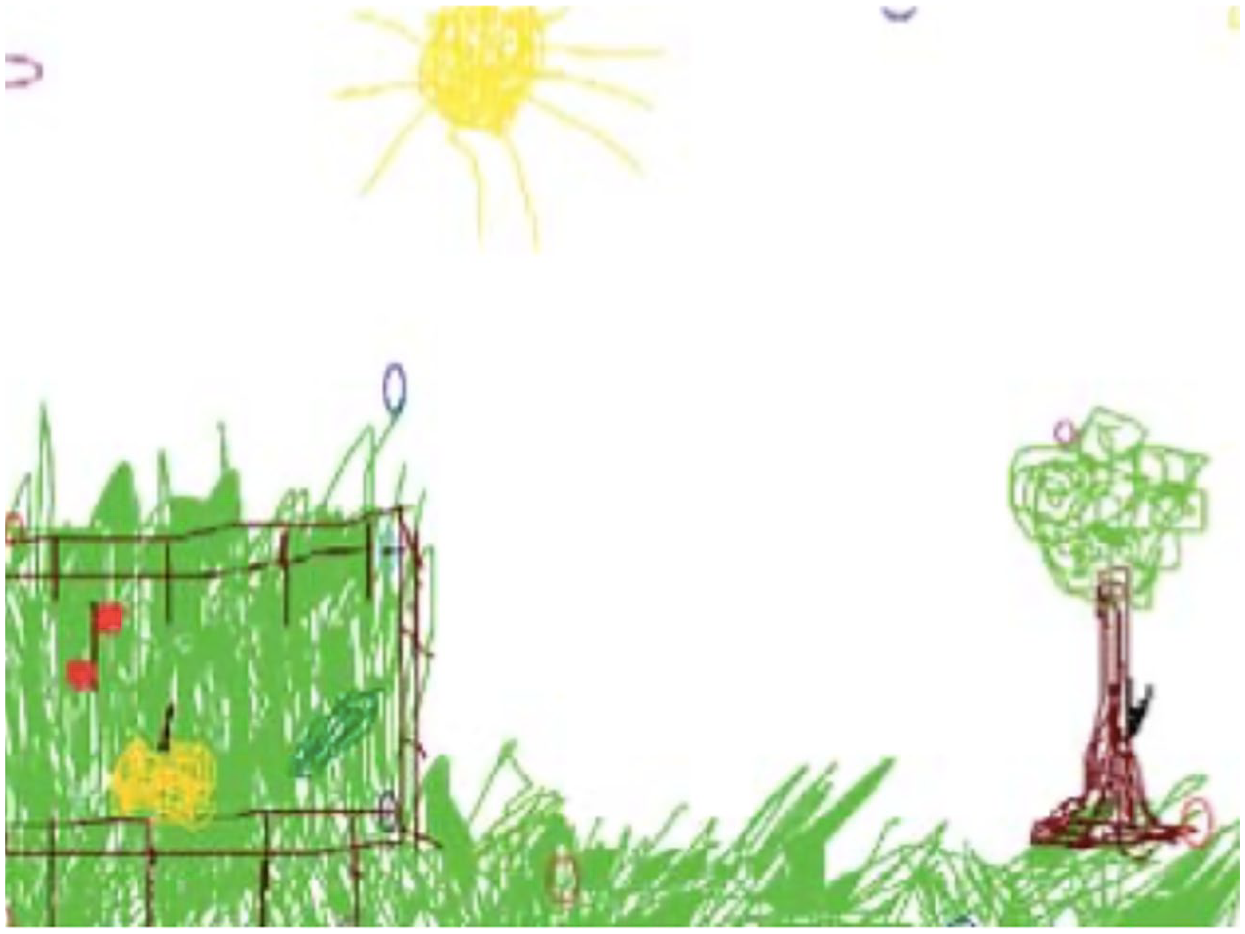
Picture – ‘Easterbunny has brought 12 eggs for you . . . Can you find them? Easter rabbit is also hidden on the picture, but you can only see 1 ear. Happy easter holi- days and have fun – all the best from Vici (I ‘m 6 years old and attend 1st class primary school . . .)’ (Søndergaard, 2009).
The project involved a series of mobility visits where a small group of children from the other participating countries visited a kindergarten in one of the other countries, together with one of their parents and their kindergarten educator. Here, the children experienced other educational cultures and structures, and it transpired that children from kindergartens, where the play was the main focus, had difficulty engaging in activities in kindergartens with a strict educational structure. However, the children participated gladly in joint activities under looser structures.
The kindergarten educators generally had difficulty getting started with the communication activities, and where they succeeded, no one was able to maintain contact. This was despite the fact that the kindergarten educators had met each other at the mobility visits and at conferences.
The children experimented with the online streaming at the two parallel conferences. Some children felt that it was natural for them that they could just go to the camera and present the products they had made in an activity to children from other kindergartens in other countries. The direct communication was of course challenged by the children’s other languages.
The eTwinning project
Later, I tested the contact between children and their kindergartens in the Nordic countries in an eTwinning project (2011–2012), where contact was established between kindergartens and where the kindergarten educators were supposed to have contact by sending other materials to each other. 2 It was in the context of development of the large European school collaboration platform, eTwinning, which would also allow international kindergarten cooperation, the Nordic countries Ministries of Education gathered a smaller group of kindergarten educators from each country and let them collaborate across the borders.
The plan was that after inspirational cross-national meetings, they should make projects with the children across their kindergartens. The project was a smaller version of the mPc project, but the idea was that there would be fewer language challenges among Nordic kindergarten educators and children, than between European kindergarten educators and children. Surprisingly the results were the same as in the mPc project. There was great willingness among the educators when they met at the inspirational meetings, where specific collaborations were agreed, but when they returned to everyday life in their kindergartens they forgot to keep in touch.
The DRD project
In a Danish national research project ‘DRD’ (2015) initiated by the National Association of Municipalities in Denmark and the Danish Ministry of Education, one of the sub-projects had to answer a research question on how digital technologies can support the framework for children’s communities. 3 This project mainly examined how digital technologies could support the educational framework in kindergartens. However, one of the participating kindergartens wanted to explore how Skype could be used for immigrant children and children visiting Denmark for a few years with their parents, so they could be in contact with children from their home country and keep their mother tongue intact.
At that time, there was a child from Greenland in the kindergarten who missed her homeland a lot. At first, the educators decided to make a project about Greenland, but they found that it was not enough. They had the idea to use Skype, and as one of the educators said in an interview, ‘How can we do it so we’re almost there?’. The idea was that someone in Greenland should walk around with a smartphone filming in Skype, then it would almost be like being there. This project was never realized, partly because they had difficulty finding a contact person in Greenland and partly because the girl moved back to Greenland before they got the project started. However, the idea was created and they wanted to test it with other children.
The test in online communication which I observed in the kindergarten was with two Polish children who were to be in Denmark for a couple of years and then they would move back to Poland with their parents. Therefore, the kindergarten educators would test how they could support the children to maintain their mother tongue, even outside the family. A contact was made with a Polish-speaking kindergarten educator and a Skype meeting was arranged to take place while I visited the kindergarten. When I came to the kindergarten, the kindergarten educators had forgotten about the appointment and the Polish-speaking children were visiting another child from the kindergarten at home because of a birthday. When they returned to the kindergarten, the kindergarten educators quickly established a Skype connection and the meeting could begin. However, the children were by now not ready to Skype with a stranger, so they did not say anything at all, and the kindergarten educators never managed to get the children to speak in the Skype conversation.
This description of a project that went completely wrong is included in the article to show how important it is that as an educator you do not do Skype conversations or other online communication with children unexpectedly or without proper preparation. We gained similar experience from other tests in the DRD project, for example, in a kindergarten where they also would work with online communication, where they set up a Skype station inside the kindergarten and one out in the playground, so the children could learn how to use Skype. In this test, the children saw no purpose in communicating online with other children they could see through a window and which they could just go outside or in to communicate with. The children did not see the idea of Skype as an educational or communicative tool, until after the summer holiday period where they had merged with another kindergarten in town. After that, the children would enjoy to Skype with the children in the other kindergarten, who they had been playing with during the summer holiday period.
The global friendship kindergartens project
When I visited a university in Ghana (2018) in connection with our student exchange programme, a small project on online communication between Danish and Ghanaian kindergartens was established with inspiration in Global Schools projects. 4 The idea of the project was to let children from Danish kindergartens Skype with children from Ghanaian kindergartens, after in each of the kindergartens they had made small projects about culture in other countries and had made a small video that presents the culture in their kindergarten. Again, the goal for the project was that the children could be in touch after the project with continuous Skype conversations where they could share life experiences, ideas for play and present their cultural activities to each other. As part of the visit to Ghana, two tests were conducted where children communicated on Skype. The Danish kindergartens were supported by some of my students who were working on the module Media and Digital Culture.
Both children in Denmark and in Ghana had experience with the use of digital technologies in their everyday lives. We visited both a public preschool and a private preschool in Ghana, and we saw how the children in the private preschool were allowed to play with or watch YouTube on their parents’ smartphones, when they were picked up from school. The children in the public preschool were not picked up in cars, so we did not see them with their parents, but when they got access to our iPads, they had no trouble operating them. They filmed each other and then watched the movie clips together.
The children in each of the two countries made a video about their daily life in the kindergartens together with their kindergarten educators, and they were sent to a kindergarten in the other country. Here, the children watched the videos from the other country and talked with their kindergarten educators about the other cultures. At an agreed time while I was in Ghana, the children in each of the Danish kindergartens had a Skype meeting with children from the preschool in Ghana, where they sang a song for the other kindergarten, showed their kindergarten and eventually the children sang the song – head, shoulders, knees and toes together. Singing together posed some real challenges due to delays on the Internet while the rest of the Skype conversation went fine. However, the Internet was so lacking in one of the kindergartens that we had to give up the Skype meeting after some time. This project seemed a success, because in all the participating kindergartens the children were very enthusiastic and active in communication, and because we did not experience major language barriers.
In these four very other projects, we gained experience, partly in relation to the children’s immediate experiences with a trans-institutional and a transnational contact, and partly in relation to didactic and pedagogical problems that arose in the implementation of the projects. All the tests I have been involved with have started off well, with great enthusiasm from both children and kindergarten educators, but they were not continued as researchers and consultants were no longer affiliated with the project. In the following, I will argue theoretically for projects similar to those described above.
A changing society
Digital media has become an important part of everyday life for both children and adults in an increasingly digitalized and globalized world. Most of us will find it difficult to imagine how we can manage without digital technologies, digital media or media at all, and many adults also have difficulty understanding the changes in the world that globalization brings.
The concept of mediatization is a good proposition of an understanding framework that allows us to embrace and understand media usage in the modern world. It is an expression of the overall process of modernization that takes place in the late- or postmodern society. Stig Hjarvard (2013), a Danish professor of media studies, defines the concept in this way: By the mediatization of culture and society we understand the process whereby culture and society to an increasing degree become dependent on the media and their logic. This process is characterized by a duality, in that the media have become integrated into the operations of other social institutions and cultural spheres, while also acquiring the status of social institutions in their own right. (p. 17)
The media, on the one hand, are invisible and everywhere, and at the same time they have emerged as media institutions, such as media houses, TV stations and newspapers, but also as major international social media companies such as Facebook, Google and Apple. Mediatization challenges our approach to and understanding of communication, behaviour and norms. A particular strength of the concept of mediatization is that it says something about the particular potentials of media use in a particular situation, which is called media affordances, and this allows us to elucidate the relationship between the media on the one hand and social practices, cultural production and communication on the other hand. In doing so, the focus is shifted from the technologies themselves, to the contexts and relationships in which they are embedded, thus emphasizing the importance of applying a broad and relational understanding of technology.
On the other hand, we are also experiencing a digitization process whereby known technologies are being digitized, which basically means that something has been converted to digits (Christensen and Søndergaard, 2014). In digitalization, almost all media as well as storage and transfer of information have been changed to electronic formats. This has resulted in a technological convergence in which digitalization of all media, communication, texts, sound, images and even currency can be converted into a common digital format or language. That is why today we have technologies, such as tablets, which can be used as music players, picture and video recorders and e-books and can be carried and used anywhere. At the same time, technological convergence gives children increased access to communicate, for example, by being able to speak to a technology that translates spoken language into written language. The Danish government’s strategy for a stronger and safer digital society states, Even though Denmark has already become much more digital, we are still at the beginning of the major transition process we are going through. An increasingly digital everyday life means that citizens and businesses have high expectations for a digital public service that comes with time and provides value for the individual in everyday life. (Regeringen and Danske Regioner, 2016: 10)
In addition to mediatization and digitization, we are seeing other changing social processes impacting kindergarten children’s everyday lives. Today, youth culture is characterized by a process of change such as individualization, which Thomas Ziehe (Ziehe and Stubenrauch, 1983) has called ‘cultural release’, a term inspired by Marx explanation about how the proletariat in the early capitalism doubly was released, from both the feudal bounds and from their own means of production. It is not only a positive liberation, and it is not something that an individual can choose from or to. This process of individualization is affecting both younger and older generations, and today, Danish 10-year-old children must make choices that determine their future educational opportunities.
Another societal trend that has an impact on kindergarten children’s daily lives is commercialization. In Denmark, where the children do not wear school uniforms, clothing is an important factor to profile oneself, right down to the kindergarten age. It is about having clothes with the right brands, which in kindergartens may well be other brands than the ones youngsters and adults see as the right ones. In the kindergartens I have visited in Europe, this also applies to the toys where children compete to have toys with the right brand, such as Disney’s ‘Frost’, and to have a lot of it. This toy is also often found in digitalized form as video games and movies, and children’s use of these media influences what they play and the way they play. Thus, the commercialization involves a standardization that makes children go with the same clothes, play the same games and play with the same toys. Today, clothing, media and video games are seen as series with the same brand and with the same logo (Andersen, 2009), and we use both series with other products and series of the same product. For example, children do not only see a section of Peppa Pig at the time, but they see a number of sections one after the other, and at the same time they have Peppa Pig on their clothes, Peppa Pig dolls and Peppa Pig toys. As an example of the commercialization, I have observed a 10-year-old boy, having an Android smartphone with an Apple logo on the back, which he was calling his Samsung iPhone.
Finally, in this section, I will shortly present Hartmut Rosa’s critical theory of social acceleration (Rosa, 2013). He describes several forms of social acceleration which are changing people’s living conditions. First, he describes the technical acceleration that is to be understood as the ever-increasing speed at which new technologies are being invented, and these technologies are making the world smaller. Or, more correctly, the world feels smaller because we can travel from one side of the earth to the other in less than a day, because we can communicate with people elsewhere in the world simultaneously through digital technologies, unlike the time it took to get a letter delivered. Second, there is an acceleration of social change, in which the life cycle of families becomes shorter than a human’s life. People no longer have the same job throughout their lives, and we also change housing more often than we did in the past, which also means that kindergarten children cannot expect, as an adult, to get the same job as one of their parents, and cannot expect to have the same job in their upcoming work life. Therefore, it is not possible to plan in advance what the children will need to learn in order to be ready for the labour market. Third, the pace of life is accelerating, and we need to reach more activities every day. Going to kindergarten is not enough. At the same time, many children, for example, have to learn to swim, attend dance classes and use the digital technologies. In 2016, Danish 3-year-olds had a daily screen time use of just over 1.5 hours, and the consumption increases with age (Heiselberg and Gretlund, 2016).
Children’s use of digital technologies
Around the year 2002, I started to argue that educators in Danish kindergartens should relate to children’s interest in using ICT, as we called it at that time. During visits to kindergartens in a suburban municipality to Copenhagen, I observed that children, who did not have direct access to the digital technologies, included them as concepts in their role play. I saw children walking around with toy bricks against one ear speaking out in the air; ‘Where are you?’ and ‘What are you doing?’ as if they were talking to someone on a mobile phone. On a visit to a kindergarten, I observed some boys who played that they were sitting with a game on a computer. They had taken the box of bricks, emptied it, and put it on the table to look like a computer screen. They then played a game, by inserting bricks into the box, making it look like, as if the bricks had come down over the screen, just like in the computer game Tetrix. Every time they had put a new brick into the box, they typed on the table as if they were using a keyboard.
When I subsequently interviewed children about whether they had access to play computer at home, not many did; however, many told, for example, that their big brother knew someone who had a computer. The computer and the mobile phone were not technologies that children as such, and especially not kindergarten children, had access to. Yet, the technologies were already an integrated part of the children’s play culture. Both of the above technologies were imaginary artefacts in their play and they were the theme of the children’s play. Today, most children in Europe have access to digital technologies such as mobile phones or tablets, even if they do not always have their own, but they often borrow the adults’ phones to be entertained.
According to Chaudron et al. (2018), young children across Europe use digital technologies for relaxation and entertainment, for information and learning, for developing and exercising their creativity and for communicating with the family. They spend most of their time on the technologies, watching video on sites like YouTube or watching on-demand TV shows. In our interview with children in Danish kindergartens in various research projects (Frøkjær et al., 2015; Søndergaard et al., 2018), the children told us that they use phones and tablets at home to watch videos, and also to play other games. These games are often simple learning games where the child must recognize figures, numbers or letters, or these are games where the child has to move a character around in a visual universe. Children’s use of digital technologies for a creative purpose is often simple, such as colouring drawings in a digital drawing book, taking pictures, recording small video clips or creating simple drawings in a drawing programme.
Young children mirror other children’s and adults’ use of the technologies and learn to use them by a trial and error method. They gain some skills in the use of digital technologies at home, but also in Danish kindergartens where many technologies are used. Here, one of the most important activities, in addition to learning games, is that children help to document the daily activities by taking pictures, which some kindergartens put into an eBook app or in an app to make a poster of the pictures, they print and put on the wall.
In a Danish kindergarten participating in the DRD project in a suburban municipality to Copenhagen, I observed two boys sitting on the floor with a tablet, where they had got the task to create some pages in an eBook in which they should present themselves. They had been asked to take a picture of each other, and put it into the eBook, and then they had to write their names under the pictures. On the eBook page, they also had to record a small audio sequence where they each had to tell something about their interests. Once they were done with that, they could paste one of the small figures, built into the app which the children used to call stickers, onto the page. The two boys did what the kindergarten educator expected, but when they came to put the stickers on the page, their activity changed into play that went in a completely other direction: One boy (Boy1) sits with his right hand on the iPad and the left hand on the floor. With two fingers he increase the size of the sticker, making it much bigger than the screen of the iPad, so they eventually could only see one colour. Boy1: ‘It’s white now’. Boy2: ‘It’s snow’. With the left hand, the boy presses the sticker icon and selects a teddy bear. Then he uses the right hand to navigate the iPad, and the left to backs to the floor. Boy2: ‘It is a bear’ Boy1: ‘Now there is xxxxxxx’ (cannot clearly be heard on the recording). This sticker is also made very large. Boy2: ‘Oøøj’ (An expression of enthusiasm). The image is so big that only a reddish colour can be seen. Both boys whine excitedly. Boy1: ‘Now there will be lava’. Boy2: ‘Osse hvitte’ (sounds enthusiastic–cannot be translated). Boy1 presses the icon to select stickers again. This time he chose a balloon with the text ‘Happy Birthday’. The picture is made big, but there are still more colours and the corner of some text on the screen, Boy2: ‘Oh, look right there’. Boy1 says: ‘Look right there’, while pushing the iPad toward some other boys who have come into the room. Then he clicks on the icon again (And the recording is over). (Søndergaard, 2018: 57)
Here, we see two boys who, on the day of the observation, were engaged in an activity, organized on the basis of educational considerations of children’s possible learning with the digital technologies. We saw that the children were trying to do the tasks the kindergarten educator wanted, but over time they were caught up by play and the activity changed. Many kindergarten educators would take action on those children’s play because they would think that the boys did not perform the task, but these boys had a creative approach to the technology in which they created images of snow and lava that could be used in the development of their play. Children seek meaning in the world they live in and which they are currently acquiring. They seek meaning in the activities they participate in, and children use their bodies, their emotions and their senses through their physical participation and learning in the activity (Gulløv, 1999).
It is important to remember that not all children have the same access to digital technologies and knowledge about them, and not all children have the same skills in using the technologies. When Marc Prensky (2012) talks about children as digital natives, it should not be understood that children, as a starting point, have the skills or competencies it requires to be able to handle digital technologies in a creative way, where they not only become passive consumers but become active producers. It must be understood as, the children are born in a digitalized world, and that they do not know anything else. Children are not by nature better at using technology than adults, even though they often approach the technologies in a more playful and creative way than the adults.
Children’s digital Bildung
The German term Bildung, which is a common term in Danish pedagogical literature as ‘dannelse’, cannot be directly translated into English, so I will use the German term, which is used in various texts in English and addresses several phenomena and challenges. The term Bildung refers both to the process in which a person acquires culturally specific skills, knowledge and attitudes, as well as to the outcome of these processes. Therefore, the term Bildung can refer to the learning of individuals, the development of skills and competences, the formation of identity and the shaping of ourselves as human beings. It is a dynamic concept that needs to be seen in a lifelong learning and development perspective and should be seen as something that is constantly changing.
One of the many ways of describing the term Bildung could be that, on the one hand, the concept is about behaving in a formed way, with good manners, and, on the other hand, it is about acting independently and competently, ethically responsible in a democratic society and both on the basis of historical experience (Bundsgaard, 2017). In the didactic thinking, the bildung process takes place within the individual; the task of the education system is to support this process. Bildung, knowledge and learning can in general terms be described as a movement between the subjective and the objective, but the process begins and ends in the subject. The learning process consists of a shuttle movement between the subjective and the objective (Gustavsson, 1998).
Digital bildung involves the acquisition of knowledge and skills that enable people to participate in a mediatized and digitized world, engaged, democratic, independent, competent and in an ethically responsible manner. Digital skills and competences are today a prerequisite for developing and understanding oneself and one’s surroundings in a cultural perspective. It is also a matter of enabling individuals to understand the role of technology in our common lives and to relate to the opportunities and challenges of these technologies, after all, all people must be supported in order to take advantage of the opportunities and challenges that technologies offer us as individuals, in our communities and in the society. It is important to be able to analyse and reflect on the role of technologies in other areas of our lives.
We adapted The Danish Ministry of Education guidelines for the use of ICT in the primary and the secondary school (Undervisningsministeriet, 2010), in which they described four student positions, which are important key positions for students’ learning, and identified four roles that are relevant for kindergarten children in children’s bildung project from the early years and beyond (Christensen et al., 2018):
The child as curious investigator. Not all children are investigating new technologies by themselves and every child needs to be supported to learn and understand the possibilities of the digital technologies they surround themselves with.
The child as critical viewer. Children watch many pictures and movies on other technologies of other quality, and there are many who want to influence them through these virtual media. Therefore, the children must be supported to become critically receptive.
The child as creative participant. Digital technologies can be used as creative tools, but they are easily used for passive entertainment where the children’s play is forgotten. Therefore, children must be supported for creative processes in which digital technologies can be used.
The child as partner in communities. Children use digital technologies with other children or adults if they have the opportunity. At the same time, all the new digital technologies are connected to the Internet, so children need to learn how to engage in online communities.
The digital culture in the kindergartens
With digital culture in kindergartens, on the one hand, we understand the organizational culture that takes into account the influence of mediatization on children, which incorporates children’s interest in and use of digital technologies in ordinary educational practice (Søndergaard, 2013). On the other hand, digital culture in kindergartens can also be used as a term describing the cultures that arise in children’s groups when they have access to and use digital technologies. Developing a digital culture in the kindergarten is not about how much digital equipment is available, but it is about the approach and how the kindergarten educators handle the equipment in their educational practice. It is therefore unfortunate when municipalities and kindergartens have a narrow focus on the amount and cost of new equipment. Mediatization and digitization are inevitable conditions, and there is a need to build a new cultural understanding in the kindergartens of both children and adults, based on these conditions. At the same time, daily life must be organized in relation to an understanding of the digitalization and the mediatization of society.
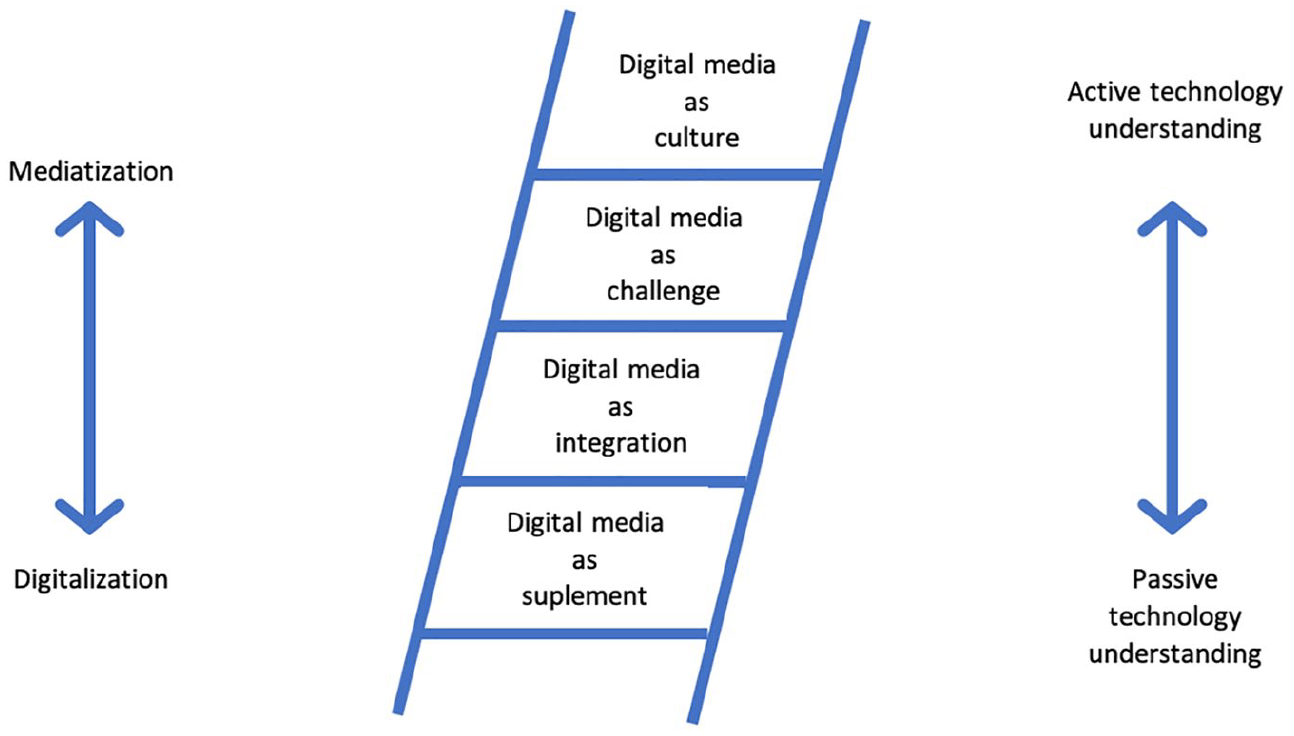
During the work in the projects about use of digital technologies in kindergartens, we have developed a model (in the model, we use the term ‘digital media’) that can be used to capture the digital culture, and how we can understand the use of digital technologies when the focus is on the use in everyday educational practice (Figure 2). In this context, the model is a reflection tool that illuminates other perspectives when digital technologies both support the educational practice and challenge the educational agenda (Christensen and Søndergaard, 2016).
Christensen & Søndergaard, 2016 (p. 76).
The first step on the ladder is ‘Digital media as supplement’, which means that the technologies are essentially used as a complement to the educational practice in the kindergarten. The kindergarten educators allow the children to play with a tablet as a reward for active participation in educational activities that the educators see as important in the kindergarten at this stage. In my observations, I have seen the digital technologies at this stage used both as a reward, but also as a kind of punishment. I have seen kindergarten educators who have had a hard time penetrating a small group of troubled children, using the technology as a distraction, and excluded the children from the group, by giving them access to play on a tablet.
The next step on the ladder is ‘Digital media as integration’; here, the technologies are integrated into the educational practice in accordance with current norms and values. This is done, for example, by involving the iPad in dialogic reading, where children and adults together can develop the story with pictures and text. They can use stories others have written or they can use stories the children create themselves using the tablet.
In the step ‘Digital media as challenge’, the kindergarten educators use the technologies to challenge the kindergarten’s given didactic and pedagogical practice and offer new learning spaces and forms of learning. When children can express themselves in new ways through digital technologies, there will be the opportunity to work in a more experimental practice. The technologies, for example, allow the children to speak at a parent meeting by having produced a presentation on an eBook app, a PowerPoint or a film where they present their ideas. In this way, the adults no longer have a monopoly on providing input for decision-making meetings.
When the use of the technologies acts as ‘Digital media as culture’, the technologies become part of the kindergarten’s routines and rituals and are no longer perceived as anything special. When the technologies are experienced as a challenge that can help change practice, they are still perceived as something special. I have not yet seen a kindergarten which has moved on to that stage.
The model also considers the relationship between digitalization and medialization. With an educational focus on the context and situated practices, the mediatization challenges the pedagogical practice in new ways, for example, the existing learning spaces and forms of learning are challenged, and the kindergarten educator moves up the ladder by changing the relation of the use of time (synchronous and asynchronous), place (physical and virtual) and space (mental and aesthetic) in the didactic and pedagogical planning and practice (Christensen and Søndergaard, 2016).
On the right side of the model, a double arrow shows the relationship between a passive and an active technology understanding. With a passive understanding of technology, technologies are simply used as they appear, the kindergarten educator applies them to what they are designed for. In an active technology understanding in the kindergarten, the use of technologies involve knowledge about children’s handling of the technologies, knowledge of technologies in itself and knowledge of the relationship between technology, children and adults, all in an educational practice (Hasse and Tafdrup, 2012).
Summary comments
As stated at the beginning of this article, my arguments are not based directly on research into the specific theme, they are based on experiences partly from broader research projects and from pilot experiments with children’s online communication between children in other kindergartens, in other cities and in other countries. We do not know much about the importance of children’s contact to knowledge about and understanding of other cultures, but in Danish kindergartens, inclusion is the focus, which means that all children, regardless of cultural background, have an impact on the community.
Everything that has been written so far in this article is a basic argument about why we in the educational field should relate to and experiment with ‘Children’s encounter with other cultures through online communication’ in kindergartens. As we began experimenting with and observing kindergarten children’s online communication and playing via communication on the Internet, many educators did not want children to be sent out into this dangerous space. Our only answer was that this is precisely why we have to teach the children to navigate there.
When the kindergarten educators want the children in their kindergartens to communicate with children in other kindergartens through online communication, the children must have something important to communicate about. Kindergarten children do not get excited about the opportunity to communicate online by itself, even though they like to mirror adults’ behaviour, for example, on smartphones and computers. Even though they generally like to use the technologies, there are a lot of other toys the children like to play with.
Many kindergarten educators have stated that they think it is a good idea to have contact with other kindergartens. I have experienced a general interest in working with other kindergartens through online communication, but I rarely see it happening over a long period of time. In all the years I have worked with online communication between kindergartens, I have only experienced one online collaboration between to kindergartens that has lasted for several years. It was a Danish kindergarten educator who wanted his kindergarten to have contact with another kindergarten, first in the mPc project, and then in the eTwinning project, but at last, he had to settle for a collaboration with another Danish kindergarten, from another region and where there were several socio-cultural differences in the children’s groups. Although the two kindergartens had weekly Skype talks for some years, the relationship still depended on the specific kindergarten educators.
We do not know much about the long-term impact of children’s participation in projects that engage children from other cultures through online communication, and despite both children and kindergarten educators’ interest in online communication, we need to measure the impact of online communication between children through more targeted research. Although we do not have the results of such research, we need to develop a didactics and educational practice that supports ‘Children’s encounter with other cultures through online communication’, because children grow up in a globalized, mediatized and digitized world, and it is important to support children to be able to act in the world in which they live.
Footnotes
Funding
The author(s) received no financial support for the research, authorship and/or publication of this article.
