




Abstract
This article takes as its starting point a recognition of play as meaning-making, and the playground as a rich and dynamic ‘meaning-makerspace’ where children draw moment-to-moment, rapidly and readily on the multiple resources available to them to make signs of their interest evident. These resources are drawn from their own lifeworlds, folkloric and site-specific imagination, transmitted game forms from the past, and their pleasure and affective response to contemporary media. The playground is, therefore, a dynamic site for making and re-making, reflecting the concept of ‘makerspace as mindset’, where creative, collaborative meaning-making occurs ceaselessly in a range of modes. To illustrate this position, we share findings from ‘Playing the Archive’, an ‘Engineering and Physical Sciences Research Council’ funded project exploring archives, spaces and technologies of play. Building upon the Iona and Peter Opie Archive of play from the 1950s–1960s, the project involved ethnographic research in two contemporary London primary school playgrounds, working with children aged 7–11 as co-researchers. A range of multimodal methods were used with the children to gain insights into their play, including iPads as filmmaking devices, chest-mounted GoPro cameras, voice recorders, drawings and mapping of playspaces. The research highlights that contemporary play exists not only in physical playgrounds, but increasingly in globalised ‘virtual playgrounds’ such as video games and social media. While these playworlds may at first appear separate, we identified ways in which virtual play intersects and inflects activity in the physical playground. We argue that play should therefore be seen as a series of ‘laminates’ drawing variously on media culture, folklore and the children’s everyday lived experiences, re-mixed and re-mediated inventively in the playground.
Keywords
Introduction: playing the archive
With its continual noise and motion, chaos and ritual, a children’s playground is a space of complex and diverse meaning-making, incorporating codes and conventions, tradition and improvisation alongside the transmission of oral and media cultures. Folklorists Iona and Peter Opie spent much of the latter part of their lives mapping this territory, collecting games from children in playgrounds in the United Kingdom over a number of years in the second-half of the 19th century (Opie, 1994; Opie and Opie, 1954). Their pioneering, groundbreaking work was brought back to public attention in the project ‘Children’s Games and Songs in the New Media Age’ (2009–2011) which sought both to digitise, and bring into a new collection at the British Library, the audio recordings the Opies had made and, at the same time, to explore contemporary playworlds (Burn and Richards, 2014; Willett et al., 2013). Recently, the playground has again been the site of research in the context of the work of the Opies in the ‘Playing the Archive’ project (2017–2019), funded in the United Kingdom by the Engineering and Physical Sciences Research Council (EPSRC) and involving University College London and the University of Sheffield.
‘Playing the Archive’ set out to explore archives, spaces and technologies of play, building on the legacy of the Opies. In our work on one strand of this larger project, we sought to locate the detail of children’s experience of play in contemporary digital culture, with the children themselves as our guides and co-researchers. We aimed to record the ways in which children make meaning in and through their play, bringing innovation into the field in terms of both research method and theories of meaning-making, as a means to explore the digital media-influenced, as well as folkloric and playful imagination at work, in contemporary play cultures. In this article, we describe and re-theorise the playground as a rich and complex meaning-makerspace, full of invention and child-led agency with both the raw material of popular culture and traditional forms of games.
Our ethnographic work on ‘Playing the Archive’ draws on the paradigm of the sociology of childhood which, in recent years, has foregrounded the agency of children and their right to exist as subjects and social actors in their own right (James, 2009). We wanted to expand the ways in which children could be involved in our data collection, in order to add a dimension of direct contemporary reportage, by using multiple forms of media and techniques of analysis which were not available to the Opies. A further influence on our work was the philosophy of method developed by John Law (2004), which suggested that trying to impose a knowable order on the ‘mess’ of the world, in pursuit of a research agenda, raises many fundamental questions. We recognised in his words their relevance to the complex context of the playground: If much of the world is vague, diffuse or unspecific, slippery, emotional, ephemeral, elusive or indistinct, changes like a kaleidoscope, or doesn’t really have much of a pattern at all, then where does this leave social science? How might we catch some of the realities we are currently missing? Can we know them well? Should we know them? Is ‘knowing’ the metaphor that we need? And if it isn’t, then how might we relate to them? (Law, 2004: 2)
In this quotation, we found a direct parallel with Iona Opie’s sensation of being surrounded by ‘the kaleidoscopic vitality of . . . the people in the playground’ (Opie, 1994: ix). So, in designing the research, we identified that such kaleidoscopic variety and dynamism was best approached by multiple data collection methods, appropriate to movement, sound, gesture, image and speech; methods which ultimately gave us the best possible chance of providing a ‘thick transcription’ (Cowan, 2018: 43) of what we were seeing, and not simply providing essentialist, interpretivist descriptions of these (Geertz, 1973). We found an affinity with the approach of Burnett and Bailey (2014) who, in researching an after-school computer club, found ways to capture and describe the ‘baroque complexity’ of the play-lives of children. Moreover, we wanted to explore the meaning-making practices we were seeing in children’s contemporary play, choosing methods which allowed us to approach such questions as: How are these games enacted, learned and transmitted? How do so many learned ways of being in the playground move across different generations, different spaces and, in an addition to the original collection, different cultures? What is the position of media culture in the enactment of play and has it shifted in recent years?
Playground researchers have found themselves metaphorically standing on the shoulders of the Opie research for a number of years but, as screen-based media forms have come to be a predominant and all-pervasive presence in the intervening time, so they have come to play an even greater role in researching playground activities of all kinds for children of all ages. Recent playground research has therefore found complexity in the notion of ‘tradition’ as a concept on which to hang both the learning and the characterisation of games (Willett et al., 2013), while others have spoken back to the prevailing opinion on the decline of children’s play noting that ‘the picture of children’s free play activities which emerges is predominantly one of vibrancy, creativity, continuity and variety, not one of decline’ (Bishop and Curtis, 2001: 2). We were interested in exploring behaviours and dispositions in playground games which frequently challenged adult stereotypes of children as inert and passive consumers of screen-based media who no longer play with each other.
Our focus, then, was on the ways in which children drew on resources from games and songs which had been learned in the playground, and on how they worked with these repertoires alongside those of digital media culture to produce new variants of games in which to immerse themselves. In this, we acknowledged the influence of both peer cultures noted in childhood studies (Corsaro, 2009) and were interested in the learning relationships between players of various skipping, clapping, rhyming games and more. We were also interested in how play extended beyond the playground itself to virtual spaces and communities, and almost always by reference to peers, their shared media and popular cultural interests. However, we also shared Willett’s (2014) stance on the complexity of interrelationships in the games she observed, in which she noted the over-simplification of describing ‘media references’ in play preferring instead to think about media remixes and inflections on meaning-making, looking for examples of global media cultures alongside referents from the local context. This facility with swinging between local and global contexts of play, re-working and re-combining them in a matter of moments in a game was in evidence in all our visits to the research sites. With the degree of complexity in evidence and the amount of data generated, we needed ways to frame and explore it which were appropriate not only to the sounds heard and recorded but to the performed gestures, interactions and movement through space and time. For this reason, we turned to multimodality as a way of unlocking codes, conventions and constituent elements of the play we, and our child co-researchers, were observing.
Play as meaning-making; playground as meaning-makerspace
Play has been approached from multiple fields and disciplines including philosophy, psychology, psychiatry and anthropology among many others, all attempting to understand children’s dynamic playful activity. This article employs sociocultural view of play but specifically takes a multimodal social semiotic perspective (Kress, 2010). Social semiotics (Hodge and Kress, 1988) is concerned with the social dimensions of meaning, based on the foundation that meanings derive from social action and interaction using semiotic resources as tools (Jewitt et al., 2016). Building upon Halliday’s concept of ‘language as social semiotic’ (1978), social semiotics emphasises the context of sign-making and the agency of sign-makers. The concept of sign-maker is used to refer to both the producer and interpreter of a sign, highlighting that sign-making is always an active, agentive and ongoing process of re-making, and never a straightforward ‘transmission’. Rather than the oft-repeated developmental perspective of ‘learning through play’, where the adult’s agenda for learning is often privileged, a multimodal social semiotic perspective can reposition play as meaning-making, focusing on the meanings to children themselves (Cowan, 2018).
Since the 1990s, a multimodal social semiotic perspective has developed, seeking to examine sign-making in multiple modes beyond language within one comprehensive theoretical frame (Kress and Van Leeuwen, 2001, 2006). Such an approach is particularly relevant for the study of play, where signs are often made in combinations of modes such as gesture, movement, gaze, facial expression, manipulation of objects and speech. A multimodal perspective recognises that different modes offer distinct potentials and limitations for making meaning, but that one mode does not have more or less importance than another. Instead, it calls for us to attend to the multimodal complexity of play, recognising that choices made by sign-makers are agentive and principled, giving insights into children’s interests and understandings. Play is, therefore, recognised as a socially situated sign-making activity in which players draw upon the many modes available to them for representing the meaning they want to express at a particular moment. As they play, children create ‘a momentary condensation’ (Jewitt et al., 2016) of their social experiences including family practices, local folklore, school curricula, global media and the traditions of the playground. Traces of these experiences and interests become apparent as children draw moment-to-moment, rapidly and readily, on the multiple resources available to them in their play.
The material and social resources available to children in playgrounds are particularly significant and different to many other spaces in which children make meaning, such as classrooms. Materially, playgrounds place fewer restrictions upon children in terms of space, volume and large-scale movement than is likely to be the case inside classrooms. Socially, playtimes are positioned as moments outside of formal teaching, with adults (if present) usually acting in a supervisory capacity, and the majority of social interaction happening between children. While still constrained by adults in several ways (e.g. duration of playtimes, enforcement of school rules, physical boundaries such as fences), playtime arguably gives children greater freedom to draw from their wide-ranging experiences than inside classrooms, where particular modes (e.g. linguistic) and forms of meaning-making (such as canonical knowledge given priority in the curriculum) are valued above others (e.g. knowledge of global media and folklore).
The playground is, therefore, a particularly dynamic site for making and re-making meaning, and could be considered to encapsulate a concept of ‘makerspace as mindset’. Like the traditional makerspaces more often used in relation to this term (see Blum-Ross et al., 2019), the playground can be seen as a space where creative, collaborative making occurs ceaselessly in a range of modes. However, unlike traditional makerspaces where traces of making may remain long after making (e.g. models, drawings, constructions, digital artefacts), traces of making in the playground are likely to be embodied, ephemeral and fleeting. This requires tools, methods and dispositions that attempt to attend to the rich, vibrant and dynamic nature of making and re-making meaning in the playground.
Methodology
To address these methodological challenges, we developed a form of participatory, multimodal ethnography, alongside the children, which allowed us to find ways to represent the ‘messy’ and ‘kaleidoscopic’ worlds of children’s play (Law, 2004; Opie, 1994). Since we were not able to be embedded in the playground daily, albeit visiting regularly, we chose to work with a range of written and media methods in order to pay attention to small elements in a larger, complex and dynamic system. We were guided by the concept of a ‘focused ethnography’ (Knoblauch, 2005) in which short-term, intensive, regular field visits replace the traditional embeddedness of anthropological methods. For the subsequent missing ‘insider knowledge’ gained by anthro-ethnographers who are immersed in a certain situation for a longer period of time, we worked in partnership with child researchers and collected a rich range of focused data in forms appropriate to the recording of image, gesture and movement through space, speech, drawing and other forms of multimodal meaning-making.
In pursuit of both the mess and the mass of data needed, we, and the children, used a range of methods including iPads as filmmaking devices, chest-mounted GoPro cameras, voice recorders, binaural sound recording, field notes, drawn data and maps of playspaces. We recorded video of multiple kinds including playground games and tours in multiple perspectives from mid-shot to aerial overview, and point-of-view GoPro recordings foregrounding movement, gesture and use of space. We interviewed children using our own questions and those employed in the original fieldwork by the Opies alongside the children’s own interviews of each other.
Our focused ethnography took place in playgrounds in two London primary schools over the course of half a year, effectively two school terms, from the spring of 2018 to the end of the summer term of that year, visiting roughly once per week. Both schools had very high levels of ethnic diversity and many children spoke English as an additional language. We recruited a team of child researchers in each school, drawing on the expertise and co-operation of the teachers as well as a process of parental consent and information-giving. We worked in each location with a core of 12 child researchers aged between 7 and 11 years, who became both our lead informants and lead co-researchers. Simultaneously, a similar ethnographic approach was adopted by members of the project team at the University of Sheffield, allowing for discussions and analytic comparisons between London and Sheffield. Sound ethical practice (derived from BERA, 2018) informed all work on the project and was reviewed by the university’s ethics committee. All names used in this article are pseudonyms.
Table 1 summarises ways in which data were collected by all the researchers in the field, by us as adult researcher-ethnographers and the children as participant researchers of their own play.
Data collection overview.
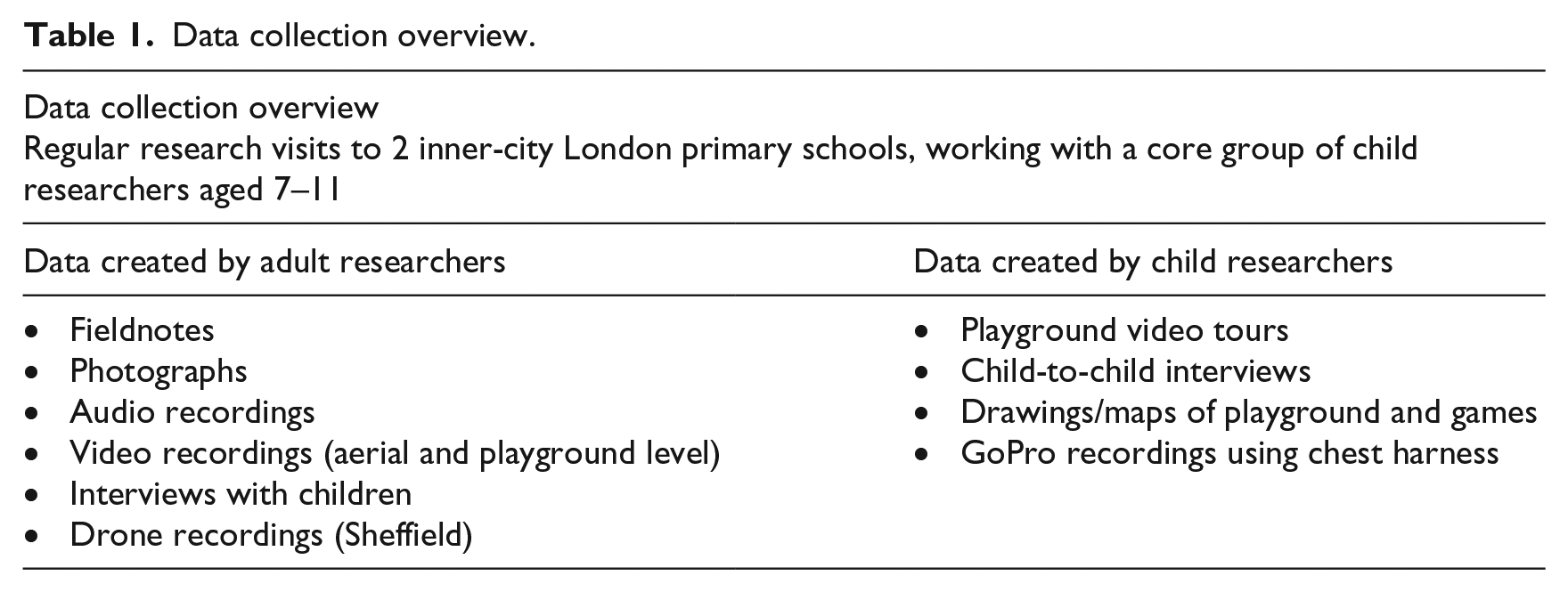
Our working methods on research visits were designed to encourage agency on the part of our child researchers and we began by collecting filmed playground ‘tours’ in one of the schools, at a time when there were no children in the space. Pairs of children filmed the playground and provided rich commentary on how the spaces were regularly and habitually used: there were zones occupied by clapping games, by skipping, by running, by playing ‘King Ball’, sheltered areas, the football pitch, the pirate ship, the designated quiet area by the pond and the secret spaces for more private conversation. We compared these tours with our own recordings of the playground from above during playtimes, and gathered further triangulated data in the form of hand-drawn maps and diagrams created by the children. Voice recorders were distributed to the researchers who proceeded to interview children about their play and we continued to film and record the play in front of us. We conducted regular semi-structured interviews with the children who were members of our research team and shared data back to the whole class and the teachers as regularly as was practicable during busy school days.
Participatory methods arguably led to a change in the power and agentive relationships in the project, as has been reported in other studies (Flewitt et al., 2017; Pahl and Pool, 2011). However, it is worth underlining that although the locus of control in the work moved closer to them, the children were effectively co-producers, rather than co-designers, of the research. They embraced the project at least partly because they had a choice of a range of artefacts with which to produce texts about the raw material of their play practices and partly because they were enthusiastic about making meaning for others in a provisional and playful way. In essence, over the lifetime of the visits to the schools, the project itself became part of the playful meaning-making space of the playground and the children’s immersive engagement in the recording experience produced a rich dataset across a range of play forms.
We were guided throughout our data collection and analysis by the principle of representing the complex reality of play and interaction and not by trying to over-simplify the ‘mess’ (Law, 2004) into essentialist accounts of children’s play worlds. In our analysis of such a large and complex dataset, we were responsive to new and salient themes emerging with the aid of appropriate multimodal analysis. These ranged from traditional forms of thematic coding (Bryman, 2012) through to innovative, multimodal transcription of the embodied meaning-making inherent in children’s movement through the space (Cowan and Kress, 2017). One such example featured in this article is the transcription of children’s clapping games. Since body movement was such a crucial component of these moments of play, it was essential to find a means of closely attending to features such as clapping pattern, gesture and whole-body movement in addition to the spoken/sung rhymes. In this article, this is presented through annotating clapping rhymes with symbols denoting clapping actions (see Figure 1). Clapping games have elsewhere been transcribed in the field of musicology using complex notation on a musical score (Marsh, 1995, 2009). Here, a simplified version is used, positioning symbols above the written rhyme to denote the approximate timing of the actions. In this way, the multimodal transcript design seeks to support close attention to the ways in which clapping games simultaneously combine a range of modes in meaningful and intentional ways.
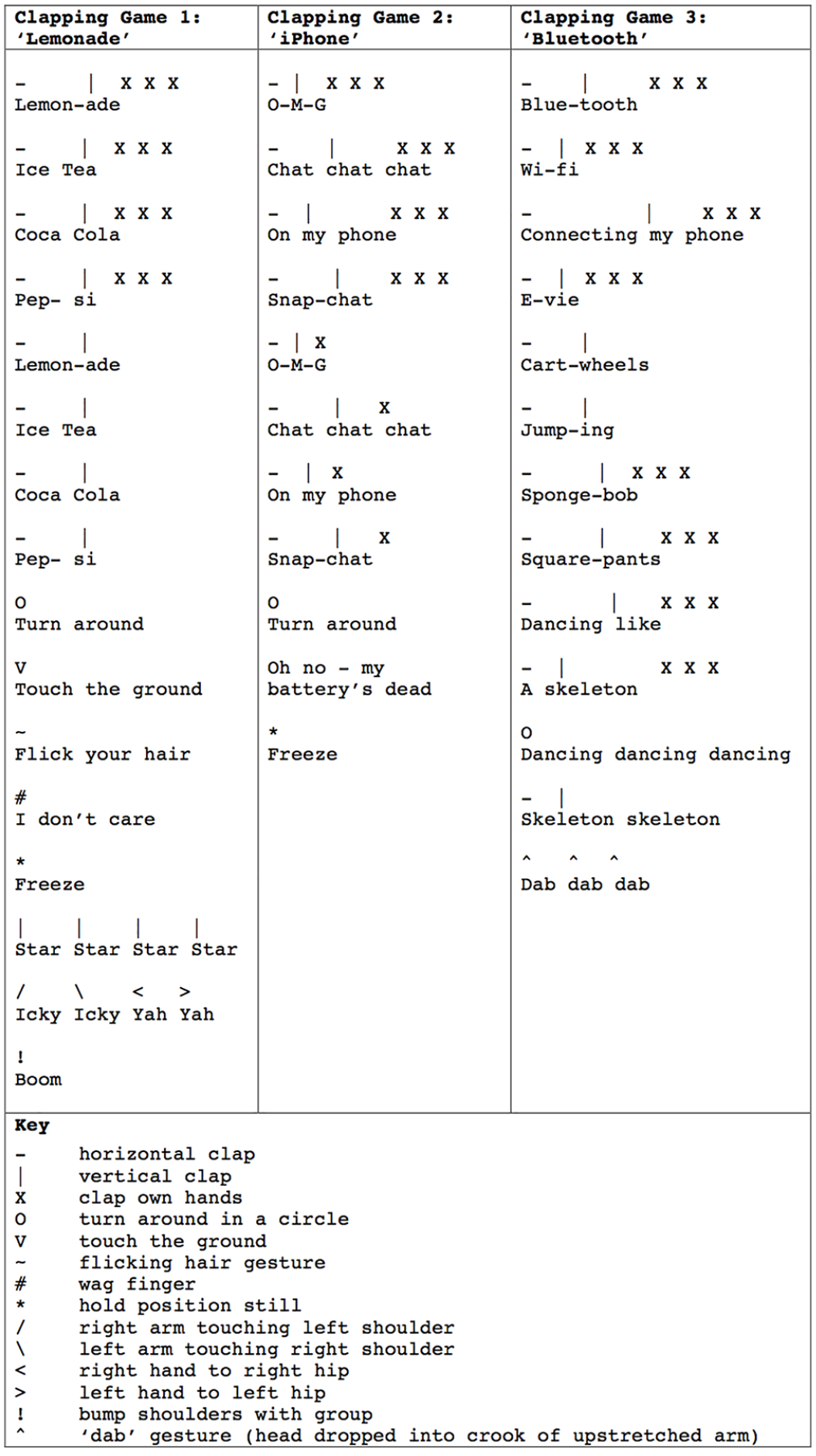
Comparison of three clapping games.
Findings
In order to develop the concept of ‘playground as meaning-making space’, we share four examples of play which were recorded using a mix of the methods outlined earlier. Each of these extracts from the dataset depicts a moment of children’s playful multimodal making and re-making of meaning. Each illustrates complex and layered meaning-making combining folkloric traditions, children’s imagination and popular cultural reference points from children’s media cultures.
Example 1: ‘granny wants a hug’
In the first example, 5 children, between the ages of 10 and 11, play a chasing game they call ‘Granny’ on a tarmacked area of the school playground. They explain that to play the game one player must act as ‘Granny’, pretending to fall asleep at the base (a bench), while the other players run and hide. When Granny wakes up, the children must try to return to base without being caught by Granny.
Hibbah takes on the role of Granny, sitting on a bench, closing her eyes and counting while the other children (Milly, Ruby, David and Joseph) run to far areas of the playground. When she opens her eyes, she says phrases such as ‘Granny wants a hug Ruby!’, coaxing the other players into attempting to return to the bench. As Granny advances forward, the players are careful to keep their distance to avoid being caught. Simultaneously, when players advance towards the base, Granny often retreats to try and guard it. In this way, the children carefully read the space and proximity between each other and the base, as well as attending to Granny’s gaze, looking out for moments of distraction that might allow them to win the game.
The game sometimes results in moments of brief ‘impasse’, where neither Granny nor the other player would move great distances, as if attempting to balance the risks and rewards of movement. In these moments, David often did a move the children called the ‘Take the L’ or the ‘Loser Dance’, lifting his right hand to make an L-shaped sign on his forehead with his finger and thumb, while alternately kicking each leg outwards.
The ‘Take the L’ dance features in Fortnite, an online video game that has gained widespread international popularity since its launch in 2017. In the free-to-play game, 100 online players must attempt to stay alive while eliminating other players, with the last player standing becoming the winner. One feature of gameplay is the ability to use, earn and collect different ‘emotes’ (dances moves). These serve no advantage in battle, but are cosmetic additions to ‘express yourself on the battlefield’ (Epic Games, 2017). The emotes emulate dances from a range of origins, including traditional styles (e.g. ‘The Flapper’ based on the 1920s Charleston) and from popular media culture such as films, TV, social media and music videos (e.g. ‘Ride the Pony’ emulating the ‘Gangnam Style’ dance made famous by the Korean entertainer Psy). ‘Take the L’ appears to draw on the ‘loser’ hand sign popularised in the 1994 film ‘Ace Ventura: Pet Detective’ and a dance performed by the clown Pennywise in the 2017 remake of Stephen King’s horror film ‘It’. The name seems to draw on the phrase ‘take the loss’ used in sports when a defeat is suffered in competition.
We found numerous examples of Fortnite dances being performed in playgrounds throughout the research, across both the London fieldwork schools and also in the Sheffield schools involved in the study. For instance, children would sometimes call the names of different Fortnite dances, challenging others to copy and showcase their moves. We also witnessed Fortnite dances being woven into the fabric of more traditional games, for instance children doing ‘The Floss’ when stationary in games such as ‘Stuck in the Mud’. Often children who had not played the Fortnite game themselves were nonetheless familiar with many of the dances.
David’s use of ‘Take the L’ in the game described earlier often preceded movement forward by Granny or after she had retreated back to the base. In this way, he seemed to be using ‘Take the L’ to disrupt moments of impasse, both as a provocation to be chased and as a taunt for evading capture (as if to communicate, ‘You can’t catch me’). In a noisy playground and at some distance from each other, physical expression conveyed this message, in particular, effectively.
This example demonstrates several layers of making and re-making. First, the Fortnite dance ‘Take the L’ itself has a layered origin incorporating influences from films, re-mediated into a video game, then recreated physically in the playground. Second, the children incorporated moves such as ‘Take the L’ into their traditional playground games in apt and purposeful ways, to serve functions such as taunting or breaking stalemate. In this way, David’s use of ‘Take the L’ shows a global media reference being blended and interwoven with traditional physical pursuit games such as ‘Granny’, highlighting the layered meaning-making of contemporary playground play.
Example 2: ‘oh no my battery’s dead – freeze!’
A popular clapping game we witnessed during our playground observations was a rhyme the children called, ‘Lemonade’. This was observed between pairs and groups of children, usually girls, arranged face-to-face (in pairs) or in a circular formation (as groups). Slight variations were found across the school, but the most common lyrics and actions for ‘Lemonade’ are included in the first column of Figure 1. Symbols have been used to attempt to concisely note the clapping actions and gestures that accompanied the spoken/sung words (see key). During each word (‘lemonade, ice tea, coca-cola, pepsi’), a player claps their partner’s hands horizontally and vertically, followed by a triple clap of their own hands. When the words repeat for a second time, the triple clap is omitted, speeding up delivery of the rhyme. This is followed by several commands with corresponding actions (‘turn around, touch the ground, flick your hair, I don’t care’). On ‘freeze’, all children briefly hold their pose, then clap their partner’s hand vertically (‘star, star, star, star’), before crossing arms across their body (‘icky, icky, yah, yah’) and bumping shoulders with the other player(s) (‘boom’).
During our fieldwork in the playground, girls from the Year 2 class (ages 6–7) told us about another clapping game they called ‘iPhone’. Aisha said she had learned it from her sister, and offered to demonstrate. The lyrics and actions for this clapping game are included in the second column of Figure 1. In ‘iPhone’, the lyrics relate to contemporary global technologies and social media (e.g. the chat abbreviation ‘OMG’, and the social media app ‘Snapchat’). The transcript highlights that while the words had been changed, the clapping actions and gestures for ‘iPhone’ have strong similarities to ‘Lemonade’ (for instance, the partnered claps for each word, followed by a triple clap, which is then omitted when words are repeated). Similarly, ‘iPhone’ uses the same command to hold still and ‘freeze’, although this becomes associated with a battery dying on a phone.
We observed Aisha teaching ‘iPhone’ to her friend Zara during one playtime. Both girls laugh when the clapping game ends, and later that playtime we observed Zara making up her own version and teaching this to another friend, represented in the third column of Figure 1. Again, the clapping actions and gestures have strong similarities to the structure of ‘Lemonade’ and ‘iPhone’, using a repeated horizontal and vertical clap followed by a triple clap which becomes omitted. Across all three versions, there is also incorporation of a whole-body turn on the spot. In Zara’s version, new references to contemporary technologies are included in the lyrics (‘Bluetooth’, ‘Wifi’) as well as references to globally popular children’s media culture (‘Spongebob Squarepants’) and the craze for ‘dabbing’ (a playful gesture that has been popularised particularly through Internet memes). She also incorporated references to the immediate playground environment and action as it was unfolding, noticing a friend doing handstands against the nearby wall (‘Edie, Cartwheel, Jumping’). It seemed that Aisha’s re-making of Lemonade had inspired Zara to create her own re-making of iPhone, keeping the core clapping pattern similar as a consistent anchor, while ‘riffing’ and remixing the lyrics, incorporating a wide range of references from home, the playground and popular culture.
The examples of ‘Lemonade/iPhone/Bluetooth’ demonstrate children’s making and re-making of clapping rhymes in the playground. The children took the core elements of a traditional, well-known clapping game and re-mixed it by adding referents to the global popular culture they were familiar with outside the playground. This re-making shows traces of their interest in new media and their readiness to create and invent with what is readily to hand.
Example 3: ‘everyone watches YouTube’
Ruhana, like many children in the playground, enjoyed watching YouTube and showed extensive knowledge of YouTubers. One playtime we asked Ruhana and her friends (aged 6–7) who watched YouTube, with them telling us, ‘Everyone watches YouTube!’. During several playtimes, we observed Ruhana demonstrating gymnastic positions, including lying on her front and bending her legs over her shoulders. When we asked where she had learned this, she told us it was from ‘Sofie Dossi on YouTube’. Sofie Dossi is a self-taught contortionist and finalist of America’s Got Talent (aged 14 at the time of competing), who herself learned contortion from watching YouTube videos.
One playtime, Ruhana showed us a drawn image that she told us was of the YouTuber LDShadowLady, a UK-based gamer with a channel mainly devoted to the video game Minecraft. She explained to us that she had traced her image on the laptop screen the night before, coloured it in, written LDShadowLady’s real name (Lizzy) beside the drawing and brought it into school (see Figure 2). At morning break, she brought the crumpled piece of paper out into the playground, a physical representation of her hero with whom she could play imaginary games and demonstrate her fandom. The physical artefact was important in the imaginative world she created in the playground and in her play, a bridge between the virtual playspace of the screen and the physically located playspace of the playground. We found in this a direct, artifactual making and re-making a physical manifestation of the co-location in the child’s imagination of the virtual resource of the screen and the resource of pen and paper and an example of a form of ‘artifactual literacy’ described by Pahl and Rowsell (2011) as a powerful connection with home cultures in their work.
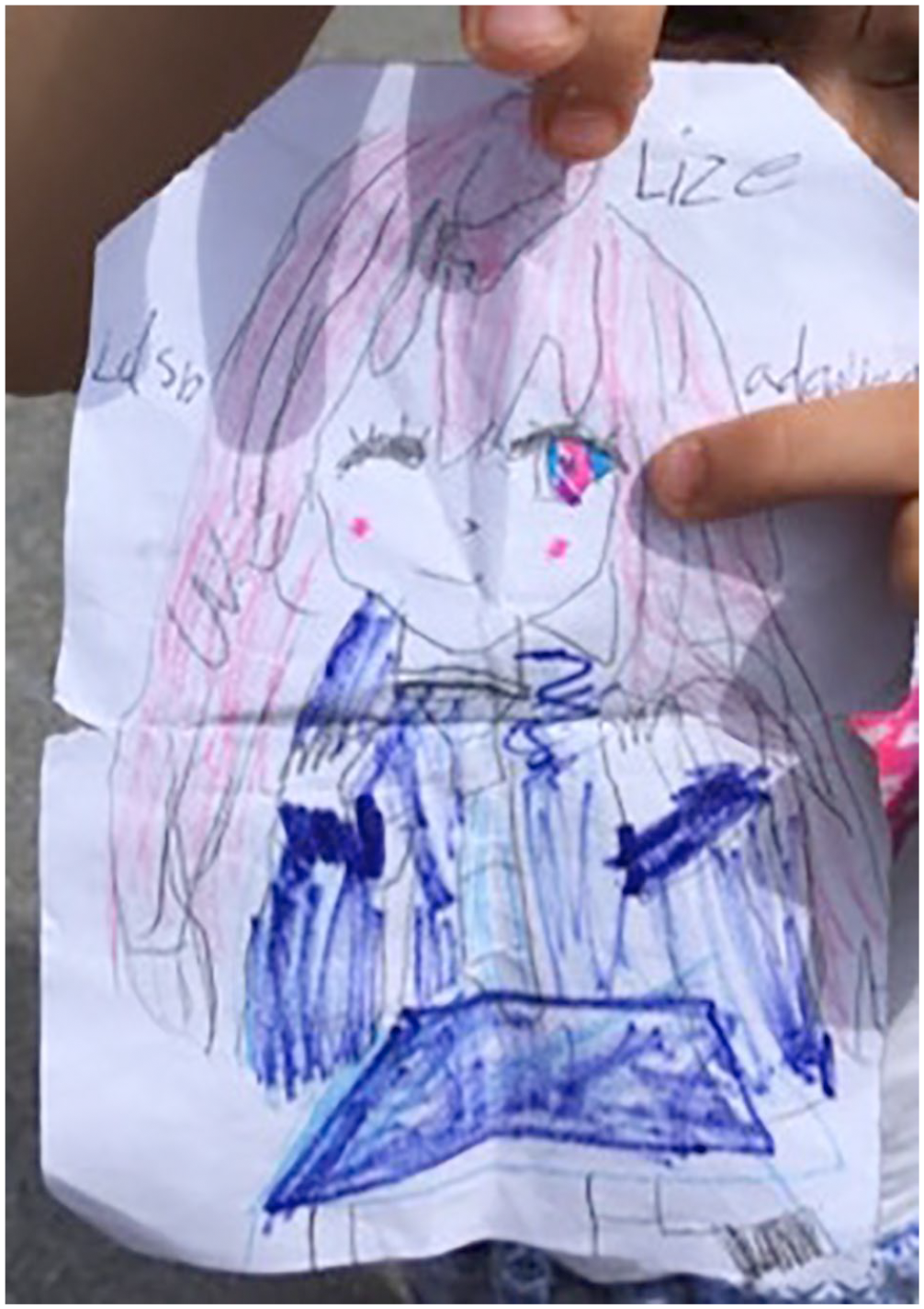
Ruhana’s drawing of YouTuber LDShadowLady.
There were further similarities in this example to the ways in which the Fortnite dances and the clapping games brought artifactual literacies and virtual spaces into play with one another. In addition, a number of children we observed and talked to during the project played at ‘being’ YouTubers. Social media frequently supplanted broadcast media as a key media influence on imaginative play and the YouTubers, creators and maintainers of subscription channels represented key aspirational and devotional figures. When they used their voice recorders, our child researchers often played at being YouTubers themselves, even if in audio form only, using phrases commonly employed by YouTubers and signing off with expressions such as ‘see you on my next video, bye’. Again, we noted the importance of the artefact, in the way the holding of the voice recorder transformed the act of researching into a form of play, allowing the child to take on a new role, just as the drawn image of LDShadowLady on paper carried into the playground made it possible for Ruhana to bridge home and school cultures in her play.
Example 4: ‘VAR ref!’
Football was a particularly popular playtime activity, played on a designated enclosed pitch area of the playground most playtimes. In one play sequence we observed, a group of boys aged between 9 and 11 played an energetic match recorded by Riaz, aged 10, who wore a chest-mounted GoPro camera as he played. During the game, one boy dramatically falls to the ground and, although unhurt, lies prone on the pitch, while Riaz cries out repeatedly: ‘Red card for Lingard, red card for Lingard’. He produces a replica red card from his pocket which becomes part of the play, a material artefact again joining the game.
During our period of data collection, the drama of the 2018 Football World Cup was being played out, with great excitement generated in the playground (including references to players such as England’s Jesse Lingard, as in Riaz’s comment above). The tournament in 2018 saw the first use in a major football competition of Video Assistant Refereeing (VAR), which addressed controversial and marginal decisions made on the pitch. Referees could, and did, indicate with their arms drawing a rectangular screen in the air that they needed help from VAR. They would run to the side of the pitch to consult a screen with an instant playback of key incidents. They would subsequently run back to the field of play, pointing to a penalty spot or brandishing a red card to order a player to leave the field for dangerous play. This happened frequently enough that it became a major element in the play in the football area of the playground, where play was frequently interrupted by controversy and punishment for various offences. The players would often call, ‘VAR ref!’, accompanied by drawing a rectangle in the air, followed by one child running to the pitch’s sidelines, viewing an imaginary monitor and returning to make a verdict on the proposed foul. The games became, as in the earlier observations of children’s play, heavily media-inflected with the whole performance re-enacted and with red cards being brandished.
The children’s football play layered traditional and established rules of football with dramatised references to contemporary media. Making use of the wearable possibilities of a GoPro camera, we were offered rich insights into an activity which, from a distance, might have been dismissed as ‘just’ football, but was revealed to be a creative re-making of an established game. Indeed, screens and media artefacts have been noted as influences on football played in the playground, generating as much interest as actually physically playing or attending football matches, factors noted by Marsh and Bishop (2013). Similarly, Gilje and Silseth (2019) note the ways in which playing football, watching matches and playing video games such as FIFA were closely interconnected in children’s lives. We realised that for the children in the playground, the exuberance and excitement of football play were amplified in the media-referenced performance of the VAR, the award of a ‘red card’ and the simulation of the player lying on the pitch. In this way, the contemporary global culture of televised football made its way into the play as one of the few examples in this dataset of traditional broadcast media inflecting play and undergoing remix in the imaginations and interactions of the children.
Discussion: lifeworlds, folkloric imagination, media remix and community
In what ways can the children’s playground be characterised as a ‘makerspace’? Clearly, the label does not fit the definition which revolves around the creation of material artefacts through problem-solving and improvisatory activity. However, we see from our examples that the resemblance comes instead from considering meaning itself as something to be shaped and made through playful interaction, moment to moment, with whatever is to hand. Just as ‘makerspaces’ are described by reference to ‘maker literacies’ (Marsh et al., 2018), the playground, as a site of literacy ‘events’ (Street, 2003), provides a space for intensive and extensive ‘meaning-making’. The transitory and ephemeral nature of much of the improvisatory moment-to-moment play in the brief spells which the children experience each day during ‘playtimes’ are rich sites of self-directed meaning-making; the playground is a rich meaning-makerspace.
We deliberately position play as meaning-making – active, creative and generative – rather than a straightforward transmission model from player-to-player. Children draw upon a wide range of influences and references, and use the many modes available to them to express these in innovative ways. As noted throughout the examples earlier, many can be traced to the influence of global media of various kinds (social media, broadcast media, digital technologies and online gaming), as has been evidenced in other research on contemporary play (see Burnett, 2016; Giddings, 2007; Willett et al., 2013).
Although ‘Playing the Archive’ did not focus on children’s play in the home environment, we might speculate that influences were not unidirectional from home to playground, but also operated in reverse. Several children in the study told us that they enjoyed playing online games such as Fortnite after school, sometimes meeting up with their school friends or distant family members to play collaboratively in virtual environments. Marlatt (2020) likens Fortnite to a mass social gathering in an ‘ever-expanding, global neighbourhood’ (p. 5), highlighting ways in which online games are reconfiguring play across time and space. With unsupervised outdoor play on the decline in the United Kingdom (particularly in urban areas – see Woolley and Griffin, 2015), we might consider whether games like Fortnite, with their multiplayer virtual environments experienced in real time, might share some similarities with the games of the playground (for instance, hide and seek and pursuit games such as ‘Granny’). In this way, contemporary play exists not only in physical playgrounds, but increasingly also in globalised ‘virtual playgrounds’. At the time of writing, these possibilities are being recognised by the World Health Organization’s ‘#PlayApartTogether’ campaign encouraging people to stay at home and connect remotely during the COVID-19 pandemic (Takashi, 2020). Such initiatives recognise the power of ‘virtual playgrounds’ to enable social play despite physical distance. While online and physical playworlds may at first seem separate, our research identified ways in which they are closely related for the players themselves, with digital play intersecting and inflecting activity in the physical playground, and potentially vice versa.
Through repeated viewing of the data, multimodal methods have allowed us to unpack something of the processes of design and use of resources, attending to the meaning-making in the playground and the ways in which remix and roleplay, improvisation and agency have contributions to make. By reaching out to theoretical models from allied fields such as sociocultural theory and multimodal social semiotics, we can attempt to build hypotheses about the skills and dispositions in evidence and work to question the hierarchies which determine the values which are ascribed to apparently ephemeral happenings, such as playground play. We have found evidence of the following four interacting domains which are present across our data in which the children find resources to make meaning in their play with each other: Lifeworlds, Folkloric imagination, Play as media remix, and Community and belonging.
Children’s ‘lifeworlds’ encompass artefacts, texts and practices drawn from their experience of contemporary culture. In the ‘red cards’ and the hand-drawn LDShadowLady, we have physical manifestations of media culture which travel across the ‘semi-permeable membrane’ between home and school (Potter, 2011) and become key components of play. Similarly, in the uses of voice recorders in playful performance, we observe a connection, through a media artefact, to the lifeworlds of fandom and popular culture, expressed in imaginative play as YouTubers. Research itself becomes playful and the flattening of the hierarchies within the playground space of the school generates a ‘third space’ in which meaning-making is a manifestation of a ‘dynamic’ form of literacy (Potter and McDougall, 2017). It is this which generates the improvisatory possibilities in the space for making meaning; it provides the children with common cultural touchstones in the place and is a generator of much of the play we saw, alongside our child researchers.
The ‘folkloric imagination’ at work in the playground, in the re-assemblages of traditional rhyming templates and game rules, has been a feature of previous research and we found these processes alive and well in the spaces of the contemporary playground. In the examples, we have quoted there is evidence of multiple and sophisticated use of improvisation and composition in both working with resources from tradition (e.g. the template of the ‘Lemonade’ clapping game) and contemporary digital artefacts (the phone whose battery freezes in the re-made clapping game). Likewise, the performed Fortnite dances are re-imagined as taunts in the ‘Granny’ chasing game. The instances of contemporary play with the forms and functions of earlier games suggests an imaginative action on the world which retains a link to oral and physical transmission, remediation and re-combination of resources.
Turning to ‘play as media remix’, in the earlier ‘Children’s Games and Songs in the New Media Age’ project, children aged 5–7 danced and sang with each other in play which was teeming with media quotation and remix. At the time, Willett found this activity was never simply an end in itself as a form of quotation or ‘media reference’. Instead, it was a fruitful location for hypothesising across the four dimensions of social performance, learning, recontextualisation and preteen girlhood (Willett, 2011). Our experiences, 10 years on, revealed fewer performances derived from broadcast media and far more, as might be expected, from social media and online gaming. Nevertheless, in the many references to YouTube and TikTok, there were continuities with earlier findings in the ways in which ‘remix’ operated, drawing on the resource of the virtual spaces of screen-based media as raw material for play, and for making meaning through play. This was, of course, ephemeral, but also dynamic, sophisticated and worthy of close attention to the detail of lived experience of popular digital culture.
‘Community and belonging’ was present in the patterning and recapitulation in learning behaviour around games, and the role of leadership in such social groupings, were similar to those uncovered by Willett (2011). Indeed, friendship itself frequently became a resource on which to draw in the moment of creation of a new game. In the emergent ‘Bluetooth’ clapping game in our second example, the child creating the new rhyme catches sight of her friend doing a handstand against the wall. As we follow her gaze in repeated viewing of the clip, in the quick glance away from the handclap pattern, she sees the move as a ‘cartwheel’ and tries it out by adding it to the template, guiding her fellow participant into its incorporation into the new form. At the same time, new children gather during these processes, observing how the ritual creates community and belonging from the raw material of the clapping game.
These four domains (Lifeworlds, Folkloric imagination, Play as media remix, Community and belonging) operate in the space of the playground in different ways at different times but are frequently co-present in the production of meaning therein. They operate in a process of ‘lamination’ in which the laminates retain ‘some of their original distinctiveness, although in a different configuration’ in the words of Holland and Leander (2004: 131), who were writing about ethnographic studies of hybridity and subjectivity. Each contributes in different proportion in different situations to the creation of meaning in the moment of play.
To return to the Opies, where we began, in the light of this hypothesis of lamination in games, a question which might be reasonable to ask is: What determines how games last beyond the present moment? How does the playground meaning-makerspace exist as an ecosystem in which these games have a life handed down beyond their immediate users? In keeping with the spirit of hearing from the child researchers as experts on play, we offer 1 theoretical explanation which arose in a discussion with an 11-year-old boy in 1 of the schools: It’s like evolution. If games stayed the same, even if they’re really good games, they’ll die out. The games that will stay are the ones most adaptable to change, just like animals and plants in evolution. Games have to evolve to suit people’s interests in a different time period, so- but if a game stays the same it will eventually no longer suit people’s interests and will die out as a game. For a game to survive through the ages it needs to keep modifying the rules again and again in order to suit people’s interests for that time period.
If indeed there is an evolutionary aspect to the creation and subsequent preservation of games, we view it as the potential to re-combine resources across the laminations of lifeworlds, folklore, media and community in a physical and/or virtual playground as ‘meaning-makerspace’.
Footnotes
Funding
The author(s) disclosed receipt of the following financial support for the research, authorship, and/or publication of this article: The research in this article took place as part of a project entitled “Playing the Archive: Memory, Community and Mixed Reality Play” which was funded by the UK Engineering and Physical Sciences Research Council (EPSRC) under grant no. EP/P025730/1. The EPSRC makes no claims to the intellectual property rights arising from the research which it supports and copyright is retained by the authors.
