



Abstract
The aim of this article is to explore early childhood students’ views on how variations in educational technology might impact young children’s learning experiences in the classroom. Initially, a meta-analysis of 33 studies was carried out in order to identify how technology is positioned in children’s lives (m = 4.8 years), identifying two key dimensions: one, regarding aspects of children’s learning and, the other, regarding their personal development. At a second stage, two online vignettes, informed by the meta-analysis findings, were completed by 45 university students studying early childhood studies (N = 45). Participants’ understandings of the interplay between the First Space (material space) and the Second Space (mental space based on perceptions and attitudes) were explored from the perspective of Soja’s Third Space which combines both First and Second Spaces. Data show that alterations in the First Space influence participants’ opinions on the relationship between technology and children’s learning and development. The implications of this study reflect the complexity of educational technology in early years settings where both First and Second Spaces play a significant role and provides the opportunity to implement a spatial perspective on how practitioners can become navigators, transformers and constructors of their own technological praxis and practice.
Introduction
We live in an era where technology develops and expands into all aspects of our life (Marsh, 2016), because it now constitutes an integral part of our everyday life (Sung, 2017). This applies equally to adults and children. Originally, Prensky (2001) argued that children are born in a society where technology is already present, and this automatically enables them to surf through technology as natives. However, this argument has been questioned more recently. Plowman and McPake (2013) state that the term ‘digital natives’ applies to college students while its use does not extend to young children. Therefore, the natural bond between technology and today’s children is a myth. Interactions between technology and young children do not happen automatically as the term ‘digital natives’ suggests, thus technology is not intuitive for young children, but instead children learn certain abilities through observation, support and guided interaction until they become independent users of technology. Young children can be rather described as ‘digitally fluent’ (Palaiologou, 2016a: 14) and become ‘literate’ in terms of technology from a very early stage of their lives and inevitably acquire an abundant number of digital literacy skills which many times are fostered from the early childhood classroom.
The debate whether children should be interacting with and using digital technologies is now considered to be outdated. The question today evolves around how children will be enabled to use digital technology in a way that best benefits them (Goulding et al., 2018) and what are the best possible pedagogical practices, addressing the role of the practitioner and the role of the curriculum (Yelland, 2010). Arnott (2016) argues that a full answer to this question has not been given yet. Similarly, Knauf (2016) observes that the number of studies concerning young children below 8 years has only recently been rising, as the majority of the studies before 2010 focused on older children’s use of digital technology. An increasing interest on technology both in early years settings and in the home depicts the growing acceptance and understanding that technology has the potential to enhance early childhood experiences (Burnett and Daniels, 2015) as part of their holistic development (Goulding et al., 2018) and play (Edwards and Bird, 2017).
In this context, the rationale of this article is to explore how early childhood students as future teachers bridge the two spaces of the material world (technological resources) to their mental world (views and attitudes) on how educational technology contributes to children’s learning and development. By drawing on the theoretical framework of the Third Space (Soja, 1996), this article unpicks how attitudinal and material spaces are bridged, transformed and navigated. In this study, the material world consists of laptops, tablets and cameras, as according to Plowman and Stephen (2007), all these devices provide support for mobility and collaborative use, are easy to integrate into play activities, are fun to use, are familiar to practitioners, are affordable and can give children the opportunity to build on competences and knowledge that they may develop in the home. The mental world has to do with pre-service early childhood teachers’ opinions and attitudes towards the integration of educational technology as part of daily practice.
Theoretical framework: first, second and third spaces
The Third Space theory has been applied in various disciplines and fields and has gained a lot of interest over the last years. For example, it has been used to unpick issues related to colonisation (Bhabha, 1994), to religion (Khan, 2000), to language and literacy (Gutiérrez et al., 1997), to higher education, (Whitchurch, 2008), to teacher training (Gannon, 2010; Moje et al., 2004), to visual arts (Elsden-Clifton, 2006), to the digital realm (Potter and McDougall, 2017). Third Space theory is used to explore and understand the spaces ‘in between’ two or more discourses, conceptualisations or binaries (Bhabha, 1994).
Soja (1996) explains this through a triad where First Space refers to the material spaces, whereas Second Space encompasses mental spaces (Danaher et al., 2003). Third Space then becomes a space where ‘everything comes together’ (Soja, 1996: 56). According to Soja (1996), ‘Thirdspace is a purposively tentative and flexible term that attempts to capture what is a constantly shifting milieu of ideas, events, appearances and meanings’ (p. 2). Consequently, this space blends and merges binaries or ‘opposing categories to open new alternatives’ (Soja, 1996: 5). Thus, these alternatives generate new knowledge and new discourses.
According to Moje et al. (2004), the Third Space has been positioned in education research as a space to: (1) build bridges between marginalised discourses or understandings, (2) allow members to navigate across different discourse communities, and (3) create conversational spaces that bring competing or contradictory ideas into dialogue. The Third Space enables participants to see connections and contradictions and to bridge competing and contradictory understanding. Zeichner (2010) agrees that the Third Space is where participants discard binaries and instead look for bridges that encourage seamless learning. So, he proposes that instead of only talking about formal or informal learning, for instance, the Third Space enables movement between the two.
The Third Space is not only seen as a bridge though but is also perceived as a navigational space as well as a transformative space of cultural, social, and epistemological change (Moje et al., 2004). When viewed as a navigational space, participants can cross over or explore different binaries, discourses or understandings. When viewed as a transformative space, personal linguistic and cultural forms, goals or ways of relating, transform the official space of the school, teacher or classroom – enabling participants to become more central to their learning and gain access to alterative knowledge (Gutiérrez et al., 1999). Elsden-Clifton (2006) reached findings that support this notion of transformation, where migrant students used art to navigate and negotiate the ‘in-between space’ of cultures and spaces.
For the purpose of this study, Soja’s (1996) triad of spaces is used in exploring the role of educational technology in early childhood practice. The First Space is considered to be the material environment in regard to technology and the Second Space is the participants’ mental representations and opinions on the use of technology in the classroom. The aim of the study is to explore how the Third Space is shaped on the basis of the binary: material space (presence or absence of educational technology) and mental space (participants’ attitudes and views on the role of technology in the early years classroom). Do alterations in the First Space (material space) have an impact on the formation of the Third Space? What are the features of participants’ Third Space?
The material space of educational technology in early childhood education: benefits and challenges
Educational technology is an umbrella term that includes a variety of technological tools and resources and their use through procedures and approaches that aim to enhance learning experiences in a number of different settings including formal and informal learning. Nowadays, educational technology goes beyond the early uses of teaching tools to include digital devices, mobile technologies, virtual and augmented realities, simulations and immersive environments, collaborative learning, social networking, cloud computing, flipped classrooms, robotics, 3D printing and more (Huang et al., 2019). Educational technology is often characterised as a ‘game changer’ because it is considered as a tool that has the power to positively impact the current pedagogical approaches to teaching and learning (Selwyn, 2016; Vaughan and Beers, 2017) starting from early childhood.
The pedagogical value of educational technology has now moved from the simple use in free play or teaching children how to use technological devices (Jack and Higgins, 2019). It is now considered as a multifunctional and dynamic tool that can be used across the early years curriculum in open and exploratory ways where children become co-constructors of their learning process (Palaiologou, 2014). Bers (2012) describes this approach as the potential of educational technology to become a playground; a place where children will explore, take safe risks and discover autonomously. This approach enables children to integrate technological devices into a wider play theme and context and use technology as an open-ended source that facilitates different types of play rather than using technology as the central activity (Arnott, 2016; Plowman, 2016).
McManis and Gunnewig (2012) argue that only when technology is used under partial supervision and the simultaneous interaction with more capable peers and adults who are going to facilitate the process and monitor the developmentally appropriate use, will there be effectiveness. In this sense, the successful integration and the use of technology in early years depend on their appropriateness in terms of children’s age and developmental stage, but also on the level of support that is provided by teachers or parents (McManis and Gunnewig, 2012; Sung, 2017). For this reason, Plowman et al. (2010) suggested that technology should be carefully and selectively integrated into early years education in a way that it expands knowledge of and for the world, supports the acquisition of operational skills and promotes children’s desire to learn.
Specifically, educational technology has the potential to enhance positive social interactions and social learning (Flewitt et al., 2014; Kelly, 2015; Stephen et al., 2013; Sung, 2017). It facilitates reasoning, abstract thinking, problem solving and experimentation (Spector, 2019) and can boost engagement and children’s learning curve; although it depends on the type of technology and the reason it is being used for. Numerous studies have shown the benefits of technology for young children. For instance, active participation was heightened when iPads were used for early literacy (Flewitt et al., 2014) and similarly, Howard et al. (2012) found that the level of engagement and playfulness were at high levels when children were interacting with the class computer, regardless of teacher presence, the location and the social context. Furthermore, (Preradovic et al., 2016) found that children who had opportunities to use several digital devices to create their stories showed greater levels of motivation and enthusiasm in comparison with those in the control group who created stories without any technological means. Knauf (2016) also found that children can become independent users of digital devices like when they use books and pencils and educational technology has been found to support literacy and language acquisition (Beschorner and Hutchison, 2013), early mathematics (Preradovic et al., 2016), self-esteem (Kervin, 2016), autonomy (Furman et al., 2018) and creativity (Preradović et al., 2014; Sung, 2017).
Despite the potential of technology in early years educational practices and children’s holistic development, there is still a sort of scepticism among early years educators, parents and scholars. This is one of the main reasons why many early years settings are under-equipped with technological hardware and software (Knauf, 2016), and even if they are well-equipped, many early years educators are reluctant to incorporate them in their teaching (Yelland, 2016). However, Alper (2013) points out that these concerns are mainly based on the question how technological tools can best exist side-by-side with the non-technological tools. This reflects the importance of teachers’ views and opinions on the position of technology in the classroom.
The mental space of educational technology in early childhood: early childhood students’ perceptions and technology integration
According to UNESCO (2011), technology can complement, enrich and transform education for the better. Palaiologou (2016b) notes that compared to primary and secondary education, the integration of digital devices into ECE has been slow and limited. Over the last few years, there has been emerging interest in early childhood teachers’ views and attitudes as these in combination with professional development and digital literacy determine at a certain level the successful integration of technology in the classroom (Olofsson et al., 2011). It has been found that teachers’ views and confidence or anxiety about using technology are correlated with the actual use of technology in daily practice (Ertmer et al., 2012). However, having positive attitudes towards technology does not necessarily lead to more or better integration of technology in the classroom (Instefjord and Munthe, 2017).
Teachers, either pre-service or in-service, can have positive attitudes towards technology but might choose not to use it due to other factors that need to be considered. Palaiologou (2016b) identified three key conditions that affect the integration of digital devices into ECE practice: teachers’ agency, the ambiguities of play-based pedagogy ideology, and concerns for the dominance of materiality and children’s safety and well-being. Similarly, Kopcha (2012: 1109) identifies five barriers to technology integration: lack of access to technology, teachers’ vision for technology, teachers’ beliefs about the usefulness of technology, time constraints, and lack of professional development in relation to the use of technology in the classroom. This latter factor is highlighted by Haydn (2014) who states that despite the substantial investment in both equipment and training, in many countries, there is still variation in the extent to which new teachers are able to use educational technology effectively in their teaching.
Accessibility to relevant equipment is another factor that shapes technology integration. Goktas et al. (2013) compared the status of technology integration in Turkey between 2005 and 2011 and found that lack of technology and limited hardware and software were still barriers in 2011. In contrast, other studies claim that lack of access to computers no longer seems to be a relevant issue in many western countries (Agyei and Voogt, 2011). Therefore, access can be more than simply the average number of technological devices available as it also relates to the technical functionality of these. If they are not working properly or if there is limited on-site support, then despite teachers’ attitudes, technology might be used in a restricted way (Instefjord and Munthe, 2017). Furthermore, Jack and Higgins (2019) found in their survey in the United Kingdom that early years practitioners are accessing a wider range of technologies than has previously been reported and that technology is physically embedded in early years education and being used in more pedagogically appropriate ways than it was in the past.
In addressing teachers’ perceptions on the relationship between technology and children, a key factor to be accounted for is teachers’ views on their own role as part of this relationship. As Plowman and McPake (2013) point out that children learn certain abilities through guidance and active support until they become independent users of technology. This active support reflects the teacher’s perceptions, position, understanding, attitude and knowledge. Plowman and Stephen (2007) devised a taxonomy of this guided interaction which includes different types of support, the context where this support is activated as well as the learning outcome as a result of the provided support. They concluded that there are two types of guided support in early years: distal and proximal. Distal guided support has indirect impact on learning as it refers to the support that is provided remotely and probably at a different time and place. For example, the process of planning learning activities with the use of educational technology or setting up the learning environment for children. This is a complex process that includes the choice of pedagogical approach based on learners’ learning styles, features and needs. Proximal guided support has a direct impact on learning as it includes all physical, verbal and non-verbal interactions between adults and children during the learning process which are multimodal in nature. Both types support the idea that a teacher’s presence, support, location and social context play a significant role in the effective and pedagogically valued use of educational technology in early years settings.
Thus, in this study, we explore early childhood students’ views on the role of educational technology (Second Space: mental space) based on given vignettes with variations on the availability and accessibility of technological devices (First Space: material space). Participants are encouraged to express their views on how the mental and material space come together in addressing the importance, challenges and benefits of educational technology in the early years classroom (Third Space).
Methodology
This study has two stages. Initially a systematic literature review was conducted to reach emerging themes on the relationship between children below eight and technology. The second stage used these emerging themes to inform two vignettes with five related questions each, aiming to explore participants’ views on the use of technology in practice. The vignettes were presented in the form of an online anonymous questionnaire and comprised of open-ended questions.
Stage 1: meta-analysis
A meta-analysis of 33 studies (see Appendix 1) on young children and technology was carried out, based on the timeframe of 2010–2018, under the keywords early childhood and educational technology including studies where children below the age eight participated. For each study the following aspects were considered: (a) date, (b) location, (c) methodology used, (d) settings (formal or informal), (e) type of technology (i.e. computer, tablet, etc.), (f) type of activity (i.e. game, educational activity etc.), (g) subject area, (h) type of technology usage (i.e. individual, collaborative etc.). The meta-analysis led to the identification of two main themes consisting of five aspects of plurality of technology in early years (Figure 1). These provided the basis for the development of the two hypothetical vignettes for the data collection in stage 2.
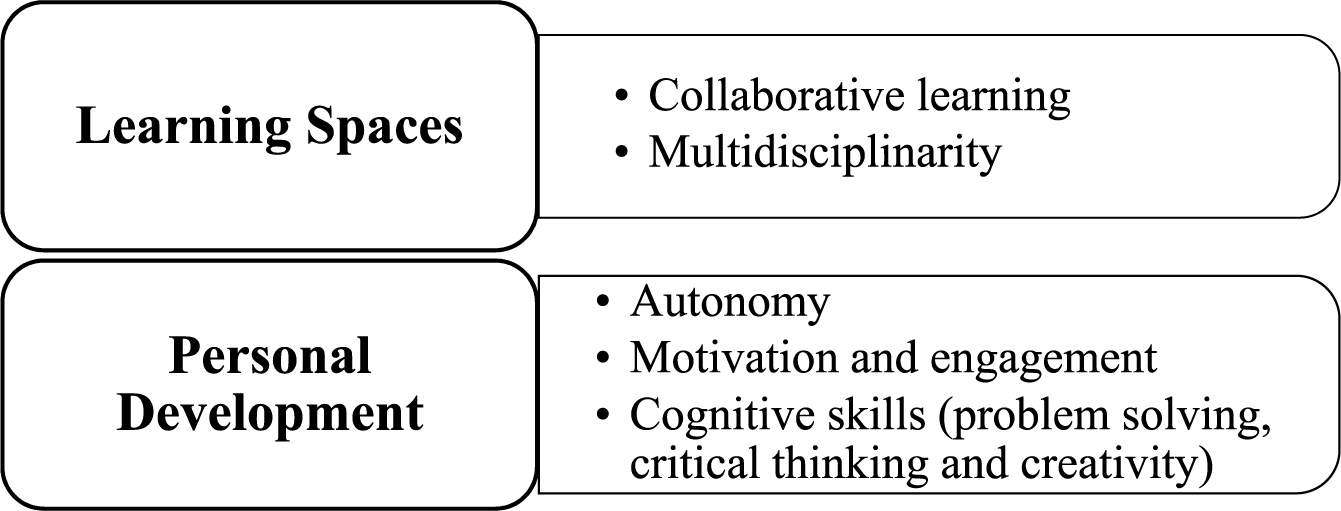
Five aspects of plurality of educational technology in early years.
Stage 2: online questionnaire with vignettes
The use of vignettes as a methodological tool has been employed frequently in awareness and attitudinal research in social sciences (Jenkins et al., 2010; O’Dell et al., 2012; Spalding and Phillips, 2007) to explore participants’ views, perceptions and attitudes towards several topics (Finch, 1987). It is based on the idea of using short devised hypothetical vignettes and characters that introduce a situation to the participants in the research in a concrete context (Crafter et al., 2015) and is followed by questions based on its complete story (Braun and Clarke, 2013). A vignette always has a vague element that participants need to critically reflect upon in order to answer the questions that follow it. Therefore, a good vignette should provide enough details in order to enable participants to fully understand the vignette, put themselves in a similar position and then reflect upon those details and its vague elements. Through vignettes, participants have the option to give corresponding identity positions while at the same time presenting diversity within their own range of experience (Crafter et al., 2015). Methodologically, vignettes capture how meanings, beliefs, judgements and actions are situationally positioned (Hughes, 1998).
In this study, the two vignettes used different character who were about to start teaching in a classroom where they would have access to either rich or limited technological resources (First Space: material world). The differentiation was based on the different number of available devices in each scenario. The two vignettes were then followed by five questions on participants’ attitudes (Second Space: mental world) as of how the available technology could be employed in their settings in order to enhance different aspects of children’s learning and development (see Appendix 2). The vignettes were presented through an online questionnaire in order to support ease of access, distribution and high return rates (Thomas, 2017).
Participants
The participants (N = 45) were undergraduate and postgraduate students of a UK university who were studying Early Childhood-related courses during the academic year 2018–2019. Many of the participants are potential early years practitioners and might have had placement experience. According to a recent study (Silberfeld and Mitchell, 2018) that explored graduates’ perspectives on their Early Childhood studies programmes and employment opportunities in the United Kingdom, less than half of the 48 graduates who participated were taking postgraduate courses in teaching or in an early childhood education-relevant jobs a few years after graduation. It is important to note that the nature and content of the studies and training of this study’s participants is not part of this article. Participants have had general teaching and learning sessions on the role of educational technology in early years but this has not been included in the context of this study.
Ethics
The study adheres to the BERA (2018) and EECERA (2015) ethical guidelines. The participants were recruited through a number of calls via the virtual learning environments of their courses where the link of the online survey was included. The first page of the online questionnaire included all the information that participants needed to know about the research project, including their right to withdraw anytime. There might have been identified power relations between researchers and potential participants as the researchers may have been tutors of some of the participants at some point during their studies. Therefore, participants might have felt obliged to take part. For this reason, it was clearly stated in any call made through the virtual learning environment and the introduction page of the online questionnaire that participation is completely voluntary and there were no obligations for anyone to take part. Also, it was clearly stated that participants were not asked to disclose any personal details on the questionnaire which means that the researchers would never know who had participated and who had not. It was made clear that informed consent was provided by agreeing to fill in the questionnaire and that participation was optional, voluntary and fully anonymous. As soon as responses were collected, they were transcribed in an encoded way and the original responses were deleted.
Data analysis
For the data analysis, a thematic analysis approach was used (Braun et al., 2019). This analysis allowed identifying ‘thematising meanings’, finding common or different trends and attitudes and drawing conclusions. The coding frame was developed in an inductive, bottom-up manner aiming to capture the views of the participants concerning the use of the available technological resources in the two provided vignettes (referred as v1 and v2) in order to facilitate the learning environment and development of their hypothetical learners. The reliability of the research was ensured by several discussions between the researchers who initially analysed and grouped the data separately and then engaged in dialogue about the main findings and sets of categories (Cohen et al., 2018).
Findings and discussion
Participants’ third space
Most of the participants (referred as p) viewed technology as a tool that has the potential to enhance learning experiences (Second Space) in both vignettes, despite the variance in the available technological devices (First Space). This implies that the majority believed that in either limited (a smaller number of the available technological devices) or rich technological environments (a larger number of the available technological devices), technology will benefit children’s learning and development in particular ways (Third Space).
It was found that 27% of the participants felt that the availability and number of technological devices might influence children’s educational experiences with the use of technology (Table 1). These participants had their Third Space transformed on the basis of alterations in the technological environment (rich vs limited). In particular, 51% of the participants felt that limited technology has an impact on children’s cognitive skills, 27% felt that collaboration can be promoted more in a classroom with limited resources, 27% felt that change in the available technological devices has an impact on what children can learn, 22% felt that more available devices encourage more independence and only 9% felt that motivation is influenced negatively by small numbers of devices in a classroom. These changes in attitudes and opinions due to alterations in technological resources reflect some of the barriers teachers face in integrating technology in practice, identified by Ertmer et al. (2012) and Kopcha (2012). The availability of resources and teachers’ attitudes are key factors in defining whether practitioners can and will use educational technology. So, if these are affected by external or internal barriers then effective use of technology might be challenged.
Alterations in participants’ third space.
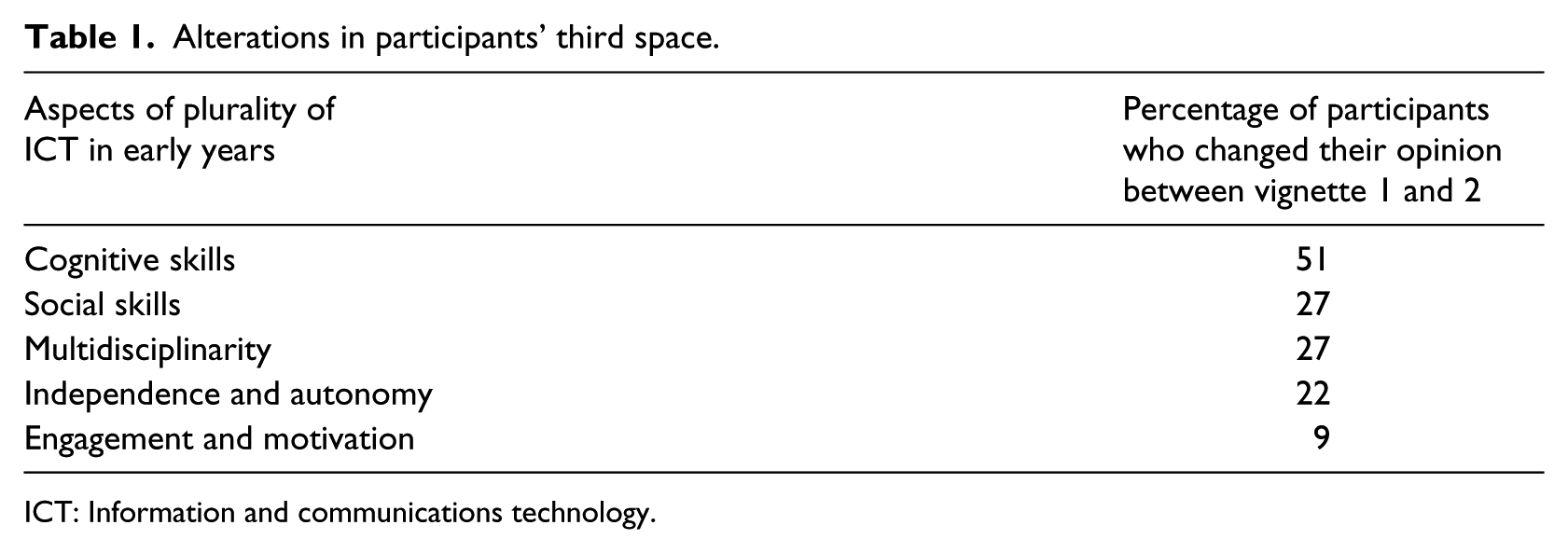
ICT: Information and communications technology.
Features of the third space: how are material and mental worlds bridged?
In 91.6 % of the participants’ responses there was a reference to how educational technology enables particular skills and capacities. The answers identified how educational technology can support different areas of children’s physical, cognitive, personal and social development.
‘They can work together to set tasks and allow them to build positive relationships and to make each other take turns’. (p12, v2) ‘The tablet devices could have writing applications installed which could be used to develop fine motor skills with children taking turns in using these’. (p13, v1) ‘This will empower their self esteem in using the devices and builds their confidence in using digital technology’. (p32, v2)
These findings illustrate how education technology can provide authentic experiences. Children can successfully achieve their goals and thus boost their self-esteem (Kervin, 2016) and confidence (Flewitt et al., 2014; Furman et al., 2018; Sung, 2017). Also, these findings agree with Sung (2017), who concluded that the use of iPads had positive effects on children’s collaborative learning which in turn supports the development of other skills; like negotiation, turn-taking, imitation, peer learning through observations and interactions, managing operations of technology and joint problem solving.
However, in comparing the answers between the two vignettes it was found that the limited technological environment might enhance more teamwork and problem solving. In particular, p31 stated that ‘children can work as small groups and work together on a project this would enable to promote them in sharing resources as well work with peers’. (v1)
Similarly, p3 (v1) mentioned, ‘the children will have to solve how they are going to share the devices’.
Furthermore, other participants indicated that teamwork is not promoted by a rich technological environment, as this may lead to more independent work, isolation and limited interactions with peers.
‘It can be used within small groups however as there is a wide range of technology this can reduce the amount of interaction between children’. (p21, v2)
Rich technological environment may increase the individual use of devices which in turn reduces interactions between the child and peers or adults. This might influence positive relationships and social development but also other aspects of development. For instance, when children interact with others, they acquire new vocabulary and develop their language. Only the well-designed technological applications that enable interpersonal interaction rather than preventing them can be beneficial for very young children’s learning and development (Reich et al., 2016).
In addition, the promotion of children’s autonomy through the use of technology was mentioned. It was found that the issue of autonomy was more evident in the case where more technological devices were available. A total of 84.4% of the participants in v2, opposed to 62.2% of the participants in v1, believed that autonomy and independence can be fostered if the technological environment is rich. For instance, p17 (v2) stated, ‘Children can work alone at their own pace’.
P12 (v2), however, noted in a more critical way that ‘having increased number of devices may improve autonomy and independence, yet I feel that this may be at the risk of producing decreased collaboration and teamwork’.
P22 claimed, ‘using the tablets individually and completing a task or finding information for themselves to then share will support autonomy greatly’. (v2)
This supports the research carried out by McPake and Stephen (2016) who found that children become less dependent on the practitioners and more actively involved in creating their own storyboards in learning a minority language as a second language in Scotland. This also falls in line with Furman et al.’s (2018) findings which suggest that autonomy and responsibility were also increased among the children, with the practitioners feeling that tablet computers in particular are a good tool for fomenting these particular skills.
The role of the practitioner was also highlighted in the responses. Participants felt that the practitioner needs to ‘observe and plan appropriate experiences’ (p33, v2), to ‘monitor the children’ (p24, v1) to set ‘a culture of effort (where) the teacher guides’ (p45, v2). This resonates with how McManis and Gunnewig (2012) considered practitioners’ partial supervision and interaction as important in defining the effective use of technology and agrees with Plowman and Stephens (2007) who concluded to the necessity of distal and proximal guided support when young children interact with educational technology. Both types of support are important and highlight the necessity of teacher’s input in the effective and pedagogically valued use of educational technology in early years settings.
In the case where the technological resources were limited, there was an emphasis on the practitioner’s responsibility to support everyone: ‘But as not all the children could use it, Paul will need to have other tasks to the rest of students’. (p45, v1) ‘Paul can partner up or group children’. (p41, v1)
These responses reinforce the idea that is not only a matter of how many technological devices a class has, it is mainly down to the teacher’s beliefs, literacy and training (Haydn, 2014) as to how to use them in daily practice (Ertmer et al., 2012; Instefjord and Munthe, 2017). As a matter of fact, a participant noted that despite the resources, ‘As a teacher, this is an important job role so every child feels important and is willing to learn’. (p16, v2)
Another interesting finding was that 18 participants felt that learning and development can be supported by other methods too, perhaps more traditional ones, without using technology. For example, p15 stated that ‘real life situations may offer better problem solving situations however this could still develop their development in micro ways such as fingers on iPads’. (v2)
and p3 said that ‘in some activities, each child having technology would be useful but I think these areas are done off technology’. (v2)
This echoes the debate between technology over other ways of learning and vice versa. It accords the sort of scepticism among early years educators, parents and scholars who in turn might be reluctant to use technology with young children (Yelland, 2016). However, Alper (2013) clarifies that this might not reveal any kind of technophobia, but instead implies that technology is one, but not the only, means that can support learning. In this respect, technology can be seen as a complementary but not substitute resource and mode of teaching and learning aiming at a range of levels, learning styles and individual needs. This aligns with the argument that technological tools can be used as open-ended tools rather than isolated and distinct learning resources that provide additional opportunities for creative playful learning (Arnott et al., 2017). Arnott (2016) provides an example of hybrid play with the use of technological devices, a type of play where technologies are integrated as part of traditional pretend play. In her example, children pretend that a cash register is a card reader in a simulation of a conventional Chinese restaurant in the home corner. In this case, technology is not used as the central activity, but as a complementary tool and prop in children’s play. This perspective reflects how technology can become a playground (Bers, 2012) where children will explore, take safe risks and discover autonomously.
Some responses highlighted the benefits of technology overall, like ‘Technology makes the lessons interactive which can make them more engaging for young children’. (p3, v2)
Other responses underlined the affordances of specific types of technological devices.
‘Camera would be used more abstractly for story telling or maybe photographing items that are of a certain number for maths’. (p7, v1) ‘Yes, not stuck doing writing on paper all day, iPads, computers and cameras are a more forward and interactive way of learning’. (p19, v2) ‘. . . Learning apps designed as games for example. It’s a great way to attack a topic from a different angle’. (p29, v2)
These statements show how technology can afford a child-friendly and child-centred learning environment (Burnett and Daniels, 2015).
In a similar direction, some participants suggested how technological resources might support children with particular difficulties.
‘Paul could use the technology to engage children who may struggle with for example; maths, and use a game to incorporate this into the child’s learning’. (p25, v1)
Or, as p6 underlined, ‘. . . technology has been used well to support children in these areas. Specifically children with additional needs’. (p 14, v1)
These results are consistent with other studies suggesting that the way that technology is used and the developmentally and age appropriate choice of technology are key in order to promote children’s engagement, motivation and other essential skills (McManis and Gunnewig, 2012; Plowman et al., 2010; Sung, 2017).
Conclusion
Educational technology and effective integration of technology in early childhood education is an emerging, complex field of necessary interest. There is still space for exploration in developing ways of transforming the ‘digitally fluent’ child into a digital ‘literate’ one, through best possible ways (Goulding et al., 2018; Palaiologou, 2016a). Children today can develop their digital fluency and literacy when they are given opportunities to interact with educational technology and acquire competences and skills through guidance and active support until they become independent users of technology. These technology-related skills are not acquired intuitively or automatically, but they are rather the product of social and cultural influences and guidance, as well as opportunity of explicit instruction.
In this respect, early childhood students’ views and attitudes regarding educational technology matter. As future practitioners, their professional practice will depend on their beliefs, literacy, training, but also on the availability and accessibility of the technological devices in their classroom (Ertmer et al., 2012; Instefjord and Munthe, 2017). Even though the sample was relatively small, and this is one of the limitations of the study, participants provided aspects of how their Third Space is negotiated, by unpicking how the richness or not of the technological environment can promote children’s learning and development. Fine motor skills, social skills like sharing, turn-taking, collaboration, relationships building, cognitive skills like problem solving and creativity, personal skills like engagement, motivation, self-esteem and confidence emerged, portraying a holistic approach of the affordances of technology. These results confirm the growing understanding that technology has the potential to enhance early childhood practices (Burnett and Daniels, 2015; Goulding et al., 2018).
This study implemented the notion of the Third Spaces (Soja, 1996) as a novice theoretical framework where binaries and conflicts come together. The binary between attitudes (mental space: Second Space) and resources (material space: First Space) was bridged, transformed and navigated through the context of the emerged vignettes. Participants developed their Third Space where the technological resources and personal opinions met the significance of early learning technological experiences in early years (Figure 2). The Third Space that derived from the participants raised the importance of the type of technological devices available, the role of the practitioner and how learning can be extended with and beyond technology.
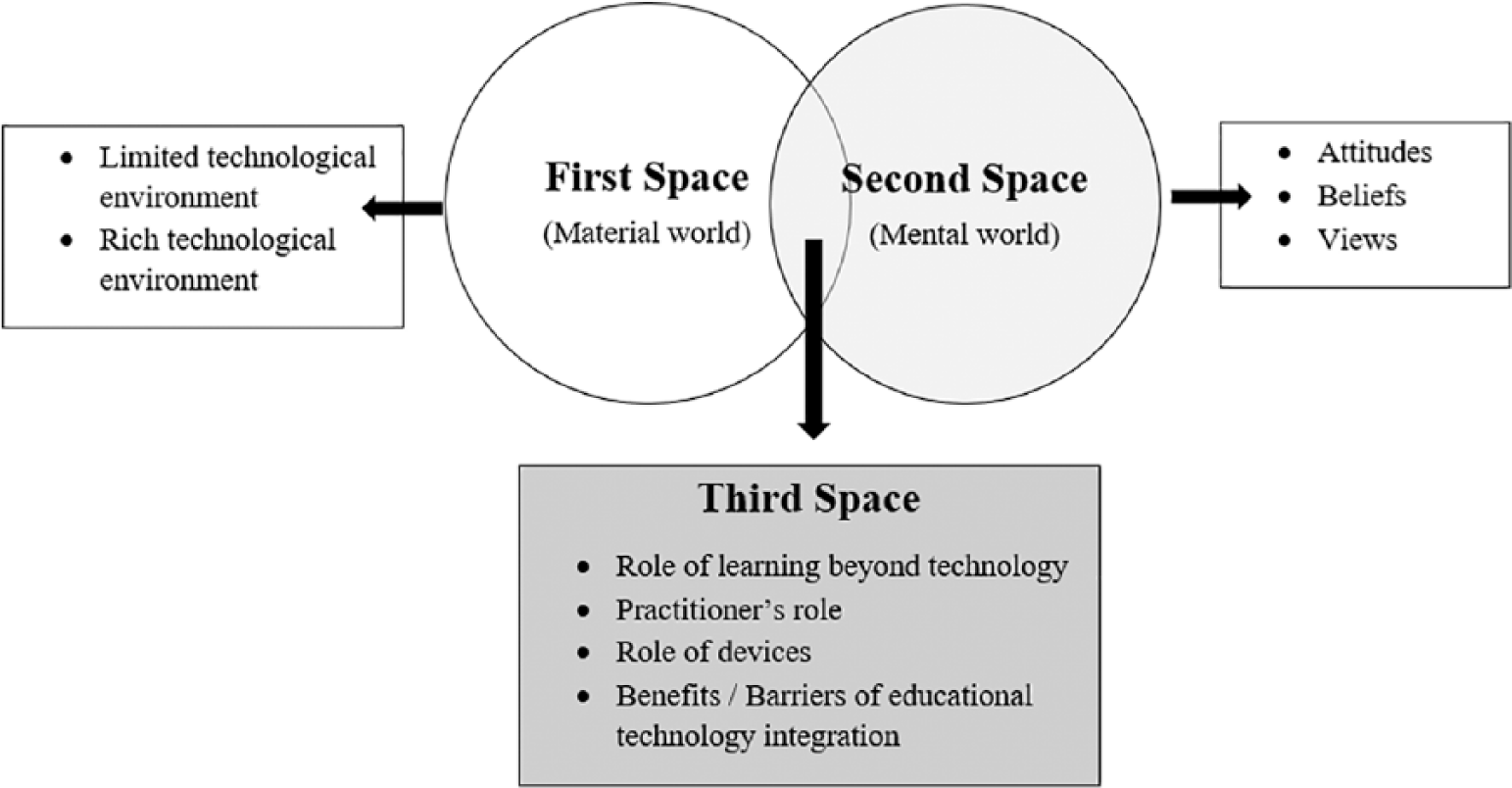
The relational space of educational technology in early childhood: early childhood students’ views.
These have future implications in an attempt to further outline the relationship between technology and children in the early childhood classroom, by focusing on the how and why of technologies instead of what of technologies. Thus, effective integration of educational technology in early years curricula (Edwards and Bird, 2017; Yelland, 2010) is a field of emerging attention given that changes and advances in technology are unforeseen, immediate but also opportunities for novice ways of educational practices.
Supplemental Material
Appendix_1 – Supplemental material for The relational space of educational technology: Early childhood students’ views
Supplemental material, Appendix_1 for The relational space of educational technology: Early childhood students’ views by Lorna Arnott, Ioanna Palaiologou, Colette Gray, Kyriakos Demetriou and Zoi Nikiforidou in Global Studies of Childhood
Supplemental Material
Appendix_2__vignettes – Supplemental material for The relational space of educational technology: Early childhood students’ views
Supplemental material, Appendix_2__vignettes for The relational space of educational technology: Early childhood students’ views by Lorna Arnott, Ioanna Palaiologou, Colette Gray, Kyriakos Demetriou and Zoi Nikiforidou in Global Studies of Childhood
Footnotes
Funding
The authors received no financial support for the research, authorship, and/or publication of this article.
Supplemental material
Supplemental material for this article is available online.

Author biographies
References
Supplementary Material
Please find the following supplemental material available below.
For Open Access articles published under a Creative Commons License, all supplemental material carries the same license as the article it is associated with.
For non-Open Access articles published, all supplemental material carries a non-exclusive license, and permission requests for re-use of supplemental material or any part of supplemental material shall be sent directly to the copyright owner as specified in the copyright notice associated with the article.
