




Abstract
Although studies have investigated the enablers and barriers of digital teaching and learning of STEM, the integration of digital technologies into teaching geometry – one of the main mathematical concepts, is frequently ignored and does not garner much scholarly attention. To fill this specific gap, this small-scale qualitative study explored the perspectives of four early childhood educators who have successful experience in using digital technologies in the teaching and learning of geometry with preschool-age children. The analysis of data uncovered early childhood educators’ effective pedagogical practices of digital geometry teaching while discussing the pedagogical benefits and challenges of embedding digital educational materials in geometric teaching. The findings of this research can particularly contribute to a qualitative lens of practically utilising digital technologies in engaging children in explorative geometric learning, which thereby provides valuable information for early childhood stakeholders to take into consideration in digital pedagogies of geometry education.
Introduction
The 2022 updated version of the Australian National Early Years Learning Framework (EYLF) specifies and emphasises children’s abilities of effectively using digital technologies to “access information, investigate ideas and represent their thinking” (Australian Government Department of Education [AGDE], 2022, p. 58) – and not simply manipulate such technologies – as critical learning outcomes in early years. This highlights the importance of providing engaging and meaningful learning opportunities to young children to promote their investigation with digital resources and materials in early childhood settings, which includes early learning of mathematics. Our concern in this paper is with the use of digital technologies in early years geometry teaching. While one of the four main concepts in the mathematics curriculum in early childhood (Clements & Sarama, 2020; Yelland et al., 2014) – alongside numbers, measurement, chance and data –, geometry, also known as spatial awareness, is often overlooked by early childhood educators in their pedagogical practices. This may be related to the insufficient spatial knowledge early childhood educators have that in turn causes under-preparation for teaching geometry (Clements & Sarama, 2011). Whatever the cause, its absence is important because children with deficient geometric learning experiences at an early age show less success in their mathematical performance in later schooling (Uttal & Cohen, 2012). This occurs because “from number lines to arrays, even quantitative, numerical, and arithmetical ideas rest on a geometric base” (Clements & Sarama, 2011, p. 134). Therefore, there is an essential need to support early childhood educators to become more equipped to teach geometry in early childhood classrooms. To this end, this paper uses data from qualitative interviews with four early childhood teachers from an ongoing study in Victoria, Australia, to explore the question ‘How do early childhood educators perceive the use of digital technologies in relation to geometry education?’.
This study is significant since it allows early childhood educators with successful experiences in digital teaching geometry to articulate in detail and in their own words how they view digital teaching of geometry in early childhood classrooms. As Clements and Sarama (2011) suggested, educators can refine and advance their educational methods of geometric teaching through learning from other’s self-described successful practice. Therefore, the findings of this paper could be useful for preschool educators when planning and enacting geometric learning experiences using digital technologies. Furthermore, the insights of this research can also provide valuable and practical information for early childhood institutions and educators to be more conscious of the enablers and barriers that they may have in embedding digital technologies into spatial teaching and learning. By unearthing the pedagogical practices, benefits and challenges of digital geometry education, this study has a potential to contribute to the combination of digital teaching and geometry teaching at preschool level, in Australia and potentially beyond.
Definitions of key concepts
In this research, digital technologies refer to any type of electronic and digital resources that can generate, store or process data (DET, 2019), specifically encompassing iPad, interactive whiteboard, computer and television. Geometry, also called spatial awareness, means the spatial concepts of shape, orientation, location and transformation (Bishop, 1988; Clements & Sarama, 2020; Victorian Curriculum Assessment Authority [VCAA], 2016). Here, the concept of digital geometry education refers to integrating digital technologies into the teaching and learning of geometric concepts in early childhood education. In this study, pedagogical strategies adopted by early childhood teachers include “asking questions, explaining, modelling, speculating, inquiring and demonstrating to extend children’s knowledge, skills and enjoyment in thinking and learning” of geometry (AGDE, 2022, p. 22).
A brief overview of literature on digital technologies and learning geometry
Various studies have established the positive impact of different digital technologies on children’s spatial learning, including programmable toys (Misirli et al., 2019; Newhouse et al., 2017), tablets and applications (Disney et al., 2019; Milkova & Pekarkova, 2021; Özçakir et al., 2019), computers and software (Jung & Conderman, 2015; Lin & Hou, 2016; Zaranis & Synodi, 2017). For instance, Özçakir et al. (2019) and Zaranis and Synodi (2017) highlighted the use of computers to support children’s understanding of shape properties and matching shapes with real objects. This is because digital learning experiences provide children opportunities for interacting with shapes in different orientations (Özçakir et al., 2019), which deepens children’s understanding of the geometric concept. This is significant since many children’s recognition and discrimination of basic shapes derives from the prototype images of their previous experiences (Jung & Conderman, 2017; Özçakir et al., 2019). That is, children may regard a shape as a rectangle because it looks like a door, instead of by shape attributes, such as number of sizes and corners.
In addition to geometric shapes, children’s learning of other key spatial concepts, including location and transformation, can also be improved by using digital resources. Messer et al. (2018) and Lin and Hou (2016) argued that programmable applications and software afforded children exploration of spatial orientation and location. This is reasonable since when programming routes, children need to employ mapping skills and positional language to communicate ideas, such as left/right and forward/backward (Lin & Hou, 2016). Moreover, children need to take into consideration the potential shortest route to the destination by comprehending the spatial relationship between each spot (Lin & Hou, 2016). This thereby facilitates children’s understanding of space scope and route planning rules. This underscores the educational potential and benefits of embracing digital technologies in teaching and learning of geometry.
Researchers have also investigated children’s learning through digital applications and game-based software targeting spatial awareness. Namely, the positive efficacy of RelationShapes (Polinsky et al., 2021) and modified TOSA (a match-to-sample task by Verdine et al., 2017) were illustrated (Bower et al., 2022). Researchers argued that digital resources encouraged children to manipulate and place different 2D shapes in an identical arrangement and location as the given images (Bower et al., 2022; Polinsky et al., 2021). This promotes children’s ability to locate and orient objects by identifying the spatial relations between each shape. Furthermore, another digital spatial application, Toca Blocks, affords children more open-ended digital play (Polinsky et al., 2022). Through engagement with Toca Blocks, children not only use blocks to create patterns but also build structures in the landscape (Polinsky et al., 2022). This affordance allows children to explore the spatial concepts of orientation, location and transformation more creatively instead of route learning.
Furthermore, the role of early childhood educators in providing scaffolding, explicit instructions and developmentally appropriate challenges to extend children’s digital geometric learning has been accentuated in previous studies (Lin & Hou, 2016; Newhouse et al., 2017; Özçakir et al., 2019). With educators’ active participation, children showed longer persistence and greater improvement on their construction of spatial concepts in digital contexts (Newhouse et al., 2017; Özçakir et al., 2019). Meanwhile, to support children’s geometric learning, early childhood educators act as informed decision-makers in selecting age-appropriate digital resources and integrating those into the existing pedagogical curriculum (Jung & Conderman, 2015; Lavidas et al., 2022). This stresses the role of early childhood educators in employing effective pedagogies to consolidate and extend children’s understanding of geometric concepts using digital materials.
Although teaching with digital technologies is beneficial for both children’s learning and educators’ pedagogical efficiency, early childhood educators confront several challenges in their teaching and learning of geometry with digital devices, such as personal insecurity of digital teaching and a lack of professional training in digital pedagogies particularly for early childhood educators (Lavidas et al., 2021; Nikolopoulou & Gialamas, 2015). Bourbour and Masoumi (2017) proposed that preschool educators’ technological knowledge and skills need to be strengthened to embed digital technologies more effectively in early mathematics teaching and learning, rather than isolate the teaching and learning of spatial concepts and competencies. Therefore, it is critical to support early childhood educators to become more equipped to employ digital technologies to enrich children’s geometric exploration in early learning environment.
Quantitative data regarding the positive impact of digital technologies on children’s learning of geometry are available through approaches such as experiments detailed in previous studies (Messer et al., 2018; Zaranis & Synodi, 2017). Yet, they are unable to provide insights into early childhood educators’ self-generated personal insights into day-to-day practical use of digital technologies in teaching geometry, including their effective pedagogical practices and perspectives of benefits and challenges. This calls for qualitative research exploring how early childhood educators can effectively use digital technologies to foster young children’s learning of spatial concepts and competencies. Drawing on a data from a small-scale qualitative study, this paper contributes important insights by addressing the pedagogical practices employed by preschool educators to support children’s geometric learning in digital contexts. This sets the foundation of unearthing the pedagogical benefits and challenges of educators’ teaching practices of digital geometry education.
Theoretical framework
Exploring early childhood educators’ accounts of how they set about facilitating children’s understanding of geometry by adopting digital resources, our analysis is informed by primarily Vygotsky (1978) and Bishop (1998). Vygotsky (1978) underscores the significance of children’s engagement with objects and tools in their early cognitive development, and the higher level children’s mastery of tools and objects is, the greater problem-solving skills and use of tools children acquire in their exploration. In line with Vygotsky’s theory, Bishop (1988) highlighted the role of tools in children’s mathematical learning, including acquisition of geometric concepts, and sees mathematics as a cultural product. This illustrates that children’s mathematical abilities are highly correlated with manipulating objects and materials in social and cultural experiences (Clements & Sarama, 2020; Yelland et al., 2014). This explains teaching geometric concepts by embracing different manipulatives and representations, which, in the age of digitalisation, include different types of digital technologies.
Additionally, and of further relevance for the current study, Vygotsky’s cultural-historical theory (1978, 2011) puts a critical emphasis on the role of early childhood educators and the social interactions between children and educators in children’s cognitive development. This is important since in social interactions with children, early childhood educators intentionally provide scaffolding and guidance to foster children’s knowledge and skills development from Zone of Actual Development (the level of using matured abilities to solve problems independently) to Zone of Proximal Development (the level of using developing abilities to solve problems with adults’ help) (Vygotsky, 1978, 2011). On account of early childhood educators, therefore, it is important to identify children’s ZAD and ZPD to select and use effective pedagogies to foster children’s achievement of their ZPD. This highlights the co-constructive relationship between children and educators in reaching the former’s upper level of cognitive development.
Methodology
This research reported here is part of a project focusing on cultivation of knowledge and skills with the use of digital technologies in early geometry education. Drawing upon a constructivist ontological position and interpretivist epistemological orientation, we adhere to the understanding that knowledge and reality are constructed through social interactions but “in a constant state of revision” (Clark et al., 2021, p. 28) and interpreting other social actors’ subjective experiences to understand socially constructed meanings (Cohen et al., 2017). Correspondingly, we adopt a qualitative methodology to address early childhood educators’ perspectives of digital geometry education at preschool level. This enables the generation of a deep insight concerning the research topics through an engagement with people (Clark et al., 2021). We follow the logic of similar small-scale studies by Wong et al. (2013) and Jung and Conderman (2015), who also employed qualitative research design to explore preschool educators’ views on the use of digital technologies in teaching and learning in early childhood settings. Their research productively elicited the pedagogical practices and benefits of using digital devices in teaching and learning of mathematics (Jung & Conderman, 2017) and science (Wong et al., 2013), in ways that go beyond the possibilities of a quantitative study. By adopting qualitative methodology, the articulation of educators’ teaching experiences of geometry can provide us an in-depth insight into how they perceive the use of digital technologies in their pedagogical practices.
Participants and recruitment
Demographic information of participants.
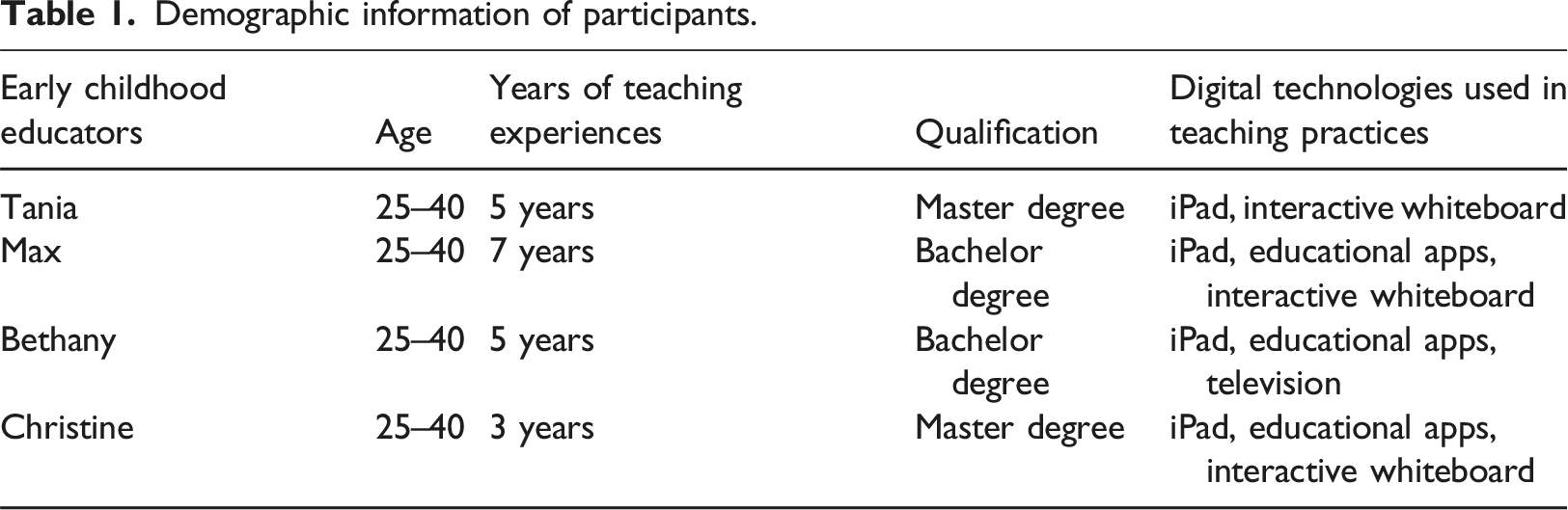
Data generation
We employed semi-structured interview to elicit early childhood educators’ perspectives on the integration of digital technologies into early geometry education. Although not all interviewees will be equally perceptive and articulate, researchers generally consider that narrations of interviewees’ lived experiences can still provide a depth of understanding into social phenomena (Kervin et al., 2016). A large amount of data is available through quantitative ‘evaluation forms’, but the benefits of a qualitative approach are numerous, and the semi-structured interview method itself has particularly benefits for this type of exploratory study. Firstly, semi-structured interview allows us to record thoughts, attitudes, feelings and experiences of participants with depth and in richer detail. This is because interviewers and interviewees exchange ideas and feelings regarding the theme to generate knowledge through social and interpersonal interactions during interviews (Hammersley, 2013), which subsequently assists in answering the study’s research.
A final but significant advantage of semi-structured interview is its flexible format throughout the process. In this study, individual interviews were conducted via Zoom at a mutually agreed time with participants to minimise travel and disruptions to their timetables (Cohen et al., 2017). A preamble was given before interviews to re-explain the study’s purpose. During the interviews, open-ended questions were complemented by tailored questions that focused on the individual’s experiences to maximise the useful data gathered (Cohen et al., 2017); for example, “How do you engage children in using digital technologies to learn geometric concepts and skills?” and “What challenges have you faced in teaching geometry using digital technologies?”. This is critical for collecting insights into digital teaching of geometry since participants could have different perspectives based on their varied attitudes and experiences. Interviews lasted for 30–60 min and were audio recorded for subsequent transcription coding.
Data analysis
This research adopted thematic analysis proposed by Braun and Clarke (2006) for coding and analysing the interview. Initially, all interviews were transcribed verbatim, and the participants’ perspectives were decomposed into different codes closely linked to digital teaching and learning of geometry. Then, we compared and contrasted these codes to make interconnections between these codes and elaborate the main themes and sub-themes to address the research question (Braun & Clarke, 2006). Last, major themes and sub-themes were reviewed and refined to ensure they are meaningfully and theoretically coherent to each other whilst having identifiable distinctions (Braun & Clarke, 2006; Clark et al., 2021). The themes presented in this article were those codes which dominated the discussion generally. The major initial codes were pedagogical practices, benefits and challenges. From participants’ responses regarding the pedagogical challenges of digital geometry, we generated several sub-themes, such as personal insecurity, limited professional development resources in digital teaching, classroom organisation, planning and enacting meaningful educational experiences, and constraints of digital technologies on geometry teaching. Since three sub-themes (personal insecurity, limited professional development resources in digital teaching, classroom organisation) have been broadly covered in existing literature as discussed in the overview of above, for reasons of space here we focus only on the data that pertains to two sub-themes, which are (1) planning and enacting meaningful educational experiences, and (2) constraints of digital technologies on teaching geometry.
Ethics
Ethical approval was obtained from Monash University (Project number: 36099), and written consent forms were gathered from the participants prior to the interviews. Participation was voluntary, and participants were reminded that they could withdraw at any time without consequence and skip questions if they preferred not to answer. Pseudonyms were used for all participants to ensure confidentiality and non-identifiability. The participants were provided with a summary of findings to confirm the researchers fairly represented their viewpoints on digital geometry education.
Findings and discussion
A summary of themes and sub-themes.
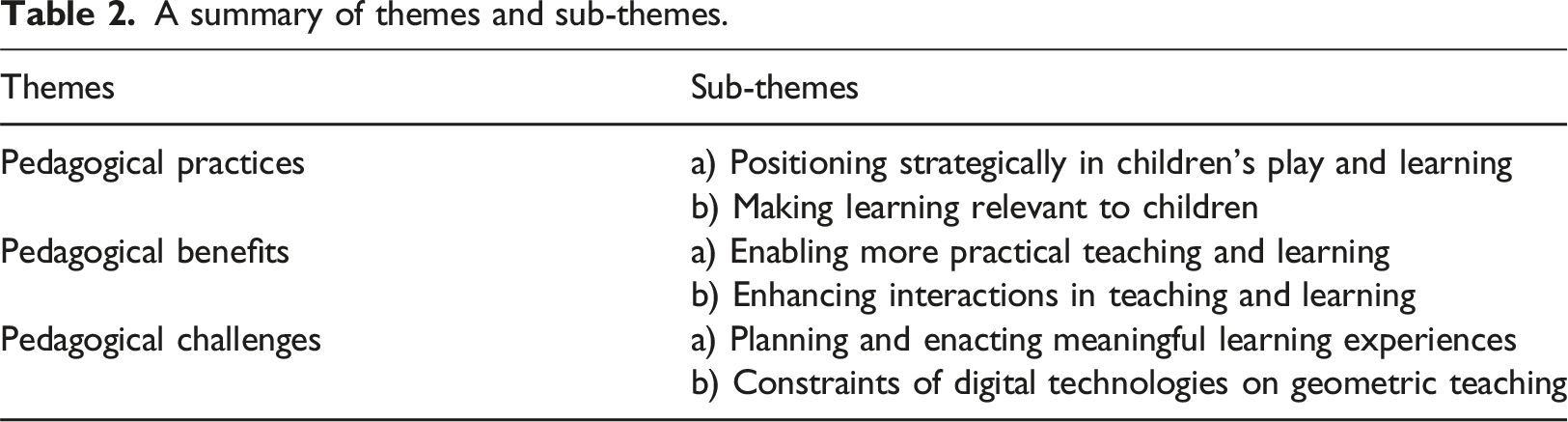
Pedagogical practices
Positioning strategically in children’s play and learning
The first productive pedagogical practice identified by the educators refers to positioning themselves strategically and deliberatively in children’s digital learning and using intentional teaching strategies to extend children’s understanding of geometric concepts. To achieve this, participants utilise multiple pedagogical methods when supporting children’s thinking and learning of geometry with the use of digital technologies. This aligns with Jung and Conderman (2015) who emphasised educators’ role in scaffolding and promoting children’s mathematical thinking when engaging in digital learning context. This also resonates with Vygotsky (1978, 2011) who accentuated the social interactions between educators and children in facilitating the latter’s cognitive knowledge and skills. Regarding pedagogies, some participants strongly advocated child-led play and learning in digital exploration of spatial concepts. Max said, “We encourage a set routine everyday for about an hour, and we take the iPads out so children can take turns to explore the little games or the Ella program. They guide and explore as they go.” What this may imply is that Max sees her role as a facilitator of digital geometric learning, yet it is the children who take the predominant active role in spatial exploration in the digital context. Correspondingly, another participant, Tania shared her perspective, saying: You can be there to scaffold, and you can be there to support, but there are certain times when that’s just not appropriate to be included. And if you can empower them to take a lead on that, that’s really beautiful. And then the interest and the motivation will keep coming from them, because they’re creating a bond with the topic and enjoyment of the topic. And that’s pushing them forward to explore and experiment more.
This indicates that educators acknowledge the importance of child-directed play and learning and play the role in enabling learning context and opportunities for children to lead their playful exploration of geometry and digital technologies (Disney & Li, 2022; Jung & Conderman, 2015; Özçakir et al., 2019). This aligns with the EYLF which highlights children’s integration of their motivation and thinking into their play, and encourages educators to “foster children’s motivation to learning and reinforce their sense of themselves as competent learners” (AGDE, 2022, p. 16). In parallel, what educators of this study did is draw on children’s intent and enthusiasm and act as a facilitator, rather than a director, to allow space for children’s autonomous exploration geometric topics of their interest.
Other educators stressed the significance of deliberatively scaffolding and supporting children to extend their conceptual understanding. Bethany noted, “I think my job is mostly to scaffold them to recognise the shapes that they may have understood, but they just don’t know how to explain or how to connect them to each other.” This understanding implicates the role of early childhood educators in identifying children’s current level of acquisition of geometric concepts through observations and interactions and accordingly promoting their conceptual development to higher level. This aligns with Vygotsky’s theory (1978, 2011) which underscored the role of educators in fostering children’s conceptual development from their ZAD to ZPD. Additionally, when early childhood educators observe that children may need assistance in their spatial exploration on digital devices, they capture these teachable moments and step in to support and stretch children’s learning with intentionality. Christine remarked, I remember there is one game, like children can use different shapes to build towers, but they found out it’s hard to build a tower using triangles because they fell apart. So I asked them, “Why did the tower crash easily when you used triangles?” Then children thought about it and said, “Because triangles have three sides, not like a rectangle has four sides, so that’s why it’s easy to fall apart.”
These educators stay attuned to children’s needs, problematise the learning context and challenge children’s spatial thinking to extend their understanding of spatial concepts. This aligns with the statement made by Jung and Conderman (2015) which stressed the intentional role of early childhood educators in promoting children’s mathematical development in digital learning environment. The data presented here evidenced the role of early childhood educators in strategically moving their positions in children’s play and learning to enrich and maximise children’s learning opportunities of spatial concepts with digital representatives.
Making learning relevant to children
The other pedagogical practice frequently mentioned by our participants is making digital learning of geometry relevant to children, which encourages children’s digital exploration of spatial concepts. In this research, respondents accented the need to ensure spatial learning experiences in accordance with children’s interests and cultural experiences to achieve positive learning outcomes. Bethany said, “When you have the examples that they’re interested in and they are familiar with, they have more willingness to learn.” This is parallel with Tania who stated, “I think it very much depends upon the way that it's being taught. […] It’s how do we incorporate that into their lives to make them excited about it.” This indicates the importance of planning and enacting pedagogical curricula of digital geometry education in accordance with children’s interests and social and cultural experiences. This is important since it stimulates children’s motivation and learning dispositions towards spatial concepts and abilities, thereby promoting their spatial learning outcomes. This is in alignment with Bishop (1988) who regarded mathematics as a cultural product and stressed children’s real-life encounters in their early numeracy learning. The finding of this study is consistent with Bourbour and Masoumi (2017) who pointed out the more important role of educators’ pedagogical skills and practices in engaging children in digital mathematical learning experiences than simply creating a digital learning context.
Moreover, participants noticed that children have varied interests that motivate their selections and engagement with learning materials in classrooms. For example, Christine shared her experience, recalling, Some children like to play iPad and smartboard, but not all enjoy it. As a teacher, I’m trying to offer the children as many materials as possible which are age-appropriate for them and create an inclusive environment for all children.
Such thinking aligns with the EYLF (AGDE, 2022), which underscores the development of an inclusive learning community in early childhood settings by respecting and supporting children’s diverse interests and needs. Meanwhile, participants’ responses elucidated the importance of incorporating both digital technologies and concrete manipulatives as pedagogical materials and tools when fostering children’s development of spatial concepts since every child has different enthusiasms and interests. This echoes Bishop (1988) who emphasised the role of different tools and objects in children’s mathematical learning, including the acquisition of geometric concepts. By providing an engaging learning environment embodied with digital and concrete materials, educators in this study aim to provide an inclusive educational context for all children with diverse interests and motivations to explore geometric concepts. This boosts children’s learning dispositions as well as learning opportunities as children can choose to engage with the learning materials that motivate them when investigating geometry in early childhood settings.
Pedagogical Benefits
Enabling more practical teaching and learning
In this research, a predominant pedagogical benefit of integrating digital technologies into geometric curriculum is making the teaching and learning of geometry more practical. Educators are conscious of the constraints of traditional teaching of geometry by its physical space, tangible resources and delivery model. As Tasha said, “I feel like it’s kind of two dimensional and more of a memory game to the children and focus more on terminologies.” Whereas with the multimodality and versatility of digital technologies (Wong et al., 2013), including sounds, images and video clips presented simultaneously, children can be shown more comprehensive and vivid explanations of spatial concepts. Bethany stated, “For example, like iPad, it gives you more resources to show children what the shape is, and it can also connect to the real-life objects.” This implies that the intrinsic three-dimensionality of digital technologies and infinite educational resources on digital media can amplify the teaching and learning opportunities of geometric concepts for children. This finding corresponds with previous studies (Lin & Hou, 2016; Wong et al., 2013; Zaranis & Synodi, 2017) which argued that digital materials could actually provide more learning opportunities to young learners than traditional objects do.
Moreover, since digital technologies can provide various visual and audio materials relevant to children’s living experiences, educators can practically and effectively bridge the gap in cultural differences and inclusively support children from different cultural backgrounds who speak languages other than English. Bethany remarked, “When teaching ESL children, it’s important to find something that they can see, feel or listen every day in their life, so it is really helpful using digital technologies.” This emphasised that digital technologies are beneficial for enabling the teaching and learning of geometry in a manner that reflects modern teaching requirements. In addition, digital technologies are also more practical to use for children at younger age who are still developing their fine motor skills, since they can manipulate shapes and objects using their fingers or hands. Max stated, “Children can take turns to use their hands to drag the circle to where it asks for, so I find it’s more practical.” This is analogous with the findings of the study by Jung and Conderman (2015) who indicate that some young children may find it frustrating using physical pattern blocks due to the difficulty of accurately placing them in proper position. By contrast, children can easily move 2D shapes on screen as well as view 3D shapes from different perspectives via magnification and rotation to explore spatial orientation. This, therefore, enables pedagogical practice of teaching spatial concepts to be more effective and to achieve expected learning outcomes.
Enhancing interactions in teaching and learning
The other benefit of digital technologies pointed out by respondents is facilitating spatial teaching and learning to be more interactive for children, rather than simply a transmission of knowledge from early childhood educators to children in traditional ways. The analysis of the interview data illustrates that interactions among educators, children and digital representations act in a triangular way to enrich children’s exploration of geometric concepts. The interactions and conversations between educators and children are enriched by using digital technologies. Max remarked, “Children in my room will say ‘Let’s go Google’ to search the meaning of different shapes. which is a more engaging way of learning rather than I tell them the answer.” This implies that not only educators but also children are aware of the affordance of digital technologies to explore knowledge they are interested in and curious about. Digital technologies, therefore, empower both educators and children to work collectively in the investigation of different concepts, through which children’s curiosity and autonomy can be fulfilled and developed. This supports children practically to become autonomous and involved learners by using digital technologies to represent mathematical thinking as recommended by the EYLF (AGDE, 2022). The finding parallels with Wong et al. (2013) who indicated that early childhood educators have more opportunities to interact with children via digital technology than conventional teaching while implementing activities.
Through interaction with digital manipulatives, children can generate inquiries, communicate ideas and make meaning of their spatial learning. Christine elaborated, “They will ask, ‘Oh, what is this shape?’ They want to know more about shapes.” This implies that as pedagogically meaningful tools, digital technologies create an informal learning environment where children can freely share and verify their geometric ideas and thinking with educators and peers. This finding resonates with Vygotsky’s (1978) suggestion that children construct cognitive knowledge and skills through social interactions with more capable learners, including both adults and peers, and through the manipulation of tools.
Pedagogical Challenges
Planning and enacting meaningful learning experiences
The first common pedagogical challenge disclosed by participated educators refers to designing and implementing meaningful digital teaching and learning of geometry to children. This includes planning and enacting both meaningful learning experiences of geometry and meaningful digital learning experiences for children. Tania shared her perspective, saying, In terms of challenges, I would say making it meaningful and relevant to the children. I think that sometimes we can get quite fixated on topics we need to teach. But that’s not necessarily very meaningful to the child who’s learning it, whereas if you would apply that in a construction setting or an engineering setting on smartboard, it suddenly becomes a lot more relevant and engaging.
Tania’s response indicates that educators acknowledge the significance of embedding spatial concepts in engaging and meaningful learning experiences and teaching moments. However, educators’ insufficient knowledge and skills of geometry or personal insecurity of teaching other geometric concepts, can sometimes negatively lead to preoccupation of topics that need to be taught (such as recognising basic shapes) and thereby ineffective teaching and learning of digital geometry education. Meanwhile, Tania’s argument echoes with the importance of making geometric learning experiences relevant to children’s interests and needs, as discussed above. As the EYLF (AGDE, 2022) highlights, connections between educational experiences make learning more meaningful to children, and children are more likely to become involved and autonomous learners when their prior experiences are recognised and included in the curriculum. Rather than being dominated by the comprised need of teaching specific concepts, educators are encouraged to identify and respond to children’s motivations in geometric teaching practices to deliver effective and quality educational practices to children.
Constraints of digital technologies on geometric teaching
Although participants agreed that digital technologies could improve children’s learning outcomes of geometric shapes and shape properties, they regarded conventional physical activities as more effective methods than digital technologies to promote children’s understanding of location and transformation. For instance, Bethany said, “For kids at preschool age, to teach them what location is better just using traditional ways, such as dancing and moving.” This, however, is opposite to the findings of other studies, which underscore the effectiveness of digital technologies on children’s learning of spatial relations and orientations (Lin & Hou, 2016; Polinsky et al., 2021). A potential reason behind the contrast between the teachers’ views and the quantitative evidence could be the relative lack of experience of the educators in this study in using the digital materials examined in other studies, such as a touchscreen application named RelationShapes in the research by Polinsky et al. (2021) to promote children’s understanding of location and transformation. Additionally, the finding of the present study may also suggest that even though research has established a positive relation between digital teaching and children’s development of orientation, location and transformation, the practical use of digital devices in teaching these certain spatial concepts is not yet pervasive in early childhood settings. This may imply the educational potential to alternatively incorporate robotic or programmable toys, as physical digital devices, into early childhood educators’ pedagogical practices of teaching geometry.
Conclusion
This study sought to explore the perspectives of early childhood educators on using digital technologies in teaching and learning of geometry with children at preschool age. In particular, this paper has examined the practices and the perceived pedagogical benefits and challenges of digital geometry education by investigating the experiences of educators who have implemented digital spatial teaching in practices. This complements the findings reported in the wider literature regarding the effectiveness of using digital technologies in teaching and learning of geometry, with much of the data of this present research underscoring the merit of the affordances of digital technologies in early geometry classroom for young children. There was evidence from the interviews that educators have modified their conventional pedagogical approach to engage with digital educational tools to teach children spatial concepts. This indicates that educators believe that digital technologies can lead to children’s investigative learning of geometry as well as more effective and efficient teaching of geometric concepts. Meanwhile, respondents purposefully utilise the multimodality and versatility of digital technologies to enable more practical teaching of geometry. It is evident that teachers perceive that using digital technologies also promotes the interactions between educators and children in the latter’s investigation of spatial concepts.
This study also reveals two major challenges confronted by early childhood educators in digital geometry education, which could be the barriers to the successful integration of digital pedagogical tools into children’s geometric learning and development. In particular, early childhood educators are aware of the constraint of digital technologies on supporting children’s learning of orientation, location and transformation. To prompt children’s learning of these geometric skills, educators are disposed to implement physical activities, such as dancing and moving. What this may imply is that robotic and programmable toys, as more tangible digital technologies compared to traditional applications and software, could be embraced in early childhood educators’ educational approaches to facilitate children’s understanding of certain spatial concepts. Further, this finding may also suggest the need for the development of more practical and effective pedagogical digital technologies and applications which have a specific focus on fostering children’s learning of these spatial concepts. Moreover, to overcome the other challenge – planning and enacting meaningful learning experiences – the development of high-quality professional training is vitally needed. This can support early childhood educators’ improvement on teaching geometry as well as pedagogical agency and abilities to effectively implement digital spatial learning experiences to promote children’s spatial development. Yet, although challenges of digital spatial teaching are revealed, it is beneficial for early childhood educators to provide children with digital learning experiences which can enrich children’s exploration of spatial concepts in early years.
Several limitations of this research and recommendations for future studies are delineated in the following. First, this is a small-scale study which was conducted with four early childhood educators all from Australia. Therefore, the conclusions drawn from this study are exploratory and tentative and may be limited to particular contexts. Nonetheless, the purpose of qualitative studies is to develop an in-depth understanding of using digital technologies in teaching and learning of geometry (Clark et al., 2021). Therefore, we contend that the study provides useful and valuable insights in qualitatively rendering both the enablers and hindrances of digital geometry education at preschool level. Another limitation is that semi-structured interview was the only data generation method employed in this project. The adoption of different methodologies, such as observations of participants in their naturalistic setting, would allow for a deeper level of qualitative analysis of educators and children engaging in these topic areas. Despite these limitations, participating in this research project still provided a valuable opportunity to give early childhood educators a voice to articulate their teaching experiences in digital geometry education.
In sum, this study documented early childhood educators’ views on the teaching and learning of geometry with the use of digital devices. Since both digital abilities and spatial concepts are the outlined learning objectives in the EYLF (see literature review), it was necessary to conduct this research as it contributes to the knowledge of both digital pedagogy and geometric teaching practices at preschool level. Consequently to begin this aim, the findings of this study can provide important information on how preschool educators utilise digital technologies in their teaching and learning of spatial concepts in early childhood settings.
Footnotes
Declaration of conflicting interests
The author(s) declared no potential conflicts of interest with respect to the research, authorship, and/or publication of this article.
Funding
The author(s) received no financial support for the research, authorship, and/or publication of this article.
