




Abstract
Digital technologies are increasingly prevalent and can complement more traditional resources to support children’s investigations and explorations in early learning contexts. A new consideration is the value of technology in positioning early childhood educators as co-learners and co-investigators alongside children. This article presents findings from a case study undertaken with two early childhood educators working with a class of preschool-aged children. The participating educators engaged in a practitioner inquiry project focusing on how technology could support and extend children’s interest in outer space and the solar system. This study found that digital technology supported educators and children to work as co-investigators, moving between the roles of apprentice and expert as they shared pre-existing understandings and sought new knowledge. In addition, digital and non-digital resources were used contemporaneously to support investigation in their ongoing project. The findings provided clear examples of technology as an integrated, complementary resource in play-based learning, supporting children’s agency as they worked with educators to increase scientific knowledge as well as digital handling skills.
Introduction
The ubiquity of technology as a resource in everyday life positions it as a significant cultural tool (Rogoff, 1995; Bittner et al., 2018) and creates new opportunities for teaching and learning. However, current research in Australia indicates that a significant number of educators, families and other stakeholders do not feel that technology has a place in early learning settings (Edwards et al., 2018). Lack of integration is connected to lack of contextually relevant professional learning opportunities (Edwards et al., 2018). In addition, Yelland (2011) suggests children often come to their early learning service with knowledge of technology that may be unfamiliar and even intimidating for their educators. As such, educators must think carefully and critically about how their beliefs and confidence with technology influence what they choose to integrate and how their choices can best align with children’s social and cultural experiences.
A new consideration for technology integration is how it can support educators as co-learners. Space and the solar system are topics that frequently arouse an interest for children in early learning services. However, many adults have inaccurate knowledge of this field, which can stem from incorrect guidance in childhood (Kampeza and Ravanis, 2012; Siegal et al., 2011). These misconceptions are often maintained throughout adulthood with concepts partially understood and inconsistencies in logic not recognised or challenged. This is a significant considerations as it is acknowledged that educators play a pivotal role in helping children’s intuitive understandings of everyday phenomena, including aspects of the solar system, develop into more accurate and robust knowledge of scientific concepts (Hamlin and Wisneski, 2012; Siegal et al., 2011). Children develop conceptual scientific knowledge through using their senses in everyday experiences (Hamlin and Wisneski, 2012). This can include direct experiences with elements of the solar system, such as observing the sun and moon and feeling the influence they have on the earth. Early experience with precursor concepts regarding space and earth science supports the development of abstract thinking and can prevent development of misconceptions (Kampeza and Ravanis, 2012). These contribute to building foundational understandings of scientific concepts relating to the natural world, astronomy and the Earth as part of the solar system in the early years and provide an essential base for later, more sophisticated understandings (Kampeza and Ravanis, 2012; Siegal et al., 2011). In addition, Siegal and colleagues (2011) note that discussing concepts relating to Earth and the solar system provides opportunities to use reasoning and questioning. These are key scientific processes and pivotal to developing skills and knowledge as a scientific thinker (Hamlin and Wisneski, 2012).
Rich learning environments for children and relationships with educators enable children to move beyond direct observation when learning new concepts. Children can draw on educator knowledge and expertise on properties that are less obvious – for example, the world being spherical rather than flat (Kampeza and Ravanis, 2012; Siegal et al., 2011). However, this can be confounded by the limited or inaccurate knowledge held by educators themselves. One way to overcome this challenge is to consider how educators can be positioned as co-learners and co-investigators alongside children.
Katz (1998) in reflection on the value of ongoing project work in Reggio Emilia states that children’s interest in the solar system and elements such as space travel often emerges from engagement with digital media and popular culture. This includes experiences with movies, television shows and associated toys, an occurrence reinforced by Kampeza and Ravanis (2006). Katz (1998) notes that while children’s understanding of space and the solar system were not always scientifically correct during the project, their creative art experiences demonstrated rich thinking and created opportunities for educators to help children develop accurate understandings of space and to help build foundational scientific knowledge. When adopting a Reggio Emilia approach, the environment is considered key to learning, alongside children and educators. Gordon and Highfield (2014) note the value of technology as a provision or resource within the environment in positioning educators as ‘active participants’ (p. 429).
Given the position of technology as a cultural tool, it is important to build common understandings around definitions and conceptualisations of technology that reflect children’s experiences in their everyday lives (Bittner et al., 2018). This includes recognising technology as a resource that can be used contemporaneously with non-technological resources to supplement and complement children’s previous experiences, ongoing investigations and play (Yelland, 2011). To foster deeper understanding of technology as a pedagogical tool, educators need opportunities to engage in reflective discourse that thoroughly examine the theories and philosophies that justify its value (Palaiologou, 2016). With this approach, technology integration is more likely to be pedagogically sound as well as socially and culturally appropriate. Practitioner inquiry is a professional learning strategy that enables in-depth understanding of the complex, interwoven ideas, beliefs and experiences that impact educator practice (Groundwater-Smith et al., 2013). These insights can provide a foundation for challenging, affirming and extending thinking on the relevance of technology in play-based learning. In addition, practitioner inquiry positions educators as agentic researchers who are able to apply new learnings and ideas to their particular contexts in ongoing projects. Professional learning content can be adapted based on individual interests and needs as well as the specificities of the broader milieu. As such, any changes implemented reflect the educators’ knowledge and understanding of the context (Groundwater-Smith et al., 2013). In addition, engaging in critical reflection and ongoing professional learning in a collegiate environment encourages educators to develop their sense of objectivity, to be cognisant of their own values and beliefs and to also acknowledge the perspectives of others.
This study aimed to gain insights into how educators can use technology as a tool to extend learning interests and investigations. This was examined through educator participation in a practitioner inquiry project. Throughout the project, educators were supported to develop new understandings of how technology could feature in an integrated and complementary way in their early learning curriculum.
Method and design
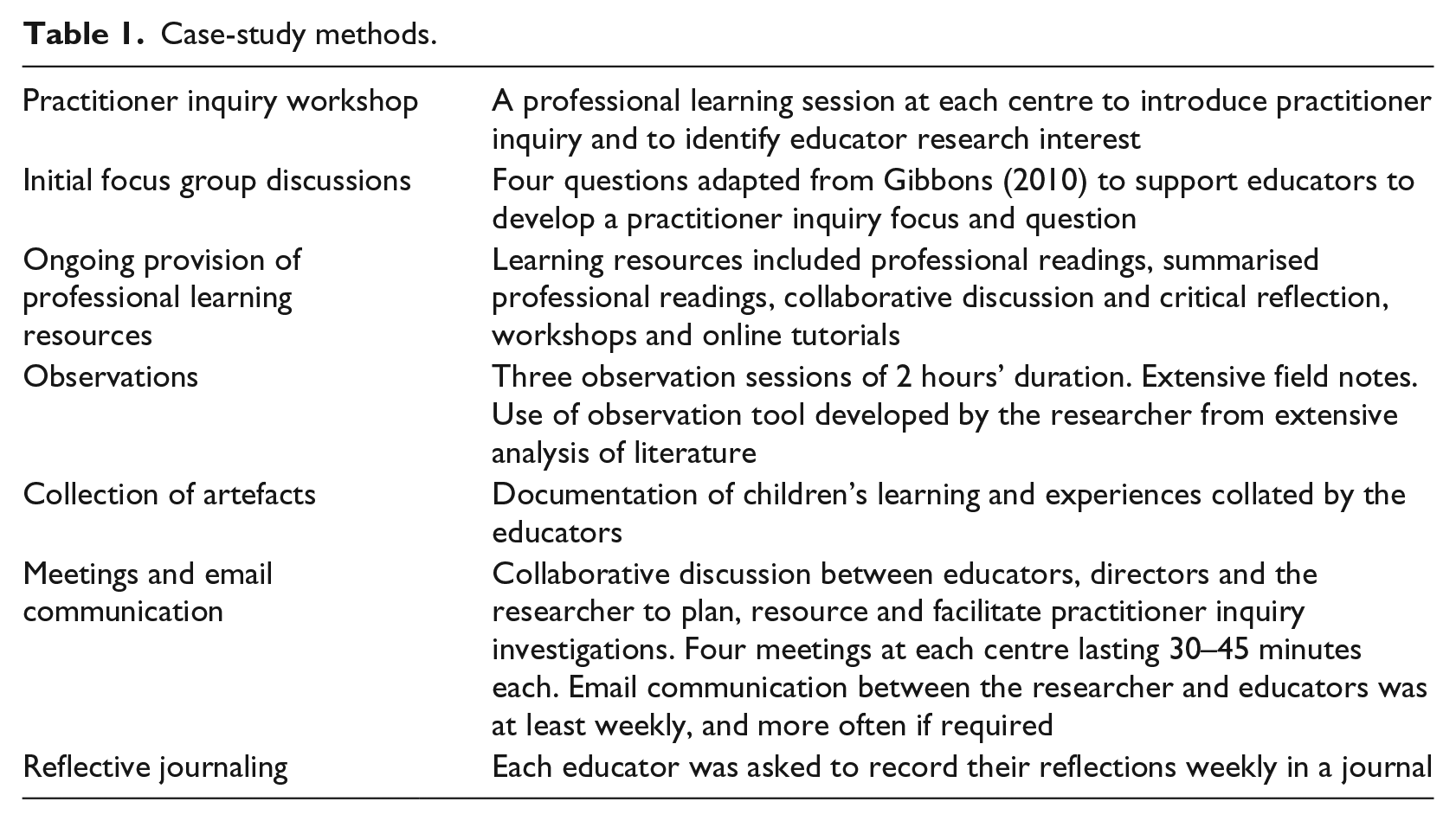
The project utilised a case-study approach (Johnson and Christensen, 2008). The study was iterative in nature with findings throughout informing involvement in the practitioner inquiry projects. Table 1 outlines the case-study design. The overarching focus of the practitioner inquiry project was twofold: (1) to support new scientific knowledge relating to space and the solar system and (2) to target digital literacy skills to support inquiry and investigation of their chosen research topic.
Case-study methods.
Participants
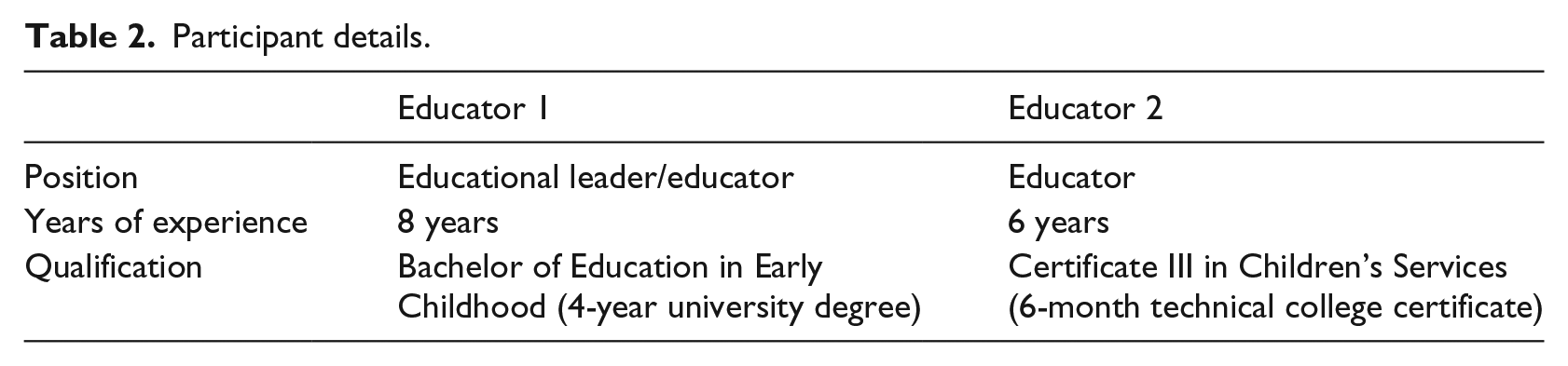
Participant recruitment relied on a purposive sampling approach (Johnson and Christensen, 2008). Two educators working with children aged 3–5 years took part in the practitioner inquiry project (see Table 2 for details). The service was positioned at a university campus in Sydney, Australia.
Participant details.
Practitioner inquiry
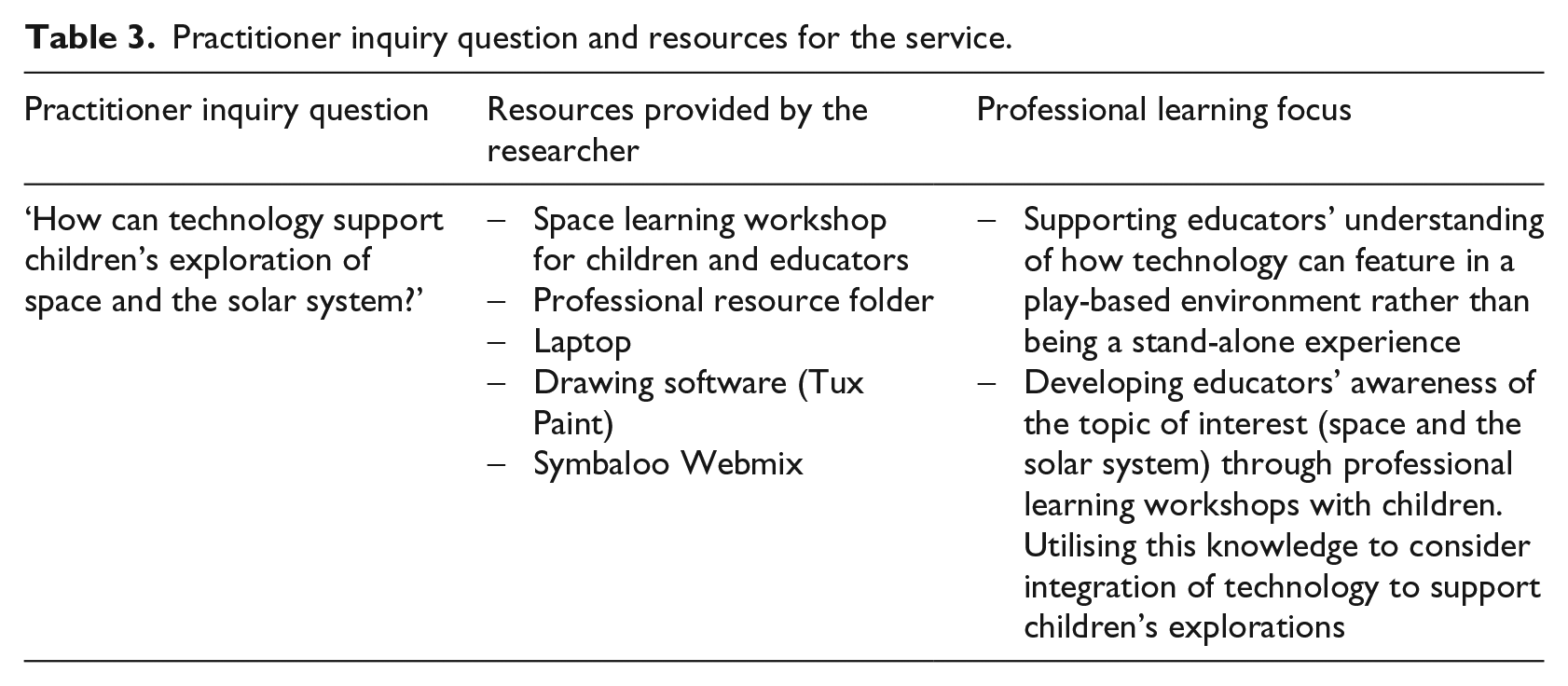
During the practitioner inquiry projects educators developed their own research questions and topics for inquiry with the underpinning focus of considering technology as an integrated tool or resource. The educators identified the need for information, support and resources that would enable them to respond to children’s interests in space and the solar system and to consider how technology could be integrated to facilitate investigation. Table 3 contains an outline of the practitioner inquiry question and resources provided for the educators.
Practitioner inquiry question and resources for the service.
Many children attending the centre were participating in a programme called ‘Young Star Watchers’ with their families and siblings (Young Star Watchers, 2011). The programme was run by the university associated with the early learning service and focused on astronomy with separate programmes for children aged 2–6 years and above 6 years of age. To further promote development of accurate scientific content knowledge the facilitator of the Young Star Watchers programme visited the early learning centre to conduct a workshop with the educators and children. The workshop focused on stars and planets and provided opportunities for children to share their own knowledge and ideas with the facilitator. It also provided a hands-on, interactive learning experience where children and educators learnt about how stars are born, how they grow and how they die. The workshop included a dramatic representation of a nebula with the children sitting in a circle around a large black blanket filled with coloured confetti as a physical representation of stardust in a nebula. A storytelling approach was used to introduce technical terms while also using language that made the information accessible to children and explaining complex scientific ideas in simple ways. The same confetti (representing stardust) was then made into piles to show the relative size of each different planet and their position in the solar system. These experiences provided a common foundation of scientific information for both educators and children that underpinned further exploration in the curriculum. To further support development of knowledge, an additional educator filmed the large group experiences so that they could revisit the content at a later time.
Data collection
Data collection was integrated with the practitioner inquiry project and included five components: focus group discussions, observations, collection of artefacts, meetings and individual reflective journals (see Table 1). The study commenced with a practitioner inquiry workshop and focus group discussion. The discussion centred on professional learning, reflective practice and their interest in technology, as identified in discussion with the educators. Discussions were recorded and transcribed for analysis. Three naturalistic observation visits of 2 hours’ duration were conducted by the researcher, focusing on educator interactions with children, technology use and technology prevalence in the classroom. Extensive field notes were taken by the researcher, which were reviewed alongside an observation tool developed by the researcher, focused on technology and pedagogy including predetermined characteristics that were based on an extensive review of the literature and research relating to technology in early learning services. Copies of educator’s documentation of children’s learning and experiences were also collected. Meetings were undertaken weekly during the practitioner inquiry projects and informed development of professional learning content. Educators were requested to keep individual reflective journals throughout the practitioner inquiry process. Questions adapted from the (Ritchart, Church, and Morrison, 2011) Look-Think-Wonder model were provided to guide the reflection process.
Data analysis
Analysis in the practitioner inquiry projects included an adaptation of Saldaña’s (2009) coding-to-theory model. To reduce potential bias and subjectivity, Rogoff’s (1995) planes of analysis were employed as a coding filter or analytical lens (Saldaña, 2009). An extensive review of the literature was undertaken to identify key categories or themes and also to inform development of the observation tool (Saldaña, 2009). All data sets were then reviewed with a focus on the similarities, differences and frequency. Less common or more subtle themes were then sought and identified through a process of disassembling and reassembling data (Yin, 2011).
Triangulation of data continued throughout the study (Yin, 2011). Transcribed meeting notes, written records of observation, data collected from the educators’ reflective journals and artefacts such as programming and planning recorded by the educators were all analysed and coded based on themes that emerged, with the opportunity to create new codes and sub-codes as they emerged throughout the study (Saldaña, 2009). This process allowed for consideration of both educator and researcher perspectives within the analysis and helped to ensure that data were valid (Yin, 2011).
Theoretical framework
Rogoff’s (1995) three planes of sociocultural activity and analysis were utilised as a theoretical framework for this study (see Table 4). The planes provided an effective lens for understanding how educators’ beliefs and knowledge influenced use of technological resources in their early learning curriculum and how beliefs and knowledge were influenced by personal characteristics as well as broader contextual factors. Here the relationship between educator understanding of and confidence with science and technology were seen as interrelated with pedagogical practice and engagement with professional learning. Rogoff’s (1995) planes enabled the synergy between personal, interpersonal and community planes of sociocultural activity to be understood. This understanding informed the provision of professional learning content that was contextually relevant for educators. It also enabled professional learning content to be responsive to educator understandings of technology as a cultural tool – that is as an embedded resource that is observed as having cultural value and significance (Rogoff, 1995).
Vygotsky and Rogoff’s sociocultural theories as foundations of Rogoff’s planes of analysis.
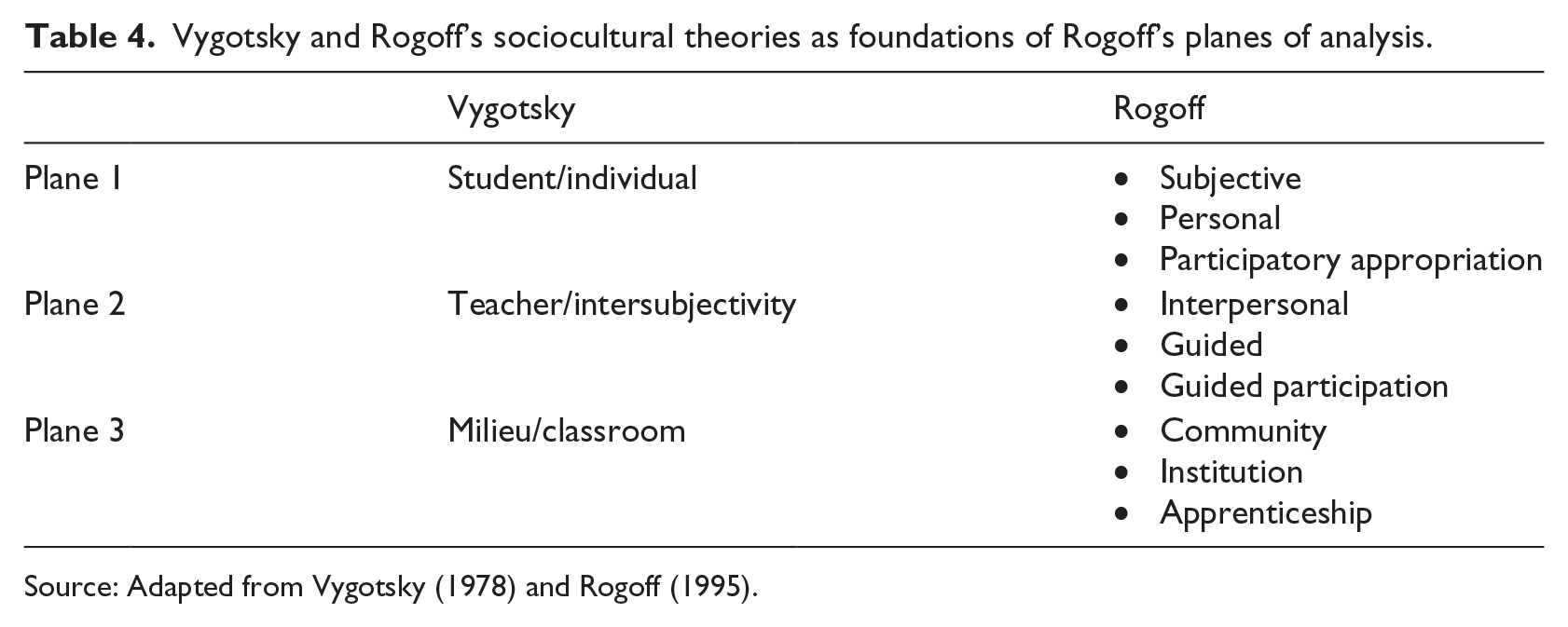
Source: Adapted from Vygotsky (1978) and Rogoff (1995).
Ethics
This study met the requirements of the Macquarie University Human Research Ethics Committee. Written consent was obtained from all participants. Rigorous procedures were followed to ensure confidentiality, anonymity and the voluntary nature of being involved in the study.
Findings
The practitioner inquiry project encouraged educators to consider how technology could be used to extend and support investigation on an area of interest to children. Multimedia and digital resources along with other experiences were identified as an impetus for children’s interest in space and the solar system. Technology used was found to support inquiry and investigation through the project and was effectively integrated with non-digital tools and resources. Of most note was the capacity for technology to be used as a tool to position educators and children as co-learners on this often-unfamiliar topic.
Technology as an impetus for interest in space and the solar system
During early practitioner inquiry meetings during the development phase of the practitioner inquiry process, the educators noted that children often spoke about elements of the Young Star Watchers Programme and these discussions evolved into various play-based experiences. While involvement in the programme was identified as a key influence, multimedia sources and popular culture were also identified as a consistent and long-standing key impetus for young children’s interest in space and the solar system. During a meeting Educator 1 commented that Every year children have this interest [in space and the solar system] [. . .] it comes through in their imaginary play or block play. Last year a DVD started it. Last year we did what was very basic, we want to do more, but there is no information. Information books you can only go through pictures. It’s not age-related.
Documentation of children’s conversations, as recorded by educators during the practitioner inquiry project showed children’s interest in and knowledge of diverse aspects of space. Documentation of children’s conversations, as recorded by educators early in the practitioner inquiry project showed connections with popular culture characters, such as Transformers, and involved deep interest and complex space-related themes. As an example, a short segment of a lengthy and detailed conversation with a child (4 years old) recorded by Educator 1 included this comment: [Child’s name] made another spacecraft with blocks. I asked him what it was [child’s name] responded: ‘It’s a starship, it’s a kind of satellite, it’s like an aircraft like to help the Transformers’.
These examples reinforce that children’s interest in space and the solar system often stems from experience with multimedia sources. However, another conversation between children, documented by Educator 2 early in the practitioner inquiry project, demonstrated that children’s interest in space can come from diverse experiences. Here the children drew on their knowledge of dinosaurs and asteroids developed in connection with experience of museum spaces:
Look at my asteroids!
Wow they are really cool! Do you know what they do?
Yeah, they get to Earth and it hits Earth. It goes ‘karpoo!’ and then the dinosaurs get hurt by the asteroids
Is that why the dinosaurs are extinct?
Some didn’t die, but they are only at museums [. . .] and there’s fire. It comes out of them. The fire hurts the dinosaurs.
Why do you like asteroids?
Because they are really cool and I like watching them crash into Earth.
Conversations such as these demonstrate that the impetus for children’s interest in space and the solar system comes from diverse sources and includes multimedia experiences. They also demonstrate the integrated and influential nature of technology such as digital media in children’s lives and ways of experiencing the world and therefore an important consideration in the early learning curriculum.
Technology integration with other resources to support investigation
During a meeting early in the practitioner inquiry project, Educator 1 expressed the belief that technology was an effective way to support children to investigate their interests. She stated, Technology is the best way to help us with that. Information books are good but usually I translate, but through the apps it’s easier for the children to go through and then the parents can download the app too.
However, during this meeting the educators also indicated that they used technology to find information for and with children. As an example, Educator 1 noted that children were discussing ‘what was behind the clouds’. The educator stated it was difficult to find meaningful information on this or a way to effectively explain it to children. The educator stated that technology was utilised for co-learning on this unfamiliar topic, with opportunities for sharing information between educators and children.
During the workshop for children and educators the facilitator created a culture of co-learning stating that the session aimed to share information with the children and educators. This was extended throughout the workshop with the facilitator reinforcing the co-learning possibilities in follow-up experiences, suggesting a variety of sources and approaches. These included accessing images of nebulae online as well as in print, using visual arts to enable children to extend their thinking and understanding and for educators to be intentional in extending children’s vocabulary of scientific terms and language relating to nebulae, stars, the Earth and the solar system. In a meeting a week after the presentation, educators reported accessing images and information from the Internet with children to revisit ideas about nebulae to seek inspiration and to also increase their own scientific knowledge of components of nebulae. Educator 1 commented, [. . .] our children are pushing our knowledge beyond [what we know]. We need to have the knowledge and resources ready [. . .] we don’t want to give them the wrong answer.
Throughout the practitioner inquiry project, educators reported and were observed to use online images and Internet information searches in a number of different ways to support investigations and understandings of space and the solar system. During a meeting, Educator 1 noted children often lost interest before suitable information was located when conducting Internet searches. As such, relevant websites were organised into a Symbaloo Webmix. This platform enabled a number of different website links to be grouped as tiles on one central page. Clicking on the tile linked to the space/solar system-related website. This system enabled websites to be accessed quickly and could also be pre-screened for suitable content. There are also benefits in doing online searches with children to help them to build experience and understanding of Internet spaces. Educators and children conducted searches together and discussed elements such as advertisement and how to find suitable information. This enabled both educators and children to develop an increased awareness of effective navigation of online spaces.
At the beginning of the project, both the educators stated the belief that children would access the sites independently. However, midway through the practitioner inquiry project a shift in thinking occurred with Educator 1 expressing recognition that children benefitted from guidance and help to navigate through the Webmix. Educators reported that children’s interests and knowledge diversified throughout the project. They became interested in the Earth’s core and began sharing ideas about it containing lava. In a meeting, Educator 2 noted their own limited understanding on this topic and their surprise at hearing children use language like ‘mantle’ and ‘core’. The educator expressed a sense of disappointment, stating, ‘I feel like I should have known more. I should have researched it at home’. Later in the project, educators reported using the Webmix to find information to add to children’s descriptions of planets and asteroids. Observation of practices and feedback shared by educators in meetings indicated that using digital resources enabled a shift in mindset. Educators became positioned as co-investigators and were able to find information with children to address their questions, rather than having the expectation that the educator should know everything.
Discussions with the educators during meetings revealed broader changes in their attitudes towards technology. Educator 1 noted, they were ‘not heading straight to Google for answers’ and instead now saw technology as a tool. The educators identified being more intentional in using Internet searches and included employing scientific inquiry processes through conversations with children about their opinion, ideas and theories.
In the final meeting, Educator 1 stated a new understanding of the capacity for technology to extending learning rather than just being of novelty value or a one-off experience. The educator also expressed new perspectives on the benefits of technology in positioning educators as co-learners and constructors of knowledge, stating that ‘teachers [are] researchers too, learning with the children. The teacher is a learner and a researcher’. Educator 2 tempered this response to technology by adding that ‘sometimes children need hands on experiences like paint, clay and plasticine’. However, educator documentation of children’s learning showed that children used digital media as an artistic medium to investigate idea on nebulae, extending on ideas presented in the workshop. In a practitioner inquiry project meeting, the educators explained that information drawn from the Internet was used to further extend these creative art experiences. The educators explained that children discussed the colours in the nebulae with an educator and then moved to the laptop and used Tux Paint to draw these elements of space. Documentation recorded by the educators provided an example of two children working side by side on computers. They created a design of bright colours representing the nebulae and then covered it with black, explaining that ‘space is dark’. Here, educator preconceptions of ‘hands-on’ and ‘creative’ experiences, raised during meetings, was challenged as children used technology as a creative medium to explore ideas gained across both digital and non-digital mediums.
Discussion
The educators in this study noted that space and the solar system were a consistent topic of interest for the different children they had taught over many years. They identified digital media sources as a key impetus to this interest, which is consistent with other research (Kampeza and Ravanis, 2012; Katz, 1998). Educators were unsure of how to extend children’s interest in space and the solar system due to limited knowledge on the topic and also lack of access to resources that supported exploration in an early learning curriculum. Technology was identified as a tool to foster knowledge and understanding for both educators and children. The practitioner inquiry project enabled provision of context-specific professional learning content (Groundwater-Smith et al., 2013) that focused on foundational understandings of technology in play-based learning. It also enabled exploration of how technology could support educators and children to learn more about space and the solar system. Establishing a culture of children and educators as co-learners was key to building knowledge in these areas. Co-learning was explicitly introduced through the workshop conducted with children and educators early in the practitioner inquiry project. Understandings and support for children and educators as co-learners and co-investigators continued as a key focus throughout the project. This approach enabled children and educators to move between the roles of apprentice (Rogoff, 1995) and also enabled acknowledgement of children’s insights and knowledge on scientific concepts (Gordon and Highfield, 2014). Co-learning was introduced in the familiar context of hands-on, interactive play experiences and then easily extended to experiences with digital technologies, which were often a less comfortable or less familiar space for educators.
Technology as an integrated tool
Technology integration continued to emerge throughout the practitioner inquiry project, demonstrating increasing awareness of technology as a complementary resource. This is an important consideration as relevant, integrated technology experiences help create a curriculum that reflects children’s social and cultural contexts (Edwards et al., 2016). Initially, educators viewed technology as a stand-alone activity to be used independently by children. The value of guidance and explicit instruction on technology use was included in the professional learning content for the service and helped to shape educator practice in terms of introducing technological resources to support learning. This also addresses the common misconception that technology use is intuitive for children (Plowman and McPake, 2013). The Webmix was utilised as a resource to extend learning through interaction, conversation and discussion with children. It also positioned children and educators as co-learners. Educators could follow children’s interests, seek information online and increase their own understanding while also sharing the information with children about scientific content, digital literacy and technology handling skills.
As a tool for investigation, technology enabled educators to provide images of different aspects of space such as information on planet names to verify and complement ideas provided by the children as well as information in other reference material. Accessing the Internet enabled educators to develop their own understandings of these topics alongside children rather than perpetuating the misconception that educators consistently need to be the more knowledgeable other or be seen to have comprehensive and exhaustive knowledge on every content area. This is important in terms of creating a culture of co-learning in science, acknowledging children as capable, competent and equal in terms of agency and position (Gordon and Highfield, 2014).
In addition, using digital devices to record experiences such as the workshop was a valuable tool to support co-learning. Yelland (2011) advocates the worth of including new technologies alongside more traditional ones to create integrated and holistic approaches to pedagogy. In revisiting the workshop, children and educators shared their knowledge and ideas, building on, complementing and challenging the ideas of others in the group. In this way, technology was effectively integrated as a tool alongside other resources that supported learning and investigation by creating more focus on learning and less focus on instructive teaching (Gordon and Highfield, 2014).
Technology supporting scientific inquiry
Learning about concepts relating to Earth and space science is not limited to content, it also incorporates scientific process such as asking questions, explaining, listening, testing ideas, recording findings, making sense of findings and planning and extending based on new information gained (Hamlin and Wisneski, 2012). Within this project, technology such as the Internet was conceptualised beyond being a resource that simply provided answers. Through the practitioner inquiry process, educators developed an understanding of how technology could be used intentionally to build critical inquiry skills. This resulted in Educator 1 expressing that technology was now used effectively to extend learning rather than as a one-off experience with novelty value, as previously conceptualised.
Technology supported processes of investigation, including supporting children’s ideas to unfold – even if they were initially inaccurate, conducting conversations that helped educators and children to identify inconsistencies and contradiction in their ideas as a point of initial critique, and following up with Internet searches to test, confirm or re-evaluate ideas. In this way, using digital resources to access information enabled educators to develop a ‘sciencing attitude’, as described by Fleer et al. (2014). This involves thinking more intentionally about science content in the curriculum rather than relying on incidental science in everyday experiences with superficial or generalised discussions. In addition, technology supported educators to be co-learners in terms of having a shared sense of wonder and discovery with the children as they explored new information on space and the solar system. This is of key importance in supporting children’s development. When educators foster a sense of curiosity and wonder towards science, it positively affects children’s long-term learning dispositions and attitudes (Fleer et al., 2014) and promotes further scientific inquiry and investigation (Hamlin and Wisneski, 2012). Technology facilitated this process, complementing non-digital and more traditional resources. Future research could investigate whether other educators would have similar experiences with technology as a tool for co-learning. This consideration could extend to other topics, contexts or forms of technology. This would extend on the results from this study, which emerged from examining the experiences of two educators with the group of children they worked with.
Conclusion
Outer space, space travel and the solar system are common topics of interest for young children. Children often develop interest in this topic through engagement with movies, television shows or other media which include themes associated with space and planets (Kampeza and Ravanis, 2012; Katz, 1998). The social and cultural relevance of these engagements and interests mean that investigations of space and the solar system are a consistent topic of interest for young children. However, it is a topic with unique complexities when included in early learning curriculums. Educator expertise in and awareness of teaching the scientific concept knowledge effectively is needed to compensate and accommodate the fact that children cannot learn much of the content through direct observation (Siegal et al., 2011). Extending on children’s interests in space and the solar system can provide fundamental information on scientific concepts that will help to reduce misconceptions and inaccuracies that often develop in childhood and are maintained throughout adulthood (Siegal et al., 2011). Scientific learning should also focus beyond concepts to include inquiry processes such as question asking, hypothesising, problem-solving and developing critical thinking skills (Hamlin and Wisneski, 2012). Technological tools provided important information in terms of scientific concepts and also enabled children’s inquiry skills to be fostered. Here, technology was used in an integrated and complementary way to support co-learning on an unfamiliar topic. When educators are positioned as co-learners, they can move beyond the belief that they need to hold expert knowledge in all areas of interest of the children they work with. Instead, they can recognise how a combination of technology and more traditional resources can support the acquisition of new knowledge in partnership with children, with each shifting between the roles of apprentice and more knowledgeable other. This study highlights that to support educators to integrate technology, professional learning content needs to focus on technology as a complementary tool. Professional learning content extended beyond technology in play-based curriculums to include resources specifically related to the overarching topic of space and the solar system with a focus on the integrated and holistic nature of technology.
Footnotes
Funding
The authors received no financial support for the research, authorship and/or publication of this article.
