




Abstract
This article describes an international classroom partnership with twenty-eight 5-to 7-year-old Canadian and Tanzanian children, and outlines the meaningful ways they were involved in the research process. In this project, the children shared their valued school-based experiences and environments through multiple self-chosen modes. The children’s arts-based multimodal texts, descriptions of their valued school experiences and environments, and their personal biographies were then shared at a 2-week exhibit at a national art gallery in Canada. The findings across both data sets revealed the children’s interest in spending time outdoors in their local contexts, engaging in collaborative and imaginative play. This project also addresses the importance of providing a space for children to share their perspectives, which aligns with Article 12 of the UN Convention on the Rights of Child. Article 12 addresses the importance of children having a right to have a voice and to have their opinions heard in matters that affect them. Article 13 is also highlighted in this project and outlines children’s right to freedom of expression. This right includes the freedom ‘to seek, receive, and impart information and ideas of all kinds, regardless of frontiers, either orally, in writing or in print, in the form of art, or through any other media of the child’s choice’. In this project, the Canadian and Tanzanian children’s multimodal texts of their valued school-based experiences revealed more similarities than differences in relation to what learning experiences mattered to them at school. During this project, the children in both contexts became interested and invested in their international peers’ lives and school-based experiences, and felt a sense of connectedness and kinship across the globe.
Introduction
According to Oxfam (2015), international school and classroom-based partnerships play a vital role in helping children recognize their contributions as citizens of the global community, and enable children to develop deeper understandings of their global peers’ everyday lives. Through these international partnerships, children are provided with opportunities to appreciate the similarities between people everywhere and value diversity, understand the global context of their local lives, and develop skills that will enable them to address and combat injustice, stereotypes, prejudice and discrimination. In this study, a group of fourteen 5- to 7-year-old children in North Vancouver, British Columbia, Canada, and fourteen 5-to 7-year-old children in Dar es Salaam, Tanzania, used arts-based multimodal methods to share what school experiences mattered to them in their local school contexts. Research has identified the importance and benefits of the arts in young children’s lives (Ewing, 2010; Twigg and Garvis, 2010; Wright, 2012), and Eisner (1972) contended that art-making and aesthetic experience ‘are among the most sophisticated aspects of human action and feeling’ (p. 1).
In this article, the positioning of children as capable and competent meaning-makers occurred through their use of self-chosen arts-based modes to convey their valued school experiences. In their work, Barrett and Smigiel (2003) expressed concern that much of the research on the importance of the arts and multimodality in children’s lives has failed to respect young children’s perspectives. They contended that this has discounted the fact that young children can talk about their own experiences and, additionally, express these ideas through art. In this article, the power of listening to children’s voices through art and narrative is shared, as well as the importance of displaying children’s perspectives in a unique and meaningful way to enhance the participants’ and their communities’ cross-cultural knowledge and understandings of diverse worldviews (Davies, 2008; Dill, 2013; Rapoport, 2010).
Theoretical framework
This project is framed by the following theories: (1) multimodality (Kress, 2010), (2) sociocultural theory (Vygotsky, 1978) and (3) critical literacy (Luke, 1997). In young children’s worlds, children’s use of multiple modes is closely linked to the Reggio Emilia approach which encourages children to give artistic expression to their unique perspectives (Edwards et al., 1993). Specifically, a multimodal perspective recognizes children as sign-makers who communicate simultaneously the ‘here and now’ of a social context (Kress, 1997). Sociocultural theory recognizes learning as socially and culturally situated (Lave and Wenger, 1991; Moll, 1990; Rogoff, 1990; Vygotsky, 1978; Wertsch, 1991). According to Wertsch (1985), sociocultural theory focuses on the dynamic interaction between individuals, other people, and cultural texts, all of which contribute to the social formation of the individual mind, and leads to the realization of socially valued goals (Engeström et al., 1999). Critical literacy also framed this project. This framework views literacy in broader, sociocultural and political terms, and acknowledges any kind of representation of meaning as a site of negotiation and change. Luke (1997) contended that while earlier psychological perspectives conceived literacy as the acquisition of particular behaviours, cognitive strategies, and linguistic processing skills, recent insights from ethnography and cultural studies have led to increasing recognition that literacy and meaning making are also practices that are socially constructed and locally negotiated (Norton, 2007).
Context and research participants
The 14 Canadian children involved in the project attended public school 5 days a week in a high socio-economic neighbourhood comprised primarily of single-dwelling homes. Geographically, the school and outdoor context is located in a mountainous and densely forested area of North Vancouver, British Columbia. The Canadian participants either walked to school every week day or arrived in vehicles. The 14 Tanzanian participants attended public school 5 days a week at a primary school located on the campus of a large teacher-training university in Dar es Salaam, Tanzania. The children wore uniforms and paid a minimal school fee, and the school provided the children with a snack every morning. The Tanzanian children lived outside of the guarded gates of the university in low socio-economic neighbourhoods that were comprised of small homes with corrugated metal roofs, dirt roads, and little vegetation. Most of the children walked to school; however, a small bus also transported children who were not within walking distance to the school.
Literature review
Global education and international school partnerships
Since the 1970s, global education approaches have been integrated in classrooms through the incorporation of elements of social justice, intercultural understanding, and human rights issues in the curriculum (Mundy et al., 2007). To help students develop cross-cultural understandings in 21st-century classrooms, many countries, including Canada (Schweisfurth, 2006), have begun adding content to Ministry of Education provincial documents aimed at developing a global orientation for students. This movement is evident in the newly implemented British Columbia Social Studies elementary curriculum (British Columbia Ministry of Education, 2016), as valuing diverse global perspectives and approaches to learning are included in the curriculum. According to the United Nations Educational, Scientific, and Cultural Organization (UNESCO, 2015), global education can be addressed with young children by helping them understand that they belong to a broader global community and common humanity, and by emphasizing the interconnectedness between the local, the national, and the global. This approach recognizes that global education is a multifaceted approach, employing concepts and methodologies already applied in other areas, including human rights education, and education that focuses on the development of international understandings (UNESCO, 2014a). This approach to education and international school and classroom partnerships also promotes a lifelong learning perspective, beginning from early childhood and continuing through all levels of education and into adulthood (UNESCO, 2014b).
Arts-based approaches in early childhood
The arts have always been an integral part of early learning (McArdle and Wright, 2014). Ewing (2010) argued that the arts have the potential to transform ‘learning in formal educational contexts, and ensure that the curriculum has relevance for all children’ (p. 1). Several researchers (Edwards, 2010; Isenberg and Jalongo, 2009; Russell-Bowie, 2009; Wright, 2012) have examined the importance of the arts in young children’s worlds and how children’s use of art to express themselves positions them as active agents in the world (Isenberg and Jalongo, 2009; Wright, 2012). This is particularly evident in the Reggio Emilia approach where children engage extensively in the arts and act as collaborators, co-constructors of their environment, and creative and effective communicators (Bartlett and Gandini, 1993). Wright (2012) contended that children’s engagement with the arts can also be seen as an additional way of knowing, thinking, and innovating that encompasses affective realms of being. Liamputtong and Rumbold (2008) stated that arts-based approaches are ‘particularly suited to working with participants who may not respond to the more verbal research methods such as interviews and focus groups’ (p. 3). This is important to consider in the early years, as many children will still be developing their oral language but may be able to communicate more effectively through other modes of communication such as drawing, movement, or other visual approaches (Switzer, 2009).
Methodology
This project was framed by a rights-based participatory research approach, and focused on children’s voices through their creation of multimodal arts-based texts. Rights-based participatory research with children has at its heart an ethos of empowerment for children, which centres on their active involvement in the research process, and the promotion of their rights as citizens with voice and power (Pascal and Bertram, 2009). This approach is based on the assumption that we can learn from children (Arojjo and Nyonyintono, 2009; Clark, 2005; Dockett and Perry, 2005; Einarsdóttir et al., 2009; Theobald, 2012) and has led many researchers to seek ways to involve children’s perspectives in research projects in which they are involved. This approach has also sensitized early childhood researchers to the challenges of inclusive research, where young children are viewed as active participants, rather than objects, in a research process that is set in the context of a democratic encounter (Asselin and Doiron, 2016; Pascal and Bertram, 2009). Beresford (1997), Dockett and Perry (2005), and James and Prout (1997) contended that including multiple arts-based modalities in research projects with young children can help elicit deeper, more meaningful responses. The UN Convention on the Rights of the Child (UNESCO, 1989), specifically Articles 12 and 13, also link to a rights-based participatory approach.
International project and art exhibit
In this project, the 28 Canadian and Tanzanian children shared their valued school-based learning experiences with me during individual sessions. In the Tanzanian context, the headmistress at the school assisted with the individual sessions by acting as a translator for the participants. Although the Tanzanian children were learning English at school, their home language was Kiswahili. During the data collection sessions, all the Tanzanian participants chose to verbally communicate in their home language. This study occurred over two school years, and in the spring of both years, I asked the children in each context to share what learning experiences mattered to them at school. The data shared in this article is from the second year of the study. Over the course of 2 years, I spent several weeks participating in the daily school routine with the children in Tanzania, and several months participating in the Canadian children’s daily routine at school. Each individual session with the participants spanned approximately 30–45 minutes where, the children were provided with an opportunity to use multiple arts-based modes of their choosing (e.g. drawing, sketching, painting, storytelling, photography) to share their valued school-based experiences. Throughout the 2 years, the students in each distinct context also learned about each other as I shared their arts-based texts in both international research sites. I also shared images of the children in both environments, and video clips of the participants’ schools, playgrounds, and local neighbourhoods. These visual images enabled the children to develop deeper and richer understandings of their peers’ lives.
In this project, 12 of the 14 Canadian children shared that playing outside in the forested area of their schoolyard, on the soccer pitch, and on the playground equipment were their most valued school experiences. Two of the children preferred playing indoors – and stated that they liked being read to by their teacher and playing with toy cars. The Canadian children chose to share their favourite experiences through oral language, drawing, painting and photography. Drawing on narrative analysis (Engel, 2006) and visual analysis (Lomax, 2012), dominant themes emerged across the Canadian data set that focused on autonomy, and the importance the children placed on social relationships and collaborative play outdoors. In comparison, 12 of the 14 Tanzanian children also revealed that playing outdoors – on the soccer pitch, on their school playground equipment, and in the school’s flower garden – were their most valued school-based learning experiences. The Tanzanian children also chose to share their favourite school-based experiences through oral language, drawing, painting and photography, as well as gesture. I used the same analysis techniques when examining the Tanzanian children’s texts and the same dominant themes emerged from the data linked to autonomy, collaboration and social relationships, and the importance of outdoor play in their school worlds.
Art exhibit
The planning for the art exhibit–opening and 2-week show at a national gallery in Canada began 8 months prior to the event and involved the children in both settings in multiple ways. For example, the children in both research contexts contributed to their personalized biographies (that were mounted next to their arts-based texts during the show). In their biographies, the children shared their favourite colours and foods, along with a detailed description of their most valued learning experience at school. Over the course of the 2-year study, I had taken several photographs of the children at school and the participants decided what images they liked best of themselves to feature on their biography. After an explanation of the art exhibit was shared with the Tanzanian children and families by the headmistress, the children and families provided their verbal consent to share the children’s images at a public event. In the Canadian context, I discussed the exhibit with the children, and their families also provided their consent to have their children’s images displayed at the art exhibit. This consent process was significant, as this enabled the children’s identities and perspectives to be shared with a wider national and international audience. Throughout the project, the Canadian and Tanzanian children were partnered, and their art pieces and biographies were placed next to each other at the exhibit. The research participants were linked based on my familiarity with the children in both settings and I paired them based on a range of factors, such as (1) their shared interests and valued school-based experiences, (2) similar personalities and (3) their choice of mode(s) to share their valued school-based experiences. For the exhibit, I transferred the children’s artwork onto larger pieces of canvas and wood. The children who took photographs of their valued school experiences had their images transferred to larger metal pieces. Below are examples of the artwork and biographies that were displayed at the 2-week art exhibit (Figures 1–4).
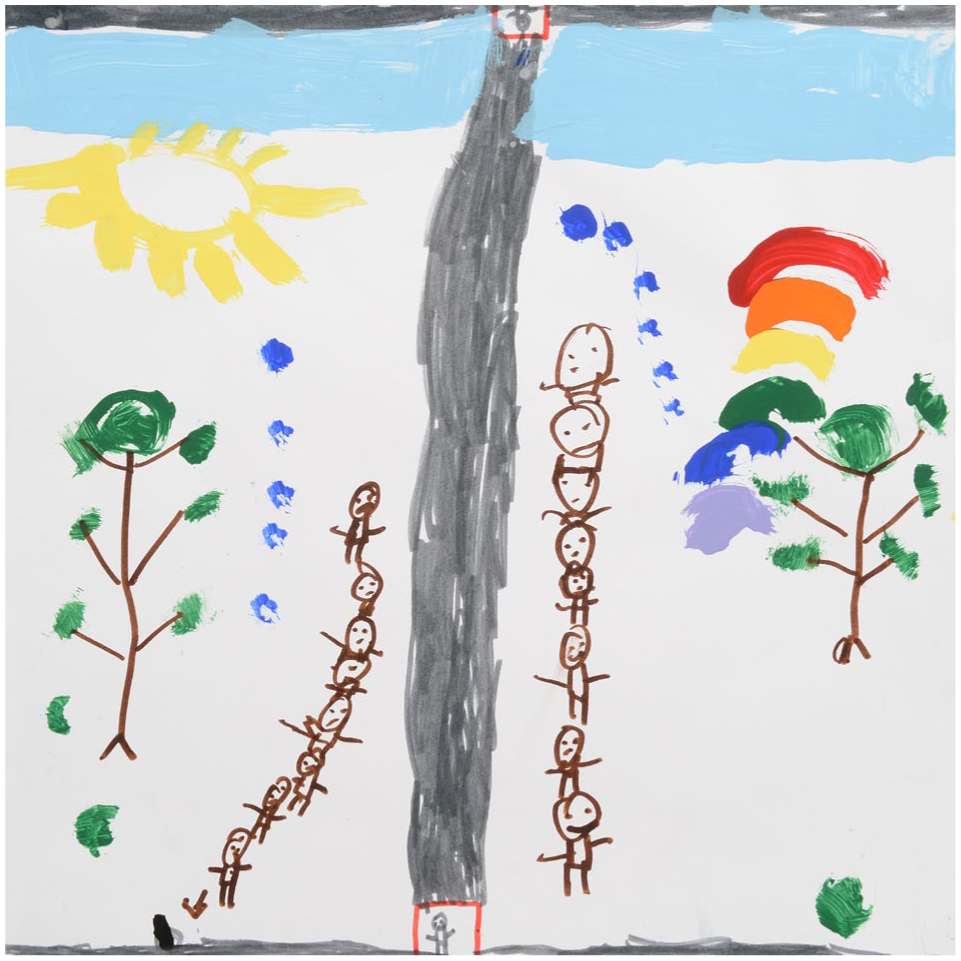
William’s drawing of the soccer pitch at his school, two teams, and the outdoor playground environment (Canadian participant).
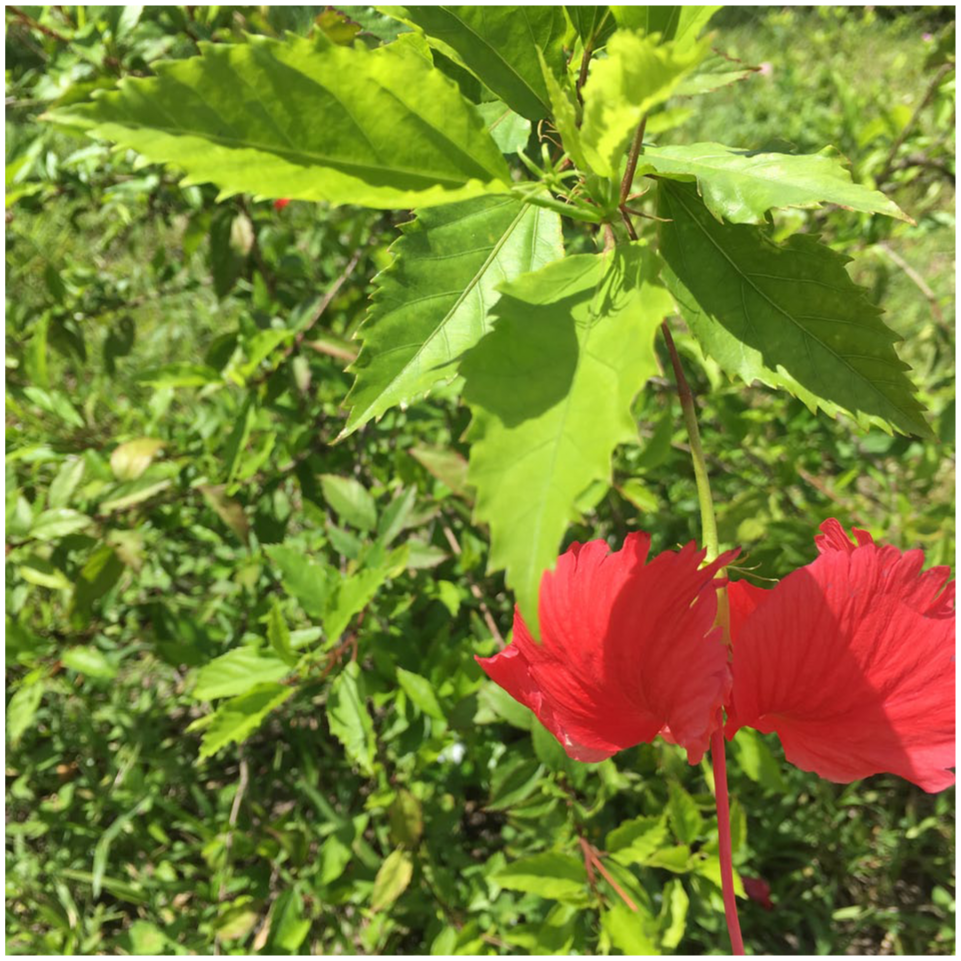
Najma’s photograph of the flowers at her school (Tanzanian participant).
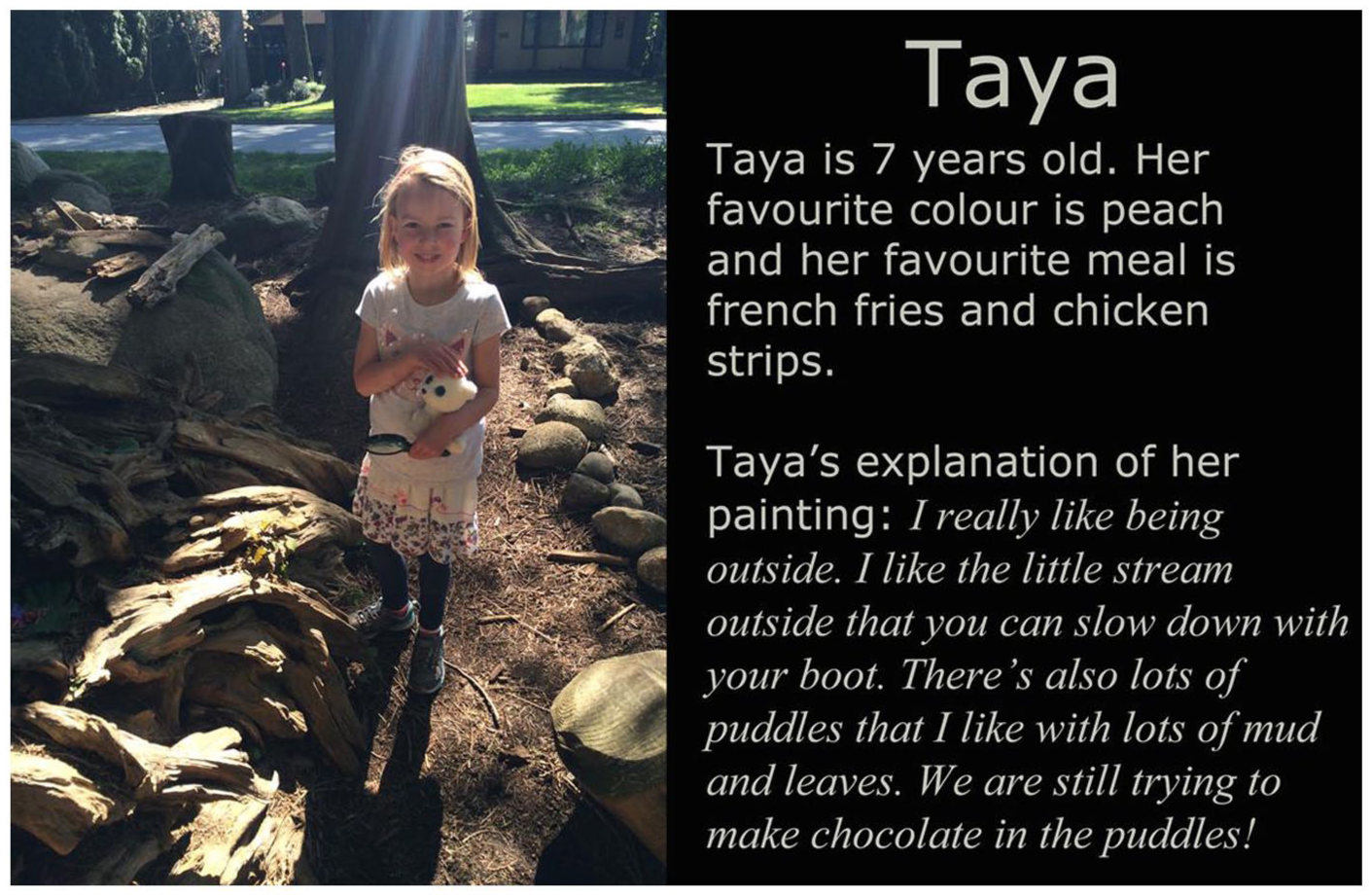
Taya’s biography (Canadian participant).
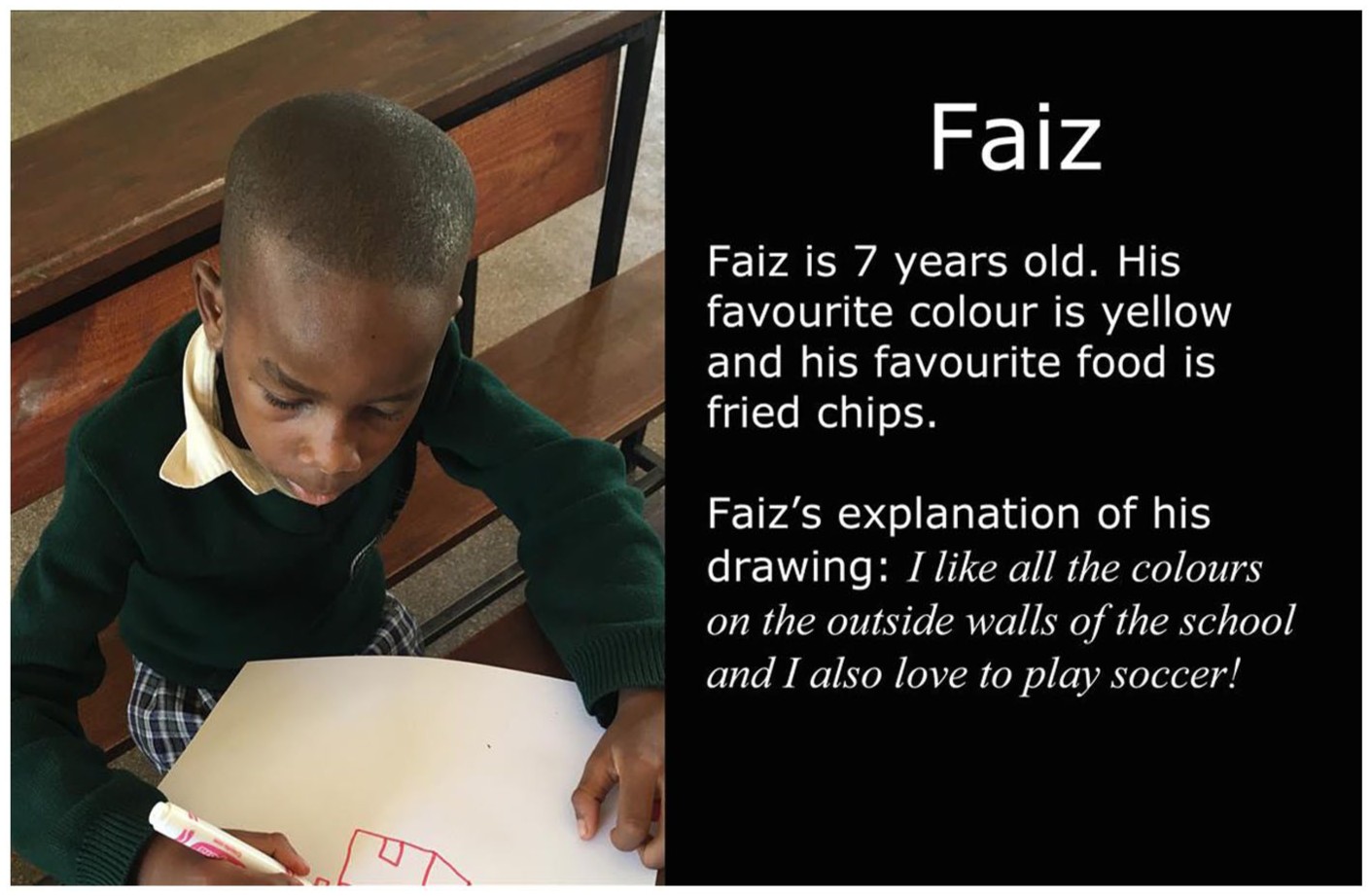
Faiz’s biography (Tanzanian participant).
In addition to the artwork and biographies, a large poster was also displayed in the gallery that explained the research project to the families, teachers, administrators, school board trustees, and community members who attended the exhibit. The poster featured photographs of the participants and both schools, and highlighted the link to the UN Convention on the Rights of the Child. Six of the Canadian research participants also chose to give short speeches at the opening event. The children’s speeches centred on their thoughts on the Tanzanian children’s artwork, and their perspectives on their relationships with their international peers. All of the Canadian children also participated in a 15-minute question and answer (Q&A) session. During the Q&A session, the children were asked numerous questions by the audience that focused on what they learned about the children in Tanzania, if they want to visit Dar es Salaam, and why they liked certain learning experiences at school. The school district also hired a videographer to document the opening of the art exhibit. The videographer also conducted interviews with individual children about their artwork. On my next visit to Tanzania, I shared the video that was produced from the event with the Tanzanian children. At the conclusion of the opening event, the art exhibit remained at the national art gallery for the next 2 weeks and was open to the public.
Discussion
Respecting and valuing children’s voices, and the multiple ways they choose to make meaning in their worlds, played a central role in this international project. This understanding supports research that has emphasized the importance of listening to children’s perspectives on issues that are important and relevant to them (e.g. Clark, 2005; Einarsdóttir et al., 2009), and the relevance of providing children with opportunities to create multimodal texts to construct and convey meaning. In addition, involving children in an early childhood project that goes beyond the children providing data and provides them with opportunities to share their perspectives and arts-based texts with a wider global network is also significant to this project. This understanding aligns with the UN Convention on the Rights of the Child (UNESCO, 1989) which intends to ensure that children have participatory involvement in all matters affecting their lives. Asselin and Doiron (2016) contended that involving children in research processes in meaningful ways is significant, as children are generally not informed about the ways research can contribute to their lives, and they often do not participate in any part of the research process. In Arojjo and Nyonyintono’s (2009) review of 83 studies involving African children, they distinguished research on and about children in terms of data collection methods. They concluded that in research on children, children are researched as objects with little agency. In turn, research about children involves the exploration of children’s issues, with adults speaking on behalf of the children. In the project described in this article, involving the children in the development of the art gallery exhibit by having them create arts-based texts on their valued school-based experiences and personal biographies enabled the children to be actively involved in the research process. The Canadian and Tanzanian children’s multimodal texts of their valued school-based experiences also revealed more similarities between the children and what matters to them at school, than differences. Additionally, during this project, I observed the children in both contexts become interested and invested in their peers’ lives and school-based experiences, and feel a sense of connectedness across the globe.
Conclusion
In this project, the development of an international classroom-based partnership proved to be an effective way for young children to learn about each other in authentic and meaningful ways. This project, and the subsequent art exhibit, revealed the capacity of young children to share their complex and rich school lives across diverse cultures. Throughout the project, I also observed the Canadian children become invested in the Tanzanian children’s interests, artistic abilities and school lives. In turn, the Tanzanian children were equally interested in the Canadian children’s arts-based texts, interests, and school experiences. Based on my conversations with the children and their families at the opening event, the exhibit also seemed to disrupt and challenge stereotypes of sub-Saharan African children’s abilities and school experiences - particularly how sub-Saharan African children have come to be characterized and viewed, by a single, negative narrative. This narrative is especially evident in the various ways African children’s lives are discussed, leading to a particular focus of African childhoods as being difficult and on the margins. This narrative has eclipsed the everyday life for many sub-Saharan African children whose lives are not characterized by ‘lacks’ (Imoh, 2016). In this project, the art exhibit provided a space where the Canadian and Tanzanian participants’ perspectives and art-based modes of communication were highlighted, shared, and valued by their families and educators, community members, and the general public. The participants’ artwork and accompanying narratives therefore provided new insights and knowledge on young children’s school lives and what matters to them across culturally, linguistically, and geographically diverse contexts.
Footnotes
Funding
The author(s) disclosed receipt of the following financial support for the research, authorship, and/or publication of this article: The author received financial support for the research from the North Vancouver School District and the Canadian School’s parent advisory council.
