




Abstract
This study explores how mapmaking, as an arts-based and culturally responsive pedagogical practice, supports young children’s voice, agency, and identity construction within classroom and public gallery contexts. We focus on 22 children (ages 6–7) in the early years of primary school, situated within the early childhood education life phase, whose multimodal mapping activities culminated in a curated exhibition at The Rooms—Newfoundland and Labrador’s provincial art gallery. Data included video transcripts of children’s narrative map sharing, teacher interviews, and field observations. Using reflexive thematic analysis informed by sociomaterial and multimodal literacy frameworks, we found that children’s maps functioned as cultural texts, expressing personal geographies through images, spatial arrangement, gesture and narration. Public exhibition recontextualized these artifacts as civic texts, validating children’s knowledge and affirming cultural identities—particularly for newcomer families. This study contributes to early childhood literacies and public pedagogy scholarship, illustrating how gallery curation can foster cultural affirmation, relational pedagogy, and civic participation within early education.
Introduction
In the wake of the COVID-19 pandemic, educators have been called to re-examine not only logistics but also the epistemologies that guide literacy instruction. For children from culturally and linguistically diverse backgrounds, formal schooling often marginalizes their lived experiences, languages, and ways of knowing. The pandemic’s disruption amplified these inequities, reinforcing narrow and standardized approaches to literacy that risk sidelining children’s voice, agency, and cultural expression (Chapman & O’Gorman, 2022; Conto et al., 2020).
This article centers on a culturally responsive pedagogical approach that affirms children’s home cultures, languages, and lived geographies as foundational to their literacy development (Gay, 2010; Ladson-Billings, 1995). Through a multimodal mapmaking project with six- and seven-year-old children in a Grade 1 classroom, we explore how arts-based, child-led practices can surface rich, layered understandings of identity, voice, and belonging. These cartographies—assembled through collage, drawing, narration, and spatial arrangement—enabled children to represent their relationships to place, family, memory, and movement.
Situated in Newfoundland and Labrador, Canada, this research was part of the broader ADVOST initiative and culminated in a curated exhibition at The Rooms—the province’s largest public cultural institution. Housing the provincial museum, archives, and art gallery, The Rooms functions as a civic space for cultural engagement and public learning (The Rooms, n.d). For many families, this was their first visit to a formal cultural institution and a moment of recognition, as children’s maps were displayed alongside those of professional artists. The public nature of the exhibition recontextualized these artifacts as civic texts, validating children’s cultural knowledge and lived experience.
While situated in a primary classroom, the participating children fall within the early childhood education spectrum, typically defined as birth through age eight (NAEYC, 2009; UNICEF, 2017). This framing is essential for repositioning early literacy as relational, embodied, and grounded in place. The children’s maps were not peripheral activities but central multimodal expressions of meaning-making, affirming the everyday literacies of young children.
The study was conducted in partnership with classroom teachers, gallery educators, and researchers. As embedded participants, we approached the work with an ethical commitment to relational inquiry and reflexivity (Groundwater-Smith and Mockler, 2007). Three intersecting frameworks guided our analysis. First, Culturally Responsive Teaching (CRT) framed the project as a pedagogical act that honors children’s cultural knowledge and lived realities. Second, a sociomaterial lens (Barad, 2007; Fenwick, 2015) helped us attend to the entanglements of materials, bodies, and space in children’s meaning-making. Third, multimodal literacy theory (Kress, 2003; Serafini, 2012) informed our understanding of the maps as complex semiotic texts where meaning was made through gesture, layering, spatial logic, and embodied narration.
Voice and agency, as conceptualized here, are not fixed traits but relationally produced through interaction, recognition, and material engagement (Cook-Sather, 2006; Kumpulainen, 2016). Children’s choices—what to include, how to arrange, how to narrate—were not merely artistic decisions, but literate acts of self-representation.
The public gallery exhibition in the project enacted what Giroux (2004) terms public pedagogy: a reconfiguration of cultural authority that centers marginalized voices in civic discourse. Teachers described the exhibit as a moment of realization—where children were seen not only as learners but as cultural contributors. The event also catalyzed shifts in teacher perception and parent engagement, expanding notions of what early childhood literacy can be when supported through responsive, community-based, and materially rich pedagogies. In this article we consider the following questions: (1) How do teachers interpret children’s use of materials in mapmaking activities as sociomaterial expressions of literacy, identity, and culture? (2) In what ways did children express voice and agency through the arts-based mapmaking process in the classroom context? (3) How did the public exhibition of children’s maps in a gallery setting shape children’s and families’ perceptions of cultural identity and recognition?
This article contributes to scholarship that expands early childhood literacies beyond print-based and school-bound definitions (Badwan et al., 2024; Binder, 2011). By positioning cartographies as multimodal, sociocultural, and public literacies, we affirm that when children are given space, tools, and recognition, they do not simply reflect culture—they actively create it.
Conceptual framework- literature review
Interweaving culturally responsive teaching, sociomateriality, and public pedagogy
This study is informed by a three-part conceptual framework integrating sociomateriality, culturally responsive teaching (CRT), and public pedagogy. Together, these theoretical lenses offer a multifaceted perspective on how young children’s literacies—and their attendant expressions of voice, agency, and identity—are shaped not only within classrooms but also through materials, cultural institutions, and community recognition. These frameworks are not viewed in isolation; instead, they intersect in this study to support a nuanced understanding of children’s learning as relational, embodied, and culturally situated.
Culturally responsive teaching: Literacy as identity work
Culturally Responsive Teaching (CRT) serves as the core theoretical foundation of this study, shaping both how the project was designed and how we interpreted children’s literacy practices. At its heart, CRT recognizes that children come to school with rich cultural knowledge, ways of expressing, and lived experiences that should be seen not as challenges to overcome, but as essential starting points for meaningful learning (Gay, 2010; Ladson-Billings, 1995). It moves beyond surface-level inclusion to foster three key goals: academic success, cultural competence, and critical consciousness.
These principles were woven throughout the classroom from the beginning. Teachers, already attuned to the growing cultural and linguistic diversity in their classrooms, worked alongside researchers to center children’s lives in the curriculum. The mapmaking prompt—“What is your culture?”—was a powerful opening. Children responded by drawing, narrating, and designing maps that reflected their homes, families, journeys, and everyday lives. Through these artifacts, they made visible the parts of themselves that often remain hidden in formal schooling.
The decision to publicly exhibit the maps was an extension of this pedagogical commitment. By placing children’s work in a gallery space—often reserved for professional or adult artists—we aimed to affirm their stories as worthy of public recognition. The exhibition became a moment of visibility, not just for the children, but for their families as well. For many, it was their first experience seeing their child’s learning acknowledged in such a formal and civic way.
While other theoretical perspectives—such as sociomaterial and public pedagogy—help us understand the material and relational dynamics at play, CRT remains our anchoring framework. It allows us to see the children’s mapping not just as art or literacy, but as acts of identity and belonging. In these maps, children didn’t just describe the world—they claimed space within it.
Sociomateriality: Literacy as emergent and entangled
Sociomateriality challenges individualistic and cognitive views of learning, instead positioning literacy as a distributed practice emerging through entanglements among children, materials, spaces, and discourses (Barad, 2007; Fenwick, 2015). Drawing from Barad’s notion of intra-action, agency is not a possession of the child but an effect of relationships—with crayons, glue, spatial arrangements, and meanings shaped by the social dynamics within which the maps were created.
In this study, mapmaking is theorized as a sociomaterial literacy event (Burnett and Merchant, 2019), where children’s knowledge of place is visually represented through their mapped journeys from home to school. Interpretation was aided by embodied gestures, material choices, and visual composition. These maps were infused with movement, as children traced identity through landmarks, images, and symbols—culturally rooted and animated during side-by-side interviews. Meaning arose not only through language but through how children moved, marked, assembled, and related to surfaces and symbols (Hackett et al., 2020). In the interviews, children gestured, danced, and mimicked, revealing layers of storytelling embedded in their identity maps. This lens informed both data collection—attending to how bodies, artifacts, and materials co-constituted meaning—and analysis, by tracing the non-verbal, spatial, and affective dimensions of both mapmaking and museum-based literacy events. Even without capturing all real-time entanglements, a sociomaterial lens enabled us to read maps and interviews as layered sites where materials, gestures, and memory co-constituted meaning.
While sociomaterial theory—particularly (Barad, 2007), concept of intra-action—guides our framing, we acknowledge that the data in this study primarily capture children’s reflective narrations and spatial descriptions, rather than real-time, micro-level intra-actions. The gallery-based conversations were retrospective, offering insight into how materials and meaning-making were recalled and represented, rather than documenting emergent entanglements during the act of creation. As such, our analysis emphasizes the distributed nature of agency across human and nonhuman elements—even when accessed through reflective storytelling and spatial composition.
Although not framed specifically through an artifactual literacies lens (Pahl and Rowsell, 2010), the maps can also be read as personal artifacts—objects that hold memory, cultural meaning, and lived experience. These multimodal compositions are not only aesthetic products but material documents of children’s identity work (Burke and Collier, 2023), representing how they understand and locate themselves within familial and social geographies.
Public pedagogy
Public pedagogy expands understandings of education beyond formal classrooms to include museums, public discourse, and cultural spaces (Clover et al., 2014; Sandlin et al., 2011). In this study, the provincial gallery/ museum/ and archive space with a dedicated room(s) to each aptly named “The Rooms”—served not only as an exhibition space but as a context in which children’s multimodal work gained civic visibility. While this article does not provide systematic analysis of audience or family responses, the gallery is understood as a setting that offered institutional recognition of children’s literacies. Rather than treating public pedagogy as a central analytical framework, we position it as a supportive conceptual lens that helps frame the significance of curating children’s work in public cultural institutions. Deeper analysis of family and community interactions within the exhibit is ongoing and will be explored in future work.
Synergy across frameworks
These frameworks are not applied in parallel, but in productive intersection. Sociomateriality explains how children’s literacies emerge through bodily-material practices; CRT ensures those practices are rooted in identity, language, and culture. Public pedagogy—while not a focus of analysis here—contextualizes the gallery as a civic space where children’s creative work can be made visible and valued. Together, these lenses illuminate literacy as relational, multimodal, and shaped by both classroom and cultural settings.
While identity is not treated as a standalone framework in this study, it functions as a connective thread that is deeply embedded within and across all three theoretical lenses. In sociomaterial terms, identity emerges through interaction with materials, spaces, and others—rather than being fixed or pre-existing. Culturally Responsive Teaching positions identity at the heart of pedagogical practice, recognizing children’s cultural knowledge, home languages, and lived experiences as central to meaning-making. Public pedagogy then elevates these identities by making them visible and valued in civic spaces such as galleries. Figure 1 visualizes this entanglement, illustrating how children’s identity formation is inseparable from the multimodal, spatial, and social processes of their mapping and exhibition experiences. A visual representation of the Conceptual Framework.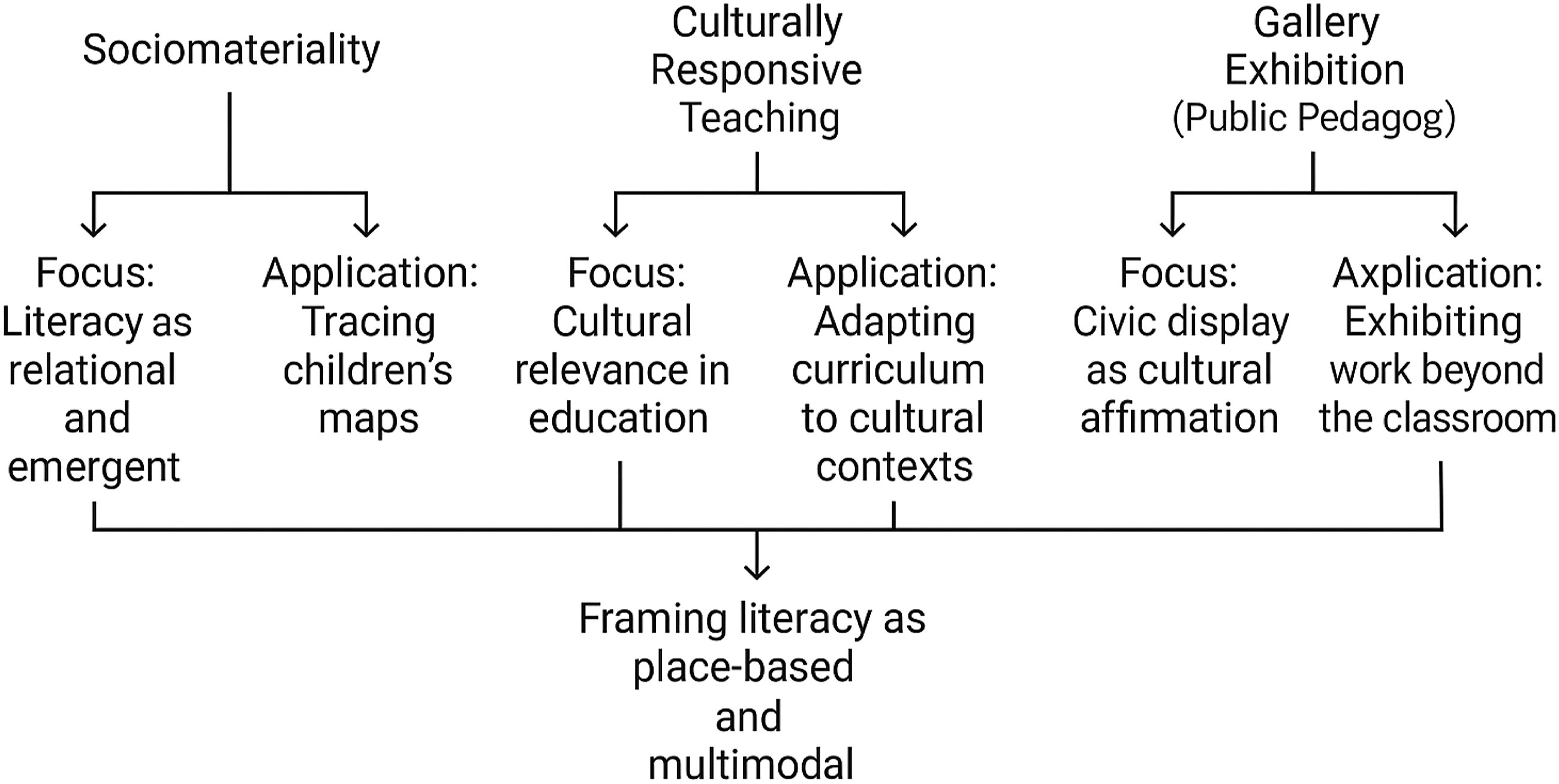
We employ sociomateriality, culturally responsive teaching (CRT), and public pedagogy as interconnected lenses that work in concert rather than isolation. Together, they illuminate how children’s literacies are shaped through material interaction (sociomateriality), grounded in cultural identity and lived experience (CRT), and extended into public, intergenerational spaces (public pedagogy). By treating these frameworks as interwoven, we frame literacy as relational, embodied, and publicly meaningful—enabling deeper insight into how young children’s voices and identities are formed, expressed, and recognized across settings.
Together, these lenses guide our methodology, data analysis, and interpretive stance. They help us recognize that when a child’s map is exhibited in a provincial gallery, what is on display is not only their artwork, but their entangled, embodied, and culturally grounded voice, asserting its place in public space. Next, we discuss our methodology.
Methodology
Research design
This study employed a qualitative, arts-based case study design (Barone and Eisner, 2012; Leavy, 2015) to explore how young children’s voice, identity, and agency were enacted through mapmaking and public exhibition in a formal gallery context. Anchored in a sociocultural and interpretive paradigm, the study is embedded within the larger ADVOST project, an International initiative exploring multimodal and arts-integrated literacies in early learning classrooms. This data set draws from the larger project of five Canadian primary classrooms of children in kindergarten to grade 4 . In this study we consider data from one classroom of 22 primary-aged children, aged 6–7, who participated in the collaborative gallery-based project over one school year, with a project culminating in a curated exhibit at The Rooms, Newfoundland and Labrador’s provincial art gallery. The study received full approval from the Memorial University Research Ethics Board and the school board. Written informed consent was obtained from teachers and caregivers, and verbal and visual assent was sought from children using age-appropriate language and pictorial materials, in line with ethical guidelines for research involving minors (Conto et al., 2020; Groundwater-Smith and Mockler, 2007). Pseudonyms are used for teachers and children in this study.
Particular attention was paid to relational and ongoing ethics throughout the project. As children’s work was publicly displayed, the research team negotiated decisions around visibility, authorship, and attribution in dialogue with families and facilitators. Faces were anonymized unless specific permission was granted, and all digital data (including videos and photos) was securely stored. Children’s dignity, agency, and participation rights were upheld across research phases, including curation, with constant reflexive attention to adult power and representation (Lundy, 2007).
Participants and context
Children represented diverse cultural and linguistic backgrounds, including newcomer families to Canada alongside rural families who had recently moved to the metropolitan areas due to changes and shifts in population demographics, alongside other children who reflected a broad spectrum of local identity. The mapmaking project was grounded in an inquiry-based pedagogy emphasizing art-making, artifactual storytelling, and situated literacy experiences.
The culminating exhibit featured maps created by children in response to the prompt, “What is your culture?” posed as part of the co-created unit between the teachers and children, inviting them to narrate place, belonging, and identity through multimodal composition. The pedagogical and curatorial process provided the backdrop for the data generated and analyzed in this study.
Classroom selection, case focus, and timeline
The featured Grade 1 class, taught by Ms Snowden, was located in an urban public school with a high number of multilingual and newcomer families. The class was selected through existing ADVOST partnerships that supported classroom-to-gallery inquiry. Mapmaking occurred across a three-month period during spring term, with weekly visits from the research team and co-designed lessons integrating art, storytelling, and cultural reflection. Ms Snowden’s intention was to deepen students’ awareness of place and cultural identity through arts-based inquiry and to connect their everyday experiences with public cultural institutions. Children worked individually but within shared spaces, often interacting informally with each other, commenting, joking, and offering suggestions during map development.
Emre and Adeya were selected for focused analysis due to the richness of their maps, the clarity of their verbal and visual storytelling, and their differing cultural contexts. Both children demonstrated strong agency and multimodal meaning-making in their interviews. The rich givings of the children’s maps transformed how Ms. Snowden interpreted children’s literacy: “I didn’t realize how much they held inside—until they put it on paper and shared it on the walls.” Gallery educators also noted how confidently children led their families through the exhibit, creating a shared intergenerational literacy space that blended civic learning with cultural celebration.
Data collection
Data were collected through multiple, complementary sources designed to document the making and public presentation of children’s literacies. In this study, we primarily focus on video transcripts led by the children’s narratives. The study employed thick description—presenting detailed accounts of children’s mapmaking, verbal narration, spatial orientation, and the affective atmosphere of the gallery—to situate meaning within the full ecological and cultural context. In keeping with Lincoln and Guba’s (1989) framework for trustworthiness, rigour here is defined not by replication but by richness, relational depth, and conceptual coherence.
To address how children’s agency and voice may be expressed in partial or unexpected ways, we also identified counter-examples that complicate straightforward narratives of expression. In some instances, children’s map narrations revealed layered or mediated expressions of agency, suggesting that voice and meaning were sometimes co-constructed with adults or shaped by the materials themselves. For example, one child explained, “That’s my hand. I put my hands in it,” referring to a blue handprint on their map. While the gesture suggests embodied engagement, the child’s verbal narration primarily focused on naming visual elements (“That’s my glasses,” “That’s candy,” “That’s my prince”) without elaboration. This points to a sociomaterial entanglement in which meaning arises through touch, gesture, and symbolic representation, but also illustrates how children’s voices may be scaffolded or subtly influenced by adult prompts and the immediate context. Rather than negating agency, such moments highlight its partial, emergent, and relational nature—offering a more nuanced understanding of how children navigate expressive boundaries in both classroom and gallery settings.
Children were invited to walk peers and facilitators through their self-created maps, describing people, places, and meanings embedded in their visual artifacts. These sessions were video recorded and later transcribed. The video material was essential for capturing the multimodal, embodied dimensions of their storytelling—gesture, gaze, spatial reference, and movement—all central to understanding literacy as sociomaterial and situated (Hackett et al., 2020). Teachers participated in recorded, semi-structured interviews reflecting on their pedagogical goals, the children’s engagement with mapmaking, and the impact of the gallery exhibit on learning and identity. These narratives added interpretive insight into how adult mediators viewed the role of arts-based literacy in affirming children’s voice and agency.
Field observational notes and photographs were taken during the gallery exhibit setup, opening, and walkthroughs. These captured how children’s work was arranged and received in the gallery space. Visual documentation of lighting, layout, labels, and audience reactions supported analysis of the exhibit as a public literacy event, where materials, institutional logics, and viewer interpretations shaped the meaning of children’s artifacts (Clover et al., 2014).
This multi-method approach aligns with participatory visual methods in early childhood (Clark, 2010; Thomson, 2008) and reflects the understanding that literacy emerges through verbal and non-verbal, visual, affective, and spatial modes.
Data analysis
The data were analyzed through a reflexive thematic analysis (Braun and Clarke, 2021), adapted to account for visual and spatial data. Child narratives and teacher interviews were transcribed and inductively coded using NVivo, identifying themes related to voice, agency, cultural identity, spatial reasoning, and material engagement.
Simultaneously, visual data—including children’s maps and gallery installation elements—were analyzed using a multimodal literacy lens (Serafini, 2011) and a sociomaterial approach (Burnett and Merchant, 2020). This included attention to composition, layering, use of colour and space, and the physicality of making (e.g., tearing, folding, pinning). The gallery context was treated as a literacy environment in itself, with curatorial choices and audience interactions contributing to meaning.
In addition, we draw on the concept of artifactual literacies (Pahl and Rowsell, 2010) to interpret the maps as more than visual texts. These artifacts encapsulate the children’s personal and cultural histories, and are infused with meaning through their materiality. The selections, marks, and textures in the maps represent children’s lived experiences and identities, and function as multimodal traces of their everyday worlds—bridging home, school, and community in tangible form.
Data were interpreted not in isolation but through triangulation across modes, enabling layered readings of how children’s meaning-making shifted across classroom and public contexts.
Mapping voice and identity: Children’s literacies in cultural space
This study contributes to reimagining literacy as a public, aesthetic, and justice-oriented practice by positioning children’s mapmaking practices within both pedagogical and curatorial contexts. It highlights how multimodal, sociomaterial pedagogies can reveal previously unrecognized dimensions of children’s literate lives, and how cultural institutions can serve to display, amplify and validate those lives. In tracing the movement from classroom to gallery, we argue that children’s voices are not only heard—they are curated, situated, and celebrated in spaces of public meaning.
This project considered mapmaking practices as a route to understand how literacy, as perceived in schools, could be revisited and widened, to expand orientations and acknowledge the importance of multimodal and sociomaterial pedagogies. When considering expanded dimensions of literacy, we are able to see how a culturally responsive approach brings forth children’s voices through public exhibitions. In essence, our research’s central aim was to understand how mapmaking and public exhibition could support children’s voice, agency, and cultural identity.
The findings are shared thematically, drawing from children’s artwork (maps), video transcripts, teacher interviews, and observational notes from the classroom and exhibit. We also note that the themes may overlap as literacy practices were deliberately multimodal and layered.
Mapping as cultural narrative and identity performance
The mapping workshop
Our mapping workshop for the children and teachers was held at the provincial gallery the ROOMS. The teachers shared how excited the children were to attend the field trip, for many it was their first ride on a yellow school bus. The journey itself was important, and the teachers were mindful of the instructions given by the gallery education staff for children to visually map their journey from the school to the gallery. A specific route had been planned which saw the bus drive by some city landmarks, while teachers noted different things their students could see along the way, such as signs, monuments, buildings, posters, traffic lights, and people. On arrival, the children shared stories about things they saw enroute as they entered into the gallery classroom. Clara, a well-established artist and gallery educator, met the children at the door as they entered, wide-eyed and excited. Impressed by the building’s monumental size and dramatic foyer, some children immediately shared with her that they “liked her house.” In the workshop, Clara asked the children what they saw on their bus trip, while she drew a map from the school to the art gallery and wrote down the things the children called out, including a hospital, traffic lights, the police station, the fire station, the big church, a graveyard and other schools. Many of the children in the group have limited English language skills; however, this did not limit their communication with the interpreter. We noted that children have many forms of expressing their meaning when words are not enough. While school literacies do not always capture the richness of children’s expressive forms in communication, during the map discussion, we noticed moving hands, circling motions on paper, finger tapping and even twirling as excitement grew, in particular, when children’s voices and agency were affirmed in Clara’s discussion of their journey map.
Ms. Snowden’s grade 1 class
Home and family serve as emotional, cultural, and narrative anchors for young children’s lives, often appearing first or most prominently in their drawings and stories. Often, as the students created their maps, these were accompanied by illustrations showing objects such as food and cultural activities that they engaged with their parents. We noted that in most children’s maps, these sociomaterial representations in their stories anchored their identity and literacy practices outside of school. We visited the classroom site weekly for one school year.
The children often greeted the researcher, Bethany with ‘Knock Knock’ jokes, especially when they realized she would play along. Adeya, whose family had recently emigrated to the area from Central Africa, took great delight in sharing her own jokes.
“Knock Knock…?” “Who’s there?” “Fufu!” “Fufu who?” Bethany would chime in return. “Fufu for you!” she would announce gleefully, referencing a popular Nigerian treat she often brought to class to share with other students during celebrations. These moments of rapport were precious, as they offered students a chance to share their own authentic cultural voice, their ‘home voice’, reinforcing the mapping work happening concurrently in the classroom.
The field interactions contributed to key themes that emerged while the mapmaking creation took place over 3 months, culminating in the curated public gallery exhibit (Figure 2) Visual representation of overlapping identity.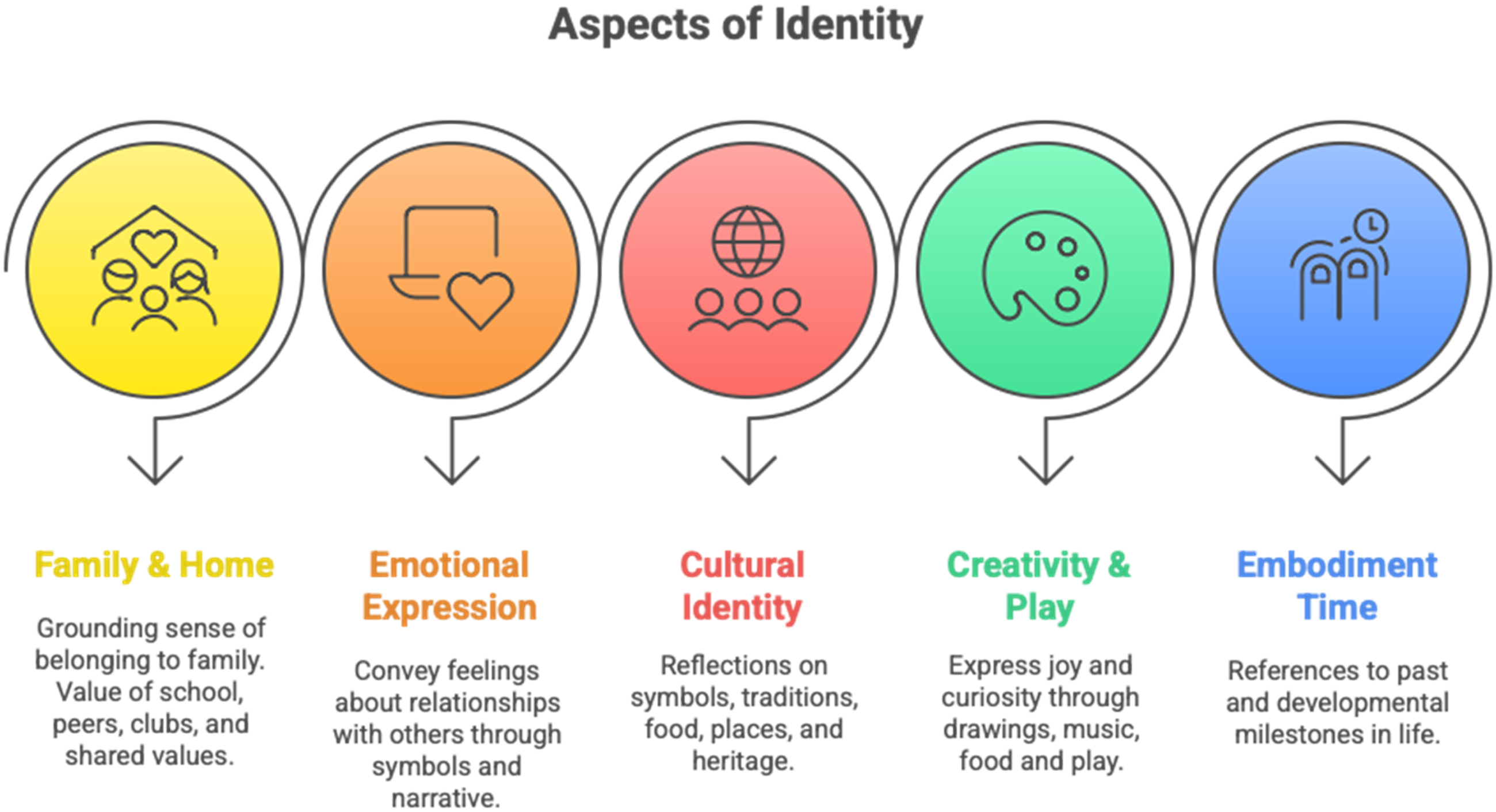
As researchers, we noted how the mapmaking activity gave us and the teachers more insight into the cultural lives of the children, and how this sharing enhanced and addressed cultural responsivity. The maps noted how many children expressed their experiences, family relationships, migration and cultural memory. These were often reinforced through cultural representations of the objects, drawings and emotional connections to people attached to stories that were shared along the storying of each child’s map. Analysis of the maps sharing videos showed how children shared a playful creativity in the multimodal representation of their objects. We also noted how children referenced past events in an embodied storying of time. Below we share two students’ storying of their maps from field notes and interviews where the student enagaged in storytelling of the objects on the map.
Adeya’s map
It is recess, and Adeya is eating a plastic container of peaches. She finishes her snack and uses her spoon to guide us through her map, narrating her walk from home to school. It is her first year in Canada, having recently arrived from Nigeria. Like many of her classmates, her map features cultural symbols, personal references, and representations of family and friends. These maps function as sociomaterial and relational artifacts, entangled with memory, identity, and cultural narrative.
Adeya begins by identifying the starting point of her map (see Figure 3): “And this is my house, and this is the pond,” she says, referring to the community park located across from the school. She points to a drawing of her guitar, which she announces is purple—her favourite colour—and shares that she can play Twinkle Twinkle Little Star by heart. One notable feature is the rainbow she included, which references a real rainbow the class observed through the large window in the foyer of the gallery. Her map centers friendship and belonging. In the far-right corner, she has drawn a house: “This is far away,” she explains. It represents her grandmother’s home in Nigeria. She also references members of her extended kinship network—Grandma, Uncle Oloumide, and Nolan—as distant yet significant. Notably, although she marks their presence on the map, she omits roads connecting them, subtly underscoring the emotional and spatial distance. Adeya’s map.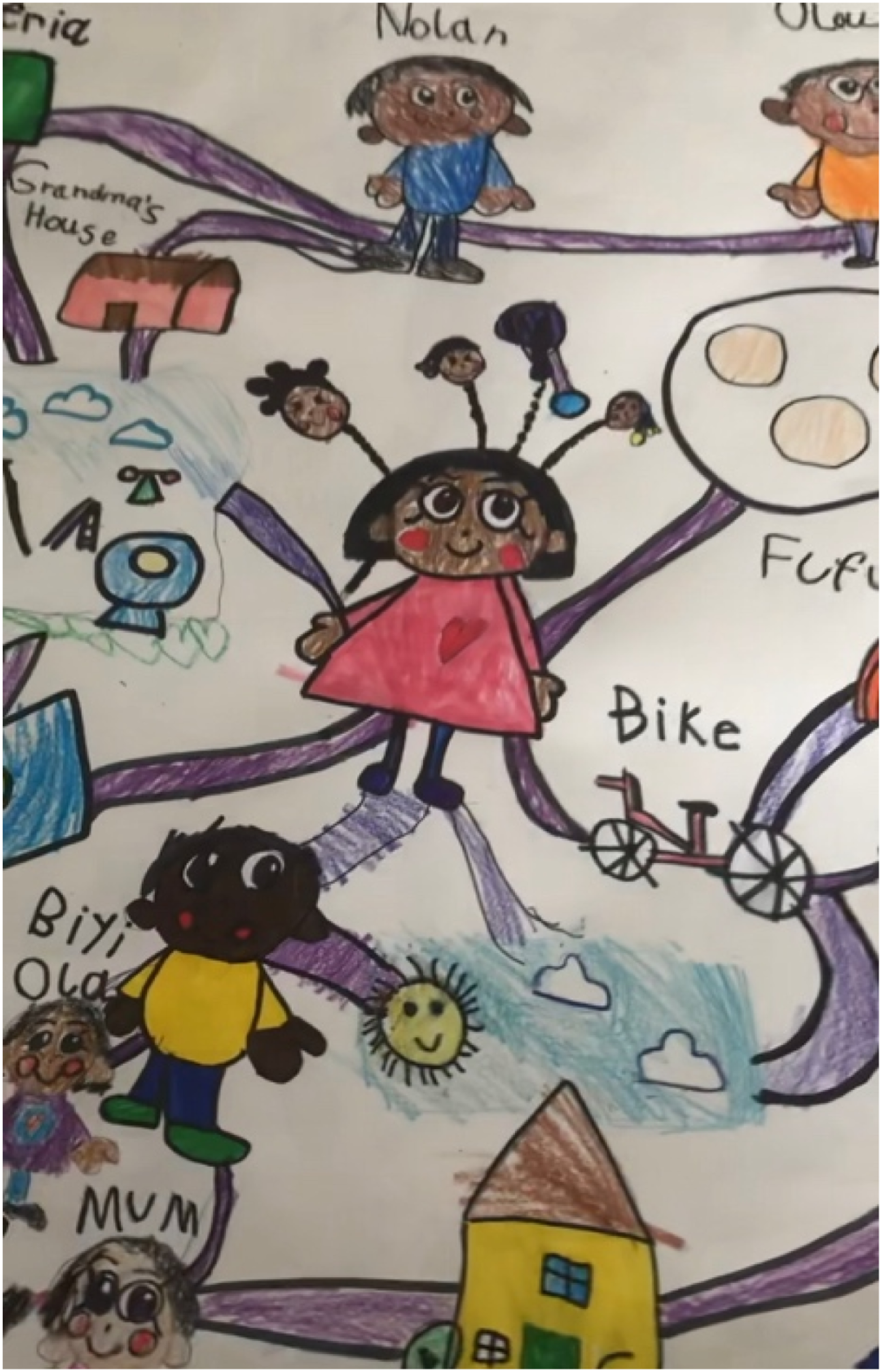
Play and creativity are also central to her map. She includes extracurricular activities such as music lessons with her purple guitar. As she narrates her map, her literacy practices become embodied and spatial—she rocks from foot to foot and leans over her map, animating her story with movement and gesture. “Ooh, what’s this?” Clara asks, pointing to a drawing of food. Adeya smiles and rubs her tummy: “It’s fufu, a kind of Nigerian food that my mom makes.” Is it one of your favorite foods? Yes!!! she exclaims.
Here, the physical interaction with the map is complemented by spatial and affective narration, as Adeya traces the image of fufu with her finger. This moment exemplifies how identity is expressed not only through visual representation but also through embodied storytelling. This was further evident in classroom visits, where Adeya frequently shared personal updates—especially about her hair. “These are my favorite hairstyles,” she said, pointing to the first drawings on her map (Figure 3). “Yeah, I’ve got that—when I was really young, and I got this when I was 3 years old. And I got this when I was 5 years old. And I got this now!”
These temporal identifications—made vivid through gesture—demonstrate how embodied narration animates the static images of the map. Teachers noted that children’s live storytelling provided deeper insight into their lived realities, beyond what was typically observed in class. In Adeya’s case, discussion of hairstyles led to stories about weekly gatherings of Nigerian families for food, news-sharing, and communal hair braiding.
This moment reflects how a multimodal reading of children’s sociomaterial choices foregrounds affective and spatial understandings of their literate worlds.
Children also expressed identity through shared participation in activities like Sparks (junior Girl Guides), skating, and swimming. In a teacher focus group, educators reflected on how the maps enriched their understanding of students’ lives. As one teacher shared: The maps show that they know more than what we teach in school. They drew what mattered to them, and I learned so much about their cultural practices in their home country and what they look like now in Canada.
Children’s maps conveyed lived experience, family connection, migration, and cultural memory—often symbolized through hand-drawn items like churches with crosses, national flags, foods such as Nigerian fufu or Filipino adobo, and religious symbols including the Islamic crescent moon. These maps offered teachers and researchers alike an expansive lens on literacy, identity, and cultural continuity.
Emre’s map
Map sharing empowered children to demonstrate agency and authorship through both material choices and embodied narration. In Emre’s map (see Figure 4), his agency was evident in how he chose to represent family, place, and culture—and in how he physically traced his journey during the gallery interview. Emre’s map at the rooms exhibit.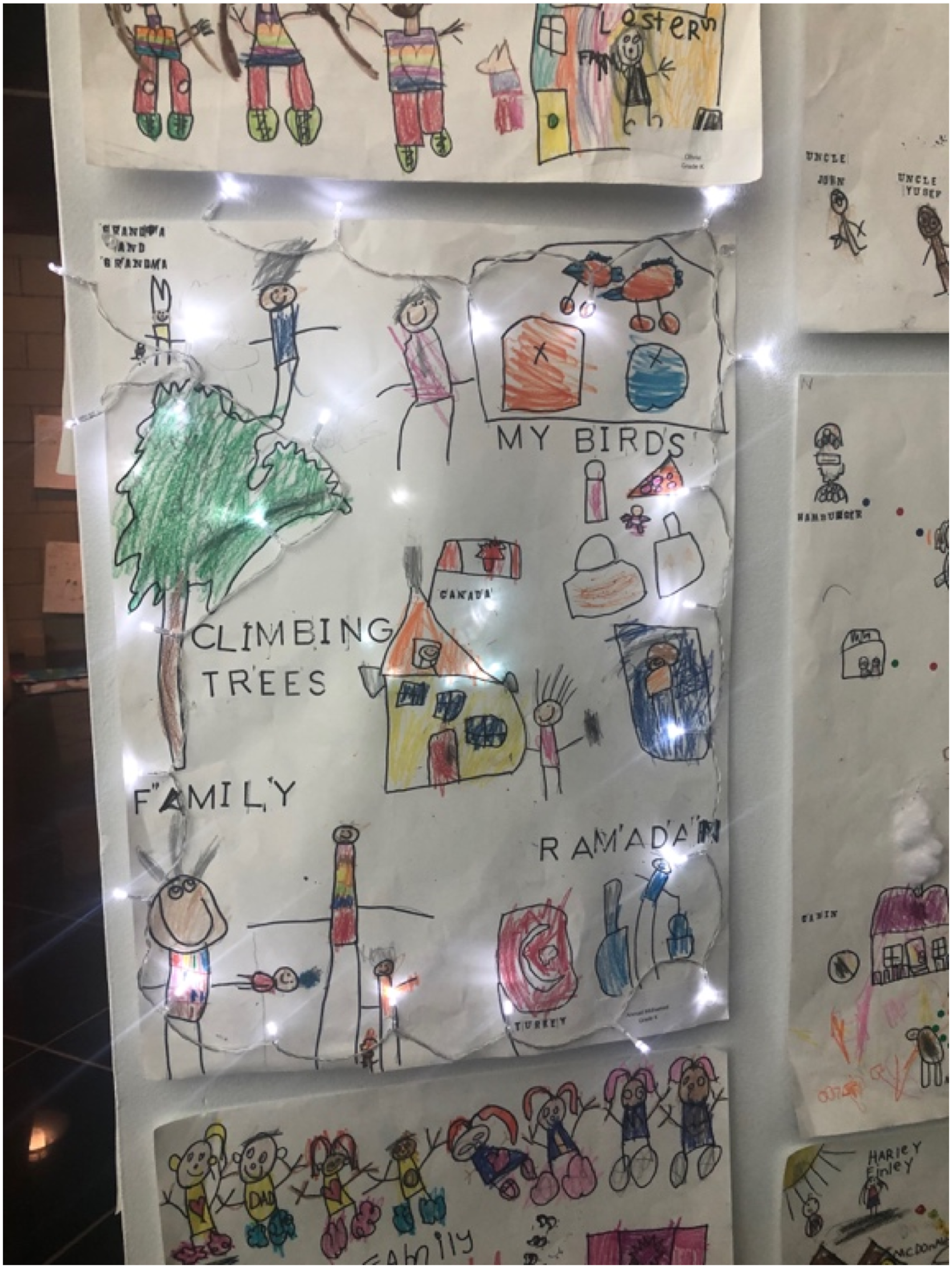
Emre centred his map around his experience of Ramadan and the celebration of Eid, rather than the more typical home-to-school trajectory. He adorned the map with twinkle lights to mark Eid and drew his house with his sister inside, his father outside returning from work. These images illustrated daily life and relational dynamics. His narration began with a drawing of his mother, siblings, and himself under a large tree: “I like climbing trees—it makes me strong,” he explained, tracing the drawing with his finger.
Emre proudly pointed to the Turkish flag and labeled the celebration “Ramadan” in block letters. He described waking early to eat before dawn during the holy month, illustrating this with a figure of himself in bed. His narration moved from the act of his family fasting to the celebratory feast, including drawings of aprons, baskets, and food. He also referenced his pet birds, still in Turkey with his grandparents, as a connection to home and memory.
Through this multimodal and embodied presentation, Emre conveyed a dual identity—rooted in Canada and Turkey—while foregrounding religious practice and family life. From a sociomaterial perspective, his map becomes an artifact that entangles material, movement, and meaning: the twinkle lights, drawings, and gestures all contributing to his storytelling.
This reading aligns with culturally responsive pedagogy, which affirms children’s lived experiences and cultural knowledge. Emre’s map illustrates how identity, voice, and agency emerge through multimodal expression and material interaction—and how public exhibition can honour and amplify such complexity.
The gallery as pedagogical and civic space
The curated exhibit recontextualized children’s work as public texts, granting cultural legitimacy and civic visibility to their voices. Teachers and researchers were invited to assist with curatorial planning, and the exhibit event included cultural making stations that brought together children, families, and artists in an atmosphere of communal learning and cultural exchange.
During the gallery workshop, children were initially in awe of the space—some even intimidated. Yet as one child remarked to Clara, the gallery educator, “I like your house,” smiling she quietly shared, “This is your house too.” This simple exchange reframed the gallery as a space of shared ownership and civic belonging. In a discussion near the gallery’s large picture window, a child named Jasmine, wearing a Ukraine flag t-shirt in solidarity, participated in a conversation about who takes care of the building:
Gallery Teacher: Who do you think takes care of this building and the grounds? Jasmine: The custodian does, he has to make sure it is clean. Gallery Teacher: Yes—and we all help the custodian. This place is for visiting, for learning about our province’s culture and heritage—and also for learning about new people moving here. Who owns The Rooms? Jasmine: You do! Gallery Teacher: We all own it (gesturing to each child). You own it… and you… and you too.
Teachers later reflected on the significance of this moment. Students expressed pride in seeing their work displayed in a monumental space, alongside renowned artists. Children began to understand themselves as creators of public culture.
On the evening of the exhibit’s opening, transportation was provided by a private school sponsor for families without transport means. For many, it was their first time visiting the provincial gallery. Teachers welcomed families, and children shared their maps proudly—some even video calling relatives abroad to share the moment. One teacher reflected, “In five minutes of Jacob showing his map to his parents, I learned more about his emigration journey than I had in a school interview.”
Another teacher shared, “It was reassuring to newcomer parents to see their children playing with Canadian classmates at the cultural art- making stations.” These shared experiences forged new school-home-community connections. One family, recently discovering their Indigenous ancestry, arrived early to participate in a drum-making workshop led by an Indigenous artist, who viewed the child’s map alongside her family—validating her cultural identity in the exhibit space.
Throughout the evening, teachers observed a shift: from private classroom learning to public recognition of children’s cultural narratives. Parents took pictures in front of maps, exchanged contact information, and reflected on the meaning of their children’s work being institutionally acknowledged. One teacher noted that for some immigrant parents, this validation in a public institution was deeply emotional—an unfamiliar but affirming interaction with civic structures.
These moments of intergenerational civic learning prompted teachers to rethink their pedagogies. The exhibit helped them envision culturally responsive teaching not only as a classroom practice, but as a form of public pedagogy—a way to extend learning, agency, and recognition beyond school walls. Children’s multimodal maps, when curated publicly, enabled new possibilities for understanding literacy as relational, embodied, and culturally situated.
In the next section, we integrate our findings in a discussion to consider broader implications for pedagogy, curation in public spaces for children’s voices and agency in early childhood literacies.
Discussion
Weaving voice, agency, space, and recognition
We draw together the findings across overlapping aspects of identity , considering how we can synthesize theoretical insights, but also consider what this means for schools and educators when we expand our understanding of literacy.
In our interviews with children, we noted that children’s voices and identity are interdependent on others’ experiences and communicated through sociomateriality. Multimodal understandings of children’s voice and agency reinforces culturally responsive perspectives that consider identity central to literacy (Ladson-Billings, 1995; Paris and Alim, 2017). We saw a shift in teachers’ understanding of children’s voices. In our interviews, aided by Adeya and Emre storying of their maps, children’s voices were not simply added to their identities—they were enacted through them. As children told stories through maps, they visually and verbally constructed their cultural identities, familial relationships, and positionalities. We show that identity is not a background trait, but an active, creative, and embodied process. Children’s maps became narrative sites where voice emerged through story, symbol, and spatial design.
Children’s agency is further mediated by the teaching materials, lessons, and opportunities that are given in classrooms. Our research illustrates how interactions with the mapmaking materials, tools, and layout shape children’s agency. This supports sociomaterial claims that learning and agency are always materially mediated (Burnett et al., 2020; Fenwick, 2015). In our observations of mapmaking in classrooms and later in the cultural making table activities during the project’s culminating curated exhibit, we noted how children’s creative decisions were often co-constructed through choice of artistic materials ,teacher support, parent guidance, and peer feedback. Our use of sociomaterial theory shows that agency is not an isolated trait, but something enacted through relations between child, material, and space. Even gallery limitations such as the (e.g., map size or layout) shaped how children could express themselves.
The space itself shaped children’s agency and expression in meaningful ways. The formal gallery setting, marked by openness, aesthetic order, and a sense of public significance, seemed to amplify children’s voices. Freed from the habitual norms of school, children engaged with the materials with heightened focus and pride. Yet, this space was also co-constructed by the presence of adults. Teachers, researchers, and gallery staff shaped the affective atmosphere through prompts, encouragement, and interpretive scaffolding. These adult-child-material interactions demonstrate how public pedagogy is not only spatial but relationally produced.
While not the central focus of this analysis, we recognize the role of public spaces in shaping how children’s creative work is received and valued. The gallery setting offered a civic backdrop that amplified the significance of children’s mapping and multimodal storytelling. Though we did not systematically analyze family or community responses here, the visibility of children’s work in such a setting invited moments of intergenerational engagement, cultural affirmation, and recognition that extended beyond the classroom.
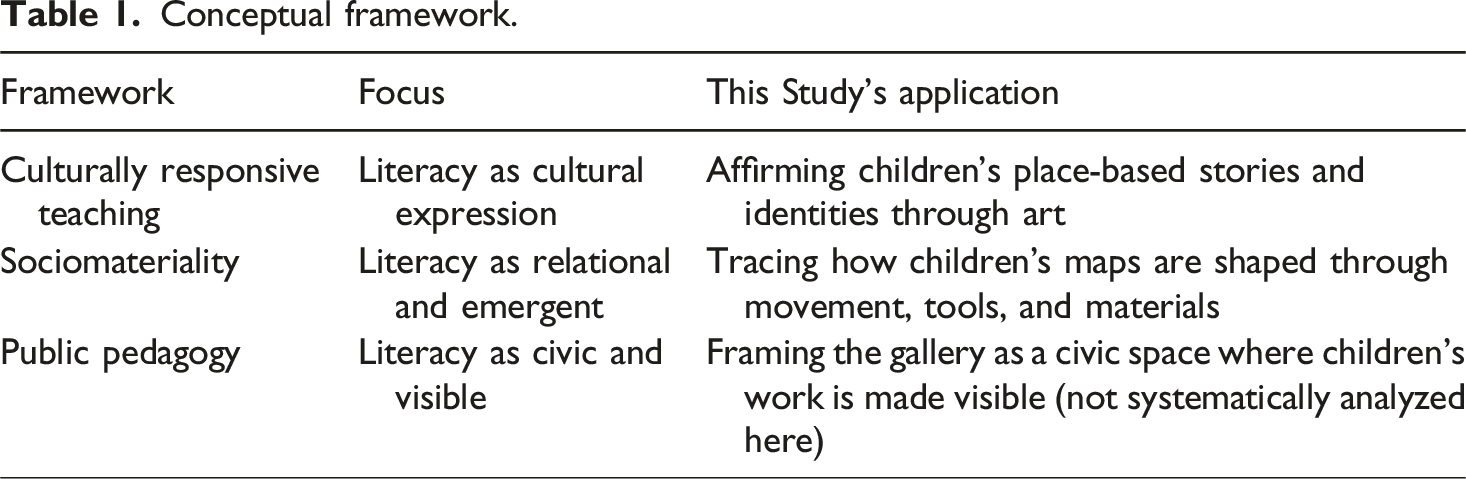
Conceptual framework.
Ultimately, this study affirms that when children engage in the cartographies of their lived experience—mapping their identities, relationships, and cultural memory through multimodal and material forms—they act as cultural authors. These cartographies do more than depict space; they chart meaning, belonging, and voice. When shared in public cultural institutions with care and intention, children’s work expands how literacy is understood, redefines the role of the classroom, and repositions children as contributors to civic discourse and public knowledge.
Conclusion
This study has explored how arts-based, multimodal mapmaking can be a powerful pedagogical vehicle for expressing young children’s voice, agency, and identity within early childhood classrooms and public cultural contexts. Through a participatory inquiry culminating in a curated exhibit at The Rooms, this study demonstrated how children—when invited to represent their lived geographies through art—become cultural producers and meaning-makers whose literacies are deeply rooted in place, memory, and relationship. These maps were not static products, but dynamic acts of identity performance, grounded in the material textures of children’s lives and rendered visible through civic exhibition.
We showed that children’s agency was not fixed or individually possessed, but emerged relationally—shaped by interactions with materials and supported through social engagement. A sociomaterial lens helped surface how their literacies unfolded through gesture, movement, repetition, and layout decisions in the mapmaking sharing. Cultural identity, in turn, was constructed and communicated through language, colour, spatial organization, and revealed in the story of a child’s journey from home to school. Approaching these multimodal practices framed within a culturally responsive pedagogy resulted in children’s personal geographies and family knowledge being affirmed, not as tangential to literacy, but as central to how meaning is made and shared.
This conceptual integration (outlined in Table 1 and modelled in Figure 1) provided a critical lens through which findings were interpreted. The intersections of sociomateriality, culturally responsive pedagogy, and public literacy were not only theoretical anchors but were deeply entangled in how children’s meaning-making practices unfolded and were made visible. These frameworks informed our data analysis in how we recognized agency as relational, identity as constructed across spaces and materials, and curation as a pedagogical process capable of reconfiguring whose voices matter in public discourse.
Equally, this study argued that curation itself is a form of pedagogy. For young children, this act of public display extended classroom learning into civic life—reinforcing that their cultural knowledge matters not just at school but in society. When children’s work was exhibited in a formal gallery, it became recontextualized as a civic text that invited community participation and validated the cultural realities of families, particularly those from newcomer or historically underrepresented backgrounds. However, curation is not a neutral process. Institutional values, curatorial choices, and spatial arrangements shaped what was seen, emphasized, or marginalized. As researchers and educators, we approached this with ethical awareness, reflexively considering whose narratives were most visible and how curatorial frameworks might unintentionally constrain meaning even while aiming to amplify it. Such as challenging the school practice of student maps being displayed according to grade level.
This research contributes to early childhood literacy scholarship by offering one of the first Canada-based studies to examine gallery-based multimodal curation as a culturally sustaining literacy practice. It affirms that literacy does not reside solely in text, nor solely in classrooms, but is enacted across materials, relationships, and—in this case—within the context of a public cultural institution. When designed with care and cultural responsiveness, gallery spaces can become sites of relational pedagogy, civic engagement, and intergenerational affirmation.
The implications of this study extend across pedagogy, curriculum, and cultural institutions. Educators are encouraged to integrate arts-based and place-based teaching practices not as enrichment, but as foundational to literacy development, especially for children whose experiences are often peripheral in dominant curricular models. Policymakers and gallery professionals are challenged to co-create spaces where children’s voices are welcomed and treated as legitimate contributions to public knowledge. Future research might expand this work across time, explore co-curation with families and communities, or critically examine how cultural institutions can engage more ethically with children as collaborators rather than subjects.
Ultimately, this study affirms that when children are trusted to narrate their worlds—using their own languages, materials, and modes—they do not just reflect culture; they reshape it. When made public with care and intention, their stories have the power to reimagine how we teach, where we learn, and whose knowledge counts.
Footnotes
Acknowledgements
We thank Newfoundland and Labrador Schools for their support of this research alongside the Provincial Museum and Gallery Educators and Administrators at The Rooms. We also thank our colleague and co- researcher Diane Collier from the Advost Project as well as our collaborating teacher researchers.

Funding
The authors disclosed receipt of the following financial support for the research, authorship, and/or publication of this article:This study draws on research supported by the Social Sciences and Humanities Research Council. Socially Innovative Interventions to Foster and to Advance Young Children’s Inclusion and Agency in Society through Voice and Story (ADVOST) project is supported in part by funding from the Social Sciences and Humanities Research Council (Grant no: 213409000).
Declaration of conflicting interests
The authors declared no potential conflicts of interest with respect to the research, authorship, and/or publication of this article.