




Abstract
This article will focus in on one short play spell in the outdoor space of a classroom of 2-year-olds. Using the medium of video as data, it explores the way that children’s bodies are caught up in what Ingold calls a ‘dance of animacy’, when bodies and matter encounter each other. I will deploy the figure of the ‘post-human’ child to challenge a conception of play whose outcome is a child’s mastery – of self and of the world. Instead, I would like to propose that play is a way of being of the world. This re-conceptualising of play comes through a much closer attention to the moving body as it encounters the world, looking at points of contact where bodies and matter animate each other. By playing with film data in slow motion, I will put Manning’s notion of the minor gesture to work, as a way to resist more normative accounts of play, where play is coupled to cognitive and social stages of development.
Introducing a research residency
I stand in the outdoor area and it is the two children (S and K) playing with the Red Blanket that have caught my attention. The soft slightly furry blanket and the two children move around the space: sometimes they are blanketed, sometimes when it slips off they remain connected to each other as they hold onto the blanket. The blanket is also in motion; it sometimes slips away from them, working free as it responds variously to gravity, to the forward force produced by running limbs, and to the jerks and pulls of the boy bodies. When the bodies move in counter directions, the held blanket keeps the bundle together. I start to film this moving blanket-and-body bundle as it moves around the outdoor area. And just as my attention has been caught by the moving bundle, A’s attention has also shifted in its direction, and his body moves with this attention, towards the body/blanket bundle. A manages to keep hold of the basket-ball he is holding in one hand, while with the other he wrestles with the edge of the blanket using tugs and pulls. This repeated tugging results in the blanket slipping off K’s head accompanied by giggling shrieks from both K and S.
This data snippet is the opening paragraph of a transcription of a filmed play event. The drawn image (Figure 1) is a sketch traced from a freeze frame of the opening shot of the video of the event that I now call ‘The Red Blanket’. As well as re-watching the film in slow motion many times, the above forms of translation of the film are different ways that I have tried to attend to the micro-level of a play event that unfolds through movement, each form of translation is insufficient, but each offering new ways of making sense of the event.
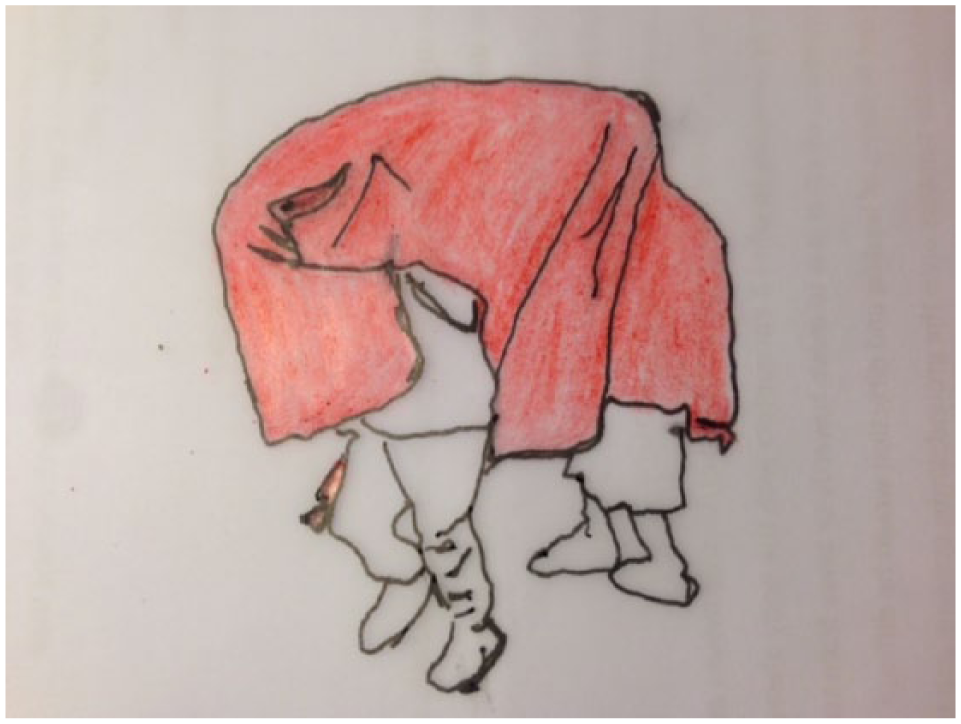
Sketch of blanket/boy/bundle.
The film data that I use to think with in this article comes from an ethnographic research project following a state-funded nursery class of 2-year-olds over a period of 2 years at Martenscroft Nursery School and Children’s Centre in inner city Manchester. I have spent 1 day a week in the class for a year, working alongside Early Years practitioners as a participant observer. The context for this ‘Slow Research’ (Horton and Kraftl, 2006; Millei and Rautio, 2017) is current anxieties in the United Kingdom about the education gap between richest and poorest, where 2-year-olds have become central to concerns about maximising normative development for all children – so the maturing toddler becomes the focus of intense scrutiny and diagnosis of speech delay and other special educational needs (Bercow, 2008; Ofsted, 2012). As a result of these anxieties, new Government funding has been made available to Early Years providers in England to offer places to ‘disadvantaged’ 2-year-olds. Over this first year, that I have spent visiting the funded 2-year-old class, I have found myself grappling with the pressures that this places on practitioners in terms of trying to maintain a relational ethics of care while also being enmeshed in a developmental discourse of assessment and identification.
My position as an ethnographic participant, embedded in the weekly routine of a class over two consecutive years, has adopted a deliberately slow methodology as an antidote to the current anxieties about the speed of progress and the normative performance of the 2-year-olds in relation to their future school success. The Red Blanket event was filmed near to the end of the summer term, and I had not had time to look at it before school closed for the end of term; it was not until the summer holiday that I had time to review and reflect on the event.
A post-human child
Talking about a post-human child can seem like an odd direction to take given that Early Years practitioners have historically, and continue to, put the child at the centre of their practice. The giants of early childhood pedagogy over the last two centuries have (and rightly so) battled to raise the status of childhood, and re-position the child in relation to the adult to produce child-led pedagogies that contrast with adult-directed learning. However, as Goodley and Runswick-Cole (2013) observe, the figure of the human child at the centre of our practice is bound up with how we conceptualise the human: a conceptualisation of ‘a bounded, rational, independent, individual self’ (p. 13). This can lead us to value different ways of acting over others. Play becomes a narrative of mastery and ability – mastery of self and of the world. The figure of the child is extracted from what Erin Manning would call its ‘milieu’ (Goodley and Runswick-Cole, 2016: 190), and recognised as the sole locus of agency. Play is in Olsson’s (2009) words a ‘pre-determined map’ (p. 3) where it becomes the performance of normal development, and the final destination is a reasonable thought and action that is transacted through speech.
Although Piaget’s cognitive developmental map has been modified by social-cultural theory which re-situates the child into a web of social relations, the idea of the human as a bounded knowing subject endures. Murris (2016) observes that while Piaget’s cognitive mapping of childhood downplayed the social, a socio-cultural mapping sidestepped the physical, biological, and material, ensuring a continuing ‘indivi-dualism’ which she calls the ‘story written in our bones’ (p. 46). Curiously, it is to Piaget’s notion of the sensory-motor that I return, as a way to give more weight to the biological, the physical and the material that have often been displaced by socio-cultural accounts. At the same time, I want to trouble the idea of play as normatively mapping a pre-determined trajectory where the sensory-motor is both cast as essential and necessary, but only as a more primitive and unthinking mode that is superseded by reason and the symbolic. In my readings and participations of play in the 2-year-old classroom, my aim is to try to open play as radically as possible, in order to include play events that seem to resist or sit uneasily at the centre of proper play.
Karin Murris (2016) has recently made the case for de-centering the child through her theoretical ground-work to re-figure the child as ‘post-human’. Her account builds on earlier work by Lenz Taguchi (2010) that uses the ideas of Gille Deleuze and Felix Guattari, as well as Karen Barad, in order to turn away from ‘a search for the “true” child, “true” knowledge, and “true” development’ (Dahlberg and Moss in Lenz Taguchi, 2010: xviii). Instead, there is an emphasis on how practices of knowing are mutually implicated in our ways of being in the world, in what Barad (2007) puts forward as an onto-epistem-ology (p. 185, original italics). This approach puts a greater emphasis on the active and performative force of the non-human, shifting attention to the part played by matter in ways that we come to know the world. The influence of this material turn can be seen in the work of Early Years research that explores young children’s engagements with the outdoor spaces of their nursery settings, for example, Änggård (2016), Hultman and Lenz Taguchi (2010), and Merewether (2019). This article extends this work, but with a particular focus on the role of bodies in movement, affect and the unfolding of a play event.
In this article, I will use film analysis as a method to, in Manning’s words, ‘care for the event’. Watching film in slow motion initially occurred accidentally during the viewing of the film, rather than as part of a methodological intention. Although the research was deliberately longitudinal in order to give an in-depth time frame for relationships, the literal slowing-down of video data had a de-stabilising effect. It brought the data to life in new ways that foregrounded the form, expression and intensity of bodies encountering the world through movement, leading me towards Manning’s (2016) idea of the event as a ‘dance for attention’ that is not human-centred but attends to how the human and the non-human relate to each other (p. 193). In particular, this article works with her idea of the minor gesture. Using Deleuze and Guattari’s (1987) idea of minoritarian and majoritarian registers, Manning thinks more specifically about the gestural in relation to the act and the event, and how these unfold through a body that responds to the world through movement. As opposed to attending to the performance of the normative, it is action that might at first glance seem unintelligible in terms of developmental progression that becomes methodologically significant. Trying to think with Manning’s idea of the minor gesture becomes a way for me to re-activate what Piaget describes as the sensory-motor stage – and to consider the possibility of re-conceptualising the sensory motor more as an ongoing minor key that has the potential to pulsate through life beyond infancy.
The ‘dance of animacy’
What happens when we notice and attend to materials’ entanglements? What happens when we allow more and more things to enter our pedagogies? Might noticing materials in relations open possibilities for early childhood pedagogies? (Pacini-Ketchabaw et al., 2016)
Before spending thinking time with the unfolding play event that the camera follows in The Red Blanket film, I will set out the theoretical and methodological ground for my research a little bit more. This ground, however, is not a place from which I started out, but rather a ground that is still in the process of composition through my own dance with theory and method while thinking with the data. Drawing from Änggård (2016), my initial research questions were interested in developing a re-conceptualist reading of Piaget’s sensory-motor stage, by exploring how ‘matter seems to talk more directly to children’s hands and bodies’ (p. 7). The idea that 2-year-olds occupy a pivotal and threshold space is under-pinned by Piaget’s developmental theory that locates at this age, a shift from the sensory-motor stage, characterised by perceptual and embodied ways of knowing the world, towards representational and symbolic modes of thought. According to Piaget, whose progressive and sequential projection of child development continues to shape Early Years curriculum and understandings of the child, at around 2, there is an overlapping and sometimes mixed-up transition phase often characterised by ‘practice play’ (Nicolopoudou, 1993: 3). But as the child matures and moves on from the sensory-motor stage, non-representational ways of knowing are left behind, and children move into what Piaget sees as the symbolic (‘preoperational’) stage. Braidotti (2009) suggests that such a hierarchy of knowledge privileges bios (discursive, intelligent social life) over zõë (brutal and animal life). Furthermore, Duhn (2015) uses this split to think about the infant/toddler, who she claims is so often located as belonging to zõe, which lies within a humanist discourse that understands the 2-year-old as not quite fully human (p. 924). Working with these two concepts in relation to the toddler/infant, Duhn proposes, instead, that we consider the infant as bios-zõë, as a mind/matter assemblage, and that this way of thinking ‘provides a line of flight and a radicalisation of the tired structure that holds the infant in its place as a body (yet) unable to be governed by its own logos’ (Duhn, 2015).
To be guided by the concept of bios-zõë also helps me to work with Ingold’s concept of ‘the dance of animacy’ (Ingold, 2013: 100–102). Here, the dance is more about how one body and another might ‘correspond’ (Ingold, 2013: 101) rather than how they act upon each other. Using the example of kite-flying, Ingold foregrounds the relation between the human that flies the kite, the air and the kite itself. This dancing kite is less about a back and forth of agency between body/kite, but more about a process of ‘correspondence’ (Ingold, 2013) where what is produced is ‘a movement in which partners, take it in turns to lead and to be lead’ (Ingold, 2013: 101). Rather than seeing the body as a container, both Ingold’s ‘dance of animacy’ and Duhn’s assemblage of bios-zõë conceptualise a more dynamic ‘entanglement’ with the world (Ingold, 2008: 1806), where things and bodies are always ‘in the making’ (Devlieger and De Coster, 2017: 2).
The major and the minor registers
The major is a structural tendency that organises itself according to pre-determined definitions of value. The minor is a force that courses through it, unmooring its structural integrity, problematizing its normative standards. (Manning, 2016: x)
If major tendencies are dominating structures of thought and forms of value, one way to think of this in relation to childhood is to think of the major as our common-sense expectations of neuro-typical development. As I have discussed, these expectations are coloured by mapping the child as approaching adulthood through cognitive milestones. This is combined with a socio-cultural trajectory which adds to this the transmission of cultural values by emphasising the critical value of speech not only as a vehicle for thought but also as the means for self-expression and communication.
The problem with majoritarian developmental mappings is the way that they lead us to read backwards from the end point, of, for example, a play event, with an understanding that what composes the event is inevitably leading to the resulting end state. Manning (2016) draws our attention to the way that this is how we usually ‘explain our actions’, but she says this is not how we act: How we act is based on a continuous interplay of conscious and nonconscious movement with nonconscious movement playing a vital part, especially as regards movement’s creative potential. (p. 19)
Manning invites us to linger in the unfolding of experience, to care for the event, by giving it more fully our attention. This allows us to hover over its indeterminate character, rather than using it as a retrospective explanation.
According to Manning (2016) ‘the minor gesture often goes unperceived, it’s improvisational threads of variability overlooked, despite their being in our midst’ (p. 2). The minor is often expressed in micro-moments that we miss. It is characterised by a wildness, and an indeterminate and an unpredictable quality (Manning, 2016: 1). Hovering on the cusp between the unconscious and conscious (Manning, 2016: 24), it has a vulnerable quality that by its nature is insignificant – and this failure to signify is both its strength and its weakness. Because the minor is an expression of action that emerges from a body thinking through encounter as it moves, it does not carry the weight of an inevitable arrival.
The potential of filmic data
Drawing from visual-ethnographic methods, my aim has been to foreground the sensory and affective experiences of the 2-year-old in a classroom context. As a participant observer, I spend much of my time watching, listening, joining in, and responding to children as they play. I sometimes make written observations, but film has offered me a medium where I can slow down a dynamic event and attend to the small details of ‘how children’s bodies and all kinds of matter, as well as discursive practices, are entangled in the phenomena constituted by play activities’ (Änggård, 2016: 82). Film offers me a way to attend more fully to the micro-moments that occur during play events. Using film accentuates what is in motion and much more closely allows me to attend to the dynamic quality of the event.
The practice of pedagogical documentation also links with practice-based methods employed by practitioners working in nursery schools in Reggio Emilia, as part of what they call a ‘pedagogy of listening’ (Rinaldi, 2001: 80). Here, a visual trace of an event becomes a ‘meeting point’ and a ‘social memory’ (Olsson, 2009: 47), and ‘pedagogical documentation offers a tool in that it “maps out” a fraction of a learning event and makes it materialise before us in the documentation’ (Lenz Taguchi, 2010: 60). This makes it possible to read an event in terms of its complexities, and affords the opportunity for practitioners to give attention to children’s intra-actions in much greater depth than is often possible when they make observations that are part of the assessment and planning cycle. Sylvia Kind and Adrienne Argent (2017) call this ‘a particular kind of noticing’ (p. 86), and they make the case that video ‘uniquely allows for a focus on moving bodies, a world in motion and intersecting perspectives’ (p. 88). This concern with movement reverberates with the pedagogical intent of the documentation, which orients itself towards transformation of practice, rather than ‘standing at an objective distance’ (Kind and Argent, 2017: 89). The researcher/camera assemblage not only moves in relation to the action that it follows in the immediacy of the event, but the process of slow (re)viewing of film also has the potential to (re)make the researcher/practitioner.
I am also aware that I always run the risk of tapping into and intensifying the regulatory gaze of the adult in relation to the child: seeking the micro-level of children’s actions and then rendering them comprehensible through interpretation is a deeply ingrained colonising habit to ‘moisten everything with meaning’ (Barthes, as quoted by Minh-ha, 1991). But, as Foucault (1983) reminds me, ‘everything is dangerous’ (p. 232), so I proceed cautiously and attend to how the film data makes me think and act, rather than setting out to attribute meaning to children’s actions.
Red Blanket as event
The Red Blanket play event, of which the film itself was/is a part, was filmed in a series of seven clips. Altogether, the film data are just over 12 minutes. The camera follows two children and a Red Blanket in the outside space of the 2-year-old classroom. During the filming, two other children make contact with the body/blanket bundle. As well as the Red Blanket, other things, such as wood-chippings, tarmac, a group of three tree stumps, and a garage, all emerge as playing a role in the unfolding action.
In order to sketch out the event briefly, I have mapped three phases of the film:
Red Blanket phase:
S and K move around outdoor space of the nursery covered by a red blanket. At moments, another child A joins in.
They move from tarmac ground to wood-chippings.
Sometimes their movement avoids people and objects in the line of travel, and sometimes it takes them towards people and objects.
Garage Wall phase:
A garage wall becomes an active part of the play.
S and K run back and forth crashing their bodies against the garage wall and A joins them for a longer duration.
Tree Stump phase:
Tree stumps become installed into the flow of play.
I will now explore three themes emerging for me as I undertake close readings of the film. For simplicity’s sake, I will link these to the phases in the film, even though the themes cross cut these. As I now turn to the filmed series of events, I am guided by the question posed by Hultman and Lenz Taguchi (2010) when they looked at photographic data in the outdoor space of an Early Years classroom. They asked themselves whether they could challenge their anthropocentric gaze, and grant non-human matter a greater active role in the unfolding of the event.
Entwined, tumbling, care-full bodies
The film opens with the dance of the Red Blanket bundle. Watching this phase of the event in slow motion, what stands out is how the bodies/blanket/bundle moves around the space. The bundle is an assemblage that responds dynamically to what it encounters with the bundle always moving in anticipation of these encounters, whether it is to move towards or away from something, for example, moving from the harsher surface of the tarmac towards the more giving surface of the wood-chippings. But to try and separate agency out in terms of leading and direction would be difficult. In the episodes where the bodies/blanket/bundle tumbles onto the ground, limbs entwine and bodies roll over each other. At times during the choreography of this dance, it seems as if intentional action can be briefly glimpsed, for example, when K’s body appears to gravitate towards the wood-chippings and his weight starts to bear down on top of S. However, intentionality never stays still; it is always shifting as one body encounters another, and as the bodies respond to gravity.
The construction of an assemblage does not take place in a rationally planned manner. It must be treated as a little machinery that sets itself going and that nobody really controls. (Olsson on Deleuze and Guattari, 2004: 150).
What the assemblage produces is a dance, a dance where bodies are entangled both with each other and with matter that is encountered through movement. The wildness of the jerks of the blanket by pulling arms, the tumbles of intertwined bodies onto the ground, and force with which bodies push and roll over each other seem to express the wild spirit of zõë, with its overtones of puppy play. The word ‘rough and tumble’ might come to mind.
But slow-viewing shows that despite the wildness of the dance, the body/blanket movements are full of care, as bodies continually play at the edge of what Sheets-Johnstone would call their ‘vulnerabilities’. Where rough and tumble is variously cast as lacking purpose, or adaptive in terms of self-regulation, Sheets-Johnstone (2003) recasts it as body play that produces ‘corporeal-kinetic transfers of sense’ that open up a creative space of innovation: In play with others, creative energies and degrees of freedom are compounded so that play can be and often is on the verge of breaking into something new … Play with others at the cutting edge of innovation complexifies the fundamental pleasure, fun and delight of movement. (p. 418)
While Sheets-Johnstone accentuates the pleasure of play, it is a pleasure that is created through exposure to vulnerability. Always bodies might be hurt; this is the wildness and the danger of play. Through this co-composed and felt sense of bodily vulnerability, one could argue that alongside the ‘innovative’ qualities of play, a shared sense of common-body is also produced. This evokes an understanding of the emergence of community through what Davies (2014) calls a ‘… doing that cannot be mandated through moralism, or through regulations’ (p. 6).
Attuned bodies; aligning to matter and to each other
In the Garage Wall phase, the three children’s bodies re-align themselves after a chance moment when S’s body crashes into the metal side of a garage. After this initial encounter with the metal, S’s body repeats this action, running back and crashing into the wall again. This is followed by a long spell when, one by one, K and A’s attention turns towards the sheet of metal. In turn, they then follow S, throwing their bodies against the metal surface, with the accompanying sound. As the run-ups to the crashes evolve, the noise of bodies on metal intensifies, and the children hurl themselves with increasing force. As the sound of the crash grows louder, the children join its chorus with their loud vocalisations. Slowing film down shows how children’s bodies start to correspond with the metal. Each body, in anticipation of the metal sheet, aligns itself differently but always with a sympathy towards the flatness, hardness and resonance of the metal by turning head to side, or by raising arms with hands flattening in anticipation of the encounter.
This close bodily attunement to materials in the playground milieu is less a conscious knowing mediated by a brain that has mapped where it is going, and more a sensed way of being in the world. It is a kind of attunement that Ash and Gallacher want to draw our attention to when they resist the temptation to think of human bodies as bounded containers. Instead, they urge us to attend to how porous they are, and how attunement is a way of encountering the world that reverberates across human and non-human. They define attunement ‘as the capacity to sense, amplify and attend to difference’ (Ash and Gallacher, 2015: 8), and that this sensed difference is a force that travels both ways changing both human and non-human. The production of sense is thus in a dynamic state of change as sensations are ‘constantly being reorganised through events of affective encounter, which in turn generate new sensations, and thus new contexts for the occurrence of affective encounters’ (Ash, 2015: 6). In each crash against the metal wall, the boys’ bodies are in a state of alteration: as they anticipate the encounter with the wall; as they meet the wall and there is an exchange of energy between the metal and their body; and as the trace of this energy remains in both the metal and the boys’ bodies.
Deploying Ash and Gallacher’s concept of attunement can also remind us, as researchers, to resist interpreting behaviour through the logic of consciousness and rather to give credence to a different ‘bodily logic of potentiality’ (Olsson, 2009: 48). This is a more ‘basic way of sensing the world before we organise it through internal self-narration, the representational logics of language or a theoretical account of the senses as a series of discrete faculties’ (Ash and Gallacher, 2015: 1). The pre-discursive value of this kind of sensing the world also raises questions about the role of speech in communication. It is noteworthy that during the 12 minutes, only a few words are spoken, but what is striking is the depth of bodily communication and alignment between the three boys in relation to matter, as well as to each other. The shared alignment of the boy’s fascination could also be interpreted as another example of how community is manufactured through ongoing moments of encounter, where ‘each participant affects, and is open to being affected, by the other’ (Davies, 2014: 6).
Encounters, bundle-power, and improvisation
In the final phase, tree stumps become part of the dynamics of the action, as they are installed into the play as part of the children’s ever-lengthening run-ups that intensify the force with which they crash into the wall. While one could view the stumps instrumentally as providing a platform by which to increase the force with which the children crash into the wall, the tree stumps produce new patterns and rhythms into the children’s actions. They coalesce as a new temporary bundle, a bundle that sets off the human bodies in a variety of unanticipated ways. The bodies dance precariously in relation to each other as two children stand together on the same tree stump – and eyes gaze skywards as arms reach upwards towards tree branches above them. Arms begin to lightly pound back and forth on chests accompanied by shouts and calls that are variously directed at the sky, at me and to each other.
Encounters with people or things always have the potential to change the direction of the act as it unfolds; things always have the potential to re-align the body in a new direction as part of the improvisational impulse when a thinking body responds dynamically to the encounter as it moves. This re-alignment of the body is a product of encounters with matter in time and space: referring to Deleuze and Guattari, Olsson (2009) talks about a machinic energy rather than the natural spontaneity of a person (p. 149). This recalls Manning’s (2016) ‘dance for attention’, and the way that paying attention to the minor gesture in the unfolding event reveals the elasticity of thought, as thinking begins in movement (p. 116). This thinking is entangled with the milieu of experience, rather than a thinking separate from it, ‘it is not in the body or in the mind, but across the bodying where world and body co-compose in a welling ecology’ (Manning, 2016, original italics).
Concluding thoughts
Pushing against the performativity of normal development, towards the improvisational performance of small acts, the Red Blanket as event has played on me and it has re-oriented my thinking. While I was not part of the boy/blanket bundle that I filmed many months ago, I was part of the ecology of that event, as my body and camera moved around the playground following the dancing bundle. By slowing film down, by translating film into text and by making drawings from the film, the event continues to reverberate through my re-tracings. Inspired by Manning to ‘care for the event’, I have become sensitised to small moments and small things, which are precarious and fragile as they can so easily be overlooked. These moments of encounter are often ignored as they do not appear to be consequential in the final destination of the event. However, by paying fuller attention to the potential for these moments to shift the unfolding field of experience, an awareness is cultivated of how ‘the poised field is alive with tendencies’ (Manning, 2016: 118), even if not all these tendencies take flight. It has also brought to the fore an awareness of tendencies that do gather momentum, shifting the field of experience as one body aligns to another, whether human to human or human to non-human.
This attention to the field of experience has allowed me to expand my understandings of the popular idea of sustained-shared thinking that is gaining currency early years discourse. If thinking was not contained within each body, but was more distributed and sensed through these minor moments, then this notion becomes more of a shared ‘emergent mattering’: A community is not so much a place, or a finite group of people, but a way of engaging with the world, and of re-configuring that world as a place where self and other matter, and make a difference, to each other and with each other. (Davies, 2014: 12)
Tuning into the event has also re-oriented my attitude to what is sometimes thought of as rough and tumble play, or ‘roughhousing’. Just as attention to the field of experience directed me towards relations between human bodies and non-human matter, in the dynamics of the boy/blanket bundle, I glimpsed an alignment of human body to human body. This kind of body play is sometimes encouraged as adaptive: a way to build self-regulation and resilience, often specifically as an activity that has value for fathers and sons. Thinking back to the bios/zõë split identified by Duhn, this works as discourse of self-regulation, where intelligent social life (bios) overcomes animal impulsivity (zõë). However, what I glimpse in the slow-motion dance of bodies is a thinking in action, where entangled bodies sense their own and each other’s changing capacities and tendencies as they play wildly: bodies are kinetically connected, moving in correspondence with each other in an animated dance. These tangled and tumbling bodies do not acquire a reasoned understanding of their own limits, but rather they experience co-composed ‘corporeal-kinetic transfers of sense’ (Sheets-Johnstone, 2003: 418). While Sheets-Johnstone argues that this produces empathetic bodies, at the same time this relational ethics is generated by the sheer ‘pleasure, fun, and delight of movement’ (Sheets-Johnstone, 2003), where bios and zõë both are active forces.
Finally, taking seriously the idea of caring for the event and the concept of attunement ‘encourages us to concentrate on relations between body and world as a process of material exchange, translation and differentiation … rather than a gathering and organisation of forces by something called human perception or cognition’ (Ash and Gallacher, 2015). For Manning, the question is not so much how can we resist the major, or how to create the minor, but more to think carefully about the conditions in which the minor gesture might arise, and how to make space for its singularity and difference. Working alongside and with children means that as researchers and practitioners, we might pay greater attention to attuning ourselves with the small things, things that seem inconsequential through a majoritarian lens of developmental progress.
Footnotes
Funding
The author(s) received no financial support for the research, authorship, and/or publication of this article.