




Abstract
This article delves into the controversies of student volunteers working around children in developing world contexts, by proposing a model where the organisations that send and those that receive volunteers can collaborate to ensure volunteers’ purposeful involvement. The article is based on the results of a collaborative initiative between an Australian university and its international non-governmental partner organisations who receive student volunteers through a university experiential learning programme. The authors of this article contest the universalisation of the concept of childhood, offer a critique of detrimental forms of international volunteering and then discuss a co-creation process between the university and its international non-governmental organisation partners that resulted in a series of training resources intended to shed light on three important issues for volunteers to consider: the complexity of defining who is a child and how a child should live, the challenges of child protection and the need to enable children’s empowerment. The resources generated during the co-creation process were turned into freely available online learning modules to enhance the value volunteers can add to the improvement of children’s lives around the world, and to their own communities upon return.
Introduction
Critique of contemporary approaches to international development has been an area of core concern in academic debates over the last four decades. Grounded in the 1990s, the critique of international development intended to show the failure of post-war intervention projects in what was still referred to as ‘Third World’, and the deepening of hegemony of the West compared with the rest of the world. Critics called for a reinvigoration of local knowledge and practice and claimed that the emergence of grassroots movements was evidence of the failure of development (e.g. Escobar, 1992, 1995; Gupta, 1998). Authors such as Hart (2001), however, added that such critique ran the risk of falling into a romanticised understanding of the ‘local’, even of ‘social movements’, ignoring the entrenched inequalities existent within communities targeted by development projects, and worse still, overlooking ‘the development of capitalism as a geographically uneven, profoundly contradictory set of historical processes’ (p. 650). More recently, the critique of development has turned into a critique of hope, with some authors claiming that post-development practice that is genuinely and critically grounded in aspirations of social justice and emancipation are possible (e.g. McKinnon, 2007), and that these new understandings can be transferred back to the development practitioners’ communities upon return (Hammersley, 2014). Student volunteers, through critical reflection, can therefore act as the catalyst for these emancipatory perspectives (Sakinofsky et al., 2018).
Moving from academic to practitioners’ discourses, the deficit view of ‘marginalised’ communities in which interaction is often conceptualised in terms of needs, shortcomings and depletion has also been challenged, with a shift to viewing such communities as capable and equal partners in development. Low-income communities in the majority world should be understood in development practice as valuable sources of ideas, knowledge and experience. Underpinning these critiques is the view that social action should be based on the principle of universal participation where individuals find meaning and purpose in life through involvement in their own development and service to others (see Crabtree, 2013; Murphy-Graham and Lample, 2014).
Meanwhile, the legion of organisations (including not-for-profit, non-governmental, faith-based and educational; many of them are government assisted) that continue to engage in the industry of international aid is ever increasing. In Australia alone, the Australian Council for International Development (ACFID) has 130-member organisations with the list increasing every year. Many higher education institutions in high-income countries have also joined the trend (see Hammersley, 2014) and have developed programmes to offer their students the possibility of engaging in service-learning experiences in the developing world, adding glamour to their curriculum, in great part to compete for student numbers. Going even further, profit-making third-party providers have also proliferated in recent years, offering world travellers the experience of combining a holiday with aid-work. There is no sign the sector will decline in the short term. On the contrary, with the ever-increasing mobility of people, awareness about the world and avidity to explore other realities on the one side, and the growing number of people living in poverty, at risk of environmental disasters or political unrest on the other, it appears the movement of resources, aid personnel and volunteers from high-income to low-income areas of the world is only going to grow.
In this context, a core question that arises is ‘What can be done to support those engaged in this sector to ensure the experience helps them assess their pre-conceptions, intentions, and actions, and lead to transformative positive social change both during their missions and back in their communities?’ With the increasing research evidence on the detrimental effects of ‘voluntourism’ in receiving communities, particularly those working directly with children (Punaks and Feit, 2014; Ryan, 2015; UNICEF, 2011) and the vision that international student mobility will increase rather than decrease, it is paramount to educate a new generation of volunteers to engage critically with this practice, ensuring ethical engagement.
It is with this stand in mind that this article explores the work of an Australian university in co-creating ethical activities with international partner organisations as part of their experiential learning programme PACE (Professional and Community Engagement). 1 In particular, recognising the importance of student preparation, university staff at PACE worked on a project to co-create curriculum with 11 partner organisations from seven different countries, who were regularly receiving undergraduate students on work-integrated learning activities. This work was funded by an Australian federal government grant 2 to support the development of resources that would not only properly scaffold the learning of students in – sometimes challenging – international settings but would also incorporate the perspectives of PACE International partner organisations. This project known as ‘Classroom of Many Cultures’ aimed at incorporating the experiences, perspectives and expectations of the receiving communities in relation to how student volunteers could be educated before, during, and after their international experiences.
An area of great concern for partner organisations is the way in which university students coming from an affluent context may engage with young disadvantaged children in the receiving countries, and in particular, their sometimes condescending attitudes and lack of understanding of the negative impact they can have on children’s perceptions of the world. In this article, we will delve into how this co-created curriculum project, ‘Classroom of Many Cultures’, provides a framework that promotes critical thinking and ethical action for university student volunteers working with or exposed to children.
Literature review
Universal child
The development of this project is underpinned by several debates that have dominated the literature in the anthropology and sociology of childhood during the last three decades. From the 1980s onward, there has been a wealth of research claiming back children’s autonomy, agency, participation and voice in both initiatives addressing their wellbeing and in how they are researched. Scholars behind this movement have sought to shift the developmental psychology focus on child development towards a more sociological focus that considers children’s social worlds in the particular stage they are living (e.g. Alanen, 1988; James et al., 1998; Qvortrup et al., 1994). In other words, this shift in paradigm aimed at understanding children in their ‘state of being’ rather than in a ‘state of becoming’. One of the aspects of this approach is the consideration of children as social actors who make economic and political decisions, influence others and are active participants in various situations. In sum, in whatever context they live, children have and exercise agency. Agency is, understandably, limited by the structures where their lives unfold, such as families, circle of friends, schools, society at large and the contexts where those structures operate, such as particular political, economic or historical circumstances (Boyden and Levison, 2000; Levison, 2000).
These debates have also clearly problematised the question of the child as a universal category. Cross-cultural ethnographies and histories of children have shown the various understandings in relation to who is a child and what childhood is and what are the circumstances that shape those understandings (Gittins, 1988; Lancy, 2008; Stephens, 1995). Is it age? Is it puberty? Is it the beginning of legal age in particular contexts? Is it work? Is it parenthood? This relativisation of the concepts of child and childhood, however, is counterpoised with the strengthening of the universalisation of the idea of who is a child by governments and intergovernmental organisations including the United Nations. The United Nations Convention on the Rights of the Child, for example, stipulates that everyone under the age of 18 is considered a child, which is problematic in contexts where children much younger than 18 have their own children, maintain households or even participate in armed conflict. Cregan and Cuthbert (2014) explain the process of how our current understanding of children and childhood and the globalisation of this understanding has gone hand-in-hand with the colonial domination of Western nations. That is, the modern and historically determined concept of childhood, as a particular stage of life requiring protection, has been ‘exported’ to the rest of the world and has been used strategically to legitimise interventions in areas of the majority world where children cannot afford the ‘luxury of childhood’ (Stephens, 1995) (See also Cregan and Cuthbert, 2014; Montgomery, 2008). While not in any way wishing to undermine international rights discourse which upholds the value of rights and legal protections for young people, we view this debate as important for the purpose of this article as it sets the ground for understanding the affluent western world’s intentions towards majority world children, and the proliferation of international bodies, aid agencies and organisations sending volunteers over the past five decades on a mission to align the realities of children in low-income areas of the world more closely to the realities of children in more well-off contexts.
International service learning and experiential learning
Turning to our focus on university students volunteering with children in disadvantaged contexts, the ethics of this engagement and learning impact of the associated experiences are the subject of heated debate. And rightly so, as suggested above, too often have well-meaning volunteers unwittingly perpetuated oppressive structures. Sobocinska (2017) studied the development of the figure of the western ‘humanitarian volunteer’ emerging in the 1960s and argues how it was part of a strategy to influence global geographies: Behind the ideal that young well-intentioned volunteers were changing the world for the better, there were undercurrents of colonialism and control that reinforced the division between developed and developing parts of the world. Although debates around the role and impact of current western volunteers in the developing world have proliferated (see Millei, 2015), detrimental forms of ‘voluntourism’ that perpetuate colonial economic and symbolic hierarchies are still very prevalent and naively reinforce negative images of helplessness and dependence (Ryan, 2015). Young volunteers working with children sometimes support the work of unscrupulous partner organisations that evoke sympathy for underprivileged children in order to attract resources. More alarmingly, there is recent evidence to suggest that the demand for volunteering in orphanages is resulting in the removal of children from their families (ChildSafe Movement, 2018; ReThink Orphanages, 2018). This research is informing Australia’s establishment of a Modern Slavery Act (Parliament of Australia, 2018), recognising the ways in which ‘orphanage trafficking’ or ‘paper orphaning’ enable institutions to take advantage of well-meaning volunteers. These concerns notwithstanding, there is scope for student volunteering with children in developing communities where reputable partner organisations are involved and rigorous student preparation is in place. Academics have argued nevertheless that it is essential for the service-learning sector to undergo a process of decolonisation (see, for example, Hammersley, 2014; Hammersley et al., 2018; Kahn, 2011).
The purpose of this article is to challenge what we believe to be misguided intentions of international development agencies, in the context of work-integrated learning placements, through an education programme that asks students to question their intentions and prompts reflection of their actions. Although international volunteer mobility can have detrimental effects, it can also have a myriad of sustainable benefits for both sides involved. Hammersley (2014) discusses how volunteers returning from international aid missions have an impact on how knowledge about the developing ‘others’ is constructed back in their own contexts. She proposes, therefore, that ‘development volunteers understand their roles as facilitators rather than implementers, and knowledge conveners rather than knowledge providers who work in the privileged position of listener, learner and guest’ (Hammersley, 2014: 858). Hammersley (2016) goes on to emphasise the transformative potential of short-term volunteers by sharing ‘their new-found understanding of the world’ back home (p. 180). However, she argues that the process of meaningful learning and ethical engagement with communities needs to be supported before, during and after the actual experience, as long proposed by John Dewey (1859–1952), a primary figure in the literature on experiential learning (Dewey, 1955). Dewey’s model of experiential learning portrays learning as a developmental process through which purposeful action is generated through the interaction of impulses, observations, knowledge and reflection. Furthermore, he identified an ‘organic connection between education and personal experience’ (Dewey, 1955: 12) and argued that the learning process should employ those experiences which promote both social integration and development. Dewey’s thesis is especially relevant for student volunteers engaged in service learning as part of a higher education programme. We make the proposition that the student can act as the catalyst for this emancipatory perspective, and that critical reflection is necessary to achieve this outcome. We also argue that a ‘reflective consciousness of global citizenship’ (Rawlings-Sanaei, 2017: 76) is an essential understanding in order to instil a commitment to promote the common good in one’s actions.
In this article, we propose that the critique of voluntourism needs to be accompanied by an alternative on how to address the problem. We, therefore, look at how university volunteering programmes that are built around experiential learning offer an opportunity to embed the critique of international development and prepare students undertaking international work-integrated learning placements with a critical mind, enabling them to return home with the potential to disseminate their learning. Thus, the – hopefully positive – impact of their experience can pertain both overseas and back home.
A proposed solution: a co-created curriculum to promote an ethical and transformative volunteering practice
The ethical aspects of undertaking research on children are broadly recognised as a complex area, especially in respect to informed consent, power dynamics and concerns around ‘stranger involvement’ (Morrow, 2012: 25). Less recognised are those ethical aspects involved in student volunteering with children. Richter and Norman (2010) highlight the need for young people volunteering with children to be aware of the potential consequences of their involvement, exposing the vulnerabilities of children and emphasising the need for volunteers to be properly prepared. In alignment with these authors, we have argued above that there is a need for students engaged in volunteering with children to undergo a tailored education programme that will help them approach the experience with a critical mind and an understanding of their impact in the receiving communities. We will now turn to this discussion (in the context of the PACE International Program).
In addition to the preparation provided in discipline-specific academic units, all students planning to undertake a PACE International placement receive compulsory pre-departure training, regardless of their activity location or specific discipline background. Over a space of one and a half days, students participate in workshops covering a range of topics. For a number of years, university staff, in collaboration with an Australian-based third-party volunteer-sending organisation, developed and facilitated the curriculum for these workshops. Students going to volunteer with organisations working directly with children, for example, were required to complete an online module on child protection that drew on resources developed by the Australian Red Cross. While this material might have been helpful in an Australian context, anecdotal evidence suggested that students placed in contexts in which they were sometimes exposed to confronting and complex issues such as child labour and children living and working on the streets, struggled to apply this Australian-focused content in an international context, particularly around topics such as the ‘mandatory reporting’ of child abuse. What is more, they often returned home from their placements, having had their existing deficit views of children largely reinforced, and with the prevailing sense of having personally failed to ‘fix’ any of the ‘issues’ they had been exposed to.
It was clear to the ‘Classroom of Many Cultures’ (CoMC) team that the views of the organisations hosting students needed to be incorporated into pre-departure curriculum. While the important role of these partner organisations was clear during the student placement itself, never before had they been invited to participate in the pre-departure preparation of these same students. The team believed in the transformative learning effects of university courses that integrate academic learning with practical experience, highlighting in particular the tripartite learning that may occur where students are encouraged to work collaboratively with external partners as well as with their university teachers (Sakinofsky et al., 2018).
The initial idea was first suggested by several of the organisations at an evaluation workshop. With this purpose in mind, university staff and representatives of 11 partner organisations from eight countries (Australia, Cambodia, Fiji, India, Malaysia, Philippines, Peru and Vietnam) worked collaboratively during workshops (one in Sydney hosted by the university and the other in Sabah, hosted by PACOS, an indigenous rights organisation) and smaller face to face and online meetings, to exchange expectations, concerns and needs in terms of how best to prepare students for their experiential learning projects. (For details of this co-creation process, see Bilous et al., 2018). It became clear early on in the project that vernacular notions of children and childhood, children’s rights and child protection, were important themes for all PACE International community development partners, regardless of whether the organisation worked directly with children or not. Partner representatives argued that because all students were likely to interact with children, either formally (in the workplace) or informally (outside the workplace), all students should be educated about differing conceptions of childhood in non-Western contexts, as well as receive child protection training. Partner organisations shared stories and understandings about children and childhood in their contexts, as well as concerns about the type of interactions Australian students would have with them.
Through interactive workshops, games, reflective activities and various forms of remote communication, three themes emerged: the relativisation of the idea of a child; the acknowledgement that children are vulnerable and need protection; and the desire to communicate the idea that even in the most disadvantaged contexts children have a voice, have autonomy and can be empowered to realise their own positive transformations. These concerns were used as the basis for three activities in a module on child wellbeing; ‘Deconstructing the Concept of Childhood’, ‘Protecting Children’ and ‘Empowering Children’. Each have been made publicly available on a dedicated website (http://classroomofmanycultures.net/teachers/childrens-wellbeing-and-empowerment/) in the expectation that they might be used by anyone wanting to improve the preparation of student volunteers to ensure an ethical involvement with children, in ways that would also lead to a transformational learning experience for the students themselves.
Deconstructing the concept of childhood
The development of the ‘Deconstructing the Concept of Childhood’ activity enabled representatives from each of the partner organisations to explore and communicate a definition of a ‘child’, leading to a critical engagement with the ‘Convention on the Rights of the Child’ (1989). At this workshop, a number of reflections and stories were recorded and these became a core component of the online module entitled ‘Deconstructing the Concept of Childhood’. The following observation provides an illustrative example: An interesting grey area in Vietnam is the legal age of a child. Vietnam agrees with the UNCRC that a child is under the age of 18, but domestic law says a child is under the age of 16. For KOTO, because we recruit between the ages of 16 and 22, we have a child and youth protection policy which covers all beneficiaries of our program. This means a person can be 22 years old or up to 24 years old by the time they graduate and still be covered by our protection policy.(Director of People and Performance, KOTO, Vietnam)
Throughout the module, students are given the opportunity to challenge a universal definition or idea of the child to help them develop their own understandings of the circumstances young people face in particular contexts. In India, for example, marriage under the age of 18 is very common, and PACE International partner organisations in India work with young parents. The intention of the module is thus to assist prospective student volunteers to adopt a non-judgemental attitude in relation to this topic and to think about the possible ways in which children’s and young people’s wellbeing could be enhanced in an array of contexts.
Students are also encouraged to understand children’s decision-making ability and how empowering them in this regard can be the key to meaningful development. For example, the module exposes students to the case of non-formally educated children in the Philippines: One of our children is one of nineteen siblings. He was on the street, basically for his whole life, and we were able to draw him in and get him involved in programs and then he’d leave. He would come back again and then he’d leave so it’s been a very long, slow journey but he’s been able to follow the journey he needs to follow. Nobody has saved him. He now manages our kitchen and he’s incredible. In the western notion of accomplishment, we expect children to achieve results in maths and science according to curriculum but this person I am talking about never finished school and wouldn’t be able to pass school exams. But he is able to run the kitchen without any formal training and cater for a hundred people. (Associate Director, Bahay Tuluyan, the Philippines)
Formal education in itself is also a notion that the module intends to bring into question. Although no one would deny that education is the core path to economic development and to diminishing gender segregation and racism, the CoMC learning and teaching resources communicate the notion that education cannot be made equivalent with schooling. One of the persisting problems of universal primary schooling is the lack of connection that curricula oftentimes has with particular realities. As an example, in many of the countries where student volunteers undertake their placements, children’s priority is to work so that they can survive and assist their families in the maintenance of their households. These same children, however, may be under pressure by authorities to attend schools in the same way non-working children do and study a curriculum of little relevance to their lives. The CoMC teaching materials aim at deconstructing the concept of education and understand it as a series of life experiences that help enhance a child’s understanding of the world in ways that are meaningful to her. The intention is for university students to think of alternative ways in which children in the developing world get an education and to develop critical thinking in relation to how educational practices and imperatives could be improved to be more attuned with the needs of particular groups of young people and their lived realities.
Protecting children
While the ‘Deconstructing the Concept of Childhood’ activity successfully encouraged students to question the adequacy of children’s rights within an international context, it did not address issues around child protection. This gap was addressed by Bahay Tuluyan’s Associate Director, who introduced the CoMC partners to the balloon-popping, ‘Protecting Children’ activity (activity details can be accessed at the afore referenced website). In this activity, four groups are formed to represent children, child protection agencies, child abusers and an observing ‘public’. Students learn how vulnerable children are and how students themselves can play an important role in the protection of children. Most important in this activity is the facilitated discussion that occurs at the end. In the co-creation workshop in Sabah, where this activity was run with representatives from each of the partner organisations, the activity ended in a very moving discussion, with many participants providing firsthand accounts of cases involving child protection. In the PACE International workshop based on the ‘Protecting Children’ activity, students are asked to consider the ways in which child protection organisations work together, the perspectives of children and the students’ own roles in protecting children.
While many of the PACE International student activities do not involve direct contact with children, the team were keenly aware that their students would often be engaging with children informally and that students needed to consider their behaviour in terms of the portrayal of children in student conversations in social media whether through videography, photography or text; attitudes towards children; and matters of physical safety. These topics are used to guide a facilitated workshop discussion with students. The evaluation data below, from a workshop run with students from multiple disciplines, indicate the workshop’s success (Figure 1).
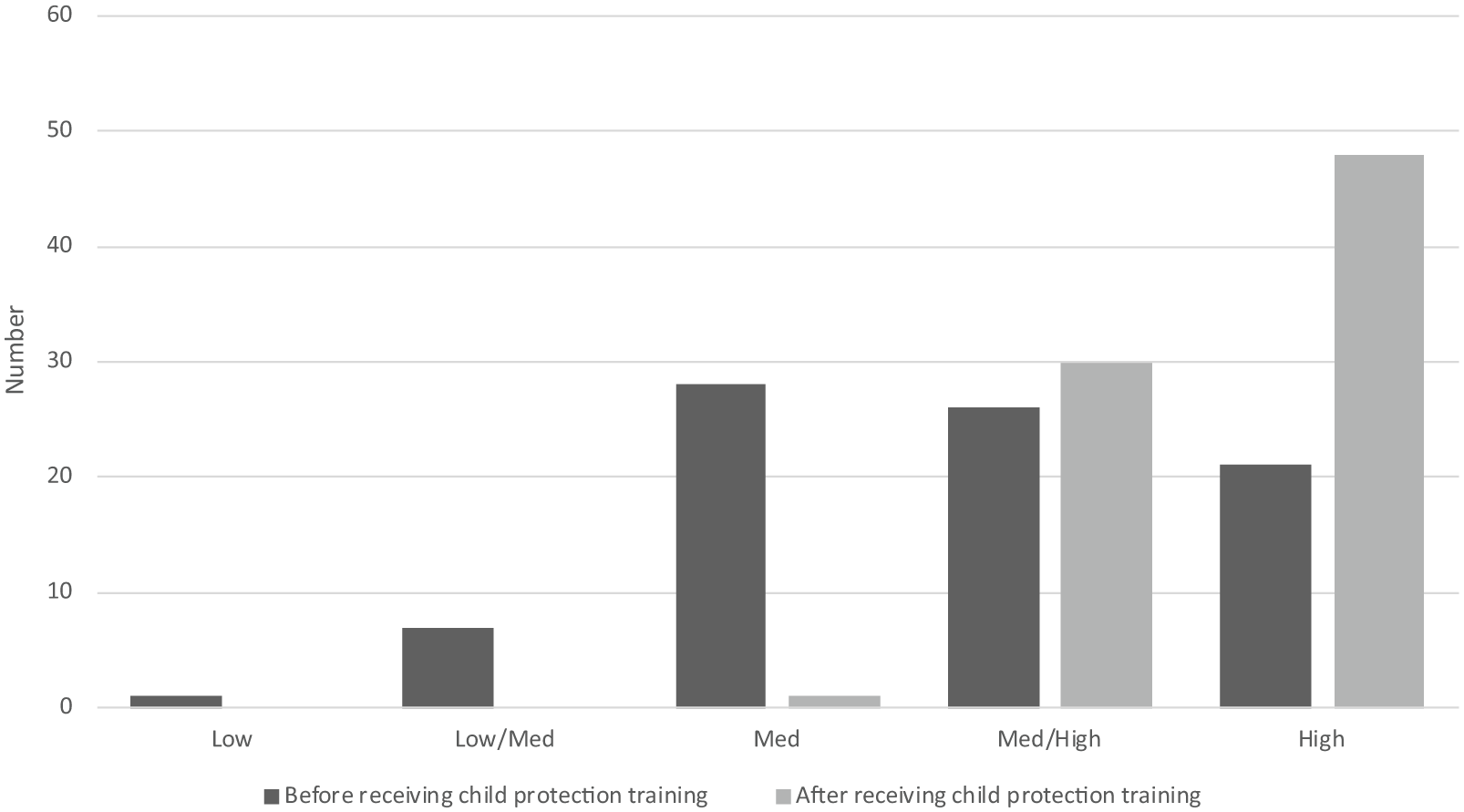
Students’ self-assessment of their understanding of child protection issues before and after the ‘Child Protection’ activity run in a pre-departure workshop (May 2017).
This evaluation data also show that while some students, including those studying education, receive thorough child protection training as part of their academic studies, other students have very limited knowledge. Comments from this same sample of 90 students include, I don’t have any kind of background with children so the session on protection was really informative for me. I already had knowledge of child protection issues, however the outside activity really demonstrated how child protection is a team effort, and demonstrated how some people can be deceptive in their intentions. Although this isn’t as relevant, as I will be working in a business, it is still important to remember in case any situation does arise with a child, I am able to complete the appropriate steps.
Of course, those students who go on and work with children in international contexts receive additional preparation in-country that is country and organisation specific.
Empowering children
The final activity in this module was developed collaboratively between university staff and participating staff from KOTO (Vietnam) and Bahay Tuluyan (the Philippines). It responded to a concern that undergraduate students often approached their PACE International activity with a condescending, colonialist, ‘save the world’ attitude to development, particularly in regards to children. The activity, ‘Empowering Children’ uses success stories from both Bahay Tuluyan and KOTO to provide examples of resilience in the lives of children in destitute circumstances, and how, given the right support, they can become the engines for positively changing the course of their own lives. The foreshadowing of issues and the provision of role-play opportunities in which to consider appropriate responses suggest an effective approach in relation to a sound preparation for international volunteering.
In summary, the activities in this module which are based on a model of collaborative learning, drawing on the expertise of partner organisations in developing curriculum resources and giving primacy to the ‘partner voice’, provide a way ‘to bridge the disconnect between conventional academic discourse around poverty, community development and the context within which PACE International partners live and work, and the learning and teaching of their history, culture and context on their own terms’ (Bilous et al., 2017: 290). The module, developed in this collaborative way, enables meaningful impact of volunteer involvement for both students and host communities. The following sample testimonials received from students on their return to Australia are indicative of this result.
It has changed the way I interact and think about children and how their rights are manifested in Australia and around the world. It also cemented me in my role as a teacher and how important education is, and how it is the best tool to introducing people to so many global, social and cultural issues. I now have a greater understanding of children’s rights and this placement has given me the opportunity to work closely with an organisation that is in the direction of work that I would like to do when I finish my degree. It cemented the pathway I hope to take for my teaching degree. Collaborative learning for both educators and children was a significant focus of this PACE activity. I was able to share my knowledge and skills with the teachers and they were able to reciprocate. The children I was lucky enough to get to know were all incredible individuals. It was enlightening to view their perspectives of learning and life, as well as harness their abilities to push their capabilities.
Limitations and directions for further research
Of course, developing curriculum in this way is not without issues. One of the challenges, and, at times, limitations of co-creating curriculum concerns the ways in which the project research team is enabled to reflect and actively embrace the diversity of perspectives and experiences of a range of organisations in different contexts. Conflicting views between organisations working in different cultural contexts is to be expected. While the ‘Deconstructing Childhood’ activity attempts to embrace this diversity and gives students the opportunity to explore the issues in detail, drawing on their own experiences as well as those of our partner organisations, this is more challenging in the context of child protection, which can have more serious implications for children. As an Australian tertiary institution, the university expects students to abide by Australian child protection guidelines and practice. Students sign a ‘Code of Conduct’ in which they adhere to statutory laws in Australia and other countries regarding child protection and undergo an Australian working with children check before leaving for their international activity. Students are sometimes placed in situations where there are conflicting views. For example, in an Australian context, students are discouraged from taking photographs of children without permission from both the child and the legal guardian. While working with some partner organisations internationally, students often find themselves asked to take photographs of children by their supervisor or by the children themselves. There is a danger, in other words, of confusing or providing mixed and complicated messages to students who may already be overwhelmed by learning to live and work in a new cultural context. What is hoped, however, is that the co-created modules prepare these students to think critically about their experiences, consider the specific international context they find themselves working within and then make their own sensible and informed decisions in ensuring children’s wellbeing and empowerment are prioritised.
A second limitation is the absence of children’s voices in the children’s wellbeing curriculum. While it was co-created with partner organisations many of whom actively work to include the child’s voice in their work (e.g. see Scerri, 2009), it was not possible within the confines of this project to enlist the direct participation of children. While there is considerable research that outlines approaches for creating curriculum in early childhood settings (see, for example, Press et al., 2012) and with children based on the pedagogical approach advocated by educators for student-directed learning (see, for example, Child to Child, 2017), this is largely focused on children co-creating curriculum for their peers. A more interesting area for future research and curriculum design are projects where children might play an active role in co-creating a curriculum designed for teaching tertiary students or adult education.
Similarly, the involvement of tertiary students in the co-creation of this curriculum was also limited. At various stages in the project, students were involved: a PACE student contributed to the initial partner workshop, a PACE graduate assembled the additional resources for the Children’s Wellbeing and Empowerment module and each of the activities have been evaluated by students. Although some work is taking place informally in the academic classroom during re-entry workshops, more work is needed to explore the ways in which students might be more actively involved in the design of curriculum resources, particularly those students who return from PACE International placements and have had their perspectives and ideas challenged.
Conclusion
In this article, we have highlighted the ever-growing mobility of young people willing to engage with international contexts through their tertiary education studies. In particular, we have raised the potential dangers of student volunteers engaging with children in disadvantaged contexts when the attitudes, behaviour and practices of the volunteers perpetuate social injustices rather than contribute to community building in the populations they serve. Importantly, our purpose in properly preparing university students for these experiences is not only to leave a positive impact and a message of hope in the contexts they visit but also to have that same sustainable positive footprint upon their return. As Hammersley (2016) proposes, the potential transformative and positive impact of such experiences can ripple back home, as these students’ communities can also benefit from this meaningful learning, and thus also impact on their future perceptions and practices around development. Our ideas proposed above about how to take this initiative further – co-creating learning and teaching resources with university students and children in the majority world – would be important steps to reinforce this commitment towards an ethical and positive engagement with children through higher education volunteer programmes.
Footnotes
Funding
The author(s) disclosed receipt of the following financial support for the research, authorship, and/or publication of this article: This work is supported by Office for Learning and Teaching, Strategic Priority Grant 14-4605.

Notes
Author biographies
María Florencia Amigó is an anthropologist interested in the economic and educational dimension of children in poor contexts. She has conducted research on child labour in Indonesia, children in immigrant families in Australia, and child marriage in Nepal. Since 2012, she has been involved in the PACE (Professional and Community Engagement) program at Macquarie University which has triggered her interest in the application of the social sciences and on the role of higher education institutions and external organisations in supporting experiential learning opportunities for students.
Rebecca Bilous is a cultural geographer with a background in heritage and education. She is interested in establishing approaches to research that are community-engaged and collaborative, working with partner organisations in a range of international contexts to develop curriculum and experiential learning opportunities for tertiary education students.
Felicity Rawlings-Sanaei is an educational researcher with a background in international education, sociology of education and experiential learning. She has a particular interest in interdisciplinary approaches to the generation of knowledge to contribute to solutions to resolve the complex interrelated problems in global society.