




Abstract
In this article, I address African indigenous knowledge of early childhood development by discussing young children’s cultural spaces of care, play and learning among the Guji people of Ethiopia. I analyze practices in the cultural spaces of young children and show how participatory community-based care and learning are pivotal in the tradition of early childhood development in the Guji people. Furthermore, I present the features of play and learning traditions in which young children are social actors in sustaining social interaction and stability in their neighborhoods. My discussion is based on data drawn from 10 months ethnographic fieldwork carried out in the rural villages of the Guji people.
Introduction
In this article, I discuss how practices in a cultural space of young children give unique features to early childhood care, play and learning traditions in Africa. Anthropological studies conceptualize “cultural space” as people’s traditionally embedded practices, beliefs, and values that shape everyday life in a local circumstance (Low, 2003; Rasmussen, 2004). According to Akpan (2011) and Mtonga (2012), “cultural space” represents what all societies acquire from their culture, the roles they have in their traditions and the means through which they interact with their environment and interpret their relationships within it. It includes contexts and practices of arts that encompass drawings, pictures, handicrafts, oral arts expressions, stories and songs as well as creativities, performances, relationships, values and norms (Ball, 2010; Kehily and Swan, 2003).
As discussed by Glenn et al. (2012) and Staden and Watson (2007), the play and learning spaces of children are culture-sensitive systems that reflect the everyday lives of young children and their care takers. Such spaces connect children to their society and enhance their chances of learning from it. As shown by Schwartzman (1976), participation in such space exposes children to culture-based early learning through which they can acquire comprehensive and relevant knowledge about the local and global realities. In emphasizing the role of cultural space in childhood socialization, Brown and Mowry (2016) and Pearson and Degotardi (2009) argue that children acquire local knowledge from traditions at home and develop this knowledge through participation in their everyday social and cultural practices. According to Schafer et al. (2004), children’s everyday life in African societies entails play practices that boys and girls perform in different ways and acquaint themselves with values and customs in their society, which in turn shows the agency of children in co-construction of knowledge through creation and transmission of play practices (Soudée, 2009; Worthington and van Oers, 2017).
However, little has been researched and documented about how collective traditions in the local spaces of young children shape early childhood care and education in Africa where indigenous ways of life are prevalent. Research and documentation on young children’s cultural spaces of knowledge acquisition and care are still inadequate and the way early childhood care, play, and learning unfolds in those spaces has not been discussed sufficiently. The existing research findings in this regard present that obstacles in the use of cultural knowledge in early childhood policy formulation in Africa are the lack of research outputs in the local traditions of early childhood care, learning, and play (Schafer et al., 2004). With the aim of bridging this gap of knowledge, I conceptualize the cultural spaces of young children among the Guji people through answering the following questions: (1) What does the cultural space of young children among the Guji people encompass and what makes it unique? and (2) How do the established traditions in the cultural spaces of young children characterize the care, play and learning practices in early childhood? Through answering these questions, I seek to contribute to the knowledge about the roles of cultural values, beliefs and practices in early childhood care and education. I show how the care, play and learning practices in early childhood are rooted in the traditions of a society and enhance young children’s participation in indigenous ways of knowledge acquisition.
Methodology
Social setting and participants
The article has based the data collected through ethnographic fieldwork that I carried out among the Guji people of Ethiopia. The Guji people whose population is estimated to be 1.6 million (Central Statistical Agency (CSA), 2008) are agro-pastoralists residing in the southern part of Ethiopia. The people are governed by a cultural institution known as “Gada system” which formulates norms and values to direct customary practices, interpersonal interaction, the process of socialization and knowledge transmission (Van de Loo, 1991). In the Gada system, all members of the Guji are placed in 13 generational grades and participate actively in social and cultural roles. The following table presents names of the 13 generational grades along with the age range that each grade represents, the social position of each generational grade and the broader generational categories on the basis of social hierarchy.
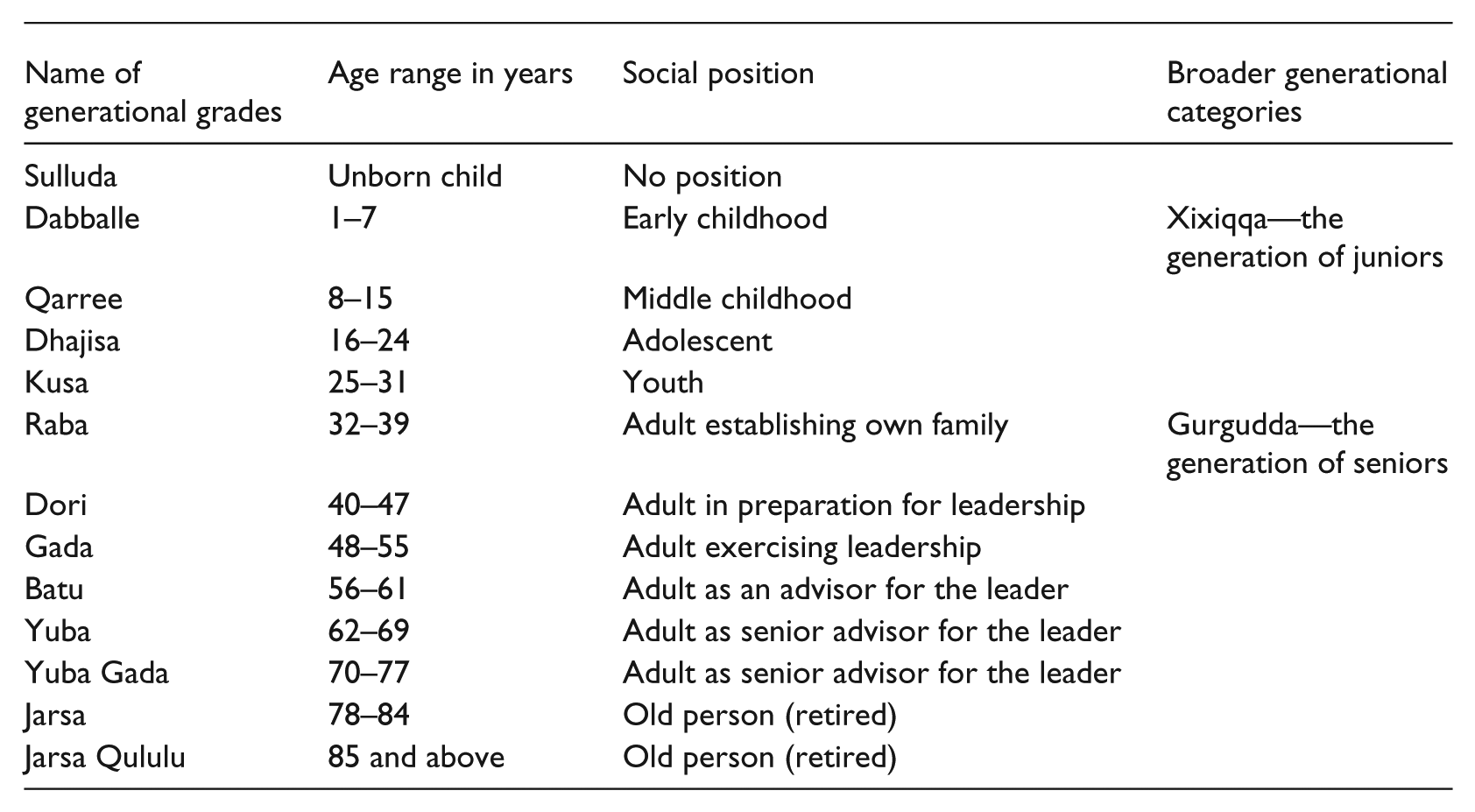
In the system, social hierarchy governs intergenerational relationship in which the generational grades are divided into two categories: the first five grades as the generation of children and youth -xixiqqa (generation of juniors) and that of the last eight grades as the generation of adults- gurgudda (generation of seniors). In the Gada system, young children are placed in the dabballe generational grade that contains all boys and girls below 8 years old. The Guji people predominantly live in villages and close neighborhoods in remote rural areas where young children’s access to preschool is almost absent (Jirata, 2017; Debsu, 2009).
As a result, young children do not have access to preschools but actively participate in the indigenous system of knowledge acquisition and sharing. Six extended families who lived as neighbors or who shared neighborhoods were incorporated in this study. Thirty-five young children—15 girls and 20 boys—who were below 8 years old, as well as 6 parents/grandparents and 6 neighbors, were participants in the in-depth interviews. The fact that I speak Oromo language and was familiar with the Guji way of life enabled me to create close relationships with the young children, parents and the people in the local villages.
Methods of data collection
The empirical data in this article were generated through 10 months of ethnographic fieldwork that I carried out in three rural villages of the Guji people. The ethnographic fieldwork activities included participant observations in the Gada ceremonies, neighbors’ social events and children’s play practices at homes, in neighborhoods and nearby cattle herding fields as these were places where young children frequently participate in social activities. It also included in-depth interviews with young children as well as people in neighborhoods including parents, grandparents and their neighbors. Through the participant observations, data about Guji people’s tradition of child care and education, the various forms of learning contexts for young children and the dynamics of young children’s social activities as well as the educative significances of these activities were generated. Through interviews with parents, grandparents and their neighbors, information about the tradition of early childhood care and education were elicited. These interviews were mainly made at homes and in neighborhoods. Through the interviews with children, data about how the young children perceive and express their play activities and relate them to realities in their local environment were collected. All empirical data discussed in this article have been translated from the original language (Afan Oromo) into English.
Conceptualization of early childhood as a “sacred stage of life”
Young children are messengers through which God blesses families and our community. (Waqo, 45-year-old man)
This statement reflects the traditional discourse among the Guji people reflecting early childhood as a sacred stage in human development. As a result, young children who are known as dabbale in the Gada system are called as annu among families and local communities. The name—annu—signifies that young children are perceived to be spiritual beings who live under the close attention and love of the supernatural power. Underneath of this tradition is the discourse that young children are holy beings closer to the super natural power that alertly cares for them. This tradition symbolizes the cultural space in which young children are supposed to be sacred human beings growing under the human and superhuman care (Figure 1).
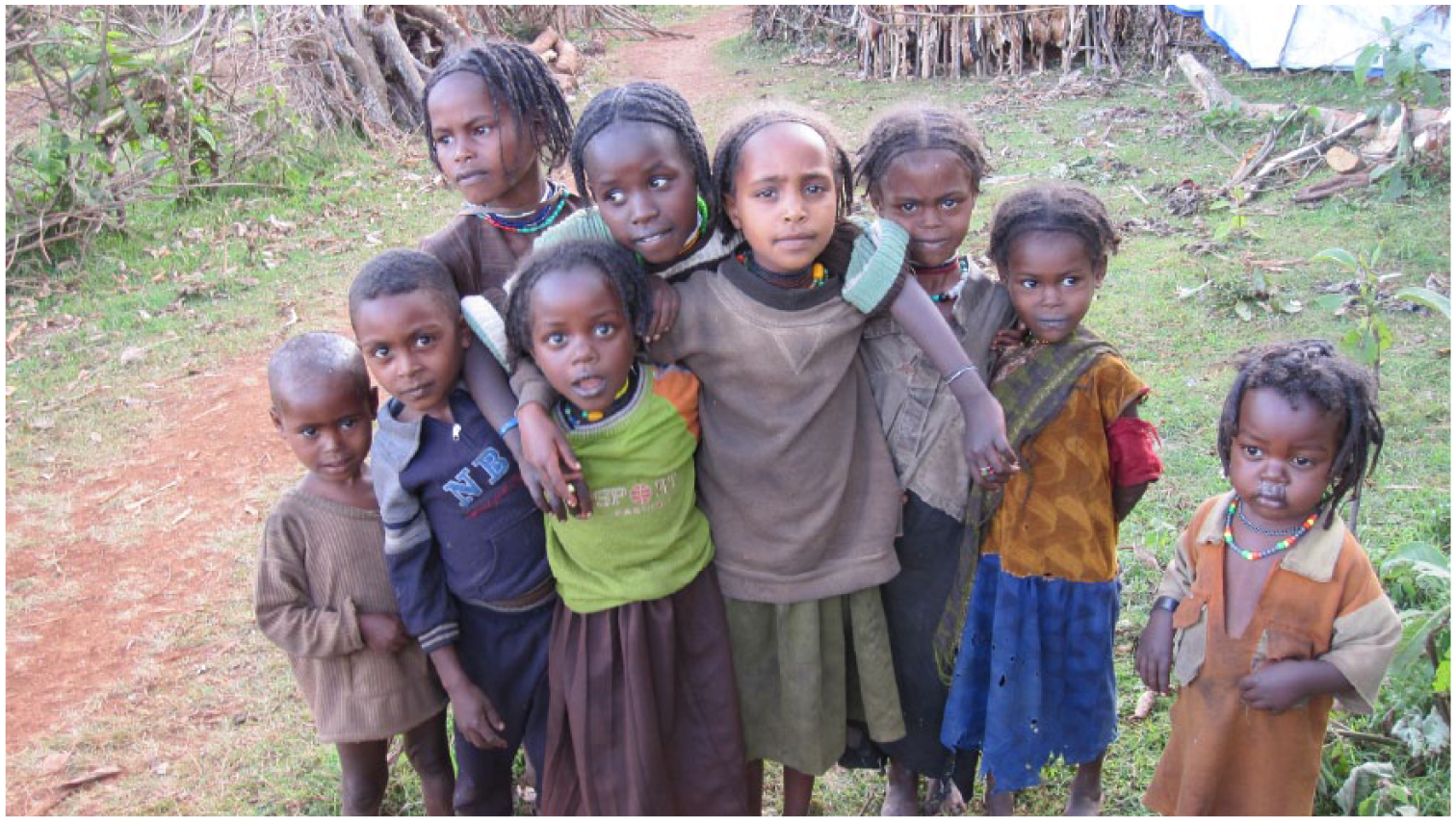
Portrait of young children among the Guji.
Dureti (35-year-old woman) and Roba (45-year-old man) articulate this tradition as, Young children are holy creatures. God resides in them. God blesses families and our people [the Guji people] through them. As God resides in them, we do not bit them, scold them and let them starve. It is ‘evil eye that hates young children, However, young children are protected by God; thus, the evil eyes do not get them.
Dureti’s and Roba’s expressions denote three concepts about the cultural space of young children. The first is the symbolization of early childhood as a “holiest” stage of human life. This tradition is parallel with Sesilie Smørholm’s (2016) study in which she argues that in Zambian culture, “babies are seen as spiritual and social beings.” Such cultural symbolization of early childhood compels adults to honor, adore, and venerate young children. The second is the value given to young children as sources of abundance and blessings for their families and communities. The third is that the Guji perceive that young children are susceptible to the “evil eyes” which they call as buda. Traditionally, the Guji people understand that young children are in the focus of two opposite powers: the evil that intends to destroy them and the divine that always protects them. As a symbol for such cultural position of early childhood, young children are marked by long hair on the top of their heads and this hair is called gamme (literally to mean unshaved top hair). This symbol represents the worthiness and power of young children on one hand and their fear and susceptibility on the other hand. Young children are not only free from verbal and physical reprimands which is usual for grown-up children but also have the right to participate in the Gada ceremonies in which they sing early childhood songs known as muddanna (to mean songs of cultural anointment). In the Gada ceremonies, they sing in chorus by saying,
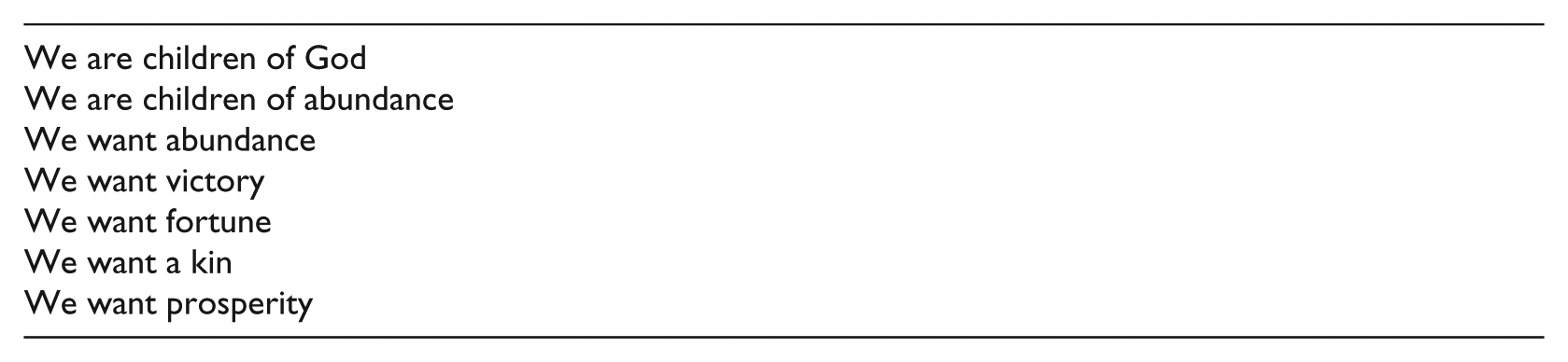
While children sing the song, the leader of the Gada system known as Abba Gada (to means the father of the Gada) holds fresh grass and milk in his hands and responds to the young children by reciting traditional blissful verses. Among the Guji people, these verses are identified as holy rhymes through which elderly persons anoint and bless young children. The Abba Gada sings for the children by saying,

In this occasion of blessing, the milk and the grass are used as cultural materials to depict young children as symbols of collective holiness, freshness, and spiritual prosperity. Rhymes chanted by the Abba Gada in this occasion also express young children as agents who reproduce fortune and abundance for people in their neighborhoods. The communication between the children and the Abba Gada through the rhymes describe the respect and value given to early childhood in the Gada system. In such symbolic cultural space, young children receive from adults the honor and attention unique to early childhood.
The cultural spaces of care for young children
“Young children belong to a neighborhood” is a common saying among the Guji people. This saying expresses neighborhood as a cultural space in which not only parents but also community members are responsible to take care of young children. The neighborhood which the Guji people call as olla represents extended family, neighbors and community members who live near each other and share common values and norms. It symbolizes a cultural space in which all people in a community cooperate to provide young children with appropriate care and where young children are exposed to pertinent childhood values and practices. In addition to being a space for cooperative care in early childhood, neighborhood symbolizes a space that provides young children with freedom for participation in cultural practices. It is a space in which one can observe how the Guji people give young children an opportunity to learn through participation in wider social and cultural contexts. For instance, unlike the grown-up children, young children (both boys and girls) are free to move across homes and learn from men and women in their neighborhoods (Figure 2).
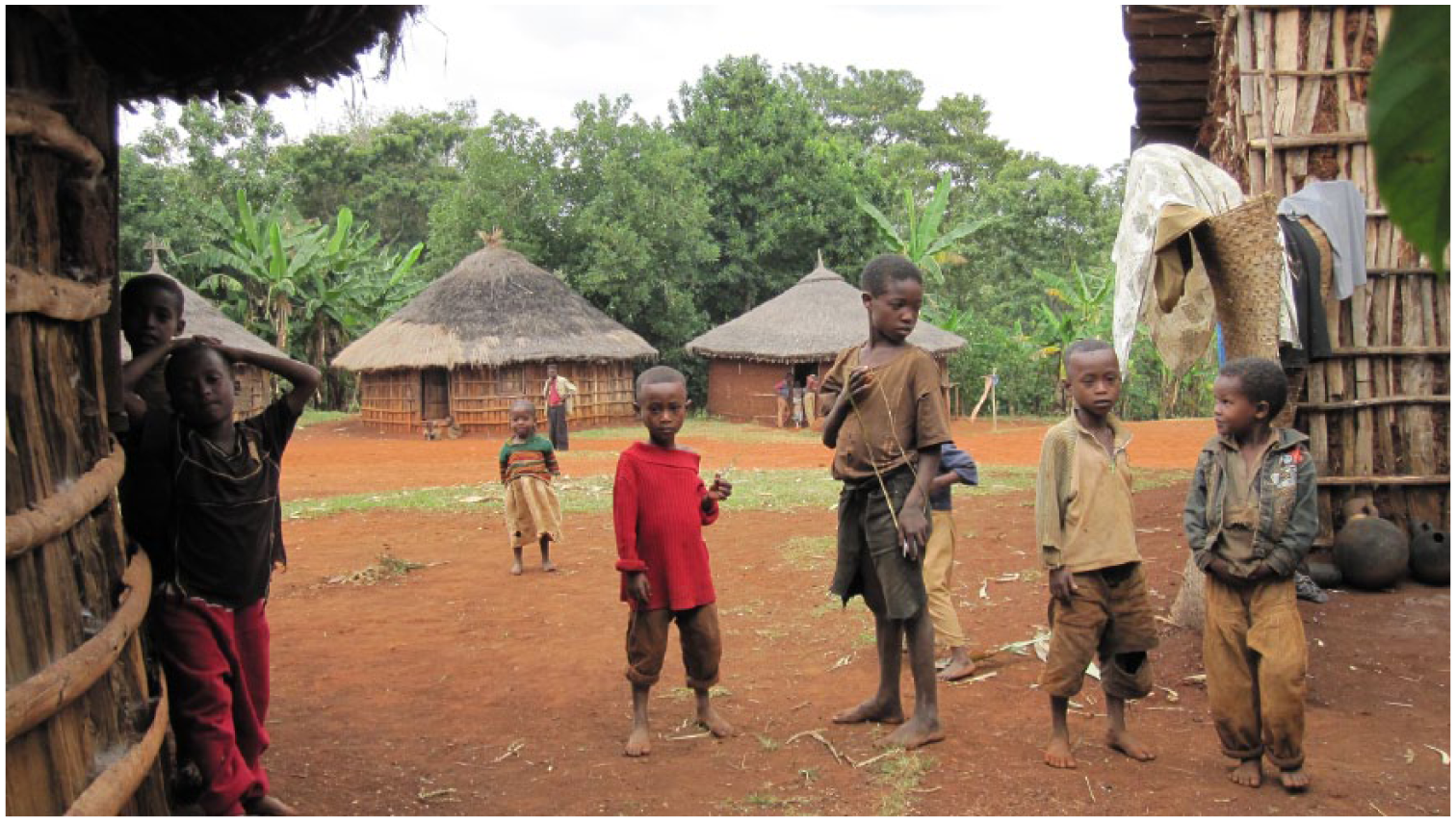
Young children in a neighborhood.
They have the right to walk between men’s and women’s spaces in homes to observe social roles. They take part in storytelling and riddling events in their homes and share their experiences with each other in their neighborhoods. In such cultural space, young children observe and learn social practices and values through which they make sense of their immediate environment. The reality that cultural contexts shape childhood learning and development is true for children across different cultures as asserted by Corsaro (2012), Glenn et al. (2012) and Worthington and van Oers (2017). What makes the Guji culture unique is that the early childhood care practices are based on the widely shared perception that young children are sacred beings.
As a result, early childhood care practices a large number of actors who provide young children with utmost attention, love, and support. It includes multigenerational groups who play their own roles and care practices. For instance, mothers and neighboring women perform the roles of feeding, bathing and hugging young children while grandparents and elderly persons play the role of entertaining and comforting them. Similarly, siblings and grown-up children protect young children from harmful encounters and acquaint them with childhood peer culture. Grandparents entertain infants and toddlers by singing songs, telling stories, and teaching them how to count ancestors.
The central practice in the tradition of comforting and socializing young children among the Guji people is the chanting of rhymes known among the society as urursa (calming rhymes) and hidda-dhowa (counting-ancestors rhymes). The following is a popular urursa song of the people and it was chanted by Sora (55-year-old woman) who performed the rhyme for her 9-month-old grandbaby. Holding the baby on her back, the woman chanted,

Care takers perform this rhyme as an instrument for pleasing and appeasing infants when they cry and refuse to sleep. Thus, the rhyme represents the power of music and language in comforting young children and creating for them a pleasant and secure social environment as also discussed by Mtonga (2012) and Blacking (1967) in Zambian and Venda cultures respectively.
The cultural care practices of the Guji people also include the oral rhythmic performance that the people call as hidda-dhawa—literally means counting ancestors. This performance involves calling the name of ancestors from the near to the far as a tradition of reciting and learning one’s lineage. The performance involves dialogue and turn-taking between a care giver and a young child. The following is an ancestor counting rhyme performed by Barite (50-year-old grandmother) for her 3-year-old grandchild.
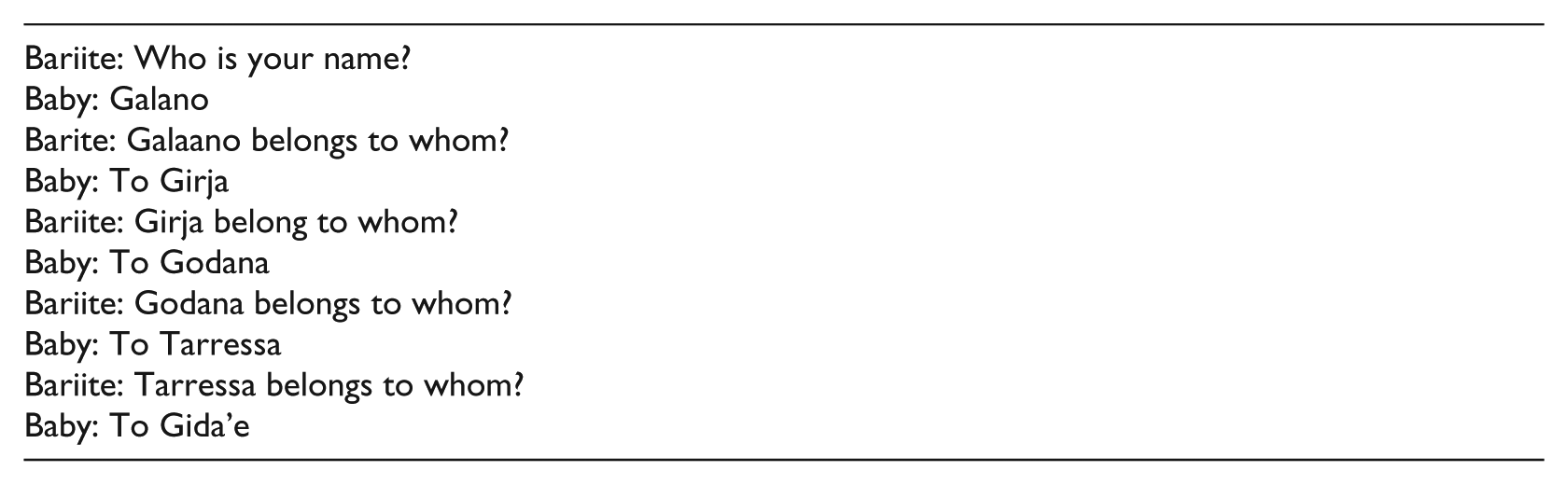
The Guji people articulate that the tradition of counting ancestors with young children serves dual purposes. First, calling ancestors by their names from a father to a remote ancestor entertains young children. Second, it enables young children to have knowledge about their lineage and members of extended family. Thus, using songs and rhymes as cultural tools to comfort and socialize young children is one of the central care practices in early childhood among the people. The people believe that when they entertain young children by performing songs and rhymes, they do not only introduce them to their lineage and familial environment but also satisfy the divine spirit that protects them from the evil power. As a result, comforting and socializing practices are aimed at giving the young children a safe social environment.
Although the family structure among the Guji people is based on a hierarchical intergenerational relationship in which children take the lower social position, young children are always given attention and priority in familial care and provisions. Barite (35-year-old mother) explains this tradition as follows: In our Guji culture, parents and neighbors give everything they have for their young children. Young children drink milk which is the best food we have. Adults and grown up children do not drink milk before young children drink and get satisfied. Mothers have to be sure that young children have eaten enough before they serve food for grown-up children and adults.
Parents, grandparents, and neighbors give priority for young children in all aspects of their collective responsibilities of care. At the core of their collective responsibilities is feeding the young boys and girls. In line with such values, a mother breastfeeds an infant until the infant is 2 years old and becomes capable to walk with siblings. Such human care and provision are believed to show honesty to the God who loves young children. In other words, this tradition of care is based on the belief that the human care is supported by the divine care and this scenario, in turn, reflects the perception that families, neighbors, and God have cooperative responsibilities to care for young children.
Young children’s play and learning practices in neighborhoods
The prominent scholars of children’s learning and development, Lev Vygotsky (1967), Jean Piaget (1962) and Mildred Parten (1932), assert that participation in play activities is essential for the social and intellectual development of young children. My discussion in this section builds on Parten’s and Vygotsky’s notion of play as a process of cultural learning and meaning making. I observe young children’s participation in multiple forms of traditional play activities among the Guji people as the process of culturally embedded interactive learning and meaning making. Young children extend their social interaction to peer members and perform symbolic play activities through which they socialize themselves with local ways of life and understand childhood values. For example, when they are 2 years old, a boy and a girl enter to peer relationships in their neighborhoods. Participation in this cultural space gives them the opportunity to learn how to perform the different forms of play and learning practices through peer interaction. Parten (1933) and Vygotsky (1967) argue that young children’s participation in such peer interaction develops their social, cognitive, and physical beings. These studies present that at the core of children’s social and cultural participation are the multiple forms of traditional childhood play practices. In this article, informed by Mildred Parten’s characterization of children’s play (Parten, 1932) and based on young children’s play tradition among the Guji people, I categorized the early childhood play practices into three and discussed them focusing on their relevance for children’s learning and development. I named the three categories as creative play, dramatic play, and oral play.
Creative play as early-age practice of invention
Researches show that participation in creative play helps young children to think beyond the common play scenario and get involved in imaginative and explorative activities (Glenn et al., 2012; Parten, 1933; Vygotsky, 1967). In this form of play, children create play objects from materials available in their local environment (Parten, 1933). What makes such cultural practice of the Guji children unique is that it shows the capability of young children to imagine their social world and create their play objects from the materials available in their local settings. Although contemporary studies in early childhood play show the fact that toys and the other commercial play objects dominate the play world of young children across different cultures (Baxter, 2016; Mertala et al., 2016; Smith, 2016; Worthington and van Oers, 2017), among the Guji people, young children utilize local materials to create their own play objects. It is also notable that the creating process gives the children senses of pleasure, accomplishment, and knowledgeableness (Møller, 2015). This form of play is dynamic (varies in line with variations in children’s environment), individualistic (accomplished by a child individually), and child-centered. The major forms of children’s creative plays and the dynamics in them can be observed in the following field notes (Figure 3): Field Note1: On the second day of my fieldwork in a neighborhood among the Guji people, I saw two young children sitting near ear other. Both children were boys who were pegging small sticks on the ground in rows. I stood and watched their action from a short distance. Then, I approached them, greeted them and made the following conversation with them.
What are you doing?
We are building a barn for our cattle.
Where are the cattle?
They are here [he pointed to a handful of fruits]. These are our cattle and this is their barn.
Yes, we keep the cattle in this barn during night times.
Ok. What about in day times?
We keep them in a pastureland.
These are tree fruits. How do you say they are cattle?
This is the way we play. We are playing by building a barn for our cattle.
Field note 2: On one of my fieldwork days in a neighborhood, I observed two young children sitting on the ground facing to each other. I curiously watched what they were doing. I approached them and observed that they were making a car-like shape from mud. I greeted them, seated among them and made the following conversation with them.
Kids, what are you doing?
We are making a car.
Wow! Are you making a car?
Yes.
How do you make it?
We first mix soil and water until it becomes sticky mud. Then, we make the car.
Why do you make it?
It is a play. We play by making a car.
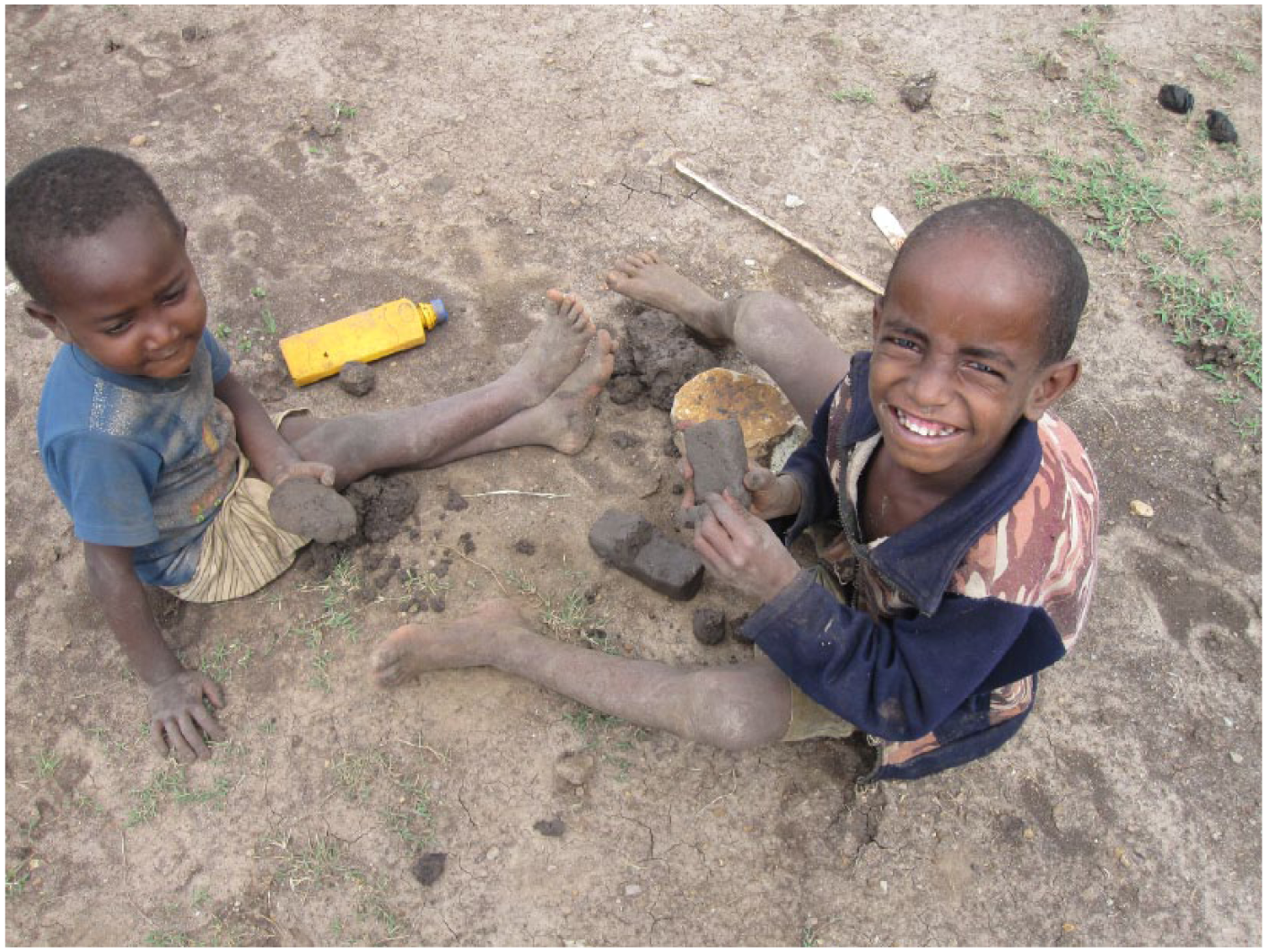
Young children in a creative play.
The above conversations reflect that creative plays are central practices in the young children’s cultural space among the Guji people. For instance, the two phenomenon that has a significant place in the Guji culture and livelihoods—the cattle and the cattle barn—have captured the attention of the children and became their focus in their creative plays. They create symbols of bulls from mud and cattle barn (moona) from sticks. In the process of making these objects, the children learn traditions and values of their society and make them part of their everyday play activities. This practice parallels with what Parten (1933), Vygotsky (1967), and Worthington and van Oers (2017) expressed as children’s capacity for divergent thinking. Young children also make mobile telephone from wet soil. Their participation in this play indicates that through their creative play activities, children reflect their desire for learning about modern technologies. This shows the capability of young children to turn the global phenomenon into local play traditions (Worthington and van Oers, 2017). In general, young children’s creative play reflects the cultural space in which children connect global phenomenon to local tradition and convert available materials to play activities. This process includes observing the environment, making a mental image of the observed environment and using locally available materials to transform the mental image into tangible objects. This shows how young children transform reality into play. According to Glenn et al. (2012), Parten (1933) and Vygotsky (1967), participation in this process, in turn, helps young children develop their creativity, imagination, and meaning making ability.
Dramatic plays as symbolic practices of learning social roles
Among the Guji people, dramatic plays comprise young children’s symbolic and imitative practices including playing the roles of husband-hood and fatherhood for boys and that of wifehood and motherhood for girls. Vygotsky (1967) and Parten (1932) call such childhood practices as pretend or imitative play. According to Vygotsky (1967) and Parten (1932), this form of play represents the way young children entertain each other through imitation of the social and cultural roles of men and women. It also shows how participation in such process enables young children to socialize themselves into gendered roles and values. The following field note illustrates this reality: One day, I saw young children gathered under a tree in a neighborhood in Samaro village. I greeted the children and joined them easily as they were familiar with me. Seated among them, I observed what they were doing and asked some of them to describe it for me. A boy continued, “We are playing a play called husband and wife. As a husband, I am making cattle barn (moonaa), and water ponds (eelaa) [He was making small holes on the ground and called it as water pond]. These are my cattle [he was showing me small fruits] which I keep in this barn. The cattle drink water from this pond. In the day time, I keep them in the pastureland. In the night, I keep them in this barn.” I also looked at a girl who was collecting leaves and grasses and doing something. I asked her what she was doing and she replied, “I am making coffee and breakfast for my husband. He should drink his coffee and eat his breakfast before he leaves for cattle herding.”
Children’s participation in this symbolic play illuminates how they learn about social values and roles in their cultural environment. In this play, the children exercise roles that are associated to masculine and feminine as well as values that govern the relationship between women and men. They also demonstrate their capability to convert cultural process into play practices which Parten (1932) and Worthington and van Oers (2017) presented as children’s learning mechanism. Through this play, young children do not only connect themselves to the traditional livelihood practices of their society but also learn values related to household role divisions and the relationship among family members.
Oral play as practices of developing interpretive skills
Play practices that involve oral interaction are popular in the cultural spaces of young children among the Guji people. These practices include riddling, story listening and singing. Unlike the creative and imitative play activities that characterize only early childhood, storytelling and riddling remains to be the popular play forms across the middle and late childhoods. Young children love to hear stories from adults, which means that they also pay great attention to this form of play in social interaction with their siblings. Similarly, riddles are the treasured form of play with young children and child-friendly way of meaning making not only in Guji people but also among African societies in general (Jirata, 2014; Schafer et al., 2004; Staden and Watson, 2007). Children acquire knowledge of both forms of play through interaction with siblings and participation in neighborhood social events. As participation in these forms of play involves intergenerational and intra-generational interactions, it provides young children with a space in which they learn from adults and other children. For instance, when they play simple riddling, two children interact with each other and in this process of interaction, one child participates as asker (challenger) and the other as an interpreter (defender). The following example illustrates this process.
The children were named as Tufa (4-year-old boy) and Elema (5-year-old boy).
A black child is on fire. What is it?
It is firewood.
You are wrong.
It is a plate.
Again, you are wrong.
Now, take a land and tell me the answer.
Ok. Give me a land.
I give you Dilla town.
I receive Dilla. I am the owner of Dilla town. It is a cooking pot.
This play helps children connect ideas in their mind to the phenomenon in their environment (Jirata, 2012). In other words, children answer the riddle question by associating what is asked to what they know from realities in their surroundings. Through such process of association, children can easily learn about their local realities as already reported by Argenti (2010) and Noss (2006).
Similarly, the cultural space of young children among the Guji people encompasses storytelling that involves simple folktales in which young children participate as performers, interlocutors, and interpreters of oral traditions. Telling a story to young children is considered to be adults’ duties. It is also a means to provide young children with a context in which they develop their ability to listen and make meanings of oral narratives (Argenti, 2010). Thus, adults have moral obligation to tell stories that young children can comprehend and understand. Young children also reproduce stories through their play interaction with each other even though their narratives are fragmented and do not meet the standard of storytelling by adults and grown up children. The following example shows how young children tell stories. In the event of this storytelling, Badhaso (5-year-old boy) was a teller and Shure (3-year-old girl) and Waqo (4-year-old boy) were listeners. Badhaso told the story as follows: There were a husband and his wife [pause] in a village. [pause] they killed a bull and collected [pause] meat in their house. [pause] they went [pause] to fetch firewood. When they came back, the meat was not there [pause] but flies were sitting in the place. The wife was pregnant. The husband chased out the flies. He saw one fly … on the chest of the wife. To hit the fly, he hit and killed his own wife.
While the boy was telling this story, the two children (the listeners) were listening, smiling, and murmuring. What is notable from this storytelling situation is the difference between young children and grown-up children in their knowledge and skill of storytelling. The grown-up children start storytelling by saying a phrase “ones upon a time” and finish it by interpreting the meaning of the tale (author, 2014). However, young children cannot do the standard style of beginning and ending storytelling. They begin from anywhere in the storyline and finish it abruptly. They can also jamb words, phrases, and sentences or disorder ideas. Adults believe that it is through such kind of exercise that young children can learn how to tell and interpret stories.
In a nutshell, oral plays are among the common practices through which young children participate in cultural reproduction as critical thinkers, strategists, and conscious actors. Argenti (2010) and Noss (2006) assert that such play involves thinking, imagining, and acting and help children to position themselves as competent actors in the interactions with their social and cultural environments. Thus, the oral play represents childhood traditions, the borderline between childhood and adulthood and the past and present patterns of intergenerational relationships.
Conclusion
Discussions in this article have shown that early childhood is understood as a cultural foundation on which families, neighbors, and communities are built among agrarian societies in Africa. Early childhood is construed as the basis for stable and pleasant neighborhoods in which young children participate as catalysts of collective livelihoods. It is also notable that not only in the past but also in the present African cultural realities, the participatory approach to the early childhood care is effective in providing young children with a compressive and interactive environment of play and learning. In this approach, the care for young children is considered to be the responsibility of everybody living in a neighborhood, thus, not only extended family members but also neighbors and community members are active participants in providing care and education for children in line with established local traditions. This tradition of care encourages young children to explore and discover their social and cultural environment. As it provides collective and wider contexts of care, it enables them to develop their imagination, creativity, and problem-solving capability. The participatory care centers on the socialization of young children through intergenerational and intra-generational play interactions which are not a mere entertainment practice but a repository of childhood thoughts, ideals, and values.
Discussions in this article also depict that African parenting tradition for young children includes not only extended family members but also all people in neighborhoods. Underneath of this tradition is the discourse that young boys and girls belong to a community. Such a participatory approach provides young children with the opportunity to understand local values in a wider context and grow connected to traditions of their society.
The other important point notable from the discussion in this article is that a neighborhood is a significant cultural space that encompasses a complex weave of contexts and gives unique feature to the early childhood care, play, learning, and development. Of these features are beliefs, values, and norms related to young children. These features are embedded in the traditions of a society and characterize the care patterns and parenting processes as shared practices within a neighborhood. In other words, neighborhoods represent not only adult to child pattern of care relationship but also a child-to-child play interaction that involve young children’s creative, artistic, and symbolic practices. Therefore, traditions in neighborhood shape the care, play, and learning in early childhood as interweaved social and cultural processes that involve young children and the community in which they live. Such scenario exposes young children to interact with and learning from adults and other children in a wider context. Through interaction with adults, they learn social norms and values by which they express themselves, fulfill their interests, and know their local environment. Through play interaction with other children including their siblings, they learn how to participate in childhood culture and make sense of their social and natural environment. This shows that neighborhood represents a two-way process. The first is the process in which cultural spaces shape early childhood, while the second the one through which young children impact their cultural contexts through their social practices. In general, it is necessary to understand early childhood as embedded in a cultural space where young children learn through interconnected traditional practices. When such cultural spaces of young children are linked to the formal preschool and school contexts, it continues to give a strong foundation for their social and cognitive development.
Footnotes
Funding
The author(s) received no financial support for the research, authorship, and/or publication of this article.